
Choosing the Right Embedded Processor for Your Smart Device
Processor selection shapes everything that follows in smart device development. Performance, power consumption, connectivity, security and scalability all trace back to decisions made early in the design process.
Modern Internet of Things (IoT) and Edge computing devices keep raising the bar. Capabilities that once defined premium products, such as artificial intelligence (AI) inference and wireless connectivity, now appear across entire product categories.
Engineering teams know the technical requirements. Where things get complicated is balancing those requirements against business realities. So how do you make the right choice?
The first step is to have a structured evaluation framework that aligns processor capabilities with the application’s needs. With this embedded processor selection guide, it’s easier to make the right choice from the start and set products up for success.
Embedded Processors for Smart Devices
Choosing the right embedded processor begins with understanding the differences between microcontrollers (MCU), microprocessors (MPU) and system-on-chip (SoC). Each architecture supports different performance levels, power requirements, software environments and integration capabilities that influence how devices function, develop and scale.
Microcontrollers for Dedicated Tasks
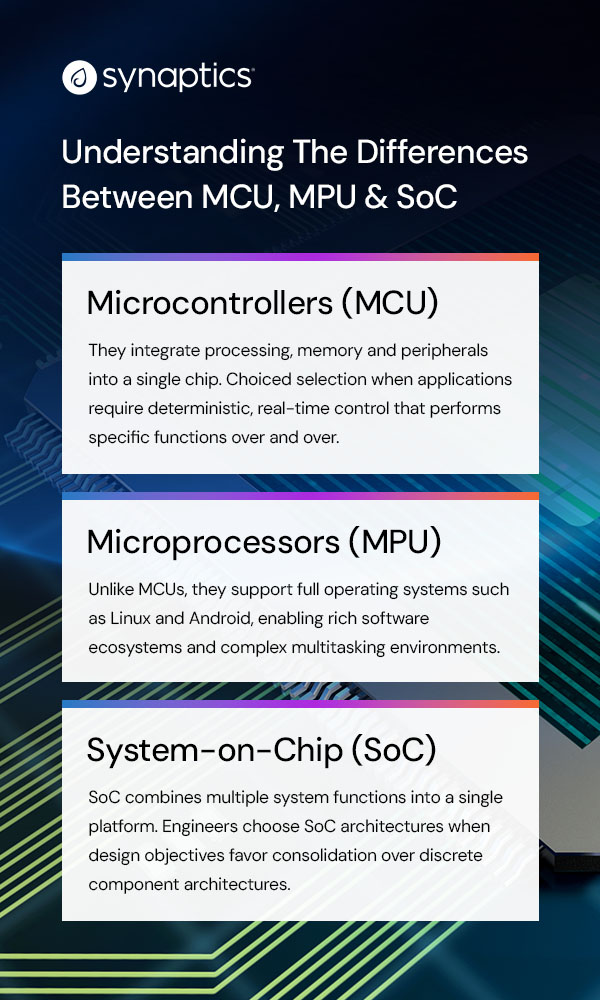
Microcontrollers integrate processing, memory and peripherals into a single chip. Design engineers choose MCUs when applications require deterministic, real-time control that performs specific functions over and over.
Key characteristics of MCUs are:
- Self-contained architectures
- Lower power consumption
- Reduced bill of materials (BOM) costs
- Simplified development environments
- High reliability for single-purpose applications
Advantages of using MCUs include:
- Predictable performance patterns
- Battery-friendly operation
- Cost-effective implementation
- Straightforward integration
- Proven reliability across deployments
MCUs are found in devices like smart thermostats, environmental sensors, health monitoring wearables, smart home automation devices and industrial monitoring systems.
Applications requiring advanced operating systems, multimedia processing or large-scale AI workloads push beyond MCU capabilities. For these use cases, teams need more computational headroom and software flexibility.
Microprocessors for Complex Operations
Complex operations work better with microprocessors as they prioritize computational flexibility and software sophistication. Unlike MCUs, these microprocessors support full operating systems such as Linux and Android, enabling rich software ecosystems and complex multitasking environments.
MPUs feature:
- Full operating system support
- External memory and peripherals
- Greater computational flexibility
- Complex networking stacks
- Advanced graphical interfaces
- Rich software ecosystems
Typical applications include:
- Smart displays with touch interfaces
- Industrial gateways managing multiple protocols
- Robotics systems with vision processing
- Connected appliances running apps
- Human-machine interfaces with rich graphics
Software requirements often determine architectural suitability before hardware specifications are considered. Operating system compatibility constraints can narrow down processor options early, as teams must consider not only current software needs but also future application requirements.
SoC for Maximum Integration
SoC combines multiple system functions into a single platform. Engineers choose SoC architectures when design objectives favor consolidation over discrete component architectures.
The benefits of SoC integration include:
- Simplified hardware development
- Lower BOM costs
- Smaller device footprints
- Improved power efficiency
- Decreased inter-chip communication overhead
Common integrated subsystems include:
- Application processors
- Microcontroller cores
- Memory controllers
- Connectivity subsystems
- Graphics engines
- Specialized accelerators
Smart home devices, industrial equipment, connected displays and advanced IoT products often benefit from strong integration. But not every application needs maximum consolidation.
Engineering teams should evaluate integration levels against specific application requirements rather than assuming that more integration always delivers better outcomes. Some designs perform better with discrete components that allow independent optimization of subsystems.
Key Evaluation Criteria for Embedded Processors
After identifying the appropriate processor category, engineering teams face the challenge of evaluating the factors that determine real-world performance and product success. Selection criteria should address application requirements, power budgets, AI workloads, connectivity needs, security posture and future expansion plans.