What is Wi-Fi HaLow (IEEE 802.11ah)?
Explanation:
Wi-Fi HaLow is a wireless communication standard specifically designed for Internet of Things (IoT) applications. It’s an extension of the familiar Wi-Fi (IEEE 802.11) family of standards but operates in the sub-1 GHz frequency band (typically 900 MHz, though it varies by region). This lower frequency allows for longer range, better penetration through obstacles, and lower power consumption compared to traditional Wi-Fi operating at 2.4 GHz and 5 GHz. It aims to provide a robust and power-efficient way to connect a large number of IoT devices over relatively long distances.
Example:
Imagine a smart farm where numerous sensors monitor soil moisture, temperature, and livestock location across a large area. Wi-Fi HaLow can connect all these sensors to a central gateway, even if they are hundreds of meters or even a kilometer away and powered by small batteries.
How is Wi-Fi HaLow different from traditional Wi-Fi (e.g., 2.4 GHz, 5 GHz, Wi-Fi 6/6E/7)?
Explanation:
- Frequency: Traditional Wi-Fi uses 2.4 GHz and 5 GHz (and now 6 GHz for Wi-Fi 6E/7), which are suitable for high data rates but have shorter ranges and poorer object penetration. Wi-Fi HaLow uses sub-1 GHz frequencies (e.g., 902-928 MHz in the US, 863-868 MHz in Europe).
- Range: HaLow offers significantly longer range (up to 1 km or more) compared to the tens of meters typical for traditional Wi-Fi.
- Data Rate: Traditional Wi-Fi offers much higher data rates (hundreds of Mbps to several Gbps) suitable for streaming video, web Browse, and large file transfers. HaLow offers lower data rates (tens of kbps to tens of Mbps), optimized for sending small packets of sensor data, not high-bandwidth applications.
- Power Consumption: HaLow is designed for ultra-low power consumption, allowing devices to run on batteries for years. Traditional Wi-Fi is more power-hungry.
- Device Density: HaLow access points are designed to handle thousands of connected devices, whereas traditional Wi-Fi access points typically support a few dozen to a couple of hundred clients efficiently.
Example:
Your home Wi-Fi router (traditional Wi-Fi) is great for streaming Netflix on your TV (high data rate, shorter range). A Wi-Fi HaLow gateway, on the other hand, might be used in a large warehouse to connect hundreds of small inventory tracking tags, each sending only a tiny amount of location data periodically and needing to conserve battery.
What are the main advantages of Wi-Fi HaLow?
Explanation:
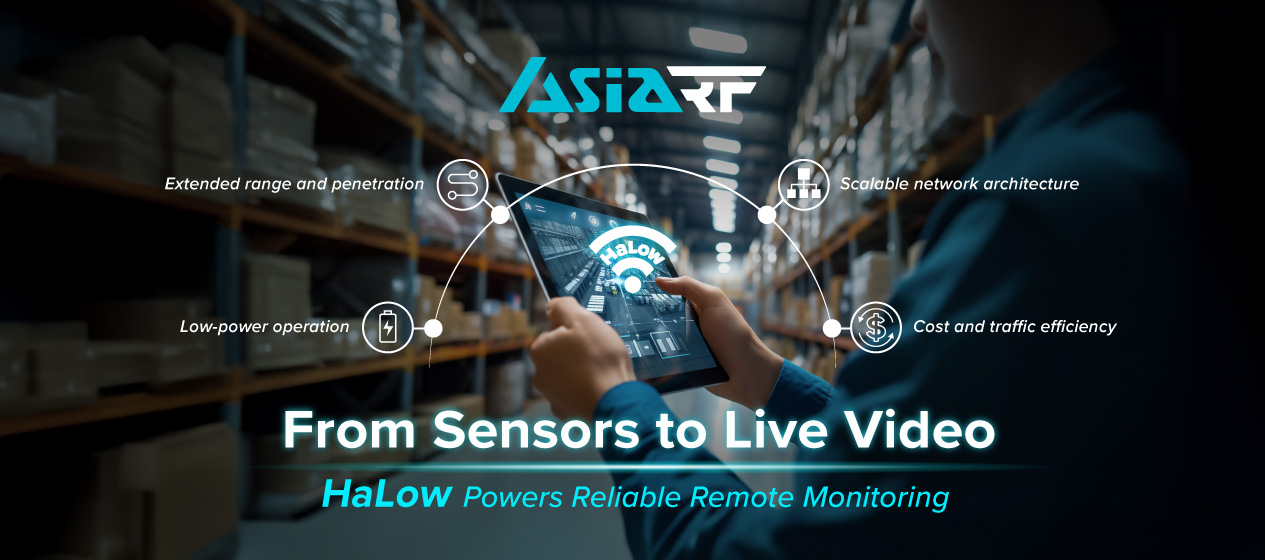
- Extended Range: Signals travel further due to the lower frequency.
- Lower Power Consumption: Enables battery-operated devices to last for months or years.
- Better Material Penetration: Sub-GHz signals pass through walls, floors, and other obstacles more effectively than 2.4/5 GHz signals.
- High Device Capacity: Can support thousands of devices per access point.
- IP-Based: Native IP support simplifies integration with existing internet infrastructure and cloud platforms.
- Standardized Technology: Being part of the IEEE 802.11 family offers potential for interoperability and leveraging existing Wi-Fi knowledge.
- Robust Security: Can leverage established Wi-Fi security mechanisms like WPA3.
Example: A smart city might deploy Wi-Fi HaLow for its public lighting system. Thousands of streetlights can be individually controlled and monitored for faults over a wide area. The signals can reliably reach controllers inside metal streetlight poles, and the low power consumption means backup batteries for the controllers can last a long time during outages.
In which frequency band does Wi-Fi HaLow operate, and why is it significant?
Explanation: Wi-Fi HaLow operates in the Industrial, Scientific, and Medical (ISM) radio bands below 1 Gigahertz (Sub-1 GHz). The exact frequencies vary by region: for instance, 902-928 MHz in North America, 863-868 MHz in Europe, and other bands in Asia. This is significant because lower frequencies inherently have physical properties that allow radio waves to travel longer distances and penetrate objects like walls and foliage more effectively than higher frequencies (like 2.4 GHz or 5 GHz). There’s also generally less congestion in these sub-GHz bands compared to the crowded 2.4 GHz band.
Example: Imagine trying to connect a sensor in a basement or deep within a concrete building. A traditional 2.4 GHz Wi-Fi signal might struggle to reach it. A Wi-Fi HaLow signal, operating around 900 MHz, has a much better chance of penetrating the concrete and establishing a reliable connection.
What kind of data speeds or throughput can be expected from Wi-Fi HaLow?
Explanation: Wi-Fi HaLow is not designed for high-speed data transfer like streaming video. Its data rates are optimized for the small, infrequent bursts of data typical of IoT devices. Speeds can range from as low as a few hundred kilobits per second (kbps) for very long-range and robust links, up to several tens of megabits per second (Mbps) for shorter ranges and wider channel bandwidths. The actual throughput depends on factors like distance, channel width (1, 2, 4, 8, or 16 MHz), modulation scheme, and environmental interference.
Example: A remote weather station using Wi-Fi HaLow might send a small packet of data (temperature, humidity, wind speed) every 10 minutes. For this, a data rate of 150 kbps is more than sufficient and helps maximize range and power efficiency. It wouldn’t be suitable for live-streaming video from that station.
What is the effective range of Wi-Fi HaLow? Can it truly reach 1 kilometer or more?
Explanation: Yes, Wi-Fi HaLow is designed for ranges significantly exceeding traditional Wi-Fi, often cited as up to 1 kilometer or even further in ideal line-of-sight (LoS) conditions. In non-LoS environments (e.g., urban areas, indoors with many walls), the range will be less but still substantially better than 2.4/5 GHz Wi-Fi. The achievable range depends on factors like transmit power, antenna gain, receiver sensitivity, environmental obstructions, and the required data rate (lower data rates typically achieve longer ranges).
Example: An agricultural application could use a Wi-Fi HaLow access point on a farmhouse to connect to irrigation controllers and soil sensors spread across fields up to a kilometer away, eliminating the need for complex wiring or multiple short-range repeaters.
How does Wi-Fi HaLow achieve its low power consumption?
Explanation: Wi-Fi HaLow incorporates several mechanisms to minimize power consumption:
- Long Sleep Cycles: Devices can enter deep sleep modes for extended periods, waking up only briefly to transmit or receive data.
- Efficient Data Transmission: Optimized protocols for sending small data packets.
- Target Wake Time (TWT): Allows the access point to schedule specific times for devices to wake up, reducing idle listening.
- Narrower Bandwidths: Using narrower channel bandwidths (e.g., 1 or 2 MHz) requires less power for transmission and reception compared to the wider channels of traditional Wi-Fi.
- Simplified MAC Layer: The Medium Access Control layer is streamlined for IoT traffic patterns.
Example: A battery-powered door lock using Wi-Fi HaLow might wake up for only a few milliseconds to report its status (locked/unlocked) or when it receives a command to unlock. For the vast majority of the time, it remains in a deep sleep state, allowing its batteries to last for years.
How many devices can connect to a single Wi-Fi HaLow access point?
Explanation: Wi-Fi HaLow is designed to support a significantly larger number of connected devices per access point (AP) compared to traditional Wi-Fi APs. While traditional APs might struggle with more than a few dozen active clients, HaLow APs are designed to handle thousands of connections (specifically, an 802.11ah AP can associate with up to 8,191 devices). This is achieved through features like efficient handling of small data packets, longer beacon intervals, and improved addressing and resource allocation mechanisms.
Example: In a large industrial facility, a single Wi-Fi HaLow access point could connect to thousands of sensors monitoring machinery health, environmental conditions, and asset locations throughout the plant.
How does Wi-Fi HaLow compare to other Low-Power Wide-Area Network (LPWAN) technologies like LoRaWAN, Sigfox, or NB-IoT?
Explanation:
- Data Rate: HaLow generally offers higher data rates (kbps to Mbps) than LoRaWAN or Sigfox (bps to kbps). NB-IoT falls in between, typically offering tens to hundreds of kbps.
- Range: LoRaWAN and Sigfox can achieve longer ranges (several kilometers in rural areas) than HaLow (up to ~1 km). NB-IoT’s range is comparable to or slightly better than HaLow, leveraging cellular infrastructure.
- Power Consumption: All are designed for low power, but specifics vary. LoRaWAN and Sigfox are often champions of ultra-low power for very infrequent, small data.
- Network Topology & Cost: HaLow uses a star topology similar to traditional Wi-Fi and can be deployed as private networks. LoRaWAN and Sigfox often rely on public or private network operators. NB-IoT uses existing cellular infrastructure, which usually involves carrier subscriptions.
- IP Support: HaLow has native IP support, simplifying integration. LoRaWAN and Sigfox often require gateways to translate to IP. NB-IoT is IP-based.
- Bandwidth: HaLow uses wider bandwidths (MHz) than LoRaWAN/Sigfox (kHz), allowing for higher data rates but potentially more power per bit transmitted.
Example: For a smart city needing to collect infrequent, tiny data packets (like a parking spot status) from tens of thousands of sensors spread over many square kilometers, LoRaWAN or Sigfox might be suitable due to extreme range and power efficiency. If the city needs higher data rates for, say, low-resolution image snapshots from security sensors or firmware updates over the air within a 1 km radius per access point, Wi-Fi HaLow or NB-IoT would be more appropriate. HaLow offers the advantage of private network ownership and no recurring carrier fees compared to NB-IoT.
How does Wi-Fi HaLow compare to short-range wireless technologies like Zigbee, Z-Wave, or Bluetooth Low Energy (BLE)?
Explanation:
- Range: HaLow offers significantly longer range (kilometers) compared to Zigbee, Z-Wave, and BLE (tens to a hundred meters).
- Data Rate: HaLow’s peak data rates can be higher than those of Zigbee, Z-Wave, and typical BLE applications.
- Network Topology: Zigbee and Z-Wave often use mesh networking to extend range, while HaLow primarily uses a star topology (though mesh is technically possible). BLE is often point-to-point or broadcast.
- IP Support: HaLow has native IP support. Zigbee, Z-Wave, and BLE typically require gateways for IP connectivity.
- Power Consumption: All are designed for low power, but the specific profiles and use cases differ. BLE is very effective for very short bursts and proximity applications.
Example: In a smart home, BLE might be used for communication between your smartphone and a fitness tracker (very short range, low power). Zigbee or Z-Wave might control lights and switches throughout the house using a mesh network. Wi-Fi HaLow could be used to connect outdoor security cameras, gate controllers, or sensors in a detached garage that are too far for Zigbee/Z-Wave/BLE or even traditional Wi-Fi to reliably reach from the main house router.
Is Wi-Fi HaLow meant to replace traditional Wi-Fi or other IoT technologies?
Explanation:
No, Wi-Fi HaLow is not intended to replace traditional Wi-Fi (like Wi-Fi 6/7) or all other IoT technologies. It’s designed to be a complementary technology that fills a specific gap. Traditional Wi-Fi excels at high-speed data transfer over shorter ranges. Other IoT technologies like LoRaWAN, NB-IoT, Zigbee, and BLE each have their own strengths for particular use cases (e.g., extreme range, ultra-low power for tiny data, mesh networking). Wi-Fi HaLow provides a standardized, IP-based solution for medium to long-range IoT applications that require more data throughput than some LPWANs but still need good power efficiency and range.
Example:
You’ll still use your traditional Wi-Fi router for Browse the web on your laptop and streaming movies. Your Bluetooth earbuds will still connect to your phone. However, a new industrial monitoring system might use Wi-Fi HaLow to connect sensors across a factory floor because it offers a better balance of range, throughput for sensor data, and power efficiency than either traditional Wi-Fi or other short-range IoT technologies for that specific application.
What are the primary applications and use cases for Wi-Fi HaLow?
Explanation:
Wi-Fi HaLow is well-suited for a wide range of IoT applications that require a combination of longer range, good penetration, reasonable data rates (for IoT), and power efficiency. Key areas include:
- Smart Buildings/Homes: Security systems, HVAC control, appliance monitoring, access control over larger properties.
- Industrial IoT (IIoT): Process monitoring and control, asset tracking, predictive maintenance sensors in factories, warehouses, and logistics.
- Smart Cities: Smart lighting, waste management, environmental monitoring, smart parking, utility metering.
- Agriculture: Soil sensors, livestock tracking, irrigation control, drone communication.
- Retail: Electronic shelf labels, asset tracking in large stores, inventory management.
- Healthcare: Remote patient monitoring (within a campus or large facility), asset tracking for medical equipment.
Example:
A large retail chain could use Wi-Fi HaLow for its electronic shelf labels across sprawling superstores. The system can update prices on thousands of labels simultaneously, reaching shelves deep within aisles, with the labels running on batteries for several years. This is difficult to achieve reliably and cost-effectively with traditional Wi-Fi or BLE.
Do I need new hardware (routers, devices) to use Wi-Fi HaLow?
Explanation:
Yes, you generally need new hardware. Wi-Fi HaLow operates on different frequencies and uses a different physical layer (PHY) and MAC layer design than traditional Wi-Fi. Therefore, existing Wi-Fi routers and devices (e.g., smartphones, laptops designed for 2.4/5 GHz Wi-Fi) are not compatible with Wi-Fi HaLow. You will need Wi-Fi HaLow-specific access points (or gateways) and Wi-Fi HaLow-enabled end devices (sensors, actuators, etc.) that contain the appropriate chipsets. Some multi-band chipsets or devices might emerge that support both traditional Wi-Fi and HaLow, but dedicated HaLow hardware is the norm.
Example:
To set up a Wi-Fi HaLow network for your farm sensors, you would need to purchase a Wi-Fi HaLow gateway (which acts like a specialized router) and ensure that the soil moisture sensors, weather station, and livestock trackers you buy are all explicitly “Wi-Fi HaLow certified” or “802.11ah compatible.” Your existing home Wi-Fi router will not be able to communicate with these HaLow devices.
Is Wi-Fi HaLow available globally? Are there regional differences in its deployment or regulations?
Explanation:
Wi-Fi HaLow is designed for global deployment, but the exact sub-1 GHz frequencies it uses are subject to regional regulations. Different countries and regions have allocated different parts of the sub-GHz spectrum for ISM (Industrial, Scientific, and Medical) use or license-exempt operation. For example:
- North America: Typically 902-928 MHz.
- Europe: Typically 863-868 MHz.
- China: Around 779-787 MHz.
- Other regions (e.g., Australia, Japan, Korea): Have their own specific allocations. This means that Wi-Fi HaLow chipsets and devices need to be configurable or specifically designed for the regulatory domain in which they will operate. The Wi-Fi Alliance certification program helps ensure compliance and interoperability within these regional parameters.
Example:
A company manufacturing Wi-Fi HaLow-enabled environmental sensors would need to produce different versions of their product (or have firmware adaptable) for the US market (using the 902-928 MHz band) versus the European market (using the 863-868 MHz band) to comply with local radio regulations.
How is security handled in Wi-Fi HaLow? Does it support modern Wi-Fi security protocols like WPA3?
Explanation:
Security is a critical aspect of Wi-Fi HaLow, just as it is for any Wi-Fi technology. Wi-Fi HaLow leverages the robust security features established in the IEEE 802.11 standards. It supports the latest generation of Wi-Fi security, including WPA3 (Wi-Fi Protected Access 3). WPA3 offers stronger encryption, protection against brute-force attacks, and enhanced authentication mechanisms, which are essential for securing IoT devices that might be deployed in vulnerable locations or handle sensitive data.
Example:
A Wi-Fi HaLow-enabled security camera installed outdoors will use WPA3 encryption to secure the video feed and control commands transmitted to and from the network. This prevents unauthorized viewing of the footage or malicious attempts to disable the camera, providing a similar level of security to what you’d expect from a modern WPA3-secured traditional Wi-Fi network.
How well does the Wi-Fi HaLow signal penetrate through walls and other obstacles?
Explanation:
Wi-Fi HaLow signals, operating in the sub-1 GHz band, have significantly better penetration capabilities through common building materials (like walls, concrete, and foliage) compared to higher-frequency signals from traditional Wi-Fi (2.4 GHz and 5 GHz). This is a fundamental property of lower-frequency radio waves – they experience less attenuation (signal loss) when passing through dense objects. This makes HaLow particularly suitable for applications requiring coverage within complex indoor environments or through moderate outdoor obstructions.
Example:
If you need to connect a sensor in a utility closet deep inside a large commercial building with multiple concrete walls, a traditional Wi-Fi signal might be completely blocked. A Wi-Fi HaLow signal has a much higher probability of successfully penetrating those walls and establishing a reliable connection with an access point located further away.
What is the current state of Wi-Fi HaLow adoption and market availability of products?
Explanation:
As of early 2025, Wi-Fi HaLow adoption is steadily growing, though it’s still in an earlier phase compared to mature technologies like traditional Wi-Fi or BLE. Chipset availability from various silicon vendors has increased, leading to a growing ecosystem of modules, development kits, access points, and end devices. It’s gaining traction in specific IoT verticals like industrial automation, smart agriculture, logistics, and smart building solutions where its unique benefits are most apparent. While not yet as ubiquitous as traditional Wi-Fi, the market is expanding, and more products are becoming commercially available.
Example:
You can now find several companies offering Wi-Fi HaLow gateways and modules for developers and system integrators. There are also initial deployments in areas like industrial sensor networks for machinery monitoring or in smart agriculture for connecting remote environmental sensors. You might not yet find consumer-grade HaLow routers in every electronics store, but the building blocks and specialized solutions are increasingly present.
What are the potential costs associated with implementing a Wi-Fi HaLow network?
Explanation:
The costs can be broken down into several components:
- Hardware Costs: This includes Wi-Fi HaLow access points/gateways and the end devices (sensors, actuators). Initially, as with any newer technology, the per-unit cost of HaLow chipsets and devices might be higher than for very high-volume traditional Wi-Fi or BLE components, but this is expected to decrease with wider adoption.
- Deployment Costs: This involves installation, configuration, and potentially site surveys, especially for larger or more complex deployments.
- Network Management: While HaLow can simplify some aspects due to its range, managing a large IoT network still requires software and potentially expertise.
- Integration Costs: Connecting the HaLow network and its data into existing enterprise systems or cloud platforms. Overall, for applications where HaLow’s range and penetration reduce the number of access points needed compared to traditional Wi-Fi, or where it eliminates the need for cellular subscriptions (unlike NB-IoT for some use cases), it can offer a lower total cost of ownership despite potentially higher initial hardware costs for individual components.
Example:
A warehouse looking to track 5,000 assets might find that using Wi-Fi HaLow requires only 5 gateways due to its range and penetration, compared to potentially 30 traditional Wi-Fi APs or a costly mesh network. While each HaLow gateway and tag might be more expensive initially, the overall infrastructure and installation cost could be lower, and there would be no ongoing cellular data fees.
Can Wi-Fi HaLow coexist with other wireless technologies operating in nearby frequencies without interference?
Explanation:
Yes, Wi-Fi HaLow is designed with coexistence in mind, but like any wireless technology, it’s not immune to interference if nearby bands are heavily used by powerful transmitters. The sub-1 GHz bands are used by various services, including other LPWANs, amateur radio, and some industrial equipment. Wi-Fi HaLow incorporates features from the IEEE 802.11 standard, such as “listen before talk” (Carrier Sense Multiple Access with Collision Avoidance – CSMA/CA), adaptive channel selection, and robust modulation techniques to mitigate interference and share the spectrum efficiently. The specific levels of interference and coexistence performance will depend on the local RF environment and the density of other nearby transmitters.
Example:
If a factory is already using a proprietary wireless sensor network in the 915 MHz band, deploying a new Wi-Fi HaLow system in the same 902-928 MHz band will require careful planning. The HaLow system’s ability to sense channel activity and select less congested channels will help, but an RF site survey would be advisable to ensure both systems can operate effectively without degrading each other’s performance.
What are the limitations or potential downsides of using Wi-Fi HaLow?
Explanation:
While offering significant advantages, Wi-Fi HaLow also has limitations:
- Lower Data Rates: Compared to traditional Wi-Fi, its data throughput is significantly lower, making it unsuitable for bandwidth-intensive applications like video streaming or large file transfers.
- Ecosystem Maturity: While growing, the ecosystem of HaLow devices and readily available consumer products is still less mature than for technologies like traditional Wi-Fi or Bluetooth.
- Regional Frequency Variations: The need for region-specific hardware or configurations due to different sub-GHz band allocations can add complexity for global product rollouts.
- Potential for Interference: Although designed for coexistence, the sub-GHz bands are used by other services, and localized interference can still be a concern in some environments.
- Not a Replacement for All IoT: It’s not a one-size-fits-all solution; technologies like LoRaWAN might be better for extreme range with tiny data, or BLE for very low power, short-range applications.
Example:
A company wants to deploy very high-resolution video surveillance cameras across a large campus. While Wi-Fi HaLow could provide the range, its data rate limitations (tens of Mbps at best) would likely be insufficient for streaming multiple HD or 4K video feeds. In this case, traditional Wi-Fi with strategically placed access points, or even wired Ethernet or fiber, would be a more appropriate choice for the cameras, even if HaLow is used for other, lower-bandwidth sensor data on the same campus.