
What Middle East hoteliers need to know about in-room entertainment, connectivity, and guest engagement
The guest room is becoming a digital environment. Guests bring their own devices, content, and expectations with them. They expect hotel technology to work together without creating extra steps or frustration.
For Middle East hotels, the challenge is even more nuanced. A diverse guest mix, multilingual needs, local considerations, and rising expectations around digital experiences all shape what a connected guest room needs to deliver.
This white paper explores how hoteliers can move beyond the traditional hotel TV to create a more connected, flexible, and guest-focused experience.
Inside This White Paper:
The connected guest room is not about adding technology for its own sake. Rather, it’s about creating an experience that works naturally for the guest and supports the way people actually travel today.
Explore this white paper to see what a more connected guest room could mean for your property.
Reliable Wi-Fi has become an essential part of the hotel guest experience. Guests expect fast, consistent connectivity that supports streaming, video calls, multiple devices, and the digital services they use throughout their stay.
For hotels, the right network can also support connected operations, guest engagement, and future technology investments.
In this white paper, you’ll learn:
Download the white paper to explore how a stronger connectivity foundation for European hotels can support better guest experiences today and the technology needs of tomorrow.
HOUSTON, TX — (06/15/26) — WorldVue, a trusted provider of video, advanced connectivity, and professional services, today announced the official release of Atlas, a next-generation customer platform designed to bring visibility, control, and intelligence to hotel technology operations, while laying the foundation for a Property Technology Operating System.
Built to unify data across essential WorldVue systems, Atlas now delivers a more powerful and transparent experience for both customers and internal teams. More than a dashboard, Atlas represents a fundamental shift in how hotel technology is managed. It provides operators with a centralized system to monitor performance, manage services, and act; transforming fragmented processes into a structured, trackable, and data-driven experience.
“Atlas represents a major step forward in how we think about technology in hospitality. We built it to simplify complexity, scale globally, and give our customers a platform they can rely on today while being ready for what’s next. This launch reflects our commitment to building smarter, more connected experiences without adding operational burden,” said Mark Schaps, Executive Vice President and Chief Informational Officer.
Atlas delivers immediate value with a robust set of features designed for both portfolio-level oversight and property-level detail:
WorldVue customers will be provided with an onboarding experience to provide the proper communication and documentation for the owner or operator to feel fully informed.
As Atlas continues to develop, WorldVue is building toward a future where operators can manage every aspect of their technology ecosystem, assets, vendors, services, performance, and cost, from a single platform. Upcoming capabilities include proposal management, lifecycle inventory, end-of-life equipment document repository and agnostic vendor management regardless if it is a WorldVue serviced product.
Atlas is built for flexibility, with web-based access today and dedicated iOS and Android applications now available to all WorldVue customers. WorldVue is ensuring operators can stay connected to their technology from anywhere.
“We’re not just improving visibility, we’re redefining how technology is managed at the property, portfolio or even brand level,” added Schaps. “Atlas is the first step toward giving our customers complete control over their technology environment.”
###
ABOUT WORLDVUE
WorldVue® is a trusted provider of video, advanced connectivity and professional services to properties and enterprises across the world. With a dedication to customer service, WorldVue is leading the way in delivering innovative technology solutions that enhance the resident, guest, and staff experience. From managed services to digital transformation, WorldVue is a single point of contact for all property technology needs.
Founded in 1975, WorldVue is a privately held company headquartered in the United States with offices globally. The company serves over 8,000 properties and over 1,000,000 rooms.
Media Contact:
Reagan Baker
[email protected]
Ella Steele
Modern hotels rely on more connected technology than ever before. Guest Wi-Fi, in-room entertainment, smart devices, digital signage, and operational systems now shape nearly every part of the guest experience.
That growth has created new opportunities for hospitality teams. However, it has also created new operational challenges.
Many hotel teams still manage technology across multiple dashboards, vendor portals, spreadsheets, and support channels. At a single property, that can feel frustrating. Across an entire portfolio, it can become difficult to maintain visibility into system health, ongoing support needs, equipment deployments, and property-level performance.
Hotel technology ecosystems and integration continue to expand. Therefore, operators need better oversight of the systems that support both guests and staff.
Recent hospitality industry research also points to technology fragmentation as a growing operational challenge. In the 2025 State of Hospitality Tech survey published by Hotel Yearbook, integration challenges and disconnected systems ranked among the most common frustrations reported by hotel operators and technology providers.
Hospitality technology no longer operates in isolated categories. Guest connectivity, in-room entertainment, networking infrastructure, and operational services now work together to support the modern hotel experience.
That interconnected environment thus increases the importance of operational awareness.
Without awareness, teams cannot quickly identify network issues, track equipment status, or understand what is happening across properties. Thus, small problems can become larger operational disruptions. Delays in support requests or incomplete visibility into deployments can also slow decision-making.
This challenge becomes even greater for ownership groups and management companies overseeing multiple properties.
Technology teams often need to answer important questions quickly:
Without centralized oversight, however, finding those answers may require logging into multiple systems or contacting several vendors.
Hotel operations move quickly, so technology management needs to keep pace.
Many hospitality organizations are shifting away from reactive technology management models. Waiting for issues to impact operations or guest satisfaction is likely to negatively impact the guest experience. This kind of reactive approach can also end up costing more to resolve issues. Instead, teams want earlier visibility into performance trends and system health.
A more proactive approach helps teams:
Better oversight also supports long-term planning.
Teams using a proactive approach spend less time navigating disconnected systems or manually tracking operational information. Thus, they can respond faster to issues and focus more attention on guest experience, operational consistency, and property performance.
As hotels continue investing in connected experiences, operators need a clearer understanding of how systems perform across their portfolios. Access to consolidated operational insights can help teams make faster and more informed decisions.

Hospitality teams do not need more disconnected tools. Instead, they need better ways to understand the environments they already manage.
Centralized operational visibility can simplify day-to-day technology management. A key benefit is consolidating property-level insights, network monitoring, support activity, and deployment tracking into a unified view.
That level of visibility becomes especially valuable for multi-property operators. Teams can compare performance across locations, identify recurring operational issues, and maintain better alignment between properties.
The goal is not simply to collect more data. Rather, the goal is to make technology operations easier to manage.
Technology now plays a larger role in hotel operations than ever before. As hospitality environments become more connected, the need for operational oversight will continue to grow.
Hotels can use this oversight to better monitor, manage, and support their technology ecosystems. This positions leadership and staff to respond to operational challenges and evolving guest expectations.
At the same time, hospitality teams continue searching for ways to simplify operations while improving visibility across their portfolios.
WorldVue continues to invest in solutions that help hospitality teams simplify technology operations, improve operational visibility, and better support connected guest experiences across properties.
As hotel technology environments continue to evolve, centralized oversight will play an increasingly important role in supporting efficient operations and long-term performance.
Hospitality organizations looking to simplify technology management across properties should continue to evaluate how greater operational visibility, centralized support workflows, and proactive monitoring can improve efficiency and advance long-term operational goals.
To learn more about how WorldVue supports connected hospitality operations, visit www.worldvue.com/hospitality
Hotel development has always balanced aesthetics, functionality, and cost. Today, another layer carries equal weight: technology.
Across the U.S., new hotel construction remains active, with thousands of projects in the pipeline. According to Lodging Econometrics, the U.S. hotel construction pipeline exceeded 6,200 projects and 720,000 guest rooms in late 2025. That continued growth raises the stakes for getting design decisions right the first time. Properties that open with outdated or underpowered technology face immediate disadvantages that are difficult to correct later.
For hotel developers, architects, and designers, guest-facing technology and the infrastructure behind it are not just add-ons. They have become foundational elements that shape both the guest experience and long-term property performance.
The challenge is not just choosing the right technologies. It’s also knowing when to plan for them and how to integrate them into the built environment. Decisions made early in design directly impact cost, scalability, and guest satisfaction long after opening day.
Guests no longer separate physical space from digital experience. Reliable connectivity, seamless streaming, mobile interactions, and smart room controls are expected, not optional. When these elements fail, the perception of the entire property suffers.
The guest experience is now directly tied to the performance of underlying systems, especially the network. From a design perspective, this shift therefore changes priorities.
Hotels must treat technology like plumbing or electrical systems. It requires early coordination, dedicated pathways, and long-term planning.
This includes:
Each of these depends on infrastructure decisions that are difficult and expensive to retrofit later.
One of the most common mistakes in hotel development is including technology partners late in the design phase. When properties treat technology as a final-phase addition, it creates conflicts with architectural plans, increases costs, and limits performance.
As Hitesh Patel, VP of Solution Architecture at WorldVue, notes, “The earlier we’re involved in a project, the better the outcome for the property.” WorldVue’s guidance on technology planning for new construction hotels reinforces this point. Early engagement allows teams to align infrastructure with design intent before construction locks in constraints.
Late-stage adjustments often lead to:
In one common scenario, a property that did not plan infrastructure early required multiple data closets to support coverage. With better planning, that same layout could have been supported with a single, well-placed space. That difference alone can add $30,000 to $40,000 in unnecessary costs.
In many cases, resolving even simple issues requires reopening finished ceilings or walls, delaying timelines, and increasing labor costs.
These issues are not just technical. Instead, they directly impact guest satisfaction and operational efficiency.
Early planning avoids these constraints. It allows technology requirements to inform structural decisions rather than react to them.
The visible layer of hospitality technology gets attention, but the infrastructure that supports it often does not. That imbalance creates risk.
A poorly designed network limits every connected service in the building, from guest Wi-Fi to operational systems.
In addition, a well-designed network infrastructure must account for both current needs and future growth. Device density continues to increase, and new services place additional demands on bandwidth and reliability.
To address this, key infrastructure considerations include:
A scalable network design ensures that the property can support increasing demand without major redesign. This includes proper segmentation between guest traffic, operational systems, and IoT devices.
Structured cabling must be designed with capacity in mind. This includes planning for fiber backbones, horizontal cabling, and accessible pathways for future upgrades.
Telecommunications rooms require adequate space, power, and cooling. Undersized or poorly located IDF and MDF rooms create long-term operational challenges.
Reliable technology requires reliable power. Backup systems and redundancy planning are essential for maintaining uptime, especially for critical guest services.
These elements are far more efficient to implement during construction than after occupancy.
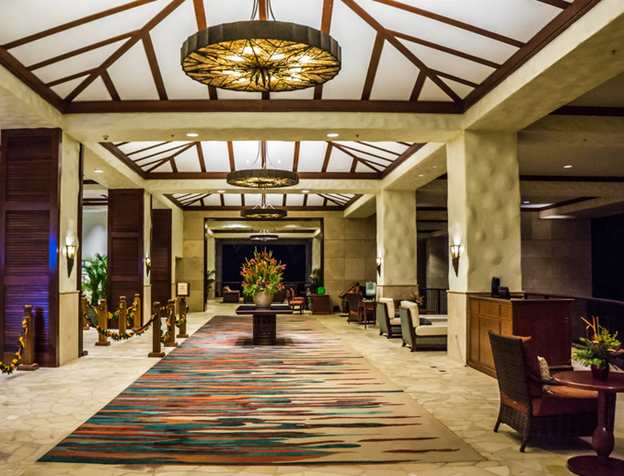
Wi-Fi design is one of the clearest examples of why early coordination matters. Coverage cannot be assumed; it must be engineered based on the physical environment.
WorldVue’s real-world Wi-Fi heatmapping scenarios highlight how building materials and layouts directly impact performance. Specifically, materials such as concrete, metal, and low-E glass significantly affect signal propagation. Ceiling types can limit the placement of access points. Room layouts can increase device density in ways that strain poorly designed networks.
Heatmapping during the design phase allows teams to predict performance and optimize placement before installation. This reduces the risk of dead zones, interference, and inconsistent service.
Without this step, properties often rely on reactive fixes after opening, which are more costly and less effective.
In practice, successful projects treat technology planning as a cross-disciplinary effort. Architects, developers, designers, and technology providers must collaborate early and consistently.
As emphasized in earlier WorldVue guidance on including technology teams in hotel design, when design teams don’t include technology teams early, projects often require rework that impacts both budget and timelines.
As a result, early collaboration ensures that:
Bringing technology partners into the process during early design phases creates alignment and reduces downstream friction.
Hotel lifecycles extend well beyond initial construction, but technology lifecycles do not. Most systems require meaningful updates every 5-7 years, while the building itself will likely perform for decades.
However, futureproofing does not mean predicting every innovation. Instead, it means designing flexibility into the infrastructure during the planning phase.
This includes:
These decisions add minimal cost during construction but provide significant long-term value.
For developers and owners, early technology planning is not only a technical decision but also a financial one. As a result, it directly influences long-term returns.
Properties that integrate technology effectively tend to see a higher return on technology investments:
Conversely, properties that underinvest in infrastructure often face recurring upgrade costs and negative guest feedback.
Technology also plays a role in brand differentiation. As guest expectations continue to rise, properties that deliver seamless digital experiences gain a competitive advantage.
Ultimately, technology decisions made during the design phase shape both the physical environment and the hotel’s long-term operational performance.
Telecom room placement affects usable square footage. Ceiling design impacts access point placement. Wall materials influence signal propagation. These are not technology-only concerns; they also represent architectural decisions with lasting consequences.
Addressing them early allows teams to balance aesthetics, performance, and cost without compromise.
The path forward is clear: technology must be part of the conversation from the earliest stages of design.
Practical steps include:
Together, these actions create a foundation that supports both immediate performance and future growth.
Today, the modern hotel is a connected environment where physical and digital experiences intersect. Designing for that reality requires a shift in mindset.
Technology is no longer a layer added at the end; it is part of the building itself. Developers and architects who recognize this early can avoid costly missteps and deliver properties that meet evolving guest expectations.
As the hospitality industry continues to evolve, the most successful projects will be those that consistently treat technology as an integral part of design, not an afterthought.
Planning a new hotel or major renovation? Engage your technology strategy early in the design phase. WorldVue works alongside developers and architects to align infrastructure, architecture, and performance from the start. This approach helps you avoid costly rework and support a better guest experience from day one.
This article builds on our recent two-part series on hospitality technology infrastructure. In those articles, we covered how to plan network infrastructure and how WorldVue designs, deploys, and supports guest-facing technology.
In this article, we take a closer look at real-world hotel Wi-Fi design scenarios. Using heatmap examples, we show how room layout, construction materials, and access point (AP) placement affect signal strength in guest rooms.
These examples help explain why careful planning is critical to meet guest expectations. Small design decisions can have a major impact on the guest experience.
Wi-Fi heatmaps show how wireless signals travel through a space. They highlight areas with strong coverage and areas where signal strength drops.
Design teams use heatmaps to validate AP placement and coverage before installation. This helps ensure guests receive reliable connectivity throughout the room.
“Wi-Fi design is not just about adding more access points,” says Hitesh Patel, VP of Solution Architecture at WorldVue. “Placement needs to reflect how signals actually move through a space.”
The following examples reflect a typical mid-market hotel with standard-sized guest rooms. These properties often use consistent layouts and may include concrete or drywall construction.
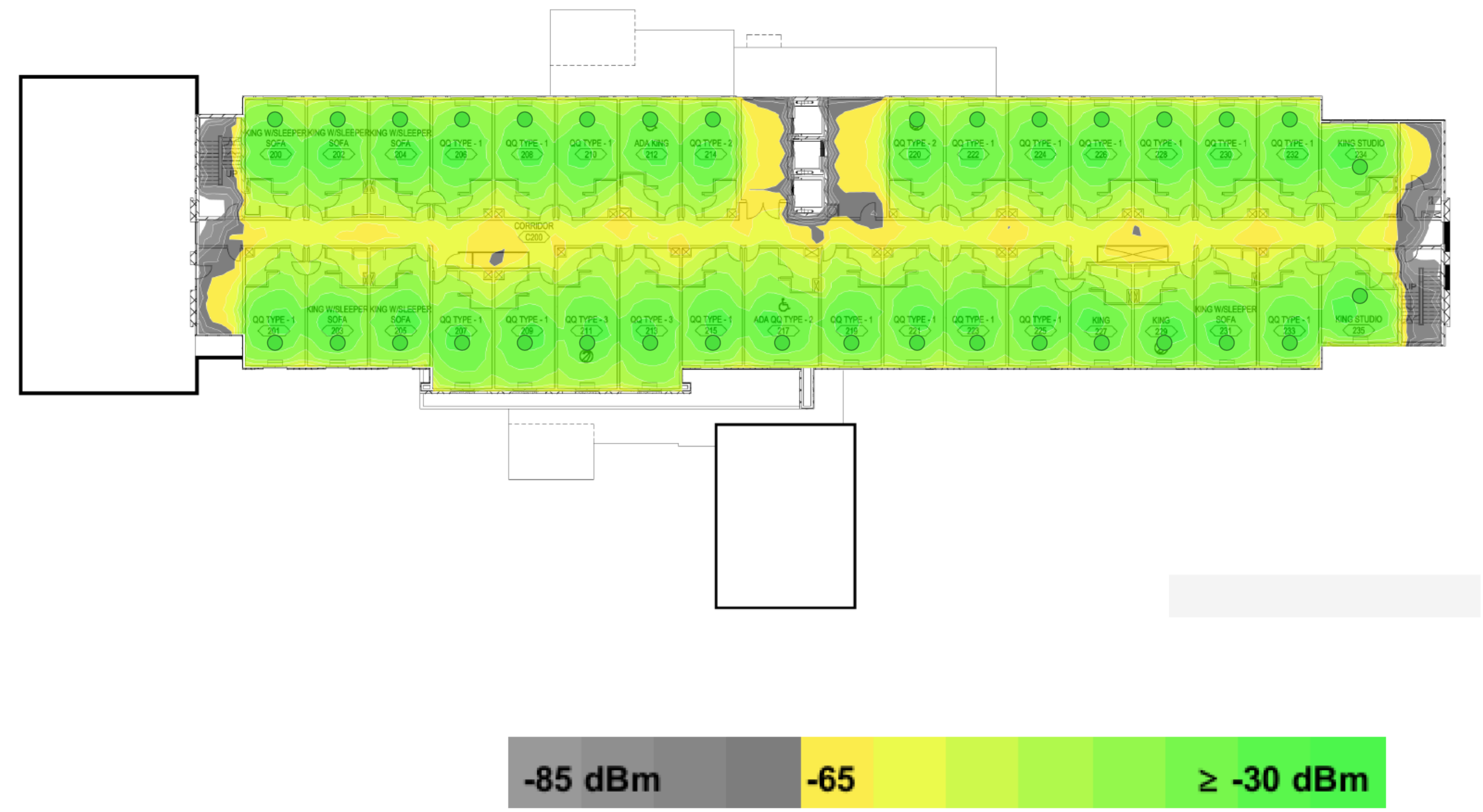
This scenario shows an access point placed inside every guest room with concrete walls.
Concrete limits how Wi-Fi signals travel between rooms. With an AP in each room, coverage remains strong and consistent within each space.
This setup delivers reliable performance and avoids coverage gaps.
Takeaway: Concrete construction often requires an AP in each room to maintain consistent coverage.
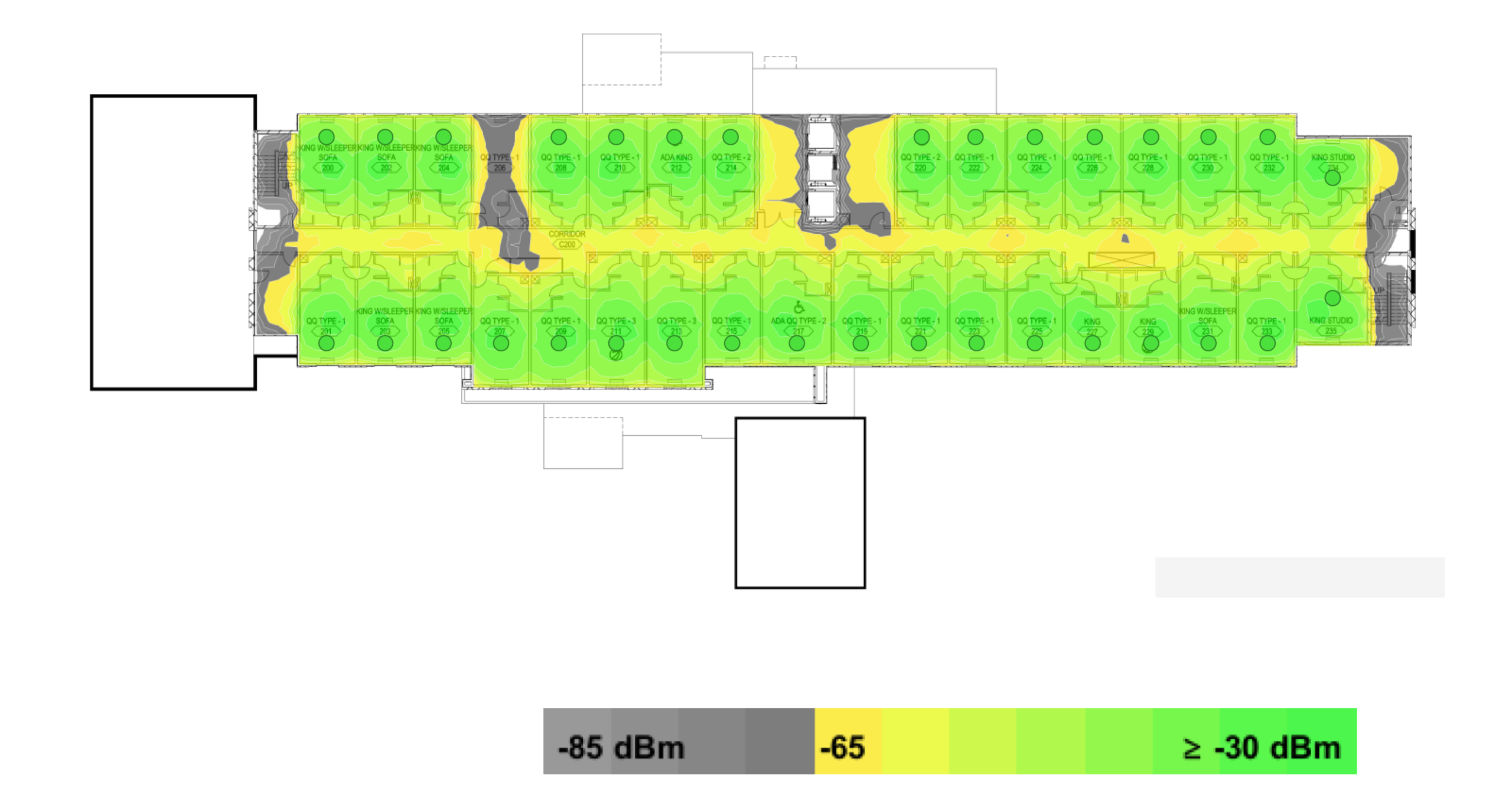
This heatmap shows the same concrete-wall layout, but with one room missing an access point.
The room without an AP becomes a clear dead spot. Concrete walls block the signal from adjacent rooms.
Takeaway: Removing even one AP in concrete environments can create immediate coverage gaps.
“Concrete limits how far the signal can travel,” Patel explains. “If you remove an AP, coverage drops off quickly in that space.”
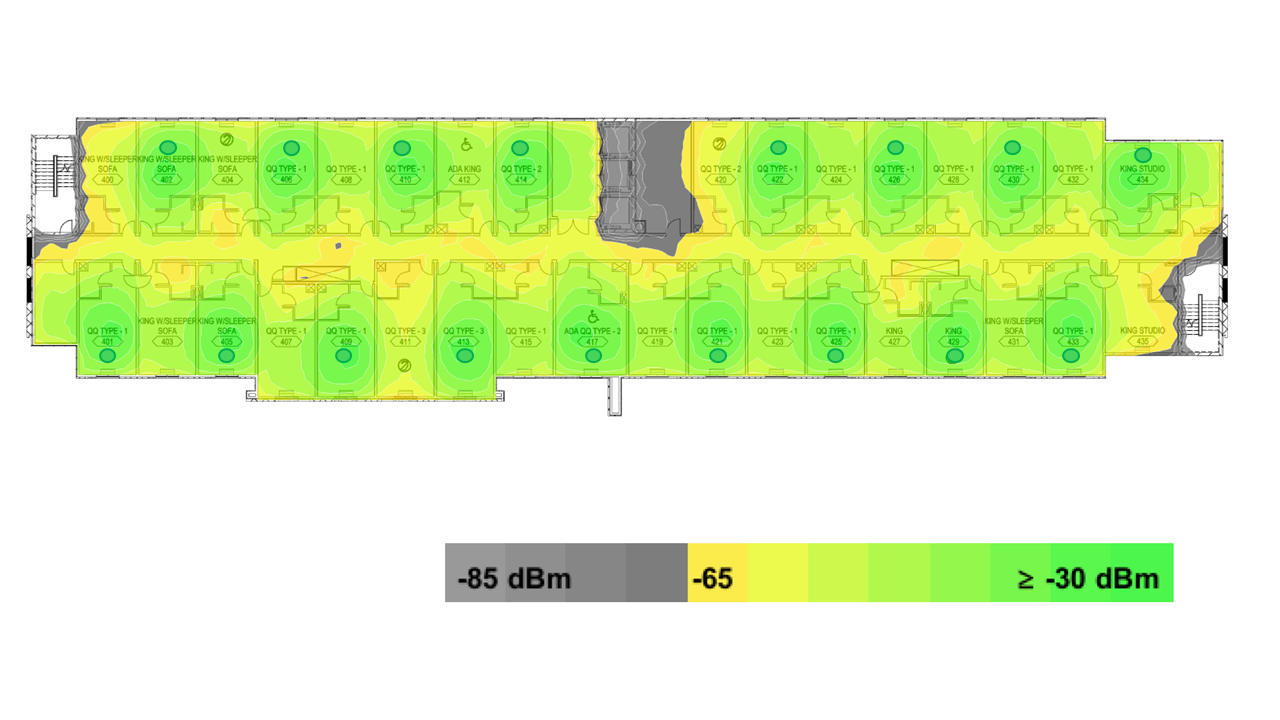
In this example, access points are installed in every other room with drywall construction.
Signals travel more easily through drywall. Coverage extends into adjacent rooms, though strength varies.
This setup can work in some layouts, but it may still create weaker areas.
Takeaway: Drywall allows the signal to travel, but shared APs can still lead to inconsistent performance.
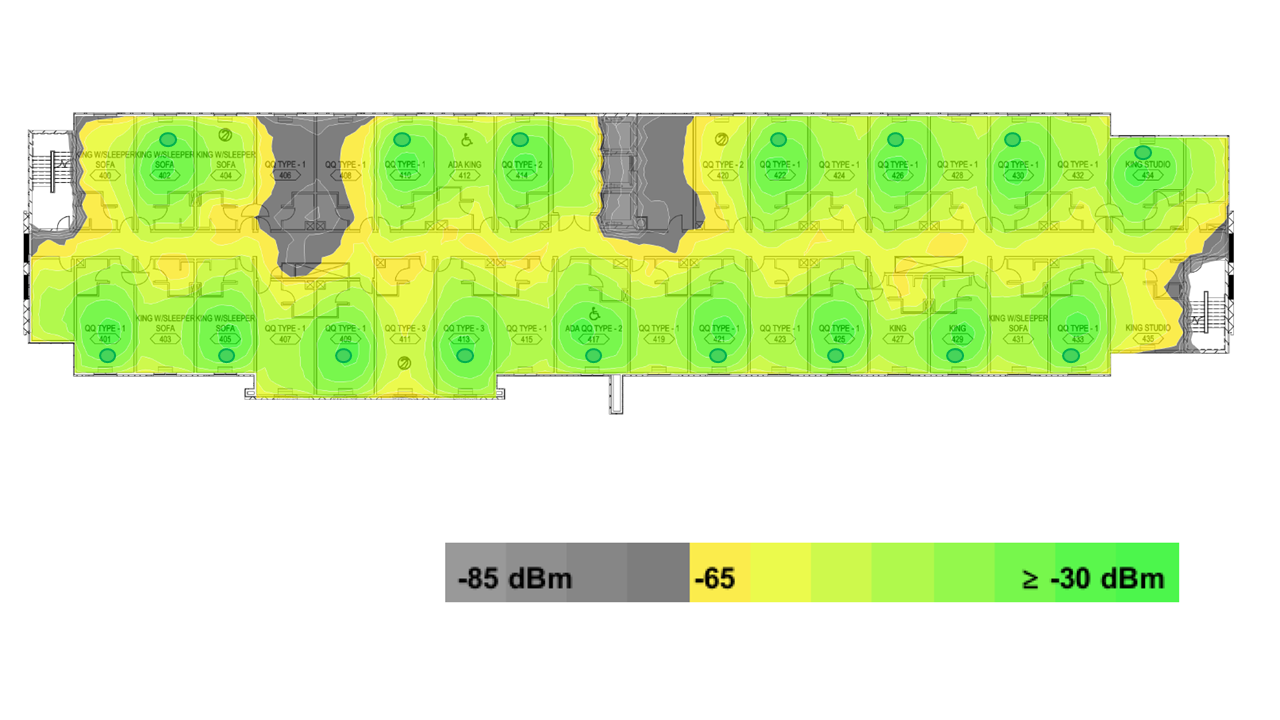
This scenario removes one AP from the drywall configuration.
Even with better signal travel, the room without an AP shows a noticeable drop in coverage. The signal also drops in part of an adjacent room.
Takeaway: Even in drywall construction, removing APs reduces reliability in affected rooms.
“Construction materials play a major role in Wi-Fi performance,” Patel says. “Drywall allows more signal movement, but placement still matters.”
The following examples reflect a larger, upscale or full-service hospitality property with more spacious guest rooms and concrete construction. These properties often include suites or expanded layouts that require more careful Wi-Fi planning.
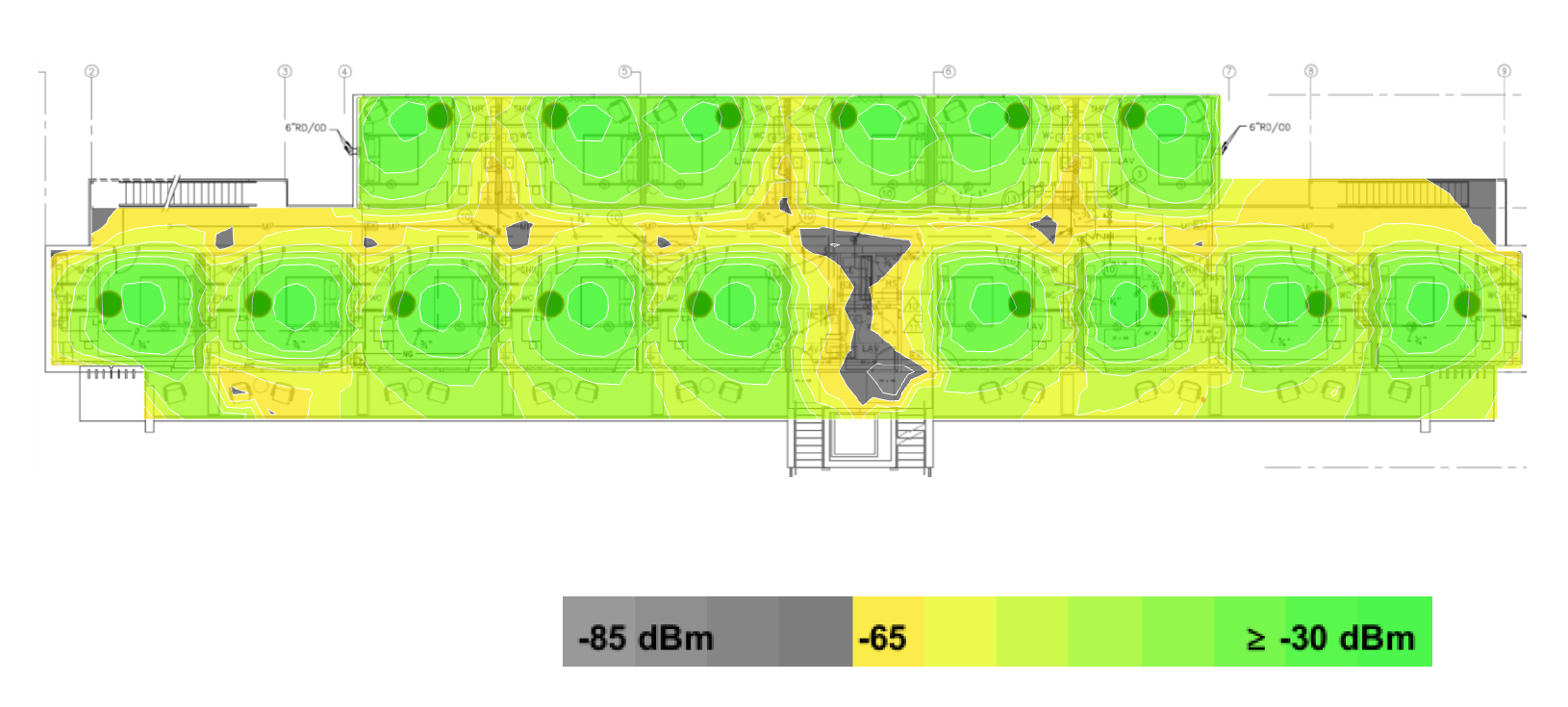
In this example, larger rooms use concrete construction with an AP in each room.
Coverage remains strong within each room, but the signal does not travel far beyond the walls.
This setup supports consistent performance despite larger spaces.
Takeaway: Larger rooms still benefit from dedicated APs, especially with dense construction.
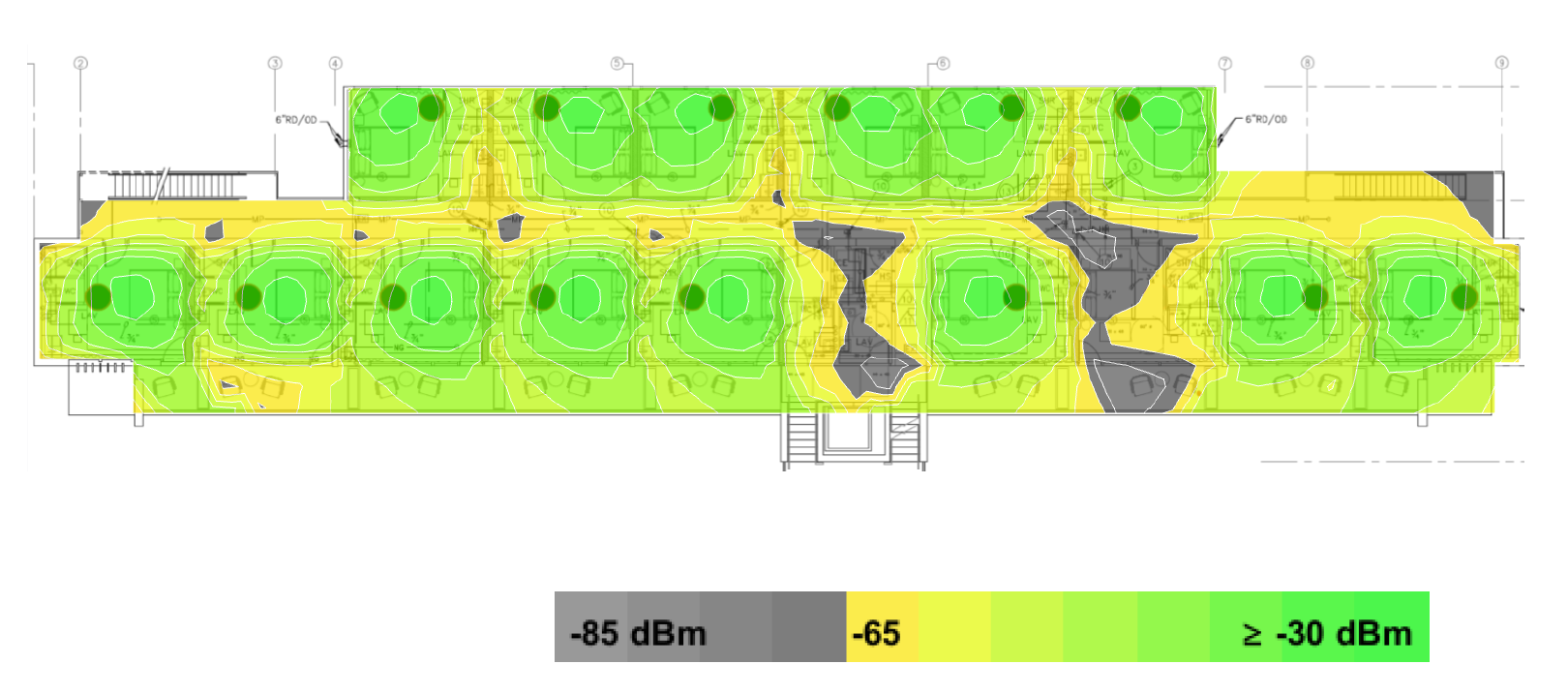
This heatmap removes one AP from the larger room configuration.
The affected room shows a clear dead spot. Concrete walls prevent nearby APs from filling the gap.
Removing even one AP can significantly reduce coverage in larger spaces.
Takeaway: Coverage gaps increase quickly in larger rooms when AP density drops.
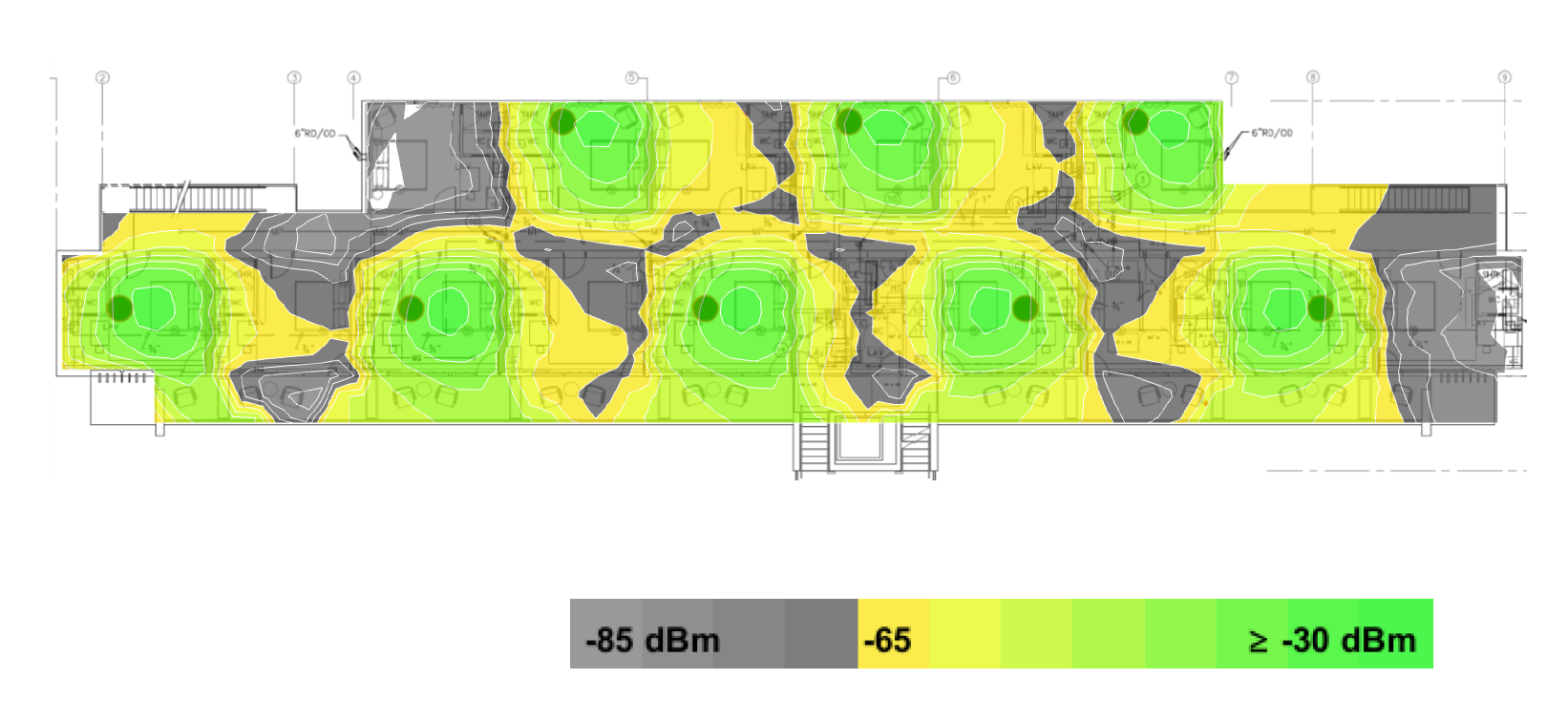
This scenario places APs in every other room in a large room, concrete-wall layout.
Coverage extends unevenly into adjacent rooms. Some areas show weak signals or inconsistent performance.
This approach may reduce hardware costs, but it can affect the guest experience.
Takeaway: Lower AP density can introduce inconsistent coverage, even if some signal reaches adjacent rooms.
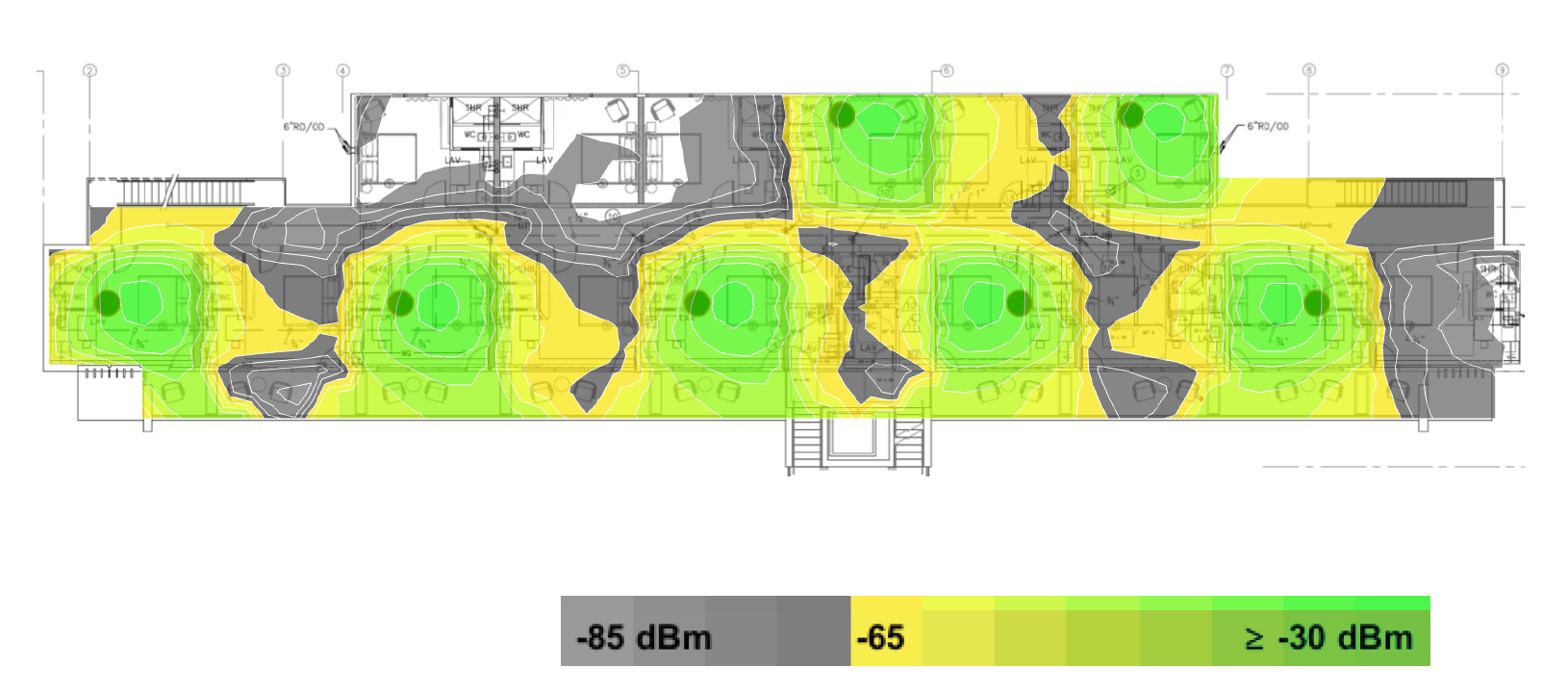
This final example removes an AP from the every-other-room configuration.
Coverage gaps become more pronounced. Several areas show weak or inconsistent signals. One whole section of this floor shows no signal at all.
These results highlight the risk of reducing AP density in larger rooms with concrete construction.
Takeaway: Cost-saving decisions on AP count can lead to widespread performance issues in larger properties.
These heatmaps highlight a key point: Wi-Fi performance depends on design decisions made early in the process.
Room layout, construction materials, and cabling availability all influence the outcome. There is no one-size-fits-all solution.
Working with an experienced technology partner like WorldVue helps ensure these factors are evaluated before installation begins. With five decades of experience, we can help you avoid stumbling blocks that waste time and money.
For additional guidance, properties can reference industry resources such as our AAHOA technology toolkit. You can also explore our guide to technology planning for new construction hotels.
These examples highlight several important principles for hospitality Wi-Fi design:
These factors directly impact guest satisfaction, especially as streaming and connected devices continue to increase.
“Guests are connecting more mobile devices than ever,” Patel says. “It’s not uncommon for a family to bring 10 devices into their guest room. That puts more demand on the Wi-Fi network and makes consistent coverage more important.”
These real-world examples reinforce the recommendations outlined in our earlier articles. They also demonstrate why access point placement, cabling design, and early planning matter.
Strong infrastructure planning supports better Wi-Fi performance and a more consistent and enjoyable guest experience.
Wi-Fi performance starts with the right design decisions. Learn how WorldVue helps hospitality properties plan and deploy wireless networks that support guest-facing technology.
Wi-Fi 6E, Wi-Fi 7, and What’s Next
Wireless connectivity for hotels now plays a central role in guest satisfaction, brand compliance, and daily operations. Guests expect fast, reliable Wi-Fi across rooms, public spaces, meeting venues, and outdoor areas. When networks fall short, reviews suffer and loyalty declines.
Many hotel networks were not built for today’s demands. Guests bring multiple devices and rely on streaming, video calls, and cloud apps. At the same time, hotels depend on Wi-Fi for mobile check-in, digital keys, staff tools, and IoT systems. These combined demands strain legacy infrastructure.
With the latest Wi-Fi standards, Wi-Fi 6E and Wi-Fi 7, hotels have a clear path forward. Wi-Fi 6E adds access to the 6 GHz band, reducing congestion and improving performance in dense environments. Wi-Fi 7 builds on that foundation with higher speeds, lower latency, and more efficient data handling. Together, these technologies deliver consistent performance where it matters most.
Hotel brands continue to raise expectations for wireless connectivity. Many now require or strongly recommend Wi-Fi 6E or Wi-Fi 7 in new builds and major renovations. When properties delay upgrades, they risk falling behind brand standards and guest expectations.
Upgrading Wi-Fi requires more than new access points. In addition to upgrading equipment, hotels must assess current performance, design networks by space, and ensure the wired backbone can support higher throughput. A structured approach helps avoid gaps and ensures long-term performance.
This white paper explains the benefits of Wi-Fi 6E and Wi-Fi 7 for hotels. It outlines brand expectations, upgrade considerations, and key planning steps. It also provides a brief look at Wi-Fi 8 to support long-term strategy. Hoteliers will gain practical insight to guide investment decisions and improve wireless connectivity across their properties.
Planning the Infrastructure That Powers the Modern Guest Experience
In this series, we address how hospitality properties can plan, deploy, and support technology that shapes the modern guest experience. In Part 1, we focus on the infrastructure that makes guest-facing technology possible. Part 2 will explore how WorldVue works with properties to design, install, and support these systems from start to finish.
Guests expect fast, reliable connectivity everywhere on a property. From streaming in the guest room to connecting devices in meeting spaces, technology now shapes the entire stay experience. But those guest-facing services only work well when teams correctly design the underlying infrastructure.
For hospitality properties, network planning should begin long before installation starts. Cabling pathways, network equipment rooms, and wireless access point placement all influence the performance of the final system. When engineering teams consider these elements early, properties can avoid unnecessary cost and disruption later.
Strong infrastructure also supports the broader ecosystem of guest-facing technology across the property. Connectivity enables streaming, casting, mobile services, and other digital experiences guests expect today.
Planning the network with these services in mind helps ensure the technology environment can grow as guest expectations evolve. As an experienced hospitality technology provider, WorldVue maintains a dedicated in-house engineering team. With this team, we can evaluate these requirements early and translate them into practical infrastructure plans.
A common challenge in hospitality projects arises when properties make technology decisions late in the construction or renovation process. By that point, building layouts and infrastructure pathways are already fixed.
Engaging a technology partner early enables hotel teams to evaluate floor plans, equipment locations, and cable pathways before finalizing construction decisions. This step can prevent inefficient design and reduce the need for expensive changes later.
“The earlier we’re involved in a project, the better the outcome for the property,” says Hitesh Patel, VP of Solution Architecture at WorldVue. “If technology planning happens after properties have already locked in construction decisions, it often leads to compromises or added cost that we could have avoided.”
Early collaboration also allows teams to plan for future technology demands rather than designing solely for current needs. Our in-house engineering team can help review architectural plans and anticipated needs. Thus, properties can align infrastructure decisions with both brand requirements and the property’s long-term technology roadmap.
A strong hospitality network begins with the physical infrastructure that supports it. That includes structured cabling, main equipment rooms, and intermediate telecom closets throughout the property.
The location of these rooms matters. Network cabling has distance limits, so poorly placed closets may require additional equipment rooms and extra fiber connections.
“Sometimes a small change in where the main telecom room sits can eliminate the need for multiple additional closets,” Patel explains. “That can save both equipment cost and installation complexity.”
Careful planning also ensures there are clear pathways for cabling between floors and across the property. Elevators, utility spaces, and other vertical pathways often play an important role in efficient network design.
Planning these pathways during construction is far easier than retrofitting them later. Guidance, such as that outlined in WorldVue’s hotel technology planning guide, can help hoteliers avoid common design challenges.

Technology infrastructure in hospitality must also align with brand standards. Many major hotel brands specify approved vendors for network hardware such as access points, switches, and other core components. These standards help ensure consistent performance and security across properties.
When brands define required equipment, those standards guide the technology design from the start. For midscale brands and independent properties, owners may have more flexibility in equipment selection.
In those environments, experienced engineering teams can evaluate the building layout, expected guest usage, and operational needs to recommend equipment from leading technology vendors. The goal is always to deliver reliable performance while meeting the property’s specific requirements.
WorldVue works with a wide ecosystem of technology partners. This helps ensure each property receives equipment suited to its needs.
Wireless connectivity depends heavily on the placement of access points. The goal is not simply to install more devices. Instead, teams must design the network to deliver strong, consistent coverage throughout guest rooms and common areas.
Construction materials can make a major difference. Signals travel more easily through drywall than through concrete or other dense materials. In some buildings, corridor access points may provide sufficient coverage. In other cases, installers may need to place access points in individual guest rooms to ensure reliable connectivity.
“Every building is different,” Patel notes. “Sometimes you can place access points in the hallway. In other situations, especially when construction materials block signals, the best option is to place them inside the rooms.” He offers an example in which the wiring is in the hallway’s drop ceiling, with APs above the doors in each room.
Engineering teams must balance signal strength with practical considerations such as cabling availability and installation complexity. The right approach depends on each property’s structure.
Every hospitality property presents its own design challenges. Some buildings have multiple towers or large campuses. Others may be historic structures with limited traditional cabling pathways.
In these situations, infrastructure design often requires creative solutions. Technology teams may need to identify alternative pathways, surface-mounted cabling, or specialized equipment. During the design process, our in-house team considers both operational and aesthetic requirements.
“We’ve worked with properties where you simply cannot run traditional cabling behind walls,” Patel says. “In those cases, the design has to adapt to the building while still delivering the performance guests expect.”
With the right planning, even complex environments can support high-performance connectivity. This applies to everything from a 100-room midscale hotel to a multi-building luxury resort.
Connectivity is the foundation for many of the technologies hotel guests interact with during their stay. Streaming entertainment, casting, property apps, and other digital amenities all depend on a reliable network.
That is why hoteliers should view network infrastructure planning as a strategic decision rather than a simple installation project. When designed correctly, the network becomes the backbone that supports the entire guest technology environment across the property.
Working with a technology partner that understands the full guest technology ecosystem can also simplify planning. Coordinating multiple vendors for different systems can be difficult and costly. Instead, properties can work with a single partner that designs infrastructure with every guest-facing technology in mind. This makes it easier to align network planning with streaming, casting, and other guest services from the beginning.
Infrastructure planning is only the first step in building a strong technology environment for hospitality properties.
In Part 2 of this series, we will explore how WorldVue works with hospitality properties as a consultative partner. We will look at the company’s in-house engineering team and its approach to technology design and deployment. We’ll also address how our team supports guest-facing technology across many hotel brands and property types.
Early technology planning helps hospitality properties avoid costly redesigns while delivering the connectivity guests expect. Learn how WorldVue supports hotels with infrastructure planning and guest-facing technology solutions.
Peak occupancy drives revenue. It can also expose weaknesses in your network.
When Wi-Fi performance drops during sold-out nights, the impact goes beyond speed tests. It affects the guest experience, online reviews, brand perception, and the likelihood of repeat stays.
When every room is booked, hundreds of devices compete for bandwidth. Guests stream video, join virtual meetings, scroll social media, and upload content at the same time.
If your infrastructure is not designed for those spikes, performance drops quickly. Slow speeds and buffering soon turn into front desk complaints.
Technology-driven amenities continue to shape guest satisfaction. A 2025 Hotel Dive report found that technology-related amenities influence how guests evaluate their stay. When connectivity supporting those amenities underperforms, the overall perception of the property can decline.
Bandwidth management during peak occupancy is about control, not just capacity.
Adding more internet speed alone will not solve the problem. You need intelligent distribution backed by proactive oversight.
Device counts per room continue to rise. Many travelers connect three to five devices during a stay. In fact, it’s not uncommon to find double that number of devices in a room. Smartphones, laptops, tablets, and streaming devices all draw from the same shared pool of bandwidth.
At full occupancy, even a well-designed network can become strained if traffic is unmanaged. A few heavy users streaming high-definition content can consume significant bandwidth. Multiply that across multiple rooms, and congestion builds fast.
The problem is rarely just due to the size of your internet pipe. The issue is how the network shares that bandwidth across users, networked devices, and applications.
A strong bandwidth strategy combines intelligent traffic control with expert network oversight. Hotels that rely on unmanaged or lightly supported systems often struggle during peak occupancy because no one is actively optimizing performance.
A managed network goes beyond installing access points and increasing internet speed. It includes specialized design, continuous monitoring, performance tuning, and dedicated support.
With a hospitality-focused managed network:
This level of oversight is especially important at peak occupancy, when device counts surge and usage patterns change quickly.
Interested in a deeper look at how managed network services compare to do-it-yourself IT models? Take a look at WorldVue’s analysis of the hidden operational and financial costs many hotels overlook.
Traffic shaping is a core component of smart bandwidth management. It prioritizes essential traffic and distributes bandwidth evenly across users and devices. This approach allows properties to:
Guests still enjoy strong performance for everyday use. At the same time, the network prevents a small number of users from overwhelming shared capacity.
This becomes especially important in hotels with meeting space. Conferences and group events can create sudden surges in demand. Without shaping policies, those spikes can affect the entire property.

Reactive troubleshooting is costly and disruptive. By the time guests report slow Wi-Fi, the experience has already suffered.
Managed Wi-Fi environments rely on proactive network monitoring tools. These tools track throughput, device density, latency, and performance trends across access points in real time. When the system detects strain, adjustments can happen automatically.
The right managed Wi-Fi solution can rebalance bandwidth allocations when needed. It can limit non-essential traffic, preventing individual users from overwhelming the network. Technical teams can receive alerts before congestion becomes visible to guests.
In this way, proactive network monitoring protects the guest experience by resolving issues before they turn into complaints. This approach protects satisfaction scores and reduces operational stress on staff.
Traffic shaping is not a substitute for proper capacity planning.
Properties should size their internet service based on realistic peak conditions, not average occupancy. Planning should account for:
If your hotel regularly reaches 90-100% occupancy, you should treat that level as standard operating conditions.
Modern Wi-Fi standards improve performance in high-density environments. However, successful performance at scale requires thoughtful design, segmentation, and continuous oversight.
WorldVue addresses this through our approach to network modernization and managed services. We focus on density planning and proactive monitoring to support peak demand scenarios.
Hardware alone cannot solve congestion. Without policy controls and continuous oversight, even advanced access points can become overloaded. Our team incorporates these aspects into your customized network design.
If you notice performance issues primarily during high occupancy, distribution is likely the root cause.
Common warning signs include:
These patterns suggest the need for smarter bandwidth control rather than simply more speed.
Reliable connectivity is no longer a premium amenity. Guests view it as essential infrastructure, and it plays a central role in shaping the overall guest experience.
When performance remains stable at full occupancy:
A managed network with traffic shaping and proactive monitoring ensures bandwidth is distributed fairly. It keeps guests online even at peak occupancy. Real-time adjustments prevent congestion before it affects the stay.
Peak nights should strengthen your reputation, not put it at risk.
If your property experiences slowdowns during high occupancy, it may be time to reassess how you monitor and manage bandwidth. Explore how WorldVue supports high-density hospitality environments through managed connectivity services.
WorldVue designs and supports hospitality networks built for high-density environments. Connect with our team to evaluate your current infrastructure and prepare for your next sold-out weekend with confidence. Outside the US, contact our international team.
HOUSTON, TX – February 17, 2026: WorldVue today announced its new affiliation with Preferred Hotels & Resorts as the latest addition to the brand’s Alliance Partner Program. This partnership solidifies WorldVue’s position as a recommended provider of in-room entertainment and WiFi for Preferred Hotels & Resorts member properties across the globe.
Preferred Hotels & Resorts is renowned for its dedication to offering guests authentic, one-of-a-kind experiences across its global portfolio of independent hotels and resorts. By aligning with WorldVue, Preferred Hotels & Resorts further solidifies its mission to provide best-in-class services and resources to its member properties.
“Independent luxury properties deserve technology that supports their vision without compromising their identity. At WorldVue, we approach every partnership with long-term stewardship in mind, ensuring the infrastructure behind the experience is as exceptional as the experience itself. Joining Preferred Hotels & Resorts lets us build on this approach to ensure every property has technology stability and a partner to fully rely on,” said Robert Grosz, President and Chief Operating Officer at WorldVue.
For over five decades, WorldVue has partnered with independent hotels and resorts to create tailored infrastructure ecosystems that blend performance, discretion, and long-term reliability. The company understands the operational complexity behind refined guest experiences and builds every technology ecosystem custom to the property, their landscape, guest expectations and their goals. WorldVue’s role is to ensure the foundation remains uninterrupted, collaborating directly with ownership groups, asset managers, and property leadership to ensure alignment from implementation through long-term optimization.
Representing more than 625 luxury hotels, resorts, residences, and unique hotel groups in over 80 countries, Preferred Hotels & Resorts brings strategic advantage to hotel owners, operators, and management companies through brand prestige and global operating scale, supporting the goals of its member hotels by providing strategic sales, integrated marketing solutions, comprehensive revenue management, global connectivity through reservations services, progressive distribution technology, and solutions-focused products and services from trusted partners through its Alliance Partner Program.
For more information about WorldVue and its offerings, please visit www.worldvue.com.
For more information on Preferred Hotels & Resorts Alliance Partner Program, visit Preferredhotels.com/Alliance-Partner.
###
About WorldVue
WorldVue® is a trusted provider of video, advanced connectivity and professional services to properties and enterprises across the world. With a dedication to customer service, WorldVue is leading the way in delivering innovative technology solutions that enhance the resident, guest, and staff experience. From managed services to digital transformation, WorldVue is a single point of contact for all property technology needs.
Founded in 1975, WorldVue is a privately held company headquartered in the United States with offices in Canada, Mexico, United Kingdom, Netherlands, Dubai, Singapore and Australia. The company serves over 8,000 properties and over 1 million rooms.