
We’re a long way from simple greasepaint and limelights. In today’s world of live entertainment, precision is everything. A spotlight that arrives a fraction too late, a sound cue that doesn’t quite match the performer’s position or a camera angle that misses the emotional beat can pull audiences out of an otherwise magical experience. For Vienna-based zactrack, the mission is simple but ambitious. Make those distractions disappear.
Powered by Ultra-Wideband technology from Qorvo, zactrack enables real-time performer tracking through wearable trackers that capture highly precise positional data on stage. This data is calculated and seamlessly transmitted to lighting, audio, video and camera systems, transforming how they work together in real time. The result is seamless, immersive performances that feel effortless to audiences and empowering to creative teams.
“We are now coming from the entertainment industry,” said Chief Technical Officer Christoph Rosenberg. “The core of zactrack has always been processing data. You’re getting some data input, you process it and you control different protocols or fixtures.”
That “core math,” as Rosenberg describes it, is the brain of the system. It predicts motion, calculates positioning and distributes precise tracking data across lighting consoles, audio systems, media servers and cameras. Early systems relied on complex fiber-based solutions. Over time, zactrack embraced Ultra-Wideband as the ideal input technology for real-time performer tracking.
Today, zactrack builds its own Ultra-Wideband hardware using Qorvo DWM modules, combining accurate positioning with low latency and high reliability. The tracking data feeds directly into Zactrack’s software engine, enabling automated control across an entire production.
The technology has evolved far beyond its original purpose. What began primarily as a lighting tool is now a creative and strategic platform used across multiple disciplines.
zactrack Marketing Manager Yvonne Bolhar-Nordenkampf has seen firsthand how the technology brings people together.
“At the very beginning, people implemented it as a technical solution,” she explained. “They had an issue, and it solved that issue. But then it became so much more.”
On London’s West End alone, zactrack systems are currently used in more than 10 productions. Designers who initially adopted the system for automated follow-spot functionality are now leveraging it for immersive audio and media effects, all synchronized to performer movement.
Traditionally, lighting, audio and video departments worked in parallel but rarely in close collaboration. Tracking data is changing that dynamic. With a single, reliable source of positional information, multiple departments can build from the same creative foundation.
“It has become a creative tool, but also a connective tool,” Bolhar-Nordenkampf said. “Hardware and software that were just technical systems are now connecting people in productions.”
That sense of community extends beyond the stage, as zactrack has expanded its online presence by launching a dedicated Discord channel and sharing designer interviews on Instagram, creating spaces where users can connect, exchange ideas and learn from one another. By encouraging long-time users to share their expertise with newcomers, these platforms foster collaboration, knowledge-sharing and a global network of designers and technicians united by shared creative experiences.
For audiences, the impact is immediate and emotional.
Rosenberg describes a simple example: in a traditional theater setup, when a performer walks across the stage, their voice still appears to come from the front. With Ultra-Wideband-based tracking, immersive audio systems can shift the sound in real time to match the performer’s position. Even with eyes closed, the audience senses exactly where the actor stands.
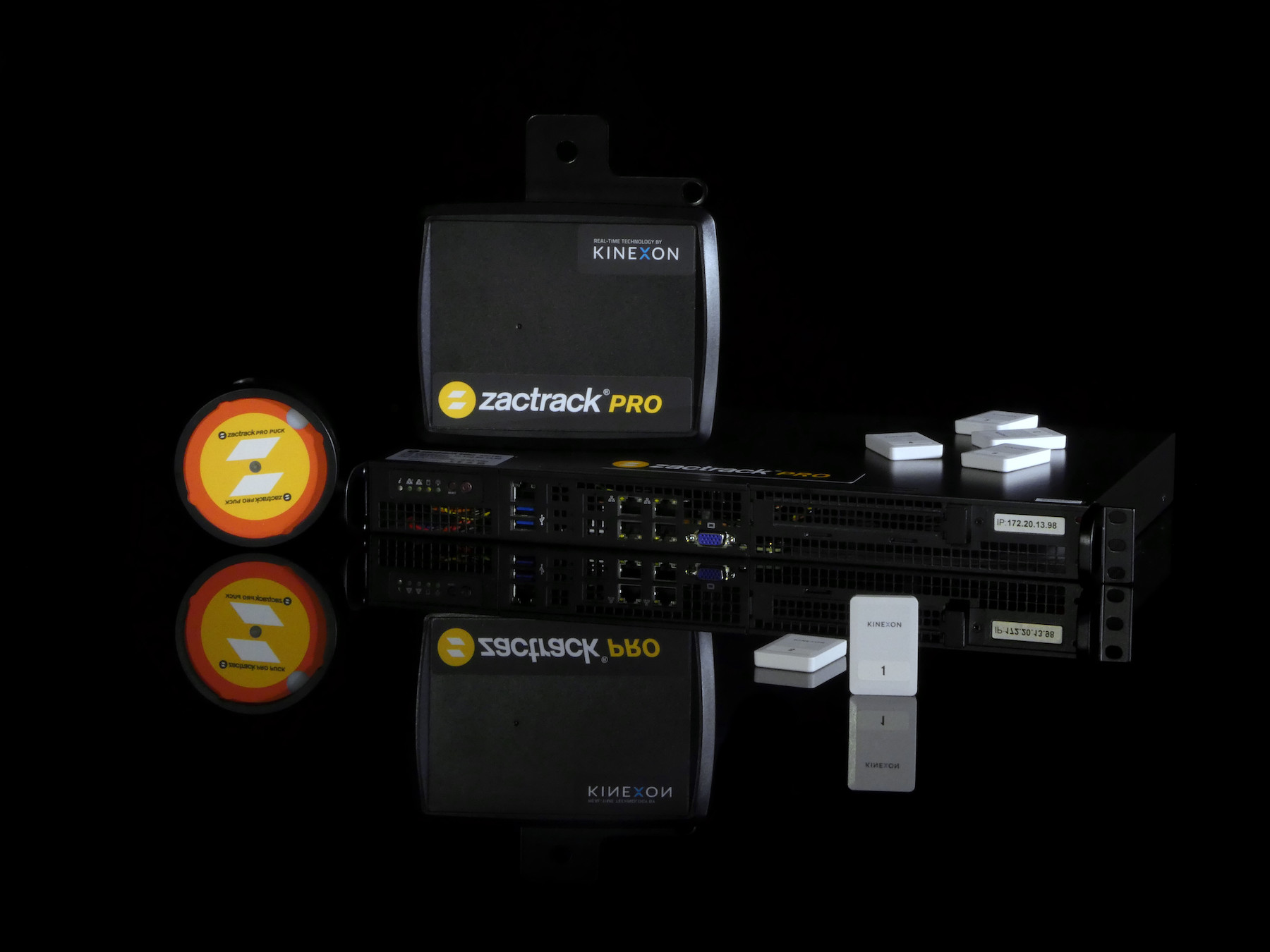
zactrack PRO is an automated follow-system to fulfill all requirements for big projects. People and objects in motion are tracked with high accuracy and represented in a 3D model. High-precision mathematics automatically control moving lights, video and sound devices.
Lighting has undergone a similar evolution. Instead of a single static white follow-spot, any moving head fixture in the rig can dynamically track a performer from multiple angles, eliminating harsh shadows and opening new creative possibilities.
“You are not limited anymore to fixed positions,” Rosenberg said. “When people get these ideas, they start to think more creatively.”
That creativity was on full display at the world premiere of “House of Dancing Water” by Dragone in Macau, one of the world’s most technically ambitious productions. Sitting in the audience after months of development, Rosenberg felt the emotional payoff.
“When you put so much effort and work into a project and then feel how smoothly it goes. Without this technology, the production wouldn’t work. That feeling is really special,” he said.
Now celebrating its 17-year anniversary, zactrack operates in more than 30 countries and is trusted by global brands and productions, from Maria Theresia – Das Musical in Vienna over The Hunger Games: On Stage in London to AVATAR’s In the Airwaves World Tour.
Behind the spectacle is a powerful partnership built on precision positioning. As productions demand greater accuracy, new frequencies and ever-higher reliability, Ultra-Wideband technology continues to unlock new creative frontiers.
“We’re always looking into new technologies to move forward,” Rosenberg said. “And we hope Qorvo is the right brand to go into the future with us; with new ideas, new frequencies, new accuracy.”
For performers, designers and audiences alike, that future looks brilliantly in sync.
Want the backstories about RF technology? Explore our blog.
Ready to look under the hood? Discover our robust library of technical articles.
Like many science fiction fans, I’ve been intrigued by the buzz surrounding Steven Spielberg’s film Disclosure Day, based on one of humanity’s favorite topics: what happens when intelligent life from another world finally makes contact.
Hollywood has generally assumed that aliens would be impressed by our accomplishments. We certainly seem to think they should be. After all, we’ve built artificial intelligence, reusable rockets, quantum computers and social media platforms capable of turning complete strangers into experts on virtually any subject.
But if an advanced civilization has been monitoring Earth for decades, I suspect their conclusions might be very different.
Imagine a team of extraterrestrial scientists arriving after years of studying our television and radio broadcasts, satellite transmissions, cellular networks and Wi-Fi signals. Before meeting world leaders, they compile a report on the most remarkable technologies they have observed.
Artificial intelligence receives favorable marks. Reusable rockets are viewed as an encouraging development. Quantum computing is classified as promising, though admittedly still a work in progress.
The report notes that humanity’s greatest achievements appear to include the moon landing, modern wireless communications and the spork. The researchers remain uncertain which required the larger breakthrough.
Then the scientists examine a modern smartphone.
The report reportedly expands from twelve pages to nearly six hundred. One researcher is said to have remarked that humans appear to carry a laboratory-grade RF system in their pockets primarily to exchange emojis.
The visitors become fascinated by the realization that humans routinely carry devices containing multiple radios, dozens of frequency bands and an astonishing collection of filters, amplifiers, switches, tuners and antennas. More remarkably, the devices function while moving through buildings, vehicles, stadiums, airports and countless other environments seemingly designed to make wireless communication difficult.
Particularly baffling is humanity’s reliance on acoustic wave filtering. According to the alien report, humans somehow discovered that one of the best ways to manage increasingly crowded radio spectrum was to create microscopic acoustic waves inside handheld devices. The visitors struggle to understand why a species capable of creating microscopic acoustic resonators by the billions still cannot agree on a universal charging connector.
The section on envelope tracking is equally perplexing. The visitors note with admiration that humans dynamically adjust power supply voltages in real time to improve transmitter efficiency and extend battery life. Unfortunately, their analysis also concludes that a meaningful percentage of these energy savings are ultimately devoted to watching cat videos.
A separate chapter addresses antenna tuning. The scientists appear genuinely impressed that humans deliberately place antennas near batteries, cameras, displays, metal enclosures and human hands, then invent sophisticated tuning systems to compensate for the resulting performance challenges. The report describes this as “an unnecessarily complicated but undeniably creative engineering strategy.”
Things become truly confusing when the visitors encounter millimeter-wave technology and spectrum sharing. The concept of using frequencies that struggle to penetrate walls while simultaneously coordinating access among countless users appears to generate considerable debate among the alien researchers.
Several pages are devoted to understanding FCC spectrum allocation rules. One appendix concludes that humanity invented interplanetary communication because it was easier than reorganizing spectrum allocations.
In fact, the report’s most surprising conclusion is that interstellar travel appears easier to explain than terrestrial spectrum management. Another appendix notes that the visitors successfully mapped multiple dimensions of spacetime before fully understanding a spectrum allocation chart.
Yet beneath the humor lies an important observation. The technologies that most impress the visitors are largely invisible to the people who use them every day. Even those of us who work in the industry aren’t immune. At Qorvo, we spend our days solving extraordinarily complex RF and power challenges. Then we go home and ask ChatGPT why unplugging the Wi-Fi router and plugging it back in again still fixes so many problems.
When a video streams flawlessly, a call connects instantly or a message arrives without delay, few people think about acoustic filters, envelope tracking, antenna tuning, beamforming or spectrum sharing. They simply expect the connection to work.
Perhaps that’s why our hypothetical visitors find wireless technology so remarkable. Not because any individual breakthrough is extraordinary, although many certainly are. It’s because millions of engineering decisions, innovations and compromises operate together so seamlessly that the entire system feels effortless.
If extraterrestrials ever do arrive, they may come expecting to study artificial intelligence, quantum computing or rocket science.
Instead, I suspect they’ll spend much of their time reading Microwave Journal and wondering how humanity managed to make RF look so easy.
IRVINE, Calif. and GREENSBORO, N.C., JULY 28, 2026 — Skyworks Solutions, Inc. (Nasdaq: SWKS) and Qorvo, Inc. (Nasdaq: QRVO) today announced the expected executive leadership team for the combined company, effective upon the successful completion of the pending transaction.
“Our expected leadership team unites deep industry expertise, proven operating experience and a shared commitment to helping customers solve their most complex challenges,” said Phil Brace, president and chief executive officer of Skyworks, who will serve as chief executive officer of the combined company. “Identifying this team is an important step in preparing us to move with clarity and conviction after close. This group will play a critical role in bringing together the strengths of both organizations, supporting a smooth transition and positioning our combined company to realize the tremendous opportunities ahead.”
The following executives are expected to report to Mr. Brace as of the closing:
Bob Bruggeworth, president and chief executive officer of Qorvo, who is expected to join the board of directors of the combined company post-close, added, “Today’s announcement reflects the strong partnership that has shaped our integration planning efforts from the very beginning. I am confident these leaders will help foster collaboration across our teams as we build on the engineering excellence, innovation, and customer focus that have long distinguished both organizations.”
About Skyworks
Skyworks Solutions, Inc. is empowering the wireless networking revolution. We are a leading developer, manufacturer and provider of analog and mixed-signal semiconductors and solutions for numerous applications, including aerospace, automotive, broadband, cellular infrastructure, connected home, defense, entertainment and gaming, industrial, medical, smartphone, tablet and wearables.
Skyworks is a global company with engineering, marketing, operations, sales and support facilities located throughout Asia, Europe and North America and is a member of the S&P 500® market index (Nasdaq: SWKS). For more information, please visit Skyworks’ website at: www.skyworksinc.com.
About Qorvo
Qorvo (Nasdaq: QRVO) supplies innovative semiconductor solutions that make a better world possible. We combine product and technology leadership, systems-level expertise and global manufacturing scale to quickly solve our customers’ most complex technical challenges. Qorvo serves diverse high-growth segments of large global markets, including automotive, consumer, defense & aerospace, industrial & enterprise, infrastructure and mobile. Visit www.qorvo.com to learn how our diverse and innovative team is helping connect, protect and power our planet.
Qorvo is a registered trademark of Qorvo, Inc. in the U.S. and in other countries. All other trademarks are the property of their respective owners.
Important Information About the Proposed Transaction and Where to Find It
In connection with the mergers, Skyworks has filed with the SEC a registration statement on Form S-4 (File No. 333-291947) (the “Registration Statement”), which includes a prospectus with respect to the shares of Skyworks’ common stock to be issued in the mergers and a joint proxy statement for Skyworks’ and Qorvo’s respective stockholders (the “Joint Proxy Statement/Prospectus”). The Registration Statement was declared effective on December 23, 2025, and Skyworks filed a final prospectus on December 23, 2025, and Qorvo filed a definitive proxy statement on December 23, 2025. The Joint Proxy Statement/Prospectus was mailed to stockholders of Skyworks and Qorvo on or about December 23, 2025. Each of Skyworks and Qorvo may also file with or furnish to the SEC other relevant documents regarding the mergers. This communication is not a substitute for the Registration Statement, the Joint Proxy Statement/Prospectus or any other document that Skyworks or Qorvo may mail to their respective stockholders in connection with the mergers.
INVESTORS AND SECURITY HOLDERS OF SKYWORKS AND QORVO ARE URGED TO READ THE REGISTRATION STATEMENT AND THE JOINT PROXY STATEMENT/PROSPECTUS INCLUDED WITHIN THE REGISTRATION STATEMENT, AS WELL AS ANY OTHER RELEVANT DOCUMENTS FILED WITH THE SEC IN CONNECTION WITH THE MERGERS OR INCORPORATED BY REFERENCE INTO THE REGISTRATION STATEMENT AND THE JOINT PROXY STATEMENT/PROSPECTUS (INCLUDING ANY AMENDMENTS OR SUPPLEMENTS THERETO), BECAUSE THEY WILL CONTAIN IMPORTANT INFORMATION REGARDING SKYWORKS, QORVO, THE MERGERS AND RELATED MATTERS.
The documents filed by Skyworks with the SEC also may be obtained free of charge at Skyworks’ website at https://www.skyworksinc.com/investors or upon written request to Skyworks at [email protected]. The documents filed by Qorvo with the SEC also may be obtained free of charge at Qorvo’s website at https://ir.qorvo.com/ or upon written request to Qorvo at [email protected]. These documents filed with the SEC are also available for free to the public at the website maintained by the SEC at www.sec.gov.
No Offer or Solicitation
This communication is for informational purposes only and does not constitute, or form a part of, an offer to sell or the solicitation of an offer to buy any securities or a solicitation of any vote or approval, nor shall there be any sale of securities in any jurisdiction in which such offer, solicitation or sale would be unlawful prior to registration or qualification under the securities laws of any such jurisdiction. No offer of securities shall be made except by means of a prospectus meeting the requirements of Section 10 of the Securities Act of 1933, as amended, and otherwise in accordance with applicable law.
GREENSBORO, NC – July 13, 2026 – Qorvo® (Nasdaq:QRVO), a leading global provider of connectivity and power solutions, today announced it has been recognized by Northrop Grumman Corporation with a 2026 Supplier Excellence Award for Strategic Excellence.
Northrop Grumman acknowledged Qorvo for Strategic Excellence, underscoring the vital role suppliers play in delivering next-generation capabilities across defense systems, including aircraft, missile defense and space platforms.
“Northrop Grumman has a legacy of fostering strong partnerships, a network of hardworking innovators and collaborators striving toward a mutual goal of protecting the United States and its allies,” said Ken Brown, vice president and chief supply chain officer, Northrop Grumman. “From putting the first humans on the moon to introducing stealth technology that revolutionized defense, Northrop Grumman and our partners have continually pushed the boundaries of what is possible.”
“This recognition reflects the strength of our strategic partnership with Northrop Grumman and our shared commitment to advancing next-generation defense technologies,” said Philip Chesley, president of Qorvo’s High Performance Analog business. “We are proud to support mission-critical applications with high-performance RF solutions that help enable global security.”
Qorvo’s contributions include delivering high-performance RF solutions and services supporting mission-critical applications across radar, communications and electronic warfare systems, helping enable advanced capabilities that strengthen the defense industrial base.
Northrop Grumman’s Supplier Excellence Awards highlight the critical role suppliers play in supporting more than 100,000 jobs and generating significant economic impact across the United States.
About Qorvo
Qorvo (Nasdaq: QRVO) supplies innovative semiconductor solutions that make a better world possible. We combine product and technology leadership, systems-level expertise and global manufacturing scale to quickly solve our customers’ most complex technical challenges. Qorvo serves diverse high-growth segments of large global markets, including automotive, consumer, defense & aerospace, industrial & enterprise, infrastructure and mobile. Visit www.qorvo.com to learn how our diverse and innovative team is helping connect, protect and power our planet.
GREENSBORO, NC – June 16, 2026 – Qorvo® (Nasdaq:QRVO), a leading global provider of connectivity and power solutions, today announced it has received the Diamond Award from Chervon Group at Chervon’s 2026 Global Supplier Day. The Diamond Award is Chervon’s highest level of supplier recognition, reserved for partners who demonstrate sustained excellence in quality, innovation, delivery and strategic collaboration. The award recognizes Qorvo’s multi-year performance from 2023 through 2026.
Charles Wong, Qorvo vice president of APAC Sales, accepted the award on behalf of Qorvo at the Supplier Day ceremony.
“It was a tremendous honor to accept the Diamond Award on behalf of our team,” said Charles Wong. “This recognition is a credit to our sales, applications and operations teams who work alongside Chervon every day.”
Chervon is a leading global designer and manufacturer of handheld power tools, bench tools and outdoor power equipment, with a portfolio of brands that includes EGO®, FLEX®, DEVON® and SKIL®. The company’s Supplier Day brings together its top global partners to recognize outstanding contributions in support of Chervon’s mission: “Better Tools. Better World.”
Qorvo’s Power Application Controller (PAC™) motor control and battery management solutions (BMS) power Chervon’s industry-leading portfolio. Qorvo power solutions support the platforms which have made Chervon a global leader in cordless power tools and outdoor power equipment.
“We are honored to earn Chervon’s Diamond Award,” said Jeff Strang, general manager of Qorvo Power Management. “This recognition reflects the deep collaboration between our engineering teams, and our shared commitment to delivering best-in-class motor control, BMS and power solutions. We look forward to continuing to support Chervon as they bring next-generation cordless tools and outdoor power equipment to customers around the world.”
“Qorvo has been a trusted technology partner to Chervon, and their continued investment in motor control, BMS and advanced power solutions have been instrumental to our success” said Jianjun Run, GM Chervon Group. “The Diamond Award reflects Qorvo’s outstanding performance across quality, innovation and partnership, and we look forward to continuing to build the next generation of better tools together.”
Qorvo and Chervon have teamed for nearly a decade on motor control and battery management solutions across Chervon’s portfolio. The Diamond Award underscores this long-standing strategic partnership.
About Qorvo
Qorvo (Nasdaq: QRVO) supplies innovative semiconductor solutions that make a better world possible. We combine product and technology leadership, systems-level expertise and global manufacturing scale to quickly solve our customers’ most complex technical challenges. Qorvo serves diverse high-growth segments of large global markets, including automotive, consumer, defense & aerospace, industrial & enterprise, infrastructure and mobile. Visit www.qorvo.com to learn how our diverse and innovative team is helping connect, protect and power our planet.
GREENSBORO, N.C., May 18, 2026 – Qorvo® (Nasdaq: QRVO), a leading global provider of connectivity and power solutions, today announced a major step forward in making Ultra-Wideband (UWB) real-time location systems (RTLS) deployable at enterprise scale. By combining industry standards including FiRa and Omlox with integration into Wi-Fi enterprise access points (EAPs), Qorvo enables precise, real-time location services without the need for dedicated RTLS infrastructure.
Qorvo addresses key barriers to RTLS adoption, including fragmented systems and the cost and complexity of dedicated anchor networks. By embedding UWB into enterprise Wi-Fi infrastructure, Qorvo enables location services to scale using existing access points and workflows. With over a decade of UWB innovation, the company provides a proven RTLS foundation deployed across healthcare, mining, logistics and automotive manufacturing environments.
“Real-time location has long been limited by infrastructure cost and lack of interoperability,” said Alexis Bizalion, Director of Product Marketing & Enablement at Qorvo. “By bringing standards-based UWB into enterprise Wi-Fi access points, we’re making real-time location a native capability of the network. We’re excited to enable OEMs, system integrators and solution providers to build and deploy RTLS solutions with greater flexibility, lower cost and reduced integration risk.”
A key differentiator is Qorvo’s collaboration with leading enterprise Wi-Fi providers to integrate UWB into access points, transforming Wi-Fi infrastructure into a dual-purpose platform for both connectivity and location services while reducing deployment cost and time to market. The company has achieved multiple industry-first UWB milestones, including:
At the core of this ecosystem is Qorvo’s new QPK3000 module, designed for tags and end devices. It enables interoperable UWB functionality across EAPs, dedicated anchors and other UWB-enabled infrastructure, simplifying development while ensuring compatibility across FiRa- and Omlox-based systems.
Qorvo recently showcased the QPK3000 and its RTLS ecosystem approach at the Wi-Fi NOW UWB Global Summit in Mountain View, CA, highlighting how standards-based UWB is enabling scalable, interoperable RTLS deployments. For more information on UWB RTLS, visit Qorvo’s Real-Time Location Systems (RTLS) page.
About Qorvo
Qorvo (Nasdaq: QRVO) supplies innovative semiconductor solutions that make a better world possible. We combine product and technology leadership, systems-level expertise and global manufacturing scale to quickly solve our customers’ most complex technical challenges. Qorvo serves diverse high-growth segments of large global markets, including automotive, consumer, defense & aerospace, industrial & enterprise, infrastructure and mobile. Visit www.qorvo.com to learn how our diverse and innovative team is helping connect, protect and power our planet.
The core mission of electronic warfare (EW) hasn’t changed: control the all communications so your forces can operate, and your adversary cannot. What has changed is everything around it. Today’s EW systems operate across airborne, naval and ground platforms that are increasingly built around multifunction RF architectures, where radar, sensing and electronic support capabilities are integrated into a single system.
In addition, performance expectations continue to rise. As threats appear without warning and signals shift instantly, response time is no longer measured in seconds, but in microseconds. Systems must continuously sense, interpret and respond across the entire RF spectrum.
EW environments now require wide instantaneous bandwidth, high output power and stable operation under extreme conditions. Publicly acknowledged frequency ranges such as 6–18 GHz and 32–38 GHz highlight the breadth of spectrum these systems must cover, often extending even further in practice.
Wideband EW design comes with distinct design challenges because of the need to make one RF chain behave well everywhere, all at once, across frequency, power levels and operating conditions.
EW receivers are designed to achieve high spurious-free dynamic range (SFDR), typically in the 90–110 dB range, enabling detection of weak signals in the presence of strong interferers. For example, a 6–18 GHz receiver with 500 MHz bandwidth and a ~5 dB noise figure yields a noise floor near −82 dBm, with minimum detectable signals around −72 dBm when accounting for detection margin. To meet these requirements, wideband low-noise amplifiers must maintain 2–3 dB Noise Figures with minimal Gain variation, while also delivering high linearity, often with Third-order Intercept Points near +30 dBm and compression points around +20 dBm, requiring careful matching, biasing and thermal design.
Here are the core challenges engineers must solve:
Maintaining Gain flatness across frequency is a key challenge in wideband EW design. Amplifiers inherently exhibit Gain variation over frequency, which becomes more pronounced as bandwidth increases, leading to uneven signal response and potential distortion. Addressing this requires carefully engineered matching networks and equalization techniques to stabilize performance across the operating range. In EW systems, inconsistent Gain can degrade signal fidelity, resulting in missed detections or reduced jamming effectiveness.
Maintaining linearity over wide bandwidths is another critical challenge in EW system design. Wideband signals often contain multiple simultaneous tones and complex modulations, increasing the likelihood of nonlinear behavior in RF components. This nonlinearity generates intermodulation distortion (IMD) and spectral regrowth, which can degrade overall system performance. In practice, distortion can mask weak signals, reduce the effectiveness of jamming operations and even interfere with friendly systems operating within the same spectral environment.
Balancing efficiency and bandwidth is a fundamental tradeoff in EW system design. High efficiency is typically easier to achieve in narrowband architectures, where components can be optimized for a specific frequency range. In contrast, wideband systems often sacrifice efficiency to maintain performance across a broader spectrum. This reduced efficiency leads to increased heat generation, larger power supply requirements and degraded size, weight and power (SWaP) performance, factors that directly impact system integration and operational effectiveness.
Maintaining consistent output power across a wide frequency range is a significant challenge in EW system design. As frequency increases, device performance often begins to degrade, making it difficult to sustain high power levels across the entire operating band. This variability can impact overall system effectiveness, particularly in jamming applications where consistent power delivery across the spectrum is essential to ensure reliable threat suppression.
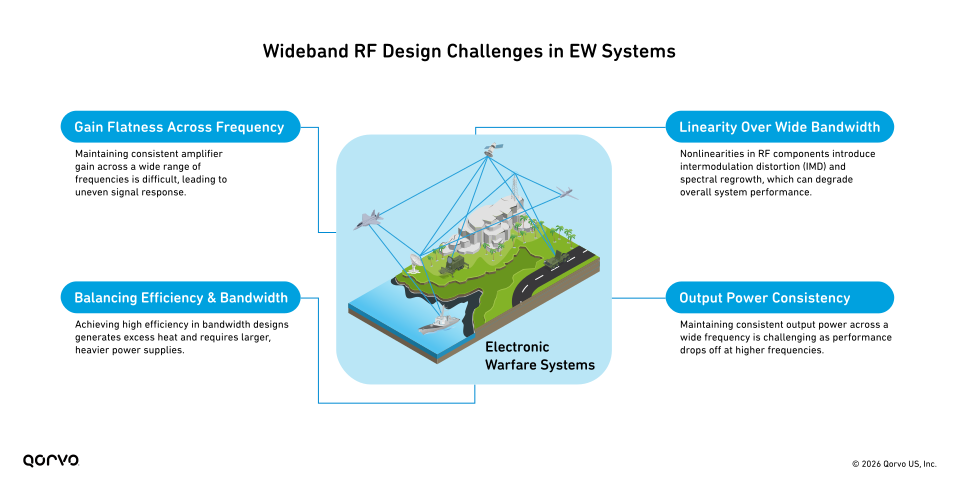
Wideband EW architectures address core RF design challenges through a combination of solid-state technologies, optimized circuit design and system-level integration. Solid-state power amplifiers and carefully engineered RF front ends enable more predictable gain behavior across wide frequency ranges, while optimized matching networks and equalization techniques help minimize variation and ensure uniform signal amplification, which reduces the risk of missed detections or degraded jamming effectiveness. The inherent predictability of these devices also supports improved linearity, and when paired with optimized biasing and system-level design, helps reduce intermodulation distortion and spectral regrowth to preserve signal integrity in dense, multi-signal environments.
At the same time, solid-state solutions help manage the tradeoffs between efficiency and bandwidth by delivering improved Power-Added Efficiency (PAE) and more consistent performance across temperature and load conditions, reducing excess heat and supporting more SWaP-efficient designs. These architectures also enable more consistent output power across wide frequency ranges, particularly when implemented in modular form factors that allow power scaling without redesigning the entire transmit chain. On the receive side, wideband low-noise amplifiers and front-end limiters protect sensitive components while maintaining stable noise figure and gain, preserving detection capability across the spectrum. Finally, integrated RF modules simplify system design, reduce assembly complexity and improve repeatability, while the inherent reliability of solid-state architectures ensures consistent performance under sustained, mission-critical operating conditions.
Wideband EW design is a constant balancing act—maintaining gain, linearity, efficiency and stability across a broad and dynamic spectrum, often under high power and real-time operational constraints.
By aligning device technology, integration strategy and system design with the realities of wideband operation, engineers can overcome the core challenges of modern EW, and deliver predictable, high-performance capability across the electromagnetic spectrum.
For more information about our RF solutions for wideband, high-power systems, visit our EW solutions page. Additionally, you can find more interesting collateral on this subject by visiting our Qorvo Design Hub for a rich assortment of videos, technical articles, white papers, tools and more. For technical support, please visit Qorvo.com or reach out to Technical Support.
There was a time when power engineers and RF engineers occupied different ends of the hallway.
The RF team debated noise figure and linearity as if civilization depended on it. The power team worried about volts, amps and whether something might overheat. They shared a PCB but not always a worldview. If a spur appeared in the spectrum, it was clearly an RF problem. If something got hot, that was clearly a power problem.
Life was simpler then.
Today, those hallway boundaries are dissolving. Modern converters switch fast enough that layout parasitics resemble transmission lines. Gate loops behave like resonant structures. Package inductance stops being an afterthought and starts showing up in the lab as an unexpected oscillation.
And when power management is treated casually, the PCB occasionally rewards you with a full laser-light-and-pyrotechnics show.
The oscilloscope glows with overshoot. The spectrum analyzer fills with harmonics you never budgeted for. That tidy switching node becomes a broadband radiator with impressive range and zero respect for your carefully tuned RF front end. A near-field probe appears, wielded like a fire extinguisher.
The board may not literally ignite, but it can behave as if it is auditioning for a stadium tour.
Fast edges create ringing. Poor loop control creates EMI. A little optimism in the layout can turn a clean design review into spectral damage control. Once the show begins, it is very difficult to argue that power management belongs to someone else’s discipline.
Eventually the smoke clears — metaphorically, one hopes — and the lesson becomes obvious: high frequency is no longer exclusive to the RF team.
At the same time, RF systems have grown far less tolerant of sloppy electrons. AI accelerators, phased array radars, 5G radios and satellite payloads all share a dependency on tightly controlled, dynamically managed power. We celebrate the antenna aperture, beamforming algorithms and heroic PA linearity. But none of those subsystems behave well if the supply rail resembles a suggestion rather than a specification.
Ripple becomes phase noise.
Transients become spectral regrowth.
Impedance becomes destiny.
Consider a modern phased array. Hundreds or thousands of elements must maintain phase coherence while digital control, converters and RF front ends draw from shared power domains. A transient event in one corner of the board can surface elsewhere as jitter, drift or degraded dynamic range. In high order modulation schemes, that becomes degraded EVM. In radar systems, it can mean reduced detection sensitivity.
Efficiency, in this environment, is not merely a thermal metric. It becomes an RF specification.
As systems scale, so does power density. Data centers supporting AI workloads offer a convenient illustration. We speak of “the cloud” as if it floats. In reality, it is racks of silicon pulling tightly regulated current at astonishing speed. Switching frequencies rise to shrink passives and sharpen transient response. Those faster edges introduce coupling paths and parasitics that refuse to be ignored.
The physics is indifferent. Inductance does not care whether it resides in a matching network or a buck converter. A poorly controlled current loop will radiate whether it carries a carrier wave or a switching waveform. Maxwell’s equations remain gloriously impartial.
This is where the quiet revolution in power management becomes compelling. The focus is shifting from delivering power to managing it intelligently. Adaptive control loops respond in real time. Power domains are segmented to isolate sensitive circuits. Integration reduces loop area and parasitic uncertainty. Packaging and layout are treated as electromagnetic structures, not mechanical necessities.
In other words, power design increasingly looks like RF design — just with larger currents and fewer Smith charts.
For microwave engineers, this convergence is both challenge and opportunity. The electromagnetic environment inside modern systems is crowded. High di/dt edges, dense routing and compact integration leave little margin for wishful thinking. Power integrity analysis belongs in the same conversation as S-parameters and stability circles.
The opportunity is equally clear. RF engineers already think in terms of impedance, resonance and coupling. Applying that intuition to power distribution networks and switching loops can elevate overall system performance. When the supply rail is treated as part of the signal chain rather than background infrastructure, the architecture becomes more predictable and more robust.
Power management is no longer the quiet corner of the board that “just has to work.” In high performance infrastructure, aerospace and defense systems, it is a lever for differentiation. A well-managed power architecture enables higher linearity, lower noise floors and tighter timing margins. It allows RF subsystems to operate closer to their limits without being sabotaged by their own energy source.
We often talk about pushing the boundaries of frequency. Just as important is pushing the boundaries of how precisely we manage the energy that makes those frequencies possible.
The best light show, after all, is the one that never makes it past the layout review.
This article first appeared in Brent’s Musings in Microwave Journal.
In massive warehouses and factories around the world, fleets of autonomous guided vehicles (AGVs) and autonomous mobile robots (AMRs) are transforming the way goods move from shelf to shipment. Productivity can soar by 300%, but a single human step into the robot work zone can bring the entire operation to a halt. Every pause for safety costs time, money and momentum.
That’s the challenge Redpoint Positioning set out to solve—and they’re solving it with Qorvo Ultra-Wideband (UWB) technology.
“For large-scale automated warehouses, efficiency and safety have always been in tension,” explains John Calcio, Vice President of Partnerships at Redpoint Positioning. “If a technician needs to enter an AGV zone, regulations require shutting down every robot in the area. It’s safe—but it’s also massively inefficient.”
High-volume warehouse environments may deploy thousands of fast-moving robots working side-by-side with human crews. Maintaining over 99% reliability in such a dynamic, high-density space is critical, particularly when functional safety standards like SIL2 (Safety Integrity Level 2) must be met.
“The easiest way to stay compliant is to stop everything,” Calcio says. “But that’s a brute-force solution. We knew we could do better with real-time, centimeter-level awareness.”
Redpoint’s real-time location system (RTLS) integrates directly into AGVs and wearable safety gear. Each robot and worker is equipped with a UWB tag that continuously tracks its position with centimeter-level accuracy and millisecond latency. When a worker enters a restricted zone, nearby robots automatically slow or stop—without requiring a full fleet shutdown.
“Think of it as indoor GPS,” Calcio explains. “Our technology lets machines and people ‘see’ each other in real time, even in environments where Wi-Fi or vision systems struggle. It’s fast enough that a forklift can slow down or reroute before a collision is possible.”
The result is a SIL2-compliant wireless safety system that keeps both people and production moving.

At the heart of Redpoint’s RTLS is Qorvo’s UWB technology. With its low power consumption, precision ranging and robust performance in congested RF environments, Qorvo UWB provides the foundation Redpoint needed to meet industrial-scale performance and safety goals.
“Qorvo’s UWB delivers exactly what these environments demand—centimeter-level accuracy, millisecond response and exceptional reliability in complex, high-density deployments,” says Percy Yu, Qorvo Regional Marketing Manager in China. “Redpoint has been a long-term partner of Qorvo—over seven years now—and they’ve built on our UWB platform to create a proven, safety-certified RTLS solution.”
That partnership has already paid dividends: Redpoint’s system now powers tens of thousands of AGVs worldwide, improving operational efficiency by an average of 4–5%, with up to 15% increases in operator productivity and a 95% reduction in workplace accidents.
“These numbers may sound modest,” Calcio notes, “but when you’re talking about multi-million-square-foot facilities, a few percentage points translate to tens of millions of dollars in savings.”
One of Redpoint’s key differentiators is scalability. Their RTLS solution is purpose-built for environments where hundreds or thousands of moving assets share the same wireless space.
“When you have that many nodes transmitting position data at once, congestion and interference can become real issues,” says Calcio. “We engineered custom wireless protocols to keep latency and reliability at SIL2 standards, even in massive deployments.”
And that scalability isn’t limited to warehouses. Redpoint’s technology is now being adopted in industries ranging from logistics to mining—and they’re not alone in this UWB-powered expansion.
In China, Tsingoal—the country’s largest RTLS solution provider—is leveraging Qorvo UWB across a diverse portfolio that includes robotics control, factory automation, mining, logistics, parking systems and smart city infrastructure. Tsingoal’s UWB-based systems provide real-time tracking of assets, vehicles and personnel, improving safety, workflow efficiency and spatial awareness across industrial and urban environments.
From intelligent manufacturing lines to airport logistics and even humanoid robotics demonstrations, Tsingoal’s implementations showcase the versatility of Qorvo’s UWB technology in complex, multi-layered operations.
Both Redpoint and Tsingoal exemplify how Qorvo’s UWB technology is enabling a new generation of connected, intelligent and safer industrial ecosystems.
“What’s exciting,” says Yu, “is that we’re seeing global adoption. From North America to Asia, companies are realizing that UWB isn’t just about precision—it’s about trust, reliability and safety at scale.”
Calcio agrees. “This is where the market is going. The future of automation depends on real-time awareness—and that starts with UWB.”
Find out more about Qorvo UWB solutions here.

Dublin, Ireland – February 11, 2026 – Danalto, a pioneer in location intelligence software, today announced the successful integration of Danalto’s Cardinal™ Cloud Location Engine (CLE) with Qorvo’s latest Ultra-Wideband (UWB) System-on-Chip (SoC) and industrial and enterprise SDK.
This milestone brings enterprise customers one step closer to scalable, cloud-first UWB Real-Time Location System (RTLS) solutions capable of powering next-generation asset tracking, indoor navigation, and smart facility applications.
By combining Qorvo’s UWB performance with Danalto’s cloud-native multi-technology positioning framework, developers and integrators can now evaluate and prototype high-accuracy location services with reduced integration complexity and enhanced scalability.
“The Cardinal framework’s compatibility with Qorvo’s SDK and SoC opens exciting possibilities for UWB adoption in enterprise environments,” said Finbarr Coghlan, Chief Product Officer at Danalto. “It’s a strong foundation for future solutions that combine ease of deployment with precision performance.”
“We’re enabling our ecosystem partners to innovate faster with proven UWB silicon and a robust software platform,” said Nicolas Layus, general manager of Integrated Systems at Qorvo. “Our proven UWB combination lays the groundwork for flexible RTLS architectures that can adapt to evolving enterprise needs.”
About Danalto
Danalto provides physical AI and cloud-based positioning intelligence that enables enterprise customers to deploy real-time location services using multiple positioning technologies. Learn more at www.danalto.com.