Intelligently connecting virtually everything around us is the vision that drives our work at Qualcomm Technologies, and it’s why we deliver a broad portfolio of purpose-built processing and connectivity solutions to meet the needs of diverse industries.
A key focus area is low-power, wide-area (LPWA) connectivity designed for massive IoT deployments, where deep coverage and multi-year battery life are must-haves. This is where 3GPP-standardized LPWA technologies, narrowband IoT (NB-IoT) and enhanced machine-type communication (eMTC) aim to provide secure, globally interoperable connectivity for sensors, meters, trackers and other low-complexity IoT devices designed to operate for years on a single battery charge.

For most LPWA IoT applications, power consumption is often the primary design constraint: devices must deliver reliable coverage while having multi-year battery life, so every microamp counts in both low-power and active modes. Lower power extends operating life and reduces maintenance visits—cutting total cost of ownership (TCO)—and it can also enable smaller device form factors by requiring a smaller battery, improving overall aesthetics and sustainability.
That’s why the Qualcomm E51 4G Modem-RF leads in LPWA IoT, purpose-built to support both LTE Cat-M1 and Cat-NB2 with advanced power efficiency. It is developed to pair optimized power consumption with a compact, cost-effective design and rich peripheral support—helping customers build smaller, longer-lasting devices without compromising features.

To quantify the advantage of Qualcomm E51 4G Modem-RF, we measured its power consumption in our lab across different power modes and representative use cases — then benchmarked those results against one of the most deployed eMTC and NB-IoT dual-mode chipsets, the Altair ALT1250.
Figure 3 below shows a comparison of the measured results of E51 versus ALT1250’s published specifications. The takeaway is clear: E51 delivers >20% power savings across all power modes, from ultra-low-power modes such as power save mode (PSM) to active transmit/receive states.

In extended discontinuous reception (eDRx) mode, the power profile is defined by both the baseline sleep current and the periodic paging wakeups. A closer look at the curves shows E51 implements power optimizations to reduce total energy in these low-power states — delivering 33% lower deep-sleep current and a more efficient wakeup mechanism with 67% shorter paging wakeup time. The result is smaller current spikes, which reduces overall battery draw while maintaining network reachability.

To go beyond lab measurements, we also ran system-level simulations based on our lab-measured power data to model end-to-end modem behavior in real-life operating profiles. These simulations translate sleep, wake, attach and transmit events into expected battery draw over time — showing how E51 can support battery life required by targeted use cases. In this study, we looked at the power profiles for three different low-power, wide-area use cases and their battery life requirements, including smart meters, remote sensors and asset trackers.
Smart meters: Water and gas meters typically have no main power, so they run on batteries and require ultra-long life — often 15+ years — with infrequent data transmission. For gas meters, paging monitoring is the primary battery drain, so the device commonly operates in eDRX; our simulation shows E51 reaching 15-year battery life with 7.5–11 Ah batteries, depending on the number of uplink transmissions per day. Similarly for water meters, the same 15-year target can be achieved with 0.3–4.5 Ah batteries, primarily by relying on PSM.

Remote sensors: In applications ranging from weather stations and agricultural sensors to grid-monitoring devices, the typical battery life target is up to five years of operation on a compact battery. With PSM and sending infrequent, one-way data uploads, the E51 can achieve this target with as little as 0.2–2.6 Ah of battery capacity, depending on payload size and reporting frequency. This is designed to support smaller device formfactors and can help reduce maintenance needs and total cost of ownership for large-scale remote deployments.

Asset trackers: These devices operate in challenging conditions, continuously uploading location data via GNSS, monitoring temperature, humidity, ambient light and motion through multiple onboard sensors, all while running in power-efficient eDRX mode. Despite this workload, the E51 can achieve up to three months of battery life on just 0.2–0.7 Ah of battery capacity, depending on upload frequency.

At Qualcomm, high-performance wide-area connectivity and ultra-low-power design are part of our DNA. This is the foundation needed for delivering cutting-edge products like the Qualcomm E51 4G Modem-RF. Engineered for LPWA use cases, it helps devices run longer on a single battery charge, connect more reliably, and scale deployments more cost-effectively. We’re excited to help power what’s next in IoT, and we’ll continue to share updates as the ecosystem advances toward the vision of connecting virtually everything.
Whether you’re hailing a ride on a busy city street, navigating a drone over a field or relying on your car to get you safely home, one thing underpins it all: knowing exactly where you are. Location technology has quietly become one of the most essential capabilities in modern connected devices — and it’s evolving faster than most people realize.
Qualcomm Technologies has long been a leading provider of Global Navigation Satellite System (GNSS) solutions, and today we’re pushing the boundaries further than ever before. To us, GNSS is more than a standalone feature. It’s a system-level capability that’s designed alongside connectivity, compute and power management to enable precise, reliable location across billions of devices. From meter-level accuracy on your smartphone to centimeter-level precision for drones and autonomous vehicles — all with significantly reduced power consumption — the latest innovations from Qualcomm Technologies are setting a new standard for what location technology can do.
You’ve almost certainly heard of GPS, or Global Positioning System. It’s the satellite navigation system launched commercially by the United States in the early 1990s and for many years it was synonymous with the idea of positioning. But the satellite navigation landscape has grown considerably since then.
Today, other countries and regions have launched their own global or regional satellite constellations. Europe operates Galileo, Russia operates GLONASS, and China operates BeiDou. India has its NavIC system, and Japan operates QZSS. Taken together, all these systems fall under a common umbrella term: GNSS, which stands for Global Navigation Satellite System.
Why does having multiple satellite systems matter? Because when a device can receive signals from more than one constellation simultaneously, positioning becomes faster, more accurate and more reliable. Think of it like triangulating your location with more reference points — the more signals your device can hear, the more confident it can be about exactly where you are. This multi-constellation approach is especially critical in dense cities, remote regions or other real-world environments where reliability matters as much as raw accuracy.
GNSS didn’t start out as a consumer technology. In its early days, it was the domain of researchers, surveyors and engineers — people who needed to monitor shifts in the earth’s crust, plan the construction of roads and bridges, or manage large-scale precision agriculture. That changed in the early 2000s, when GNSS technology began making its way into mobile phones. Emergency services mandates in multiple countries required phones to be able to report their location, and that opened the floodgates. Suddenly, location awareness wasn’t just for experts — it was for everyone. App developers quickly embraced it, and today there are thousands of location-capable apps available across every major platform.
GNSS is now woven into the fabric of daily life, powering experiences across a remarkable range of devices.
On your smartphone, GNSS helps you discover what’s nearby, navigate from one place to another, order a ride through your favorite app or make sure your food delivery lands at your door rather than your neighbor’s.
In your car, GNSS has become a cornerstone of telematics and infotainment systems — and increasingly, it plays a critical role in the push toward autonomous driving.
For professional and industrial users, GNSS powers everything from precision agriculture — where knowing the exact position of a tractor or planter can dramatically improve efficiency — to infrastructure monitoring and logistics.
The common thread across all of these applications is a growing demand for location data that is not just present, but precise.
Modern connected devices are marvels of engineering. At any given moment, your smartphone might be running 4G or 5G connectivity, Wi-Fi, Bluetooth and GNSS — all while simultaneously executing demanding computing tasks. Every one of these technologies draws on your battery, and managing power consumption is a constant engineering challenge.
GNSS is no exception. Location services that run continuously — tracking your route on a long drive, for example — can meaningfully drain a battery over time. That’s why Qualcomm Technologies has made power efficiency a key pillar of its location technology innovation. Our technologies incorporate GNSS as part of a broader power-optimized system that is designed to enable continuous, high-accuracy positioning without compromising battery life.
To put the impact in concrete terms: a 25% reduction in GNSS power consumption can translate to an additional 100 hours of GNSS tracking on a device with a 5,000 mAh battery. That’s not a marginal improvement — it’s the difference between a device that works for you throughout a long day (or a multi-day adventure) and one that leaves you scrambling for a charger.
One of the most exciting recent advances from Qualcomm Technologies is what we call Qualcomm Meter-Level Positioning.
Qualcomm Technologies first introduced Meter-Level Positioning in 2020. The original implementation used a combination of enhanced signal processing on Qualcomm Technologies’ chipsets and a paid external correction service to achieve significantly better accuracy under real-world conditions.
But here’s the key development: Qualcomm Technologies has now made it possible to achieve a similar level of accuracy without relying on a paid correction service. This is a significant shift. It removes a cost burden that previously fell on device manufacturers, network operators or end users, and it makes superior positioning accuracy accessible to a much broader audience.
What does this mean in the real world? Imagine you’re waiting for a ride-share pickup on a busy city street. With conventional GPS, your driver might not know which side of the street you’re on — and you might have to dodge traffic to reach them. With Qualcomm Meter-Level Positioning, the app can pinpoint your location with enough precision to eliminate that ambiguity. For the ride-share company, the same technology can track their entire fleet with greater accuracy, identifying which lane each vehicle is in and dispatching cars more efficiently — reducing both wait times and operational costs.
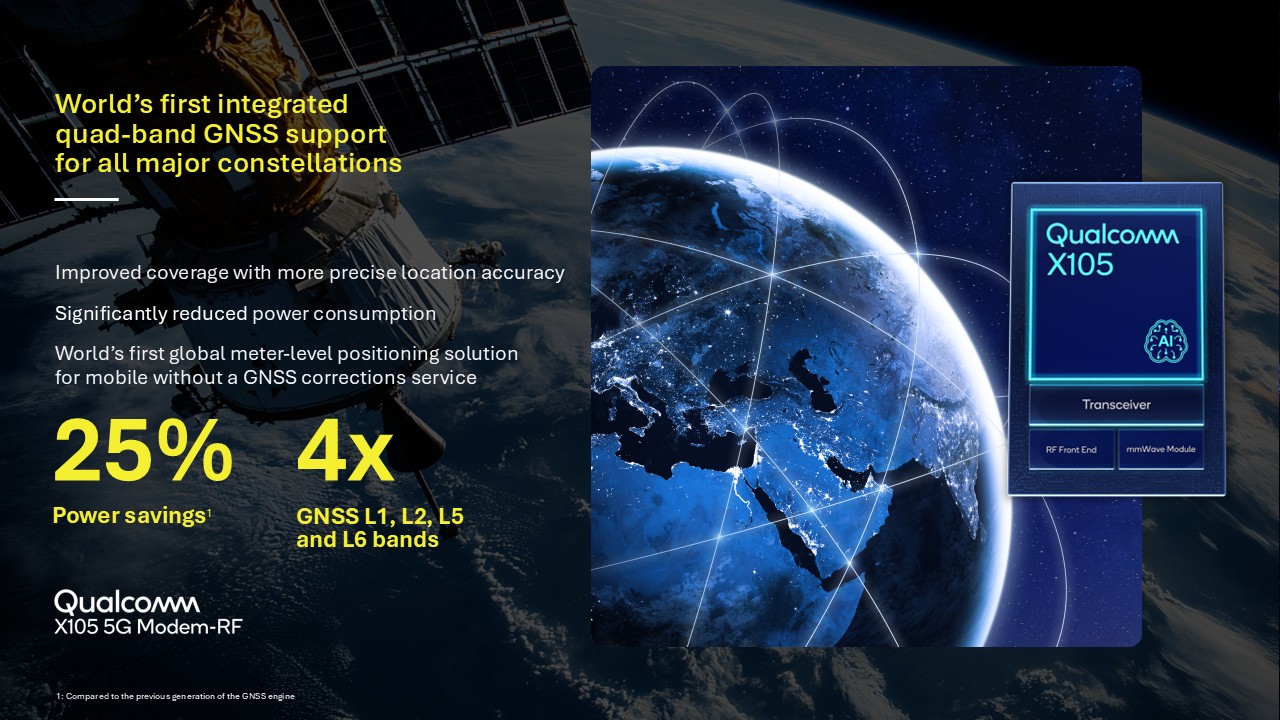
To understand what Qualcomm Technologies is introducing with its latest Qualcomm X105 modem-RF chipset, it helps to know a little about how GNSS signals work.
Satellites broadcast their signals across different frequency bands. Most modern GNSS devices have long supported two of these: the L1 band (around 1,575 MHz) and the L5 band (around 1,176 MHz). Using both — what the industry calls Dual-Frequency GNSS, which Qualcomm Technologies introduced in 2018 — gives devices a meaningful accuracy advantage, especially in challenging environments like dense urban areas where signals can bounce off tall buildings.
In 2022, Qualcomm Technologies introduced Triple-Frequency (L1/L2/L5) support, adding the L2 band (around 1,227–1,246 MHz). Triple-frequency devices, when paired with sophisticated external correction services, can achieve positioning accuracy at the decimeter level — that’s roughly four inches — or even centimeter-level accuracy with a high-quality antenna. Remarkable, but it required subscribing to a paid correction service to unlock the full benefit.
Now, with the Qualcomm X105 modem-RF chipset, Qualcomm Technologies is introducing quadruple-frequency GNSS, adding support for the L6 band (around 1,278 MHz). L6 signals are already being broadcast by two constellations: Galileo (known as Galileo E6) and QZSS. What makes L6 remarkable is that it carries the same kind of high-accuracy correction data that previously required a paid service — but it is available free of charge to any device that can receive it.
In practical terms, this means that the decimeter-level and even centimeter-level accuracy that was once reserved for professional surveying equipment or premium subscription services is now accessible to a much wider range of devices — at no additional cost to the user.
The implications of quad-frequency GNSS reach across industries and device categories.
And at Qualcomm Technologies, we know that delivering this at scale requires tight integration across silicon, software and connectivity.
Qualcomm Technologies has spent decades pioneering in GNSS technology, and the innovations described here represent the next chapter in that story. By delivering breakthrough accuracy improvements without added cost or complexity, these advances reflect a deep commitment to making location technology work better for everyone.
To summarize what’s new:
Looking ahead, there is no doubt that these enhancements in GNSS accuracy and power efficiency open the door to entirely new use cases across devices and device categories. As the world becomes more connected — and as devices become smarter, more autonomous, and more deeply integrated into the fabric of daily life — knowing precisely where you are will only matter more. Location technology will shift from a background utility to a core input. Qualcomm Technologies is committed to making sure the technology is ready when the world needs it by enabling devices to understand not just where they are, but how to act on that information efficiently, securely and at global scale.
The MBM Family features three products across two tiers, with higher tier MBM Series and mainstream tier MBM Series.
The MBM7 Series today includes the MBM715 for premium 5G and Wi-Fi connectivity, high-end multimedia capabilities and integrated AI for quality user experience.
With support for 5G NR sub‑6 GHz, including standalone (SA) and non‑standalone (NSA) modes, the Dragonwing MBM Series enables fast, reliable broadband performance across environments. Advanced Wi‑Fi, including Wi‑Fi 7, 320 MHz channels and 4K QAM, enables low‑latency, high‑throughput connections that feel immediate and responsive. Bluetooth® 6.0 wireless technology, including Bluetooth LE Audio and Bluetooth Channel Sounding, further supports proximity‑aware and more intuitive user interactions.
It also has support for high‑resolution, high‑refresh‑rate displays for smooth, engaging visuals, while advanced camera capabilities powered by the Qualcomm Spectra Image Signal Processor (ISP) enable sophisticated imaging, including triple 12‑bit ISPs and support for up to 200‑megapixel photo capture. Combined with integrated Qualcomm Adreno GPU capabilities, these features enable visually rich, responsive experiences that adapt to user behavior and input.
The MBM4 Series includes the MBM415 for 5G and Wi-Fi connectivity, advanced multimedia features and flexible memory options.
At the core of the Dragonwing MBM Family is industry‑leading connectivity that enables responsive, always‑on broadband experiences. By integrating advanced cellular, Wi‑Fi and Bluetooth technologies, the series provides the foundation for real‑time interaction — supporting how users connect, communicate and engage with content throughout the day.
The Dragonwing MBM Family is built to power rich, interactive multimedia experiences that bring broadband usage to life. Advanced integrated multimedia subsystems support display, camera and graphics pipelines simultaneously — enabling immersive visual experiences designed around how users watch, create, collaborate and interact.
No two broadband experiences are the same. The Dragonwing MBM Family supports flexible memory configurations with options for LPDDR4x and LPDDR5x. It also supports Android and Linux software, allowing device makers to tailor performance, power efficiency and design to specific user needs and usage models.
With the introduction of the Dragonwing MBM Family, Qualcomm Technologies expands its broadband portfolio with platforms designed to support interactive, personal and premium user experiences. This series brings together premium 5G and Wi-Fi connectivity, advanced multimedia and platform flexibility into a cohesive family focused on experience‑level outcomes. By prioritizing responsiveness, immersion and personalization, the series enables broadband devices that feel fast, intuitive and engaging — built around how people actually use them.
Qualcomm’s engineering journey to evolve RF exposure management for modern wireless performance
When Qualcomm Technologies pioneered a new way to manage RF exposure through real-time averaging, it wasn’t simply about a new product. Behind this breakthrough development is a story about years of vision, collaboration and technical rigor that paved the way for a new era in RF exposure management. Spanning nearly a decade, the journey to develop this new technology — Time-Averaged Specific Absorption Rate (SAR), also known as TAS — stands as another example of our relentless drive to develop the best wireless experience possible and deliver maximum benefit to industry and consumers.
Developing TAS required years of systematic effort to redefine how wireless devices manage RF exposure. Our expertise in mobile gave us a unique line of sight to where the industry was headed, and we were pursuing novel ways to enable the growth required for better uplink performance.
The seeds of TAS were planted in 2012, when our engineers and scientists recognized a looming challenge: Legacy RF exposure management was holding back the promise of next-generation wireless technologies. The team saw that RF exposure management using static, capped peak power limits were stifling innovation and making it harder for device makers to deliver the performance users were demanding. Thus began a decade of dialog, research, testing and validation, culminating in a breakthrough solution that set a new standard for the industry.
This effort unfolded through several key milestones:
In 2012, we presented the concept of real-time averaging for RF exposure management to the FCC, initiating a dialogue that would shape future compliance procedures. We worked closely with regulators worldwide, advocating for the adoption of time averaging as a scientifically sound and practical approach to Regulatory compliance.
Between 2013 and 2015, Qualcomm Technologies developed and tested prototype algorithms and devices, including the first sub-6 GHz hand-held device. These efforts demonstrated the feasibility of real-time power averaging and provided critical data for regulatory review.
In 2016, we released to the regulators the first version of SAR measurement procedures for validating TAS algorithms. Since then, the test cases and procedures for regulatory certification of wireless devices enabled with TAS RF exposure management have been updated to validate enhancements and used to enable other TAS providers to enter the market.
As wireless technology has evolved, so have Qualcomm Technologies’ solutions. In 2018, our engineers expanded the algorithms to support 5G mmWave, addressing new challenges in device complexity and simultaneous multi-radio transmissions.
To ensure robust validation, Qualcomm Technologies partnered with leading compliance labs and third-party test houses worldwide. These collaborations helped to harmonize TAS testing procedures and meet the compliance test and regulatory certification needs of OEMs for on-time launch of their commercial products.
In 2018, the FCC first approved time averaging procedures for sub-6 GHz and mmWave devices, a direct result of our sustained engagement and technical advocacy. This enabled OEMs to design for compliance using time averaging, rather than relying on legacy power back-off methods.
Qualcomm invested significant resources in educating OEMs, operators, and labs about the new approach. Our teams provide training, consulting and technical support to accelerate industry adoption and ensure consistent, reliable compliance. To date, we have on-boarded 25 compliance labs in 8 different countries with 10 more labs in progress.
In April 2019, Qualcomm Technologies launched TAS as a commercial product, branded Smart Transmit, as an optional feature in the first 5G-enabled smartphones. Smart Transmit was more than a product introduction; it was the culmination of years of hard work, technical excellence and industry-wide collaboration. The technology was validated, the ecosystem was ready and the industry was aligned on the benefits of dynamic RF exposure management.
In addition to cellular, today Smart Transmit includes Wi-Fi, Bluetooth® wireless technology, UWB, RFID and satellite radios. The rise of AI, XR and an ever-increasing number of wearables are placing even more importance on the efficiency and capacity of uplink transmission as devices send more and more data to the cloud for real-time learning and personalization.
The principles and methodologies developed during this journey paved the way for other OEMs and set new benchmarks for compliance and performance. The groundwork laid between 2012 and 2019 enabled not just a technical solution, but a transformation in how the industry approaches RF exposure compliance and device performance.
Qualcomm’s leadership in developing TAS reflects the strength of our research and development teams, our engineering ingenuity and our commitment to solving the hardest problems in wireless.
Qualcomm’s engineering journey to evolve RF exposure management for modern wireless performance
When Qualcomm Technologies pioneered a new way to manage RF exposure through real-time averaging, it wasn’t simply about a new product. Behind this breakthrough development is a story about years of vision, collaboration and technical rigor that paved the way for a new era in RF exposure management. Spanning nearly a decade, the journey to develop this new technology — Time-Averaged Specific Absorption Rate (SAR), also known as TAS — stands as another example of our relentless drive to develop the best wireless experience possible and deliver maximum benefit to industry and consumers.
Developing TAS required years of systematic effort to redefine how wireless devices manage RF exposure. Our expertise in mobile gave us a unique line of sight to where the industry was headed, and we were pursuing novel ways to enable the growth required for better uplink performance.
The seeds of TAS were planted in 2012, when our engineers and scientists recognized a looming challenge: Legacy RF exposure management was holding back the promise of next-generation wireless technologies. The team saw that RF exposure management using static, capped peak power limits were stifling innovation and making it harder for device makers to deliver the performance users were demanding. Thus began a decade of dialog, research, testing and validation, culminating in a breakthrough solution that set a new standard for the industry.
This effort unfolded through several key milestones:
In 2012, we presented the concept of real-time averaging for RF exposure management to the FCC, initiating a dialogue that would shape future compliance procedures. We worked closely with regulators worldwide, advocating for the adoption of time averaging as a scientifically sound and practical approach to Regulatory compliance.
Between 2013 and 2015, Qualcomm Technologies developed and tested prototype algorithms and devices, including the first sub-6 GHz hand-held device. These efforts demonstrated the feasibility of real-time power averaging and provided critical data for regulatory review.
In 2016, we released to the regulators the first version of SAR measurement procedures for validating TAS algorithms. Since then, the test cases and procedures for regulatory certification of wireless devices enabled with TAS RF exposure management have been updated to validate enhancements and used to enable other TAS providers to enter the market.
As wireless technology has evolved, so have Qualcomm Technologies’ solutions. In 2018, our engineers expanded the algorithms to support 5G mmWave, addressing new challenges in device complexity and simultaneous multi-radio transmissions.
To ensure robust validation, Qualcomm Technologies partnered with leading compliance labs and third-party test houses worldwide. These collaborations helped to harmonize TAS testing procedures and meet the compliance test and regulatory certification needs of OEMs for on-time launch of their commercial products.
In 2018, the FCC first approved time averaging procedures for sub-6 GHz and mmWave devices, a direct result of our sustained engagement and technical advocacy. This enabled OEMs to design for compliance using time averaging, rather than relying on legacy power back-off methods.
Qualcomm invested significant resources in educating OEMs, operators, and labs about the new approach. Our teams provide training, consulting and technical support to accelerate industry adoption and ensure consistent, reliable compliance. To date, we have on-boarded 25 compliance labs in 8 different countries with 10 more labs in progress.
In April 2019, Qualcomm Technologies launched TAS as a commercial product, branded Smart Transmit, as an optional feature in the first 5G-enabled smartphones. Smart Transmit was more than a product introduction; it was the culmination of years of hard work, technical excellence and industry-wide collaboration. The technology was validated, the ecosystem was ready and the industry was aligned on the benefits of dynamic RF exposure management.
In addition to cellular, today Smart Transmit includes Wi-Fi, Bluetooth® wireless technology, UWB, RFID and satellite radios. The rise of AI, XR and an ever-increasing number of wearables are placing even more importance on the efficiency and capacity of uplink transmission as devices send more and more data to the cloud for real-time learning and personalization.
The principles and methodologies developed during this journey paved the way for other OEMs and set new benchmarks for compliance and performance. The groundwork laid between 2012 and 2019 enabled not just a technical solution, but a transformation in how the industry approaches RF exposure compliance and device performance.
Qualcomm’s leadership in developing TAS reflects the strength of our research and development teams, our engineering ingenuity and our commitment to solving the hardest problems in wireless.
In just a few years, AI has leaped from research labs to the real world. As this momentum accelerates, AI is no longer a vision, but a reality. One which is not confined to the cloud, instead quickly moving to the edge. Generative AI, agentic AI and physical AI are now being embedded directly into the devices and infrastructure that power our world. This imminent shift changes the game, especially for teams moving from prototype to production — success depends not on training the largest models, but on deploying AI that is efficient, secure and scalable where it matters the most. At Qualcomm Technologies, our edge AI processors portfolio is purpose-built for this future, designed to enable intelligence across industries, from early validation to scaled deployment.

That’s the difference between edge AI in theory and edge AI in production. Edge AI is where artificial intelligence matures from only running in centralized data centers to distributed, real-world deployments. Real-time decisions can’t wait for the cloud. Sensitive data can’t risk exposure. Billions of devices can’t rely on constant connectivity. Purpose-built edge AI processors solve all these challenges, embedding intelligence directly into the devices and AI appliances.
Our journey in industrial and embedded IoT began many years ago, culminating in the launch of our most advanced, industrial-grade Dragonwing IQ Series processors in 2024, including the Dragonwing IQ6, IQ8 and IQ9. These processors are designed to bring AI to the edge across factories, warehouses and infrastructure. In 2025, we expanded this portfolio with the Dragonwing IQ-X Series, powering the next generation industrial PCs running Microsoft Windows. Most recently at CES 2026, we unveiled our flagship Dragonwing IQ10 Series of industrial processors, marking our entry into advanced robotics.
Together, this comprehensive portfolio is designed to enable us to scale edge intelligence without forcing teams to re-architect as they grow across every industrial vertical and tier, supporting AI processing from 1 TOPS for sensor-level intelligence to 350 dense TOPS for complex vision and decision-making tasks. For customers requiring even greater AI capability, our AI on-premises appliances deliver peta-flop-class performance and can run 200B-parameter models on a single system. This enterprise-grade performance keeps data and processing local, which is an important capability for industrial applications with strict security, privacy, reliability and latency requirements.
At Embedded World 2026 in Nuremberg, we’re bringing more than 20 demonstrations powered by our industrial processors and AI on-prem appliances. These demos reflect the momentum we’ve built turning prototypes into deployable systems to drive digital transformation across industries, in close collaboration with our partner ecosystem, to make AI real and scalable. This theme is explored across distinct focus areas including developer enablement and solutions that span from commercial and industrial to robotics. If you are at the show, be sure to drop by our booth in Hall 5, Stand #5-161. If not, let me spotlight a selection of these areas to illustrate how edge AI is delivering value across multiple verticals and use cases.
Powered by the Dragonwing IQ8-Series processor, the Arduino VENTUNO Q combines Arduino’s developer-friendly ecosystem with industrial-grade edge AI performance of up to 40 dense TOPS. This new platform democratizes access to production-ready AI development, enabling engineers to rapidly build and deploy edge AI systems. To showcase its capabilities, we have multiple demos on display at the Qualcomm and Arduino booths, including an interactive smart mirror, an engaging chatbot, an AMR and more.
For the broader industrial use cases, we are bringing several demos in coordination with partners to highlight how connected intelligence can help enhance operational efficiency, safety and productivity. Below, let me spotlight four important use cases:
Collaborating with Qt Group and Edge Impulse, we are making great strides aimed at radically improving the development experience for AI-driven industrial software. Our demonstration exhibits distributed edge AI on multiple interconnected manufacturing sites. Powered by Dragonwing IQ9, the demo showcases four AI applications — visual defect detection, equipment fault detection, worker safety and AI factory assistant — with multiple AI models operating simultaneously. Additionally, we enabled Dragonwing IQ6-based Human Machine Interface (HMI) devices running on-device face detection for operator access and AI tethering with Dragonwing IQ9 to leverage AI factory assistant remotely. With AI tethering, operators using Dragonwing IQ6-based HMIs are not limited by the on-device AI and simple monitoring of the data, but they are able to leverage the power of Dragonwing IQ9 to help get prescriptive responses on the defects and manufacturing lines.

By analyzing visual data in real time, edge AI can be trained to detect defects, variations and anomalies early on the manufacturing line, improving production yield, reducing waste and helping to ensure consistent quality. In collaboration with CODESYS, we are demonstrating an industrial PC for PCB defect detection, running Windows on Dragonwing IQ-X that supports EtherCAT, motor control, image processing and AI chatbot. It also demonstrates Qt for user interface.
PLC and HMI consolidation
We demonstrate consolidation of PLC and HMI functions on a single Dragonwing IQ9 platform through virtualization. Here, Real-Time Linux is used to run CODESYS for PLC application enabling low-jitter motor control over EtherCAT, while virtualized Windows HMI on the same Dragonwing IQ9 platform shows the data for monitoring and control. This consolidation of various functions and devices over single platform through virtualization is designed to give customers flexibility to implement, scale, add and modify capabilities as the factory evolves. Additionally, consolidation can lead to reduced hardware and maintenance costs.

A core challenge in industrial networking is connecting a diverse set of sensors and devices that support different connectivity standards. Our Dragonwing IQ9 based industrial gateway is purpose-built to address this, supporting 5G, Wi-Fi, Bluetooth, LoRa, Ethernet and other communication standards, while designed to deliver powerful edge AI for sensor fusion and other edge AI workloads. Our demo aims to show how on-device vision processing can support worker safety, integrate with industrial SCADA systems to enable real-time production monitoring, and support simplified device management.

Edge AI redefines enterprise productivity and operations when it’s designed to deploy consistently at scale. With cutting-edge VLMs and LLMs, organizations can personalize interactions, improve efficiency and strengthen security, all while keeping data closer to where it’s generated. Here are a few demos that highlight edge AI in the commercial environment:
VLMs combine computer vision with natural‑language reasoning to unlock richer video insights, from scene understanding to intelligent action triggering. Running these models at the edge enables faster decisions and stronger data privacy. Our demo showcases multiple Dragonwing IQ9‑based solutions, including a video surveillance demo based on the Qualcomm Insight Platform, a performance comparison against a competitor’s solution and an example of multiple VLM instances running simultaneously on a single device.

Our Dragonwing processor platforms also enable a wide range of AI‑driven retail experiences designed to elevate customer engagement. In collaboration with BRICKS, we’re demonstrating an Dragonwing IQ9-based interactive digital signage solution that powers more intelligent, dynamic storefront interactions.
In collaboration with Consult Red, we’re also demonstrating a voice‑enabled fast‑food ordering kiosk that runs Android on Linux with the Dragonwing IQ9 industrial processor, featuring on‑device voice control powered by multiple AI models. Using Android on Linux, we can now run modern Android apps on a highly powerful edge AI industrial platforms that are also ruggedized and come with long-life support.
Announced at CES 2026, the Edge Impulse On-Prem AI can enable secure local AI inference and MLOps for a wide range of use cases. Customers can run inference for models up to 120B parameters, like GPT-OSS 120B, at just 150W on one Qualcomm Cloud AI 100 Ultra card. This architecture offers enterprise-grade precision, secure operation, private networks and full offline support.
The appliance also powers on‑premise generative AI enterprise workloads, as demonstrated through collaborations with context.ai for content creation. In telecom, we have supported Lanner and Ecrio to enable telecom and generative AI applications. We also collaborate with partners like Aramco for oil & gas and Siemens for industrial projects. To scale, we work with hardware vendors such as Aetina, Advantech, XSLAB and AUK Computing.

Our Dragonwing processors are helping to power the future of physical AI, where prototype-to-production gaps are most visible, to deliver end‑to‑end robotics solutions that scale intelligence from household robots to full‑size humanoids. Our demos showcase our work with partners and customers across a broad range of robotics use cases. We are also highlighting how we scale robotics development and deployment, from rapid prototyping on Dragonwing IQ8 with VENTUNO Q to an Advantech and Autocore AMR prototype, and more. Learn more about our latest robotics progress.
We are also launching Dragonwing Robotics Hub, built on the Arduino Project Hub, to accelerate this journey with ready‑to‑run samples and end‑to‑end workflows spanning sensors, Dragonwing compute, edge AI and robotics control, complete with schematics, documentation, tutorials and reusable sample code. Learn more about our latest robotics progress.

At Qualcomm Technologies, we’re not just talking about transforming industries, we’re leading it. Through our integrated portfolio of purpose-built edge AI solutions, we’re working closely with industry leaders to solve real-world challenges across industrial, commercial, robotics and beyond to help teams move from evaluation to deployment with confidence.
The momentum is accelerating and 2026 promises to be a pivotal year for scaling AI to the edge. Follow us for upcoming announcements as we continue pushing the boundaries of what’s possible.
Dragonwing wireless networking platforms span home, enterprise, fiber and fixed wireless, and are designed for reliability, intelligence and scale
AI is reshaping not just applications, but the infrastructure underneath them. Qualcomm Technologies has built a Wi‑Fi 8-generation networking infrastructure portfolio for the AI era, expressed across five platforms that span home routers and mesh systems, enterprise access points, fiber gateways and fixed‑wireless access. These platforms represent a unified architectural foundation, scaled across deployment tiers and environments where AI‑driven workloads are already the norm.
Each platform is built on common design principles: ultra‑high reliability at scale, intelligence embedded at the network edge, power efficient operation and a platform architecture that enables developers to create differentiated experiences, integrate new capabilities and innovate faster.

When considering AI infrastructure, the focus must be on distributing intelligence across the edge-to-cloud continuum. Data moves between cloud inference, on-device models and services running at the network edge. Because these experiences are real-time and continuous, every part of the path matters. There can be no weak link. The access point in the home, the broadband connection and the cloud share the same performance burden.
This evolution is reshaping infrastructure reality. AI traffic is becoming more continuous, more upstream, and increasingly sensitive to latency and reliability than previous generations of applications. AI workloads are moving beyond bursty, best‑effort patterns toward requirements for predictable latency, ultra‑high reliability, consistent performance under load and stronger uplink. Speed remains essential, but it is no longer the only measure that defines a high‑performance network.

Meeting these requirements demands a new class of wireless networking infrastructure, one designed end-to-end to deliver predictable performance under continuous, time‑sensitive workloads while embedding intelligence at the edge, closer to where data is generated and consumed.
This shift elevates the role of wireless connectivity from a best‑effort access layer to a foundational part of the AI infrastructure itself. Wi‑Fi 8 plays a critical role in this transition by providing a wireless foundation designed for real‑world reliability and deterministic performance.
Building on the performance gains of Wi‑Fi 7, Wi‑Fi 8 extends those capabilities with a stronger focus on reliability, responsiveness and determinism in real‑world operating conditions. It is designed to deliver consistent performance across challenging environments, including at greater distances from the access point, in dense and device‑rich deployments, and in scenarios involving client mobility and variable interference. By prioritizing predictable behavior under load, Wi‑Fi 8 enables more dependable connectivity for latency‑sensitive and always‑on applications at the edge.

Meeting AI-era requirements cannot be achieved by optimizing the radio in isolation. This is why we designed Wi-Fi 8 infrastructure as a system, co-optimizing radios, RF front ends (RFFEs), compute and network intelligence as a unified platform. This system-level design ensures that Wi-Fi 8 capabilities translate into meaningful real-world gains, going beyond simple compliance with the specification.
That difference is most visible in the areas experienced every day, including coverage, responsiveness, power efficiency and scale:

Our platforms are built around a coordinated set of specialized engines that work together as a system: high-performance compute to deliver superior wireless networking performance, manage control and services, dedicated packet processing to keep traffic moving predictably at line rate, on-device AI acceleration to run inference without relying on the cloud, and network centric intelligence that continuously optimizes quality of experience in real time and deliver AI-native telemetry to power AIOps workflows.
By separating and specializing these roles, the architecture ensures that AI workloads do not compete with networking tasks for resources, allowing responsiveness, reliability and intelligence to scale together as networks grow more complex.
As networking infrastructure becomes more intelligent, the gateway follows the same path as the smartphone, evolving from a single‑purpose device into a programmable platform. That evolution is enabled by our approach: designing the gateway from the start with a unified, developer‑ready silicon‑to‑cloud stack that provides the foundation for this shift.
High‑performance compute and connectivity at the silicon layer are paired with a unified OS, SDK and middleware layer, as well as extended through open APIs and rich telemetry, that gives OEMs and operators deep visibility into network performance, device behavior and application demands. Critically, the platform is built for ecosystem readiness from day one. Native support for open-source middleware environments such as Prpl and RDK streamlines integration and accelerates time to deployment.
This architecture allows the gateway to evolve over time via containerized applications to support new capabilities and services. Combined with integrated AI developer tools, frameworks and model workflows for on-device inference, these foundations turn the gateway into a durable innovation surface, where developers can build, deploy and continuously evolve intelligent services at the network edge.

This architecture comes to life across five platforms, each designed to apply the same system-level foundation to different deployment realities. By leveraging a common connectivity and AI feature-set foundation, OEMs and operators can deliver consistent, intelligent user experiences across fiber, fixed wireless and Ethernet broadband, while scaling seamlessly from mainstream to premium deployments. That shared foundation is expressed across the portfolio as follows:
AI‑era requirements are already shaping everyday networks. Dense device environments, always‑on services and intelligent applications are becoming the norm across homes, enterprises and service provider deployments.
Meeting these demands requires more than faster connectivity in isolation. It calls for a system‑level architecture that combines ultra‑reliable wireless, high‑speed broadband, edge intelligence, high‑performance compute and developer‑readiness. That architecture is expressed as a single story across five platforms, each applying the same foundation to deliver predictable performance as AI workloads grow.
With intelligence becoming more continuous and embedded into everyday environments, the network itself becomes a defining part of the experience. The infrastructure choices made now will determine how effectively AI can be delivered and scaled in the years ahead.
Ganesh Swaminathan, vice president and general manager for wireless infrastructure and networking at Qualcomm Technologies, Inc., shares further insight into how this portfolio is shaping the future of AI‑era networking infrastructure:
SAN DIEGO–(BUSINESS WIRE)– Qualcomm Incorporated (NASDAQ: QCOM) today announced that it has completed its acquisition of Alphawave IP Group plc (AWE.L) (“Alphawave Semi”), approximately one quarter ahead of schedule. The acquisition of Alphawave Semi aims to further accelerate and provide key assets for Qualcomm’s expansion into the data center. Tony Pialis, CEO and co-founder of Alphawave Semi, will lead the Qualcomm data center business.

“Alphawave Semi’s expertise in high-speed connectivity technologies complements our Qualcomm Oryon CPU and Hexagon NPU processors,” said Cristiano Amon, President and CEO of Qualcomm Incorporated. “Qualcomm delivers high-performance, energy-efficient compute and AI solutions, and the addition of Alphawave’s technologies will strengthen our platforms and optimize performance for next-generation AI data centers.”
“Joining Qualcomm marks an exciting new chapter for Alphawave Semi,” Pialis said. “We’re ready to bring our leadership in high-speed connectivity and custom silicon to help shape the future of data center innovation.”
Alphawave Semi is a global leader in high-speed wired connectivity delivering custom silicon, connectivity products and chiplets that drive faster, more reliable data transfer with higher performance and lower power consumption. Alphawave Semi’s products form a part of the core infrastructure enabling next-generation services in a wide array of high growth areas, including data centers, AI, data networking and data storage.
The full announcement can be found on our website at: https://investor.qualcomm.com/update-details/update-details-offer.
About Qualcomm
Qualcomm relentlessly innovates to deliver intelligent computing everywhere, helping the world tackle some of its most important challenges. Building on our 40 years of technology leadership in creating era-defining breakthroughs, we deliver a broad portfolio of solutions built with our leading-edge AI, high-performance, low-power computing, and unrivaled connectivity. Our Snapdragon® platforms power extraordinary consumer experiences, and our Qualcomm Dragonwing™ products empower businesses and industries to scale to new heights. Together with our ecosystem partners, we enable next-generation digital transformation to enrich lives, improve businesses, and advance societies. At Qualcomm, we are engineering human progress.
Qualcomm Incorporated includes our licensing business, QTL, and the vast majority of our patent portfolio. Qualcomm Technologies, Inc., a subsidiary of Qualcomm Incorporated, operates, along with its subsidiaries, substantially all of our engineering and research and development functions and substantially all of our products and services businesses, including our QCT semiconductor business. Snapdragon and Qualcomm branded products are products of Qualcomm Technologies, Inc. and/or its subsidiaries. Qualcomm patents are licensed by Qualcomm Incorporated.
Qualcomm, Snapdragon, Qualcomm Dragonwing, Qualcomm Oryon, and Hexagon are trademarks or registered trademarks of Qualcomm Incorporated.
Wi-Fi 8 is beling developed to meet the demands of a new era shaped by AI-driven systems, personal device ecosystems and mission critical applications.
Learn more in Part 1 of this series
Previously, we explored how Wi-Fi 8 is being developed to meet the demands of a new era shaped by AI-driven systems, personal device ecosystems and mission-critical applications. Designed to deliver ultra-high reliability, Wi-Fi 8 aims to provide consistent, low-latency and near-lossless performance in real-life environments where congestion, interference, mobility and coverage boundaries challenge legacy Wi-Fi.
Here, we’ll take a closer look at the technologies making Wi-Fi 8 uniquely capable of solving these challenges. We’ll also explore how these innovations translate into tangible benefits across key environments: enterprise and industrial settings, connected homes and public venues — where seamless, intelligent connectivity is becoming more and more essential.

Wi-Fi technology, like all wireless communication systems, is built on a layered architecture that organizes how data is transmitted and received. Two of the most critical layers in this architecture are the physical (PHY) layer and the medium access control (MAC) layer. The PHY layer is responsible for the actual transmission of data over the air. It defines how bits are converted into radio frequency signals and vice versa, including aspects like modulation, coding and signal strength. The MAC layer, on the other hand, governs how devices access the shared wireless medium, coordinating when and how data packets are sent to avoid collisions and ensure efficient use of the spectrum.
The IEEE 802.11bn standard, which serves as the base for Wi-Fi 8, introduces a suite of innovations at these foundational layers to improve reliability, throughput and responsiveness, especially in challenging conditions. Wi-Fi 8 tackles long-standing limitations in signal handling and spectrum coordination, setting the stage for a new generation of ultra-resilient and high-performance wireless connectivity.

Wi-Fi 8 brings a wave of targeted PHY layer enhancements to address connectivity challenges like weak uplink signals, inefficient MIMO modulation and signal degradation at the network edge. These enhancements are designed to deliver more robust performance and higher effective throughput in non-ideal signal conditions than any previous generation of Wi-Fi.
Together, these PHY layer innovations form the foundation of Wi-Fi 8’s ultra-high reliability promise, ensuring performance remains consistent, robust and efficient, while also increasing range and boosting throughput in challenging wireless conditions.


These coordination mechanisms allow Wi-Fi 8 to deliver consistent, high-throughput, low-latency connectivity in environments with high device density and overlapping coverage.

Wi-Fi 8 is designed not just for theoretical gains, but for impact; its innovations are tuned to the realities of modern connectivity, where reliability, responsiveness and efficiency are mission-critical. Let’s explore how the technical breakthroughs, many spearheaded by Qualcomm Technologies, connect to the environments where they’ll reshape expectations and redefine what wireless performance feels like.
Enterprise and industrial environments have long relied on wired Ethernet to meet the stringent demands for operations like robotic assembly, real-time monitoring, high-quality conferencing and increasingly AI-driven automation that require ultra-reliable, low-latency connectivity. Wi-Fi 8 introduces the opportunity to deliver that same level of reliability over wireless, unlocking new flexibility for intelligent operations.
While earlier Wi‑Fi generations delivered their strongest performance closest to the access point, Wi‑Fi 8 is designed to extend that experience, delivering consistently higher throughput and lower latency throughout the home.
In public venues like airports, stadiums and transit hubs, Wi-Fi 8 tackles the dual challenge of high user density and constant mobility.
In summary, Wi-Fi 8 introduces a suite of innovations designed to meet the demands of modern connectivity, where mobility, density and responsiveness are critical. Together, these innovations enable systems to operate with the precision, responsiveness and reliability traditionally reserved for wired infrastructure, while also delivering significantly faster wireless connectivity in scenarios where legacy Wi-Fi struggled.
As a leader in wireless innovation, Qualcomm Technologies is driving the development of Wi-Fi 8, delivering advanced connectivity solutions that empower enterprises, public spaces and homes worldwide. With our deep expertise in wireless technologies, we are uniquely positioned to unlock the full potential of Wi-Fi 8 for intelligent computing at the edge.
About Ubiquiti
Ubiquiti is a leader in enterprise networking, delivering scalable Wi-Fi 7 solutions that enable seamless, multi-gigabit connectivity for environments from small offices to global stadiums. Their vision addresses the demands of today’s high-performance, connected devices and the hyper-connected world of modern business.
Use Case Spotlight
Ubiquiti’s Wi-Fi 7 portfolio — including the E7 series — delivers enterprise-grade connectivity at scale, proven in high-density venues like convention centers and arenas. These solutions provide reliable, content-rich wireless experiences for thousands of users, even under heavy traffic and with a wide range of devices.
Qualcomm Innovation
Ubiquiti’s latest access points are built on the scalable Qualcomm Dragonwing Networking Infrastructure Wi-Fi 7 platforms, leveraging advanced features like Multi-Link Operation, ultra-wide 320MHz channels, and 4K QAM for high throughput, low latency, and robust reliability. The Dragonwing N7 Platform’s modular architecture and automated frequency coordination enable both indoor and outdoor deployments, supporting diverse market needs.
From large stadiums to small offices, today’s high-performance devices require multi-gigabit speeds and real-time responsiveness. Ubiquiti’s Wi-Fi 7 access points (APs) lineup deliver multi-gigabit connectivity directly to client devices, ensuring seamless performance across diverse environments. With scalable, license-free networking solutions, Ubiquiti is enabling the hyper-connected world of modern business.
To bring its breakthrough vision for Wi-Fi 7 access points to life, Ubiquiti turned to a long-time trusted collaborator: Qualcomm Technologies. Powered by the Dragonwing Networking Wi-Fi 7 platforms, Ubiquiti’s access points lineup integrates the full capabilities of Wi-Fi 7 and offers significant advantages over previous generations, including:
With its advanced and modular networking architecture, the Dragonwing N7 Platform and Dragonwing NPro 7 Platform align perfectly with Ubiquiti’s software-driven innovation strategy.
“The Dragonwing Wi-Fi 7 Networking Platforms combine powerful quad-core processing with advanced high-speed networking to deliver exceptional performance,” said Tom Hildebrand, Ubiquiti Engineer. “Its ability to seamlessly route and shape traffic provides the flexibility our customers need to scale and adapt with confidence.”
The scalable Dragonwing platforms support both dual- and tri-band configurations. This enables Ubiquiti to bring the core innovations of Wi-Fi 7 to more cost-sensitive markets and regions (including those that do not have 6GHz spectrum available) through other solutions in their lineup, such as UniFi U7 Lite.
Next-gen connectivity even outdoors
A leader in enterprise connectivity transformation, Ubiquiti further expanded the reach and flexibility of its next-gen wireless networks with its first 6GHz outdoor Wi-Fi solution. The U7 Pro Outdoor and Enterprise APs enable this breakthrough connectivity in large open-air settings, such as stadiums and campuses.
While 6GHz spectrum has traditionally been limited to indoor use due to spectrum regulations, outdoor deployments in North America are now possible with automated frequency coordination (AFC) systems. Ubiquiti once again turned to Qualcomm innovation. The Dragonwing AFC Suite, a complete turnkey solution integrating geolocation technology, was integrated to manage spectrum sharing with 6GHz spectrum incumbent users.
“With Dragonwing AFC Suite, 6 GHz Wi-Fi can now meet the indoor and outdoor deployment needs of our customers, including extended range unheard of with Wi-Fi 6E,” said Hildebrand.

Real-world impact: From convention centers to stadiumsUbiquiti’s expanding Wi‑Fi 7 portfolio is already delivering enterprise-grade connectivity at scale across diverse, high-density environments. And the results speak for themselves.
More than 6,000 attendees to a week-long event hosted in a Canadian convention center enjoyed flawless wireless connectivity, even under heavy traffic and with 40% of clients using 6GHz. One of the largest 6GHz deployments they’ve done in North America, Ubiquiti used their E7 and E7 Campus APs to provide users with reliable, content-rich experiences across their devices, including smartphones and laptops.
Also in North America, Ubiquiti is upgrading an 18,000-person-capacity arena, both inside and out, to Wi-Fi 7 from an increasingly inadequate Wi-Fi 5. Early results already show over 120 users per AP with seamless performance. Once the full deployment of UniFi Enterprise APs is complete, it will be a gamechanger.
Through its collaboration with Qualcomm Technologies, Ubiquiti is bringing the full promise of Wi-Fi 7 to life. From flagship enterprise deployments with the high-capacity E7 series to cost-conscious rollouts with the U7 Lite and super-compact 10G Cloud Gateway Express 7, customers can meet the connectivity needs of today and into the future.