

High-performance use cases such as Work From Home, industrial IoT, telehealth and 4K streaming video are driving adoption of a new generation of Wi-Fi connectivity. These use cases come with high expectations even as the complexity of Wi-Fi networks and the interoperability challenges surge. How can service providers and vendors ensure Wi-Fi 6/6E and beyond deliver the performance their customers demand? They must thoroughly test new Wi-Fi products and services in controlled, repeatable conditions that mimic the real-world.

Learn how to validate 802.11 WLAN AP and device performance, ensure network security, maximize service coverage.

You could say there’s an inverse correlation between how easy Wi-Fi has made broadband connectivity and how complicated mass market Wi-Fi device testing has become. Consider the plight of service providers and device makers tasked with testing Wi-Fi in recent years: constantly acquiring multiple pieces of testing equipment from multiple vendors, managing integrations, adding more and more test chambers with more antennas, running substantial cabling between antennas and chambers, and figuring out how to properly isolate components for repeatable testing. That was challenging enough when Wi-Fi was a mostly standalone, consumer-focused technology. But with Wi-Fi 6 underpinning new high-performance service offerings and expanding 5G convergence on the horizon, “complicated” can no longer be tolerated when it comes to testing.
This escalating challenge served as the backdrop for Spirent’s recent acquisition of octoScope. When I founded octoScope to streamline Wi-Fi testing, the burdens on the teams actually doing the testing were already mounting. Now, with Wi-Fi 6 and 5G poised to join forces to address trends across #WFH, industry 4.0, healthcare anywhere, fixed wireless access, and far beyond, stakeholders simply don’t have time for testing headaches. With that in mind, it’s no longer feasible for service providers and device makers to continue trying to make do with homegrown testbed solutions. Not when profitability, smooth customer experiences and time-to-market are on the line.
“It’s no longer feasible for service providers and device makers to continue trying to make do with homegrown testbed solutions. Not when profitability, smooth customer experiences and time-to-market are on the line.”
Wi-Fi 6 driving new testing needs
The complexity of traditional Wi-Fi testing environments has steadily grown over time. There were roaming, handoffs and mesh networks to be tested across access points and devices using dozens of pieces of testing equipment and hardware from multiple providers. All those devices under test and test systems had to be isolated in an array of chambers and interconnected via hundreds of cable connections, as expanding needs like traffic loading and ever-increasing numbers of antennas were added to the equation.
Wi-Fi 6 and now Wi-Fi 6E, fueled by more than a gigahertz of new spectrum in several countries, introduces even more testing requirements. More capacity, longer battery life, latency improvements, extended range, throughput increases, QoS guarantees, even more users – and it all has to be repeatable across a range of environments.
Service providers and device makers can’t keep running to multiple vendors for standards-based and high-performance testing and they can’t be consumed with managing a complex array of chambers and antennas and the cabling between them. Really, there’s only one way forward: a complete solution that can be deployed quickly and configured for precisely the new testing needs at hand. With Wi-Fi 6/6E, a turnkey, modular approach to testing has emerged not as a nice-to-have, but a necessity.
“There’s only one way forward: a complete solution that can be deployed quickly and configured for precisely the new testing needs at hand. With Wi-Fi 6/6E, a turnkey, modular approach to testing has emerged not as a nice-to-have, but a necessity.”
Defining a complete Wi-Fi test platform, on-demand
A modern, unified Wi-Fi testing platform built to accommodate traditional and emerging requirements will be capable of delivering channel emulation, testbed automation, full layer 2-7 testing and load testing – but only as needed in the moment. A modular approach addresses the full range of needs any service provider or device maker would bring, from standards-based and pre-certification testing, all the way through to advanced options for high-performance testing. It is supported by highly-realistic channel and network traffic emulation that allows stress testing based on real-world conditions.
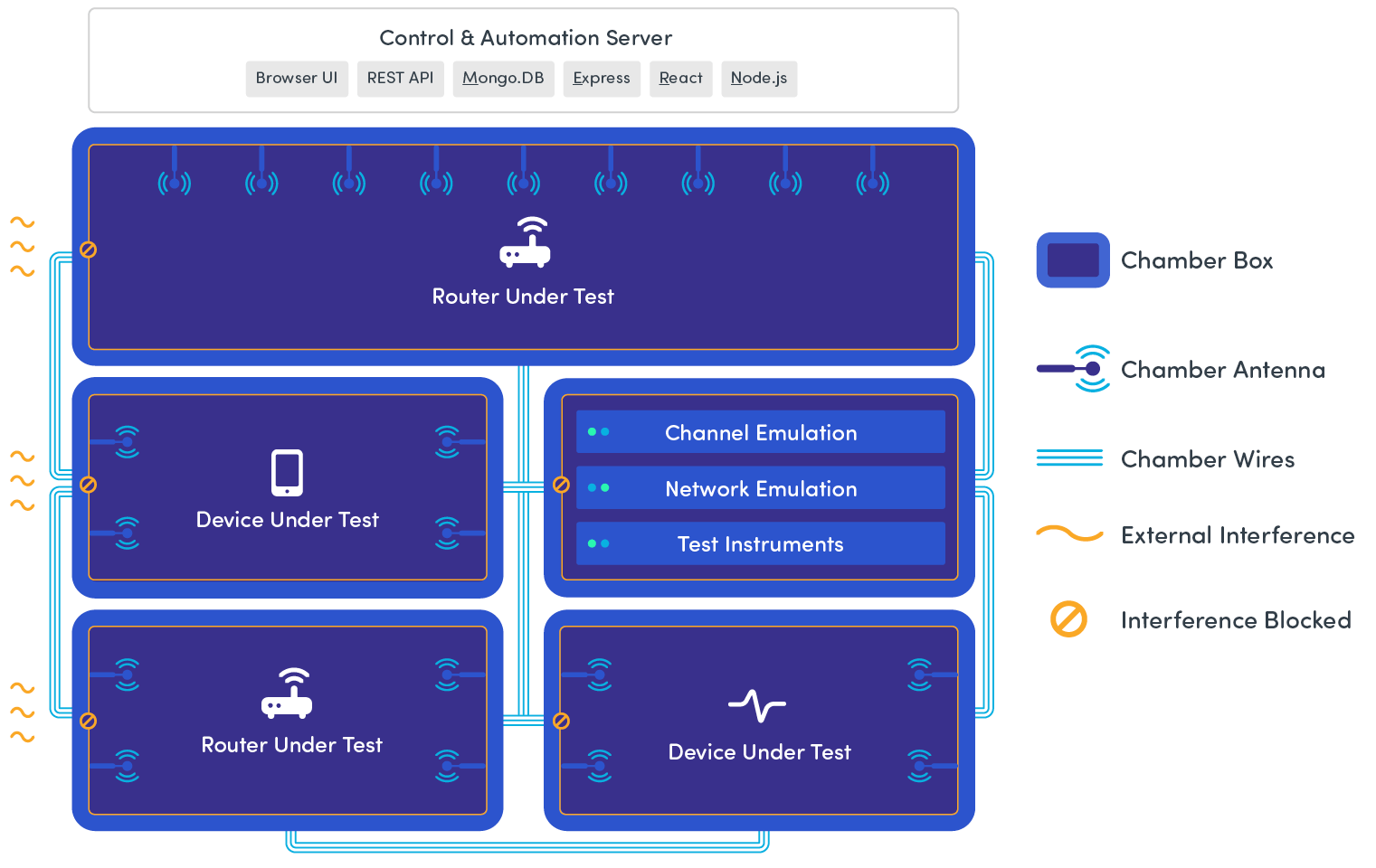
Streamlining Wi-F 6 testing requires a modular approach that allows automated testbeds consisting of isolation chambers, antennas, emulators and test instruments to be rapidly configured and deployed.
Today, Wi-Fi chipset, access point, residential gateway and connected device vendors rightly place a premium on automation and ease of integration to existing systems when selecting Wi-Fi testbeds. In response, a comprehensive testing solution must support automated benchmarking of product performance and validation of functionality and scalability, while presenting simple interfaces and options for integration with existing lab automation.
On the service provider side, operators offering a Wi-Fi service place a high value on automation and ease of use when selecting Wi-Fi testbeds. Their focus is on home and business network environments that “just work” and provide high levels of service that reduce call center inquiries, truck rolls and churn. Delivering this experience at scale to upwards of millions of customers for a range of environments means automated test and assurance processes are a must. In enterprise environments, SLAs for Wi-Fi will increasingly become a reality and pre-deployment testing will go a long way toward ensuring service providers meet promises. From device performance validation and vendor selection to pre-deployment testing, software upgrade testing and recreation of field issues for problem solving, automation will be the common denominator amongst successful Wi-Fi 6 deployments.
The path ahead for better Wi-Fi testing
Modular solutions capable of generating highly-realistic traffic, authentically replicating a range of deployment environments, reducing traditional complexity headaches and supporting automated, repeatable testing scenarios represent the new must-haves for Wi-Fi testing. With octoScope now part of the Spirent family of test solutions, we’re better positioned than ever to offer the industry a one-stop shop for these must-haves, while pursuing octoScope’s original mission of streamlining Wi-Fi testing with a renewed sense of purpose and urgency.

Best effort. That about sums up expectations of Wi-Fi among daily users. In the coffee shop? Airport? The park? Our homes? We take what we can get. Some networks are better than others, but in the end, it’s always been “just Wi-Fi.”
Lately, the emergence of use cases for work from home (WFH), small business, hospitals, factories, and IoT, and the onslaught of Covid, has elevated the importance of Wi-Fi, pushing it into the role of global wireless workhorse for our generation, and we expect, for the future. Yet, for all the performance demands being placed on Wi-Fi, it is tested infrequently and inconsistently. This stands in stark contrast to mobile networks, which are tested extensively by operators.
But this is changing. The rapid evolution of use cases, introduction of Wi-Fi 6/6E, rivaling 5G tech and Wi-Fi’s anticipated convergence and harmonization with 5G represent a sea change. The latest tech advancements see Wi-Fi all grown up, with new responsibilities and expectations, and all the complexities of a mature, sophisticated technology. Especially for indoor environments, Wi-Fi 6/6E has the potential to rival what 5G can deliver, at a fraction of the cost.
Considering the COVID-19 impact on Wi-Fi in the wireless ecosystem – which won’t likely change post-pandemic – service providers (SPs) will need to “up their game” to deliver the performance and QoS required to continue the productivity gains and economic trends established pre-pandemic. But offering bulletproof performance requires operators to adopt unprecedented, advanced testing and validation strategies.
In this new era of Wi-Fi, there’s no more room for error. Performance issues won’t just get a shoulder shrug. They’ll impact business revenues. Degrade user experiences. They’ll affect the bottom line. Meanwhile, competitive pressures will intensify at an accelerating velocity. Speed to market for a host of new devices with expanded feature sets will drive competitive battles. Just as importantly, it will necessitate a completely new approach to testing.
“Competitive pressures will intensify at an accelerating velocity. Speed to market for a host of new devices with expanded feature sets will drive competitive battles. Just as importantly, it will necessitate a completely new approach to testing.”
Goodbye disaggregation, hello results
In a previous post, octoScope founder (and now Senior VP of Wi-Fi Products with Spirent) Fanny Mlinarsky, discussed the rising urgency to streamline and automate Wi-Fi testing. Homegrown, multi-vendor testing shops based on garden-variety test products just weren’t meant for scale. Originally, within the more confined requirements of Wi-Fi’s earlier incarnation, they got the job done. But now, with Wi-Fi 6 and Wi-Fi 6E offering customers 5G speeds and latency, based on a new set of standards, it’s a non-starter.
Today, Spirent recognizes a critical opportunity to evolve from slow and expensive DIY testing to turnkey, configurable Wi-Fi test suites that deliver a seamlessly integrated testbed. All without prohibitively large and expensive chambers typically employed for performance testing that comprised previous approaches.
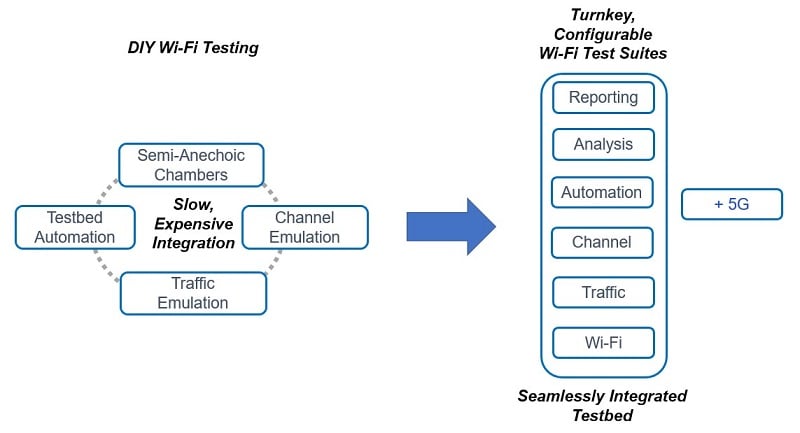
Evolution to a unified approach to Wi-Fi testing
It should be noted that a unified solution does more than just streamline processes – it impacts business outcomes.
Moving ahead, operators and device makers don’t want to buy test equipment – they want to buy results. And they need them as quickly as possible. Testing is emerging as not just a checkpoint before launch, but a driver of innovation itself. Wi-Fi 6 won’t be possible with a best-effort approach. It must be about maximizing performance results and getting them to market rapidly with advanced unified solutions.
Wi-Fi testing strategies for success
Spirent recognizes five key strategies for Wi-Fi 6 testing that merit serious consideration:
Wi-Fi’s new role in WFH, along with new use cases for small business, hospitals, factories, IoT, and Wi-Fi 6’s promise, all represent a world of opportunity where this ubiquitous connectivity tech finally stands on its own as a highly capable, and highly performant solution for complex devices, services and access environments. But Wi-Fi’s full potential can only now be achieved with an evolved and holistic advanced test strategy that mirrors the ambitions of the technology itself.
octoBox software 2.0 brings new dashboard mode, improved graphics and multiPerf® traffic tool
The new software leverages the power of parallel databuses and processing built into all the octoBox testbeds, allowing them to be used for emulation of multipoint-to-multipoint test scenarios involving dozens of real devices, while providing real-time feedback of the test progress and results.
Fanny Mlinarsky, founder of octoScope, and Senior Vice President of Wi-Fi Products at Spirent, said “octoBox software 2.0 greatly improves the productivity of the wireless test engineer and solidifies octoScope’s position as the easiest to use testbed in the Wi-Fi industry.”
octoScope is a Spirent company.
Enables easy and quick deployment of new test scripts and development of customized test automation
This increasing complexity in test management drives the need for an easier way to deploy test scripts across testbeds. Instead of installing scripts on each server, scriptMachine allows running these scripts on any testbed or on multiple testbeds at once. The scriptMachine comes with Python libraries and script examples, making it easy for customers to develop their own customized test automation sequences.
“The scriptMachine makes our octoBox testbeds easier to use and easier to automate,” said Fanny Mlinarsky, President of octoScope.
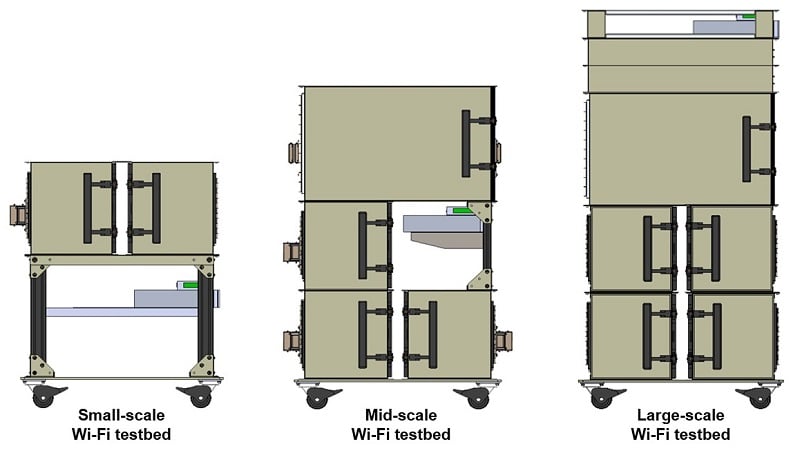
Stackable and configurable, octoBox personal testbeds are completely isolated from external interference and can be used at an engineer’s office or lab bench.
Each octoBox testbed is controlled by a dedicated Node.js web server accessible via a browser UI for manual control, or via REST API for test automation. The server provides the time base for the testbed and controls the built-in instruments, DUT configuration, traffic, and test flow. Test results are saved in a MongoDB database, enabling multiple teams to easily collaborate by sharing the test automation scripts and test results.
octoScope is a Spirent company.
Combination that firmly establishes Spirent as the Wi-Fi test leader
London, UK – 5 March 2021 – Spirent Communications plc (LSE:SPT), the leading provider of test, assurance, and analytics solutions for next-generation devices and networks, today announces that it has acquired octoScope, Inc (octoScope) from the founder Fanny Mlinarsky, management and other investors, for an initial cash consideration of $55 million on a debt and cash free basis, with an additional consideration capped at $18 million based on annual revenue growth targets for 2021 and 2022 and retention of key staff. The acquisition will be funded from existing cash resources.
Founded in 2006, octoScope is a US-based technology company that provides market-leading accurate, repeatable and automated wireless test solutions and methodologies to the wireless industry. Its test solutions leverage patented technology to provide automated Wi-Fi and 5G testing in emulated real-world environments, including the latest Wi-Fi 6 and 6E technologies. octoScope’s products are used by a blue-chip roster of leading global communication service providers, chipset, device, network infrastructure and Wi-Fi equipment vendors including: Google, Facebook, Verizon, Qualcomm, Nokia, Amazon, Philips and Sony.
This complementary acquisition is in line with Spirent’s targeted investment and M&A plans outlined at its Capital Markets Day in October 2020, securing a broader assurance opportunity and expanding our diversified customer base. octoScope will be incorporated into our Lifecycle Service Assurance operating segment along with our emerging Wi-Fi revenue stream currently residing in our high-speed Ethernet business within the Networks & Security operating segment.
The gross assets of octoScope at 31 December 2019 were $11.6 million. Revenue in the year to 31 December 2019 was $17.4 million and profit before tax was $4.5 million. Revenue grew to around $20 million for 2020, subject to audit. The business has a history of delivering robust growth and we expect that to continue.
Wi-Fi sits alongside 5G as a critical next-generation wireless access technology. With the explosive growth in the Internet of Things, the emergence of new mission-critical use cases in sectors such as healthcare and industry, and expansion of applications including fixed wireless access and Wi-Fi offload, the importance of reliable and secure Wi-Fi is greater than ever. Wi-Fi applications continue to grow on the back of a robust technology roadmap (Wi-Fi 6/6E/7), the rise in remote working and expansion into new frequency bands around the world.
Spirent already has a strong position in the Wi-Fi and 5G test markets and the combination of octoScope with our existing portfolio firmly establishes Spirent as the Wi-Fi test leader. It also provides opportunities to extend the capabilities of our 5G solutions and offer new and differentiated services to our customers through our global channels.
Commenting on the acquisition, Eric Updyke, Chief Executive Officer, said: “Having firmly outlined our M&A intentions at our Capital Markets Day in October, I am delighted to welcome octoScope to the Spirent family. The need for reliable and secure Wi-Fi is greater than ever and our teams look forward to working together to address an increasing range of complex Wi-Fi challenges for our customers.”
“This acquisition supports our strategy of sustainable, profitable growth by establishing Spirent as the firm market leader in the expanding Wi-Fi space, adding to our 5G solution portfolio. octoScope brings to us an impressive and well-known customer base, providing us with the opportunity to further leverage our established global routes to market and trusted relationships with our key accounts.
November 23, 2020 · 3 min read

Compliance to local regulations, such as FDA 510k certification and IEEE/ANSI Wi-Fi C63.27 standard in the US, require medical device manufacturers to ensure the functionality and safety of their devices through rigorous testing. In addition, healthcare facilities must test their Wi-Fi network regularly to:
A joint cybersecurity advisory, coauthored by the Cybersecurity and Infrastructure Security Agency (CISA), the Federal Bureau of Investigation (FBI), and the Department of Health and Human Services (HHS) was issued on Oct 28, 2020, and shared the following findings:
Similar concerns were echoed by the INTERPOL Secretary General Jürgen Stock in early 2020:
“As hospitals and medical organizations around the world are working non-stop to preserve the well-being of individuals stricken with coronavirus, they have become targets for ruthless cybercriminals looking to make a profit at the expense of sick patients.”
Unfortunately, there has been an increased number of cases, which resulted in various forms of services interruptions at hospitals and clinics, even to an extent that critically ill patients had to be re-routed to other facilities, globally. With this backdrop, it is more vital than ever that healthcare providers assess their network’s vulnerability, perform network penetration testing, including compliance testing of Wi-Fi security protocols (e.g. WPA3, WPA2) and web authentication like secured use of Captive Portals.
As Wi-Fi coverage becomes mission critical for patient care and workflows, it is important to ensure healthcare provider Wi-Fi networks are up to the tasks. Yet improving and optimizing Wi-Fi network and device performance for unique healthcare provider deployment scenarios can be complex.
Learn about the latest test solutions for Wi-Fi turn up services and solutions specifically designed with healthcare providers in mind, including emulating hospital environments in a lab.
November 17, 2020 · 4 min read

A recently published Spirent eBook on the impact of COVID-19 on the Wi-Fi ecosystem discussed the effect of underlying factors such as the economy, business, government and consumer-behavior on Wi-Fi deployments and testing. While certain Wi-Fi market segments such as large public venues (LPV) and hospitality are still struggling to recover, the healthcare industry is facing altogether different challenges.
According to a recent report from Frost and Sullivan (April 2020), “Telehealth market in the US is estimated to display a staggering seven-fold growth by 2025, resulting in a five-year compound annual growth rate (CAGR) of 38.2%. In 2020, the telehealth market is likely to experience a tsunami of growth, resulting in a year-over-year increase of 64.3%.”
The World Health Organization (WHO) defines Telehealth as the “delivery of health care services, where patients and providers are separated by distance. Telehealth uses ICT for the exchange of information for the diagnosis and treatment of diseases and injuries, research and evaluation, and for the continuing education of health professionals.”
“Wi-Fi 6 helps solve the different challenges the healthcare industry is facing.”
Wi-Fi has been the preferred wireless technology of choice for decades in hospitals and clinics, globally. This is primarily because Wi-Fi offers technical advantages in indoor environments, and often, it’s the most cost-effective option for healthcare providers. As a result, an increasing number of medical devices enabled with Wi-Fi technology are entering the healthcare industry each year, ranging from simple applications to mission critical real-time applications (e.g. ubiquitous access to patient medical records).
With stringent regulatory requirements such as FDA 510k certification for product introduction in the U.S., patient safety and privacy concerns (e.g. HIPAA in the U.S., GDPR in Europe), and the need to provide patient care around the clock (24/7/365), it is understandable that new technology adoption takes longer for the healthcare industry. However, the various new features and promises offered by Wi-Fi 6, are providing a great motivation for healthcare providers to think seriously about upgrading their devices and networks.
Wi-Fi 6 offers several benefits over legacy standards such as Wi-Fi 5/4. Key features include Orthogonal Frequency Division Multiple Access (OFDMA) for Downlink and Uplink (DL/UL), Multi-user Multiple Input and Multiple Output (MU-MIMO) for DL/UL, Target Wake Time (TWT) among others.
Coupled with the latest security standard by the Wi-Fi Alliance (WFA) Wi-Fi Protected Access 3 (WPA3) for Enterprise, Wi-Fi 6 enables healthcare providers to benefit from a reliable, efficient, and secured Wi-Fi connection for patient care and clinical workflows.
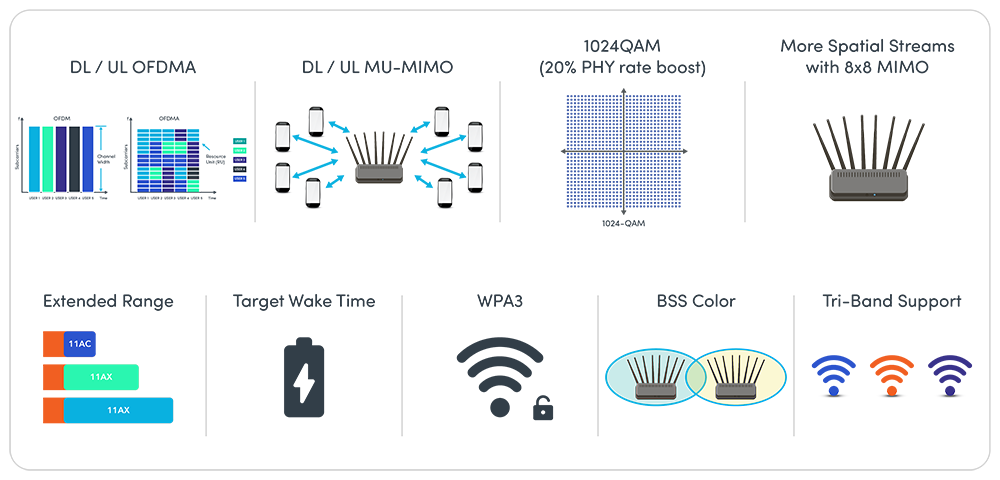
Key Wi-Fi 6 features
In addition, Wi-Fi 6 is backward compatible, enabling legacy clients to co-exist with the latest Wi-Fi 6 devices. This is particularly important in healthcare facilities, where thousands of devices from various Wi-Fi generations are served by the same network at any given time.
In the sequel to this blog, we will take a closer look at Wi-Fi device and network testing considerations for healthcare providers.