
EAP and Seamless Access with SIM Authentication
Seamless Access with SIM Based Authentication
A key component of Wi-Fi offloading is SIM-based authentication, which provides a seamless, secure Wi-Fi experience comparable to cellular networks. This section will examine the mechanics of SIM authentication from a standards perspective. The 3GPP AAA server plays a central role in SIM authentication for 3G, 4G, and 5G networks using the 5G non-standalone architecture (5G NSA), which relies on the existing Evolved Packet Core (EPC) from 4G. However, as we will discuss later, real-world implementations often require capabilities beyond the standard 3GPP AAA function.
The 5G standalone architecture (5G SA) introduced some changes to how SIM-based authentication works for Wi-Fi access (untrusted and trusted non-3GPP Access) compared to previous generations. In 5G SA, no 3GPP AAA server is specified. Instead, the authentication process for Wi-Fi access using SIM credentials is more tightly integrated with the 5G core network and distributed across multiple core network components. Looking ahead, the 3GPP AAA may evolve into a comprehensive bridging function, providing unified management for Wi-Fi access across all generations of cellular networks. SIM Authentication for Wi-Fi Access in 3G, 4G and 5G NSA
The 3GPP AAA server, exemplified here by the Enea Aptilo SMP, plays a crucial role in SIM authentication for 3G, 4G, and 5G NSA networks. It securely manages the authentication process by integrating with the mobile core to verify the device’s credentials. Free Wi-Fi at restaurant SIM Authentication for Untrusted Wi-Fi Access in 3G, 4G and 5G NSA Networks
Untrusted non-3GPP Access is used for Wi-Fi networks that the mobile operator does not trust. This is why this is the access method of choice for Wi-Fi Calling, which must be available wherever there is a Wi-Fi network. Note that the 5G non-standalone (5G NSA) networks use the same mobile core (EPC) as 4G.
The user device is already assumed to be onboarded to the Wi-Fi network, for instance in a home, office or public hotspots. So, SIM authentication has nothing to do with security or login to the Wi-Fi network. Instead, SIM authentication is used to authenticate and authorize the user device to access the mobile core through an IPsec tunnel. The keys for setting up the IPsec tunnel are derived from the SIM authentication process.
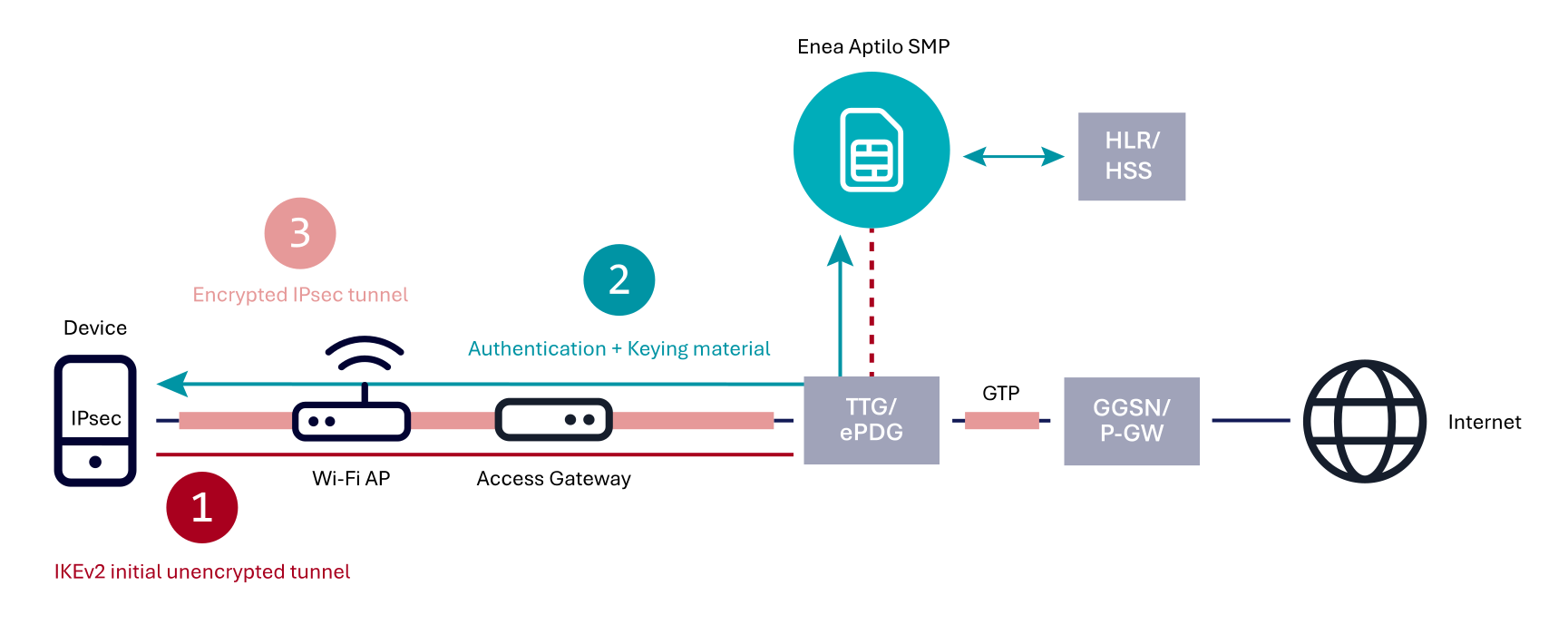
EAP SIM-AKA in 3G/4G/5G NSA untrusted 3GPP access (Wi-Fi)
Trusted secure Wi-Fi. SIM Authentication for Trusted Wi-Fi Access in 3G, 4G and 5G NSA Networks
In Wi-Fi networks, the 3GPP AAA serves a dual purpose for trusted non-3GPP access.
The user gets internet access through the local gateway, as shown in the picture below (the most common scenario). The traffic can also be backhauled to the mobile core using the 3GPP-specified trusted WAG/TWAG gateway functionality with an optional local traffic breakout.
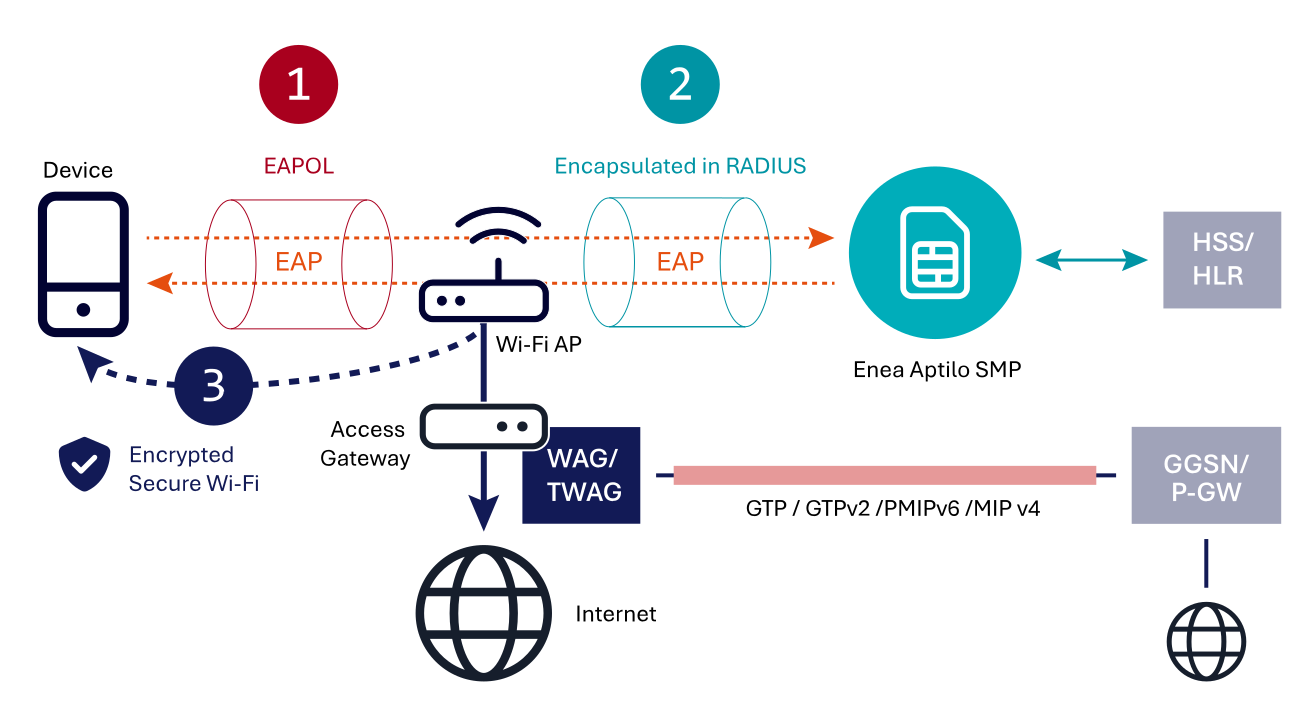
EAP SIM-AKA in 3G/4G/5G NS trusted non-3GPPP access (Wi-Fi)
SIM Authentication for Wi-Fi Access in 5G SA
Today (November 2024), relatively few 5G networks (50-60 networks) are utilizing the 5G standalone (5G SA) architecture, but this architecture will grow in importance over time. The authentication process for non-3GPP access, such as Wi-Fi, is more unified with the cellular authentication process, which introduces new technical challenges. One of these is how to be able to use Non-Access Stratum (NAS) signaling over Wi-Fi. The EAP-5G protocol has been introduced to encapsulate NAS messages to go over Wi-Fi through an IKV2 connection. So, EAP-5G is not an authentication protocol, which can be a bit confusing at first look. SIM Authentication for untrusted Wi-Fi Access in 5G SA Networks
The principles are the same as for untrusted Wi-Fi access towards the Evolved Packet Core (4G/5G NSA). The user is assumed to be already onboarded to the Wi-Fi network, and security is enforced by having an IPsec tunnel between the device and the mobile core.
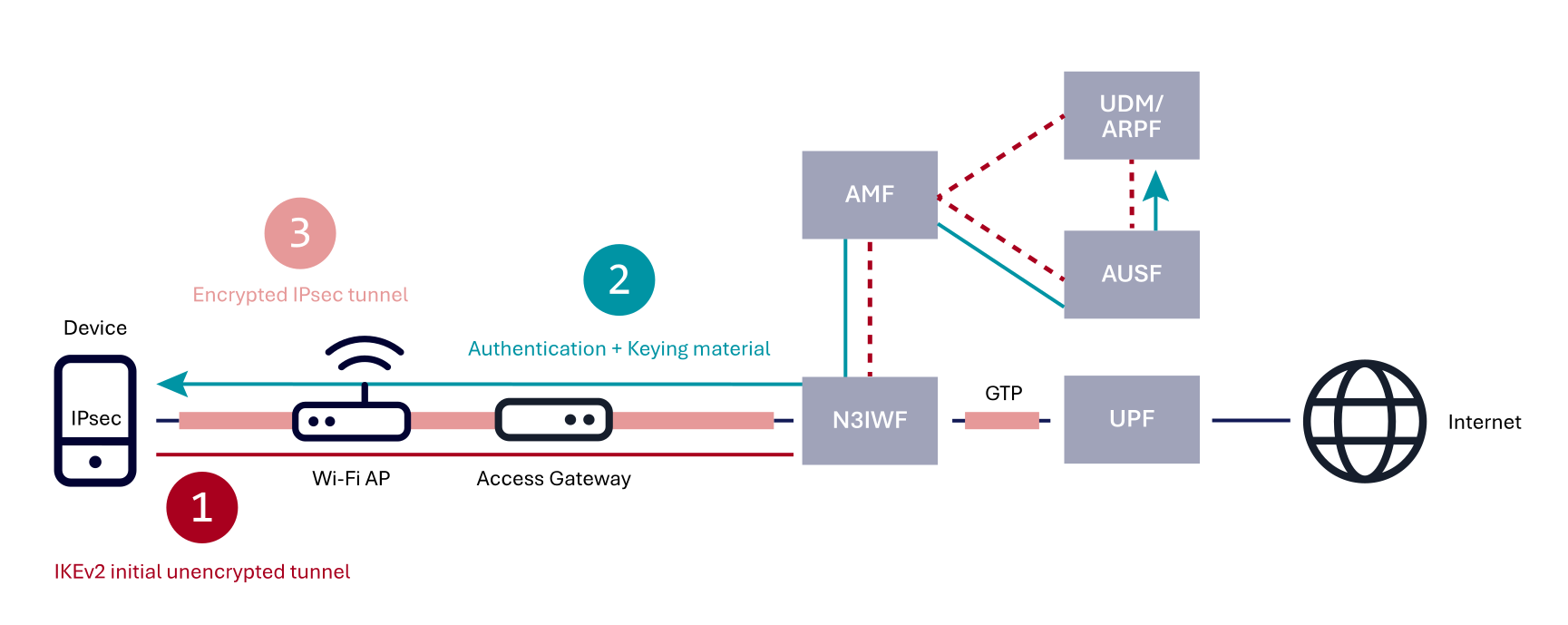
EAP-SIM in 5G standalone architecture for untrusted 3GPP access (Wi-Fi)
SIM Authentication for Trusted Wi-Fi Access in 5G SA Networks
The authentication process is very similar to the process for untrusted Wi-Fi access, with some important exceptions:
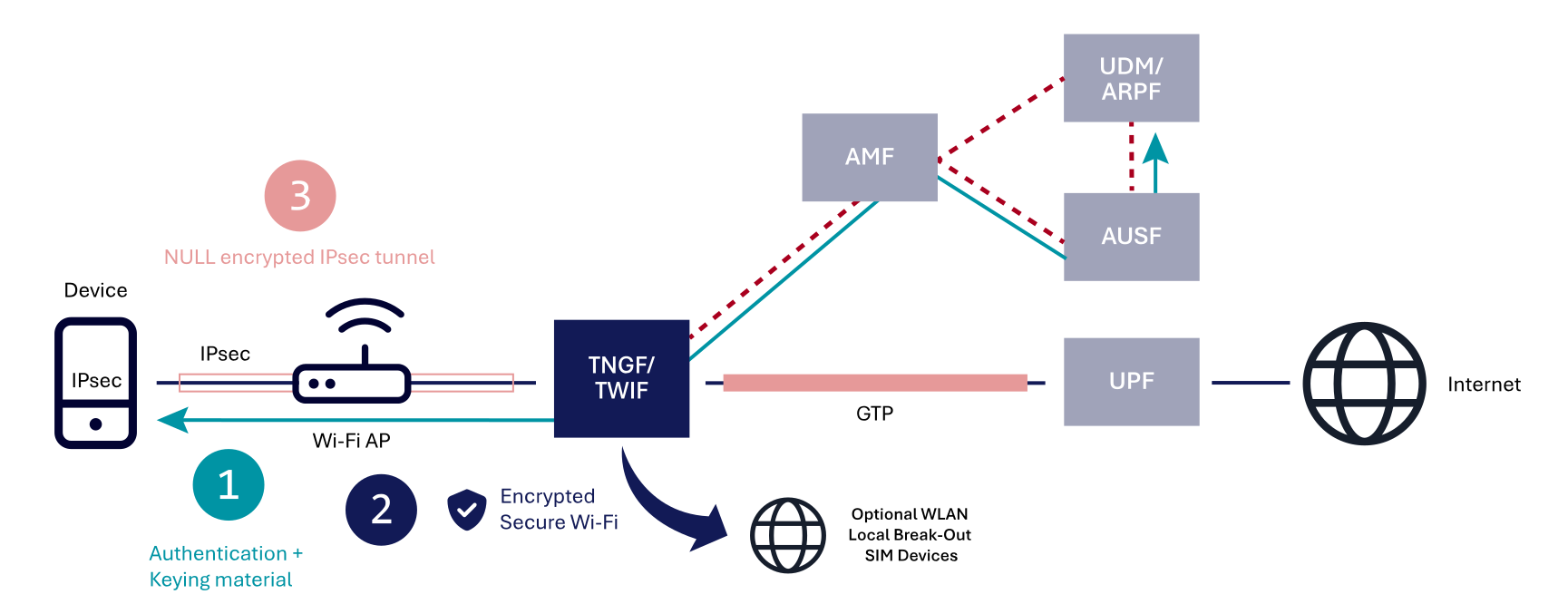
EAP-AKA in 5G-standalone architectures for trusted 3GPP access (Wi-Fi)
Bridging the 3GPP Standard with Real-World Solutions
While the outlined flows above reflect 3GPP standards for SIM authentication, practical network implementations often favor pragmatic, hybrid approaches due to existing network design, equipment and investments. In real-world deployments, the RADIUS protocol—widely used in Wi-Fi and various gateways—will likely continue to play a significant role alongside emerging 5G standards and protocols.
Historically, many 3GPP-specified interworking gateway functions for Wi-Fi (non-3GPP Access) have not seen widespread adoption for Wi-Fi offloading. For example, in 4G with the Evolved Packet Core (EPC), the tunnel-terminating ePDG gateway has primarily been used for Wi-Fi Calling rather than Wi-Fi offloading. Wi-Fi Offloading
Unified SIM-authentication for 3G, 4G,5G NSA and 5G SAFor Wi-Fi offloading in trusted Wi-Fi network environments, there has been limited demand for the WAG/TWAG to backhaul traffic to the EPC mobile core. In fact, the vast majority (around 90%) of Enea’s Wi-Fi offloading customer deployments opt to route traffic directly to the internet via a non-3GPP gateway, bypassing the mobile core. We foresee a similar trend in 5G SA, with a strong preference for local traffic breakout. Backhauling traffic through the mobile core only offloads the radio network (RAN), while local breakout delivers a more efficient solution by directly handling traffic at the edge.
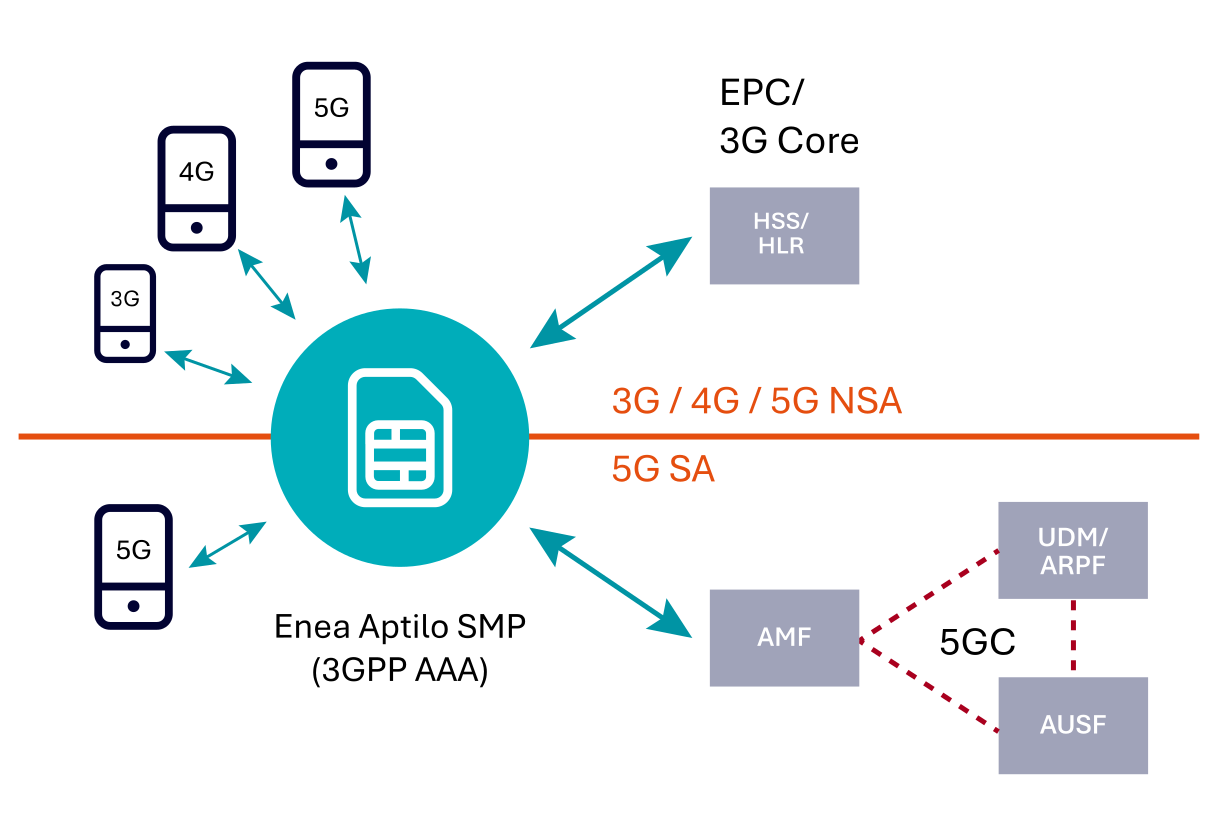
In this context, the 3GPP AAA is expected to evolve and take the role of SIM-based authentication (control plane only) also in 5G SA, effectively offering a unified SIM authentication function across all generations of cellular networks. This evolution would give mobile operators a streamlined and pragmatic architecture, capable of handling SIM authentication seamlessly across both 4G and 5G core networks. Wi-Fi Calling
For Wi-Fi Calling utilizing untrusted Wi-Fi access in 5G SA, the N3IWF function will still be required. One potential scenario is the adaptation of the 3GPP AAA function as a “bridging function” within the authentication flow for Wi-Fi Calling. Mobile Network Operators (MNOs) often prefer leveraging established, proven technologies over quickly adopting new standards when practical alternatives exist. It’s important to note that the N3IWF is only a reference in the 3GPP standard and not a specific gateway product. An adaptive authentication server (3GPP AAA), like Enea’s Aptilo SMP, could potentially evolve to integrate with the 5G SA core for control plane authentication while the existing ePDG gateways manage the N3IWF roles within the traffic plane. The same scenario could also happen for trusted access, with the existing WAG/TWAG gateways taking over the TNGF/TWIF functions in the traffic plane. These scenarios would require cooperation between the 3GPP AAA and gateway vendors.