
“AI infrastructure is no longer a one-size-fits-all proposition. Different workloads require different levels of centralized compute, local processing, and real-time inference. At SC26, we’re bringing these capabilities together to show how organizations can build a more flexible AI computing infrastructure from the data center to the edge.”
Scalable AI Performance from Data Center to Edge Servers
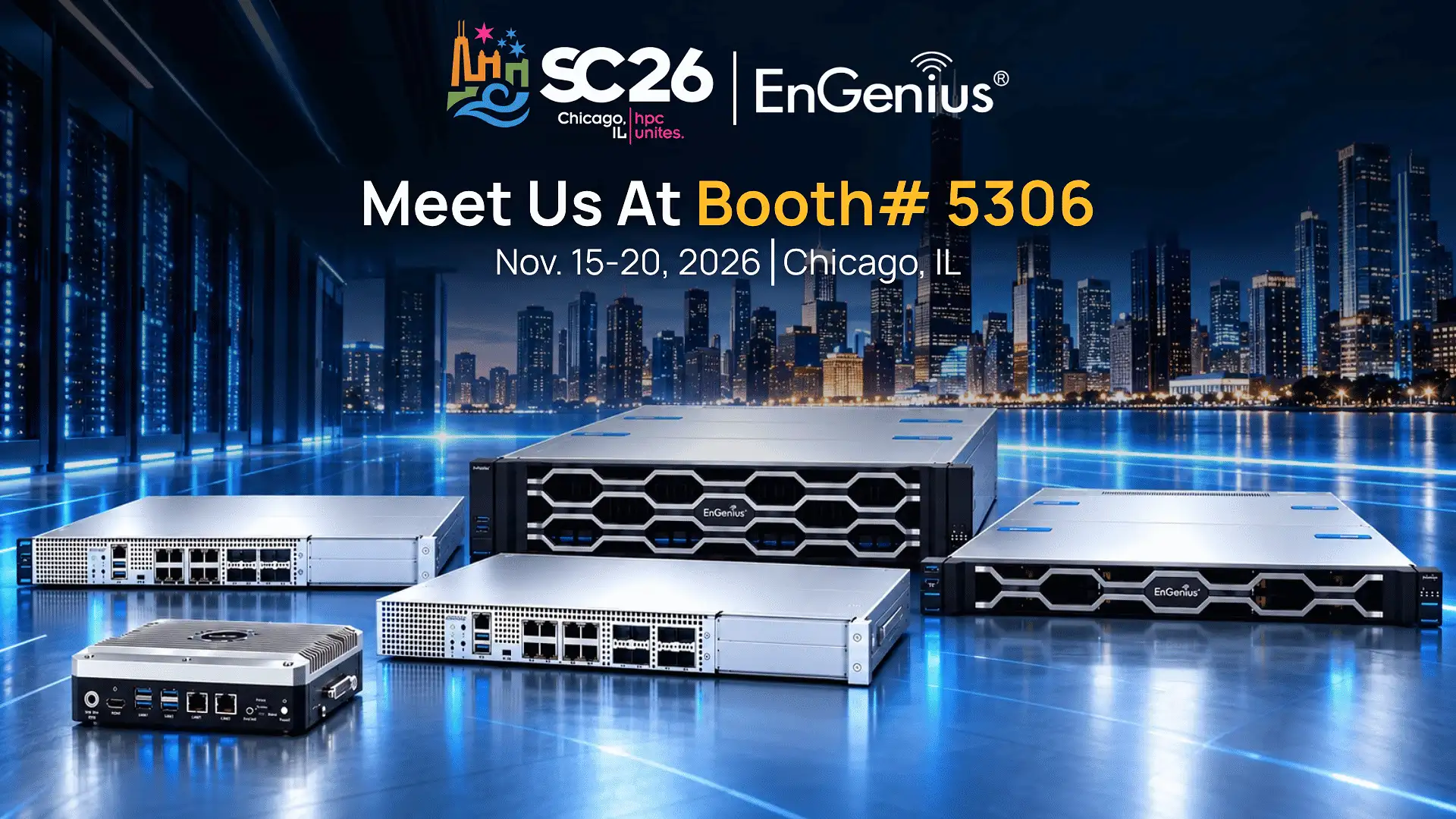
The EnGenius Data Center Server Series, including the S11, S21, and upcoming S41, is engineered for demanding AI, HPC, virtualization, and data-intensive workloads. Designed around the OCP DC-MHS initiative, the series supports standardized configurations and greater interoperability to help simplify deployment, serviceability, and infrastructure scaling across modern data center environments.
Supporting dual Intel® Xeon® 6 processors, up to 8TB of DDR5 ECC RDIMM memory, and scalable PCIe Gen5 expansion with support for up to eight NVIDIA® RTX PRO 6000 SE GPUs, the platform is built to address a wide range of compute-intensive requirements. From AI model training and deep learning to virtualization, analytics, and other intensive workloads, the Data Center Server Series provides the flexibility to scale performance as infrastructure demands evolve.
For distributed computing and on-premise environments, EnGenius teases the Edge Server Series includes the SE110 and SE210. Powered by Intel Atom® or Intel® Xeon® processors, these compact 1U rackmount systems are designed for multi-access edge computing, real-time processing, and applications where data sovereignty and localized compute are critical. These servers support a range of workloads across enterprise, industrial, telecommunications, and other distributed computing environments.
Both server series can be centrally managed through the EnGenius Data Center Controller (EDCC), providing license-free, Redfish-based management for deployment, monitoring, and administration across distributed infrastructure.
AI infrastructure is no longer a one-size-fits-all proposition. Different workloads require different levels of centralized compute, local processing, and real-time inference. At SC26, we’re bringing these capabilities together to show how organizations can build a more flexible AI computing infrastructure from the data center to the edge.
— Roger Liu, CEO at EnGenius Technologies
Bringing AI Inference Closer to the Data Source
The EnGenius AI Box Series brings accelerated AI processing directly to the data source. Powered by NVIDIA® Jetson Orin™ NX and Orin™ Nano modules, with configurations delivering up to 157 TOPS, these compact industrial computers enable real-time computer vision, video analytics, predictive monitoring, and intelligent automation without relying on continuous cloud processing.
Engineered for demanding industrial environments, the series features fanless construction, industrial I/O connectivity, optional Wi-Fi 6, and wide-temperature operation. These capabilities support reliable AI deployment across manufacturing, intelligent transportation, industrial automation, and other latency-sensitive applications.
Supporting Real-World AI Applications
Together, EnGenius computing platforms enable organizations to allocate workloads where they perform best: intensive processing in the data center, localized computing at the network edge, and real-time inference at industrial endpoints. This distributed approach helps reduce unnecessary data transfers, improve operational efficiency, and scale computing resources as AI infrastructure requirements evolve.