Network demands are surging as businesses adopt AI across more applications, branches, and cloud environments. At the same time, networking and security teams are under growing pressure to protect distributed users, devices, applications, and data—without adding more operational complexity.
In today’s distributed, cloud-first environments, legacy overlay security can’t protect high-bandwidth AI workloads, remote users, hybrid branches, and dynamic data flows.
To safely scale AI initiatives while protecting corporate data and preventing data leakage—and without overwhelming already-stretched IT teams—growing businesses need embedded network security, infusing protection into the network itself.
AI and agentic workloads demand massive bandwidth and create complex, unpredictable traffic patterns. Data now flows dynamically across hybrid environments, remote branches, cloud applications, and multicloud infrastructures. In fact, a single agentic task generates 450% more traffic than a human doing equivalent work. Securing that movement requires a more agile, intelligent network.
At the same time, attackers are using AI to increase the volume, speed, and sophistication of cyberattacks. Phishing campaigns are now hyper-personalized, malware is adapting to evade detection, and automated bots are probing networks for weaknesses at an unprecedented scale.
AI-era threats require AI-assisted network and security operations. By integrating AI directly into network devices and leveraging AI-enabled SecOps tools, networking and security teams can move from reactive firefighting to faster detection, prioritization, troubleshooting, and response. This can help growing businesses adopt AI with more operational confidence, while helping lean teams reduce manual investigation and contain risk faster.
Traditional overlay security adds appliances and software to existing infrastructure. This often creates more operational complexity: fragmented visibility, disjointed consoles, inconsistent policy enforcement, and bottlenecks that can slow performance.
Some businesses may look into upgrading a firewall appliance or investing in new routers, but with this add-on approach, traffic may need to be routed out of its way to a security checkpoint and back again. That added latency and complexity can be especially challenging for AI workloads, distributed users, and cloud-first environments.
Embedded network security changes the model. Instead of treating security as a separate layer, protection is integrated across the network fabric itself, including routing, switching, wireless access, cloud access, and identity-aware controls. The network becomes a point of visibility, intelligence, and enforcement.
In this model, every node becomes both a sensor and an enforcer, and every connection becomes a point of visibility and control.
Moving away from fragmented point solutions and adopting a secure networking model can help reduce operational complexity, improve resilience, and give lean IT teams more consistent control across distributed environments.
The Cisco approach to secure networking is a model that can support business continuity, modernization, and scale without a linear increase in tools or manual work.
Secure networking starts by embedding protection into the infrastructure, not bolting it on piecemeal. Cisco 8000 Series Routers with built-in Cisco firewall provide protection at the WAN edge, helping organizations secure distributed environments and support cloud-managed security. Cisco Wi-Fi 7 and Cisco Smart Switches extend embedded security directly into campus and branch infrastructure, where users, devices, and applications connect.
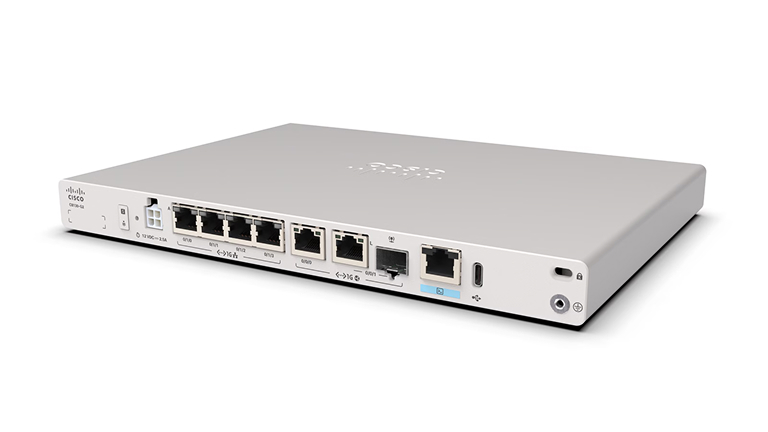
Cisco Multicloud Fabric (announced at Cisco Live 2026) helps IT connect sites directly to clouds and cloud-to-cloud with built-in security, end-to-end visibility, and a fabric that scales with AI workloads.
These solutions help IT teams gain visibility and enforce policy closer to where activity begins, whether supporting remote employees, securing branch connectivity, or protecting regulated environments where consistent access control and uptime are critical.
The agentic AI era requires a network that can support true innovation while defending against rapidly evolving threats. At Cisco Live 2026, the secure harness for agentic AI was announced: Cisco Cloud Control.
Cisco Cloud Control is an AI-native management solution for orchestrating and securing enterprise IT infrastructure. Cisco Cloud Control gives humans and agents a unified operations platform that brings every Cisco domain and third-party tool into one environment—one login, one view, one operating model.
Cisco also delivers AI tools to enhance security operations. Cisco AI Assistant and AI Canvas make ops more actionable by helping teams detect threats faster, simplify management, and respond more effectively. These capabilities can reduce the burden on lean IT teams by making complex network and security tasks easier to understand and act on.
With intelligence built into the operating model, teams can move from manual investigation and reactive troubleshooting to more proactive, AI-assisted operations.
Firewalls remain essential, but modern security can no longer rely on firewall-centric thinking alone. Users, devices, applications, and data now operate across branch locations, cloud services, software-as-a-service (SaaS) platforms, remote environments, and hybrid infrastructures.
Cisco’s approach to secure networking goes beyond the firewall by integrating protection across routing, access, and cloud environments. Secure routers and firewalls help protect traffic moving between sites, clouds, and users while SASE extends identity-aware protection to cloud applications and remote users.
This equips IT teams with consistent control across WAN edge, campus, branch, cloud, and remote access environments.
In distributed environments, trust cannot be assumed based on location. A user in the office, a remote employee, a branch device, and a cloud application all need consistent, identity-aware access control.
Cisco Access Manager enables unified access control across users, devices, and applications. It helps organizations verify who and what is connecting, apply appropriate policy, and reduce the risk of unauthorized access.
Together with Cisco SASE for Meraki, organizations can extend secure, identity-aware access to remote users and cloud applications without multiplying management tools.
For many growing businesses, the biggest security challenge isn’t just the number of threats. It’s the number of tools required to manage them.
Cisco helps simplify operations through a unified platform that brings networking and security together across routers, firewalls, wireless, switches, access control, SASE, and AI-powered operations. This integrated approach helps lean IT teams maintain high performance and strong security while reducing complexity.
Policies can be applied more consistently. Visibility improves across users, devices, branches, and clouds. AI-assisted capabilities help teams investigate, troubleshoot, and respond faster. The result? Integrated security and network performance that lean teams can manage more consistently across distributed environments.
For teams building a business case, the Cisco secure networking model can also support tool consolidation and operational efficiency discussions.
As a maritime technology company helping the shipping industry improve vessel efficiency and reduce emissions, Silverstream Technologies depends on digital collaboration and dependable access across a growing global business.
For a company focused on serving customers across a complex maritime ecosystem, the network is more than infrastructure. With the Cisco Meraki dashboard and Cisco Secure Client, Silverstream strengthened the technology foundation needed to support its operations, connect teams, and scale securely.
The company now enforces consistent policies, encryption, and monitoring across all facilities and remote connections—including a London HQ with more than 1600 detectable wireless networks.
Silverstream’s secure, cloud-managed Cisco network also helps it achieve ISO 27001 certification by adhering to the rigorous data protection standards demanded by the world’s leading shipbuilders.
YMCA of Niagara is a mission-driven organization with a goal to deliver better digital experiences across distributed locations. Supporting multiple facilities, programs, staff, members, and guests requires reliable connectivity and simplified IT operations.
With Cisco Meraki switches and SD-WAN appliances, YMCA of Niagara transformed their network foundation to better support secure access and consistent connectivity across community environments. Thanks to the Cisco Premier Breach Protection Suite, YMCA of Niagara deploys threat detection and response across network, cloud, endpoint, and email, with integrated tools like XDR Premier and Cisco Secure Email Threat Defense combined with 24/7 managed services.
By moving to the centralized Cisco Meraki dashboard, their IT team is now spending less time managing complexity and more time supporting the services and experiences people rely on. They have achieved an 80%+ decrease in mean time to resolution (MTTR) and 70% reduction in support incidents with Cisco.
The AI era has rewritten the rules of enterprise technology. To keep pace with business demands while defending against automated, intelligent threats, organizations can no longer rely on fragmented, bolt-on security tools.
The future belongs to those who build security from the ground up. By unifying networking and security into a single embedded architecture, IT teams can simplify daily operations, reduce complexity, and build more consistent availability, policy control, and operational resilience.
It’s time for your network to do more than connect your business. With Cisco, your network actively defends itself—everywhere—so you can scale assuredly as you grow.
The industrial landscape is evolving at an incredible pace. As IT and OT environments continue to converge, the traditional boundaries of network security are shifting, creating both new challenges and significant professional opportunities.
It was a privilege to connect with so many of you at Cisco Live this year to discuss the critical workforce and skills gap in OT security. Whether we spoke during my session or connected on the show floor, the energy around securing our critical infrastructure was palpable.
In our session, Securing Tomorrow’s Factories: Developing Essential IIoT Job Skills for Organizational Resilience, we dove deep into the unique security and operational challenges of industrial IoT (IIoT). For those who attended, we explored:
If you missed the session or want to revisit the material, the best way to continue your journey is by mastering the fundamentals. I recommend these 10 modules on Cisco U. as your essential foundation for understanding OT security:
Visibility & foundations
Segmentation & architecture
Compliance & protection
The factories of tomorrow are being built today, and they require secure, resilient networks. The learning doesn’t stop when the event ends. I encourage you to log in to Cisco U., explore these free modules, and continue building the skills necessary to bridge the IT/OT divide.
Thank you to everyone who joined me at Cisco Live. I look forward to seeing how you apply these skills to secure the future of our critical infrastructure.
Cisco Cloud Control brings together human operators and trusted AI agents to run the world's most critical systems
News summary:
LAS VEGAS — Cisco Live US, June 2, 2026 — In an agentic AI world, organizations must act and defend at machine speed and scale. Cisco Cloud Control, unveiled today at Cisco Live, is a unified platform built for humans and AI agents to manage, monitor and defend critical IT infrastructure — and the foundation for Cisco’s AgenticOps operating model.
With one login, Cisco Cloud Control delivers a single view of Cisco networking, security, compute, observability, and collaboration in one secure environment. People and agents work from a single data layer, sharing the same operational context and the same system of action, while humans stay in control. Customers can build their own applications and agents using natural language directly within the platform, which also connects to a large ecosystem, including AWS, Linear, Microsoft, PagerDuty, ServiceNow, Slack, and Google Cloud, which now includes Wiz.
“AI agents reason and act continuously at software speed, and that changes everything about how we scale, manage, and defend our critical infrastructure,” said Jeetu Patel, President and Chief Product Officer, Cisco. “Cisco Cloud Control is a command center for agentic AI: a platform where your team and your AI agents work together, in the same environment, with the same information, and with humans in control.”
One platform for humans and agents to run the agentic enterprise
Cisco Cloud Control is the single management plane that brings a customer’s entire estate into one environment — one login, one view. It’s a new way to run critical infrastructure that ties together:
Cisco Cloud Control enters Controlled Availability in United States today, with Global Availability to follow.
Security for the Mythos era, fused directly into the infrastructure
Reactive defense is no longer enough when the window between vulnerability and exploit has collapsed from weeks to minutes. As a charter member of Anthropic’s Project Glasswing and OpenAI’s Daybreak, Cisco stress-tests its own products using the latest frontier AI models — finding the weaknesses adversaries would, before they can. Cisco isn’t keeping that advantage to itself: through the recently open-sourced Foundry Security Spec, every defender can apply that same rigor to their AI-driven security evaluations.
Cisco is expanding protections across its infrastructure to shield customers from new vulnerabilities quickly following discovery — with Cisco Cloud Control as the security command center where defense plays out in real time.
Always-on defense across the infrastructure
Live Protect acts as a digital immune system for Cisco products, shielding them from newly discovered and prioritized vulnerabilities for supported platforms at runtime — no reboots, no upgrades, no maintenance windows. Now available in N9000 series switches and included with the Nexus One product entitlement, Live Protect is expanding to more products in the Cisco Portfolio in the coming months, starting with campus and branch smart switches, followed by secure routers later in the year.
Hybrid Mesh Firewall extends unified protection across networks, applications, and Cisco and third-party firewalls — limiting the blast radius when something goes wrong.
Protecting agents from the world, and the world from agents
AI agents are joining the workforce, working alongside humans, and taking on tasks that require a secure environment. At RSAC, Cisco announced an array of new innovations to protect agents from the world, protect the world from agents, and detect and respond to issues at machine speed. Today, Cisco announced further enhancements across its agentic security offerings, from AI Defense, to Zero Trust for agents, to the Agentic SOC.
Clear path to quantum-safe infrastructure.
“Harvest now, decrypt later” attacks are already happening, collecting encrypted data to unlock when quantum capabilities catch up. Cisco is turning tomorrow’s threat into a plan enterprises can start building today:
Long-term resilience with Cisco
To help customers navigate this new era, Cisco Services is announcing new capabilities:
Global availability planned for July 2026.
Read more in our executive blogs:
About Cisco
Cisco (NASDAQ: CSCO) is the worldwide technology leader that is revolutionizing the way organizations connect and protect in the AI era. For more than 40 years, Cisco has securely connected the world. With its industry leading AI-powered solutions and services, Cisco enables its customers, partners and communities to unlock innovation, enhance productivity and strengthen digital resilience. With purpose at its core, Cisco remains committed to creating a more connected and inclusive future for all. Discover more on The Newsroom and follow us on X at @Cisco.
Disclaimer: Some products or features described may be in various stages of development and offered on a when-and-if available basis.
If you close your eyes and picture a mine, you probably imagine dusty boots, heavy machinery, and the rhythmic sound of rock being crushed. And while that’s still part of reality, the “brains” of the operation have shifted dramatically. Today’s mining landscape is less about brute force and more about bytes, bits, and the invisible threads of wireless connectivity that keep everything moving. The industry now relies on automation and innovation as its operational reality.
Automation has become foundational to the modern mining industry. The following applications are a reality in many mining operations.
Why the rapid adoption? It comes down to two primary drivers: safety and productivity. Safety is the most critical factor; by moving operators from hazardous pits into remote control centers, we effectively remove humans from the most dangerous zones. Simultaneously, productivity gains are substantial. For example, autonomous haul trucks do not require coffee breaks or shift changes, allowing them to keep the cycle moving 24/7.
However, there is a caveat: automation is only as effective as the network that powers it.
You can have the most advanced tele-remote dozer in the world, but if its connection drops while it’s navigating a steep grade, you end up with expensive paperweight.
Mining environments are notoriously hostile. We’re talking about massive open pits or deep, signal-dampening underground tunnels filled with dust, vibration, and extreme temperature swings. A standard office Wi-Fi setup simply won’t cut it.
To support mission-critical applications, the network must provide:
To meet the extreme demands of modern mining, Cisco has developed a portfolio specifically engineered for these harsh environments. At the heart of this solution is the Cisco Catalyst IW9167E Heavy Duty Access Point. Built to survive the most challenging conditions, this device is IP66/IP67-rated, ensuring total protection against dust, water, and it can withstand extreme temperature fluctuations and vibrations.
When paired with Cisco Ultra-Reliable Wireless Backhaul (URWB), the IW9167E transforms from a simple access point into a mission-critical communication backbone. Unlike traditional wireless technologies, URWB is designed specifically for continuous mobility. It provides fiber-like reliability and seamless handoffs, ensuring that autonomous trucks and remote-controlled equipment maintain a rock-solid connection even while traversing vast, rugged pits at speed. With URWB, “zero packet loss” becomes a standard operational reality, eliminating the risk of equipment downtime due to network drops.
Proven in the Field: Validated Designs and Partnerships
We know that in mining, theoretical performance isn’t enough; solutions must be proven under pressure. Cisco doesn’t just provide hardware; we provide a roadmap for success.
Our commitment to reliability is best demonstrated through our Cisco Validated Designs (CVDs). These are comprehensive, validated design guides that remove the guesswork from network deployment. By visiting our Cisco Mining Design Zone, you can access architectures that have been tested and verified in lab environments to ensure they meet the rigorous demands of the mining sector.
Real-world success stories, such as our work with Aterpa, highlight the transformative power of these solutions. Aterpa leveraged our technology to support tele-remote operations for dam decommissioning projects, enabling work in environments where human presence was not allowed.
Furthermore, our strategic partnership with global industry leaders like Caterpillar allows us to rigorously test and validate our wireless solutions against the specific applications and machinery used on-site. This collaborative approach ensures that when you deploy Cisco, you are deploying a solution that has been tested and validated by key players in the mining industry.
Whether you are looking to enhance safety by removing personnel from hazardous zones or aiming to boost productivity through 24/7 autonomous operations, the right network is foundational to your entire operation.
Don’t let connectivity gaps hold your operation back. Cisco is here to help you design, deploy, and scale a wireless network that is resilient to support your operations. If you are ready to learn more about how our industrial wireless solutions can drive efficiency in your specific mining environment, we invite you to reach out to our team today. Let’s build the future of mining together.
Global Partnership to Power Next-Generation, High-Speed Connectivity for Future Kentucky Derby Experiences and Across CDI Properties
Louisville, KY., (April 15, 2026) – Cisco (Nasdaq: CSCO) and Churchill Downs Incorporated (“CDI” or “the Company”) (Nasdaq: CHDN) today announced a multi-year partnership to significantly enhance the networking capabilities at the historic Churchill Downs Racetrack (“Churchill Downs”). As the Official Enterprise Networking and Network Infrastructure Partner of the Kentucky Derby, Cisco’s industry-leading AI-ready secure networking platform and solutions will bring simplicity, visibility, reliability and protection across the organization’s expansive digital footprint.
This partnership represents a significant investment in the future of connectivity at Churchill Downs, designed to support next-generation fan experiences at future Kentucky Derby Weeks and other year-round events. The network refresh — spanning more than 7,000 switches and a modernized routing fabric — will deliver high-speed, high-capacity connectivity across all CDI properties built for performance at scale for one of the world’s largest sporting events.
With 12 regional casinos and 18 live and historical racing venues, CDI operates a large and complex network environment. By consolidating capabilities under Cisco Catalyst Center, the Company will enhance visibility, security and control while delivering faster, more reliable connectivity across all locations. Throughout the partnership, Cisco and CDI will continue to advance wireless and routing innovations to further strengthen speed, performance and digital resilience across the enterprise.
“This partnership with Cisco reflects our commitment to providing a world-class experience for our guests by modernizing and connecting our core technology platforms across networking, security, and observability,” said Nate Simon, Senior Vice President and Chief Technology Officer at CDI. “With Cisco’s technology, we will deliver faster, more connected experiences across our properties, while enhancing security and ensuring reliable operations — from everyday guest interactions to the scale of the Kentucky Derby.”
For the 350,000+ fans who attend the Kentucky Derby Week events each year, this network upgrade will ensure a seamless digital experience — from mobile ticketing and high-speed access to betting platforms like TwinSpires.com to the ability to share high-definition content in real-time. For Churchill Downs staff, the modernized infrastructure provides the reliable, high-speed connectivity required for point-of-sale systems to process food and beverage and wagering transactions without interruption, significantly reducing wait times and ensuring that operations run with the precision expected of the world’s most iconic horse race and cultural event.
“Racetracks like Churchill Downs don’t just require speed on the track — they demand it from their networks,” said Anurag Dhingra, SVP & GM, Enterprise Connectivity & Collaboration, Cisco. “Cisco’s networking technology delivers real-time, reliable connectivity that keeps every moment, from the grandstands to the winner’s circle, running flawlessly.”
CDI will leverage Cisco’s unified on-premises networking platform, powered by Catalyst Center, to centrally manage, secure and automate its enterprise network. With Catalyst Center, CDI can streamline operations through zero-touch provisioning, policy-based automation, and orchestrated rolling upgrades that help minimize disruption while maintaining reliable connectivity across its venues. Cisco Success Tracks will further support CDI with efficient asset tracking and proactive software management for secure, high-performing network operations. Use of Splunk Observability Cloud will ensure greater digital resiliency across the entire CDI digital environment, including the performance of TwinSpires and Churchill Downs application infrastructure throughout the year to deliver a seamless user experience, especially on peak days during Kentucky Derby Week.
For more than a decade, marquee sports teams, events, organizations and venues around the world have relied on Cisco technology and expertise, including McLaren Mastercard Formula 1 Team, Real Madrid F.C., United States Golf Association (USGA), Live Nation Entertainment, Madison Square Garden and many more.
About Churchill Downs Incorporated
Churchill Downs Incorporated (“CDI”) (Nasdaq: CHDN) has been creating extraordinary entertainment experiences for over 150 years, beginning with the company’s most iconic and enduring asset, the Kentucky Derby. Headquartered in Louisville, Kentucky, CDI has expanded through the acquisition, development, and operation of live and historical racing entertainment venues, the growth of online wagering businesses, and the acquisition, development, and operation of regional casino gaming properties. ChurchillDownsIncorporated.com
About Churchill Downs Racetrack
Churchill Downs Racetrack (“CDRT”), the world’s most legendary racetrack, has been the home of The Kentucky Derby, the longest continually held annual sporting event in the United States, since 1875. Located in Louisville, CDRT features a series of themed race days during Derby Week, including the Kentucky Oaks, and conducts Thoroughbred horse racing during three race meets in the Spring, September, and the Fall. CDRT is located on 175 acres and has a one-mile dirt track, a 7/8-mile turf track, a stabling area, and provides seating for approximately 60,000 guests. The stable area has barns sufficient to accommodate 1,400 horses and a 114-room dormitory for backstretch personnel. CDRT also has a year-round sports book and simulcast wagering facility. www.ChurchillDowns.com.
About the Kentucky Derby
The $5 million Kentucky Derby takes place on the first Saturday in May at historic Churchill Downs Racetrack in Louisville, Kentucky. Inaugurated in 1875, the legendary 1 1/4-mile race for 3-year-old Thoroughbreds is the longest continually held major sporting event in North America and the first leg of horse racing’s Triple Crown series. Also known as The Run for the Roses® and The Most Exciting Two Minutes in Sports®, the Kentucky Derby is the most attended horse race in the nation. The 152nd Kentucky Derby will take place on Saturday, May 2, 2026. KentuckyDerby.com
About Cisco Cisco (NASDAQ: CSCO) is the worldwide technology leader that is revolutionizing the way organizations connect and protect in the AI era. For more than 40 years, Cisco has securely connected the world. With its industry leading AI-powered solutions and services, Cisco enables its customers, partners and communities to unlock innovation, enhance productivity and strengthen digital resilience. With purpose at its core, Cisco remains committed to creating a more connected and inclusive future for all. Discover more on The Newsroom and follow us on X at @Cisco.
Cisco and the Cisco logo are trademarks or registered trademarks of Cisco and/or its affiliates in the U.S. and other countries. A listing of Cisco’s trademarks can be found at http://www.cisco.com/go/trademarks. Third-party trademarks mentioned are the property of their respective owners. The use of the word ‘partner’ does not imply a partnership relationship between Cisco and any other company.
If you’re reading this from a desk in a climate-controlled office at HQ, take a second to appreciate your Wi-Fi. It doesn’t have to deal with strong winds, flammable vapors, or the constant threat of combustible gases. But for the IT teams managing “The Patch”- the remote rigs, sprawling pipeline networks, and high-stakes refineries—connectivity is a completely different beast.
In the Oil & Gas (O&G) world, “standard” equipment doesn’t just struggle – it fails. And in this industry, failure isn’t just an IT ticket: it’s a multi-million-dollar downtime event or, even worse, a safety hazard. As the industry pivots toward the “Digital Oilfield,” the demand for high-speed, reliable data at the extreme edge has never been higher. You need a network as tough as the crews operating the drills.
Let’s be real: trenching fiber to a remote wellhead or a moving offshore platform is a logistical nightmare and a financial black hole. Traditional wireless has often been the “best-effort” alternative, but it comes with its own baggage.
First, there are environmental extremes. We’re talking temperatures from -50°C to +75°C. Then there’s the HazLoc (Hazardous Location) factor. If your access point isn’t certified for Class I Division 2, ATEX, or IECEx, it may not even be allowed on your site. Finally, there’s a mobility challenge. Assets in O&G move—drilling rigs shift, service vehicles roam, and autonomous robots are now entering the fray. Maintaining a seamless connection while these assets are in motion has historically been the “Holy Grail” of industrial networking.
This is where the Cisco Catalyst IW9167E-HZ steps into the ring. Think of it as the Swiss Army Knife of industrial wireless, specifically engineered for some of the most volatile environments on Earth.
The “HZ” stands for Hazardous Locations, and it wears its certifications like a badge of honor. With a heavy-duty, IP67-rated design, it’s built to withstand the vibration of a rig floor and the corrosive air of a coastal refinery. But it’s what’s inside that really changes the game for O&G IT professionals.
Why choose between local access and robust backhaul when you can have both in one box? The IW9167E-HZ features tri-radio capabilities that allow it to run Wi-Fi 6/6E and Cisco Ultra-Reliable Wireless Backhaul (URWB) simultaneously.
By integrating both into a single device managed through a “single pane of glass” with Cisco Catalyst Center, you’re not just improving performance – you’re slashing your Total Cost of Ownership (TCO). No more managing separate, siloed networks for backhaul and access.
We know IT teams are under pressure to “AI-enable” their operations. According to the 2024 State of Industrial Networking Report, 48% of industrial leaders believe AI will have the greatest impact on their networking strategy over the next five years. In O&G, this isn’t science fiction – it’s happening now.
The right connectivity does more than keep systems running; it acts as a safeguard for your personnel and a catalyst for operational efficiency. Whether you are connecting a remote wellhead or managing a complex refinery, with the IW9167E-HZ you are building a resilient foundation that supports advanced AI, strengthens cybersecurity, and ensures that critical data is always available, even in the most volatile environments.
It often starts quietly.
A customer-facing AI assistant hesitates before responding.
An automated workflow pauses, then resumes.
A recommendation engine delivers inconsistent results—right one time, wrong the next.
Nothing is technically “down.”
No alerts are firing.
But confidence begins to slip.
Teams look first at the model. Then the data pipeline. Then cloud capacity. Everything appears healthy—until someone asks the uncomfortable question:
Could this be the network?
Across large, globally distributed enterprise networks, this pattern is emerging with increasing consistency. As organizations embed AI into core business workflows—customer engagement, software development, security operations, supply chain optimization—the network is being asked to support workloads it was never originally designed for.
Clearly understanding the limitations of your existing architecture can help you anticipate challenges before they impact operations, refine deployment strategies, and establish safeguards that prevent costly disruptions. This will enable smoother AI adoption and drive more reliable and successful technology outcomes for your organization. So, let’s examine AI workloads and where conventional networks struggle.
One of the most common missteps enterprises make is treating AI workloads like traditional applications.
They’re not.
AI workloads are highly sensitive to latency, intolerant of jitter, and dependent on continuous, real-time data movement across campuses, branches, clouds, and edges. They introduce new traffic patterns—east-west, north-south, machine-to-machine, agent-to-agent—that many existing network designs were never optimized to observe or assure.
In an AI-driven workflow:
When performance degrades—even slightly—the impact isn’t just slower response times. It shows up as inconsistent outcomes, unreliable automation, and hesitation to trust AI-driven decisions.
Networks built for predictable applications don’t fail catastrophically here.
They struggle inconsistently—which is harder to diagnose and more damaging at scale.
Traditional network performance models assume:
AI breaks all three.
Traffic shifts dynamically based on where inference occurs. Application behavior changes in real time. Congestion doesn’t appear as a clean outage—it surfaces as erratic AI behavior that’s difficult to reproduce or explain.
Operations teams are left asking:
Many existing monitoring tools struggle here, but they report utilization, not experience. Health, not intent. Metrics without the context needed to explain why AI outcomes fluctuate.
The lack of insight is inevitably paired with the following result:
AI workloads run—but rarely deliver consistent performance as they scale.
Before AI, network teams relied on assurance to gain end-to-end visibility and pinpoint network issues impacting user experience.
In an AI-driven world, assurance becomes foundational, providing dynamic, continuous monitoring and proactive management to keep pace with the complexity and speed of AI workloads.
AI systems depend on continuous confidence that:
Networks designed for manual intervention rely heavily on after-the-fact investigation. Humans piece together logs, dashboards, and alerts across multiple tools and teams.
That approach doesn’t hold when AI systems operate continuously and autonomously.
AI doesn’t wait for tickets.
AI doesn’t pause for triage.
When visibility and trust degrade, AI systems don’t stop—they make poorer decisions.
Without assurance integrated into the network itself, organizations often slow AI adoption—not because the use cases lack value, but because outcomes become unpredictable.
Security was historically designed to protect human-driven applications moving at human speed.
AI operates at machine speed—and it exposes every point of friction in between.
Many traditional security approaches rely on:
That friction was manageable for human-driven applications. For AI workloads operating continuously and autonomously, it becomes a limiting factor.
Every additional hop adds latency.
Every policy mismatch introduces unpredictability.
Every blind spot increases risk.
When security isn’t integrated directly into the network fabric, teams are forced into trade-offs they shouldn’t have to make—between protecting the environment and keeping AI responsive.
Performance, assurance, and security challenges are symptoms. The underlying constraint is architectural.
Most enterprise networks evolved as collections of domains:
Each optimized independently. Each managed with its own tools, policies, and operational workflows.
AI workflows span all of them—simultaneously.
They require shared context, coordinated policy enforcement, and the ability to reason across domains in real time. When architecture remains fragmented:
This is why many AI initiatives stall after early success. The models work. The pilots prove value. But scaling exposes friction—not in AI itself, but in the network layers beneath it.
As AI moves from experimentation to everyday operations, a pattern is becoming clear.
AI doesn’t struggle because models lack sophistication. It struggles because the networks they run on were designed for a different operating model.
Networks optimized for predictable, human-driven applications need to support continuous, autonomous, and outcome-driven workflows.
For many organizations, this realization doesn’t arrive as a dramatic failure. It surfaces through inconsistency, operational friction, or difficulty scaling what initially worked. Over time, these signals accumulate—prompting a broader rethinking of how the network fits into the AI roadmap.
Your AI roadmap can’t wait for pressure to build. In the years ahead, as AI becomes embedded into every workflow and decision loop, networks will increasingly be judged not just on availability, but on their ability to assure outcomes at machine speed. The time for recognition and action is now.
Because in the AI era, the network isn’t just infrastructure.
It’s part of how intelligence moves, reasons, and delivers value.
Your industrial footprint keeps expanding – more manufacturing plants, pumping stations, and power substations. But your security team isn’t growing at the same pace. Here’s what keeps CISOs awake: every new site increases your attack surface while resources stay flat.
If you’re managing OT security across multiple sites, you know this challenge. Teams spend weeks manually updating sensors with the latest firmware and threat intel in a never-ending loop. Site 12 runs the latest threat intelligence while Site 7 operates with firmware and threat intelligence that are six months old – leaving you exposed.
When the board or auditors request enterprise-wide reporting, you’re compiling spreadsheets from 30 sites – often taking weeks at a time. As the CISO, you have no aggregated view of vulnerabilities and threats, let alone the capability to stand-up an enterprise-wide governance program to drive down cyber risk strategically.
This approach isn’t sustainable – or secure.
Security teams at large industrial organizations spend significant time maintaining tools instead of remediating vulnerabilities and hunting threats. Your experienced security team should not be contending with out-of-date software, needing to troubleshoot connectivity, let alone having to manually distribute threat intelligence on a site-by-site basis – tasks that should be automated.
The business impact: regulatory fines from inconsistent security posture, operational disruptions from undetected threats, and budget overruns from inefficient resource allocation. Most critically, you can’t confidently answer stakeholder or board questions about your OT security posture because you lack consistent, enterprise-wide visibility.
Industrial organizations require five capabilities to secure operations at scale:
Traditional point solutions create more silos, manual work, and security gaps.
Cisco Cyber Vision Site Manager delivers enterprise-wide management for every Cyber Vision Center and sensor across all industrial sites from a single console. Monitor sensor health, their connectivity status, license usage in real-time.
Site Manager automates software management across your entire infrastructure. Schedule and deploy updates to all sites in hours instead of weeks. The system respects operational windows – you control update timing to avoid production disruptions.
Site Manager also automatically distributes the latest threat intelligence to your entire OT security infrastructure from one location. This ensures zero-day vulnerabilities and threats are identified consistently across all sites. No intelligence gaps. No outdated protection. Additional capabilities include secure integration of Cyber Vision Centers with Cloud security solutions such as IP address geolocation to create allow and deny-list to prohibit communication to unauthorized geolocations.
Instead of updating Cyber Vision security infrastructure manually, on a site-by-site basis, your security team can instead focus on more important tasks. Existing Cyber Vision customers get to leverage this capability as part of their existing Cyber Vision license.
Now that we’ve made it easier to manage your multisite industrial security infrastructure, how do you gain aggregated visibility from all sites to drive an enterprise-wide cyber risk governance program?
The Cyber Vision app for Splunk seamlessly enables Cyber Vision Center telemetry to be ingested into prebuilt and customizable dashboards in Splunk Enterprise – the Splunk Platform. Security analysts get a complete overview of all Cyber Vision telemetry, including focused views per sensor, operational and security overviews, vulnerabilities, asset summaries, and the ability to detect and remediate malicious activity across sites in one platform.
Pre-built dashboards provide immediate value by aggregating security telemetry from all sites into a single interface. The real power of the platform lies in customization bringing OT, IT and security together for specific use cases and personas. For example, plant managers can monitor local asset health, security teams can track cross-site vulnerability or security event comparisons and get context for faster threat detection, and executives can get a birds-eye view on operational and security data.
This transforms vulnerability management from site-by-site exercises into strategic, enterprise-wide programs. Gain comprehensive visibility into security weaknesses across all industrial assets, with prioritized risk scoring based on asset criticality, exploitability, and operational context.
The Cyber Vision application can be downloaded on Splunkbase.
These capabilities work together as an integrated approach:
Cyber Vision Site Manager handles infrastructure management – centralized deployment, automated software and threat intelligence updates, health monitoring, and troubleshooting across all sites.
Cyber Vision app for Splunk powers security operations – unified Cyber Vision telemetry aggregation, transforming industrial cyber risk management from a site-by-site exercise into a strategic, enterprise-wide OT security governance program.
Together, they deliver operational efficiency, security effectiveness, and strategic oversight. Manage industrial security infrastructure with confidence at scale, remediate vulnerabilities and threats faster, and effectively communicate cyber risk to executives and auditors.
The question isn’t whether you’ll face sophisticated OT threats – it’s whether you’ll detect them in time. As industrial connectivity increases, so does your attack surface. Manual, site-by-site security management can’t keep pace.
Multi-site industrial operations require enterprise-wide security management without enterprise-wide complexity. With centralized management and unified visibility, security teams can finally scale industrial security programs to match their operational footprint.
Ask yourself: Can you confidently answer, “What’s our OT security posture right now across all sites?” How long would it take to deploy critical updates across all sites? Is your team stuck in a never-ending deployment and management loop, or are they able to proactively resolve vulnerabilities and detect threats?
Ready to see how leading industrial organizations scale OT security? Visit cisco.com/go/OTsecurity, download the solution at-a-glance or contact a Cisco sales representative to learn more about Cyber Vision Site Manager and the Cyber Vision app for Splunk.
New AgenticOps capabilities in networking, security, and observability reimagine how to automate, scale, and simplify IT operations in the AI era.
News Summary:
CISCO LIVE EMEA, AMSTERDAM – Feb. 10, 2026 – Cisco (NASDAQ: CSCO) today announced new AgenticOps innovations for the AI era. First launched last year, AgenticOps is an agent-first IT operating model for autonomous action with built-in oversight. New capabilities unveiled today across networking, security, and observability further transform how IT teams operate at scale.
IT environments are increasingly distributed and dynamic, placing growing operational and security demands on already stretched teams. Addressing these demands requires a new operational model, one that enables intelligent execution while preserving the reliability, accuracy, and governance organizations require. Cisco’s AgenticOps is built for this reality, providing the foundation to absorb operational complexity and operate effectively at scale.
“For teams responsible for operating and securing distributed networks and infrastructure, AgenticOps represents a profound and fundamental shift away from complexity,” said Jeetu Patel, President and Chief Product Officer, Cisco. “This is the true power of Cisco as a platform. By delivering agentic capabilities aligned to critical IT operations priorities, we’re combining Cisco’s unique cross‑domain visibility, purpose-built models, and governance together to supercharge teams.”
Last year, Cisco introduced AgenticOps and redefined how AI is applied in networking to manage the growing complexity of modern IT operations. Powered by advanced AI and unified network data, including the Deep Network Model, solutions like Agentic Workflows and AI Canvas help IT teams troubleshoot faster and automate securely. Now, Cisco is extending agentic-driven operations across networking, security, and observability, delivering AgenticOps to support IT operations in cloud, on‑premises, air‑gapped industrial, enterprise, data center, and service provider environments.
Cisco’s AgenticOps is informed by system‑wide awareness drawn from one of the industry’s richest sources of cross‑domain telemetry across Cisco Networking, Security Cloud Control, Cisco Nexus One, Splunk, and more. By ingesting live signals from owned and unowned networks, security controls, applications, and collaboration platforms, including Cisco ThousandEyes, Secure Firewall, and Splunk Observability, AgenticOps delivers context‑aware, agentic execution at real‑world operational scale. The result is trusted, closed‑loop execution that shifts day‑to‑day operations from humans to machines, while keeping teams firmly in control of outcomes.
New tools, skills, and platform enhancements across networking, security, and observability include:
Operating Networks at AI Scale with Intelligent Execution
Turbocharging Firewall Operations in Cisco Security Cloud Control
Visibility and Control Across Agentic Applications
“The industry is clearly moving toward more agentic models of IT operations, but execution and trust will determine who leads,” said Ron Westfall, VP and Practice Leader, Infrastructure and Networking, HyperFRAME Research. “Cisco’s AgenticOps approach is compelling because it grounds AI‑driven operations in decades of operational expertise, strong guardrails, and clear human oversight. That combination positions Cisco firmly as enterprises look for practical ways to manage growing scale and complexity without introducing new risk.”
Additional Resources
About Cisco
Cisco (NASDAQ: CSCO) is the worldwide technology leader that is revolutionizing the way organizations connect and protect in the AI era. For more than 40 years, Cisco has securely connected the world. With its industry leading AI-powered solutions and services, Cisco enables its customers, partners and communities to unlock innovation, enhance productivity and strengthen digital resilience. With purpose at its core, Cisco remains committed to creating a more connected and inclusive future for all. Discover more on The Newsroom and follow us on X at @Cisco.
Cisco and the Cisco logo are trademarks or registered trademarks of Cisco and/or its affiliates in the U.S. and other countries. A listing of Cisco’s trademarks can be found at http://www.cisco.com/go/trademarks. Third-party trademarks mentioned are the property of their respective owners. The use of the word ‘partner’ does not imply a partnership relationship between Cisco and any other company.
Disclaimer: Many of the products and features mentioned are still in development and will be made available as they are finalized, subject to ongoing evolution in development and innovation. The timeline for their release is subject to change.
The enterprise branch has evolved from a simple extension of the data center into a critical gateway for cloud applications, Software-as-a-Service (SaaS) platforms, and an increasingly AI-driven workforce. But as encrypted traffic and threat volumes surge, IT leaders face an impossible choice: robust security or acceptable performance. Most branch deployments sacrifice one for the other.
To avoid compromising security or performance, branches have traditionally turned to a two-box model: a router for connectivity and a firewall for protection. This legacy approach increases complexity, costs, and operational risk. Cisco 8000 Series Secure Routers change that model by converging industry-leading routing and next-generation firewall into a single, purpose-built platform for the branch WAN edge.
Better yet, independent testing by NetSecOPEN proves that with Cisco 8000 Series Secure Routers, IT leaders no longer have to choose between performance and security.
NetSecOPEN is a widely trusted, vendor-neutral organization known for its rigorous security efficacy and performance testing. Their evaluations use real-world traffic mixes, enterprise workloads, and current threat samples following RFC 9411 open-standard testing methodology.
NetSecOPEN’s independent validation provides an objective, unbiased assessment. Transparency and impartiality are crucial in helping to inform vendor selection and confirm that products meet industry standards and perform as claimed in practical scenarios.
In NetSecOPEN’s rigorous evaluation, our latest generation 8375-E-G2 Secure Router sets a new benchmark for branch security and performance, with proven intrusion prevention system (IPS) effectiveness of 99.3%, 99.8% malware detection, and HTTPS and HTTP throughput of 1.63 Gbps and 8.01 Gbps, respectively. These results validate the router’s ability to block exploits, malware, and evasive threats under real-world conditions without compromising performance.
Figure 1: Test configuration: IPS + AMP + TLS + app ID + logging enabled
Powered by the new secure networking processor and unified Cisco platform, Cisco 8000 Series Secure Routers combine multi-threaded parallel processing, hardware-accelerated cryptography, an integrated artificial intelligence/machine learning (AI/ML) engine, hardware trust anchor, and a post-quantum cryptography (PQC)-ready encryption engine. It’s built to deliver high-performance encrypted traffic inspection without impacting application experience—game-changing capabilities in today’s AI-driven enterprise.
This also delivers end-to-end operational and business benefits to the branch:
The convergence of routing and secure access secure edge (SASE) with comprehensive security capabilities represents the future of branch connectivity. That future is available today with proven, independently validated performance.