

Breaking News

Wi-Fi news from MediaTek

At Embedded World, MediaTek demonstrated how we’re bringing a new level of edge AI capabilities to a wide range of IoT devices and applications, from robots and drones to smart homes and vehicles. We’re proving that edge AI isn’t limited to small, power-constrained devices anymore. Our Genio platform pairs extreme computing power and exceptional efficiency to enable impressive on-device generative AI and real-time multimodal processing at the edge in advanced IoT applications.

MediaTek’s brand new Genio Pro platform was a standout at the show and earned an Embedded World Best in Show Award from Embedded Computing Design. With 50+ TOPS of AI acceleration, plus support for up to 16 camera inputs and three 4K displays, Genio Pro is ideal for autonomous mobile robotics, industrial robotics, commercial drones, transportation and logistics platforms, and other advanced IoT devices.

We showcased MediaTek’s technology in action, with more than 15 demos at our booth and 20 MediaTek partners demonstrating our technology across the show floor. Below are some highlights:

    • Robots: We showed off Nuwa’s Kebbi robot, powered by Genio 720, which offers health monitoring and acts as a companion with advanced AI capabilities.
    • Drones: We displayed MediaTek-powered commercial drones and related solutions from Lantronix, Taiwan Drone 100, and ITRI, integrating a range of AI features.
    • Home Security: We demonstrated an AI network video recorder (NVR) proof of concept for residential security from Pegatron, leveraging vision language models (VLM) to analyze multi-camera imagery in real time, converting videos into text records facilitates later searching
    • Virtual Concierge: We showcased a VLM-based generative AI virtual concierge that provides image-based, interactive assistance for mall navigation, culinary recommendations, and travel planning.
    • Medical: We highlighted SECO’s AI-powered medication identification and sorting system, along with SECO’s AI microscope image analysis device for researchers.
    • Industrial: We showed off an integrated smart factory management system with robotic dogs, plus a generative AI production monitoring system that enables real-time guidance and SOP compliance.
    • Smart Home: We showcased an all-in-one system from Asuka powered by Genio 520 for intuitive control of connected devices.
    • Beauty Assistant: We demonstrated an AI-powered makeup consultation device from XC-Tech that allows consumers to virtually try on different beauty products.
embedded-world-2026-1embedded-world-2026-2

MediaTek’s partners made several announcements at Embedded World, reflecting the breadth of the MediaTek IoT ecosystem.

SECO introduced its SOM-Trizeps-X-Genio360/360P platform for cost-sensitive embedded applications. Powered by Genio 360 and Genio 360P, this platform delivers robust on-device generative AI processing for advanced HMIs, mobile and handheld devices, smart appliances, and AI-enabled edge systems. SECO also demonstrated its Modular Vision solution powered by Genio 700, showing how medical automation use cases including face recognition, voice command processing, and sample inspection can run entirely at the edge with ultra-low latency.

MiTwell, MediaTek and RGo Robotics, announced a next-generation visual real-time localization solution (RTLS) to accelerate the adoption of Physical AI across warehouses, logistics operations, and industrial environments. The solution enables machines such as forklifts, mobile robots, and drones to become visible, traceable, and context-aware in real time without complex infrastructure.

Lantronix expanded its embedded compute platform with new SOM solutions based on MediaTek’s Genio SoCs, targeting industrial and commercial edge AI deployments. Lantronix also demonstrated a MediaTek-powered drone solution developed with Teledyne FLIR OEM, highlighting real-time edge intelligence for vision-based workloads.

Grinn introduced the GenioSOM-360, which brings high-performance edge AI to space-constrained applications. The module, powered by Genio 360P, delivers advanced processing and AI capabilities for industrial automation, healthcare devices, and smart city deployments. Grinn also shared that the company plans to bring Genio Pro products to market.

Plus, Beckhoff demonstrated the company’s Genio 700 module, which will hit the market later this year.

Together, these demonstrations highlight how MediaTek and its partners are accelerating the next wave of intelligent, edge AI devices across industries.

The MediaTek Genio Pro 5100 brings flagship-class AI and computing performance to highly demanding industrial IoT applications such as robotics, commercial drones, machine vision systems, transportation, edge AI systems , and other advanced use cases.The Genio Pro 5100 supports powerful on-device generative AI, achieving token generation rates of up to 23 tokens per second for models with up to 7 billion parameters. The platform is designed to handle demanding real-time workloads where responsiveness, reliability, security, and data privacy at the edge are essential.

Built on an advanced 3nm process, the Genio Pro 5100 integrates an all-big-core octa-core CPU based on the latest Arm v9.2 architecture, delivering up to 260K DMIPS. It also features an Arm Immortalis-G925 GPU that provides up to 3.1 TFLOPS of compute performance, along with an 8th-generation MediaTek NPU offering more than 50 TOPS of system-level AI acceleration.

The platform supports up to 16 camera streams, up to three 4K displays, and 8K video encoding and decoding, making it well suited for sensor-rich and multimedia-intensive systems. With LPDDR5x memory support, extensive high-speed I/O, and an industrial temperature range of -40°C to +105°C, the Genio Pro 5100 is ready for robust commercial and industrial deployments.

ADLINK MXA-312M for smart display IoT, powered by MediaTek Genio 520/720

MediaTek has partnered with ADLINK to create the MXA-312M, powered by the MediaTek Genio 520/720, that’s designed to deliver high-performance visuals in space-constrained environments.

MXA-312M Key Features:

  • Ultra-compact
  • Arm-based octa-core CPU, and multi-core GPU
  • In-chip NPU for edge AI
  • Fanless, low-power platform
  • Dual HDMI 4K output

Both the MediaTek Genio 520 and Genio 720 offer fast, highly capable edge AI computing, yet without sacrificing essential power efficiency so it can use a fanless enclosure. The device offers an exceptional balance power consumption and robust capabilities, making it the perfect engine for retail and industrial applications such as digital signage, smart retail kiosks, and industrial-grade displays.

Case study: Developing the Speedport 7 broadband gateway solution

To meet growing demand for faster, more reliable home connectivity, Deutsche Telekom partnered with MediaTek to develop the Speedport 7, a class-leading broadband gateway designed for nationwide deployment. The device marked Deutsche Telekom’s first Wi-Fi 7 program and required support for fiber, DSL, Ethernet, and cellular backup, along with seamless connectivity across an increasingly complex home network environment. It also represented the company’s most advanced in-house software integration to date.

MediaTek worked closely with Deutsche Telekom throughout the project, providing end-to-end support from design to deployment. This collaboration enabled key technologies such as Wi-Fi 7 Multi-Link Operation and EasyMesh, while ensuring compatibility with third-party applications and meeting strict requirements for quality, reliability, and security.

The result was the successful launch of Speedport 7 in October 2025. The device delivers Wi-Fi 7 BE7200 performance, dual-band operation, and broadband speeds of up to 2 Gbps, along with intuitive app-based management and robust security features.

Now widely deployed across Germany, Speedport 7 has received strong customer approval and industry recognition for its performance and reliability, demonstrating how close collaboration and advanced platform design can enable next-generation broadband experiences.

NEW YORK – Jan. 11, 2026 – At NRF 2026, MediaTek is showcasing a broad portfolio of connected solutions for the next generation of smart retail experiences. To usher in this new era of retail, MediaTek unveiled a high-performance, efficient IoT platform that combines 5G and Wi-Fi 7 support with powerful edge AI and multimedia capabilities. This platform, which leverages an octa-core ARMv9 CPU and embedded NPU to support generative AI, will help shape an array of retail IoT products, including automatic identification and data capture (AIDC) applications, table-service kiosks, point-of-sale systems, and digital signage solutions.

“NRF 2026 represents a prime opportunity to highlight the future of smart retail applications where connectivity and intelligence are boosting productivity and elevating consumer experiences,” said CK Wang, General Manager of the IoT Business Unit at MediaTek. “Our advanced computing, connectivity, edge AI, and multimedia capabilities are helping to equip retailers with the solutions they need to stay competitive as the retail landscape continues to evolve.”

Addressing consumer and market demands across retail with speed and power

The retail industry is progressing rapidly, driving a need for more advanced solutions that elevate both the customer journey and vendor experience. MediaTek’s IoT portfolio, on display at NRF alongside its collaborative partners, is transforming the capabilities of modern PDAs, retail-centric PCs and tablets, desktop and payment POS devices, and commercial displays.

At the show, MediaTek plans to highlight that the Genio platform of products is the best fit for edge AI applications in Smart Retail and Hospitality. This includes support for Vision AI and on-device Generative AI; dual-display support and remote management for desktop POS; 4K resolution; and a smart kiosk with self-checkout capabilities.

MediaTek has over 35 technical demonstrations on display that illustrate how retailers can deliver a true store-of-the-future experience. These demos highlight innovative use cases, including shelf organization, real-time inventory tracking, frictionless payments, and AI applications that improve operations and enhance customer interactions.

What’s ahead for the smart retail ecosystem, and the technologies driving change

On Monday, Jan. 12 at 10:30 a.m. ET, Sameer Sharma will take the Snowflake Stage at NRF to moderate a panel exploring the progress, pitfalls, and potential of AI in retail. The session will explore the new levels of personalization possible in applications such as interactive kiosks and the role that solutions like sensors, computer vision, and edge computing play in driving new vendor and customer experiences.

Shortly after his session, Sameer is joining an industry roundtable on Jan. 12 at 11:20 a.m. ET to examine the pulse of retail and look ahead to the technology, trends, and products driving the next wave of innovation.

To learn more about MediaTek at NRF 2026, please stop by our booth #6445 or visit: https://www.mediatek.com.

VIDEO

Share your pictures, videos or files in a flash. The MediaTek Dimensity 9500 can connect to all three Wi-Fi 7 bands simultaneously over 5 streams (2×2 + 2×2 + 1×1) so it transfers large videos faster than ever. When streaming media, MediaTek Connect UltraSave provides up to 20% Wi-Fi power savings using AI traffic prediction.

Inside the MediaTek Genio Platform: Bringing IoT and AI Together

In a recent All About Circuits webinar, Sameer Sharma, AVP for IoT at MediaTek, spoke about how edge AI (on-device) is reshaping the Internet of Things, and why the MediaTek Genio platform is uniquely positioned to deliver that future. For OEMs and developers, it’s now time to embrace AI’s clear advantages and build devices that are powerful, efficient, and scalable. That’s exactly what MediaTek Genio was designed to do.

IoT Processors Built for Scale

IoT devices span everything from smart appliances to industrial systems, but they share a common need: a consistent, scalable foundation. The MediaTek Genio family delivers exactly that. The Genio 520 and Genio 720 platforms in particular are inter-compatible, giving OEMs flexibility so a simple chip swap allows a single hardware design to scale across different performance tiers. Similarly, the Genio 510 and 700 share the same design compatibility. This allows customers to accelerate development, reduce costs, and efficiently build “good / better / best” product lines to appeal to broad markets.

Scalability extends beyond performance. MediaTek Genio platforms include powerful NPUs in the chip, enabling on-device AI. They also support for advanced multimedia features and offer flexible connectivity options including Wi-Fi, Bluetooth, and cellular modem add-ons to fit diverse IoT applications, like mobile point-of-sale devices, to new markets like EV charging stations. Our unique expertise in multimedia, built on years of leadership in smartphones, smart homes, and smart TVs, brings these advanced capabilities into IoT from human machine interfaces (HMI), smart retail, to enterprise use, benefitting from multiple high-resolution displays, 4K video processing and rich audio capabilities for information and advertising – all from a single, highly power-efficient chip. And because IoT deployments demand long-term reliability, MediaTek Genio platforms are built with 10+ years of product longevity, multi-OS flexibility (Android, Linux, Ubuntu), and long-term OS and security support. Together, these features give product designers (OEMs) the confidence to scale solutions across markets and sustain them for the long term.

Optimized for Generative AI

Unlike platforms that have added AI on top an extra, MediaTek Genio was architected with AI at its core. The latest SoCs feature MediaTek’s 8th-generation NPUs, capable of up to 10 TOPS and optimized for both vision workloads, and emerging generative AI applications.

Customers increasingly want to run small language models for natural language interaction, personalization, and contextual decision-making all on-device, avoiding the cost and dependance on cloud services. MediaTek Genio enables this with:

  • High bandwidth LPDDR5 memory
  • Large memory footprints of up to 16GB for more capable Gen-AI inference
  • An octa-core CPU that balances performance and efficiency between core types, ensuring the right tasks is assigned the right processor, avoiding wasted power or bottlenecks.

This makes MediaTek Genio one of the first IoT platforms carefully optimized for GenAI at the edge, giving OEMs the ability to deliver next-generation AI experiences locally without depending on the cloud.

A Developer Ecosystem That Accelerates Time-to-Market

MediaTek understands that software is just as important as silicon. The MediaTek Genio Developer Portal provides SDKs, documentation, evaluation kits, and community resources to support developers at every stage.

Our partnership with NVIDIA adds even greater value; using the NVIDIA TAO Toolkit, developers can fine-tune pre-trained models on NVIDIA GPUs and seamlessly deploy them on MediaTek Genio NPUs. This integration bridges the training power of NVIDIA with the efficiency of MediaTek at the edge, giving developers a faster, more efficient path from prototype to deployment.

Edge AI is redefining IoT, and generative AI is accelerating that shift. To take advantage, OEMs need platforms that combine scalable design, AI performance, robust connectivity, and long lifecycle support.

Looking ahead, IoT adoption will be driven by AI-powered personalization, deeper integration of next-generation connectivity, and a growing focus on sustainability. MediaTek Genio is the platform built to deliver on these priorities, helping OEMs create devices that last longer, perform smarter, and reduce reliance on the cloud.

With MediaTek Genio, the edge is no longer an option, it’s a requirement. And it’s where the future of IoT is already being built. Learn more about MediaTek’s Genio Platforms.

Ask not what AI can do for Wi-Fi, but what Wi-Fi can do for AI

Exec Talk article by Shahnawaz Siraj, Director of Technology | Intelligent Connectivity at MediaTek


AI is transforming industries, and without exception, it has become the buzzword of networking. While vendors and equipment manufacturers are pitching the same AI use cases for networking, such as configuration management, self-driving networks, anomaly detection, application visibility and QoS, and location services, the real differentiation in the execution – how reliably and at scale these solutions work.

On end-user devices, the role of AI is obvious: live translation, image editing, and voice assistants. In the cloud, it’s even clearer: the cloud is the “ocean” where all the data flows, it is where centralized AI workloads can see the big picture, correlating patterns across millions of devices and networks. That’s what enables use cases like anomaly detection and others.

The harder question has been how AI is reshaping the edge, and in particular, the Wi-Fi edge.

In the home, the gateway is the logical edge compute point before traffic heads to the cloud, especially now that integrated Wi-Fi has become the standard.

When it comes to the enterprise, the definition of “edge” can be less clear: is it the WAN edge (SD-WAN/secure gateway), or the Wi-Fi access points where client devices connect? If we extend the home analogy, the WAN edge remains the logical place for heavier AI workloads.

It best addresses the key concerns of data immediacy, real-time responsiveness, latency, privacy, and network bandwidth efficiency.

Which then raises the harder question: what’s the unique role of APs (Access Points) in AI at the edge?

The reality is that the industry hasn’t yet landed on a breakthrough “AI-on-AP” use case, and that’s fine. The role of the AP isn’t limited to running AI itself, but also to be ready for the traffic shifts AI will create, through programmability, better QoS, and more flexible platforms. That’s where APs can make a real impact and this is where the conversation turns 180 degrees. It’s not just AI for Wi-Fi, but also Wi-Fi for AI.

Are Wi-Fi networks ready for the new, unpredictable traffic patterns that AI applications will generate? End devices will keep getting smarter and running more inference locally, but that won’t reduce the demand on networks. Instead, it will create new and unpredictable patterns: burst of high-throughput or latency-sensitive traffic and dynamic flows across devices and the cloud. That means Wi-Fi’s role is not just more bandwidth, but resilience, adaptability, and future-proofing against traffic we can’t yet define today.

The industry is also moving to standardize this space. Within IEEE 802.11, the AI/ML group is set to explore how AI can be embedded into Wi-Fi. There are use cases being discussed to enhance WLAN performance, for example, the AP can leverage dynamic capabilities of AI/ML to assist STAs in proactively selecting optimal configuration parameters. In parallel, there are use cases focused on enabling AL/ML itself over WLAN, for example, supporting federated learning across Wi-Fi networks.

At MediaTek, as an innovation and technology leader, we see ourselves as enablers. We develop and provide the complete platform, hardware and software together, along with the SDKs, tools, and reference use cases that let our partners and customers innovate further. Whether it’s optimizing QoS using AI, enabling hooks for edge analytics and troubleshooting, or preparing APs for workloads that haven’t even been imagined yet, our goal is to make sure Wi-Fi isn’t just keeping up with AI, but empowering it.

The future of AI will depend on the networks that carry it. And Wi-Fi, more than ever, is at the front line.

MediaTek Filogic Series Explained: Wi-Fi 6, Wi-Fi 6E & Wi-Fi 7 Chipsets

MediaTek Filogic
is a family of high-performance, power-efficient, and reliable Wi-Fi solutions designed to deliver seamless connectivity for today’s always-connected world. Whether for enterprise networks, consumer electronics (CE), broadband, retail, or IoT devices, Filogic chipsets power a wide range of applications.

From routers, access points, and repeaters to mesh systems, notebooks, mobile devices, and add-in boards (AIBs), the MediaTek Filogic series supports end-to-end connectivity solutions.

MediaTek Filogic Chipset families

These chipsets integrate cutting-edge connectivity technologies that enhance speed, coverage, and efficiency. MediaTek is a key contributor to the Wi-Fi Alliance standards, and is often first to market with new features, providing reference platforms and white papers to support industry adoption of a next-generation standard.

Why opt for Wi-Fi 7 devices powered by MediaTek Filogic?

Wi-Fi 7 introduces Multi-Link Operation (MLO), which can aggregate data bandwidth between 2.4 GHz, 5 GHz and 6 GHz bands to achieve up to 80% greater throughput in a heavily loaded network compared to previous Wi-Fi generations. Smart Link-Dispatching efficiently organizes data among the available links according to each device’s traffic requirements.. It does this by intelligently analyzing the data rate available on each band, then it adopts adaptive dispatching to achieve higher channel efficiency.

Will there be a Wi-Fi 8?

MediaTek was first to market with Wi-Fi 7 devices in 2022, and continues to lead the industry with a strong foundation of Wi-Fi 8 technologies, ready for commercialization in the next few years.

Why Choose MediaTek Filogic?

Superb Performance & Leading Features

  • Multicore CPU designs and dedicated networking processors deliver faster throughput. Wi-Fi 7 with single MAC MLO uniquely manages multiple bands with lower latency and power use than alternative chipsets. MediaTek’s Smart Link Dispatching then goes even further to improve QoS, especially for applications that have strict latency requirements.

World-Class Support

  • MediaTek partners with customers from concept to mass production, enabling faster time to market with customizable designs.

Advanced Bluetooth Integration

  • Supports multiple Bluetooth signals, improving mesh airtime and simultaneous application performance.

Power Efficiency Focused Designs

  • Optimized for long battery life with small form factor designs, perfect for mobile and IoT devices.

Extended Range and Coverage

  • Proprietary hardware algorithms boost antenna reception and signal range for more reliable connections.

Built-In Security

  • Chipsets built with a dedicated security engine, Secure Boot, and TrustZone ensure device and data protection.
Battling Wi-Fi Interference: Why you’re showing connected, but the data's not getting through

Key Takeaways:

  • 75% of home Wi-Fi suffers interference and slowdowns during peak usage periods.
  • MediaTek Anti-Interference can mitigate >95% Wi-Fi interference.
  • The result? Up to 30% faster throughput and 60% lower latency during peak use.

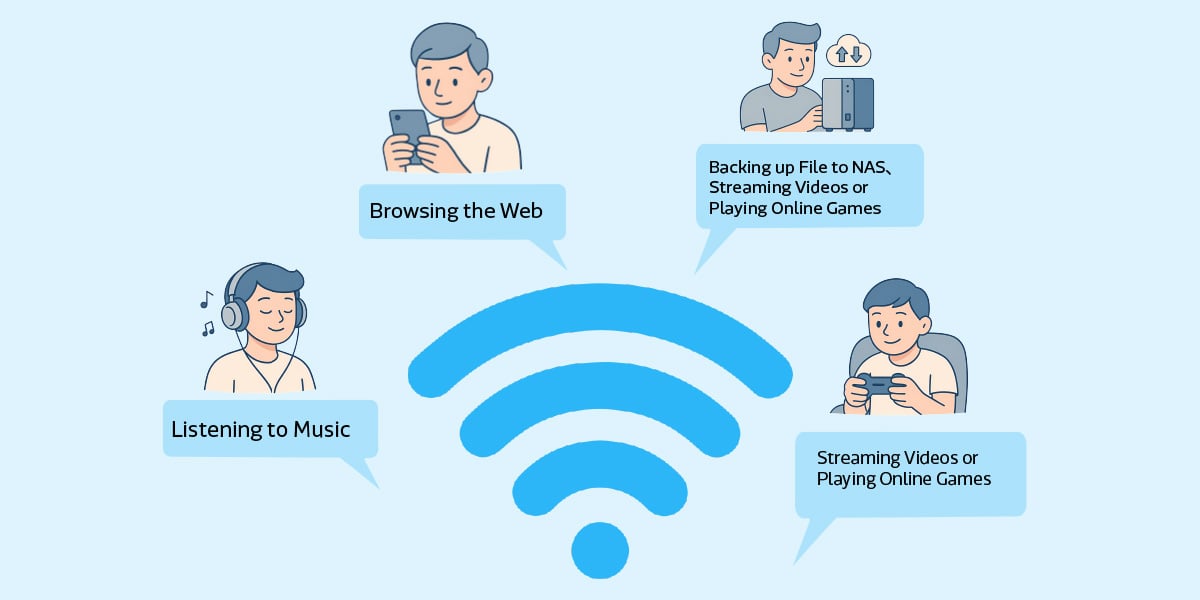
Wi-Fi has become the invisible lifeline of modern life, powering how we work, stream, game, shop, browse, and connect with one another. But as Wi-Fi has become ever-present in almost every device, it’s also continually fighting the problem of interference.

Think about a multi-story apartment building. Each family installs its own Wi-Fi router or mesh of routers, separated from the next only by a wall or a floor. Before long, dozens of signals overlap, competing for space on the same channels. The result? Slower speeds, dropped connections, and frustrating lag. The same issue appears in neighborhoods, offices, public spaces, and increasingly even in vehicles that offer in-car Wi-Fi and Bluetooth, where passengers are exposed to waves of competing signals.

Meanwhile, temporary peer-to-peer connections, like sharing files or casting videos, can also clash with local networks, hurting performance on both sides.

Engineers categorize these problems into two types: Co-Channel Interference (CCI), which occurs when networks fight over the same channel, and Adjacent-Channel Interference (ACI), which occurs when nearby channels bleed into each other. Both cause slower speeds, higher latency, and unstable connections.

While solutions like band steering and channel switching help reduce congestion, they’re not perfect and can sometimes cause devices to disconnect or stop responding. That’s why next-generation anti-interference technologies are becoming so important. By intelligently managing channel use in real time, they promise faster, more reliable Wi-Fi in crowded environments without causing the headaches of connection drops or slowdowns.

In short: as our reliance on Wi-Fi keeps growing, smarter ways to fight interference are key to keeping our digital lives connected. Read our white paper to discover MediaTek’s proposals for a series of effective Wi-Fi anti-interference technologies, including Universal Bandwidth Adaptation (UBA), Customized Preamble Puncture (CPP), Enhanced Spatial Reuse (ESR), and Coordinated Spatial Reuse (CSR).