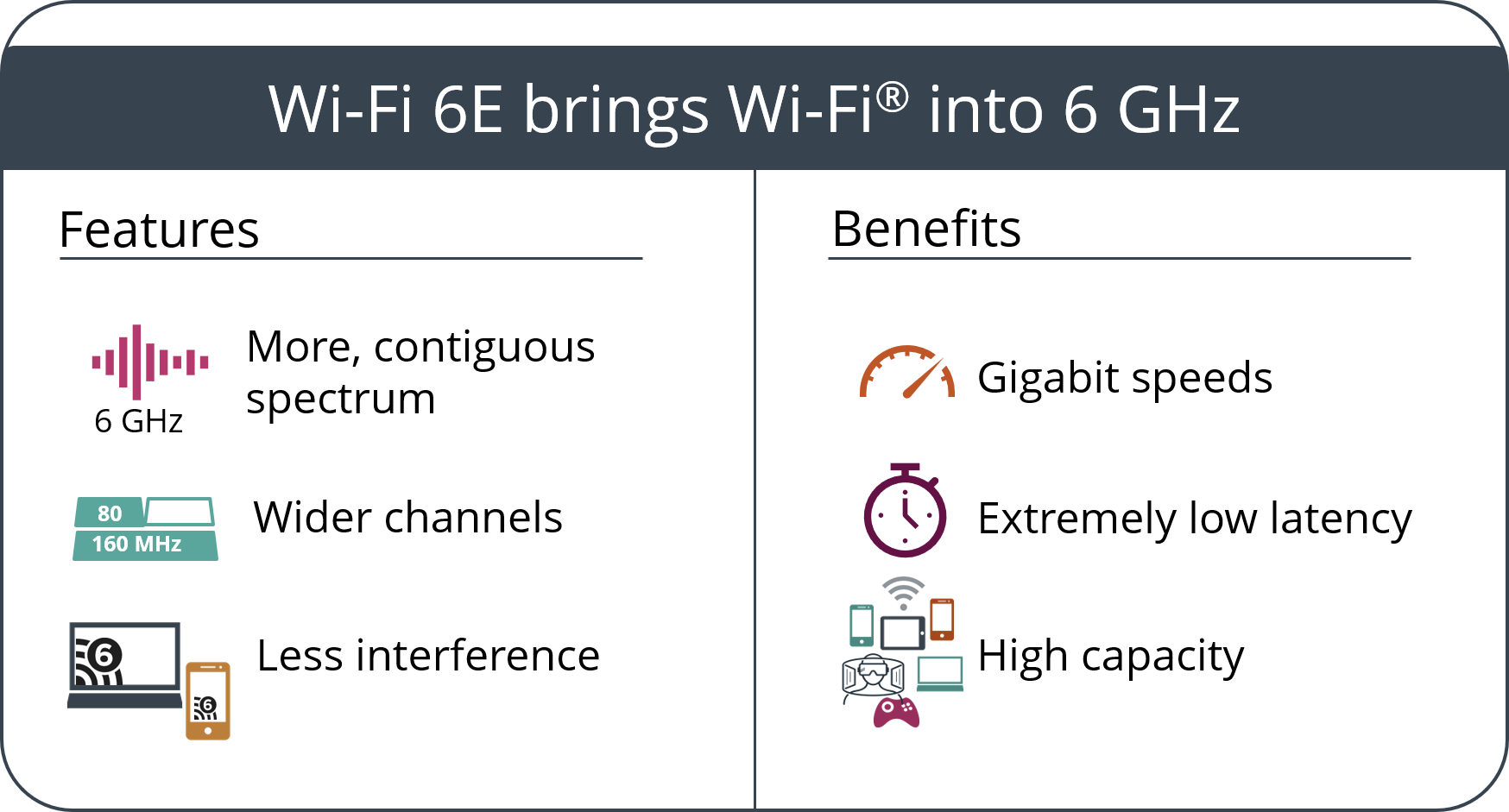
Wi-Fi 6 and Wi-Fi 6E support allows service providers to ensure state-of-the-art Wi-Fi network coverage
Austin, TX – October 7, 2021 – Wi-Fi CERTIFIED EasyMesh™ now incorporates the latest technologies from Wi-Fi 6 and Wi-Fi 6E, improving Wi-Fi® connectivity, performance, and efficiency in multiple access point (AP) networks. New capabilities enable service providers deploying Wi-Fi EasyMesh™ to deliver higher data rates, increase network capacity, and reduce spectral congestion in home networks. Support for Wi-Fi 6E allows Wi-Fi EasyMesh networks to utilize less congested spectrum in the 6 GHz band to deliver the best experience with high bandwidth, low-latency services and applications. Added support for these advanced technologies allows Wi-Fi EasyMesh networks to self-monitor and intelligently manage an extended footprint while providing reliable, uniform whole-home coverage.
The expectations for the connected home have changed, and home networks must now support extended coverage areas – such as garages and basements that now serve as work and education areas – higher bandwidth applications, and up to 20 active devices at once1. Home networks now present new challenges for service providers as they address a greater number of speed, latency, and connectivity concerns. Wi-Fi EasyMesh allows service providers to better support their customers’ growing networks and deliver more reliable and consistent quality of service, even with demanding applications
“Wi-Fi Alliance® is continually improving the quality of experience and consistency of performance in Wi-Fi networks,” said Kevin Robinson, SVP of Marketing, Wi-Fi Alliance. “Wi-Fi EasyMesh is part of a compelling collection of Wi-Fi Alliance certification programs that provide foundational tools that enable service providers to intelligently manage the connected home experience.”
Wi-Fi EasyMesh incorporates the latest technologies that enhance performance between access points and client devices on the network. The combination of these capabilities improves spectral efficiency of the network and supports higher bandwidth and lower latency requirements. Service providers deploying Wi-Fi EasyMesh can provide more extensive coverage and can more efficiently manage network resources, providing their customers a more consistent experience. Additionally, new techniques to communicate Wi-Fi 6 capabilities in Wi-Fi EasyMesh networks can also be utilized by Wi-Fi CERTIFIED Data Elements™ to provide analytics to operators for greater insight into multiple AP network health. Product vendors also benefit from improved certification efficiency and cost savings when bringing interoperable Wi-Fi EasyMesh devices to market.
Advanced Wi-Fi 6 and Wi-Fi 6E features now supported in Wi-Fi EasyMesh networks include:
“CableLabs is excited about the new Wi-Fi CERTIFIED EasyMesh capabilities, with support for Wi-Fi 6 features such as Spatial Reuse Groups, BSS coloring, OFDMA and others,” said John Bahr, Principal Architect at CableLabs. “These features will allow Wi-Fi EasyMesh networks to more efficiently reuse RF spectrum making it a great option for cable operators to deliver the next generation of home Wi-Fi, with lower latency and better speeds.”
For more information, please visit our website and download our technology overview and/or highlights sheet.
1 Consumer Expectations for Wi-Fi in 2021, AirTies
About Wi-Fi Alliance® | www.wi-fi.org
Wi-Fi Alliance® is the worldwide network of companies that brings you Wi-Fi®. Members of our collaboration forum come together from across the Wi-Fi ecosystem with the shared vision to connect everyone and everything, everywhere, while providing the best possible user experience. Since 2000, Wi-Fi Alliance has completed more than 65,000 Wi-Fi certifications. The Wi-Fi CERTIFIED™ seal of approval designates products with proven interoperability, backward compatibility, and the highest industry-standard security protections in place. Today, Wi-Fi carries more than half of the internet’s traffic in an ever-expanding variety of applications. Wi-Fi Alliance continues to drive the adoption and evolution of Wi-Fi, which billions of people rely on every day.
14 additional economies detailed in Wi-Fi Alliance® commissioned report
Austin, TX – September 14, 2021 – The Global Economic Value of Wi-Fi® (2021-2025) report now details individual forecasts for 14 additional economies in Africa, Middle East, and India. The study, commissioned by Wi-Fi Alliance® and originally released earlier this year, now focuses on 29 total economies that collectively contribute $3.3 trillion USD to the global economy in 2021, and are projected to reach nearly $5 trillion by 2025.
Key findings from the 14 additional economies include:
Wi-Fi’s economic value in these 29 economies was assessed based on several key factors and global developments impacting the Wi-Fi industry. Calculations of each factor – including free Wi-Fi access, residential and enterprise savings, Wi-Fi 6 adoption, availability of 6 GHz spectrum, and the coronavirus pandemic – were combined with implications specific to each country to develop the economic value.
Find the Global Economic Value of Wi-Fi report here, view the report highlights sheet, and download a graphics package on our website: www.valueofwifi.org
*Global Wi-Fi economic impact forecasts overall were not impacted by detailed forecasts for 14 additional economies.

About Wi-Fi Alliance® | www.wi-fi.org
Wi-Fi Alliance® is the worldwide network of companies that brings you Wi-Fi®. Members of our collaboration forum come together from across the Wi-Fi ecosystem with the shared vision to connect everyone and everything, everywhere, while providing the best possible user experience. Since 2000, Wi-Fi Alliance has completed more than 65,000 Wi-Fi certifications. The Wi-Fi CERTIFIED™ seal of approval designates products with proven interoperability, backward compatibility, and the highest industry-standard security protections in place. Today, Wi-Fi carries more than half of the internet’s traffic in an ever-expanding variety of applications. Wi-Fi Alliance continues to drive the adoption and evolution of Wi-Fi, which billions of people rely on every day.
Austin, Texas – August 17, 2021 The recently introduced Wi-Fi 6E certification program from Wi-Fi Alliance® is driving unprecedented growth in the introduction of Wi-Fi® devices into 6 GHz. Updates to this program will enhance spectral efficiency and optimize 6 GHz network performance by minimizing Wi-Fi 6E signaling while delivering the security, reliability, and interoperability inherent to Wi-Fi CERTIFIED™ products. This effort, yet again, demonstrates the industry’s commitment to improving spectral efficiency with each new generation of Wi-Fi technology.
X Reality (XR), short for extended reality, is the convergence of physical world and digital world experiences. XR is used to describe immersive applications including augmented reality (AR), mixed reality (MR), and virtual reality (VR) – used to enhance or simulate real-life experiences. XR technologies extend the reality we experience by either merging the virtual and real worlds or by creating fully immersive experiences.
Deployment of XR applications in education, healthcare, and industrial settings are contributing to strong momentum for XR, with the market expected to grow from $33 billion to $125 billion by 20261. Virtual reality alone has seen a 224% growth since October 20192 as more people upgraded their smart entertainment devices to provide more immersive experiences while working, learning, and socializing from home.
Wi-Fi® will have a significant impact on delivering the full potential of the XR market, providing high-performance connectivity for augmented, mixed, and virtual reality. Work is now underway in Wi-Fi Alliance® to promote innovation and further boost Wi-Fi to deliver connectivity that will help build connections between physical and digital worlds. Recently, Wi-Fi Alliance hosted an XR Opportunity for Wi-Fi discussion featuring panelists from Cisco, Facebook Reality Labs, Microsoft, and Qualcomm. Panelists shared insight into the benefits of Wi-Fi for XR devices, while also acknowledging some of the challenges that lie ahead. Key insights from the discussion include:
Extended reality is transforming our daily lives. New XR use cases for education, healthcare, and business will allow students, medical professionals, and employees to have more impactful, personal, and unique experiences.
Panelist Bruno Cendon Martin, Director of Wireless Technologies at Facebook Reality Labs, believes that there are three walls in XR: the physical, the augmented, and the virtual. The physical is what we experience in day-to-day life. The augmented wall is one with layers. A virtual wall is one that “transcends time and space” and allows you to transition back in forth between realities. Development of new technologies, including portal systems and other Wi-Fi devices, will enable users to be transported through technology and gain a physical presence in another location. Wi-Fi visual headsets and other innovations on the horizon will allow users to be fully immersed in an entirely different world without leaving their home.
Wi-Fi will improve the infrastructure of XR. Advancements coming to Wi-Fi will help build connections across the physical and digital worlds. Panelist Dr. Shirin Ebrahimi-Taghizadeh, Principal Software Engineering Lead for Wireless and Embedded Systems at Microsoft shared that enabling services and solutions extremely relies on having a very stable and low latency wireless solution. Wi-Fi technologies, such as Wi-Fi 6 and Wi-Fi 6E will help provide connectivity to satisfy these demands. Microsoft’s Azure Remote Rendering, for example, allows designs to come to life for developers wanting to collaborate and see the richness of details without physically creating a prototype. Wi-Fi will further allow companies to produce products that surpasses the boundaries of physical limitations.
XR will have a strong impact beyond the workspace. Matt MacPherson, CTO of Wireless at Cisco, points to XR’s impact on various types of education systems, including elementary education, higher education, and health education. With XR becoming the forefront for many teaching efforts, testing and other educational practices are being revolutionized. VR-type implementations, for example, allow students to look at the same image and learn in the same way without needing to be in the same physical location. As XR capabilities grow exponentially, advancements will further advance this use case and allow for more education possibilities. Educators expect a bright future for Virtual Environment Technology (VET) because of the increasing need for tools that will help ease the process of learning and bring it closer to the students’ interests.
Wi-Fi can deliver high-quality, wireless XR experiences. Shishir Gupta, Product Director of XR Connectivity, 6G, and Wireless Positioning at Qualcomm believes that premium XR experiences require high-performance Wi-Fi for four main reasons. The first is low-latency for responsive and lag-free experiences. The second is extreme reliability with advanced features and optimization for sustained XR-class performance. The third is power efficiency to assist rapid and efficient data transfers with advanced power save features. Finally, multi-gigabit speeds allow for instantaneous, massive data exchange which is necessary in XR.
There are attractive opportunities for XR driven by consumer, education, healthcare, and industrial applications. Wi-Fi is already a strong technology player in these markets, making it a natural choice for the future of XR. Wi-Fi Alliance members are working to further the role of Wi-Fi in XR and are working closely with the XR ecosystem to deliver key Wi-Fi applications for augmented, mixed, and virtual reality. Companies involved in developing Wi-Fi solutions for the XR space are encouraged to get involved in Wi-Fi Alliance to help propel the industry forward.
Austin, Texas and Washington, D.C. – June 30, 2021 – Wi-Fi Alliance® continues to advance development of the Automated Frequency Coordination (AFC) system that maximizes spectrum access in the 6 GHz frequency band. Wi-Fi Alliance is proud to announce the release of two additional elements necessary for AFC system implementation: the AFC System Reference Model and AFC Device Compliance Test Plan. This accomplishment follows the publication of the AFC System to AFC Device Interface Specification earlier this year. By bringing together technical experts from a broad section of the industry, Wi-Fi Alliance is rapidly enabling Wi-Fi 6E deployment worldwide.
Wi-Fi Alliance continues to advocate for countries to make the 6 GHz band available to Wi-Fi®, unleashing the capacity, speed, and reduced latency benefits of Wi-Fi 6E. The AFC system, already adopted into 6 GHz regulatory framework in Canada and U.S., is also being considered by regulators in other countries. Development of this AFC system framework demonstrates the commitment by Wi-Fi Alliance to maximizing 6 GHz spectrum opportunity and accelerating delivery of Wi-Fi 6E benefits.
Wi-Fi Alliance development efforts on this innovative AFC system are ongoing, with the aim of ensuring worldwide adoption, interoperability, security, and reliability expected of Wi-Fi. Available AFC documents now include:
For more information, please visit: https://www.wi-fi.org/discover-wi-fi/wi-fi-certified-6
About Wi-Fi Alliance® | www.wi-fi.org
Wi-Fi Alliance® is the worldwide network of companies that brings you Wi-Fi®. Members of our collaboration forum come together from across the Wi-Fi ecosystem with the shared vision to connect everyone and everything, everywhere, while providing the best possible user experience. Since 2000, Wi-Fi Alliance has completed more than 65,000 Wi-Fi certifications. The Wi-Fi CERTIFIED™ seal of approval designates products with proven interoperability, backward compatibility, and the highest industry-standard security protections in place. Today, Wi-Fi carries more than half of the internet’s traffic in an ever-expanding variety of applications. Wi-Fi Alliance continues to drive the adoption and evolution of Wi-Fi, which billions of people rely on every day.
Austin, Texas – June 23, 2021 – Wi-Fi Alliance® is introducing QuickTrack as a new certification path that provides a simpler, lower cost option to achieve Wi-Fi CERTIFIED™ product certification. QuickTrack allows Wi-Fi Alliance members to build products based on Qualified Solutions – modules, chipsets, and other solutions which have undergone prerequisite testing. Using the QuickTrack path, end product developers may pursue Wi-Fi® certification by testing new, innovative Wi-Fi products based on trusted Qualified Solutions designed to meet industry-agreed Wi-Fi CERTIFIED requirements.
QuickTrack enables Wi-Fi product vendors to introduce quality devices into the market faster. The new QuickTrack certification path lowers testing costs and reduces the time needed to complete Wi-Fi certification testing. By relying on Qualified Solutions which have already completed Wi-Fi functionality testing, QuickTrack builds upon the testing already completed for core Wi-Fi components. QuickTrack also offers the convenience of testing at a member’s own testing site, or at an Authorized Test Laboratory (ATL).
“Wi-Fi CERTIFIED provides companies tailored testing options to deliver the highest quality Wi-Fi, whether certifying an enterprise-class access point or the latest Internet of Things gadget,” said Kevin Robinson, SVP of Marketing, Wi-Fi Alliance. “Wi-Fi Alliance is excited to now offer QuickTrack, enabling solution providers to deliver great value to their customers by jump-starting the end product certification process and empowering end product developers to integrate industry-standard testing into their ongoing quality programs to ensure products meet Wi-Fi CERTIFIED requirements throughout their lifetime.”
To meet the diverse needs of more than 800 member companies, Wi-Fi Alliance now offers three paths to certify Wi-Fi products. These paths accommodate multiple product development approaches – from creating a product design built from original components to branding products designed and manufactured by another entity. Wi-Fi Alliance members will find the right testing and certification path to meet their needs, with tools that support variation in testing methods and test location options. Wi-Fi CERTIFIED paths include:
Member companies providing the first Qualified Solutions which serve as the basis for creating and certifying other products through QuickTrack include: ASR Microelectronics Co., Ltd, Intel®, Microchip and Qualcomm Technologies. The first products certified using the new QuickTrack method include: the Midea IoT Application from Midea Group, that will be used as a source to certify millions of secure, interoperable IoT and smart appliances in China, and the PIC32MZ-W1 Wi-Fi® SoC and Module Family from Microchip. SRTC is the first Authorized Test Lab supporting QuickTrack certification for members.
Qualified Solutions available include:
Industry support for QuickTrack
“To support large venue operations connecting thousands of devices, next-generation Wi-Fi equipment needs to meet high-quality standards. QuickTrack certification marks an important quality assurance step to support Wi-Fi deployments in demanding environments. At Boingo, we’re seeing more and more Wi-Fi 6E equipment coming to the market and we applaud industry efforts to establish respected quality standards to help bring best-in-class connectivity to enterprises.” – Dr. Derek Peterson, CTO, Boingo Wireless
“We’d like to congratulate Wi-Fi Alliance on the launch of the new QuickTrack certification path. This new approach will positively impact the future of the Wi-Fi industry by helping to make it much easier and less costly for companies to obtain Wi-Fi certification for their products. We were delighted to actively participate in QuickTrack’s development and that our Intel® Wi-Fi 6E AX210 product will be one of the first Qualified Solutions for QuickTrack.” – Carlos Cordeiro, Wireless CTO, Client Computing Group, Intel Corporation
“We are glad that Midea Group’s IoT application product is the first to get certified following the new QuickTrack certification path that significantly lowers the time and cost to get Wi-Fi CERTIFIED. We believe the industry will benefit from this new, simple and fast process when more and more products are certified and compliant with the Wi-Fi standards. – Joshua Xiang, CTO and VP of IoT, Midea Group
“The new QuickTrack certification path is a real milestone. With this streamlined process, the Wi-Fi Alliance enables even small and medium-sized Wi-Fi manufacturers to certify their products quickly and with manageable effort. In future, consumers will be able to choose from a wider variety of certified products on the market and compare product features more easily.” – Jan Buis, Vice President Business Development, LANCOM Systems
“Microchip is excited to take a leading position in the rollout of Wi-Fi Alliance’s new QuickTrack program. The streamlined process allows our customers to quickly and easily certify their applications. By partnering early on with QuickTrack, Microchip is able to provide out-of-the-box access to the most up-to-date, advanced Wi-Fi Alliance certification programs on our latest generation of Wi-Fi silicon.” – Steve Caldwell, vice president of Microchip’s wireless solutions business unit.
“QuickTrack provides effective certification procedures and tools, and shortens the test time and certification cycle of some Wi-Fi products. Using QuickTrack, laboratories can adopt more flexible certification strategies to quickly obtain Wi-Fi certification from Wi-Fi Alliance.” – PengZhen, Director of International Certification Department (ICD), The State Radio monitoring Testing Center (SRTC)
For more information on Wi-Fi CERTIFIED, please visit: https://www.wi-fi.org/certification
About Wi-Fi Alliance® | www.wi-fi.org
Wi-Fi Alliance® is the worldwide network of companies that brings you Wi-Fi®. Members of our collaboration forum come together from across the Wi-Fi ecosystem with the shared vision to connect everyone and everything, everywhere, while providing the best possible user experience. Since 2000, Wi-Fi Alliance has completed more than 65,000 Wi-Fi certifications. The Wi-Fi CERTIFIED™ seal of approval designates products with proven interoperability, backward compatibility, and the highest industry-standard security protections in place. Today, Wi-Fi carries more than half of the internet’s traffic in an ever-expanding variety of applications. Wi-Fi Alliance continues to drive the adoption and evolution of Wi-Fi, which billions of people rely on every day.
Follow Wi-Fi Alliance:
wi-fi.org/beacon
facebook.com/wificertified
twitter.com/wifialliance
linkedin.com/company/wi-fi-alliance
Media Contact:
Stephanie Burke
Highwire PR for Wi-Fi Alliance
[email protected]
Austin, TX – May 11, 2021 – Wi-Fi Alliance® provides trusted security to billions of Wi-Fi® devices, and regularly updates Wi-Fi CERTIFIED™ requirements to address wireless security and privacy challenges as the threat landscape evolves.
Security researchers identified vulnerabilities in the frame aggregation functionality of some Wi-Fi devices. There is no evidence of the vulnerabilities being used against Wi-Fi users maliciously, and these issues are mitigated through routine device updates that enable detection of suspect transmissions or improve adherence to recommended security implementation practices. Wi-Fi Alliance has taken immediate steps to ensure users can remain confident in the strong security protections provided by Wi-Fi.
As always, Wi-Fi users should ensure they have installed the latest recommended updates from device manufacturers.
As with any technology, robust security research that pre-emptively identifies potential vulnerabilities is critical to maintaining strong protections. Wi-Fi Alliance thanks Mathy Vanhoef (New York University Abu Dhabi) for discovering and responsibly reporting this issue, allowing industry to proactively prepare updates. Wi-Fi Alliance also thanks the Industry Consortium for Advancement of Security on the Internet (ICASI) for their strong partnership and collaboration.
For more information, please refer to statement from ICASI: https://www.icasi.org/aggregation-fragmentation-attacks-against-wifi/
Relevant Identifiers:
Relevant research:
Guidance for implementations:
About Wi-Fi Alliance® | www.wi-fi.org
Wi-Fi Alliance® is the worldwide network of companies that brings you Wi-Fi®. Members of our collaboration forum come together from across the Wi-Fi ecosystem with the shared vision to connect everyone and everything, everywhere, while providing the best possible user experience. Since 2000, Wi-Fi Alliance has completed more than 65,000 Wi-Fi certifications. The Wi-Fi CERTIFIED™ seal of approval designates products with proven interoperability, backward compatibility, and the highest industry-standard security protections in place. Today, Wi-Fi carries more than half of the internet’s traffic in an ever-expanding variety of applications. Wi-Fi Alliance continues to drive the adoption and evolution of Wi-Fi, which billions of people rely on every day.
Follow Wi-Fi Alliance:
wi-fi.org/beacon
facebook.com/wificertified
twitter.com/wifialliance
linkedin.com/company/wi-fi-alliance
May 10, 2021 by Ken Kerpez
Working from home has risen vastly over the past year, and this trend looks to be here to stay. While a user may ignore occasional blips in their “for fun” internet, working from home requires a new level of network performance. Ensuring Wi-Fi® Quality of Service (QoS) is arguably the most important component of such performance, and Wi-Fi CERTIFIED QoS Management™ is now able to provide the reliability that working from home requires.
Wi-Fi is becoming one of the most important approaches for connecting devices to the internet. Consumers are demanding that operators provide a high quality Wi-Fi experience when it comes to Wi-Fi connectivity across all devices. In particular, work-from-home, or telework, has emerged as a vitally important application supported by Wi-Fi. There is a growing need for operators to manage and ensure mission critical telework traffic over Wi-Fi, and residential connections should be managed to ensure connectivity and performance that enables productive employees. Wi-Fi CERTIFIED QoS Management has now emerged to ensure telework traffic is prioritized, resulting in an improved work-from-home experience for employees.
Wi-Fi CERTIFIED Wi-Fi Multimedia™ (WMM®) provides the over-the-air mechanisms to support traffic prioritization, including prioritization of work from home traffic. While WMM can prioritize telework applications to ensure their service quality, it did not provide the capabilities to link the Wi-Fi layer with the IP or application layers for residential Wi-Fi.
Wi-Fi CERTIFIED QoS Management simplifies the prioritization and management of latency-sensitive traffic in Wi-Fi networks by enabling IP data flows to be classified and mapped to one of four QoS access categories defined by WMM. This helps ensure that traffic for real-time applications and services is inserted into queues with higher priority, resulting in a better experience for end-users.
Wi-Fi QoS Management supports Differentiated Service Code Point (DSCP) mapping, which is a marking in the IP packet headers for managing network priority and QoS across the network. Wi-Fi QoS Management can classify traffic and map flows into DSCP code points, whereby work-related flows are identified and assigned to high priorities. Wi-Fi QoS Management then enables configuration mapping of the IP-layer DSCP markings to WMM categories, allowing for prioritization and ensuring QoS on Wi-Fi. The essential component of priority across the Wi-Fi link is enabled by Wi-Fi QoS Management. In addition, Wi-Fi QoS Management can similarly support Mirrored Stream Classification Service (MSCS) to ensure QoS of work applications on client devices across the Wi-Fi link.
Solutions such as ASSIA Equipe are coming to market to harness the benefits of Wi-Fi QoS Management for employees working from home. This Wi-Fi management platform runs on Wi-Fi gateways and Wi-Fi extenders in conjunction with a cloud-based management system and a smartphone application that the employee interacts with. Equipe collects and analyzes many Wi-Fi performance-related parameters to determine and optimize “Workput”—an AI model that learns the true impact of an individual’s connectivity for telework. Ensuring work from home prioritization for Telework QoS is crucial to high Workput.
The use of Wi-Fi QoS Management by such solutions enables operators to take a great step forward by prioritizing critical workflows to support telework as a service. For instance, Equipe can use Wi-Fi QoS Management to assign high priority and support end-to-end QoS of Workput flows across the network, particularly across the crucial Wi-Fi link. It is Wi-Fi QoS Management’s ability to support prioritization of these flows that makes it so critical to telework, enabling employees to enjoy a high quality work from home experience.
In many households, Wi-Fi is shared between time-sensitive, performance-oriented work flows and more casual traffic. Wi-Fi QoS management enables mission-critical applications to meet their delay and quality requirements, ensuring the now-pervasive needs of telework can now be fully supported.
May 04, 2021 by Michael Muller
This content was originally published on LANCOMWIRE: The LANCOM Systems Tech Blog.
Urban spaces are sprouting up like mushrooms, growing beyond their boundaries and presenting completely new challenges in terms of mobility and infrastructure. Mobility as we know it today, with overcrowded streets and poor air quality, is a model that has had its day.
Climate goals aside, urban transport networks are barely keeping pace with the enormous numbers of commuters who move around each day. If we consider Latin America, with the high altitudes of Bolivia’s capital La Paz or the Mexican metropolises, the models being implemented may well inspire urban future-proof mobility concepts for other cities in the long term: Modern cable car systems that traverse many different city plateaus. From the high altitude regions of the Alps, for example, we are familiar with gondolas and cable car systems that are networked with the latest technology. But what requirements does the network have to meet in urban areas?

© Doppelmayr Seilbahnen GmbH
Mi Teleférico, which translates from Spanish as “my cable car,” has connected the Bolivian cities of La Paz and El Alto since 2014. In this case, the Austrian cable car manufacturer Doppelmayr/Garaventa has built the world’s largest urban cable car network. Consisting of ten lines in total, the cable car network offers daily commuters a faster way to reach their destinations. Some sections of the system negotiate up to 666 meters of difference in altitude. It wouldn’t work without the latest technology: For the security-related applications and additional service offerings for passengers, a stable Wi-Fi® network is essential. The requirements of a Wi-Fi for urban cable cars like those in La Paz are extremely tough. On the one hand, the network has to control safety-related applications, such as the intercom system in the gondolas, security cameras and lighting control, as well as the monitoring of the pylons and battery systems. On the other hand, passengers in the gondola expect Wi-Fi with a strong and stable signal. With travel times of up to half an hour, a seamless Wi-Fi network offers even more convenience.
The implementation of a network over a total distance of 30 kilometers required the setup of a communication system consisting of Wi-Fi access points and directional radio antennas. In La Paz, each cable car pylon and each individual gondola is equipped with a dual-radio outdoor Wi-Fi access point. The altitudes involved demand special hardware for the networks. Thanks to their IP66 protective housing, outdoor access points work reliably in temperatures ranging from -33° to +70° Celsius and withstand the weather with its snow, dust and the cold of the Andes. The APs are equipped with directional antennas to specifically focus the Wi-Fi signal along the path taken by the gondolas. Each gondola is also fitted with an AP that receives the signal and forwards it to the Mobility Communications System (MCS)—in this case a central system designed by LOOP21. The central communication system replaces, among other things, the radio technology required for the alarm and safety system. To ensure seamless wireless connectivity for the communication system, it is particularly important that the directional radio antennas of the OAPs are aligned precisely.
The demands on a network in urban areas are great: it has to handle long distances, extreme differences in altitude, and different sources of interference from radio networks. And the wireless network is just as scalable as the cable car network itself. New sections of a route can be quickly and easily provided with Wi-Fi and integrated into the overall network.
As a model for the mobility of the future, urban cable cars like those in Latin America are a role model for metropolitan regions that are reaching their limits of their infrastructure. Thanks to modern network technology that combines passenger convenience with important security requirements, future viability is guaranteed.
All pictures were provided by Doppelymayr Seilbahnen GmbH.
April 22, 2021 by Chatwin Lansdowne

One of NASA’s space suits now has two Wi-Fi clients and three Wi-Fi antennas.
NASA astronaut Kate Rubins wore a Wi-Fi® enabled helmet camera during an extravehicular activity on 28 February 2021 to demonstrate a high-definition live video streaming application. Rubins and NASA astronaut Victor Glover were attaching brackets so that new-technology solar panels could be added to the solar arrays. The crew inside the International Space Station cabin were able to see the video on a laptop, while the support team on the ground also used the video to coach the pair through a grueling procedure that was beleaguered by two stuck bolts and a damaged glove. NASA refers to the camera by a stacked acronym, it is the High Definition Extra-Vehicular Mobility Unit (EMU) Camera Assembly, or HECA.

NASA astronaut Kate Rubins covers the hatch after egressing from the crew airlock. The crisp photo is a video frame that was streamed live from the new high-definition wireless camera mounted beside her helmet. (Source: NASA)
Although eight access points (APs) now provide service outside of the space station, Rubins and Glover needed to work together at the farthest port-side end of the space station’s main truss. That is presently about 50 meters from the nearest Wi-Fi infrastructure, and the view is blocked by the station’s solar panels and thermal radiator panels. The nearest infrastructure points consist of antennas outside the space station cabled to an AP inside the space station. Despite the challenges of distance, cables, structural blockage, and roaming, the live high-definition video was available during most of the work, and the camera’s client switched quickly between APs as Rubins changed position and orientation.
While the pair were as far from the airlock as an astronaut can climb, pausing for a routine glove check Glover observed a split in the rubbery coating at the left index finger crease of his glove. It appeared to be a small hole. Any damage to the protective layers of the glove could leak oxygen from his suit. Victor struggled to decide how much damage he was seeing.
“When Kate gets over here, maybe I can show you in the HECA.”
“Yep, and that’s exactly what we were thinking, Ike” mission control replied.
After some high-definition inspection under artificial lighting, the Capsule Communicator (CAPCOM) advised Glover, “Ike, I think we have as good a view of that glove as we’re going to get. Just minimize the use of that hand.”

Victor Glover’s standard definition camera did not convey enough detail for the ground to inspect the damage to his glove. (Source: NASA)

After Kate Rubins moved to use her new helmet camera to inspect damage on Victor Glover’s glove, CAPCOM relayed the decision to continue the spacewalk and “just minimize the use of that hand.” (Source: NASA)
The cameras were delivered to the space station in November 2019 to support servicing of theAlpha Magnetic Spectrometer, but instead remained in storage until the crew had time to retrofit the suits with a package of upgrades. In November 2020, the population of the space station more than doubled when the first operational SpaceX Crew Dragon docked with a manifest of four astronauts. And in early February, Rubins assembled a camera, turned it on to make certain it worked, and then installed the first of the cameras onto the “EV1” (red stripes) space suit.
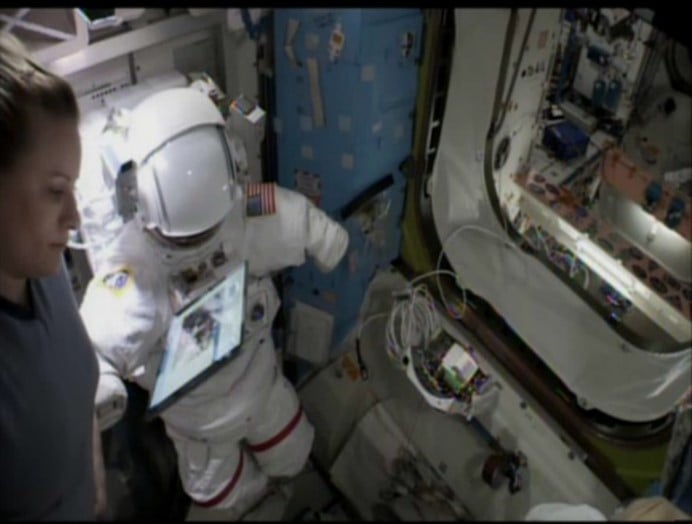
Kate Rubins pauses to read an interactive crew procedure from a Wi-Fi connected tablet that floats hands-free. (Source: NASA)

NASA astronaut Kate Rubins connects the power cable as she installs the first high-definition helmet camera onto her space suit. (Source: NASA)
The HECA up-streams live HD video through Wi-Fi for viewing by the crew and on the ground. The HECA HD video is also recorded to internal storage, and segments can be recovered afterward by uploading over Wi-Fi for return-link to the ground.
HD video will help with close-out photo-documentation that recently has been performed using a hand-held Nikon D5 or GoPro video. A ground console operator in the Mission Control Center (MCC) using the call sign “CRONUS” can command the video encoder in the new camera to a wide range of streaming rates. CRONUS can also use the camera to take still photos. The crew inside the space station can now display the video on a laptop to help them track the spacewalk as it progresses, and therefore CRONUS can configure the camera to stream to two destination addresses over wireless so that both the crew and the ground can observe simultaneously.
The camera uses a pair of low-profile circularly polarized antennas that are oriented to achieve omnidirectional aggregate coverage rather than overlapped antenna coverage. Low profile antennas on a suit are less likely to snag or break and are therefore preferred as it is not uncommon for the suit to drift against the structure as the astronauts climb, reach, twist tools, or float through narrow openings. The camera supports Wi-Fi CERTIFIED™ ac, also known as Wi-Fi 5. The Wi-Fi client adapter in the HECA is the first client to support Wi-Fi CERTIFIED LocationTM, opening the possibility that someday ground control teams will be able to plot the spacesuit location during critical operations, or that a future suit informatics system can know its own relative location by using the Wi-Fi infrastructure to gauge distances.
The U.S. space suits already had a Wi-Fi client, an engineering data recorder that debuted in March 2019. The EMU Data Recorder (EDaR) live-streams non-critical low-rate telemetry.

Chris Cassidy modeled the prototype high-definition digital helmet camera (round lens on left), as he rehearsed the Alpha Magnetic Spectrometer servicing EVA in 2019. The camera was part of a larger suit upgrade package that waited over a year on-board the space station for the crew to have time to install. Legacy cameras (square lenses on right) continue to provide standard definition video. (Source: NASA)
NASA has deployed eight mixed-vendor Wi-Fi 4 access points to provide coverage outside of the International Space Station. Other external payloads have been stationary, so the suits are NASA’s first mobile outdoor Wi-Fi clients. Some special engineering is needed to increase the agility of the Wi-Fi connection managed by the cameras as they move outside the space station. The activity allowed NASA to evaluate impacts to the network before adding a camera to the second suit.
Wi-Fi was the obvious choice for the HD suit camera. The existing wireless video infrastructure cannot support digital signaling, and the Intel single-board computer selected to perform video encoding already included a Wi-Fi radio. Wi-Fi coverage surrounding the space station is already good, and additional hardware is ready to install as needed to further improve coverage.
There was a time before Wi-Fi. The HD camera retired the widest and least-used view among the three selectable analog National Television System Committee (NTSC) standard definition cameras in the legacy system. These helmet cameras appeared on space suits in December 2000, to support the assembly work for the space station. The radio technology for these legacy cameras derives from a terrestrial design that provided cockpit video for NASCAR races during the 1990s. This system is designed to be supported by three infrastructure points on the space station, each point can support a video stream from one space suit. The HECA demonstration comes as the analog system is approaching “end of life.” In fact, the new camera demonstrated far superior wireless coverage when viewed beside the standard definition camera during the activity because one of the legacy infrastructure points had failed and needed to be replaced. The legacy system will continue to operate as the community works through the technology transition.

Cosmonaut Sergey Ryazansky with GoPro strapped to left arm. Source: NASA
Space suit live video greatly improves situational awareness on the ground and on the space station, but it is not considered critical. The Russian Orlan suits do not have a helmet camera of their own, but since 2013 have been outfitted with a GoPro to record video and then upload it to the network after returning inside using interior Wi-Fi. The NASA helmet cameras are sometimes used on the Orlan suits, and the new cameras are expected to appear soon on both NASA suits, and the Russian Orlan suits as well.
The current generation of space suit debuted on the Space Shuttle in 1983. As NASA develops the latest statement in celestial fashion for its next walk on the moon, many updates are being incorporated. Expect the functions that Wi-Fi has helped retrofit onto today’s space suits, to be integrated into the next-generation lunar suit design.
Trade names and trademarks are used in this report for identification only. Their usage does not constitute an official endorsement, either expressed or implied, by the National Aeronautics and Space Administration.