

This is an excerpt from our white paper Wi-Fi in the 5G Era – Strategy Guide for Operators. The full white paper is available here if you like what you read. Don’t hesitate to contact us if you have any questions.
OFFLOAD TRAFFIC WILL ONLY INCREASE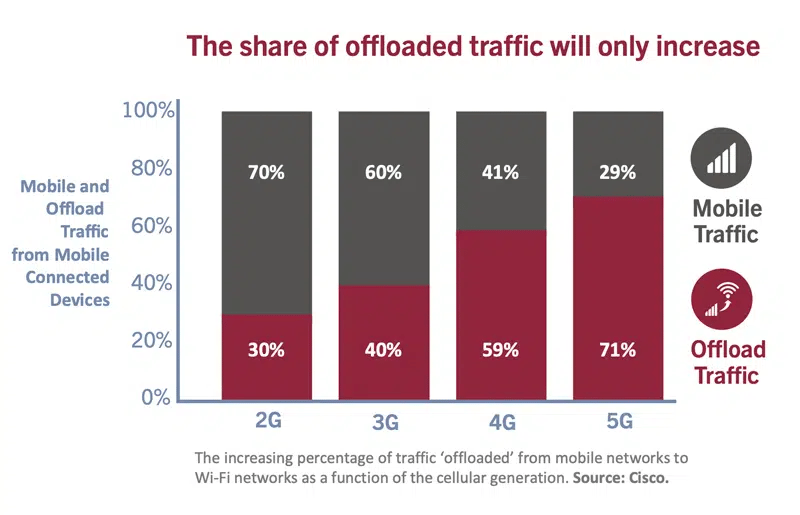
Rapid evolution and availability of new technology and new spectrum are making carrier Wi-Fi inevitable as a strategic technology of choice for service providers everywhere. The idea that Wi-Fi is the dominant indoor wireless technology is not new. But we believe that Wi-Fi’s dominance will be even more pronounced in the 5G era.
It is well known that device data consumption continues to rise particularly as the result of the increased popular demand for video streaming and – more recently perhaps – the explosive demand for collaborative work applications, such as video conferencing. More than this, research suggests (see figure) that the need for mobile networks to ‘offload’ traffic to Wi-Fi will substantially increase in the 5G era.
In some countries – such as the UK, Japan, and Germany – ‘Wi-Fi offload’ percentages (meaning the percentage of smartphone traffic delivered over Wi-Fi networks of any kind) are already well above 80%. In connection with the US decision to allocate all of the 6 GHz band to Wi-Fi, the FCC cited the need for offload from 5G networks as an important contributing factor in their decision.
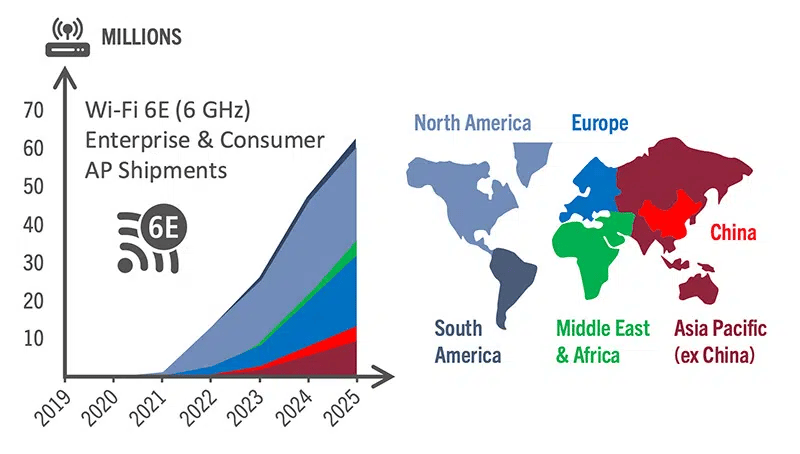
Most analysts believe Wi-Fi 6 and Wi-Fi 6E technology will be ramped up quickly and indeed faster than previous generations of Wi-Fi, specifically because work-from-home connectivity today is business critical for ISPs and consumers. Such factors will continue to play important roles as drivers of renewed connectivity demand as will the continued growth in number of devices in the home as well as data consumption.
The next phase in the ramp-up and deployment of new Wi-Fi technology will then be enterprise and carrier-grade APs and supporting systems. This evolution will happen a little later but also in parallel with the mass-market deployment of home Wi-Fi 6 and Wi-Fi 6E gateways and systems.
In general, the IEEE 802.11 standardization working group is now aiming for a Wi-Fi technology renewal cycle of five years, which means full market penetration of Wi-Fi 6 and Wi-Fi 6E into the enterprise and service provider Wi-Fi markets will sharply rise and come to completion around 2025-26.
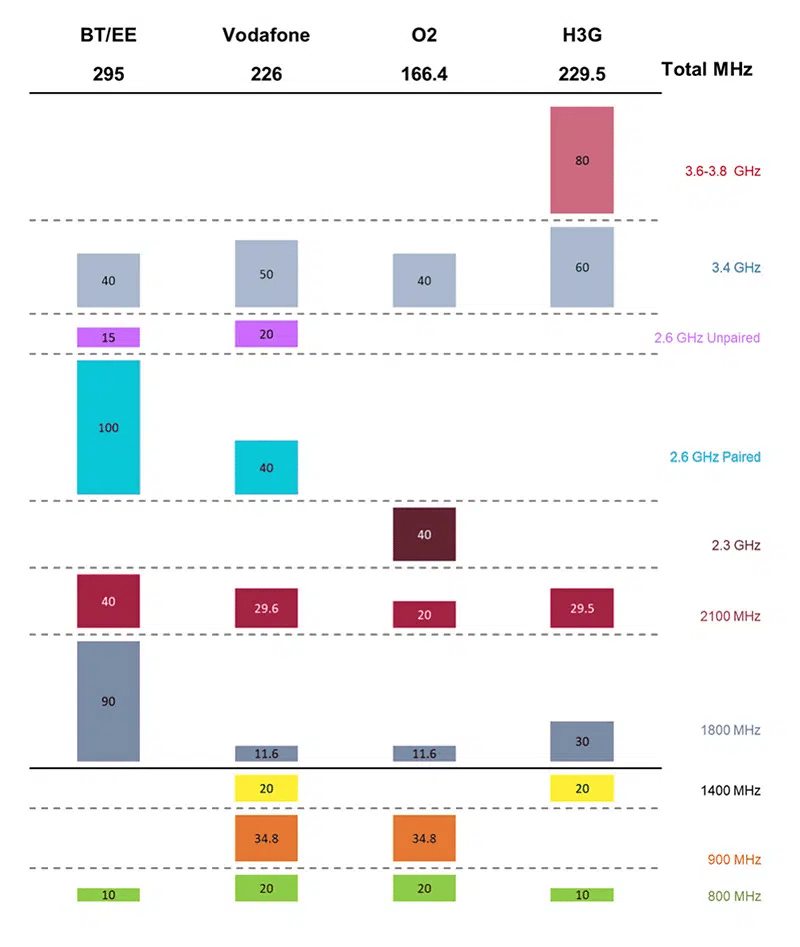
Meanwhile it is critical to understand that the availability of pristine new unlicensed spectrum has made the case for carrier Wi-Fi hugely more compelling. Have a look – for example – at the graphic picturing the total licensed spectrum holdings for mobile operators. The analysis uses the UK as an example.
The most amount of licensed spectrum is held by BT and totals 295 MHz while H3G is in second place totaling 229.5 MHz. None of the UK’s mobile operators hold more than 300 MHz of total licensed spectrum – and most hold much less.
The UK recently released 500 MHz of pristine – meaning unused by legacy Wi-Fi – unlicensed spectrum in the lower 6 GHz band. That slice of Wi-Fi spectrum alone is around double the amount of licensed band that most UK mobile operators hold at this time. Add to this the existing 5 GHz and 2.4 GHz Wi-Fi bands – and we contend that it is becoming increasingly difficult for operators to reject the strategic use of carrier Wi-Fi services. Mobile and fixed operators need to embrace carrier Wi-Fi today to stay competitive.
In countries where the full 1.2 GHz of 6 GHz spectrum (up to 7.2 GHz) has been released – including the US, Korea, Brazil, Saudi Arabia, and the Republic of Chile thus far – the situation is even more extreme. The total amount of unlicensed spectrum available (some of it available for outdoor use as well) could be up to 10 times as much as the licensed spectrum holdings of a single mobile operator.

This is an excerpt from our white paper Hyperscale Cellular IoT. If you like what you read, the full white paper is available here. Don’t hesitate to contact Enea if you have any questions. Download white paper here.
In the Hyperscale Cellular IoT white paper, we focus entirely on cellular IoT connectivity. Although cellular IoT will only stand for 22% of all connections at the end of 2026, around 5,9 billion devices will be connected through cellular networks!
The vast majority of IoT connections will be short-range devices using radio technologies such as Wi-Fi, Bluetooth, Z-wave, and Zigbee. But, just like most radio technologies for IoT, cellular connectivity will have rapid growth.
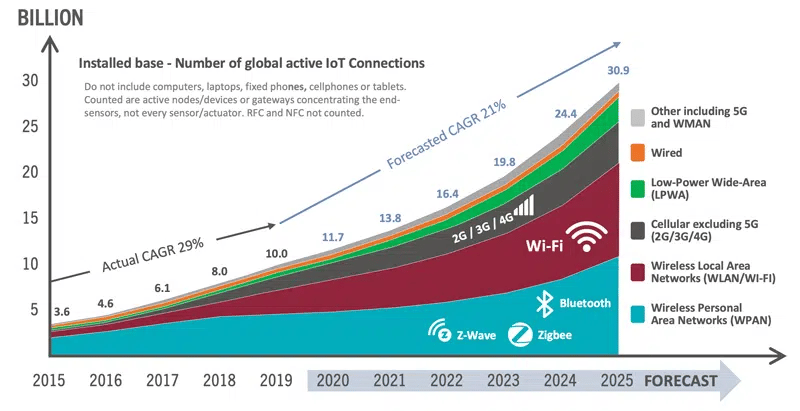
Each technology has its own use case. Cellular is the technology of choice for devices requiring mobility. Short-range technologies such as Wi-Fi are mainly for indoor connectivity. The Low Power Wide Area Networks (LPWAN), including the cellular NB-IoT and technologies such as LoRa, are focused on battery-powered devices with a battery life of up to 10 years.
MANAGEMENT IS KEY FOR IOT
Cellular is the only technology that enables global central management by using the mobile operator’s existing roaming portfolio, typically in 200 or more countries. However, as discussed in our white paper, there are markets where permanent roaming is not a viable option (regulations and/or commercial reasons).
Initiatives such as Aptilo Zero-touch Wi-Fi IoT Connectivity™ and WBA’s OpenRoaming aims to make Wi-Fi-based IoT more seamless and secure also on a global scale.
A CLOSER LOOK AT TECHNOLOGIES FOR CELLULAR IOT
Today, many IoT applications are using the existing 4G (LTE) broadband, which has been improved for IoT. In the last few years, 3GPP has created new standards to better support specific use cases. The largest volume of new IoT devices will come in the Massive IoT area designed to support low-cost wearables, sensors, and meters over long distances. 5G provides the ability to support Critical IoT use cases for real-time mission-critical applications such as connected cars and remote surgery.
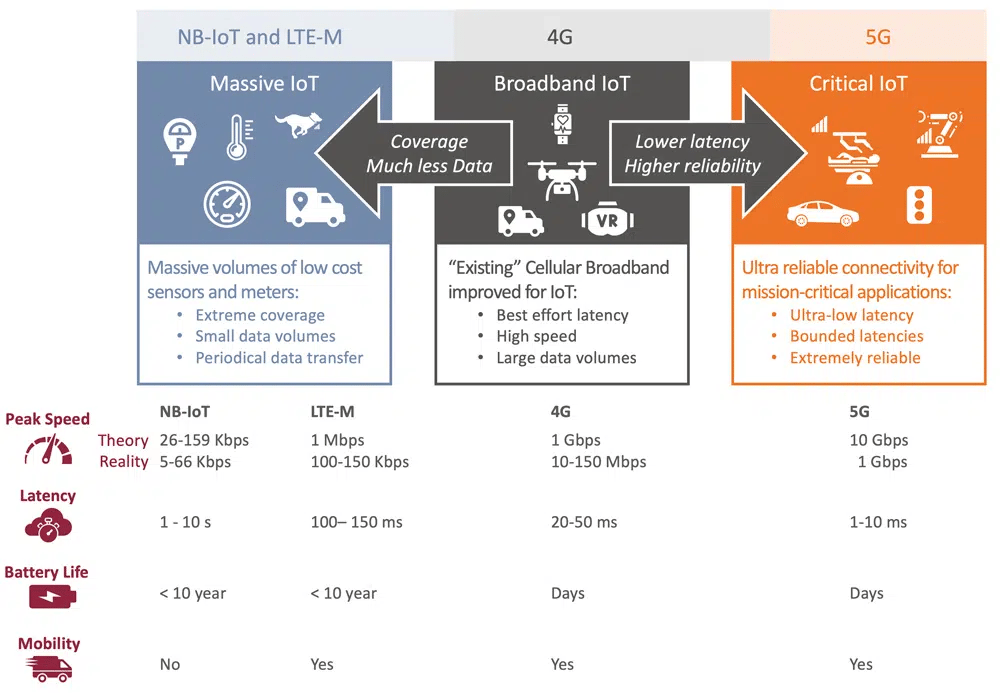
The Massive IoT market segment includes devices that are widely used in our society, mainly different sensors and meters. The NB-IoT and LTE-M technologies are the dominant technologies for Massive IoT. Compared to 4G, they are designed to deliver extreme coverage with much smaller data volumes and mainly periodical transfer of data. This means a battery life of up to 10 years which is ideal for low-cost devices such as smart meters.
NB-IoT is useful for simpler devices that don’t require connected mobility and tolerate low data rates in tens of Kbps and high latency of up to 10 seconds.
For tracking devices where connected mobility is crucial, CAT-M is a better choice. Cat-M also offers support for voice, higher data speeds of up to 1 Mbps and lower latency (100-150 ms).
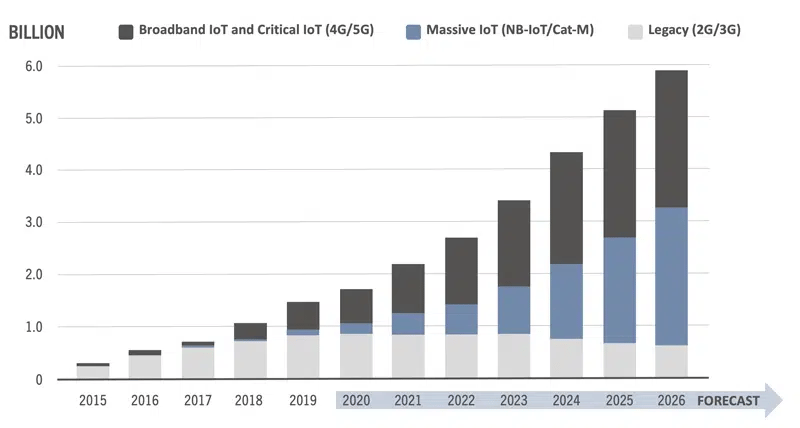
According to the Ericsson Mobility report November 2020, massive IoT (NB-IoT and Cat-M) will have an explosive growth going from almost 200 million connected devices in 2020 to approximately 2.6 billion or 45% of all cellular IoT connections by the end of 2026. At the same time, the total number of cellular IoT devices will be approximately 5.9 billion and 44 percent of those will use broadband IoT and Critical IoT (first devices expected in 2021), with 4G connecting most devices.
The non-cellular long range technology low-power wide-area network (LPWAN) will, according to the same report, go from 200 million to 400 million between 2020-2026.
Stockholm, Sweden, March 21, 2022: Enea today announced that its Wi-Fi Service Management Platform (SMP) was deployed by Batelco to seamlessly connect visitors at the Bahrain International Circuit (BIC). The BIC has a capacity of over 70,000, and the Enea Aptilo Wi-Fi SMP authenticated and connected Batelco’s customers automatically, and subscribers from other networks via a dedicated portal, during the Grand Prix event.
The BIC is part of Batelco’s ‘Bahrain Wi-Fi’ service, the Kingdom’s WiFi digital network. For over ten years the operator has used Enea’s solution to connect subscribers in hotspots nationwide.
“Enea is a valuable partner, and we share a common ethos,” said Batelco General Manager Enterprise Abdulla Danesh. “When we launched our service for people in the Kingdom to benefit from a uniform, island wide network – we relied on Enea’s technology. They have helped us deliver secure and reliable connectivity not only for our subscribers but for all people in Bahrain and visitors to the country.”
Enea’s Wi-Fi SMP not only provides secure connectivity, but also enables communication service providers (CSPs) to secure revenue streams with their Wi-Fi service. The technology has been deployed by over 100 CSPs in 75 countries and has a subscriber footprint of over 250 million.
“Our expertise supported Batelco’s delivery of Wi-Fi on one of the most important days in the sporting calendar,” said Jonas Jacobsson, Senior Vice President of Service Provider Sales at Enea. “Wi-Fi is a critical component of any sporting event adding the extra dimension on connecting fans to the action.”
References
Contact
Chevaan Seresinhe, Sonus PR for Enea
Email: [email protected]
Telephone: +44 797 1967 644 Stephanie Huf, Enea Chief Marketing Officer
E-mail: [email protected]
About Enea
Enea is one of the world’s leading specialists in software for telecommunications and cybersecurity. The company’s cloud-native products are used to enable and protect services for mobile subscribers, enterprise customers, and connected devices. More than 4.5 billion people rely on Enea technologies in their daily lives.
Enea is headquartered in Stockholm, Sweden, and is listed on Nasdaq Stockholm.
For more information: www.enea.com
STOCKHOLM – October 5, 2020 – Telkom Indonesia, owner of one of the world’s largest Wi-Fi networks, Indonesia Wi-Fi, celebrates six years in partnership with Aptilo Networks. Telkom has now completed an upgrade to the lastest version of the Aptilo Service Management Platform™ (SMP) with increased capacity and enhanced geographical redundancy.
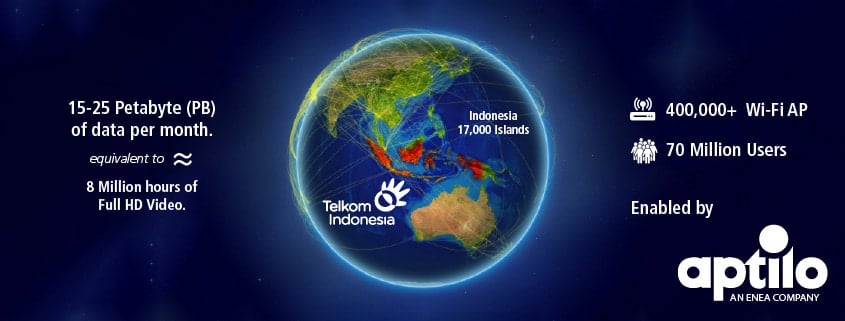
Telkom’s Indonesia Wi-Fi network is one of the businest in the world serving more than 70 million users with 400,000+ Wi-Fi access points. To be ready for the future, this upgrade further improves capacity and strengthens geographical redundancy to ensure a consistent service.
Indonesia Wi-Fi is available with high-capacity fiber backhaul nationwide in the world’s largest archipelago country with 237 million people spread across 17,000 islands. Users are consuming 15-25 Petabyte (PB) of data per month. To put things in perspective, 25 PB is equivalent to eight million hours of full HD video.
“Managing Wi-Fi services with 400,000+ access points (including homespot) and 70 million users across 17,000 islands puts extreme demands on the Wi-Fi service management core platform,” said Irwan Indriastanto, Senior Manager Wireless Product, Telkom Indonesia. “Our customers deserve the best high-performance Wi-Fi service available. We are very pleased to expand our relationship with Aptilo to enhance the capabilities of our Wi-Fi service.”
Telkom Indonesia also offers a first class business-to-business (B2B) Wi-Fi service which addresses all customer segments including enterprise, SME, wholesale and retail. Through their WICO (Wi-Fi Corner) product, Telkom Indonesia helps governments build smart cities and provide social services.
“We are proud to have enabled one of the world’s largest public Wi-Fi services for the last six years,” said Paul Mikkelsen, CEO, Aptilo Networks. “We are also impressed at how Telkom Indonesia makes the most out of the innovations from Aptilo and Wi-Fi equipment vendors.”
About Aptilo Networks
Aptilo Networks, an Enea company, is a leading provider of carrier-class systems to manage data services with advanced functions for authentication, policy control and charging. Aptilo Service Management Platform™ (SMP) has become synonymous with Wi-Fi service management and Wi-Fi offload in large-scale deployments with 100+ operators in more than 75 countries, and is a critical component of Wi-Fi calling and IoT.
# # #