
Houston-based company continues to enhance global connectivity solutions through transformative partnership
HOUSTON (January 16, 2024) – WorldVue, the trusted platform which empowers guest-centric properties around the globe to leverage technologies such as video entertainment, digital infrastructure, wireless connectivity, and smartphone applications , announced its partnership with OpenWiFi to enable global deployment of Telecom Infra Project (TIP) OpenWiFi solutions.
Through this partnership, WorldVue will integrate OpenWiFi’s open-source technology into its Wi‑Fi solutions, allowing for more flexibility and the ability to streamline network operations. This is accomplished using TIP OpenWiFi certified software and hardware and state of the art hardware from a wide array of manufacturers.
“WorldVue is committed to delivering high-quality services and seamless connectivity., We believe wireless connectivity is a major catalyst for economic growth and industry development,” said Robert Grosz, President and COO of WorldVue. “Embracing OpenWiFi allows us to break free from vendor lock, rapidly innovate in the wireless space developing deep integrations with mission critical applications and offer our clients the most flexible and lowest total cost of ownership.”
Launched in 2021, OpenWiFi is a community-developed open-source platform designed to lower the cost of developing and operating Wi-Fi networks. The platform’s unique approach to Wi-Fi creates an open-source disaggregated technology stack without vendor lock-in, ensuring a cost-effective and seamless way to deploy connectivity in a variety of use cases. OpenWiFi was created through the Telecom Infra Project (TIP), a global community of companies and organizations driving open and disaggregated infrastructure solutions to advance global connectivity. The OpenWiFi community currently includes more than 300 participants, including service providers, OEMs, ODMs, software ISVs, system integrators, silicon vendors, and industry organizations.
“We’re proud to partner with an industry leader like WorldVue to amplify our impact further and achieve our mission of closing the digital divide,” adds Jack Raynor, Chairman, OpenWiFi Program Group. The Wi-Fi industry benefits from disruptors like WorldVue who go above and beyond to enhance their offerings with an open-source solution.”
By building networks with TIP OpenWiFi solutions, customers will benefit from WorldVue’s industry-leading technology solutions combined with OpenWiFi’s innovative and cost-effective approach. This collaboration further solidifies the vision of revolutionizing how companies and individuals access and manage wireless networks.
ABOUT WORLDVUE
WorldVue®, is a trusted provider of video, advanced connectivity, and professional services to properties and enterprises on a global basis. With a dedication to customer service, WorldVue leads the way in delivering innovative technology solutions that enhance the resident, guest, and staff experience. From managed services to digital transformation, WorldVue is a single point of contact for all a property’s technology needs.
Founded in 1974, WorldVue is a privately held company headquartered in Houston, Texas. The company serves over 7,000 properties with over 900,000 rooms under management. For more information, visit www.worldvue.com.
ABOUT OPENWiFi:
Launched in 2021, OpenWiFi is a community-developed open-source platform designed to lower the cost of developing and operating Wi-Fi networks. Designed to include a cloud controller SDK and switches and enterprise-grade access point firmware validated to work seamlessly together, the platform’s unique approach to Wi-Fi creates an open-source disaggregated technology stack without vendor lock-in, ensuring a cost-effective and seamless way to Wi-Fi deploy connectivity in a variety of use cases. The OpenWiFi technology was created through Meta and the Telecom Infra Project (TIP), a global community of companies and organizations that are driving open and disaggregated infrastructure solutions to advance global connectivity. The OpenWiFi community currently includes more than 330 participants, including managed service providers, OEMs, ODMs, software ISVs, system integrators, silicon vendors and industry organizations. To learn more or deploy OpenWiFi, visit the OpenWiFi Alliance at www.openwifialliance.global.

Knowing that a certified device will interoperate in multi-vendor environments is important. But for service providers planning large-scale residential Wi-Fi deployments, validating conformance and interoperability is just the start.
When service providers are selecting Wi-Fi equipment for residential broadband deployments, you might think that evaluating device performance would be an obvious first step. It sounds straightforward enough: apply an objective, vendor-agnostic testing plan and make apples-to-apples comparisons. But this is one of those technology areas that sounds simple in theory but is actually quite complex. In fact, it’s challenged the industry for years.
There are, of course, tools that vendors and customers use to measure aspects of wireless performance. But for most of the history of Wi-Fi, standardized performance testing largely didn’t exist. Standards organizations offered highly effective testing frameworks to validate conformance with wireless standards and regulatory requirements governing RF airspace. Indeed, the massive success of Wi-Fi stems in no small part from testing regimes like the Wi-Fi Alliance, which gives customers confidence that any Wi-Fi-certified device will interoperate with any other in multi-vendor environments. When it comes to evaluating device performance, however, standards bodies have remained largely silent.
Now, that’s beginning to change. We recently published a white paper, The Importance of Performance Testing for Residential Wi-Fi Deployment detailing these efforts. The paper describes the challenges that have impeded standardized Wi-Fi performance testing and the evolving industry efforts to overcome them. The good news: while new technical hurdles continue to emerge, we finally have a solid foundation for standardized performance testing for diverse Wi-Fi use cases.
The Wi-Fi Performance Testing Challenge
Knowing that a certified device will interoperate in multi-vendor environments is obviously important. But for service providers planning large-scale residential Wi-Fi deployments, validating conformance and interoperability is just the start. They need to understand how different devices actually perform in subscriber households. After all, for the vast majority of residential customers (92% in the U.S. alone), Wi-Fi is a primary means of consuming broadband. The quality of experience that subscribers attribute to their provider increasingly depends on the performance of their Wi-Fi router or gateway—performance that service providers must be able to measure and understand.
Unfortunately, evaluating the performance of Wi-Fi equipment has historically been a difficult, expensive task, for multiple reasons:
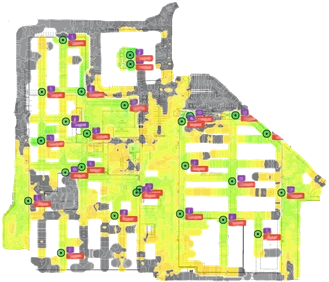
Illustrative data taken during a walk test in a real building
Inside Wi-Fi Performance Testing
Given the many variables involved in gauging performance, vendors have been reluctant to adopt any framework that might give the impression that one product is objectively “better” than another. Instead, they’ve advocated a “fit-for-purpose” approach that would allow customers to compare different devices’ suitability to specific environments and applications. The growing acceptance of this approach, along with ongoing advances in testing technologies, has laid the groundwork for the standardized Wi-Fi performance testing that service providers have been clamoring for.
Today, multiple industry groups have issued standardized Wi-Fi performance testing plans, each geared towards different purposes. These include:
Together, the new testing standards give service providers powerful new tools to plan and support residential Wi-Fi deployments. For the first time, they can evaluate Wi-Fi performance for specific use cases in meaningful ways, using consistent, in-depth testing plans from industry groups they trust.
Of course, this doesn’t mean that the performance testing challenge is “solved.” Wi-Fi is a constantly evolving technology, and new features are developed all the time. For example, performance testing specifications don’t yet address new Wi-Fi 6 and 7 features such as advanced power-saving mechanisms, multi-link operation, and others that add even more complexity. Just as important, Wi-Fi performance is becoming mission-critical for more and more applications. For augmented reality, smart home connectivity, and many others, the ability to maintain consistent latency, throughput, coverage, and other performance metrics will be essential.
Learn More
Want to know more about how the Wi-Fi testing landscape is changing, and how industry leaders are attacking the performance testing challenges of the future? Download the white paper.

Advanced Wi-Fi® capabilities fast-track the future of connectivity across home, enterprise, and industrial environments

Austin, Texas, – January 8, 2024 – Wi-Fi CERTIFIED 7™ is here, introducing powerful new features that boost Wi-Fi® performance and improve connectivity across a variety of environments. Cutting-edge capabilities in Wi-Fi CERTIFIED 7 enable innovations that rely on high throughput, deterministic latency, and greater reliability for critical traffic. New use cases – including multi-user AR/VR/XR, immersive 3-D training, electronic gaming, hybrid work, industrial IoT, and automotive – will advance as a result of the latest Wi-Fi generation. Wi-Fi CERTIFIED 7 represents the culmination of extensive collaboration and innovation within Wi-Fi Alliance®, facilitating worldwide product interoperability and a robust, sophisticated device ecosystem.
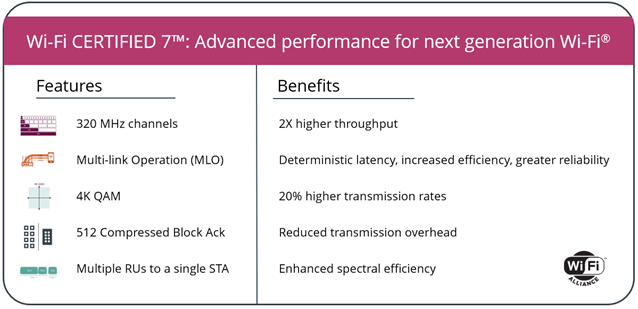
Wi-Fi 7 will see rapid adoption across a broad ecosystem with more than 233 million devices expected to enter the market in 2024, growing to 2.1 billion devices by 2028. Smartphones, PCs, tablets, and access points (APs) will be the earliest adopters of Wi-Fi 7, and customer premises equipment (CPE) and augmented and virtual reality (AR/VR) equipment will continue to gain early market traction[1]. Wi-Fi CERTIFIED 7 pushes the boundaries of today’s wireless connectivity, and Wi-Fi CERTIFIED™ helps ensure advanced features are deployed in a consistent way to deliver high-quality user experiences. Advanced features include:
“The introduction of Wi-Fi CERTIFIED 7 marks the emergence of the latest generation of Wi-Fi and will be an accelerant to mass adoption of Wi-Fi 7. This certification underscores our relentless commitment to delivering cutting-edge technology that redefines the way users experience Wi-Fi, providing faster speeds, improved efficiency, and increased reliability which expand the horizons of what is possible through Wi-Fi.” – Kevin Robinson, president and CEO, Wi-Fi Alliance
Companies including Broadcom, CommScope RUCKUS Networks, Intel, MaxLinear, MediaTek, and Qualcomm form the test bed for certification and are among the first Wi-Fi CERTIFIED 7 devices.
Industry support for Wi-Fi CERTIFIED 7™
“Airties looks forward to supporting broadband service providers’ plans to launch new Wi-Fi CERTIFIED 7 devices to their subscribers. Wi-Fi 7 provides unprecedented capacity and spectrum efficiency to support far more connections and immersive applications. By embracing Smart Wi-Fi software that is truly standards-based, open-source, and hardware agnostic, ISPs can gain maximum flexibility and control over subscribers’ home broadband experience. With Airties’ Smart Wi-Fi, ISPs will be positioned to optimize the performance of both Wi-Fi 7 and legacy devices to improve QoE, drive incremental revenue, reduce customer support costs, reduce churn, and serve as a platform for future innovation.” – Metin Taskin, Co-CEO, Airties
“Boingo has been a Wi-Fi leader for over two decades, and this leadership will continue as we pioneer Wi-Fi 7 deployments and leverage Wi-Fi 7 CERTIFIED equipment. Wi-Fi 7 promises to usher connectivity into the next phase of digital innovation, delivering unprecedented speeds and capacity. Together with 5G, Wi-Fi 7 will drive digital transformation for Boingo’s customers at military bases, airports, transit hubs, stadiums, hospitals, hotels and enterprises worldwide.” – Dr. Derek Peterson, Chief Technology Officer, Boingo Wireless
“Wi-Fi CERTIFIED 7 has arrived, bringing lower latency, blazing fast speeds, determinism and high capacity to homes, enterprises and large public venues. Built for our ultra-connected world, Broadcom’s Wi-Fi 7 solutions deliver reliable multi-gigabit broadband connectivity to where it is needed most. We are honored to once again participate in the test bed and collaborate with industry peers to revolutionize the wireless experience by launching features like Multi-Link Operation (MLO), which avoids congestion and significantly lowers latency, laying the foundation for a digitally immersive and connected world.” – Vijay Nagarajan, Vice President of Marketing, Wireless Communications and Connectivity Division, Broadcom Inc.
“RUCKUS Networks has always been at the forefront of enterprise Wi-Fi innovation. We are honored to be the only commercial Wi-Fi AP vendor selected to be included in the Wi-Fi CERTIFIED 7 AP test bed. RUCKUS, a longtime collaborator of Wi-Fi Alliance, is proud to have actively participated in multiple Wi-Fi 7 plug fests to ensure interoperability with a variety of Wi-Fi 7 client devices and to accelerate Wi-Fi 7 market adoption. RUCKUS looks forward to working with Wi-Fi Alliance in the future to continue delivering Wi-Fi technology innovations.” – Bart Giordano, SVP & President, Networking, Intelligent Cellular and Security Solutions, CommScope
“Over the past two and a half decades, Wi-Fi has revolutionized the way we interact and function as a society. It stands as the foremost technology for daily connectivity. We are still at the dawn of the 6 GHz era, heralded by Wi-Fi 6E and we are poised to unlock unprecedented wireless user experiences. Wi-Fi 7, which is the next step of this evolution, signifies more than an incremental upgrade—it’s a leap into a realm where speed, capacity, and reliability converge to meet the insatiable demands of our connected world.” – David Coleman, Director of Wireless in the Office of the CTO, Extreme Networks
“Congratulations to Wi-Fi Alliance for the launch of the Wi-Fi CERTIFIED 7™. Intel-powered PCs and IOT products with Wi-Fi 7 will enable multi-gigabit speeds with wired-like responsiveness and new extreme levels of connection reliability. Ecosystem collaboration and interoperability are essential to help deliver on these expectations. We are delighted that our new Intel Wi-Fi 7 BE200 solution has been officially certified and included in the program test bed to help make great user experiences possible with other Wi-Fi 7 devices.” – Eric A. McLaughlin, VP & GM Wireless Solutions Group, Intel Corporation
“MaxLinear is spearheading the advancement of Wi-Fi technology, in strategic partnership with Wi-Fi Alliance. Our focus extends beyond mere support; we’re actively defining the future of Wi-Fi access points. Our pivotal role in the Wi-Fi 7 certification test bed underscores our dedication to elevating user experiences with unparalleled speeds, enhanced capacity, and lower latency. Our innovative tri-band single chip Wi-Fi solution exemplifies our leadership in carrier-grade Wi-Fi. We’re not just participants; we are the architects of a new era in wireless communication, enabling diverse applications across consumer, enterprise, and industrial sectors.” – Will Torgerson, VP/GM Broadband Group, MaxLinear
“It’s impressive to see how quickly the Wi-Fi 7 certification program has progressed. As one of the first adopters of Wi-Fi 7 technology, MediaTek has worked closely with Wi-Fi Alliance to develop and test our Filogic portfolio. Now brands can be confident that devices powered by MediaTek Filogic Wi-Fi CERTIFIED 7 chipsets take full advantage of Wi-Fi 7’s enhancements to deliver fast, reliable, and always-on connected experiences.” – Alan Hsu, Corporate Vice President, MediaTek
“Wi-Fi 7 is a game-changing evolution of Wi-Fi, elevating wireless connectivity to unprecedented heights of performance. The Qualcomm FastConnect 7800 and Networking Pro Series Platforms are powering millions of Wi-Fi 7 smartphones, PCs, and access points today, and we are honored that both are included in the certification test bed. We are thrilled our customers are experiencing our full-featured Wi-Fi 7 implementations across our product portfolio, including 320 MHz channels, Multi-Link Operation maximized for robust performance at range, and improvements to enhance manageability of platforms. Together, we are racing forward, ushering in a broad ecosystem of Wi-Fi 7 networks, devices and use cases that will help redefine the world in which we live, work, and connect.” – Rahul Patel, Senior Vice President and General Manager, Connectivity, Broadband and Networking, Qualcomm Technologies, Inc
“Wi-Fi 7 significantly increases performance for both consumers and businesses. With new technologies such as Multi-Link Operation, 4K QAM, and 320 MHz channels, Wi-Fi 7 will enable new applications and ecosystems and dramatically improve user experience for existing ones.” – James Kimery, VP of Product Management, Spirent Communications
For a new video, technology highlights, technology overview and more information, please visit https://www.wi-fi.org/discover-wi-fi/wi-fi-certified-7.
About Wi-Fi Alliance® | www.wi-fi.org
Wi-Fi Alliance® is the worldwide network of companies that brings you Wi-Fi®. Members of our collaboration forum come together from across the Wi-Fi ecosystem with the shared vision to connect everyone and everything, everywhere, while providing the best possible user experience. Since 2000, Wi-Fi Alliance has completed more than 80,000 Wi-Fi certifications. The Wi-Fi CERTIFIED™ seal of approval designates products with proven interoperability, backward compatibility, and the highest industry-standard security protections in place. Today, Wi-Fi carries more than half of the Internet’s traffic in an ever-expanding variety of applications. Wi-Fi Alliance continues to drive the adoption and evolution of Wi-Fi, which billions of people rely on every day.

In an era where connectivity is paramount, venues are continually seeking innovative ways to enhance their guest Wi-Fi experience. One of the key elements in this quest is the improvement of Wi-Fi connectivity. There is one specific tool that is simple, yet efficient in encouraging guests to quickly connect to Wi-Fi – QR codes.
The Power of Wi-Fi QR Codes
Wi-Fi QR codes simplify the guest connectivity process and offer a range of benefits that contribute to an overall enhanced Wi-Fi experience:
Ease of Implementation and Promotion
The adoption of Wi-Fi QR codes is a game-changer for venues aiming to provide a superior guest experience. The simplicity, efficiency, and enhanced security offered by this technology contribute to a positive overall perception of the venue. By embracing this innovative solution, venues can ensure that connectivity becomes an asset rather than a hindrance, setting the stage for a memorable and enjoyable guest experience.
Austin, TX and Dubai, UAE – December 15, 2023 – Wi-Fi Alliance®, on behalf of its members, commends the outstanding effort and contribution of Saudi Arabia’s delegation during the 2023 World Radiocommunication Conference (WRC-23). The success of the conference in considering international regulations for the 6.425-7.125 GHz frequency band was undoubtedly a result of the dedication, diplomacy, and leadership demonstrated by Saudi Arabia’s Communications, Space & Technology Commission (CST).
The CST team members’ ability to foster collaboration, articulate informed perspectives, and engage constructively with WRC-23 delegates from diverse backgrounds enabled the formulation of a consensus approach. The positive outcomes achieved during the conference will advance Wi-Fi® and other technologies’ ability to deliver connectivity worldwide.
Wi-Fi Alliance congratulates the CST on the successful outcome of the WRC-23. The CST delegates’ accomplishments are a testament to Saudi Arabia’s commitment to technological advancement through diplomatic means.
About Wi-Fi Alliance® | www.wi-fi.org
Wi-Fi Alliance® is the worldwide network of companies that brings you Wi-Fi®. Members of our collaboration forum come together from across the Wi-Fi ecosystem with the shared vision to connect everyone and everything, everywhere, while providing the best possible user experience. Since 2000, Wi-Fi Alliance has completed more than 80,000 Wi-Fi certifications. The Wi-Fi CERTIFIED™ seal of approval designates products with proven interoperability, backward compatibility, and the highest industry-standard security protections in place. Today, Wi-Fi carries more than half of the Internet’s traffic in an ever-expanding variety of applications. Wi-Fi Alliance continues to drive the adoption and evolution of Wi-Fi, which billions of people rely on every day.
Follow Wi-Fi Alliance:
Austin, TX and Dubai, UAE – December 14, 2023 – Wi-Fi Alliance® celebrates the WRC-23 decisions on the 6.425-7.125 GHz frequency band (upper-6 GHz). Following four years of technical analysis, policymakers and stakeholders from more than 160 countries gathered at WRC-23 to consider the most responsible and efficient use of the upper 6 GHz radio-frequency spectrum. Wi-Fi Alliance is thrilled that the conference recognized the pivotal role of 6 GHz Wi-Fi® in shaping the future of global connectivity. While deciding to identify the upper 6 GHz spectrum for International Mobile Telecommunications (IMT) in Europe, Africa and a few other countries, the conference adopted an international treaty provision to explicitly recognize that this spectrum is used by wireless access systems such as Wi-Fi. Importantly, the WRC-23 rejected proposals to expand the upper 6 GHz IMT identification to several other countries or to consider such IMT identifications at the next WRC in 2027.
Wi-Fi Alliance is grateful to all WRC-23 delegates who have dedicated their time, knowledge, and expertise to make this conference a success.
About Wi-Fi Alliance® | www.wi-fi.org
Wi-Fi Alliance® is the worldwide network of companies that brings you Wi-Fi®. Members of our collaboration forum come together from across the Wi-Fi ecosystem with the shared vision to connect everyone and everything, everywhere, while providing the best possible user experience. Since 2000, Wi-Fi Alliance has completed more than 80,000 Wi-Fi certifications. The Wi-Fi CERTIFIED™ seal of approval designates products with proven interoperability, backward compatibility, and the highest industry-standard security protections in place. Today, Wi-Fi carries more than half of the Internet’s traffic in an ever-expanding variety of applications. Wi-Fi Alliance continues to drive the adoption and evolution of Wi-Fi, which billions of people rely on every day.
Austin, TX and Washington, D.C. – December 13, 2023 – Wi-Fi Alliance Services, a wholly owned subsidiary of Wi-Fi Alliance®, proudly announces the successful completion by Wi-Fi Alliance of all the requirements for regulatory approval of its Automated Frequency Coordination (AFC) system by the Federal Communications Commission (FCC). Wi-Fi Alliance subsequently requested to transfer its application to Wi-Fi Alliance Services in preparation for commercial 6 GHz standard power operations.
Read the latest announcement about Wi-Fi Alliance Services and learn more by visiting www.wi-fi.com.
About Wi-Fi Alliance® | www.wi-fi.org
Wi-Fi Alliance® is the worldwide network of companies that brings you Wi-Fi®. Members of our collaboration forum come together from across the Wi-Fi ecosystem with the shared vision to connect everyone and everything, everywhere, while providing the best possible user experience. Since 2000, Wi-Fi Alliance has completed more than 80,000 Wi-Fi certifications. The Wi-Fi CERTIFIED™ seal of approval designates products with proven interoperability, backward compatibility, and the highest industry-standard security protections in place. Today, Wi-Fi carries more than half of the internet’s traffic in an ever-expanding variety of applications. Wi-Fi Alliance continues to drive the adoption and evolution of Wi-Fi, which billions of people rely on every day.

Introduction
Cognitive Systems Corp., which provides pioneering Wi-Fi sensing technology, WiFi Motion, has redefined how people interact with wireless networks by using existing Wi-Fi signals to transform connected devices into motion sensors.
Cognitive System’s Wi-Fi Sensing technology constitutes a comprehensive software stack that can be effortlessly deployed onto an access point or client device, which enables motion sensing for a wide array of applications across any Wi-Fi-enabled environment. This technology operates seamlessly without the need for additional hardware, utilizing sophisticated algorithms for channel state information analysis, motion pattern detection, and real-time signal interpretation. Potential applications for this motion sensing technology include home monitoring, eldercare, and smart home automation.
With Cognitive Systems’ widespread deployment and operational reach, particularly in densely interconnected environments where high reliability and low latency are imperative for a multitude of applications, the integration of WiFi Motion with an efficient and scalable container orchestration service emerged as an absolute imperative.
The evolution from a single server
In the footsteps of many budding start-ups, Cognitive started their journey on a smaller scale using a single server. However, as their Wi-Fi Sensing solution gained traction, the surge in deployments gradually escalated demand on this solitary server, necessitating a scalable solution. This led Cognitive to adopt Kubernetes—a robust system capable of efficiently managing multiple servers.
However, as deployments scaled, Cognitive encountered challenges that proved far from simple, going beyond basic computer troubleshooting. This led to countless hours spent on the phone with human customer support agents, and Cognitive knew there must be a better option.
The quest for a more responsive partner
As the complexities of managing their growing Wi-Fi sensing technology grew, so did Cognitive’s demand for swift and effective customer support. Recognizing the need for a more robust solution, Cognitive explored cloud providers. In this pursuit, Amazon Web Services (AWS) emerged as a standout candidate. What sets AWS apart is not only its cutting-edge infrastructure but also its human-centric approach to customer support—a pivotal shift from their previous solution as Cognitive now had knowledgeable professionals at their disposal capable of promptly addressing issues and aiding in troubleshooting.
In 2019, Cognitive started their journey on AWS’s newly launched Amazon Elastic Kubernetes Service (Amazon EKS). The frequency of updates, global reach over multiple AWS Regions, and resource efficiency underscored the potential for ongoing growth and innovation within the platform. Transitioning to Amazon EKS therefore seemed natural to secure a reliable, scalable, and well-managed future for WiFi Motion.
Global expansion and latency woes
When Cognitive’s sales team expanded their focus to Europe and Asia, a fresh set of challenges emerged. To illustrate the potential applications of WiFi Motion to their service provider clients, Cognitive created two sample mobile phone application offerings—Home Aware and Caregiver Aware—to showcase how a service provider could seamlessly integrate Wi-Fi sensing into their offerings. Both applications centered around a key feature named Live Motion, which enables users to visualize ongoing motion within their homes through the application in real time.
The effectiveness of this feature relied heavily on low latency, specifically under 250 ms, to guarantee smooth functionality. Moreover, seamless navigation through the prototype app was paramount, particularly since these test apps were frequently employed in service providers’ Wi-Fi sensing trials.
While the latency between North America and Europe maintained a tolerable margin at around 200 ms, Asia posed a far more substantial obstacle. Given the vast geographical expanse, latency consistently surpassed acceptable thresholds, resulting in delays of over a second. Regrettably, this disparity led to adverse user experiences. This led Cognitive to explore AWS’ vast regional presence to provide low latency and improve the user experience.
Using Amazon EKS: A game-changing AWS Region in Tokyo
Amazon EKS’s global reach across multiple AWS Regions played a pivotal role in addressing these latency challenges. With the availability of an AWS Region in Tokyo, Cognitive effectively extended its presence into Asia. The results were remarkable: sample application evaluators, who had previously encountered performance issues, were now enjoying seamless interactions. Amazon EKS was instrumental in turning Cognitive’s vision of a worldwide revolution in Wi-Fi innovation into reality, which made motion sensing accessible to any Wi-Fi connected space. This global accessibility is crucial for Wi-Fi sensing to become the next transformative advancement for the ubiquitous technology of Wi-Fi, which has long been synonymous with communication.
Choosing to standardize on AWS and Amazon EKS yielded benefits beyond addressing latency concerns. The abundant talent pool familiar with AWS facilitated easier hiring while relying on off-the-shelf components of Kubernetes lightened our workload. With a small team, Cognitive was able to efficiently manage 10 Amazon EKS clusters (and counting) today. This efficiency was further highlighted by the absence of live pager duty; the cloud’s inherent self-healing capabilities ensured continuous system operation.
Amazon EKS empowered Cognitive by providing the foundational elements to develop self-monitoring and self-recovery functions, minimizing the need for extensive engineering resources. This approach, combined with AWS’s built-in healing mechanisms like Managed Node groups, mitigated the impact of sporadic server and network failures inevitable at our global scale. By focusing on maintaining desired states, the system proactively guided itself back to optimal conditions, conserving valuable man-hours.
Solution overview
Cognitive Systems’ implementation

Figure 1: High-level solution architecture
The previous figure illustrates Cognitive Systems’ high-level solution architecture. Data from the Internet of Things (IoT) nodes is routed to the nearest region using the Amazon Elastic Load Balancing Network Load Balancer, while client application requests are routed to Kubernetes services exposed through the Application Load Balancer (ALB). The routing of traffic to the nearest AWS Region is typically managed in a customer-specific manner, with a common practice being the utilization of Amazon Route 53. While customer-specific configurations vary, Amazon Route 53 often serves as the foundational layer. Additionally, Amazon Route 53 is instrumental in implementing High Availability (HA) within a specific region. To establish a robust, secure, and reliable communication channel between Cognitive’s IoT fleet and the Cloud, they employ MQTTS (MQTT + mutual TLS) facilitated by AWS Network Load Balancers. Additionally, AWS Lambda functions are employed for executing Extract, Transform, and Load (ETL) operations on collected data, which is stored on Amazon Simple Storage Service (Amazon S3). Amazon Athena and Metabase helped Cognitive gain and visualize insights from the transformed data. The same architecture is replicated across multiple regions to provide low latency and meet quality standards.
Automation scripts and Infrastructure as Code (IaC) pipelines have been developed, facilitating the replication of this architecture across various clusters and global regions with ease.
Conclusion
In this blog post, Mike Ravkine discussed how Cognitive Systems Corp. leveraged Amazon EKS to bring their innovative Wi-Fi Sensing technology, WiFi Motion, to reality. It outlined the evolution of Cognitive’s technology, challenges faced in latency when expanding globally, and how Amazon EKS addressed these issues. The post emphasized the benefits of using AWS for scalability, efficient management, and global reach, ultimately enabling Cognitive Systems to revolutionize Wi-Fi innovation and make motion sensing accessible worldwide.
Adopting a standard, like Amazon EKS and other services, allowed Cognitive Systems to seamlessly integrate with large customers already on the AWS cloud, significantly reducing the once-present barriers of networking, authentication, and authorization. The establishment of a secure, private link between Cognitive and its customers via AWS effectively manages typical security requirements, rendering compliance and privacy considerations more manageable and cost-effective. Cognitive conducts prototypes and trials using the public internet due to its expediency and accessibility. However, when transitioning to production, they use shared Amazon Virtual Private Clouds (Amazon VPC) and PrivateLink, as these options offer enhanced security measures and cost-effectiveness.
The partnership between Cognitive Systems and AWS, with a robust, globally accessible infrastructure, facilitated efficient scalability, intricate problem-solving, and the delivery of exceptional services. As Cognitive’s global reach expands and its customer relationships deepen, AWS and Amazon EKS continues to empower them to achieve more with fewer resources while upholding unparalleled quality and reliability.
To learn more about Cognitve Systems and WiFi Motion, visit www.cognitivesystems.com.
The latest generation of Wi-Fi, Wi-Fi 7, introduces a range of new capabilities for more sophisticated, higher-throughput/lower-latency wireless communications. Industry leaders anticipate that these features will enable a new generation of applications, from fully automated factories, to mass-scale Internet of Things (IoT) deployments, to immersive augmented reality (AR) gaming, and more. As with all technology advances, however, new Wi-Fi capabilities bring new technical complexity—and new challenges for those tasked with designing and debugging Wi-Fi devices.
Those seeking to exploit Wi-Fi 7 features such as multi-link operation (MLO), enhanced quality of service (QoS), and 4096 quadrature amplitude modulation (4K QAM) will find that legacy testbeds cannot provide the capabilities or visibility that such features require. Indeed, if testers can’t measure coordinated operations across radios, for example, or analyze next-generation modulation schemes, they can’t characterize how new features perform—much less debug devices when something goes wrong.
In our recent paper, Navigating Wi-Fi 7: A Deep Dive into Next-Gen Advancements, we provide an in-depth analysis of the revolutionary changes that Wi-Fi 7 introduces. We discuss the impact that these new features have on testing and the strategies Spirent is advancing to address them. This blog offers a brief overview of some of these innovations.
Measuring multi-link operation
Previous Wi-Fi generations enabled devices to use multiple radios simultaneously, either in the same or across multiple bands. Until now, though, each radio operated independently. Among its most powerful new capabilities, Wi-Fi 7 introduces coordinated multi-link operation (MLO) to improve throughput, increase reliability, or both.
Wi-Fi 7 adds a new Unified Upper MAC (UMAC) layer to coordinate multi-link operations in a multi-link device (MLD) architecture (Figure 1). The UMAC provides the higher-layer protocols with a single MAC address for data transfers in a way that is very familiar to current Wi-Fi radio users. Underneath this, the UMAC contains logic to distribute the data block across the individual radio links, as appropriate, and manage the flow of data at this lower link level. This lower-layer operation is invisible to the higher-layer protocols so that they do not need to care how many radios are being used, or in what way.
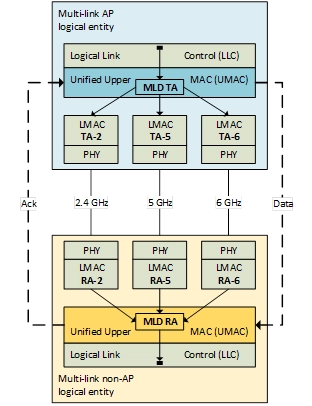
Figure 1. MLD architecture
With this additional layer of intelligence, the UMAC can distribute loads across multiple links to improve throughput and latency or transmit redundant packets to improve reliability (Figure 2).
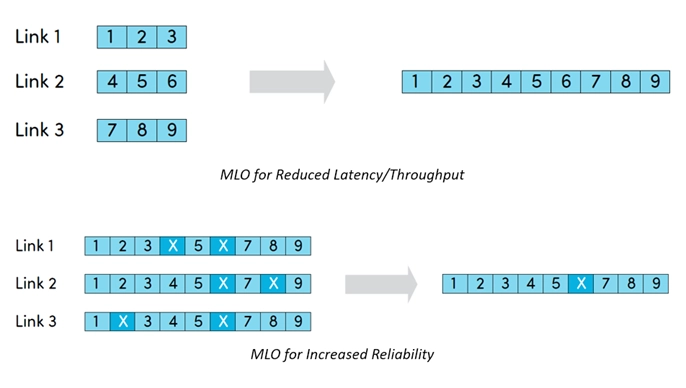
Figure 2. Overview of MLO in action
These MLO features can enable significant performance improvements for Wi-Fi users across a variety of scenarios. Validating them, however, requires new testing capabilities. To measure higher-throughput/lower-latency operations, for example, testbeds need additional computing resources to generate and consume traffic at higher rates. Testbeds must also provide visibility into the coordinated radio operations themselves. Effectively, all analysis and debugging capabilities previously performed on a per-radio basis must now extend to multiple radios operating simultaneously in concert.
Spirent’s new multi-link sniffer technology can analyze multiple bands simultaneously and provide consolidated operational data for use in Wireshark or other debugging tools.
Facilitating 4k QAM
As Wi-Fi has evolved over the years, modulation coding schemes (MCS) have evolved alongside it. Each new generation has supported more bits per symbol, increasing throughput by allowing devices to communicate more information per transmission.
However, denser QAM constellations also make devices more sensitive to channel noise—requiring ever-better signal-to-noise ratio (SNR). This issue has presented challenges through previous Wi-Fi evolutions, such as moving to 256 QAM (Wi-Fi 5) or 1024 QAM (Wi-Fi 6). As Figure 3 illustrates, however, the leap to 4096 QAM creates a constellation denser than anything Wi-Fi devices—and testbeds—have contended with before.
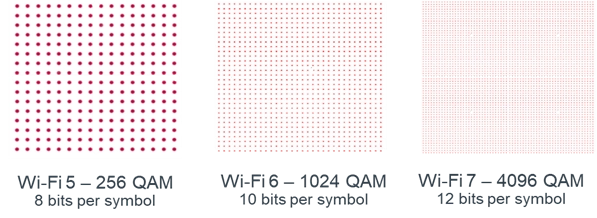
Figure 3. Increasing constellation density across Wi-Fi generations
At this density, channel noise that was acceptable in previous Wi-Fi generations can make it impossible to distinguish the position of individual points, introducing modulation errors. To capitalize on 4K QAM the new Wi-Fi 7 devices must be able to support these higher resolutions with finer decision boundaries, and testbeds must be redesigned to minimize as much path loss as possible.
Characterizing QoS enhancements
Latency also continues to improve with each new Wi-Fi generation, especially with the introduction of orthogonal frequency-division multiple access (OFDMA) in Wi-Fi 6, and deterministic latency in Wi-Fi 7. But to support more groundbreaking latency-sensitive applications QoS testing and reporting must also evolve. As part of the Device Metrics Test Plan for Wi-Fi 7, the Wi-Fi Alliance highlighted the need for latency testing that provides not just average one-way delay (OWD), but a detailed statistical spread.
This level of insight is essential for characterizing performance in scenarios where multiple users are contending for the same channel resources, causing latency to fluctuate. For example, consider an AR gaming application where latency exceeding 30 milliseconds will be noticeable (and disruptive) to users. Legacy testing might show that, with OFDMA enabled, a device maintains 30ms average OWD. But knowing that average isn’t particularly helpful if the latency periodically spikes to 100ms, ruining user sessions.
To guarantee consistently good experiences, device makers must know the full range of latency users can experience, how various mechanisms affect delay, and how often OWD exceeds maximum thresholds. Spirent’s OCTOBOX testbeds report not just the average latency but the full statistical distribution. For example, Figure 4 illustrates the change is OWD distribution gained by using OFDMA. This allows testers to fully characterize performance and determine a statistical measure of the probability of achieving any target delay—critical information for guaranteeing QoS in emerging applications.
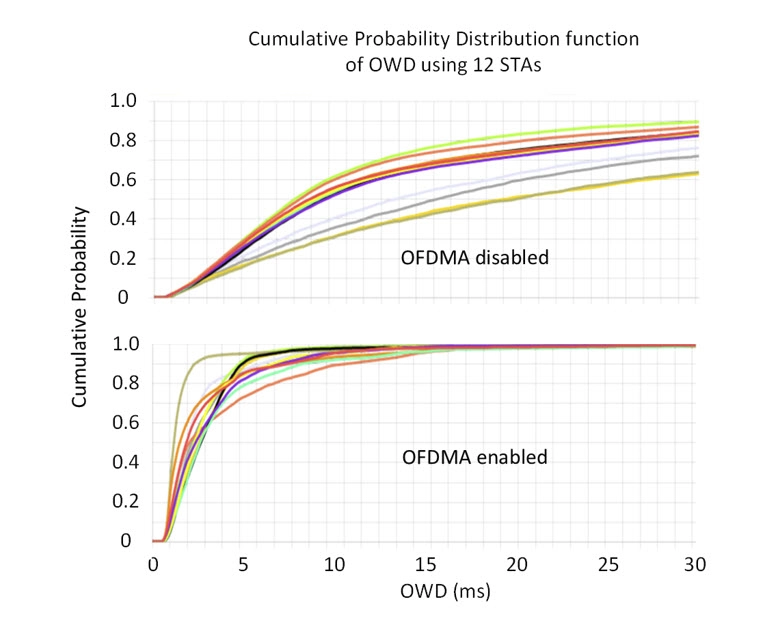
Figure 4. Characterizing device performance with and without OFDMA
The Spirent advantage
As a global leader in wireless testing solutions, Spirent has a long history of continually expanding the in-depth statistics and performance indicators our OCTOBOX testbeds provide to help organizations capitalize on new technologies. In fact, Spirent is typically the first in the industry in enabling in-depth testing and validation for new Wi-Fi advances. Why are we so often ahead of the curve? Because we’re intimately involved in the groups developing and standardizing wireless innovations.
Spirent is extremely active working across the industry to understand the implications of new wireless standards for our customers and what’s needed to test and characterize their performance. That includes working directly with leading wireless equipment and device manufacturers but also participating in industry groups like the Wi-Fi Alliance and IEEE. Spirent engineers currently serve on multiple Wi-Fi Alliance task groups, including leading the group that developed the Wi-Fi 7 Device Metrics Test Plan.
As a result, we don’t have to wait until new standards are finalized to know what will be needed to test them. So, when groundbreaking Wi-Fi advances emerge, we can help our customers start using and benefiting from them right away.
For more details on cutting-edge Wi-Fi 7 features and the latest approaches to characterize their performance, download the new whitepaper Navigating Wi-Fi 7: A Deep Dive into Next-Gen Advancements.
Wi-Fi Alliance® commends President Biden, Secretary Raimondo, and Administrator Davidson for demonstrating strong leadership in managing the U.S radio spectrum. The Presidential Memorandum and the Administration’s National Spectrum Strategy establish the cornerstone for policies and procedures that will promote more efficient use of spectrum while maximizing its benefits for all Americans. The Administration’s action to improve management of spectrum – a finite resource – is imperative to America’s connectivity, global leadership, and national security goals.
“This strategic policy framework will greatly enhance Federal agencies’ ability to maximize spectrum sharing and utilization,” said Alex Roytblat, Vice President of Worldwide Regulatory Affairs at Wi-Fi Alliance. Wi-Fi® is inherently protective of other spectrum users, and our industry is excited about the opportunities created through this policy effort. The Wi-Fi industry is committed to engaging with our Federal agencies partners on technical, operational, and regulatory solutions for coexistence that will deliver incredible connectivity benefits to U.S. users while supporting ongoing agency needs.”
About Wi-Fi Alliance® | www.wi-fi.org
Wi-Fi Alliance® is the worldwide network of companies that brings you Wi-Fi®. Members of our collaboration forum come together from across the Wi-Fi ecosystem with the shared vision to connect everyone and everything, everywhere, while providing the best possible user experience. Since 2000, Wi-Fi Alliance has completed more than 80,000 Wi-Fi certifications. The Wi-Fi CERTIFIED™ seal of approval designates products with proven interoperability, backward compatibility, and the highest industry-standard security protections in place. Today, Wi-Fi carries more than half of the internet’s traffic in an ever-expanding variety of applications. Wi-Fi Alliance continues to drive the adoption and evolution of Wi-Fi, which billions of people rely on every day.