

While many businesses are still struggling to open because of the COVID-19 pandemic, others are now at the stage where they are starting to look at new ways to save money, improve their digital marketing efforts, and get the company back on its feet.
Many find that a straightforward way to get a head start is to consolidate the various software that powers their business. By choosing one software suite that performs all the tasks of separate services, you can lower costs and make it easier to manage.
Cloud Services and SaaS Platforms Can Overlap
Today’s modern businesses utilize Software as a Service (SaaS) or cloud service platforms to help market and operate effectively. For example, many businesses deployed new systems to automate their digital marketing and customer interactions during the pandemic. While these systems are valuable, some overlap in features that increase costs to the business and decrease the likelihood of being used most efficiently to realize the ROI.
For example, a venue can implement GoZone WiFi’s Marketing4WiFi platform to provide a captive portal on their guest WiFi network. This captive portal element is a potent addition to the business since it automatically builds a list of customers who visit the venue. The business then takes that list and imports it into a secondary marketing system. However, since the Marketing4WiFi platform already has automated marketing and CRM features, the added cost of the secondary e-marketing system and the time involved to manage both systems are wasteful.
Consolidating Cloud Platforms and Services
Many businesses tend to accumulate multiple SaaS contracts over time. Consolidating those services can often lead to better workload management and lower costs for the business.
From our previous example, GoZone WiFi has customers that use its system to collect guest data, e-mail addresses, mobile numbers, and more. One might take that data, export it, and link it to a third-party system that sends out emails.
Businesses partaking in such practices are making three distinct mistakes:
These problems are easily solved by consolidating cloud platforms and services.
Every business that utilizes a cloud platform or SaaS contract should evaluate all the offerings those companies provide and then compare them against the needs of the business. Performing an audit will often reveal that the platforms can provide more for the business than originally planned. This will allow the company to avoid overlapping services to save money, making it easier for workers to manage the subscriptions and learn to integrate the platforms to gain the most effect.
As COVID lock-downs happened, brick-and-mortar businesses quickly realized that building and maintaining a list of their customers was critical. Post-COVID, businesses have changed how they communicate with their customers and the way customers interact with businesses.
Contact a GoZone partner or us today to find out how our platforms can help your business.

With the comprehensive integration between Calix Marketing Cloud and industry-leading email marketing platform Mailchimp, Calix launches the first of many integrations with major “MarTech” platforms to help marketers automate the creation and execution of targeted campaigns that eliminate churn and grow revenue
SAN JOSE, CA – May 13, 2021 – Calix, Inc. (NYSE: CALX) today launched the seamless integration of leading email marketing platform Mailchimp with Calix Marketing Cloud. This is the first step in a journey to enable broadband service providers (BSPs) to adopt a simple model for planning and executing fully integrated omnichannel marketing campaigns. These campaigns will be targeted with insights from rich behavioral data and executed through automation to create timely and relevant touchpoints that attract new subscribers as well as increase loyalty among existing subscribers. Broadband service provider marketers can now access audience segments from Calix Marketing Cloud—which is purpose-built to help BSPs leverage subscriber data to grow revenue and build brand loyalty—directly in Mailchimp, eliminating the need for cumbersome, manual spreadsheet exports. These marketers can then execute automated and highly targeted campaigns against these audiences. Calix Marketing Cloud will also include a new dashboard that provides real-time visibility into campaign performance metrics, including open rates, click-throughs, unsubscribes, and bounce rates. As a result, marketers can easily understand the impact of each analytics-driven campaign and tie marketing campaign investments to revenue. This latest enhancement to the Revenue EDGE solution marks the first in a series of planned integrations, including a major Facebook integration scheduled for next quarter.
The journey to radically simplify processes for marketers begins with the comprehensive integration between Mailchimp and Calix Marketing Cloud, and will extend to other marketing and social media platforms so that BSPs can:
In a survey Calix conducted that included both customers and non-customers, Mailchimp ranked as the most popular email marketing software among respondents. As a leader in this space, Mailchimp provides a one-stop-shop for managing email, direct mail, website, and social campaigns.
“We use Mailchimp extensively for our email marketing, and this integration with Calix Marketing Cloud is a welcome enhancement that will simplify our ability to manage email lists and audience segments from one platform,” said Chris Armstrong, director, sales and marketing for CityWest, a BSP located in British Columbia. “As marketing becomes inherently more social and our subscribers increasingly more connected, we continue to look for new and innovative ways to deliver premium services. We are eager to build on our successes to date with Calix by integrating even more of our social channels with Calix Marketing Cloud in the near future.”
Calix Marketing Cloud is the only marketing platform purpose-built for the BSP marketer, using contextual, behavioral data alongside built-in intelligence and machine learning to simplify processes and generate hyper-focused segments and audiences. As a result, marketers can create relevant, targeted, event-triggered communications that excite subscribers. For example, Wisconsin-based service provider Norvado is leveraging Calix Marketing Cloud to better understand subscriber usage patterns to personalize offers—contributing to a 99 percent uptake of its premium Wi-Fi service. Meanwhile, Nemont Telephone Cooperative in Montana tapped the advanced behavioral analytics of Calix Marketing Cloud to create a highly targeted campaign aimed at upgrading members to an optimal service tier, resulting in a year-over-year revenue increase of 65 percent.
“Today’s announcement marks the first of many integrations with marketing technologies that bring sophistication to broadband businesses of all sizes,” said Matt Collins, chief marketing officer at Calix. “Calix is committed to arming service providers with the tools they need to succeed against the consumer giants. By integrating Mailchimp data directly into Calix Marketing Cloud, marketers can enjoy all the benefits of intelligent automation while extending their marketing capabilities in an efficient, cost-effective manner. There has never been a more exciting time to be a marketer in the broadband industry—with deeper insights, marketers can uncover timely, relevant opportunities and craft campaigns across key channels designed to excite their subscribers and grow their value for generations to come. Our goal is to help our customers make their marketing so good it feels like a service. This launch is another big step in that direction.”
To help customers accelerate adoption and time to ROI, Calix has enhanced features of the Premier Customer Success Services offerings. These include best practices and guidance to help marketers take their campaigns to the next level and maximize subscriber engagement. Complementing these features are comprehensive updates to the Education Services curriculum for Revenue EDGE, which is a core pillar of the Success for All program available to all Calix customers.
Calix is the only organization that provides customers with EDGE Enablement resources that are ready-to-use, fully built marketing campaign assets, including email templates that will enable marketers using Mailchimp—arming them with new services, courses, and market activations. Marketers also benefit from direct-to-subscriber guided self-help, a new feature of EDGE Suites that enhances the subscriber experience and helps build trust and brand loyalty.
To learn more, view a replay of our recent webinar, “How to Offer the Premium Services That Subscribers Want.”
About Calix
Calix, Inc. (NYSE: CALX) – Calix cloud and software platforms enable service providers of all types and sizes to innovate and transform. Our customers utilize the real-time data and insights from Calix platforms to simplify their businesses and deliver experiences that excite their subscribers. The resulting growth in subscriber acquisition, loyalty, and revenue creates more value for their businesses and communities. This is the Calix mission; to enable broadband service providers of all sizes to simplify, excite, and grow.
This press release may contain forward-looking statements that are based upon management’s current expectations and are inherently uncertain. Forward-looking statements are based upon information available to us as of the date of this release, and we assume no obligation to revise or update any such forward-looking statement to reflect any event or circumstance after the date of this release, except as required by law. Actual results and the timing of events could differ materially from current expectations based on risks and uncertainties affecting Calix’s business. The reader is cautioned not to rely on the forward-looking statements contained in this press release. Additional information on potential factors that could affect Calix’s results and other risks and uncertainties are detailed in its quarterly reports on Form 10-Q and Annual Report on Form 10-K filed with the SEC and available at www.sec.gov.
Updates to Calix Support Cloud provide support teams with complete visibility into the CommandIQ mobile app and ExperienceIQ to eliminate inbound calls and truck rolls by providing direct access to subscriber application preferences and settings
SAN JOSE, CA – May 12, 2021 – Calix, Inc. (NYSE: CALX) today announced product and service enhancements to Calix Support Cloud and the CommandIQ® mobile app that significantly upgrade management capabilities for broadband service provider (BSP) support teams. Customer service representatives (CSRs) now have unprecedented visibility into subscribers’ network and device prioritization settings in My Priorities within ExperienceIQ™, an EDGE Suites application available within CommandIQ. Thanks to the tight integration of CommandIQ and Calix Support Cloud, CSRs can also help subscribers utilize the new SSID pool management capabilities that enable them to establish multiple, simultaneous networks in their homes. These capabilities allow support teams to better understand how subscribers are using self-service features in CommandIQ to navigate and customize their connected homes. When combined with the analytics and automation built into Calix Support Cloud, these new capabilities help CSRs quickly identify and address subscriber needs. The end result is fewer inbound calls and truck rolls.
By combining Calix Support Cloud with the newly launched GigaSpire® BLAST u6x, BSPs now have the ultimate combination to drive operational simplicity and efficiency. Armed with Calix Support Cloud and the world’s first universal, carrier-class premises system, it is easier than ever for BSPs to achieve results such as 74 percent first call resolution rates and 26 percent reduction in truck rolls. The latest enhancements in Calix Support Cloud and CommandIQ bring better visibility and insights into:
Customer support teams can now access all subscriber insights and view subscriber data in aggregate via the comprehensive dashboard in Calix Support Cloud, enabling them to automate processes and introduce other operational efficiencies to ensure their teams are running at maximum efficiency. To ensure that BSPs leverage all of these capabilities, Calix has enhanced the Premier Customer Success Services offering. The Calix Success team can help customers perform comprehensive analysis of domains such as help desk and ticketing systems operations. As customer success managers help customers uncover and address opportunities for improvement, they will help reduce trouble reports, simplify workflows, and improve first call resolution.
“Visibility is critical to helping our subscribers manage their home networks remotely—a capability that is paramount given the cost and time required to roll trucks across our large service area,” said Ron Wilson, director, network operations center for Oklahoma-based Dobson Fiber. “A single truck roll across some parts of our coverage area can easily take half a day and cost us upwards of $200. Not only has Calix Support Cloud delivered insights that have cut our truck rolls by 60 percent, but the solution has also come with the Customer Success Services team, which was instrumental in achieving that reduction and helping us build the foundation of an unmatched subscriber experience. Calix consistently improves its products, and we look forward to unleashing these new insights of this latest Calix Support Cloud release to make our team run even more efficiently.”
The BSP support function is critical to creating and maintaining loyal subscribers. These Calix Support Cloud enhancements enable CSRs to anticipate support issues and address them proactively before they cause network outages.
“The 21.2 quarterly product release cycle includes numerous enhancements for customer support teams, and they all focus on maximizing the efficiency with which teams help subscribers stay connected,” said Martha Galley, senior vice president, customer engagement and services for Calix. “The new device-level visibility into subscriber networks enables support personnel to anticipate subscriber needs before they even surface and proactively address them, reducing or dramatically shortening support calls—if not outright eliminating them in some cases. With a single pane of glass view, support team leaders can analyze network data and build workflows that are tailored to address the specific needs of their subscribers, while enabling them to self-manage their home networks as much as possible. This makes the CSR-subscriber relationship much more of a partnership than the help desk dynamic that is typical. Keeping subscribers off the phones enables CSRs to focus on proactively elevating the subscriber experience. Not only does a more efficient support team translate to happier subscribers, but it also delivers operational efficiency improvements and exceptional business value for service providers.”
Learn more about Calix solutions and services for customer support teams, and view our recent webinar, “The Data Driven Approach To Transforming Your Customer Support.”
About Calix
Calix, Inc. (NYSE: CALX) – Calix cloud and software platforms enable service providers of all types and sizes to innovate and transform. Our customers utilize the real-time data and insights from Calix platforms to simplify their businesses and deliver experiences that excite their subscribers. The resulting growth in subscriber acquisition, loyalty, and revenue creates more value for their businesses and communities. This is the Calix mission; to enable broadband service providers of all sizes to simplify, excite, and grow.
This press release may contain forward-looking statements that are based upon management’s current expectations and are inherently uncertain. Forward-looking statements are based upon information available to us as of the date of this release, and we assume no obligation to revise or update any such forward-looking statement to reflect any event or circumstance after the date of this release, except as required by law. Actual results and the timing of events could differ materially from current expectations based on risks and uncertainties affecting Calix’s business. The reader is cautioned not to rely on the forward-looking statements contained in this press release. Additional information on potential factors that could affect Calix’s results and other risks and uncertainties are detailed in its quarterly reports on Form 10-Q and Annual Report on Form 10-K filed with the SEC and available at www.sec.gov.
As demand for broadband services explodes, Calix extends the Experience Innovation Platform with the announcement of its roadmap for the GigaSpire BLAST systems, addressing a stunning array of use cases to help broadband service providers rapidly grow their value for subscribers
SAN JOSE, CA – May 11, 2021 – Calix, Inc. (NYSE: CALX) followed the launch of the latest addition to the GigaSpire BLAST systems family, the GigaSpire® BLAST u6x, by unveiling the systems portfolio roadmap for the GigaSpire BLAST. The roadmap outlines the planned evolution of the GigaSpire BLAST portfolio to help broadband service providers (BSPs) plan their service evolution and growth. These future systems will enable BSPs to excite subscribers with even more performance by leveraging new technologies such as Wi-Fi 6E, easily extend their services to new locations via temperature-hardened systems and Power over Ethernet for systems, and operate with complete flexibility and simplicity with a GigaSpire BLAST u4x system that utilizes the swappable WAN SFP connections introduced with the GigaSpire BLAST u6x.
Thanks to the power of the Experience Innovation Platform, these new systems will enable BSPs of any size to grow their value by tapping into exploding subscriber demand across an ever-expanding set of use cases. As a foundational component of the Revenue EDGE solution (which includes Calix Support Cloud, Calix Marketing Cloud, the CommandIQ® mobile app, and Revenue EDGE Suites) the new GigaSpire BLAST systems enable BSPs to establish a “digital storefront” that will generate new revenue streams for years. This expanding portfolio will include:
The Experience Innovation Platform enables a BSP to adopt and deploy new systems and services with unprecedented speed and efficiency. While it used to take months for a BSP to integrate and prepare new systems for deployment, GigaSpire BLAST systems can be incorporated into a BSPs operating model in just days or weeks. With the accelerating investment in broadband, driven by U.S. federal and state-level funding as well as private investment—speed to market and flexibility are more important than ever. Calix is investing to ensure that the family of GigaSpire systems is the most complete and easiest to adopt on the market. More importantly, Calix demonstrated with its latest systems launch and announcements that it is committed to helping customers stay on the cutting edge.
“We partner closely with BSPs to provide innovative, winning options that deliver the most flexibility and value so they can excite a wide range of residential and business subscribers in dynamic environments while easily and cost-effectively addressing their unique needs,” said Shane Eleniak, senior vice president, Revenue EDGE products for Calix. “The GigaSpire BLAST portfolio offers the broadest range of systems in the market to enable service providers to achieve these goals and more. We invest in innovation that helps them build a winning business model—one that grows their brand and only their brand and helps them build deep, lasting relationships with subscribers for generations. We were the first technology provider in the market with Wi-Fi 6 systems designed exclusively for service providers. We will continue to be the first to innovate in new areas such as Wi-Fi 6E. The GigaSpire BLAST roadmap outlines the evolution of our commitment to our customers. It will help broadband service providers of any type and size to be first in their market with the systems that meet their subscribers’ needs.”
To learn more, download the white paper, “Expanding Wi-Fi into the 6 GHz Spectrum,” and register for the May 26 webinar, “New Innovations Set to Drive Optimal Wi-Fi Performance.”
About Calix
Calix, Inc. (NYSE: CALX) – Calix cloud and software platforms enable service providers of all types and sizes to innovate and transform. Our customers utilize the real-time data and insights from Calix platforms to simplify their businesses and deliver experiences that excite their subscribers. The resulting growth in subscriber acquisition, loyalty, and revenue creates more value for their businesses and communities. This is the Calix mission; to enable broadband service providers of all sizes to simplify, excite, and grow.
This press release may contain forward-looking statements that are based upon management’s current expectations and are inherently uncertain. Forward-looking statements are based upon information available to us as of the date of this release, and we assume no obligation to revise or update any such forward-looking statement to reflect any event or circumstance after the date of this release, except as required by law. Actual results and the timing of events could differ materially from current expectations based on risks and uncertainties affecting Calix’s business. The reader is cautioned not to rely on the forward-looking statements contained in this press release. Additional information on potential factors that could affect Calix’s results and other risks and uncertainties are detailed in its quarterly reports on Form 10-Q and Annual Report on Form 10-K filed with the SEC and available at www.sec.gov.
Press Inquiries:
Dale Legaspi
408-474-0056
Investor Inquiries:
Tom Dinges
408-474-0080

Austin, TX – May 11, 2021 – Wi-Fi Alliance® provides trusted security to billions of Wi-Fi® devices, and regularly updates Wi-Fi CERTIFIED™ requirements to address wireless security and privacy challenges as the threat landscape evolves.
Security researchers identified vulnerabilities in the frame aggregation functionality of some Wi-Fi devices. There is no evidence of the vulnerabilities being used against Wi-Fi users maliciously, and these issues are mitigated through routine device updates that enable detection of suspect transmissions or improve adherence to recommended security implementation practices. Wi-Fi Alliance has taken immediate steps to ensure users can remain confident in the strong security protections provided by Wi-Fi.
As always, Wi-Fi users should ensure they have installed the latest recommended updates from device manufacturers.
As with any technology, robust security research that pre-emptively identifies potential vulnerabilities is critical to maintaining strong protections. Wi-Fi Alliance thanks Mathy Vanhoef (New York University Abu Dhabi) for discovering and responsibly reporting this issue, allowing industry to proactively prepare updates. Wi-Fi Alliance also thanks the Industry Consortium for Advancement of Security on the Internet (ICASI) for their strong partnership and collaboration.
For more information, please refer to statement from ICASI: https://www.icasi.org/aggregation-fragmentation-attacks-against-wifi/
Relevant Identifiers:
Relevant research:
Guidance for implementations:
About Wi-Fi Alliance® | www.wi-fi.org
Wi-Fi Alliance® is the worldwide network of companies that brings you Wi-Fi®. Members of our collaboration forum come together from across the Wi-Fi ecosystem with the shared vision to connect everyone and everything, everywhere, while providing the best possible user experience. Since 2000, Wi-Fi Alliance has completed more than 65,000 Wi-Fi certifications. The Wi-Fi CERTIFIED™ seal of approval designates products with proven interoperability, backward compatibility, and the highest industry-standard security protections in place. Today, Wi-Fi carries more than half of the internet’s traffic in an ever-expanding variety of applications. Wi-Fi Alliance continues to drive the adoption and evolution of Wi-Fi, which billions of people rely on every day.
Follow Wi-Fi Alliance:
wi-fi.org/beacon
facebook.com/wificertified
twitter.com/wifialliance
linkedin.com/company/wi-fi-alliance
May 10, 2021 by Ken Kerpez
Working from home has risen vastly over the past year, and this trend looks to be here to stay. While a user may ignore occasional blips in their “for fun” internet, working from home requires a new level of network performance. Ensuring Wi-Fi® Quality of Service (QoS) is arguably the most important component of such performance, and Wi-Fi CERTIFIED QoS Management™ is now able to provide the reliability that working from home requires.
Wi-Fi is becoming one of the most important approaches for connecting devices to the internet. Consumers are demanding that operators provide a high quality Wi-Fi experience when it comes to Wi-Fi connectivity across all devices. In particular, work-from-home, or telework, has emerged as a vitally important application supported by Wi-Fi. There is a growing need for operators to manage and ensure mission critical telework traffic over Wi-Fi, and residential connections should be managed to ensure connectivity and performance that enables productive employees. Wi-Fi CERTIFIED QoS Management has now emerged to ensure telework traffic is prioritized, resulting in an improved work-from-home experience for employees.
Wi-Fi CERTIFIED Wi-Fi Multimedia™ (WMM®) provides the over-the-air mechanisms to support traffic prioritization, including prioritization of work from home traffic. While WMM can prioritize telework applications to ensure their service quality, it did not provide the capabilities to link the Wi-Fi layer with the IP or application layers for residential Wi-Fi.
Wi-Fi CERTIFIED QoS Management simplifies the prioritization and management of latency-sensitive traffic in Wi-Fi networks by enabling IP data flows to be classified and mapped to one of four QoS access categories defined by WMM. This helps ensure that traffic for real-time applications and services is inserted into queues with higher priority, resulting in a better experience for end-users.
Wi-Fi QoS Management supports Differentiated Service Code Point (DSCP) mapping, which is a marking in the IP packet headers for managing network priority and QoS across the network. Wi-Fi QoS Management can classify traffic and map flows into DSCP code points, whereby work-related flows are identified and assigned to high priorities. Wi-Fi QoS Management then enables configuration mapping of the IP-layer DSCP markings to WMM categories, allowing for prioritization and ensuring QoS on Wi-Fi. The essential component of priority across the Wi-Fi link is enabled by Wi-Fi QoS Management. In addition, Wi-Fi QoS Management can similarly support Mirrored Stream Classification Service (MSCS) to ensure QoS of work applications on client devices across the Wi-Fi link.
Solutions such as ASSIA Equipe are coming to market to harness the benefits of Wi-Fi QoS Management for employees working from home. This Wi-Fi management platform runs on Wi-Fi gateways and Wi-Fi extenders in conjunction with a cloud-based management system and a smartphone application that the employee interacts with. Equipe collects and analyzes many Wi-Fi performance-related parameters to determine and optimize “Workput”—an AI model that learns the true impact of an individual’s connectivity for telework. Ensuring work from home prioritization for Telework QoS is crucial to high Workput.
The use of Wi-Fi QoS Management by such solutions enables operators to take a great step forward by prioritizing critical workflows to support telework as a service. For instance, Equipe can use Wi-Fi QoS Management to assign high priority and support end-to-end QoS of Workput flows across the network, particularly across the crucial Wi-Fi link. It is Wi-Fi QoS Management’s ability to support prioritization of these flows that makes it so critical to telework, enabling employees to enjoy a high quality work from home experience.
In many households, Wi-Fi is shared between time-sensitive, performance-oriented work flows and more casual traffic. Wi-Fi QoS management enables mission-critical applications to meet their delay and quality requirements, ensuring the now-pervasive needs of telework can now be fully supported.
With the release of the fourth Wi-Fi 6 system from Calix, service providers now have a fully modular, upgradeable Revenue EDGE System with a 10-year plus lifespan that will simplify systems integration and deployment, significantly reducing CAPEX and OPEX, while establishing a “digital storefront” in subscribers’ homes
SAN JOSE, CA – May 11, 2021 – Calix, Inc. (NYSE: CALX) today launched the new GigaSpire® BLAST u6x, giving broadband service providers (BSPs) the only Wi-Fi 6 system capable of delivering up to 10 Gbps Internet services while providing the ultimate flexibility to seamlessly and cost-effectively upgrade subscribers’ access technology today and in the future. Now shipping, the GigaSpire BLAST u6x is the fourth system in the GigaSpire BLAST family, and is the world’s first Wi-Fi 6 system with options for five different WAN SFP connections to accommodate a wide range of deployment scenarios: 1 and 10 Gigabit Ethernet and GPON—with Active Ethernet and XGS-PON capabilities scheduled for later this year—covering future subscriber network deployment scenarios for upwards of a decade. The fully modular design and integration with the real-time analytics insights of Calix Support Cloud helps BSPs dramatically simplify the deployment process, shorten installation time, and minimize inventory issues—significantly reducing both CAPEX and OPEX.
Powered by the Experience Innovation Platform, the GigaSpire BLAST u6x is fully interoperable with the end-to-end Revenue EDGE solution, including the CommandIQ® mobile app and value-added services in EDGE Suites. By deploying the GigaSpire Blast u6x, a service provider establishes a “digital storefront” in subscribers’ homes from which it can easily generate new revenue streams through exciting new services such as home network security while delivering ultimate Wi-Fi performance.
As the latest addition to the GigaSpire BLAST family, the GigaSpire BLAST u6x supports multiple access technologies, allowing BSPs to future-proof their subscribers’ networks and protect their investment. The GigaSpire BLAST u6x offers BSPs unique ways to grow their business and excite their subscribers, including:
GigabitNow, based in the state of Washington, has been a Calix customer for four years, deploying managed Wi-Fi in California, Oregon, Washington, and soon, in Massachusetts. The company has since upgraded to GigaSpire BLAST systems to develop community fiber networks and invested in the rest of the Revenue EDGE solution to excite subscribers with an unmatched experience.
“For GigabitNow, the GigaSpire BLAST system has been an excellent choice for our network deployment strategy due to its built-in management features, exceptional coverage, and powerful software platform,” said Dan Sivils, chief operating officer for GigabitNow. “We’re thrilled by the launch of the GigaSpire BLAST u6x, which will allow for easy upgrades to 10G services and fewer systems to install at the subscriber’s location, reducing installation costs—it’s a win for our subscribers and us.”
Many Calix customers are choosing to exclusively deploy GigaSpire BLAST systems to their subscribers to put their brand front and center in the home, eliminate the support headaches associated with systems purchased at big-box stores, and increase customer satisfaction—in some cases achieving Net Promoter Scores far above the industry average. As a digital storefront in the subscriber’s home, GigaSpire BLAST systems enable BSPs to craft exceptional subscriber experiences with premium service offerings that drive revenue growth. Like the rest of the GigaSpire BLAST family, the GigaSpire BLAST u6x is tightly integrated with all elements of the Revenue EDGE solution, including Calix Support Cloud, Calix Marketing Cloud, the brandable CommandIQ mobile app, and all Revenue EDGE Suites.
“Today’s introduction of the GigaSpire BLAST u6x system sets the standard for the industry—with support for multiple access technologies up to 10 Gbps, the GigaSpire BLAST u6x offers unmatched performance, flexibility and a 10-year lifespan that helps customers protect their investments,” said Shane Eleniak, senior vice president, Revenue EDGE products for Calix. “Nearly all our customers are either expanding, upgrading, or building new fiber networks, and we expect this trend to continue for years. They would like to make these important investments without having to worry about the cost and complexity of replacing the entire Wi-Fi system every time they adopt a new technology.
“With the u6x, service providers can start off using GPON technology or Ethernet behind an old DSL system, then seamlessly upgrade to XGS PON when they’re ready,” continued Eleniak. “Or they can offer an industry-leading 10 Gbps service with Calix Intelligent Access Edge right out of the gate, leapfrogging the services offered by competitors. No matter the approach, the GigaSpire BLAST u6x enables BSPs to deploy quickly, without extensive integration cost, and allows them to save on CAPEX and OPEX. With the GigaSpire BLAST u6x, we’re demonstrating the value a BSP of anysize can get by partnering with Calix to create a state-of-the-art, simplified broadband business that excites subscribers, establishes their brand as the market leader, and grows the value of their business for their stakeholders.”
The GigaSpire BLAST u6x is available in two form factors: the classic gray tower, available now, and the next-generation white tower, which will ship in the coming months. Learn more about the new GigaSpire BLAST u6x—visit the GigaSpire BLAST u6 product page and watch the new GigaSpire BLAST u6x video.
About Calix
Calix, Inc. (NYSE: CALX) – Calix cloud and software platforms enable service providers of all types and sizes to innovate and transform. Our customers utilize the real-time data and insights from Calix platforms to simplify their businesses and deliver experiences that excite their subscribers. The resulting growth in subscriber acquisition, loyalty, and revenue creates more value for their businesses and communities. This is the Calix mission; to enable broadband service providers of all sizes to simplify, excite, and grow.
This press release may contain forward-looking statements that are based upon management’s current expectations and are inherently uncertain. Forward-looking statements are based upon information available to us as of the date of this release, and we assume no obligation to revise or update any such forward-looking statement to reflect any event or circumstance after the date of this release, except as required by law. Actual results and the timing of events could differ materially from current expectations based on risks and uncertainties affecting Calix’s business. The reader is cautioned not to rely on the forward-looking statements contained in this press release. Additional information on potential factors that could affect Calix’s results and other risks and uncertainties are detailed in its quarterly reports on Form 10-Q and Annual Report on Form 10-K filed with the SEC and available at www.sec.gov.
Press Inquiries:
Dale Legaspi
408-474-0056
Investor Inquiries:
Tom Dinges
408-474-0080
May 04, 2021 by Michael Muller
This content was originally published on LANCOMWIRE: The LANCOM Systems Tech Blog.
Urban spaces are sprouting up like mushrooms, growing beyond their boundaries and presenting completely new challenges in terms of mobility and infrastructure. Mobility as we know it today, with overcrowded streets and poor air quality, is a model that has had its day.
Climate goals aside, urban transport networks are barely keeping pace with the enormous numbers of commuters who move around each day. If we consider Latin America, with the high altitudes of Bolivia’s capital La Paz or the Mexican metropolises, the models being implemented may well inspire urban future-proof mobility concepts for other cities in the long term: Modern cable car systems that traverse many different city plateaus. From the high altitude regions of the Alps, for example, we are familiar with gondolas and cable car systems that are networked with the latest technology. But what requirements does the network have to meet in urban areas?

© Doppelmayr Seilbahnen GmbH
Mi Teleférico, which translates from Spanish as “my cable car,” has connected the Bolivian cities of La Paz and El Alto since 2014. In this case, the Austrian cable car manufacturer Doppelmayr/Garaventa has built the world’s largest urban cable car network. Consisting of ten lines in total, the cable car network offers daily commuters a faster way to reach their destinations. Some sections of the system negotiate up to 666 meters of difference in altitude. It wouldn’t work without the latest technology: For the security-related applications and additional service offerings for passengers, a stable Wi-Fi® network is essential. The requirements of a Wi-Fi for urban cable cars like those in La Paz are extremely tough. On the one hand, the network has to control safety-related applications, such as the intercom system in the gondolas, security cameras and lighting control, as well as the monitoring of the pylons and battery systems. On the other hand, passengers in the gondola expect Wi-Fi with a strong and stable signal. With travel times of up to half an hour, a seamless Wi-Fi network offers even more convenience.
The implementation of a network over a total distance of 30 kilometers required the setup of a communication system consisting of Wi-Fi access points and directional radio antennas. In La Paz, each cable car pylon and each individual gondola is equipped with a dual-radio outdoor Wi-Fi access point. The altitudes involved demand special hardware for the networks. Thanks to their IP66 protective housing, outdoor access points work reliably in temperatures ranging from -33° to +70° Celsius and withstand the weather with its snow, dust and the cold of the Andes. The APs are equipped with directional antennas to specifically focus the Wi-Fi signal along the path taken by the gondolas. Each gondola is also fitted with an AP that receives the signal and forwards it to the Mobility Communications System (MCS)—in this case a central system designed by LOOP21. The central communication system replaces, among other things, the radio technology required for the alarm and safety system. To ensure seamless wireless connectivity for the communication system, it is particularly important that the directional radio antennas of the OAPs are aligned precisely.
The demands on a network in urban areas are great: it has to handle long distances, extreme differences in altitude, and different sources of interference from radio networks. And the wireless network is just as scalable as the cable car network itself. New sections of a route can be quickly and easily provided with Wi-Fi and integrated into the overall network.
As a model for the mobility of the future, urban cable cars like those in Latin America are a role model for metropolitan regions that are reaching their limits of their infrastructure. Thanks to modern network technology that combines passenger convenience with important security requirements, future viability is guaranteed.
All pictures were provided by Doppelymayr Seilbahnen GmbH.

Wireless technology has been around for more than a century, so why does it feel like wireless devices have only become popular in the last few years? Well… one of the main reasons for that is the need to license frequency bands.
Wireless devices communicate with each other and the environment using electromagnetic waves. Whenever two different devices use the same frequency, much like with Wi-Fi, the information each device captures might interfere with the other. In the past, it was common to “rent” or license a frequency to ensure that you are the only one using it and avoid interference. A perfect example is radio stations. Radio studios license a specific frequency to operate within a particular region. If you turn on the radio to your favourite station while being in a different region, it will most likely not be playing that station.
Licensing frequency bands, although sometimes necessary, can become a significant step back for innovation. It drastically limits the number of technologies that can operate under a specific frequency since there is no point in creating a product you will not be allowed to use or sell.
Fortunately, countries have been increasing the number of unlicensed band ranges. For example, several countries have now opened the use of the 6 GHz band. The proliferation of unlicensed bands has allowed many new technologies to emerge, including personal wireless health monitoring devices.

Some wireless health monitoring devices use a millimetre-wave sensor that generally operates between 24 GHz and 77 GHz and can detect micromovements. They can work as following:
If the next wave the sensor sends out comes back differently, the system can calculate all subtle position changes. Using sophisticated AI algorithms, these devices are tailored to capture living beings’ micromovements and convert that data into three crucial features:
It is essential to understand that wireless health monitoring devices do not fully replace wearable devices such as smartwatches or fitness trackers. It is the solution that fills the gaps with current monitoring systems. Let’s go over some of their pros and cons.

Wireless tech is the best solution for sleep monitoring. It can sense the necessary information to measure sleep quality (movement, breathing, heart rate), and it does not provide any discomfort to the user since it is contactless.

Due to the COVID-19 pandemic, up to 40% of American citizens avoid visiting a medical care center for non-COVID-related concerns [1]. This has led to a drastic increase in telehealth appointments. In Canada, 60% of medical visits became virtual in 2020 [2].
Wireless health monitoring devices add another component to online appointments by providing doctors with their patient’s biodata (with the proper. A great use case is a doctor checking their patients’ breathing data throughout the night and quickly spotting any irregularity, such as sleep apnea, affecting 26% of adults in the US [3].
We hope you all enjoyed this article, thanks for reading! Mercku Blogs covers the latest in wireless technology – subscribe to our newsletter to make sure you don’t miss our newest releases! Want to learn more about RF Sensing? Visit our RF Sensing blog post here.
For more information about Mercku’s Connectivity Suite, our hardware, and how you can partner with Mercku, please reach out to the team at [email protected]
Sources:
[1] https://www.cdc.gov/mmwr/volumes/69/wr/mm6936a4.htm
[2] http://www.healthcareimc.com/main/virtual-care-is-the-future-of-health-care-delivery-in-canada/
[3] https://aasm.org/rising-prevalence-of-sleep-apnea-in-u-s-threatens-public-health/
April 22, 2021 by Chatwin Lansdowne

One of NASA’s space suits now has two Wi-Fi clients and three Wi-Fi antennas.
NASA astronaut Kate Rubins wore a Wi-Fi® enabled helmet camera during an extravehicular activity on 28 February 2021 to demonstrate a high-definition live video streaming application. Rubins and NASA astronaut Victor Glover were attaching brackets so that new-technology solar panels could be added to the solar arrays. The crew inside the International Space Station cabin were able to see the video on a laptop, while the support team on the ground also used the video to coach the pair through a grueling procedure that was beleaguered by two stuck bolts and a damaged glove. NASA refers to the camera by a stacked acronym, it is the High Definition Extra-Vehicular Mobility Unit (EMU) Camera Assembly, or HECA.
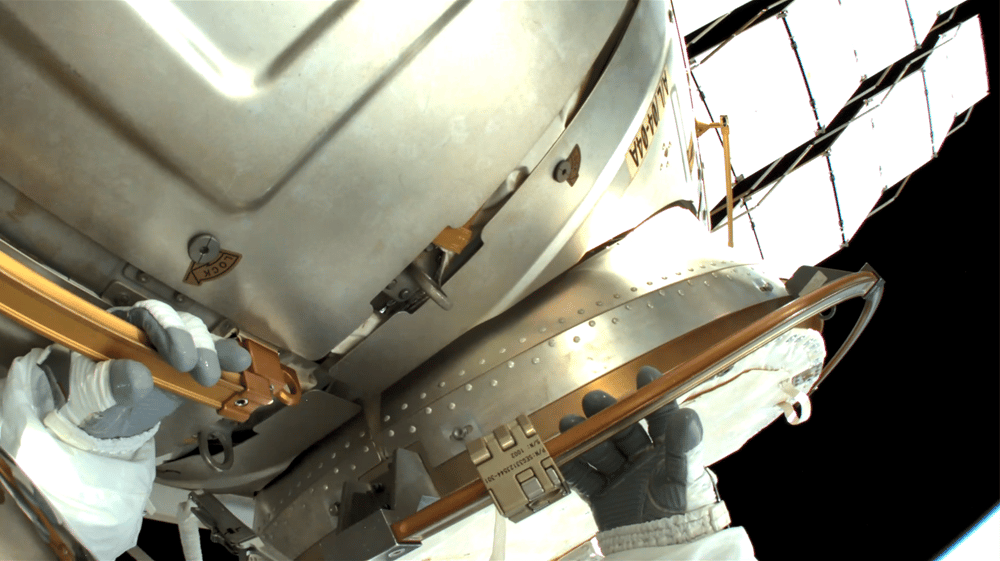
NASA astronaut Kate Rubins covers the hatch after egressing from the crew airlock. The crisp photo is a video frame that was streamed live from the new high-definition wireless camera mounted beside her helmet. (Source: NASA)
Although eight access points (APs) now provide service outside of the space station, Rubins and Glover needed to work together at the farthest port-side end of the space station’s main truss. That is presently about 50 meters from the nearest Wi-Fi infrastructure, and the view is blocked by the station’s solar panels and thermal radiator panels. The nearest infrastructure points consist of antennas outside the space station cabled to an AP inside the space station. Despite the challenges of distance, cables, structural blockage, and roaming, the live high-definition video was available during most of the work, and the camera’s client switched quickly between APs as Rubins changed position and orientation.
While the pair were as far from the airlock as an astronaut can climb, pausing for a routine glove check Glover observed a split in the rubbery coating at the left index finger crease of his glove. It appeared to be a small hole. Any damage to the protective layers of the glove could leak oxygen from his suit. Victor struggled to decide how much damage he was seeing.
“When Kate gets over here, maybe I can show you in the HECA.”
“Yep, and that’s exactly what we were thinking, Ike” mission control replied.
After some high-definition inspection under artificial lighting, the Capsule Communicator (CAPCOM) advised Glover, “Ike, I think we have as good a view of that glove as we’re going to get. Just minimize the use of that hand.”

Victor Glover’s standard definition camera did not convey enough detail for the ground to inspect the damage to his glove. (Source: NASA)

After Kate Rubins moved to use her new helmet camera to inspect damage on Victor Glover’s glove, CAPCOM relayed the decision to continue the spacewalk and “just minimize the use of that hand.” (Source: NASA)
The cameras were delivered to the space station in November 2019 to support servicing of theAlpha Magnetic Spectrometer, but instead remained in storage until the crew had time to retrofit the suits with a package of upgrades. In November 2020, the population of the space station more than doubled when the first operational SpaceX Crew Dragon docked with a manifest of four astronauts. And in early February, Rubins assembled a camera, turned it on to make certain it worked, and then installed the first of the cameras onto the “EV1” (red stripes) space suit.

Kate Rubins pauses to read an interactive crew procedure from a Wi-Fi connected tablet that floats hands-free. (Source: NASA)

NASA astronaut Kate Rubins connects the power cable as she installs the first high-definition helmet camera onto her space suit. (Source: NASA)
The HECA up-streams live HD video through Wi-Fi for viewing by the crew and on the ground. The HECA HD video is also recorded to internal storage, and segments can be recovered afterward by uploading over Wi-Fi for return-link to the ground.
HD video will help with close-out photo-documentation that recently has been performed using a hand-held Nikon D5 or GoPro video. A ground console operator in the Mission Control Center (MCC) using the call sign “CRONUS” can command the video encoder in the new camera to a wide range of streaming rates. CRONUS can also use the camera to take still photos. The crew inside the space station can now display the video on a laptop to help them track the spacewalk as it progresses, and therefore CRONUS can configure the camera to stream to two destination addresses over wireless so that both the crew and the ground can observe simultaneously.
The camera uses a pair of low-profile circularly polarized antennas that are oriented to achieve omnidirectional aggregate coverage rather than overlapped antenna coverage. Low profile antennas on a suit are less likely to snag or break and are therefore preferred as it is not uncommon for the suit to drift against the structure as the astronauts climb, reach, twist tools, or float through narrow openings. The camera supports Wi-Fi CERTIFIED™ ac, also known as Wi-Fi 5. The Wi-Fi client adapter in the HECA is the first client to support Wi-Fi CERTIFIED LocationTM, opening the possibility that someday ground control teams will be able to plot the spacesuit location during critical operations, or that a future suit informatics system can know its own relative location by using the Wi-Fi infrastructure to gauge distances.
The U.S. space suits already had a Wi-Fi client, an engineering data recorder that debuted in March 2019. The EMU Data Recorder (EDaR) live-streams non-critical low-rate telemetry.

Chris Cassidy modeled the prototype high-definition digital helmet camera (round lens on left), as he rehearsed the Alpha Magnetic Spectrometer servicing EVA in 2019. The camera was part of a larger suit upgrade package that waited over a year on-board the space station for the crew to have time to install. Legacy cameras (square lenses on right) continue to provide standard definition video. (Source: NASA)
NASA has deployed eight mixed-vendor Wi-Fi 4 access points to provide coverage outside of the International Space Station. Other external payloads have been stationary, so the suits are NASA’s first mobile outdoor Wi-Fi clients. Some special engineering is needed to increase the agility of the Wi-Fi connection managed by the cameras as they move outside the space station. The activity allowed NASA to evaluate impacts to the network before adding a camera to the second suit.
Wi-Fi was the obvious choice for the HD suit camera. The existing wireless video infrastructure cannot support digital signaling, and the Intel single-board computer selected to perform video encoding already included a Wi-Fi radio. Wi-Fi coverage surrounding the space station is already good, and additional hardware is ready to install as needed to further improve coverage.
There was a time before Wi-Fi. The HD camera retired the widest and least-used view among the three selectable analog National Television System Committee (NTSC) standard definition cameras in the legacy system. These helmet cameras appeared on space suits in December 2000, to support the assembly work for the space station. The radio technology for these legacy cameras derives from a terrestrial design that provided cockpit video for NASCAR races during the 1990s. This system is designed to be supported by three infrastructure points on the space station, each point can support a video stream from one space suit. The HECA demonstration comes as the analog system is approaching “end of life.” In fact, the new camera demonstrated far superior wireless coverage when viewed beside the standard definition camera during the activity because one of the legacy infrastructure points had failed and needed to be replaced. The legacy system will continue to operate as the community works through the technology transition.

Cosmonaut Sergey Ryazansky with GoPro strapped to left arm. Source: NASA
Space suit live video greatly improves situational awareness on the ground and on the space station, but it is not considered critical. The Russian Orlan suits do not have a helmet camera of their own, but since 2013 have been outfitted with a GoPro to record video and then upload it to the network after returning inside using interior Wi-Fi. The NASA helmet cameras are sometimes used on the Orlan suits, and the new cameras are expected to appear soon on both NASA suits, and the Russian Orlan suits as well.
The current generation of space suit debuted on the Space Shuttle in 1983. As NASA develops the latest statement in celestial fashion for its next walk on the moon, many updates are being incorporated. Expect the functions that Wi-Fi has helped retrofit onto today’s space suits, to be integrated into the next-generation lunar suit design.
Trade names and trademarks are used in this report for identification only. Their usage does not constitute an official endorsement, either expressed or implied, by the National Aeronautics and Space Administration.