
Are you feeling confined by coaxial cable? What do you do if you have an older hotel or apartment building, and residents want gigabit Wi-Fi? On World Wi-Fi Day, I would like to share with you a recipe for delivering gigabit speeds to buildings with old-world charm – at a fraction of the cost and hassle of rewiring the entire building.
Residents and guests want high-speed connectivity with low latency for gaming, conferencing and file transfer. They want access to be simple, and they want coverage across the entire venue. Property owners want to deliver a superior digital experience while also improving security and efficiency. Newer buildings have the lead with a fiber infrastructure. Older buildings can now also support Wi-Fi 6 speeds without replacing the coax throughout the building.
“It’s all about delivering an exceptional customer experience for both the property owner and hotel guests,” says Pierre Trudeau, President and CTO of Positron Access Systems. “It takes the right technology and partners to meet this expectation.”
The G.hn Aggregation Multiplexer (GAM) from Positron delivers up to 1.7 Gbps aggregate bandwidth with low latency over the existing coax, or telephone pairs. This is an ideal backbone for Cambium Networks Wi-Fi 6 indoor access points (AP) to be deployed in every other room to maximize coverage. In two older hotel projects, each GAM served 16 APs and 32 guest rooms.
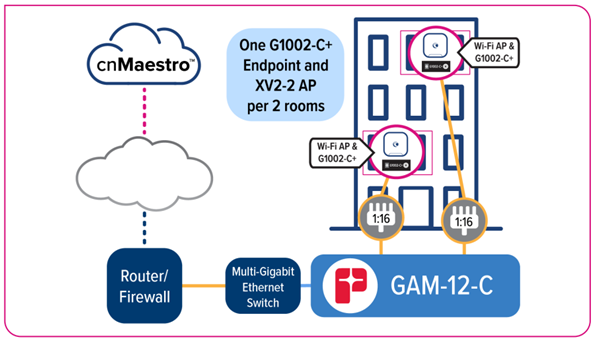
“When a property owner is sitting on coax, we can use the infrastructure to bring Gigabit capabilities,” says Kyle Beauchamp, Vice President, ImpruviX Division of World Cinema. “It’s an effective way to get them from either Wi-Fi 2 or 3 to Wi-Fi 6 without construction and associated costs.”
Teamwork delivers exceptional digital experiences. Pierre Trudeau explains, “By leveraging World Cinema’s world-class design, installation, and network management expertise, and harnessing the Positron GAM’s ability to extend gigabit speeds over the existing in-building wiring along with Cambium’s unmatched Wi-Fi 6 performance, efficiency, and reliability, we can create a seamless and satisfying user experience for everyone.”
I encourage you to download the details in the Boost Efficiency Using Existing Wiring and Indoor Wi-Fi solution paper.

Austin, TX – June 15, 2023 – Wi-Fi Alliance® commends the Bureau of Radio Regulation (State Radio Office), a subsidiary of Ministry of Industry and Information Technology of the People’s Republic of China, on issuing a consultation on the “Notice on New Type Approval Technical Requirements and Test Methods for Wireless LAN Equipment Adopting IEEE 802.11be Technical Standards”.
This important initiative advances authorization of Wi-Fi 7 in the People’s Republic of China for the benefit of consumers and industry. Wi-Fi Alliance and our member companies stand ready to move forward with enabling the next generation of Wi-Fi® in China consistent with all applicable regulations and requirements.
About Wi-Fi Alliance® | www.wi-fi.org
Wi-Fi Alliance® is the worldwide network of companies that brings you Wi-Fi®. Members of our collaboration forum come together from across the Wi-Fi ecosystem with the shared vision to connect everyone and everything, everywhere, while providing the best possible user experience. Since 2000, Wi-Fi Alliance has completed more than 75,000 Wi-Fi certifications. The Wi-Fi CERTIFIED™ seal of approval designates products with proven interoperability, backward compatibility, and the highest industry-standard security protections in place. Today, Wi-Fi carries more than half of the internet’s traffic in an ever-expanding variety of applications. Wi-Fi Alliance continues to drive the adoption and evolution of Wi-Fi, which billions of people rely on every day.
Follow Wi-Fi Alliance:
wi-fi.org/beacon
wi-fi.org/signal
facebook.com/wificertified
twitter.com/wifialliance
linkedin.com/company/wi-fi-alliance
youtube.com/wifialliance
Media Contact:
Highwire PR for Wi-Fi Alliance
[email protected]


Ultra-Wideband (UWB) has been gaining popularity since major smartphone makers adopted it as the next-generation, indoor positioning wireless standard, starting back in 2019. Since then, there have been flurries of product announcements, such as UWB tags to assist finding lost keys, and news of novel applications, such as real-time ball location tracking at FIFA World Cup 2022. However, the question remains whether UWB is just hype or here to stay as a default wireless standard like Wi-Fi. We will explore the potential of UWB technology in mission-critical applications such as keyless car entry and digital payment, and the challenges it faces in wider adoption.
UWB in Keyless Car Entry
In 2022, Car Connectivity Consortium (CCC) announced that it has adopted UWB as a complementary technology to Bluetooth® Low Energy for secure, keyless entry in its Digital Key Release 3 specification. While Bluetooth® Low Energy-based key fobs and apps have been widely adopted, concerns about possible relay-attacks have been raised. In a viral video, a Tesla was remotely unlocked and driven off with a laptop with an attached Bluetooth® relay device, and it was explained that this security vulnerability can affect any Bluetooth® Low Energy-enabled keyless entry vehicles. UWB, which relies on its nanosecond pulses to provide centimeter-level accuracy distance measurements, can ensure that the signal is coming from a legitimate, physically-present source, not from a boosted, relayed signal. With UWB providing added security, Bluetooth® Low Energy and UWB can work together to provide a reliable and secure keyless entry for ever-security conscious automotive industries.

ABI Research (2022)
UWB in Wireless Payment
As the smartphone attach rate keeps rising, UWB is also being considered as an alternative or complimentary technology to Near Field Communication (NFC). Contactless payment has been steadily gaining acceptance, as more smart devices such as smartphones and smart watches have been shipped with NFC, now reaching more than a 50% attach rate in smartphones. COVID-19 in the last 3 years has accelerated the adoption of contactless payment, both NFC- and QR code-based, to avoid handling of physical cash and credit cards. UWB can advance contactless payment even further; UWB can revolutionize the payment industry, enabling consumers to pay for the groceries and unlock their cars, all without taking out a credit card, a key or a phone. With its centimeter-level accuracy, UWB can ensure you are paying for your own groceries, not for the person in the next checkout lane.
Bluetooth® and UWB
While UWB provides unparalleled accuracy and security for mission critical applications, Bluetooth® is still a practical option for some location-based services. Bluetooth® SIG is exploring new ways to improve distance measurement accuracy and security such as Channel Sounding (CS), previously known as High Accuracy Distance Measurement (HADM). In CS, Bluetooth® signals of two or more frequencies are used to calculate the distance between two Bluetooth® devices based on the observed relative phase differences of those signals. Unlike the Received Signal Strength Indicator (RSSI) method, previously used for Bluetooth® distance measurement, which relies on the relative power level of the received signal, it is less susceptible to relay attacks and can provide better, meter-level accuracy. Such accuracy could have been previously achieved with multiple antennas, with triangulation, but the single-antenna implementation of CS is attractive in terms of reducing hardware cost. Furthermore, one can use a metric called Normalized Attack Detector (NAD) in Bluetooth® Channel Sounding to identify and quantify sudden changes in the RF environment. Comparing the received packet against the expected packet signal, a NAD metric value is calculated as the probability that an attacker is present. Given its 100% attach rate to smartphones, when CS is finalized and adopted, it will likely enable many real time location services (RTLS) that require distance measurements within a few meters, such as indoor navigation, asset and personnel tracking. However, UWB will likely continue playing the primary role, for mission critical applications that demand better accuracy and security such as contactless payment, keyless car access, and digital hotel room key.

Challenges Faced by UWB
UWB’s 500 MHz or wider bandwidth inversely produces the nanosecond pulses that uniquely deliver the unprecedented distance measurement accuracy. However, the wideband width also leads to more complexity in the design and higher power consumption. It is more regulated for emission limits as it operates in the licensed band per Part 15 of FCC Rules than its narrow-band counterparts that operate in the unlicensed 2.4 GHz band. To mitigate these challenges, location and security applications will keep relying on some of the initial discovery and synchronization on narrow band wireless standards such as Bluetooth® to offload communication, reserving UWB usage for mission-critical distance ranging. Rather than competing for convergence, wireless standards must collaborate with each other in providing the best user experience for a given use case. In other words, we will likely see more, not fewer, wireless standards integration in smartphones and cars, and UWB will likely become the main source of the precise, secure location-based communication. For that, UWB devices’ utmost priority will be accuracy quality.
Conclusion
UWB technology has the potential to revolutionize mission-critical applications such as keyless car entry and digital payment, providing unparalleled accuracy and security. While other wireless standards like Bluetooth® remain practical options for some location-based services and a critical partner in offloading traffic, UWB will likely play the primary role in security-centric applications. Despite some of the challenges UWB faces, collaboration with other wireless standards can ultimately help overcome these challenges to provide the best, integrated wireless experience for users.

The Calix platform offers the most comprehensive lineup of tri-band Wi-Fi 6E and dual-band Wi-Fi 6 systems with the GigaSpire BLAST u10xe, u4hm, and u4g—making it even easier for broadband providers to deploy in only days while addressing a wide range of subscriber needs
SAN JOSE, CA—May 18, 2023—Calix, Inc. (NYSE: CALX) announces the availability of three Calix GigaSpire® BLAST systems in its world-leading portfolio. The GigaSpire BLAST u10xe, u4hm, and u4g systems are tailored to a variety of premium, high-value subscriber profiles, enabling broadband service providers (BSPs) to address an even broader range of use cases. These include small businesses, gaming enthusiasts, subscribers who want to extend Wi-Fi experiences outdoors to the backyard or patio, or residents in apartments or multi-dwelling units (MDUs). Featuring the latest Wi-Fi technologies, these systems provide faster speeds, better coverage, and increased capacity, offering seamless connectivity within and around the home or business. With an expanding portfolio of systems for the Calix platform, BSPs can easily deliver the exceptional Wi-Fi experiences that subscribers want and need.
Because each new GigaSpire BLAST u10xe, u4hm, and u4g system is pre-integrated on the Calix platform, BSPs can deploy them in days rather than weeks or months—dramatically lowering operating expenses (OPEX). This flexibility allows Calix customers to reduce inventory, simplify training, and streamline field installations. Thanks to the power of the Calix platform, BSPs are leveraging these systems to unlock new market segments, differentiate their services against legacy competitors, and accelerate time to revenue.
The latest additions to the GigaSpire BLAST portfolio include:
“Bulloch Solutions is committed to offering our residential and commercial fiber subscribers across Bulloch County, Georgia, the very latest Wi-Fi technologies from Calix to help us gain market share and beat the competition,” said Stuart Gregory, director of business development, Bulloch Solutions. “We’re excited to be one of the first providers to offer the new Calix systems designed to meet demand for new use cases requiring faster speeds, greater reach, and improved reliability. The GigaSpire BLAST u10xe with integrated Wi-Fi 6E will give us a unique offering for high-bandwidth users that none of our competitors can match. Meanwhile, the u4hm will enable us to extend Wi-Fi so we can truly deliver an unrivalled ‘whole home’ experience—both indoors and outdoors—that will transform our subscriber experience.”
“Broadband subscribers demand seamless connectivity at the ever-growing number of locations where they connect with the network—throughout the home, by the pool, at a small business, or on the move,” said Shane Eleniak, chief product officer at Calix. “By introducing this expanded range of residential Wi-Fi systems, we’re enabling BSPs to offer the most advanced Wi-Fi technologies and expand into previously unreachable markets—offering differentiated services that keep them one step ahead of the competition. Moreover, thanks to the power and flexibility of the Calix platform, BSPs can deploy these new systems quickly and easily by seamlessly integrating with operations, customer support, and other teams.”
In this webinar, “Beat the Competition With Invincible (and Invisible) Wi-Fi,” discover how the latest Wi-Fi systems from Calix deliver an unrivalled subscriber experience that provides BSPs with a competitive edge.
About Calix
Calix, Inc. (NYSE: CALX)—Calix cloud and software platforms enable service providers of all types and sizes to innovate and transform. Our customers utilize the real-time data and insights from Calix platforms to simplify their businesses and deliver experiences that excite their subscribers. The resulting growth in subscriber acquisition, loyalty, and revenue creates more value for their businesses and communities. This is the Calix mission: To enable broadband service providers of all sizes to simplify, excite, and grow.
This press release contains forward-looking statements that are based upon management’s current expectations and are inherently uncertain. Forward-looking statements are based upon information available to us as of the date of this release, and we assume no obligation to revise or update any such forward-looking statement to reflect any event or circumstance after the date of this release, except as required by law. Actual results and the timing of events could differ materially from current expectations based on risks and uncertainties affecting Calix’s business. The reader is cautioned not to rely on the forward-looking statements contained in this press release. Additional information on potential factors that could affect Calix’s results and other risks and uncertainties are detailed in its quarterly reports on Form 10-Q and Annual Report on Form 10-K filed with the SEC and available at www.sec.gov.
Calix and the Calix logo are trademarks or registered trademarks of Calix and/or its affiliates in the U.S. and other countries. A listing of Calix’s trademarks can be found at https://www.calix.com/pages/trademarks.html. Third-party trademarks mentioned are the property of their respective owners.
Austin, TX and Washington, D.C. – May 24, 2023 – Wi-Fi Alliance® hosted member companies Broadcom, Cisco Systems, Extreme Networks, LitePoint, MediaTek, Qualcomm, and RUCKUS Networks/CommScope for an AFC Device Under Test (DUT) Test Harness event. The goal of the event was to validate test harness implementation and to assess standard power device readiness to operate in conformance with requirements established by regulatory authorities such as the U.S. Federal Communications Commission (FCC). The event successfully demonstrated compliance of all devices with the Wi-Fi Alliance System to Device Interface (SDI) specification and their readiness to effectively operate under the control of an AFC system.
The AFC DUT Test Harness simulates the behavior of an AFC system and is used to automate procedures described in the AFC DUT Compliance Test Plan for 6 GHz standard power devices. The successful outcome of this event underscores the Wi-Fi® industry’s readiness towards enabling 6 GHz standard power device operation. Significant accomplishments of this event included:
Recent forecasts indicate that standard power 6 GHz devices will drive a 50+% increase in overall Wi-Fi access point shipments by 2028.[1] Wi-Fi Alliance looks forward to enabling this growing ecosystem and is working with regulatory authorities to enable standard power Wi-Fi operations around the world.
For more information on 6 GHz AFC resources, please visit https://www.wi-fi.org/discover-wi-fi/6-ghz-afc-resources.
Industry support for this milestone:
“Standard power Wi-Fi 7 will be a game changer, not only for outdoor networks, but to provide a significant boost to indoor wireless broadband. The Wi-Fi Alliance test harness will provide a pathway for industry to certify that standard power access points operating under the control of an Automated Frequency Coordination (AFC) System comply with regulatory requirements. Broadcom was delighted to collaborate with industry partners to validate standard power 6 GHz Wi-Fi market readiness.” – Christopher Szymanski, Director of Product Marketing, Wireless Communications and Connectivity Division, Broadcom
“Thanks to Wi-Fi Alliance, industry partners, and our team for this successful event. Cisco is fully committed to continued contribution and collaboration towards the success of the AFC program and 6 GHz standard power market availability.” – Bahador Amiri, Senior Director of Wireless Engineering, Cisco Systems
“RUCKUS Networks is excited to have participated successfully in the Wi-Fi Alliance AFC DUT Test Harness testing event with R560, one of our Wi-Fi 6E APs, and AFC proxy. This demonstrates a significant milestone in the development of AFC and takes the industry much closer to realizing the benefits of full, standard power in the 6 GHz band. RUCKUS’s AFC Proxy will enable a fully scalable, enterprise-grade support for deployment of our 6 GHz Access Points, taking advantage of this once-in-a-generation increase in Wi-Fi capacity, extending Wi-Fi performance into reliable multi-gigabit speeds,” – Bart Giordano, SVP & President, Networking, Intelligent Cellular & Security Solutions (NICS), CommScope
“Extreme continues to drive the Wi-Fi industry forward and the most recent milestone is the validation of our standard power access points in accordance with AFC DUT Compliance – which is a significant step in the broader industry’s adoption and transition to embracing standard power 6 GHz Wi-Fi. This accomplishment is a testament to our commitment to securing FCC certification for standard power devices, a crucial step toward implementing Automated Frequency Coordination. We look forward to the completion of FCC certification requirements as it pertains to Wi-Fi 6E as it will drive a significant wave of innovation, performance, and experiences like we have never seen before.” – Dan DeBacker, Senior Vice President of Product Management, Extreme Networks
“As a leader in wireless test solutions, LitePoint is pleased about the continued collaboration with Wi-Fi Alliance to enhance the adoption of the 6 GHz band. With the success of the forthcoming AFC certification, standard power access points will facilitate high density deployments and offer uninterrupted connectivity at both scale and speed. LitePoint’s test equipment will continue to assist product makers in their AFC certification journey and ensure that the Wi-Fi products they ship consistently meet and exceed the highest industry standards.” – Adam Smith, Director of Product Marketing, LitePoint
“Our leadership in Wi-Fi technology would not be complete without ensuring our customers have easy access to AFC solutions. We are delighted to have successfully participated in the Wi-Fi Alliance AFC DUT Test event alongside our industry partners. Our Filogic Wi-Fi 7 and 6E chips commit to support standard power operation in 6 GHz spectrum for companies who produce Wi-Fi devices.” – Alan Hsu, Corporate Vice President of Intelligent Connectivity Business Unit, MediaTek
“We applaud Wi-Fi Alliance’s progress towards advancing the certification of AFC. We have been an active participant in enabling the industry with AFC DUT Compliance testing framework as it is a vital step towards enabling improved access to this important spectrum. Qualcomm Technologies turnkey AFC Solution’s agent meets the requirements of the AFC DUT Compliance Test Plan, an important milestone towards commercial enablement.” – Ganesh Swaminathan, Vice President and General Manager, Wireless Infrastructure and Networking, Qualcomm Technologies, Inc.

Norwegian incumbent’s new home gateway and repeater combo are built by Zyxel Communications, leverage Wi-Fi 6E on a MediaTek Filogic chipset, and are powered by SoftAtHome’s Connect’ON and Wifi’ON software products. The new network-agnostic gateway can be connected to 5G, Docsis, or GPON networks.
PARIS, France – 22 May 2023 – SoftAtHome, an independent software company for broadband, video, and analytics, announced today the deployment of Telenor’s latest home gateway and repeater. The new devices – available to subscribers since early May – are powered by MediaTek Filogic Wi-Fi technology, which delivers the highest performance, the most reliable and an always-on Wi-Fi experience.
SoftAtHome’s Connect’ON ensures connectivity and Quality of Service using either fibre or 5G networks. At the same time, the software vendor’s Wifi’ON delivers high Wi-Fi Quality of Experience to the new Telenor devices.
These new devices further improve home Wi-Fi for Telenor’s Norwegian subscribers, thanks to 6E features such as more robust security or better radio spectrum usage, a third 6 GHz band and a unique zero-touch pairing of repeaters. Telenor benefits from the same SoftAtHome software running seamlessly on the last two generations of home gateway and repeater. This highly simplifies device management and the hotline processes of Telenor.
“We’re delighted to launch our new triband products with our partner SoftAtHome,” said Anna Hvattum, Head of Broadband & Services at Telenor. “Connect’ON’s ability to seamlessly manage both 5G and wired connectivity will help future-proof our latest devices. Having the last two generations using different chipsets run under a single software stack makes our life easier.”
David Viret-Lange, SoftAtHome CEO, added, “Telenor Norway is still as innovative as ever, always offering the most advanced services and features. Working with a new chipset and device maker has again shown how we bring hardware independence to our operator clients. I’m especially proud that Wifi’ON and Connect’ON are powering Telenor’s latest home network solution.”
MediaTek’s Alan Hsu, Corporate Vice President, Intelligent Connectivity Business Unit, added, “SoftAtHome is a recognised leader in the software for HOME LAN services. Together with MediaTek’s award-winning Filogic Wi-Fi solutions, we are able to provide the highest performance, the most reliable and an always-on Wi-Fi experience. As our first major deployment together, this project was a great way to start and is the first collaboration of many to come.”
Zyxel’s VP of Product, Deputy Head EMEA RBU James Harris, added, “We are proud of our central role in the ecosystem that has delivered the latest tech to Telenor’s subscribers so that their home network can support the latest digital services to enable secure Work-From-Home or the latest high-resolution entertainment.”
Press Information: Marta Twardowska – E: [email protected]

ThinkWiFi and Mawingu Partner to Provide Disaggregated, Open-Source Wi-Fi Network Funded Through A Digital Advertising Monetization Model
Kenya, May 11, 2022—ThinkWiFi, an Africa-based ad-tech free WiFi internet service provider, and Mawingu, an internet service provider backed by Microsoft, today announced it launched the first outdoor Telecom Infra Project (TIP) OpenWiFi network in Kenya. This collaboration is funded using an advertising-based model, the first time a TIP OpenWiFi network has been built and commercialized using a sponsorship platform.
“ThinkWiFi’s mission is to empower people by giving them access to the internet. We are a purpose-based business working to close the digital divide,” said Janine Rebelo, Founder and CEO of ThinkWiFi. “Working with Mawingu and TIP OpenWiFi provides social upliftment where everyone can get connected to enterprise-grade Wi-Fi through an easy-to-use advertising platform. It’s a win-win-win where brands win by gaining access to high growth consumer segments, consumers win with free, uncapped, high speed connectivity, and the community wins by getting unfettered access to the digital economy through free Wi-Fi networks powered by advertising revenue.”
Managed from ThinkWiFi’s headquarters in South Africa, the Wi-Fi network uses TIP OpenWiFi certified hardware and software including access points (APs) from Edgecore and CIG. Wavespot provides the cloud controller which also implements the backend analytics and location-based services through its AICloud allowing ThinkWiFi to gain valuable customer experience insights. The Wi-Fi network is built on top of Mawingu’s network infrastructure.
“This network clearly demonstrates why TIP OpenWiFi is the most innovative connectivity solution on the market today–it’s open, with multiple vendors supplying hardware, so it can be scaled to provide superb speeds without vendor lock-in. Plus, funding the network through advertising makes community connectivity widely available, and as OpenWiFi already offers a much lower TCO, it’s a very effective way to build affordable Wi-Fi networks in city centers,” said Jack Raynor, TIP OpenWiFi Program Group Co-chair. “Simply put, OpenWiFi is beneficial to the communities that we serve and that’s why we’ve seen it scale so rapidly around the world.”
“Mawingu’s aim is to help our customers access new opportunities for work, education, entertainment, and social connections, through the power of the Internet. Our company’s mission is driven by this very purpose: Open Opportunities”, says Farouk Ramji, Mawingu CEO. “Through our collaboration with ThinkWiFiand OpenWiFi, we can provide free internet to bring us closer to bridging the digital divide in Kenya.”
The ThinkWiFi OpenWiFi network is the first part of a larger rollout that will include additional city centers, transit and tourist hubs and retail malls in Kenya and South Africa with future plans to expand into other African countries and southern European regions. The ThinkWiFi OpenWiFi network deployments are expected to cover a number of public service and healthcare facilities through collaboration and partnership with public organizations.
TIP OpenWiFi is an open source-based Wi-Fi architecture that enables multi-vendor, interoperable Wi-Fi networks. OpenWiFi-based solutions allow ThinkWiFi to seamlessly mix and match access points and controllers from any TIP OpenWiFi compliant manufacturer and developers to quickly create new applications given it is open source.
There are more than 300 companies involved with the TIP OpenWiFi initiative from OEMs, ODMs and silicon providers to managed service providers and app developers. Launched in 2021, TIP OpenWiFi has announced commercial deployments in the United States with Boingo Wireless, in India with Spectra, in Pakistan with Multinet, and a trial with the City of Dublin and Virgin Media that complies with the European Commission’s WIFI4EU initiative, the benchmark for public Wi-fi deployments in Europe.
About ThinkWiFi:
ThinkWiFi’s mission is to reduce digital poverty and empower people whilst providing FMCG brands with access to high growth consumer markets. ThinkWiFi’s core ambition is Giving people access to free uncapped internet, through an immersive, data enriched, brand safe AdTech platform, .. We’re passionate about closing the digital divide while laying the foundations for the 4th industrial revolution for all under-served communities, by leveraging a powerful combination of Data analytics, Digital advertising and Open WiFi. Think WiFi’s AdTech platform delivers over 14 million ad impressions each month for a growing number of major FMCG brands and financial institutions, and is proud to be a member of the IAB SA which represents the South African digital industry to all sectors, including the marketing community, the media, the South African government and the public. For out more https://www.thinkwifi.online/
About Mauwingu:
Originally founded at the foothills of Mount Kenya, in Nanyuki. Today, Mawingu has expanded coverage to 22 counties, +9,000 active users, and +300,000 hotspot customers served. We can proudly say we are Kenya’s largest internet service provider (ISP) dedicated exclusively to the rural and peri urban markets in the country. The key to our success? Our versatility. We employ wireless, fiber, and smart green-energy technology, making it possible to adapt to the changing terrain demands and market conditions. Learn more at https://mawingu.co
About Wavespot:
Wavespot is a leading provider of wifi network infrastructure and location-based services for service providers, quick-service restaurants, retail, hospitality, and healthcare. With its multi-vendor cloud controller and AI-powered analytics, Wavespot helps businesses improve their operations and customer experience through insights and automation. Learn more about Wavespot at https://wavespot.net/.
About Telecom Infra Project OpenWiFi
Telecom Infra Project (TIP) is a global community of companies and organizations that are driving open and disaggregated infrastructure solutions to advance global connectivity including TIP OpenWiFi. TIP OpenWiFi is an open sourced, community-developed, disaggregated Wi-Fi hardware and software system. The system includes a cloud controller SDK and an enterprise-grade access point (AP) firmware, designed and validated to work seamlessly together. OpenWiFi is managed within TIP’s Open Converged Wireless (OCW) project group, which enables industry collaboration to build, test and validate products that deliver the requirements of valuable service providers’ use cases. The OpenWiFi community currently includes more than 300 participants, including services providers, OEM’s, ODM’s, Software ISV’s, system integrators, silicon vendors & Industry organizations. Learn more about TIP OpenWiFi here.

With technology constantly evolving there are many upgrades that can be added to your property to improve the resident experience. Here are the top 10 technologies to upgrade your MDU.
Smart Home Technology/Mobile Apps
Smart home technology is expected to become more common in multifamily buildings as residents feel convenience is key. It allows residents to control lighting, temperature, security, and even appliances all from their smartphones or voice-activated devices. Smart home technology has revolutionized the way residents interact with their living spaces. This level of automation enhances the resident’s experience, providing a seamless and connected living environment. For property owners, smart home technology also offers significant benefits. By automating appliances like energy management, property owners can reduce operational costs and increase energy efficiency. Additionally, smart home technology is a major selling point for potential tenants, as it promotes modern and sustainable living options.
Internet of Things (IoT)
IoT refers to the interconnection of devices through the internet, allowing them to communicate and share data. IoT will continue to drive innovation in the multifamily industry. It can be used to create a network of interconnected devices, such as thermostats, security systems, lighting, and appliances, which can be controlled and monitored remotely. This type of connectivity enables property managers to optimize resource usage, monitor equipment performance, and automate maintenance tasks. For instance, IoT sensors can detect equipment failures anywhere on the property and send real-time alerts to management to take action. This proactive approach to maintenance not only reduces downtime and repair costs but also enhances tenant satisfaction by minimizing disruptions.
Predictive Maintenance
Predictive maintenance expands on what IoT can do for property owners. By using data analytics and machine learning algorithms to predict when maintenance issues are likely to occur, allowing for proactive repairs and replacements. This will become more common in multifamily properties, so it is essential to invest now. Predictive maintenance analyzes data from various sources, such as equipment sensors, maintenance logs, and weather patterns. It identifies patterns and anomalies that indicate potential failures. This enables property owners and managers to schedule maintenance activities based on actual need rather than relying on fixed schedules, reducing costs and maximizing equipment lifespan. Additionally, predictive maintenance can also help prevent emergency breakdowns, which can be disruptive and costly for both property owners and tenants.
Virtual Tours and 3D Modeling
The COVID-19 pandemic accelerated the adoption of virtual tours and 3D modeling in the real estate industry. These technological upgrades allow property owners to showcase their properties to potential tenants remotely. This eliminates the need for physical visits and increasing convenience. Virtual tours and 3D modeling create immersive and interactive experiences, allowing potential tenants to virtually walk through units, view floor plans, and visualize living spaces as if they were physically present. This not only saves time and effort but also expands the reach of property marketing efforts. This benefits potential tenants who can explore properties from anywhere, at any time. Additionally, virtual tours and 3D modeling can be easily updated and customized, making them a cost-effective and flexible marketing tool for property owners.
Digital Signage
Digital signage allows property owners to display informative and interactive content on screens throughout their properties. It can be used to enhance the residents’ experience in a number of ways, such as building directories, displaying local events and announcements, and showcasing property amenities. By strategically placing screens in common areas, such as lobbies, elevators, and fitness centers, property owners can improve communication and engagement with tenants, creating a more connected and informed community. Digital signage is a way for properties to differentiate themselves from competitors.
In Conclusion
As the demand for modern and connected living environments continues to grow, it is becoming increasingly important for MDU’s to keep up. Find a trusted technology partner to grow your property. World Cinema can provide all the essential technology property owners need. This includes digital signage, surveillance equipment, cell-boosting capabilities and so much more.
To learn more about our infrastructure solutions and the updating process, please visit https://www.wcitv.com

Charlotte, N.C., April 26, 2023 (GLOBE NEWSWIRE) — Akoustis Technologies, Inc. (NASDAQ: AKTS) (“Akoustis” or the “Company”), an integrated device manufacturer (IDM) of patented bulk acoustic wave (BAW) high-band RF filters for mobile and other wireless applications, announced today that it has received its first volume Wi-Fi 6E filter purchase order for a new, advanced, high-speed line of Wi-Fi 6E fixed infrastructure products, which will be sold through a leading US-based service provider. The customer will use multiple Akoustis XBAW® filters in Wi-Fi 6E Access Point products and is currently ramping production of these next generation multi-user, multiple-in-multiple-out (MU-MIMO) devices.
The Akoustis XBAW® filter solutions will be used initially for cable gateway products. The gateways will operate in MU-MIMO architectures, in 4 x 4 configuration, with twelve active radios. The two XBAW®filter solutions utilized for the new gateways operate with center frequencies of 5.6 GHz and 6.6 GHz, respectively.
The 5.6 GHz filter module covers the entire UNII 1-3 spectrum and enables an additional 80 MHz and 160 MHz channel in UNII-4, while the 6.6 GHz filter module covers a majority of the UNII 5-8 spectrum. Current Wi-Fi 6E configurations allow for the use of six 80 MHz and two 160 MHz channels in the UNII 1-3 spectrum, and fourteen 80 MHz and seven 160 MHz channels in the UNII 5-8 spectrum. The new XBAW® 5.6/6.6 GHz coexistence filter modules allow for the use of seven 80 MHz and three 160 MHz channels in the UNII 1-4 spectrum, and twelve 80 MHz and six 160 MHz channels in the UNII 5-8 spectrum.
Akoustis began shipping initial pre-production BAW filters against purchase orders for development, sampling, and qualification during the quarter ending December 31, 2022. The customer is now entering production with its new line of gateway routers powered by Akoustis’ filters.
Jeff Shealy, founder and CEO of Akoustis, stated, “We are excited to begin a relationship with this tier-1 US-based service provider, a significant new partner in advanced, high-speed Wi-Fi technology. This customer is pushing forward with cutting-edge Wi-Fi 6E gateway routers that will deliver leading data throughput speed and video streaming to its customers, enabled by our proprietary filtering technology.” Mr. Shealy continued, “Working with top-tier, leading companies is the goal of any technology supplier, and we are excited to help them provide the highest quality, highest speed Wi-Fi connectivity moving forward.”
Akoustis continues to experience strong demand and a growing sales funnel for its Wi-Fi, 5G mobile, and 5G infrastructure products, including CBRS XBAW® filters, as well as its new XBAW® and RFMi resonator and oscillator products. During the December quarter, the Company shipped multiple samples of its new 5G XBAW® wafers complete with its new, advanced wafer-level packaging (WLP) technology. Akoustis continues to add new Wi-Fi design wins, many of which are expected to ramp into production in calendar 2023.
Akoustis is actively delivering volume production of its Wi-Fi 6 and 6E tandem filter solutions, shipping multiple 5G small cell XBAW® filter solutions, and delivering initial designs of its new 5G mobile filter solutions to multiple customers, and has entered the market with its new Wi-Fi 7 coexistence XBAW® filter solutions. To date, Akoustis has received more than 20 customer design wins for its patented XBAW® filter solutions.
Given the rapidly growing sales funnel activity, as well as ongoing interaction with customers regarding expected ramps in 5G mobile, Wi-Fi 6, and Wi-Fi 6E in calendar 2023, the Company is completing the annual production capacity increase at its New York fab to approximately 0.5 billion filters per year.
About Akoustis Technologies, Inc.
Akoustis® (http://www.akoustis.com/) is a high-tech BAW RF filter solutions company that is pioneering next-generation materials science and MEMS wafer manufacturing to address the market requirements for improved RF filters – targeting higher bandwidth, higher operating frequencies and higher output power compared to legacy polycrystalline BAW technology. The Company utilizes its proprietary and patented XBAW® manufacturing process to produce bulk acoustic wave RF filters for mobile and other wireless markets, which facilitate signal acquisition and accelerate band performance between the antenna and digital back end. Superior performance is driven by the significant advances of poly-crystal, single-crystal and other high purity piezoelectric materials and the resonator-filter process technology which enables optimal trade-offs between critical power, frequency and bandwidth performance specifications.
Akoustis plans to service the fast growing, multi-billion-dollar RF filter market, using its integrated device manufacturer (IDM) business model. The Company owns and operates a 120,000 sq. ft. ISO-9001:2015 registered commercial wafer-manufacturing facility located in Canandaigua, NY, which includes a class 100 / class 1000 cleanroom facility – tooled for 150-mm diameter wafers – for the design, development, fabrication and packaging of RF filters, MEMS and other semiconductor devices. Akoustis Technologies, Inc. is headquartered in the Piedmont technology corridor near Charlotte, North Carolina.
Forward-Looking Statements
This document includes “forward-looking statements” within the meaning of Section 27A of the Securities Act, and Section 21E of the Securities Exchange Act of 1934, each as amended, that are intended to be covered by the “safe harbor” created by those sections. These forward-looking statements include, but are not limited to, statements about our estimates, expectations, beliefs, intentions, plans or strategies for the future (including our possible future results of operations, profitability, business strategies, competitive position, potential growth opportunities, potential market opportunities and the effects of competition), the anticipated benefits of the acquisition of Grinding and Dicing Services, Inc., future cash flow and forecasts of breakeven point and expectations regarding funding under the CHIPS and Science Act, and the assumptions underlying such statements. Forward-looking statements include all statements that are not historical facts and typically are identified by use of terms such as “may,” “might,” “would,” “will,” “should,” “could,” “project,” “expect,” “plan,” “strategy,” “anticipate,” “attempt,” “develop,” “help,” “believe,” “think,” “estimate,” “predict,” “intend,” “forecast,” “seek,” “potential,” “possible,” “continue,” “future,” and similar words (including the negative of any of the foregoing), although some forward-looking statements are expressed differently. Forward-looking statements are neither historical facts nor assurances of future results, performance, events or circumstances. Instead, these forward-looking statements are based on management’s current beliefs, expectations and assumptions, and are subject to risks and uncertainties. Factors that could cause actual results to differ materially from those currently anticipated include, without limitation, risks relating to our inability to obtain adequate financing and sustain our status as a going concern; our limited operating history; our inability to generate revenues or achieve profitability; the results of our research and development activities; our inability to achieve acceptance of our products in the market; the possibility that the anticipated benefits from business acquisitions (including the acquisition of Grinding and Dicing Services, Inc.) will not be realized in full or at all or may take longer to realize than expected; the possibility that costs or difficulties related to the integration of acquired businesses’ operations will be greater than expected and the possibility of disruptions to our business during integration efforts and strain on management time and resources; the impact of a pandemic or epidemic or a natural disaster, including the COVID-19 pandemic, the Russian-Ukrainian conflict and other sources of volatility on our operations, financial condition and the worldwide economy, including its impact on our ability to access the capital markets; increases in prices for raw materials, labor, and fuel caused by rising inflation; general economic conditions, including upturns and downturns in the industry; shortages in supplies needed to manufacture our products, or needed by our customers to manufacture devices incorporating our products; our limited number of patents; failure to obtain, maintain, and enforce our intellectual property rights; claims of infringement, misappropriation or misuse of third party intellectual property, including the lawsuit filed by Qorvo, Inc. in October 2021, that, regardless of merit, could result in significant expense and negatively impact our business results; our inability to attract and retain qualified personnel; our reliance on third parties to complete certain processes in connection with the manufacture of our products; product quality and defects; existing or increased competition; our ability to successfully manufacture, market and sell products based on our technologies; our ability to meet the required specifications of customers and achieve qualification of our products for commercial manufacturing in a timely manner; our inability to successfully scale our New York wafer fabrication facility and related operations while maintaining quality control and assurance and avoiding delays in output; the rate and degree of market acceptance of any of our products; our ability to achieve design wins from current and future customers; contracting with customers and other parties with greater bargaining power and agreeing to terms and conditions that may adversely affect our business; risks related to doing business in foreign countries, including China; any security breaches, cyber-attacks or other disruptions compromising our proprietary information and exposing us to liability; our failure to innovate or adapt to new or emerging technologies, including in relation to our competitors; our failure to comply with regulatory requirements; results of any arbitration or litigation that may arise; stock volatility and illiquidity; dilution caused by any future issuance of common stock or securities that are convertible into or exercisable for common stock; our failure to implement our business plans or strategies; and our ability to maintain effective internal control over financial reporting. These and other risks and uncertainties are described in more detail in the Risk Factors and Management’s Discussion and Analysis of Financial Condition and Results of Operations sections of the Company’s most recent Annual Report on Form 10-K and in subsequently filed Quarterly Reports on Form 10-Q. Considering these risks, uncertainties and assumptions, the forward-looking statements regarding future events and circumstances discussed in this document may not occur, and actual results could differ materially and adversely from those anticipated or implied in the forward-looking statements. You should not rely upon forward-looking statements as predictions of future events. The forward-looking statements included in this document speak only as of the date hereof and, except as required by law, we undertake no obligation to update publicly or privately any forward-looking statements, whether written or oral, for any reason after the date of this document to conform these statements to new information, actual results or to changes in our expectations.

7SIGNAL now optimizes Wi-Fi in consumer environments including homes, hotel rooms and other locations where cable, satellite and over-the-air television systems are used. Available in the Google Play store, the SaaS agent can eliminate the need to roll trucks, shorten helpdesk calls, and reduce mean time to resolution (MTTR) by 59% or more.
Cleveland, OH – 7SIGNAL®, the leader in enterprise Wi-Fi optimization, today announced the release of its Android TV set top box (STB) agent. The agent, which is available in the Google Play store, is designed to optimize consumer Wi-Fi for ISPs, IAPs and other professionally managed and supported environments including home and hospitality.
The Agent is developed for enterprise level control, governance, and deployment from Mobile Device Management (MDM) or Enterprise Mobility Management (EMM) platforms, in the future, the platform will provide direct consumer messaging for faster remediation, in support of company’s vision which is to reduce the human interaction required to solve Wi-Fi problems. A free enterprise trial is available, here.
This innovative software agent (known as Mobile Eye) and the SaaS powered 7SIGNAL enterprise dashboard are designed to optimize Wi-Fi in consumer environments including homes, hotel rooms and other environments where cable, satellite and over-the-air television systems are used providing visibility into the consumer digital experience. Proven by IDC research to reduce network MTTR by over 59% in the enterprise, 7SIGNAL expands capabilities beyond enterprise endpoint use cases such as laptops, mobility, robotics and other IoT and into the consumer-based environments for the first time.
“The set top box (STB) market was valued at over $23.9 billion in 2022 and is expected to expand well into the future according to analysts like Grand View Research,” said Don Cook, Chief Marketing Officer at 7SIGNAL. “STBs are growing in popularity because as they offer features like personalized experiences, a large app ecosystem, and even video conferencing. Now that multiple connectivity options are available including Wi-Fi, 7SIGNAL can keep these devices streaming while monitoring consumer digital experiences.
For more information about the 7SIGNAL platform, click here.
About 7SIGNAL, Inc.
7SIGNAL is a leading provider of Wi-Fi optimization solutions, helping organizations improve network performance and deliver a seamless user experience. With a focus on innovation and customer satisfaction, 7SIGNAL is committed to delivering the latest technology and best-in-class support to its customers. Learn more at www.7signal.com.