

Breaking News

GLOBAL Wi-Fi NEWS bulletin

Given the growing popularity of smartphones and other Wi-Fi enabled devices, small and medium-sized businesses often face the challenge of managing their wireless networks effectively. With the ever-increasing penetration of the Internet for agile and digitally responsive companies, even smaller enterprises have started switching to cloud-based wireless access networks to ensure seamless internet connectivity for undisrupted business operations.

While traditional wireless access points worked like routers to create a local wireless network within a predefined radius, the next generation cloud-based wireless access points are significantly better and, in addition to ensuring seamless connectivity, offer a host of other benefits.

Given below are the top four benefits of switching to a Cloud Managed Wireless Network

Minimize the Cost; Maximize your Business

Cloud-managed wireless solutions can relieve your current IT resources by eliminating the need for any onsite wireless support, as it allows you to proactively discover and eliminate technical issues before it affects your workflow.

Minimal IT Support = Reduced IT Efforts

By offering a single point of management for installation, configuration, and diagnostics, cloud-managed wireless solutions come with a central interface that dramatically simplifies the challenge of handling dynamic networking needs with minimal help and support.

Improved Security

Network sensors, applications, and software work in tandem to identify rogue APIs and other complications and send auto alerts to isolate the issue when any problem is detected. It also automatically performs software updates to protect your critical business data.

Peerless Support

A cloud-based wireless network also minimizes the need for software upgrades and equipment maintenance as these are efficiently taken care of by the vendor.

Switching to a cloud-based wireless network can boost productivity, enhance network security and reduce IT expenses. With less downtime, superior IT support, and access to key analytics, you can achieve your business goals efficiently.

In conclusion

The benefits of using cloud-based access points are endless. If used optimally, it can even trump the benefits offered by conventional wireless access points for companies. It does not just keep pace with the ever-evolving needs of growing businesses but is also massively scalable. Are you wondering how to hook your business up with a network of class-leading cloud-managed Access Points? Fret not! Augment on the go with HFCL IO Networks’ Cloud Managed Access Points.

With its longstanding and continued commitment to open industry standards, Calix gives broadband service providers maximum flexibility to leverage Calix Cloud—delivering compatibility with the broadest array of hardware—so service providers can move quickly to reduce unnecessary truck rolls, support-call volumes, and subscriber churn

SAN JOSE, CA – September 16, 2021 – Calix, Inc. (NYSE: CALX) today announced it has surpassed the milestone of full compatibility for 80 non-Calix gateways and CPE devices with Calix Support Cloud. Achieving this milestone is possible because of Calix’s commitment to industry standards, such as the Broadband Forum (BBF) TR-069 specification. Similarly, all Calix GigaSpire® BLAST systems can be managed by TR-069 compliant Automatic Configuration Servers (ACS) to automate remote provisioning and link a subscriber’s device to a broadband service provider’s (BSP) network and support teams. The industry leading GigaSpire BLAST systems enable BSPs to harness subscriber data to provide a seamless customer support experience, deliver Wi-Fi performance that excites subscribers (in part by virtually eliminating the need for mesh extenders), and offer revenue-generating cloud-based services subscribers love (such as parental controls and network security). Because Calix is committed to supporting BSPs at any point of their transformation journey, BSPs can still use legacy solutions while dramatically reducing unnecessary truck rolls and trouble-call escalations with Calix Support Cloud. They also maintain the flexibility to adopt standards-based gateways in the future.

Calix is further extending its commitment to industry standards by adding technical specifications such as Broadband Forum’s TR-369 and Wi-Fi CERTIFIED Data Elements™ to its software stack. These specifications are particularly important components of a standardized broadband ecosystem because they enable BSPs of all sizes to tap out-of-the-box device management, monitoring, upgrade, and control capabilities. Such features further enhance the connected home experience—including premium managed Wi-Fi services delivered by GigaSpire BLAST systems and the Revenue EDGE solution. Leveraging TR-369 and Wi-Fi CERTIFIED Data Elements™, Calix will deliver high-speed telemetry and further expand its Experience Innovation Platform for GigaSpire® BLAST systems with value-added, managed services and new cloud-based applications.

These specifications will enable BSPs to deliver a more complete solution for subscribers while providing deeper subscriber insights for BSPs. BSPs will be able to leverage rich, streaming, analytics that provide real-time insight into the subscriber experience. These new standards will also extend compatibility to the Internet of Things (IoT) devices that are proliferating in subscribers’ homes and businesses. Armed with technology that embraces these new standards, BSPs will be able to truly take control of the subscriber experience and ensure delivery of an exceptional experience.

Calix has long supported open industry standards while providing BSPs the flexibility to innovate at their own pace. Calix supports industry standards in many ways including:

  • Creating and co-authoring. Calix actively participates in the creation and benchmarking of multiple broadband industry standards—collaborating with both silicon vendors and software developers.
  • Testing and integrating. Calix works closely with its customers to streamline and optimize the integration of non-Calix gateways and CPEs with in-house testing and certification.
  • Expanding and supporting. Calix continues to evolve its dynamic stack environment with the incorporation of TR-069, TR-369, Wi-Fi CERTIFIED Data Elements™ and additional industry standards.

“Members like Calix are propelling the broadband industry by adopting industry standards that foster widespread innovation and drive global scale,” said John Blackford, Chairman, Broadband Forum. “The future of broadband depends on a collective, collaborative approach that goes beyond delivering high-quality point solutions. By combining the flexibility and speed of open source with the efficiencies of interoperability and open standards, the market possibilities become endless—opening up a world of collaborative opportunity for BSPs and their subscribers.”

“At Calix, we don’t believe in gated, limited ecosystems, nor do we believe that something must be proprietary to be innovative,” said Shane Eleniak, senior vice president, Revenue EDGE products for Calix. “This is why we proudly support industry standards like TR-369, Wi-Fi Alliance’s Wi-Fi Data Elements™, and Wi-Fi EasyMesh for our GigaSpire® BLAST systems, as well as the NETCONF protocol and YANG data models for our Network Innovation Platform (AXOS®). In addition, as a key contributor to—and an early adopter of—the Wi-Fi Alliance Wi-Fi CERTIFIED Data Elements™ model, Calix Support Cloud incorporates hundreds of different performance indicators to help diagnose and troubleshoot network performance. With our active support for industry standards, Calix continues to foster industry collaboration and encourage innovation so BSPs can simplify their business, excite subscribers, and grow value.”

To learn more, read about how Calix is simplifying support for multiple vendor gateways.

*Wi-Fi CERTIFIED Data Elements™ is a registered trademark of Wi-Fi Alliance.

About Calix
Calix, Inc. (NYSE: CALX) – Calix cloud and software platforms enable service providers of all types and sizes to innovate and transform. Our customers utilize the real-time data and insights from Calix platforms to simplify their businesses and deliver experiences that excite their subscribers. The resulting growth in subscriber acquisition, loyalty, and revenue creates more value for their businesses and communities. This is the Calix mission; to enable broadband service providers of all sizes to simplify, excite, and grow.

This press release may contain forward-looking statements that are based upon management’s current expectations and are inherently uncertain. Forward-looking statements are based upon information available to us as of the date of this release, and we assume no obligation to revise or update any such forward-looking statement to reflect any event or circumstance after the date of this release, except as required by law. Actual results and the timing of events could differ materially from current expectations based on risks and uncertainties affecting Calix’s business. The reader is cautioned not to rely on the forward-looking statements contained in this press release. Additional information on potential factors that could affect Calix’s results and other risks and uncertainties are detailed in its quarterly reports on Form 10-Q and Annual Report on Form 10-K filed with the SEC and available at www.sec.gov.

Thousands of people in Silicon Valley’s downtown corridor now have super-fast free Wi-Fi access enabled by 60 GHz cnWave fixed wireless distributed network infrastructure technology

SAN JOSÉ, CA & ROLLING MEADOWS, IL., October 05, 2021 – Cambium Networks (NASDAQ: CMBM), a leading global provider of wireless networking solutions, today announced that the City of San José, California has deployed public Wi-Fi in strategic corridors within the downtown area of the 10th largest city in the United States. San José’s Smart City Vision project leverages the latest 60 GHz millimeter wave wireless technology from Cambium Networks as the network infrastructure installed on streetlights, traffic lights, and buildings throughout the downtown corridor to support a network of outdoor Wi-Fi access points.

60 GHz cnWave Fixed Wireless Distribution Node

The distributed network infrastructure utilizes Cambium Networks’ 60 GHz cnWave™ fixed wireless broadband equipment with Terragraph, a technology developed by Facebook Connectivity.

“San José’s pandemic recovery efforts include Wi-Fi for our small businesses downtown, as well as digital equity access for our families,” said Dolan Beckel, Interim Deputy City Manager and Director of the Office of Civic Innovation and Digital Strategy. “The pandemic has shown how important core connectivity is to education, health, and work. These assets are essential to ensuring a stronger, connected community.”

The Cambium Networks-based distributed network infrastructure covers approximately 60 city blocks to provide free Wi-Fi connectivity for residents, visitors, workers, and businesses throughout strategic downtown corridors. The downtown Wi-Fi project is the latest step in improving the city’s digital infrastructure to support San José’s Smart City vision and Digital Inclusion and Broadband Strategy. The 60 GHz cnWave network devices and Wi-Fi access points are deployed on nearly 100 city-owned assets, enabling gigabit capacity at a fraction of the cost of deploying fiber to these locations.

City of San José Coverage Map

This deployment is the first phase of enhanced public Wi-Fi connectivity for the city’s 1 million residents and 80,000 leading businesses in the heart of Silicon Valley. The efforts deliver enhanced services to communities in need of improved connectivity options, helping to address digital equity. Additional connectivity is planned for San José’s economically disadvantaged neighborhoods to provide students and residents with greater access to critical broadband services, such as remote learning and jobs, as well as tele-health that became a clear need in the global pandemic.

“Many cities are discovering that wireless is an efficient way to extend the fiber core in a matter of days to reach the exact location where connectivity is needed,” said Atul Bhatnagar, president and CEO of Cambium Networks. “We are proud to collaborate with the City of San José and system integrators to rapidly deliver connectivity to local communities.”

Cambium Networks’ 60 GHz cnWave fixed wireless technology layers a unique industrial design with automatic beam-steering on top of the latest 802.11ay standard, providing reliable multi-gigabit capacity along with low latency and resilience. The robust network design enables large numbers of network users to enjoy bandwidth-intensive services such as streaming video, video conferencing, social media, audio streaming, voice calling and more.

Cambium Networks’ full wireless fabric portfolio of solutions are available through its global network of partners. The company has shipped more than 10 million radios and is celebrating its Decade of Excellence in its first 10 years in business.

About Cambium Networks
Cambium Networks delivers wireless communications that work for businesses, communities, and cities worldwide. Millions of our radios are deployed to connect people, places and things with a unified wireless fabric that spans multiple standards and frequencies of fixed wireless and Wi-Fi, all managed centrally via the cloud. Our multi-gigabit wireless fabric offers a compelling value proposition over traditional fiber and alternative wireless solutions. We work with our Cambium certified ConnectedPartners to deliver purpose-built networks for service provider, enterprise, industrial, and government connectivity solutions in urban, suburban, and rural environments, with wireless that just works.

Media Contact:
Dave Reddy
Big Valley Marketing for Cambium
Providing guest WiFi gives businesses a way to create a captive audience for marketing. By properly leveraging the full capabilities of a quality guest WiFi system, your business can funnel customers towards making purchases at an integrated POS system.

Ultimately, you’ll obtain customers, delight them with offers, finish an order, and follow up with clients in an effective, fluid way.

What is Guest Wi-Fi?
A guest WiFi system is a secondary access point on your network system to which guests can connect. In the context of business, guest WiFi is the wireless internet that your customers connect to rather than your company’s personal network.

This separate gateway can direct customers to specific pages, provide your business with valuable data, and allow you to schedule marketing campaigns. In short, properly utilized guest WiFi can be the difference between just another passerby and a customer.

What is Wi-Fi Marketing?
Guest WiFi systems are multi-faceted, providing a direct path for advertising to users while simultaneously gaining actionable information from them.

Signing into a guest WiFi system requires the user to provide data, such as:

  • Name
  • Email
  • Phone number
  • Date of birth

WiFi marketing uses that information to send clients general and customized offers while also creating a profile for that user.

So, what is WiFi marketing? It’s a system that both gives and takes information from a business to draw in customers, impress them and win them over, and then direct them to a company’s POS system to finish the sale and guarantee repeated transactions.

What are the Benefits of WiFi Marketing?
By viewing WiFi marketing as a system that draws in, delights, wins over, and encourages customers, it’s easy to see where the benefits of this type of marketing emerge.

From the moment customers sign into your guest WiFi, they will be subject to your advertising whims. For starters, WiFi marketing gives businesses a platform for advertising by turning the WiFi homepage into a digital billboard that advertises directly to them.

As your system continues to gain the personal data of the users, your business can generate profiles to aid in specific WiFi marketing campaigns. You’ll have the opportunity to integrate aspects from your POS system into this marketing campaign, too.

Your guest WiFi system could identify your customer’s habits and set a trigger for an offer to appear at the POS system. For example, if a repeat customer comes into the store and makes a purchase, your system could trigger an offer that provides them 20% off on their sale if they meet a certain condition.

Your business could use that to increase outright sales by requiring a higher purchase amount or it could make customers sign up for your email service to get that coupon, giving you more information to use in the future. Both of those measures, and the multitude of others available, give your business options to get more out of your interactions with customers.

Integrating marketing and guest WiFi systems can drive sales, provide customer insights, and facilitate better promotions for your entire business. GoZone WiFi’s powerful Marketing4WiFi provides companies like yours with a highly customizable, effective marketing portal.

Trying to get create an effective digital captive portal that results in better sales might seem daunting, but GoZone WiFi can help you establish the systems you need to get the results you want.

Walpole, Mass. (September, 28 2021) – BlueportiQ, a wireless cloud-software manufacturer, today announced the deployment of VAULTTM (securedbyvault.com) across DISH Fiber multifamily locations. VAULT enables property owners to offer secure, seamless, and unlimited onboarding. The solution includes a new Wi-Fi Management Portal where residents easily manage devices, passwords, guests and more.

BlueportiQ VAULT is an innovative, cloud-based software solution that enables a better way of authenticating for consumers on IP-based networks. Key advantages include seamless automatic authentication and connection, higher security, scalability, no use of certificates and customized user experience. VAULT enables seamless roaming across networks while facilitating cost savings for the operator.

“Together with DISH, we have created the most secure and convenient managed Wi-Fi network for multifamily,” said BlueportiQ CTO Ed Neipris. “Residents benefit with move-in ready Wi-Fi using a unique password that they create. The network follows the resident across the property and beyond for a fully secure connection.”

Simplified Wi-Fi Roaming

VAULT takes the user experience outside of the home to any public Wi-Fi network. Every time a user arrives to a familiar network, their device is automatically connected, secured and identified. VAULT learns the location of where the device is connected, manages the network policies for that user, and accounts for all traffic until the device leaves the network. This unique connection occurs automatically without user intervention.

“DISH Fiber’s goal is to break down the walls of the roaming experience, which is why we partnered with BlueportiQ,” said Josh Rowe, Director of Product Management for DISH Business. “VAULT enables us to go beyond the boundaries of a property, delivering a seamless connection that is important to multifamily residents.”

VAULT makes use of existing technology and does not require unique device onboarding or specialized Wi-Fi infrastructure compliance. To find out more, visit securedbyvault.com.

DISH Fiber is an industry-leading managed Wi-Fi solution for multifamily communities that provides all residents with immediate access to premium gig-enabled Wi-Fi and live streaming TV upon move-in. To learn more about DISH Fiber, please visit dish.com/fiber.

About BlueportiQ
BlueportiQ is a cloud-software manufacturer based in Massachusetts, USA. They develop unique patent-pending technology for device connectivity into Wi-Fi networks at any location in the globe. BlueportiQ provides top-tier technology across multiple markets, including multifamily, hospitality, carriers, commercial, healthcare, and more. Visit securedbyvault.com to learn more.

Edgecore Networks, the leading provider of open network solutions for enterprises, data centers, and telecommunication service providers, Ecrio, the leading supplier of Mobile Carrier Communications and Messaging client software, and today announced that Ecrio delivers Carrier Voice (4G VoLTE, 5G VoNR and VoWiFi) and Rich Communication Services (RCS) capability integrated on the Edgecore family of OpenWiFi-ready Access Points.

The Ecrio’s FlexIMS™ Software is compliant with the 3GPP and GSMA standards. It offers secured communication and messaging to the mobile Operators across varied radio and core network configurations. It serves a variety of endpoints such as Gateways (FWA and IoT) and Devices (Smartphones, Wearables, AR/VR glasses, and Drones).

Edgecore’s Access Points, with the pre-loaded TIP OpenWiFi Image, offer a highly customizable, open platform featuring Wi-Fi 6 ultra-fast, low-latency technology suited for live audio/video streaming, conferencing, and collaboration. The EAP101 and EAP102 access points include built-in Bluetooth Low Energy (BLE) and ZigBee, enabling value-added IoT applications for Industrial and Home Automation.

“We are pleased to enter into this partnership with Edgecore, a major player for disaggregated network solutions,” said Michel Gannage, Founder and CEO of Ecrio. “We look forward to delivering our pre-certified, carrier communication and messaging solutions on Edgecore’s OpenWiFi-ready Access Points”.

“We are excited about this collaboration with Ecrio to deliver pre-integrated standards-compliant communication applications on our open access-point platform”, said Tengtai Hsu, Vice President of Edgecore Networks. “Working with Ecrio and the OpenWiFi ecosystem, we look forward to enabling innovative FWA and IoT Services serving the Wireless Operators and Internet Service Providers”.


About Edgecore Networks

Edgecore Networks Corporation is a wholly-owned subsidiary of Accton Technology Corporation, the leading networking ODM. Edgecore Networks delivers wired and wireless networking products and solutions through channel partners and system integrators worldwide for data center, service provider, enterprise, and SMB customers. Edgecore Networks is the leader in open networking, providing a full line of open 1G-400G Ethernet OCP Accepted™ switches, core routers, cell site gateways, virtual PON OLTs, optical packet transponders, and Wi-Fi access points that offer a choice of commercial and open-source NOS and SDN software. For more information, visit wifi.edge-core.com or contact [email protected]

About Ecrio

Ecrio is the leading supplier of 4G and 5G Communications and Messaging client software serving a variety of endpoints such as Gateways (FWA and IoT) and Devices (Smartphones, Wearables, AR/VR glasses, and Drones). Ecrio offers a comprehensive suite of standards-compliant solutions including Messaging (RCS), Voice (VoLTE, VoNR, VoWiFi), and Video calling (ViLTE) Solutions. Built on the patented FlexIMSTM Architecture, and shipped in over 100 million devices, Ecrio’s client software can be pre-integrated on devices, distributed as part of an OTT application, or deployed in the Cloud. With headquarters in Cupertino, California, and presence in Japan, Korea, and India, Ecrio’s global support team works closely with customers across the globe. For more information, please visit www.ecrio.com. FlexIMSTM is a trademark of Ecrio Inc.

Testing UWB’s New Features

Wireless technologies that enable new micro-location capabilities are expanding use-cases of applications, including those that demand a higher level of security. In the automotive industry, for example, there is a demand for a more secure authentication between the car and the key fob. This has created a perfectly-timed opportunity for ultra-wideband (UWB) technology to flex its unique advantages in localization, position detection and direction, compared to other technologies that make it a good fit for the increased security needed. UWB is ideal for applications that enable two devices to securely find each other and understand where they are relative to one another in space.

UWB uses a technique called time of flight (TOF) to enable its secure method of authentication. Unlike other technologies, which estimate the distance separating two devices by signal strength, TOF involves sending and receiving signals and calculating distance based on the time it takes for a complete send/receive cycle. It is relatively easy to hack signal-strength measurements, but time is nearly impossible to fake. This high level of security makes UWB relevant today.

The three primary use cases for UWB are:

Access control: Embedding UWB into a device such as a key fob allows tight access control, whether access to a secure building or car. A UWB-based system can estimate proximity within 10 centimeters. The access system can be set to allow access only when an authorized user is within a given distance and anyone not carrying the UWB device will be denied entry automatically.

Location-based services: The precise proximity detection enables location-based services such as navigation for indoor spaces and contextual content based on the user’s location. As you move from room to room, the system provides information relevant to each room. Think of a museum, or an office complex, where there is information readily available specific to a certain location within the facility.

Device-to-device communication: UWB allows devices to securely share information, and this can be combined with its localization capabilities to push relevant information from one device to another.

UWB Ranging: A Closer Look
UWB uses electronic pulses that are short in time and wide in frequency—hence the name ultra-wideband. Essentially, one UWB devices emits a signal, and a device that detects the signal sends back a response. This is called either single-sided ranging or single-sided two-way ranging. By measuring the time between sending the signal (called a ping) and receiving the reply (pong), the sending device can calculate the distance separating them with precision.

In some cases, the sending device will send another signal upon receiving the reply, which allows both devices to measure the time. This technique, called double-sided two-way ranging adds a second layer of security and accuracy to the positioning.

Crucial UWB Quality Tests

When evaluating UWB device performance, there are three areas where measurements are important.

Regulatory: UWB signals overlap licensed spectrum, so it is important to validate that the device is not running afoul of regulations established by the country’s spectrum governing bodies. While the absolute transmitter power and power spectrum mask are the main regulatory metrics, other factors in the device’s performance are indicative of whether or not the device will meet the power mask requirements.  This includes transmitter calibration and testing pulse shape. The more power the device emits, the more energy will splatter out of the desired channel and potentially interfere with neighboring devices, or worse, violating licensed frequency bands. Mask refers to the device’s ability to prevent that signal bleed, due to either spurious or linearity of the transmitter, while the power output impacts the operating range of the end-device. Good calibration maximizes power while delivering valid spectral mask performance.

Interoperability: A key metric for UWB interoperability is frequency accuracy. Wireless devices use tuning capacitors to adjust the crystal that determines the broadcast frequency. If this tuning isn’t done properly, the result is carrier frequency offset (CFO), or frequency error. Put simply, this means the device isn’t exactly operating at the same frequency as the other devices. If the CFO is small, the device will be able to communicate, but ranging measurements will have error. If CFO is large, the badly tuned device might not communicate with others at all. Frequency calibration is a key part of ensuring device interoperability. Another tool is a measurement called the normalized mean square error (NMSE), which captures several different effects in the system and provides a summary measurement.

Time of flight: There are two schools of thought about calibrating TOF. One is to calibrate the system at the printed circuit board level and assume that the over-the-air performance with the antenna attached will be within a narrow tolerance range. The other approach is to test the assembled device and calibrate TOF using its actual over-the-air performance. Either approach is effective, but the key takeaway here is that there are many different components and sources of variation in the system. The goal is to minimize variation and achieve the positional accuracy that UWB can provide.

The Angle of Arrival: What it is and How it Works
UWB can work in two modes, triangulation and peer-to-peer. Triangulation requires a series of “anchor” devices placed in the environment that a UWB “tag” device can use to compare its relative position to the multiple anchors.  Peer-to-peer operation allows two devices to communicate directly without the need for anchor devices in the environment. Peer-to-peer operation requires that the device can determine both distance and direction.  Distance is achieved from TOF, direction is determined by Angle-of-Arrival (AoA).  AoA requires that the device has at least two antennas. AoA determines the time (or phase) difference between the different antennas as they detect an incoming signal. This time (or phase) difference provides information that enables the device to calculate the angle from which the signal is coming.

The FiRa Consortium
The FiRa Consortium, founded in 2019, is an organization seeking to bring together industry and product experts and develop an ecosystem in which UWB products are interoperable and work seamlessly with each other. The membership has grown dramatically in the past year. The consortium will be launching a certification program that will ensure devices meet FiRa specifications for interoperability. The certification program will cover conformance test cases for both physical layer functions (PHY) and medium access control (MAC).

Certification means the device has been tested at an independent authorized testing lab (ATL) and found, after rigorous testing, to conform to FiRa specifications. That provides manufactures and users a high degree of confidence that the devices will be interoperable with other devices.

LitePoint Solutions
LitePoint’s UWB testing system includes both hardware and software that enables pre-programmed testing scripts to maximize the testing of a particular chip. LitePoint’s IQgig-UWB is a fully-integrated, FiRa-validated system, designed for UWB PHY layer testing. Turnkey test solutions for UWB chipset and device manufacturers are available, including a FiRa PHY Conformance automation solution. IQgig-UWB is ideal for lab or high-volume manufacturing environments, for UWB-enabled modules and end-products and for UWB-enabled automotive, mobile, asset tracking or healthcare devices.

IQfact+, developed in close collaboration with leading UWB chipset vendors, is a software-based turnkey calibration solution for chipset manufacturers. It supports all of the key wireless connectivity technologies, including UWB.

Conclusion
UWB technology offers powerful capabilities for a wide range of settings where access control, location-based services and device-to-device communications are important. However, actual performance achieved in the end- application depends on ensuring that the key RF parameters meet a high degree of accuracy.  These key measurement parameters seek to ensure the devices meet regulatory guidelines and interoperability requirements as well as deliver a positive user experience. From a test point of view calibrating a UWB device’s frequency and transmitter power are crucial. Precise time-of-flight and angle-of-arrival measurements are needed to validate the centimeter-level accuracy that UWB devices can provide. LitePoint’s solutions provide that testing, helping to unlock UWB’s power.

COVID has thrown many businesses’ advertising and marketing schemes into disarray, leading to many cities losing out on valuable revenue in the form of tax money. A new opportunity for growth has emerged in the form of city-wide WiFi, something that has already been implemented in some areas to great effect.

Take a look at how city-wide WiFi could be the future of a city’s economy in these unique and trying times.

Implementing City WiFi
Implementing city-wide WiFi is often a matter of utilizing existing structural space, like public buildings and the former sites of payphones, and transforming that area into a node to promote a WiFi signal.

By doing so, first responders can access a network of cameras to gain valuable information, people can use a secure network at home or on the go, and the city can use analytics to inspire future development.

Of course, providing this WiFi comes at a cost to a city, but those expenses can be offset in numerous ways.

City-Wide WiFi Can Promote Local Businesses
The beneficial impacts of city-wide WiFi on a city’s economy are both significant and varied. A city’s local economy is highly dependent upon the businesses in the area doing well.

The recent economic uncertainty caused by COVID has left many businesses looking for new and innovative ways to gain customers, and cities have become strapped for cash as their coffers dwindled without tax income.

Fortunately, city-wide WiFi represents a mutually beneficial system that can give both businesses and the cities they call home a boost.

The cities that have employed an area-wide WiFi system have found that plenty of companies are willing to support the costs of development and upkeep on the infrastructure seeing that it helps everyone involved.

For example, GoZone WiFi has implemented its Ads4WiFi model in Clermont, Florida, allowing businesses to pay to have their company advertised on the interactive city landing page, guest flow page, and in the follow-up emails stemming from the initial contact with a prospective customer.

The vast advertising space available through the Ads4WiFi system from GoZone WiFi allows for a multitude of businesses to seek recognition and drive sales.

Not only do these companies get more web and foot traffic from their city-wide advertisements, but their revenue also becomes the city’s tax dollars. This symbiotic relationship also reduces the costs to businesses that currently have their own WiFi systems; there’s no need to pay for an individual store’s WiFi if it’s supplied by the city.

This give and take helps the city as a whole, the businesses involved, and the people that visit the area, too. A WiFi-friendly city is more appealing to consumers, tourists, and residents of the area.

Aside from the economic benefits of developing a city-wide WiFi plan, the wealth of data provided by having citizens connect to the WiFi plan makes the entire concept more desirable, especially in the context of COVID.

The WiFi infrastructure can:

  • Real-time data on user density can show if a gathering is getting too large to be safe
  • Integrated WiFi structures in city-operated venues can be used to identify potentially dangerous foot traffic
  • Emergency public health messages can be displayed to WiFi users

The versatility of a modern WiFi system means cities get another tool in their arsenal as they fight their way back to normalcy.

Applying GoZone WiFi’s Ads4WiFi can help hasten any city’s development into a futuristic, symbiotic economy where the businesses and government work together to bolster one another.

Becoming an adopter of Ads4WiFi as a company or a city can help eliminate some of the uncertainty about your economic future. Keeping people connected and informed about their options promotes higher income, and that is something that most businesses and local governments sorely need right now.

Contact GoZone WiFi today and learn about all the possibilities that you can claim to help stimulate your earnings.

Service providers and device makers can no longer make do with homegrown testbed solutions for Wi-Fi 6. Learn how a turnkey, automated and modular approach represents the new must-have for Wi-Fi testing.

You could say there’s an inverse correlation between how easy Wi-Fi has made broadband connectivity and how complicated mass market Wi-Fi device testing has become. Consider the plight of service providers and device makers tasked with testing Wi-Fi in recent years: constantly acquiring multiple pieces of testing equipment from multiple vendors, managing integrations, adding more and more test chambers with more antennas, running substantial cabling between antennas and chambers, and figuring out how to properly isolate components for repeatable testing. That was challenging enough when Wi-Fi was a mostly standalone, consumer-focused technology. But with Wi-Fi 6 underpinning new high-performance service offerings and expanding 5G convergence on the horizon, “complicated” can no longer be tolerated when it comes to testing.

This escalating challenge served as the backdrop for Spirent’s recent acquisition of octoScope. When I founded octoScope to streamline Wi-Fi testing, the burdens on the teams actually doing the testing were already mounting. Now, with Wi-Fi 6 and 5G poised to join forces to address trends across #WFH, industry 4.0, healthcare anywhere, fixed wireless access, and far beyond, stakeholders simply don’t have time for testing headaches. With that in mind, it’s no longer feasible for service providers and device makers to continue trying to make do with homegrown testbed solutions. Not when profitability, smooth customer experiences and time-to-market are on the line.

“It’s no longer feasible for service providers and device makers to continue trying to make do with homegrown testbed solutions. Not when profitability, smooth customer experiences and time-to-market are on the line.”

Wi-Fi 6 driving new testing needs

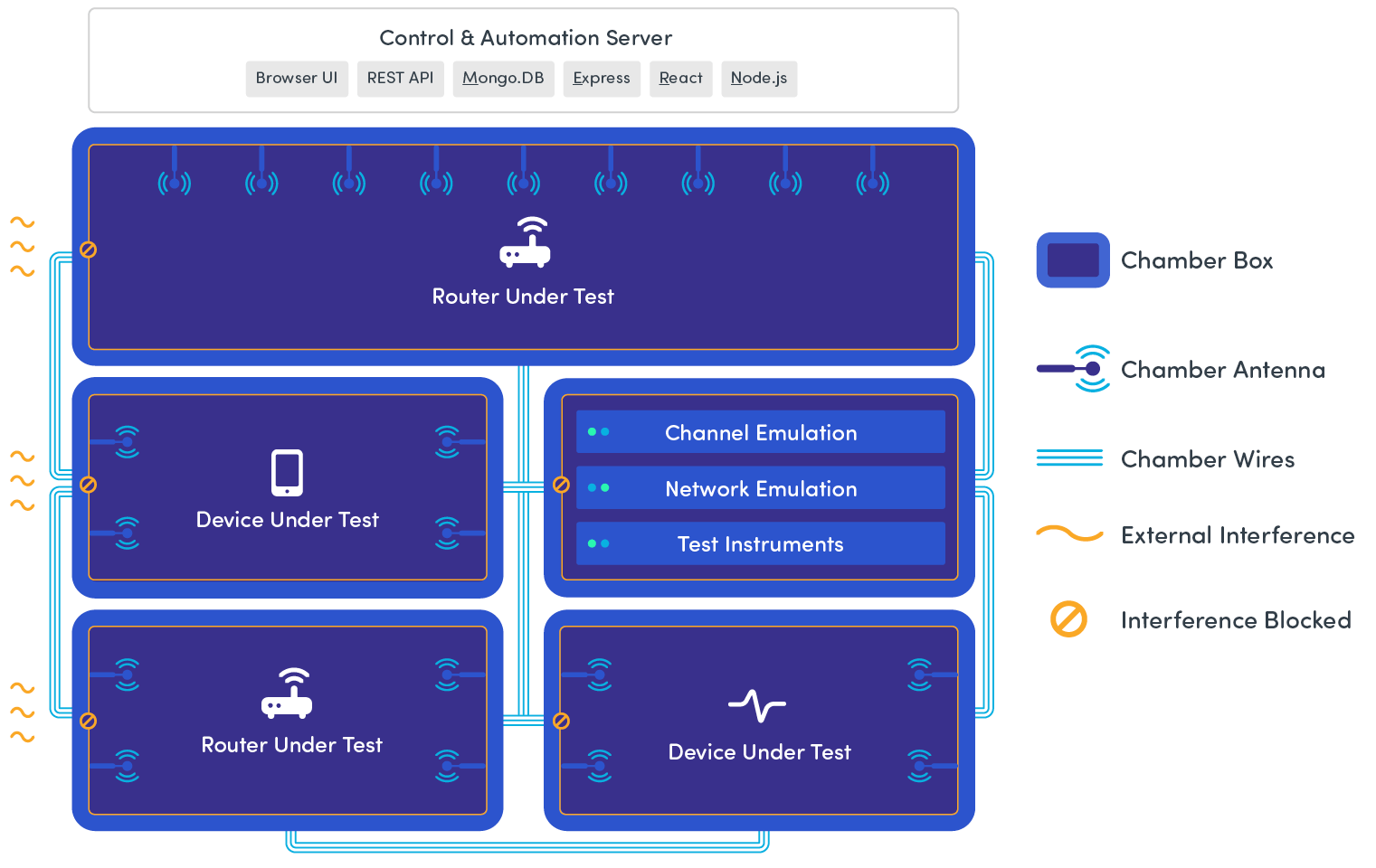
The complexity of traditional Wi-Fi testing environments has steadily grown over time. There were roaming, handoffs and mesh networks to be tested across access points and devices using dozens of pieces of testing equipment and hardware from multiple providers. All those devices under test and test systems had to be isolated in an array of chambers and interconnected via hundreds of cable connections, as expanding needs like traffic loading and ever-increasing numbers of antennas were added to the equation.

Wi-Fi 6 and now Wi-Fi 6E, fueled by more than a gigahertz of new spectrum in several countries, introduces even more testing requirements. More capacity, longer battery life, latency improvements, extended range, throughput increases, QoS guarantees, even more users – and it all has to be repeatable across a range of environments.

Service providers and device makers can’t keep running to multiple vendors for standards-based and high-performance testing and they can’t be consumed with managing a complex array of chambers and antennas and the cabling between them. Really, there’s only one way forward: a complete solution that can be deployed quickly and configured for precisely the new testing needs at hand. With Wi-Fi 6/6E, a turnkey, modular approach to testing has emerged not as a nice-to-have, but a necessity.

“There’s only one way forward: a complete solution that can be deployed quickly and configured for precisely the new testing needs at hand. With Wi-Fi 6/6E, a turnkey, modular approach to testing has emerged not as a nice-to-have, but a necessity.”

Defining a complete Wi-Fi test platform, on-demand

A modern, unified Wi-Fi testing platform built to accommodate traditional and emerging requirements will be capable of delivering channel emulation, testbed automation, full layer 2-7 testing and load testing – but only as needed in the moment. A modular approach addresses the full range of needs any service provider or device maker would bring, from standards-based and pre-certification testing, all the way through to advanced options for high-performance testing. It is supported by highly-realistic channel and network traffic emulation that allows stress testing based on real-world conditions.

Streamlining Wi-F 6 testing requires a modular approach that allows automated testbeds consisting of isolation chambers, antennas, emulators and test instruments to be rapidly configured and deployed.

Today, Wi-Fi chipset, access point, residential gateway and connected device vendors rightly place a premium on automation and ease of integration to existing systems when selecting Wi-Fi testbeds. In response, a comprehensive testing solution must support automated benchmarking of product performance and validation of functionality and scalability, while presenting simple interfaces and options for integration with existing lab automation.

On the service provider side, operators offering a Wi-Fi service place a high value on automation and ease of use when selecting Wi-Fi testbeds. Their focus is on home and business network environments that “just work” and provide high levels of service that reduce call center inquiries, truck rolls and churn. Delivering this experience at scale to upwards of millions of customers for a range of environments means automated test and assurance processes are a must. In enterprise environments, SLAs for Wi-Fi will increasingly become a reality and pre-deployment testing will go a long way toward ensuring service providers meet promises. From device performance validation and vendor selection to pre-deployment testing, software upgrade testing and recreation of field issues for problem solving, automation will be the common denominator amongst successful Wi-Fi 6 deployments.

The path ahead for better Wi-Fi testing

Modular solutions capable of generating highly-realistic traffic, authentically replicating a range of deployment environments, reducing traditional complexity headaches and supporting automated, repeatable testing scenarios represent the new must-haves for Wi-Fi testing. With octoScope now part of the Spirent family of test solutions, we’re better positioned than ever to offer the industry a one-stop shop for these must-haves, while pursuing octoScope’s original mission of streamlining Wi-Fi testing with a renewed sense of purpose and urgency.

Innovative broadband service provider delivers multi-gigabit speeds to the network edge

ROLLING MEADOWS, Ill., September 19, 2021 – Cambium Networks (NASDAQ: CMBM), a leading global provider of wireless networking solutions, today announced that Pentanet is building neXus, a multi-gigabit fixed wireless network across the metro area in Perth, Australia, to provide internet access for business and residential subscribers. The exceptional speeds will be achieved by extending their existing infrastructure consisting of 300 km of “dark” fiber with Cambium Networks’ 60 GHz cnWave fixed wireless platform, using Terragraph, a mesh technology developed by Facebook Connectivity. The result will be network performance that even the most demanding video gamers will appreciate.

“In 2019, Perth was reported as having the second slowest internet speeds of all Australian capital cities, but we know that needs to change – and fast,” said Stephen Cornish, CEO of Pentanet. “Bandwidth-heavy and latency sensitive applications like cloud-gaming are already transforming connectivity demands, and reliable gigabit speeds are the future for Perth. With Cambium Networks’ 60 GHz cnWave technology, Pentanet’s neXus is driving a leap in internet connectivity throughout the city to gigabit speeds. Using our existing fixed wireless network infrastructure, Pentanet can rapidly deploy the next-generation of wireless technology to create the neXus.”

“Our development and support teams are collaborating closely with the Pentanet team to ensure our solution can scale rapidly to be able to provide connectivity across Perth,” said Atul Bhatnagar, president and CEO of Cambium Networks. “They are pioneering a new age of communications with their business model and network architecture. We are pleased to recognize Pentanet’s disruptive leadership in the industry with our Wireless Connectivity Hero award.”

Cambium Networks’ multi-gigabit fixed wireless broadband technology and centralized management are well suited for urban applications. The solution provides multi-gigabit wireless broadband performance and reliability at a fraction of the cost of fiber. With 60 GHz cnWave, Pentanet can rapidly deploy hybrid networks to extend the fiber plant to customer premises, accelerating time to revenue at lower operating and capital costs. This video details the value that Pentanet delivers.

Cambium Networks’ 60 GHz cnWave solution elements include:

  • V5000 Distribution Node – Equipped with two sectors covering up to 280 degrees with beamforming. A single V5000 can connect up to 30 devices, which includes up to four distribution nodes. The V5000 can be used for point-to-point (PTP), point-to-multipoint (PtMP) and mesh configurations.
  • V3000 Client Node – Featuring a 44.5 dBi high-gain antenna with beamforming, the client nodes can support up to 3.8 Gbps with the capability for even higher rates in the future with channel bonding for both PtMP and PTP configurations.
  • V1000 Client Node – Includes wide-range, 80⁰ beamforming for easy installation. Powered by 802.3af PoE, V1000 supports gigabit throughputs in a compact easy to install form factor

The latest addition to Cambium Networks’ multi-gigabit wireless fabric portfolio of solutions, 60 GHz cnWave is fully integrated into LINKPlanner and cnMaestro™ end-to-end cloud management that provides a unified view of the entire network. The solution delivers reliable and secure connectivity for residential users, schools, enterprises, and industrial operations at a low total cost of ownership.

Find out more about mmWave products including 5G Fixed wireless, Wi-Fi 6 solutions and centralized management solutions at Cambium Connections’ of Cambium Networks’ online events in September. Stephen Cornish of Pentanet will be presenting live Tuesday, 21 September – Register Here.

Cambium Networks’ full wireless fabric portfolio of solutions are available through its global network of partners.

Cambium Networks is celebrating a Decade of Excellence in 2021 with more than 10 million radios shipped worldwide since commencing operations in 2011.

About Pentanet
Pentanet is a Perth-based, growth-focused telco delivering high-speed internet to a growing number of subscribers by providing them with next-generation internet speeds. This is achieved through Pentanet’s market-leading private fixed-wireless network, the largest in Perth, as well as reselling fixed-line services such as NBN, where its wireless is not yet available.

Pentanet’s flagship fixed wireless network has benefits for both customers and investors, offering an outstanding customer experience and a fixed-wireless product that is technically superior to most of the National Broadband Network (NBN) – with attractive margins for investors. This sets Pentanet apart from most broadband providers, which only resell the NBN.

Pentanet will also be part of the rollout of the next wave of subscription-based entertainment services – cloud gaming. The Company’s Alliance Partner Agreement with NASDAQ listed NVIDIA – one of the world’s largest producers of specialised graphic chips used in gaming – allows Pentanet to be the first to bring their GeForce NOW technology to Australia in 2021.

About Cambium Networks
Cambium Networks delivers wireless communications that work for businesses, communities, and cities worldwide. Millions of our radios are deployed to connect people, places and things with a unified wireless fabric that spans multiple standards and frequencies of fixed wireless and Wi-Fi, all managed centrally via the cloud. Our multi-gigabit wireless fabric offers a compelling value proposition over traditional fiber and alternative wireless solutions. We work with our Cambium certified ConnectedPartners to deliver purpose-built networks for service provider, enterprise, industrial, and government connectivity solutions in urban, suburban, and rural environments, with wireless that just works.https://www.cambiumnetworks.com/