Support for uplink capacity and greater power management benefit dense enterprise and IoT deployments
Austin, Texas – January 5, 2022 – With adoption of Wi-Fi CERTIFIED 6™ growing steadily, Wi-Fi Alliance® is evolving Wi-Fi 6 certification to meet increasing demands from today’s Wi-Fi® use cases. Wi-Fi CERTIFIED 6 Release 2 is now available, bringing new features that support increasing device and traffic density to deliver greater performance and power management with Wi-Fi devices and applications. Wi-Fi CERTIFIED 6 Release 2 adds support for uplink multi-user multiple input, multiple output (multi-user MIMO) to deliver smoother streaming services and video conferencing, faster uploads, and more reliable gaming. Additionally, three power management features improve Wi-Fi CERTIFIED 6 power efficiency, benefitting enterprise, industrial, and Internet of Things (IoT) applications. New features apply across all bands supported by Wi-Fi 6 – 2.4 GHz, 5 GHz and 6 GHz – bringing capacity, efficiency, coverage and performance benefits to residential, enterprise, and large public networks. Wi-Fi CERTIFIED 6 delivers the best experience with advanced applications, while providing strong WPA3™ security and promoting interoperability between Wi-Fi CERTIFIED™ devices.
“Wi-Fi delivers advanced capabilities that have driven tremendous global innovation, paving the way for massive growth in Wi-Fi applications that users rely on every day,” said Edgar Figueroa, president and CEO, Wi-Fi Alliance. “Wi-Fi CERTIFIED 6 Release 2 furthers Wi-Fi’s evolution to address today’s market needs, and supports more high-performance Wi-Fi scenarios with greater capacity, efficiency, and reliability.”
Wi-Fi uplink performance
Nearly two billion Wi-Fi 6 devices will enter the market in 20221, and today’s Wi-Fi supports increased device density, more bandwidth-hungry applications, and surges in uplink data demand in residential and enterprise environments. Wi-Fi CERTIFIED 6 Release 2 adds support for uplink multi-user MIMO, enabling devices to upload content concurrently to an access point (AP). Wi-Fi networks are supporting more upstream activity, with users frequently uploading work documents and videos to social media sites, and the trend toward greater uplink data consumption will further increase as more IoT devices send data via Wi-Fi to the cloud.
Uplink multi-user MIMO improves network performance and reduces latency while video conferencing, uploading documents, and any other mission-critical applications that require greater uplink capacity. Wi-Fi 6 deployments are increasing worldwide in large office buildings, public arenas, education campuses, high rise dwellings, and mass transportation hubs, and advanced Wi-Fi 6 capabilities drive innovation in the countless applications that rely on Wi-Fi. Wi-Fi CERTIFIED 6 Release 2 delivers comprehensive multi-user MIMO implementation to deliver strong Wi-Fi performance even in challenging environments with many Wi-Fi devices.
Wi-Fi power management
Wi-Fi CERTIFIED 6 Release 2 includes new features that bring power management improvements for devices in enterprise and IoT deployments. New low power and sleep mode enhancements – including broadcast target wake time (TWT), extended sleep time, and dynamic multi-user spatial multiplexing power save (SMPS)– enable power optimization of multiple battery powered devices. This trio of features allow multiple devices to receive extended sleep periods, allow for specific “wake up” times for transmitting data, and enable dynamic shut off of redundant receive chains to optimize power consumption in Wi-Fi CERTIFIED 6 Release 2 networks. Power management features benefit smart home, smart city, and Industrial IoT (IIoT) environments, and enable Wi-Fi to further its role in delivering IoT applications.
“Wi-Fi 6 adoption has outpaced previous Wi-Fi generations, driven by demand for better Wi-Fi connectivity in phones, tablets, PCs and access points to support high-performance, low latency uses in both residential and enterprise environments. Technological advancements continue to bring speed and efficiency benefits to a wide number of users and use cases, most importantly, in areas with high densities of users or client devices connecting and transferring large amounts of data,” said Phil Solis, Research Director at IDC. “Reduction in chipset costs and advancements in Wi-Fi 6 power management will also help shift the IoT space to more broadly adopt Wi-Fi 6 in the coming years.”
Industry support for Wi-Fi CERTIFIED 6 Release 2
“Today’s service providers want Wi-Fi 6 as part of a managed Wi-Fi solution to deliver the best possible connected home experience for consumers. It’s clear that the number of connected devices is increasing at an accelerated rate, and trends such as the ‘enterprization’ of the home, UHD video, telemedicine, and online gaming are all placing more demands on home networks. Wi-Fi 6 can address these demands, and Airties offers an extensive Wi-Fi 6 portfolio, powered by Airties Edge software for Wi-Fi 6 gateways and extenders.” – Metin Taskin, CTO, Airties
“Broadcom is pleased to have its Wi-Fi 6E access point and client device reference designs included in the Wi-Fi CERTIFIED 6 Release 2 test bed. The wide proliferation of Wi-Fi 6 and Wi-Fi 6E devices is already creating new experiences for the consumer. The Wi-Fi CERTIFIED 6 Release 2 certification program, which we are happy to be a part of, is designed to carry this momentum forward.” – Vijay Nagarajan, Vice President of Marketing for the Wireless Communications and Connectivity Division, Broadcom
“The breadth of new features that Wi-Fi offers consumers requires constant updates and sometimes staged releases to get products to the market. We applaud Wi-Fi Alliance for continuing to drive this phased process and the latest introduction of Wi-Fi CERTIFIED 6 Release 2, bringing powerful new features like uplink multi-user MIMO to Wi-Fi 6.” – Charles Cheevers, CTO, Home Networks, CommScope
“Wi-Fi CERTIFIED 6 was a game changer for IoT applications and Wi-Fi CERTIFIED 6 Release 2 extends these innovations even further. Wi-Fi CERTIFIED 6 Release 2 enhancements for TWT, uplink multi-user MIMO, and Extended Sleep Time allow for long-life battery-operated devices that also provide the added range for not only whole home coverage but whole property coverage including outdoor cameras, lighting, energy management systems, and sensors. Infineon’s AIROC™ Wi-Fi family of products support Wi-Fi CERTIFIED 6 Release 2 features, which coupled with advanced range and robustness improvement capabilities, improved power management, and a comprehensive security framework, delivers cutting edge solutions for IoT applications.” – Sivaram Trikutam, Senior Director, IoT Compute and Wireless, Infineon
“We would like to thank Wi-Fi Alliance for enabling the industry to ramp new Wi-Fi technologies through certification programs which help ensure device interoperability, and we are delighted to have the Intel® Wi-Fi 6E AX210 product be part of their latest test bed. New Wi-Fi CERTIFIED 6 Release 2 features like uplink MU-MIMO, coupled with new high-speed channels in the 6 GHz spectrum for Wi-Fi 6E, will help networks scale in their ability to deliver faster, more responsive Wi-Fi experiences as the number of devices continues to exponentially grow.” – Eric A. McLaughlin, VP of Client Computing Group, and GM of the Wireless Solutions Group, Intel Corporation
“With the demand for greater responsiveness and performance required by new disruptive, untethered real-time immersive experiences, Wi-Fi Alliance certification is crucial to ensure robust interoperability and rapid adoption of Wi-Fi 6 Release 2 devices. We’re honored that our WAV600-2 product family was selected as an access point test bed device for Wi-Fi CERTIFIED 6 Release 2 and that MaxLinear chipsets will empower the next generation of broadband platforms for multi-gigabit video, gaming, and other demanding low-latency services launching this year.” – Doron Tal, Vice President, Broadband Access, MaxLinear
“The Wi-Fi CERTIFIED 6 Release 2 program brings a number of improvements to high density wireless networks. We will see tangible advancements in uplink performance, power and enhanced range, unlocking new applications and use cases for residential, industrial and enterprise users. As part of the test bed of chipsets for Wi-Fi CERTIFIED 6 Release 2, MediaTek’s Filogic family provides fast, reliable and an always connected solution to help drive the Wi-Fi industry forward as we all rely on connected devices more than ever before.” – Alan Hsu, Corporate Vice President & General Manager of MediaTek’s Intelligent Connectivity business
“As one of the first companies to be certified for Wi-Fi CERTIFIED 6 Release 2 and to be included in Wi-Fi Alliance’s interoperability test bed, NXP continues to play a leading role in helping Wi-Fi Alliance innovate and drive the adoption of Wi-Fi 6. With Wi-Fi CERTIFIED 6 Release 2, Wi-Fi Alliance is proactively meeting the growing performance demands of advanced IoT applications that require significantly greater capacity and increased power efficiency both today and tomorrow.” – Larry Olivas, VP and GM of Wireless Connectivity Solutions, NXP Semiconductors
“There is a fundamental shift in how we work and play, with effective connectivity becoming critical for seamless transitions between our physical and virtual worlds. onsemi congratulates Wi-Fi Alliance’s timely introduction of Wi-Fi CERTIFIED 6 Release 2. This further helps improve the end user experience via uplink MU-MIMO and power efficiency optimizations, expanding opportunities for smoother and more reliable video, gaming and IoT applications.” – Irvind Ghai, vice president of product marketing, Wireless Connectivity and Signal Processing Division, onsemi
“To ensure productive and reliable connectivity while working, playing, and learning remotely, the demand for a better approach to uplink data has never been greater. Uplink MU-MIMO, a key feature of Wi-Fi CERTIFIED 6 Release 2, is designed to deliver in every environment. Qualcomm’s end-to-end solutions enable customers to deliver networking, IoT and mobile products that meet the moment, while deploying leading technology.” – Rahul Patel, SVP & GM, Connectivity & Networking, Qualcomm Technologies, Inc
1 IDC Research, 2021

Munich, Germany, and Tel Aviv, Israel – 5 January, 2022 – Infineon Technologies AG (FSE: IFX / OTCQX: IFNNY) and Deeyook today announced their collaboration on location solutions. The location-as-a-service (LaaS) company has invented and patented an award-winning tracking solution to determine indoor and outdoor locations of items, assets, and employees. Both companies fuse Deeyook’s ultra-precise, innovative algorithms into Infineon’s best-in-class, low power AIROC™ Wi-Fi® portfolio to enable an accurate, passive, ubiquitous, and efficient location solution.
Deeyook redefines indoor/outdoor location technology through innovation in wireless signal processing, applicable to incumbent Wi-Fi/4G/5G MODEM firmware versions. The firmware extracts angles of wireless transmissions (“Direction Finding, DF”), a first of its kind in the world of commercial wireless tracking. Deeyook’s tracking capabilities are ultra-precise, providing location information within 10cm/4in, passively exploiting the install base of 1.7 billion wireless access points worldwide.
“There are many challenges when companies implement real-time location systems, primarily because tracking solutions, such as RFID, are not really ubiquitous. This is particularly acute with GPS, which has many shortcomings,” said Gideon Rottem, CEO and Co-Founder of Deeyook. “We created Deeyook to address these challenges – technology that is ubiquitous and can track things with the utmost precision indoors, outdoors and in bad weather. We are excited to work with Infineon because its AIROC Wi-Fi portfolio is reliable, power efficient, and they are the IoT market leader.”
“Infineon’s mission is to make the world an easier, safer and greener place with our technologies through smart, connected devices,” said Sivaram Trikutam, Senior Director, IoT Compute and Wireless, Infineon Technologies. “These new IoT solutions support multiple location tracking technologies. Previously, Wi-Fi was not considered a viable option due to its power demands, while additionally real-time locating systems (RTLS) deployments required businesses to utilize custom solutions with costly infrastructure, engineering, and labor-intensive installation.”
Deeyook’s solution paved the way to solve all these problems. Embedded in the next-generation chip firmware, it has the potential to be a market leader in RTLS. With this collaboration, Infineon continues to expand its role as a key Industry 4.0 solution vendor to the world’s largest corporations.
About Deeyook
Deeyook is a patented, wireless-based firmware solution that offers precise location as a service. The firmware is self-learning, ubiquitous, ultra-precise (~10 cm), passive and low power, allowing absolute indoor and outdoor position determination. Deeyook’s solution, based on a proprietary, patented angle-measurement technology, won first place at the HiStart Innovation Forum. It also won first place at the Ruhr Summit Corporate Challenge pitch. Based in Tel Aviv, Israel, Deeyook is a privately-held, venture-backed company.
Media Contact Deeyook
Scott Rosenblum, LEVEL PR
[email protected], +1 646-776-1222

New Delhi, December 27, 2021
HFCL Limited (HFCL), a leading innovation led telecom enterprise has been recognized as the ‘Trusted Source’ by National Security Council Secretariat (Trusted Telecom Cell), a part of National Security Council who advises the Prime Minister’s Office on matters of national security and strategic interest. With this approval, HFCL has become the ‘Trusted Source’ for all Indian Telecom Service Providers (TSPs) for sourcing their telecom active network products and infrastructure and has become one of the few companies alongwith Ericsson, Cisco, Nokia, Tejas to have received the ‘trusted sources’ approval in the Country.
The Government launched Trusted Telecom Portal in June 2021 under the Cyber Wing of the NSCS to bring enhanced supervision and effective control over nationwide telecom networks. The development has come following the Government’s efforts to ensure security of telecom networks, especially with fifth generation (5G) service on the anvil. To address the perineal problem of increase in cyberattacks, intelligence gathering, which comes, laced with the growth in data consumption, the Government of India announced the directives which mandated the Indian TSPs to connect their networks only on those new devices designated as ‘Trusted Products’ from ‘Trusted Sources’. Trusted Products are products whose critical components and the products themselves are sourced from Trusted Sources. The TSPs are required to log into the Trusted Telecom Portal of the Government of India and clearly highlight their vendors and sources which should be from the government approved list of the ‘Trusted Products’ and ‘Trusted Sources’.
Over the last three decades, HFCL has been serving the telecom sector with its innovative, customized products and solutions. In the last few years, HFCL has emerged as an OEM into new-age telecom products and solutions such as next generation carrier Wi-Fi, Point-to-point Radios in various frequency bands, L2 and L3 switches and these made in India products have already been deployed in India and abroad. HFCL with its recent foray in 5G transport and radio product development, intends to address the ever-growing need for ubiquitous and affordable data connectivity. Backed by strong innovation capabilities and investment in R&D, HFCL is looking to expand its portfolio of telecom products and supply its next generation products not only to Indian TSPs but also to global telecom players.
HFCL’s Promoter & Managing Director, Mr. Mahendra Nahata said, “We are delighted to receive the approval as a ‘trusted source’ from NSCS and are fully committed to continue serving our TSP partners with our holistic range of products and services. The development will lead to cement HFCL’s position further in the Telecom sector thereby amplifying the growth opportunities for HFCL. Our inclusion in the selective list as one of the trusted source is a distinguished achievement and reinforces our commitment to delivering Make in India world-class products/solutions and contribute to further accelerating our Hon’ble PM’s vision of an Atamnirbhar Bharat with greater zeal.
About HFCL Limited:
HFCL Limited is a leading technology enterprise engaged in manufacturing of high-end Transmission and Access Equipment, Optical Fiber, Optical Fiber Cables (OFC) and is specialized in setting up modern communication network for Telecom Service Providers, Railways and Defence.
The Company has state-of-the-art Optical Fiber and Optical Fiber Cable manufacturing plants at Hyderabad, Optical Fiber Cable manufacturing plant in Goa and in its subsidiary i.e. HTL Limited at Chennai along with FRP and ARP Rod manufacturing plant in its subsidiary at Hosur.
The Company’s in-house Centre for Excellence in Research located at Gurgaon & Bengaluru along with invested R&D Houses and other collaborators at different locations in India and abroad, innovate futuristic range of technology products and solutions. Some of the newly developed products through R&D are Wi-Fi Systems, Unlicensed Band Radios, Switches, Electronic Fuses, Electro optic devices, and Video Management Systems. There is a suite of products under development, which include Software Defined Radios, Routers, PON, 5G Transport and Radio products, Wi-Fi 6 access points, Point-to-multipoint Radios and Ground Surveillance Radars among others.
Visit www.hfcl.com for more information.
Visit: https://io.hfcl.com (product by HFCL)
For further details please contact:
| HFCL Limited
Manoj Baid |Amit Agarwal Phone: 011 3520 9400 |
Adfactors PR
Poonam Saney Makhija |Shivangi Sinha Phone: 9819004968 | 9836643500 |

Smart home devices aren’t just getting more popular. They’re also creating new customer expectations and transforming the way people work, relax, and learn in their homes.
“Thanks, in part, to COVID-19, things have changed dramatically,” Plume CCO Tyson Marian said in a recent webinar. “[Customer] expectations have increased because their entire livelihood really rests on the quality of experience in the home. And we don’t see that changing anytime soon.” Communications service providers (CSPs) must keep up with these changes or risk getting left behind. And that means using data to understand exactly what customers want from their smart home experiences and how you can deliver it.
“The smart home today is less about the devices in your home and more about the data that those devices produce to create cross-device experiences. That’s why the smart home is really starting to take off now and why we believe it will continue to grow.”
Tyson Marian, Plume CCO
Uninterrupted connection throughout the home
There are more connected devices in the home than ever—and the pandemic just sped up adoption. As more people had to quarantine and begin working and schooling from their residences, what did they invest in? Smart home devices.
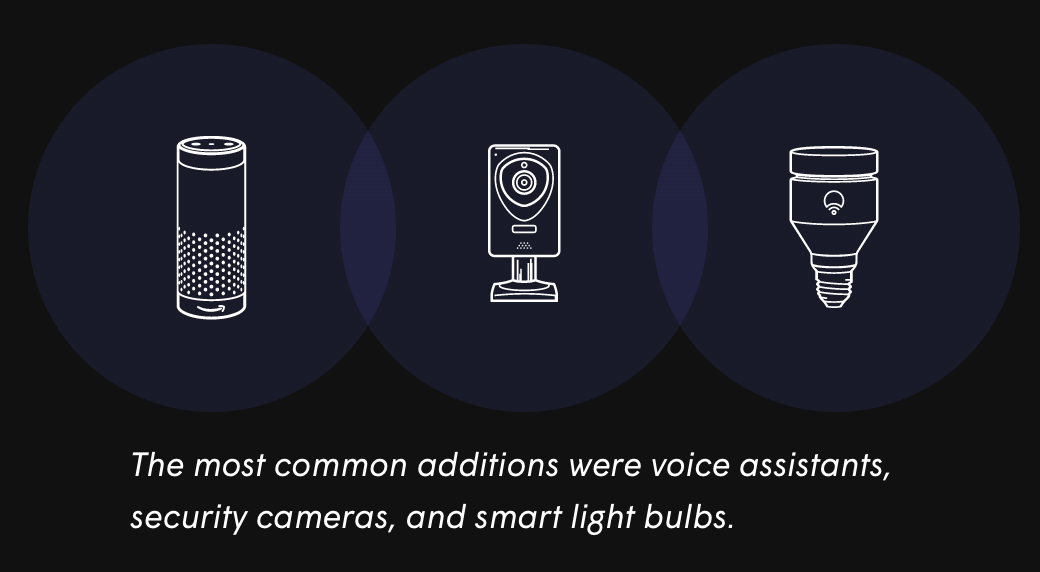
In a recent study, Plume found that the number of devices per U.S. household increased 38% from October 2019 to May 2021—the most common additions being voice assistants, security cameras, and smart light bulbs.
 38% The number of devices per U.S. household increased 38% from October 2019 to May 2021
 With all of their smart devices, customers expect seamless, uninterrupted connection so they never have to miss a meeting, class, or a favorite TV show. And if they’re now paying for more hardware and software than they used to, they want to know that they’re getting their money’s worth.
“Our digital life is becoming the greatest cost in our life outside of possibly a mortgage. What the customer expects is that those [devices and platforms] work and that they always work.”
Tyson Marian, Plume CCO
Smart capabilities across devices
In a world of smart technology, a watch is no longer just a watch and a bike is no longer just a bike. Instead, they’re internet-connected devices that use data to learn about your needs and deliver automated, personalized experiences. And consumers have increasingly come to expect those features.
“If I get a new thermostat, it’s got to give me more than just the ability to adjust the controls. With sensorless motion detection, for instance, Plume can actually turn devices like a smart thermostat into a sensor. This is the sort of thing that turns an otherwise simple thermostat into something more useful, and turns a home into a smart home.”
Tyson Marian, Plume CCO
During the pandemic, investments in smart cooking devices grew 60%, wearables and smartwatches 51%, and smart TVs and streaming devices 34%.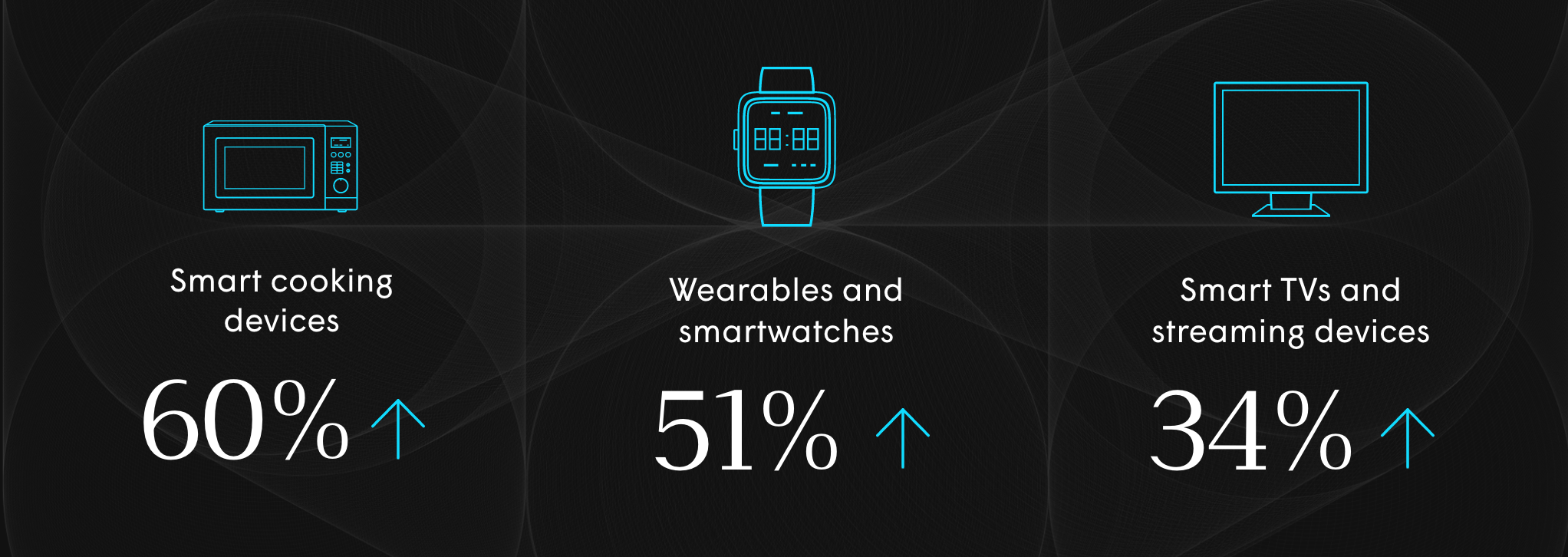
Personalized, on-call support when they need it
With all of these connected devices, CSPs should be able to gather real-time data about their customers’ experiences and offer personalized, proactive support as needed.

“When they actually call the service provider with an issue, the customer wants you to know who they are. They also want you to be able to help solve their problem efficiently.”
Tyson Marian, Plume CCO
Marian recalled a support call he once heard where a customer was passed from representative to representative until someone was able to finally address the problem. And for each new person, the customer had to repeat their name, account number, and issue. A CSP with a cloud-based, data-driven system would have been able to get a bird’s-eye view of the devices in the customer’s home, easily connect those that weren’t on the network, and offer a customized solution for increased coverage—all in just a few minutes. “That’s the kind of experience that the customer wants: bespoke,” Marian said. “What’s going on in my house and can you offer me a solution?” As smart home devices become more ubiquitous and customers less tolerant of unpersonalized experiences, CSPs have to step up their game and find a way to become a one-stop shop for customers’ evolving needs and preferences.
“A lot has changed; a lot is going to continue to change. And our belief is that every change will present more data, which means more opportunities to create new digital, smart home experiences.”
Tyson Marian Plume CCO


Senior living communities are adopting a resort-style hospitality approach to accommodate changing resident needs. This change in practice is largely a result of the technologically savvy baby boomer generation. Because of this, owners need to provide an engaging community experience in addition to medical care.
There are clear benefits to a hospitality-centered approach for senior living communities. At its core, hospitality strives to provide comfort, privacy, and a high level of customer service to guests. Likewise, it is important to provide these same ideals to senior living residents.
Technology Enhances Resident Experiences
Technology is an important factor in delivering resort-style hospitality to senior living. In today’s connected world, many older adults expect advanced technologies when choosing a community.
The long-held belief that older adults have yet to adopt technology is no longer true. According to Pew Research, 42% of American seniors own smartphones, and 67% say they regularly use the internet – a 55% increase in just under two decades. Furthermore, this number will rise in the coming years as the rest of the baby boomers generation age into Medicare.
Technology elevates the resident experience. Just as hotel guests want access to their favorite shows, senior living residents expect the same. Something as simple as a curated channel lineup can greatly improve resident satisfaction.
Enhanced Entertainment and IoT Increases Safety
Over-the-top solutions like WCI’s WorldVue platform facilitate easy communication between management and residents. Communities can use the customizable in-house channel to display activities, dining options, events, on-site services, and more.
Smart technology is making its way into senior living communities. Residents can control features like the lighting and HVAC in their rooms with a touch of a button using IoT. Utilizing smart technology helps residents live an independent lifestyle

Empower staff with the time to make meaningful engagements with residents.
Resident safety is of utmost importance to community staff, residents, and their loved ones. Cloud-based surveillance solutions help community staff monitor residents as needed. For instance, security is especially beneficial in memory care communities. Staff can receive alerts when there is movement detected in any pre-set locations. These solutions allow community staff to keep residents safe while also maintaining their privacy.
In conclusion, shifting to a hospitality mindset has significant benefits for senior living communities. It is important to meet the needs of residents while creating a better community experience.
Contact us today for your senior living needs: [email protected]


There are more than 16 billion wireless devices in the world today, driving $3.3 trillion in global economic value. The industry will ship an additional 4 billion Wi-Fi devices in 2021 alone.
This incredible growth is driven not only by existing use cases, but also emerging ones. From shopping malls and office buildings to factories and hospitals, reliance on Wi-Fi is pervasive and there’s a heightened priority to rigorously test Wi-Fi products before they ship.
Tech thought leader Diana Adams recently joined me to talk about key insights from Spirent’s new eBook, Testing Wi-Fi for High-Performance Use Cases. Watch the video below as we discuss how Wi-Fi testing today is critical for tomorrow’s wireless world.

Wi-Fi Testing Today Is Critical for Tomorrow’s Wireless World – Spirent
To learn more about Wi-Fi testing, download the eBook.


2021 has been a year that many are glad to finally see the tail-end of. No one would have expected what lay in store for the world when I was writing my predictions piece looking ahead at 2019. Almost two years since the beginning of the COVID-19 pandemic and the world is still feeling its effect. The tech industry, like countless others around the globe, is still experiencing the impact. Some good and some bad. However, such times have also brought to light great perseverance, innovation, and bravery. But, with the end finally in sight, both myself and Cognitive Systems are excited for what 2022 has in store. As we look ahead, I am most excited to see WiFi technology and WiFi Sensing enabling a truly smart future for the home and helping set new standards for connected devices.
HOW CAN WE GET THE WIRELESS INDUSTRY BACK ON TRACK?
As I alluded to above, there were few left untouched by the pandemic. With all the challenges associated with fighting back, supply chain issues became one of the defining features of the last few years. The world had very much shifted to be focused on procurement; a challenge we will continue to see being prevalent over the next year and into 2023 as we attempt to get those supply chains back in gear for people to be able to deliver new hardware solutions or products.
Unfortunately, the challenges of delivering hardware to customers and the gradual ramp-up back to pre-COVID production volumes, are having a detrimental effect on technological innovation. WiFi 6 and WiFi 7 are very much the big-ticket items in the hopper for the wireless industry. Companies are already producing demos while chip design is ongoing. But this development process is being curtailed by the silicone and chip shortages needed to innovate within the typical timeline. For example, now you might have to order chips, in some cases, 18 months before you actually need them. Demand is just too great. In fact, right now, many delivery drivers are even struggling to fit all of their packages in one truck at a time. Shipping processes have had to evolve. And so, it’s clear that an emerging theme in tech this past year has been that disruptions to the supply chain are hindering the development and deployment of new technology. The delivery of new technologies is simply going to take longer as access to hardware remains the #1 problem.
I believe companies will have to innovate if they can’t deliver their hardware. They will have to take what they already have and try to improve on it some other way. The only logical way to really do that is through software. If you can’t deliver more products into the market because of procurement then you have to work with your available resources and improve through software upgrades instead. As well, companies will have to scale their timelines and look further ahead to avoid or best prepare for these types of challenges in the future. I predict that an increased focus on software solutions and hardware being built to accommodate software innovation will become necessary. Producers in tech will need to ensure that their product has enough processing power to support all this software innovation that is outpacing them currently. Luckily, these problems will eventually rectify themselves as we settle into a post-COVID reality and industries can finally pivot. But, it will fundamentally change how companies and entire industries approach planning and supply chain management.
WHO IS DRIVING THE FUTURE OF THE SMART HOME?
When the average user thinks about the future of the smart home, they’re probably imagining something from the Jetsons. It’s much more likely that in the future, the smart home will look similar to what we have now, instead of some radical futuristic change. Ultimately though, the future is currently being decided by the industry, not the user. As smart device adoption and ecosystem integration are still scaling up, we as consumers are still following the trends fed to us by connected device manufacturers based on what they think belongs in a smart home. I mean, many of us wouldn’t even consider our own homes smart, even if most of us own something like smart plugs, a voice assistant, a smart TV, etc. Since the industry seems to be driving the smart home, you can expect to see devices and products focused on more gimmicky solutions based on companies creating what they believe the consumer wants versus what they actually want. Right now, the biggest focus as spurred by consumption are entertainment and convenience, but the smart home will eventually peak at a point where users just don’t need anything else.
As the market becomes more saturated with connected devices, I expect brand-driven ecosystems to continue to be in demand, namely a combination of a central network based around one company (such as Apple or Google) combined with devices from third parties which easily work with that central brand. I think we will see this hit the market in one of two ways, either full packages of technology that work together or a variety of separate devices that lead to more organic growth such as how you now need the iPhone to control your Apple watch. Both have the potential to overcome current market challenges. Take for example a common choice to charge wearables at night. Now suddenly you have a gap in coverage during a critical time period. Companies need to think about devices such as a charging station that doubles as a tracker to fill that gap. Layer motion intelligence into the mix and you can add more context without more hardware. These large companies know that while they will be the central piece and likely the biggest benefactors, they need compatible third-party companies so they can offer these new features and services. They can’t and won’t be able to dominate all the different smart home/IoT industries. That’s why we see many of these larger players deeply involved in associations like IEEE and Matter who are pushing for standards and initiatives that will help them safely expose CSI to work with more tech partners.
WILL VOICE ASSISTANTS FINALLY MATCH HUMAN COMMUNICATION?
Voice assistants are easily one of the most common smart devices, whether that be through your phone, smart speakers, TV, or dozens of other systems that can be activated with a few simple words. They are used for a variety of reasons such as setting timers or alarms, playing music, making phone calls, etc. However, the problem with these devices is that they require very specific input to work well. For example, in order to trigger a Google Home, you would have to say the phrase “Hey Google” and then speak a pre-defined selection of options. If you mess up these phrases or typical commands then the voice assistant usually can’t recognize what you want. That’s why there’s still much growth in the future of voice assistants – one that will see greater flexibility and modularity. Eventually, voice recognition will evolve into something closer to talking to an actual human being that is able to recognize nuances in conversation and understand conversations like a human would. And I expect that we could easily see that become a reality within the next 4 years or so.
My main takeaway from the bright future of voice recognition is that it closely mirrors what I see to be the future of WiFi Motion. When voice assistants were still in their infancy, many linguistics experts believed the technology would never take off. Now they’re everywhere. Voice recognition grew as a result of companies being willing to invest in the technology and expand functions that had seemed previously impossible. This is the same type of critical mass needed for motion intelligence to achieve some of these far-out functionalities. As well, WiFi Motion needs time to learn through people using it. This is similar to how voice recognition can listen to changes in audio frequencies and thus develop a much wider and more substantial set of training data to understand, for example, how “dog” can be said with different intonations or accents or even languages. WiFi Motion doesn’t yet have the same extensive data set to know that maybe you’ve stood up from a chair. But that doesn’t mean it won’t be able to in the future. The more the market and general interest grow, the more we will be able to build out further applications.
WHAT’S NEXT IN HEALTHTECH: AGING IN PLACE?
I want to grow old at home. In fact, 9 out of 10 U.S. adults would prefer that to a retirement home or assisted living facility. It’s only natural to want to live where you feel the most comfortable. New technologies are making a future where this is more realistic. This desire is only growing, especially as developing technologies are emerging to make this desire a real possibility. COVID, specifically, has also shown us how vulnerable our long-term care system is. But, the last two years have created a new opportunity for tech in seniors’ homes. Simple changes brought upon by the pandemic, such as Zoom calls or FaceTiming with elderly loved ones, are opening their minds and onboarding them to the benefits of technology. Going forward, technology companies will need to keep this new, growing industry in mind as they create tech that can fit the expectations of seniors. In particular, accessibility, ease of use, and quick setup are going to be key markers for successful tech in this market. As well, preventative care is currently and will continue to be a huge trend, and it’s something that Cognitive has designed our entire caregiving solution around. The opportunity to identify illnesses or injuries before they become critical and need hospital intervention is going to become even more important. As the huge baby boomer generation continues to age, they will eventually overwhelm our hospital systems if the industry doesn’t focus on developing technology and products to support early intervention before something becomes critical.
That’s why I think there is a very palpable appetite for supporting technology and services allowing people to age in place gracefully. You can even see that from the number of startups in this space alone. I believe that aging in place will not only be the norm but also the most affordable option versus a retirement home. After all, the more normalized this concept becomes the more affordable it will be as well.
WHAT’S NEXT FOR COGNITIVE?
While the world around us is changing at often times a blistering speed, the one thing that remains is that people want innovative and helpful technology. WiFi Sensing has the real potential to not only contribute to many of these forecasts, but truly change the WiFi and smart home industries. I’m excited to see WiFi Sensing become accepted on a larger scale through standardization and thus become essential in homes. I believe that WiFi Motion will be standard in 5 years, meaning motion capabilities in nearly every router or gateway.

New Wi-Fi standard will provide breakthrough speed and performance for video streaming, gaming, and virtual reality applications
SAN JOSE, California — Dec.15, 2021 – LitePoint, a leading provider of wireless test solutions, today announced it is collaborating with leading chipset maker MediaTek to deliver turnkey design validation test solutions for MediaTek’s Wi-Fi 6/6E Filogic chips. The collaboration will enable MediaTek customers to simplify and speed test results for this new family of high-performance connectivity chipsets.
Wi-Fi 6/6E provides breakthrough connectivity experiences delivering multigigabit, low latency Wi-Fi and reliable connectivity for applications like streaming, gaming, AR/VR and more.
Through this strategic collaboration, LitePoint worked with MediaTek to create a version of LitePoint IQfact+ test automation software that enables MediaTek customers to test their Wi-Fi 6/6E designs with a complete and easy to use test flow. IQfact+ software works with the LitePoint IQxel family of test systems to provide MediaTek customers with chipset-specific test development software that enables rapid design validation through volume manufacturing with minimal engineering effort.
“LitePoint continues to drive innovation in test solutions for Wi-Fi products and we are pleased to be working with MediaTek to enable their customers to bring Wi-Fi 6/6E devices to market,” said Anna Smith, Vice President Worldwide Sales, LitePoint. “IQfact+ and IQxel offer MediaTek’s customer base a complete and easy-to-use testing platform for rapid design validation.”
“As the market changes and more people are working and studying from home, many applications rely on stable networking service, like video conferencing and 4K streaming. MediaTek’s Filogic family delivers fast, reliable and always-on connected solutions to give consumers a smooth, fast and interactive connected experience with incredible video quality,” said Alan Hsu, Corporate Vice President & General Manager, Intelligent Connectivity at MediaTek. “LitePoint’s testing platform will help our customers quickly and easily validate our Wi-Fi 6/6E solutions to speed up the time to market for the next generation of devices.”
Technical Details
LitePoint’s IQxel fully integrated test RF PHY test platforms include signal generation and analysis for Wi-Fi connectivity, meeting the needs of product development and high-volume manufacturing. The IQxel product family includes support for WLAN IEEE 802.11a/b/g/n/ac/ax/be with a frequency range from 400 to 7300 MHz for validation in the 6 GHz band, as well as a full range of connectivity standards such as Bluetooth 5.x, Zigbee and Z-Wave
To learn more about LitePoint’s IQxel product family, please visit: https://www.litepoint.com/products/iqxel-mw-7g
New partnership enables Heights-Telecom to massively enhance its service provider offerings by bringing OpenSync and Plume’s award-winning services suites to its state-of-the-art range of DSL and PON gateways, and WiFi extender products.
Tel Aviv, Israel November 30, 2021 – Heights-Telecom, a leading Broadband CPE and connected home product manufacturer, today announces its partnership with personalized smart services pioneer, Plume®. The industrial design of the Heights-Telecom products has always been focused on user-friendly and elegant products that can be placed anywhere in the living-room. All products are designed with the “one LED” concept allowing users to quickly check the status of their products. The partnership with Plume takes user experience to a whole new level and brings Heights-Telecom’s service provider customers access to Plume’s cloud- and AI-driven consumer and small business services that delivers – among many benefits – flawless, self- optimizing Wi-Fi connectivity and unparalleled customer experiences for broadband subscribers.
As part of the collaboration, Heights-Telecom will adopt and integrate OpenSyncTM into their latest gateway and WiFi extender products. OpenSync is an open-source silicon-to-service framework that allows CSPs to manage their CPE from the cloud and execute new services rapidly and at scale across entire, installed device populations. Furthermore, integration ensures interoperability with other OpenSync enabled products to bring service providers choice and flexibility.
The following Heights-Telecom WiFi 6 and WiFi 6E enabled products will have OpenSync integrated:
All Heights-Telecom CPEs will come pre-integrated with OpenSync and provide out-of-the-box access to Plume’s SaaS Experience Platform––including the following service suites:
- HomePass™ brings service providers and their subscribers a “new bundle” of smart home services featuring flawless whole-home adaptive Wi-Fi, advanced parental & access controls, rock-solid cybersecurity, state-of-the-art Wi-Fi motion detection and more.
- Haystack™ provides an unparalleled back-end data prediction and analytics suite that is field-proven to significantly reduce operational costs and cut subscriber churn.
- WorkPass™ delivers an intelligent workplace services suite that enables Small Business Owners to meet their networking, cybersecurity, guest analytics, business insights, marketing and advertising and employee management needs.“The collaboration with Plume allows Heights-Telecom to add Plume’s best-in-class whole-home WiFi software to our uniquely designed gateway and WLAN extender products. With this combination, operators receive the seamless, reliable, user-optimized, and intelligent tools that broadband subscribers expect in 2021 and beyond, combined with the greatest industrial designed broadband products from Heights-Telecom,” said Gadi Malka CEO at Heights-Telecom. “I’m convinced that the partnership with Plume will help to increase our international business. Furthermore, it will allow us to enhance our products and extend the user experience with new cloud-driven services for the subscriber and powerful management tools for the service provider”.
“Plume is delighted to support this new partnership with Heights-Telecom as we expand our distribution and product availability throughout the world”, said Russell Dougherty, VP, Global Partnerships, Plume. “We believe that Heights-Telecom’s focus on usability perfectly complements Plume’s ethos in providing highly- evolved next generation user experiences, and we strongly believe that our combined hardware and software offering will empower service providers to meet their subscribers’ need for new highly personalized services delivered at super-high cadence.”
About Heights-Telecom
Heights Telecom is an innovative company that designs, develops, and manufactures custom CPE platforms in DSL/Fiber/5G populated with its own containerized software allowing operators to easily add new value-added services to increase their ARPU and reduce customer’s churn. The company HQ is based in Israel with branches in the Netherlands, China and Japan.
For more information about Heights-Telecom, please visit the corporate website at heights-t.com.
About Plume
Plume® is the creator of the world’s first SaaS experience platform for Communications Service Providers (CSPs) and their subscribers, deployed in more than 35 million locations globally. As the only open and hardware-independent, cloud- controlled solution, Plume enables the rapid delivery of new services for smart homes, small businesses, and beyond at massive scale. On the front end, Plume delivers self-optimizing, adaptive WiFi, cyber-security, access and parental controls, and more. CSPs get robust data- and AI-driven back-end applications for unprecedented visibility, insights, support, operations, and marketing. Plume leverages OpenSyncTM, an open-source framework that comes pre-integrated and supported on the leading silicon, CPE, and platform SDKs.
Visit plume.com, plume.com/homepass, plume.com/workpass, and opensync.io. Follow Plume on LinkedIn and Twitter.
Plume, OpenSync, Haystack and WorkPass are either trademarks or registered trademarks of Plume Design, Inc. Other company and product names are used for informational purposes only and may be trademarks of their respective owners.
###
Heights-Telecom media contact
Gadi Malka – CEO [email protected]
Plume media contact:
Stephen Orr
Axicom [email protected]