

It is no surprise that WiFi has come a long way since it was first introduced to consumers in 1997. Today, people around the world rely on WiFi as the number one way to communicate and stay connected. However, despite its impressive evolution over the past 20 years, the standards that dictate how our WiFi networks operate are getting an upgrade.
Enter 802.11bf: the latest standard in the IEEE 802.11™ family that is the core technology behind WiFi. For the first time ever, WiFi will officially be used for something other than communication, as this new standard will transform WiFi from a communication-only technology to a fully-fledged sensing paradigm.
As the leaders in the WiFi Sensing space, we are thrilled about the endless possibilities 802.11bf could unlock for the entire industry. This new standard is going to maximize the features, efficiencies and capabilities of WiFi Sensing, with a platform to introduce a wide range of new and life-changing applications.
The key advantage of this new standard is that there will be a defined set of expected inputs and outputs for each wireless device that is specifically related to WiFi Sensing. These regulations will enable wireless devices to behave in a specific, deterministic way. This will ensure that bandwidth is allocated more effectively, allowing the network to operate efficiently and easily support the uptake of motion sensing. Not only will this improve the efficiency and reliability of existing applications, it will open the door for many more.
WiFi permeates our lives – it is in most of our homes, offices and increasingly in many public spaces. Despite this considerable popularity and widespread adoption, using WiFi for motion sensing is still a relatively novel concept. As a result, there is no existing standard governing WiFi Sensing…until now. The implementation of this new standard will aid its mass adoption. 802.11bf will:
Standardization will benefit the entire industry and WiFi users across the globe. It will allow companies involved at every stage in the deployment process to seamlessly work together. It will ensure compatible devices are primed to enable new, useful motion sensing features. Ultimately, this results in a better customer experience.
Standardization will make it easier for OEMs (Original Equipment Manufacturers) and Service Providers to incorporate sensing insights into their products. It provides a trusted gateway for adoption, with clear protocol and specifications, reducing the integration cycle. This provides the flexibility to work with multiple chipset vendors, instead of being locked in with just one.
Similarly, chipset vendors are no longer limited to working with only one service vendor to layer WiFi Sensing onto their products. They will be able to integrate their chipsets with different companies without needing a custom process each time. The addition of new features and advanced updates is seamless and completed at the firmware level, meaning a new customer experience can be delivered easily and affordably.
Abridged implementation and guidelines will, of course, appear to the consumer as a consistent experience regardless of provider or device. The introduction of IoT devices designated to work with WiFi Sensing will help the industry move towards a more seamless customer experience. Just as with WiFi connectivity, reliability and accessibility are crucial to cement WiFi Sensing as a trusted technology that will ultimately benefit us all.
Standardization will also allow brands to benefit from this new technology. Devices that meet the standard would be recognized as optimal for WiFi Sensing and will have a higher probability of being selected as sensors. Due to their heightened visibility in the app, consumers are more likely to view devices most commonly used as sensors as a valuable part of their WiFi Sensing services.
Early in our work with WiFi Motion, we identified several challenges that could be best solved through industry-wide cooperation. This new technology has the potential to change the course of WiFi forever, but ease of implementation and a smooth user experience are crucial to its success.
For WiFi Sensing to truly flourish and become scalable, we knew that collaboration with industry groups was the first step. We partnered with the Wireless Broadband Alliance (WBA) to form the first WiFi Sensing Work Group. Our very own Senior Mixed-Signal Architect, Chris Beg, was integral in getting this group off the ground and presenting findings to the WBA. The first WiFi Sensing white paper was published by the group in October 2019, outlining current use cases as well as areas where the technology could grow and improve.
From there, the group’s discoveries and recommendations were brought to the IEEE. On September 29, the IEEE approved IEEE 802.11bf for WiFi Sensing. To bring this standard to life, the IEEE is responsible for defining the components, features and mechanisms that can be productized. The end result will see a list of rules and requirements that a device will have to meet to support WiFi Sensing. Throughout this process, the IEEE will work in tandem with the WiFi Alliance. The WiFi Alliance will then create the test and certification program, ensuring products meet the criteria to be WiFi Sensing certified.
The IEEE anticipates having the first draft of their proposed standard by January 2022.
In just over three years, 802.11bf will not only impact those with a commercial interest in WiFi, it will advance sensing to help improve the lives of people around the world. It will open up a world of new application possibilities, especially for those working alongside pioneers Cognitive Systems to unlock the full potential of WiFi Sensing. From software developers to internet service providers, and down the delivery pipeline to the end user, we are expanding our understanding of what WiFi can be used for and how it can function within our day-to-day lives. With the 802.11bf standard, the future of WiFi is in motion.
We know it is important to address privacy concerns, as 802.11bf will increase the prevalence of this relatively new technology. WiFi Sensing requires the same level of governing around privacy as any other WiFi technology and is more private than most commonly used smart devices.
At Cognitive Systems, we are committed to protecting your privacy, and we take comfort in knowing that this standard will allow us to continue to do so. WiFi Motion is inherently private by design, measuring only binary data that represents changes in WiFi signals to sense motion. Unlike cameras and VoIP systems, it cannot see you, hear you or identify you.

BANGALORE, India–(BUSINESS WIRE)–Aprecomm, a leading AI-powered Wi-Fi technology provider, announced today that Excitel, India’s fastest fiber broadband network provider, deployed Aprecomm solutions to remotely optimize residential Wi-Fi connections and facilitate Zero Touch Provisioning (ZTP).
Excitel will be converting all of their 600,000 subscriber connections located in 22 cities across India, to AI-enabled Wi-Fi access points with Aprecomm Technology. Aprecomm’s suite also provides centralized CPE provisioning, management and pro-active QoE measurement with recommendations to improve Subscribe Internet Experience across CPEs.
According to Pramod Gummaraj, CEO, Aprecomm, “ISPs incur huge costs owing to repeated calls, complaints on service and user dissatisfaction. This mandates a need to integrate 24×7 Wi-Fi monitoring applications like VWE to identify and resolve issues instantly with end to end visibility. Increaseing in internet usage, connected devices drive the need for Network Intelligence and Automation and we at Aprecomm are driving this innovation.”
Excitel’s usage of AI technology will help it reduce the time it takes to resolve customer issues and improve the customer experience across its network.
Vivek Raina, CEO, Excitel, said, “Aprecomm’s integration to our platform enables us to automate configuration management, improve quality of Wi-Fi and reduce resolution time for our customers, bringing them an unmatched high-speed internet experience.”
Guharajan Sivakumar, CTO, Aprecomm, delving into the technological insights added, “With VWE, Aprecomm merges the intelligence of admin, customer support engineers, and WLAN experts into every shipped CPE, allowing automation of operations by correlating Terabytes of data in real-time.”
Aprecomm’s vendor agnostic management platform, integrated with an AI Engine, enables Excitel to bring this intelligence and manage CPEs seamlessly across all the platforms.
About Aprecomm
Aprecomm is an industry game-changer with an AI-enabled Software Stack to understand Customer Wi-Fi Experience. Aprecomm offers cloud-based automated solutions to help enterprises, ISPs, and TSPs improve their business standards through higher reliability, reduced opex, and speedy ROI.
About Excitel
Excitel fiber broadband services have transformed the way India surfs the internet. Powered by European technology and regional partner networks, Excitel provides exceptional last-mile delivery and local support for consistent high performance.


Mercku steps up corporate social responsibility and makes the switch to more sustainable packaging.
We take the initiative to bear social responsibility and switch our product packaging into kraft paper material, reduce plastic use, and reduce unnecessary material to reduce carbon footprint and protect the environment.
Why do we promote corporate social responsibility?
At Mercku, it is paramount that our users know that they can have peace of mind when it comes to connectivity and a sense of responsibility towards social causes dear to them when purchasing our products.
Internally, Mercku aims to empower all of our employees to leverage the resources at their disposal to drive positive impact. Every staff member on our team is working to bring the company’s vision to life – leverage the most advanced technology building powerful smart-home products, to enhance daily life globally.
Why is sustainable packaging one of the most significant changes to implement?
As a consumer product-based company, Mercku M2 and M6 devices are shipped to over 24 countries worldwide, which means Mercku’s presence truly has a global reach.
By adopting sustainable packaging and using biodegradable materials such as kraft paper instead of traditional materials, such as plastic or styrofoam, Mercku uses a creative design mindset to protect the product from damage during transportation while lowering our footprint. As a result, each shipped unit contributes to reducing landfill waste.
What can be called sustainable packaging?
To be considered sustainable, a packaging concept should meet these four criteria:
What is Mercku’s approach to keeping our packaging sustainable?
The new, more eco-friendly packaging is made of recyclable and strong kraft paper. We’ve removed the plastic from the previous packaging inside the box and replaced it with a recyclable paper-based option to provide a sustainable packaging method and encourage recycling.
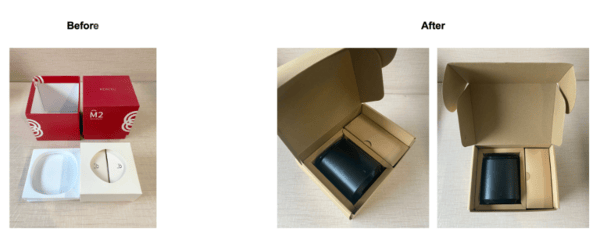
Our designers have reimagined the packaging of the products and reduced the box sizes to reduce material waste without compromising packaging integrity.

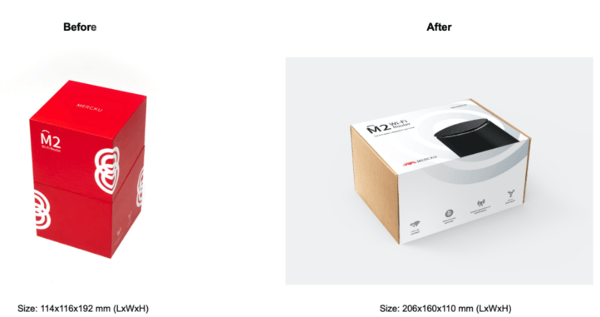
We plan to roll out the new packaging version across our product line in the next few months.
What can you do to give the old packaging a new life?
Give the existing packaging a new life. Please reuse and recycle!
Tag us on Twitter, Instagram, and Facebook and show us how you use your creativity to reuse and recycle your Mercku box to win 10% off* for your next order!
*We will select the top five creative minds to share an 10% off for your next Mercku order.
What to learn more about connectivity? Check out our latest article on Wi-Fi Roaming; the way it works might surprise you! You could also check these sources for more info on sustainability: NatureFresh, SmallBusinessBonfire
For more information about Mercku’s Connectivity Suite, our hardware, and how you can partner with Mercku, please reach out to the team at [email protected].
Thank you for reading our blog! Mercku Blogs covers the latest in wireless technology – subscribe to our newsletter to make sure you don’t miss our newest releases!
Availability: The EAP101 and EAP102 are now available for order.
About Edgecore Networks

LitePoint’s Eve Danel is the author of this blog. In this post, you’ll learn about the latest Bluetooth specifications and new test requirements for Bluetooth 5.1.
In 2010, Bluetooth Low Energy (Bluetooth LE) was introduced with the Bluetooth 4.0 standard. Compared to previous generations of Bluetooth, which were known as classic, Bluetooth LE operates at lower power, increasing the battery life of host devices. In 2016, the Bluetooth 5 standard was introduced, doubling the data rate and increasing the operation range. Bluetooth 5.1 was released in 2019, adding direction-finding enhancements that enable location tracking applications.
With the direction-finding enhancements in Bluetooth 5.1, the technology is able to provide GPS-like positioning capabilities but operating indoors. The use cases for this type of technology range from asset tracking to locating people in buildings, indoor direction finding, object tracking, among others. And this wide range of use cases can be applied in nearly every market vertical including industrial, medical, retail, hospitality, enterprise, home or transportation.
Bluetooth is already a popular technology for proximity sensing using Bluetooth beacons. In this method, the locator estimates distance using the received signal strength indicator (RSSI) value, which represents the strength of the signal that is measured on the locator’s receiver. RSSI is used to estimate the distance between a transmitter and a receiver. Knowing the transmitter’s power, it’s possible to estimate the location of an item by measuring signal attenuation.
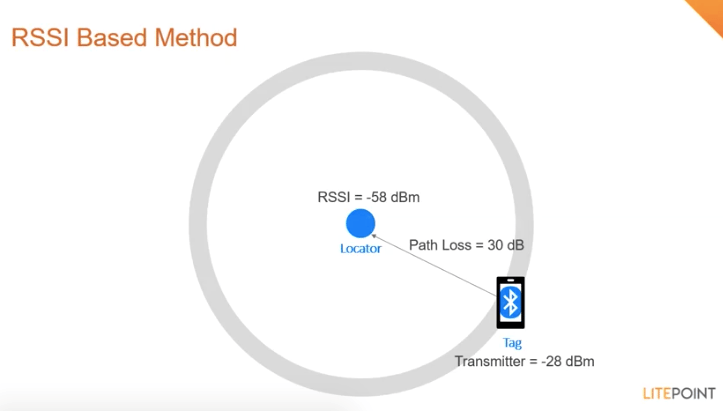
Figure 1: RSSI based method
RSSI only provides a crude estimation of distance because this method is biased by the environment. Obstacles between the transmitter and receiver that provides attenuation – a crowd of people for example can add significant attenuation to the signal and therefore decrease the accuracy of the distance estimate. In addition, the RSSI method can only detect that the device is located somewhere in a circular zone around the receiver as shown in Figure 1 above as it doesn’t provide information about the position. By deploying multiple locators and using signal trilateration, it is possible to locate the device with more accuracy, but it also increases the complexity of the system.
Bluetooth 5.1 increases the accuracy of the RSSI method by providing angle of arrival (AoA) and angle of departure (AoD) information.
AoA is designed for use in applications like asset tracking, where a moving AoA transmitter (a mobile phone for example) is sending Bluetooth LE direction-finding signals using a single antenna, and a fixed AoA receiver (for example installed on the ceiling) is equipped with an antenna array with a minimum of two antennas. The array is used to determine the direction of the transmitter by using the phase differences between the antenna. The angle of arrival determination is based on the signal’s wavelength, the distance between antenna and the phase of the received signal.
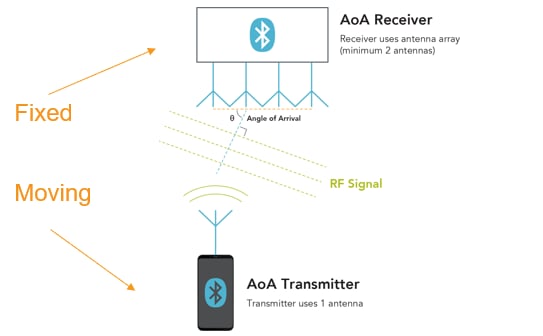
Figure 2: AoA method
AoD is designed for use in applications like wayfinding for indoor navigation. Where the AoD receiver (for example a phone) receives the direction-finding signal transmitted by the fixed AoD transmitter (for example installed on the ceiling) that is equipped with an antenna array with a minimum of two antennas. Just like AOA, the angle is determined by using the signal’s phase information.
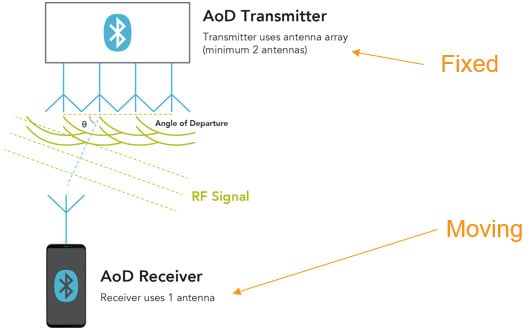
Figure 3: AoD method
To enable AoA and AoD, the signal’s phase must be measured. For direction finding, Bluetooth 5.1 core specification adds a constant tone extension (CTE) field that is a sequence of bits with a variable duration from 16 microseconds to 160 microseconds. CTE is only supported for Bluetooth LE operating at rates of 1 Mbps, which is mandatory, or, optionally, 2 Mbps. The CTE field contains a series of modulated 1 bits which must be transmitted at one frequency with a constant wavelength in order to measure the phase of the receive signal. Thus, the signal is not subject to whitening, a process that scrambles signals to ensure there will be no long strings of 1s or 0s.

Figure 4: CTE
The key to a successful technology introduction for location services is how accurately the location can be measured, BT 5.1 aims to provide a sub one-meter level of accuracy. Validation of the solution plays an important role in ensuring the system’s performance.
The Bluetooth SIG has updated the Bluetooth PHY test specifications to include validation of these new direction-finding capabilities. New test cases were added for transmitter and receiver tests for AoA and AoD methods, and the various combinations of Bluetooth data rates that are supported in 1 Mbps and 2 Mbps, as well as the 1 microsecond and 2 microsecond switching and sampling times that are supported in the standard. Overall, there are 23 new test cases that were added to the PHY tests to cover AoA and AoD.
CTE is a new concept for Bluetooth and the test cases are designed to ensure that it can be properly generated by the transmitter. On the receiver side, it’s important to ensure that the IQ measurements on the receiver CTE can be used to accurately derive the phase of the signal.
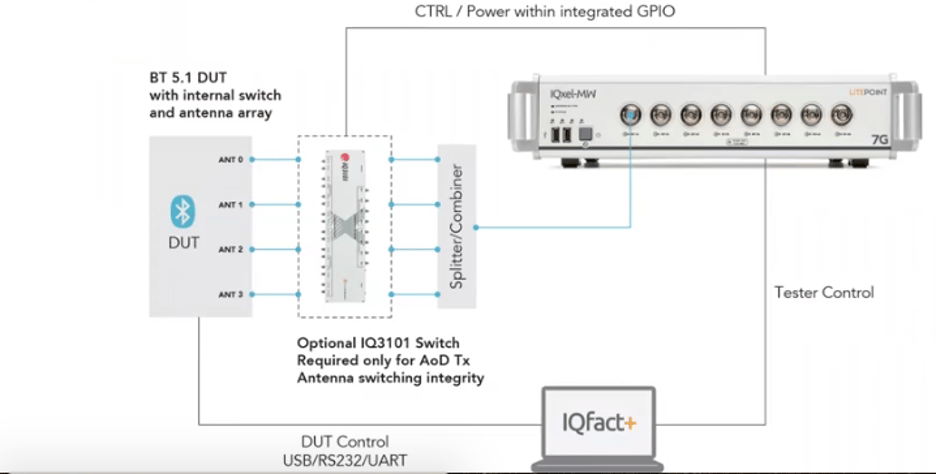
Figure 5: Complete AoA and AoD test setup
Figure 5 above shows a complete test setup for AoA and AoD transmitter and receiver testing. LitePoint’s IQxel-MW 7G supports the new direction-finding test cases. LitePoint also offers IQfact+ software packages that provide completely automated DUT and tester control for leading Bluetooth 5.1 chipsets.
AoA Transmitter and Receiver Testing
In an AoA transmitter (typically a mobile device), the device has only a single antenna and the CTE field is transmitted continuously without switching at the end of the PDUs. On the received signal, the tester verifies the maximum peak and average power of the CTE signal as well as the carrier frequency offset and the carrier drift of these transmitted signals.
The AoA receiver is more complex because it has multiple antennas and a switch, so when receiving the CTE signal transmitted by the tester, the receiver will switch between the multiple antennas in the array according to a predetermined pattern. The time of the switching is either 1 microsecond or 2 microseconds as defined in the standard. The DUT also samples the received CTE during the allocated sampling slot’s timing of 1 microsecond or 2 microseconds as defined in the standard. The IQ samples taken by the DUT are transmitted to the tester for analysis to ensure that the phase measurements are within specs.
AoD Receiver and Transmitter Testing
An AoD receiver (mobile device with single antenna) needs to sample the received CTE signal at the correct sampling slots. To verify this, the IQ samples that are taken by the DUT are transmitted to the tester for processing and analysis. Just like with the AoA receiver test, this test verifies that the phase values derived from the sampling are within specs.
AoD transmitter devices have an antenna array with a minimum of 2 antennas, therefore the transmitter test verifies that the antenna switching occurs during the proper allotted slots of the CTE and the proper switching pattern within antenna array.
Please visit the IQxel-MW 7G and IQfact+ pages for more information on LitePoint’s test solutions for Bluetooth 5.1.
For more information download our application note on Testing BT 5.1 or download the replay of our webinar on this topic.

Privately funded service provider excites subscribers and meets pent-up demand in underserved communities across Western Canada with end-to-end Calix solutions that deliver popular premium managed Wi-Fi services over a lightning-fast network—dramatically growing its value in one yea
SAN JOSE, CA – August 5, 2021 – Calix, Inc (NYSE: CALX) announced today that Northern Lights Fiber, a newly created brand under fiber network builder, owner, operator, and service provider Canadian Fiber Optics (CFOC), is signing up premium managed Wi-Fi subscribers at a record pace with the end-to-end capabilities of the Revenue EDGE and Intelligent Access EDGE solutions. Specifically, excited residents across rural Alberta communities are embracing the extensive set of parental controls available via ExperienceIQ™ and the home network security of ProtectIQ™—two value-added EDGE Suites applications delivered via Northern WiFi, the branded version of the CommandIQ® mobile app. These add-on offerings are boosting average revenue per user (ARPU) projections by 25 percent in the pre-sales stage alone and before most of the fiber broadband networks are even built in these communities—satisfying pent-up demand for these popular services in previously underserved areas. Northern Lights Fiber’s new XGS-PON fiber-to-the-home (FTTH) network builds will leverage the Network Innovation Platform (AXOS®) and the Intelligent Access EDGE to streamline operations—including rapid back-office integration—and deliver an Always On experience. As a result, Northern Lights Fiber will roll out service in the community of Valleyview later this summer with speeds up to 10 Gigabit, making it Canada’s fastest residential internet service.
Northern Lights Fiber was founded in 2020 as a subsidiary of CFOC to specifically serve rural and remote residential as well as small and medium-sized business customers. Following the rapid, five-month buildout of its fiber broadband network in the community of Grande Cache, Northern Lights Fiber began rolling out its three tiers of managed Wi-Fi service offerings to residents. Each tier includes the blazing-fast GigaSpire® BLAST u6 Wi-Fi 6 system, which is powered by the Experience Innovation Platform to enable rapid installation and deployment that reduce both capital and operating expenses.
To further grow its value, Northern Lights Fiber is selling EDGE Suites cloud applications as add-ons for a nominal monthly fee. Alternatively, subscribers can upgrade to its Experience package, which offers both ExperienceIQ, ProtectIQ, and a GigaSpire BLAST u4 system for use as a Wi-Fi mesh extender. To date, the Experience package boasts a 40 percent take rate, and Northern Lights Fiber expects to double the number of customers who sign up for at least one other add-on service by the end of the year. The same pricing structure applies to the Alberta municipalities of Valleyview, Wembley, and several other rural communities—where construction of the Calix-powered fiber broadband networks is either underway or scheduled to begin soon and pre-sales demand for these services is driving up ARPU projections.
“It’s not a typical strategy—but we’re not a typical company,” said Johann Reimer, director of marketing and sales for both Northern Lights Fiber and Canadian Fiber Optics. “We are a privately funded, fiber-first organization that is deeply embedded in and committed to investing in our communities. We are simply dedicated to helping residents and businesses in rural Canada realize the significant economic and social benefits of broadband internet, and Calix has enabled us to get to market quickly with a compelling offering that resonates with subscribers across the province.”
In addition to EDGE Suites, which some Calix customers are using to achieve up to 99 percent uptake of their premium managed Wi-Fi services, Northern Lights Fiber is also in the process of implementing Calix Support Cloud and Calix Marketing Cloud. Support Cloud will give Northern Lights Fiber full visibility of its subscribers’ network experience, simplifying customer support, reducing and quickly resolving trouble tickets, and decreasing unnecessary truck rolls by up to 60 percent. Marketing Cloud provides advanced, data-driven insights that will allow Northern Lights Fiber to segment, target, and offer services that excite subscribers and drive new revenue opportunities.
“Northern Lights Fiber is an innovator that is shaking up the service provider landscape in rural Canada,” said Alan Lieff, vice president of sales for Calix. “By partnering with Calix on everything from cutting-edge fiber infrastructure to advanced subscriber-facing solutions, Northern Lights Fiber is well on its way to achieving its 80 percent take rate goal and delivering Canada’s fastest residential internet service by the end of the year. The combined value of the integrated Intelligent Access EDGE and Revenue EDGE solutions will help Northern Lights Fiber grow its value for years to come, exciting subscribers across rural Alberta with popular services at incredibly high speeds and putting them firmly in control of their connected home experience.”
Learn more about EDGE Suites and view a replay of our recent webinar, “How to Offer the Premium Services That Subscribers Want.”
About Calix
Calix, Inc. (NYSE: CALX) – Calix cloud and software platforms enable service providers of all types and sizes to innovate and transform. Our customers utilize the real-time data and insights from Calix platforms to simplify their businesses and deliver experiences that excite their subscribers. The resulting growth in subscriber acquisition, loyalty, and revenue creates more value for their businesses and communities. This is the Calix mission; to enable broadband service providers of all sizes to simplify, excite, and grow.
This press release may contain forward-looking statements that are based upon management’s current expectations and are inherently uncertain. Forward-looking statements are based upon information available to us as of the date of this release, and we assume no obligation to revise or update any such forward-looking statement to reflect any event or circumstance after the date of this release, except as required by law. Actual results and the timing of events could differ materially from current expectations based on risks and uncertainties affecting Calix’s business. The reader is cautioned not to rely on the forward-looking statements contained in this press release. Additional information on potential factors that could affect Calix’s results and other risks and uncertainties are detailed in its quarterly reports on Form 10-Q and Annual Report on Form 10-K filed with the SEC and available at www.sec.gov.

PHOENIX – Aug. 5, 2021 — ON Semiconductor (Nasdaq: ON) today revealed its new trade name “onsemi” and refreshed brand as a next step in the company’s evolution to establish itself as the leading provider of intelligent power and sensing technologies. With a continued focus on the automotive and industrial end-markets, onsemi has sharpened its strategy to drive disruptive innovation that contributes to a sustainable ecosystem of high-growth megatrends such as vehicle electrification, advanced safety, alternative energy and factory automation.
Today, the industrial and automotive end-markets are responsible for two-thirds of global greenhouse gas emissions, providing an immense opportunity for onsemi to do its part in achieving a net-zero economy with its intelligent power and sensing technologies. Climate change presents not only a risk to the environment, but also opportunities for innovative business solutions, and onsemi is committed to applying its research and design expertise and adapting its own operations to achieve net-zero emissions by 2040.
Under the new tagline, “Intelligent Technology. Better Future.”, onsemi plans to break through traditional thinking and market barriers to create innovative and game-changing solutions that solve customers’ most difficult design challenges, and support their achievement of their own climate initiatives, propelling the sustainable energy revolution. onsemi’s value proposition includes a unique combination of deep systems knowledge, technology leadership, and industry-leading manufacturing and packaging proficiency.
“We have spent the last several months focusing the strategy, and realigning our product portfolio and investments to deliver market-leading and differentiated technologies to our customers,” said Hassane El-Khoury, CEO and president at onsemi. “We are creating intelligent power and sensing technologies to enable our customers’ success, drive a better future for next generations and create value for our shareholders, always with an eye on sustainability to make the world a better place for everyone.”
Certain statements in this press release are forward-looking statements within the meaning of the Private Securities Litigation Reform Act of 1995. Forward-looking statements are often characterized by the use of words such as “believes,” “estimates,” “expects,” “projects,” “may,” “will,” “intends,” “plans,” “should,” or “anticipates,” and similar expressions. All forward-looking statements in this press release are made based on ON Semiconductor’s current expectations, forecasts, estimates and assumptions, and involve risks, uncertainties and other factors that could cause results or events to differ materially from those expressed in the forward-looking statements. Additional factors that could cause results to differ materially from those projected in the forward-looking statements are contained in ON Semiconductor’s 2020 Annual Report on Form 10-K, Quarterly Reports on Form 10-Q, Current Reports on Form 8-K and other of ON Semiconductor’s filings with the SEC. ON Semiconductor assumes no obligation to update such information, except as may be required by law.

X Reality (XR), short for extended reality, is the convergence of physical world and digital world experiences. XR is used to describe immersive applications including augmented reality (AR), mixed reality (MR), and virtual reality (VR) – used to enhance or simulate real-life experiences. XR technologies extend the reality we experience by either merging the virtual and real worlds or by creating fully immersive experiences.
Deployment of XR applications in education, healthcare, and industrial settings are contributing to strong momentum for XR, with the market expected to grow from $33 billion to $125 billion by 20261. Virtual reality alone has seen a 224% growth since October 20192 as more people upgraded their smart entertainment devices to provide more immersive experiences while working, learning, and socializing from home.
Wi-Fi® will have a significant impact on delivering the full potential of the XR market, providing high-performance connectivity for augmented, mixed, and virtual reality. Work is now underway in Wi-Fi Alliance® to promote innovation and further boost Wi-Fi to deliver connectivity that will help build connections between physical and digital worlds. Recently, Wi-Fi Alliance hosted an XR Opportunity for Wi-Fi discussion featuring panelists from Cisco, Facebook Reality Labs, Microsoft, and Qualcomm. Panelists shared insight into the benefits of Wi-Fi for XR devices, while also acknowledging some of the challenges that lie ahead. Key insights from the discussion include:
Extended reality is transforming our daily lives. New XR use cases for education, healthcare, and business will allow students, medical professionals, and employees to have more impactful, personal, and unique experiences.
Panelist Bruno Cendon Martin, Director of Wireless Technologies at Facebook Reality Labs, believes that there are three walls in XR: the physical, the augmented, and the virtual. The physical is what we experience in day-to-day life. The augmented wall is one with layers. A virtual wall is one that “transcends time and space” and allows you to transition back in forth between realities. Development of new technologies, including portal systems and other Wi-Fi devices, will enable users to be transported through technology and gain a physical presence in another location. Wi-Fi visual headsets and other innovations on the horizon will allow users to be fully immersed in an entirely different world without leaving their home.
Wi-Fi will improve the infrastructure of XR. Advancements coming to Wi-Fi will help build connections across the physical and digital worlds. Panelist Dr. Shirin Ebrahimi-Taghizadeh, Principal Software Engineering Lead for Wireless and Embedded Systems at Microsoft shared that enabling services and solutions extremely relies on having a very stable and low latency wireless solution. Wi-Fi technologies, such as Wi-Fi 6 and Wi-Fi 6E will help provide connectivity to satisfy these demands. Microsoft’s Azure Remote Rendering, for example, allows designs to come to life for developers wanting to collaborate and see the richness of details without physically creating a prototype. Wi-Fi will further allow companies to produce products that surpasses the boundaries of physical limitations.
XR will have a strong impact beyond the workspace. Matt MacPherson, CTO of Wireless at Cisco, points to XR’s impact on various types of education systems, including elementary education, higher education, and health education. With XR becoming the forefront for many teaching efforts, testing and other educational practices are being revolutionized. VR-type implementations, for example, allow students to look at the same image and learn in the same way without needing to be in the same physical location. As XR capabilities grow exponentially, advancements will further advance this use case and allow for more education possibilities. Educators expect a bright future for Virtual Environment Technology (VET) because of the increasing need for tools that will help ease the process of learning and bring it closer to the students’ interests.
Wi-Fi can deliver high-quality, wireless XR experiences. Shishir Gupta, Product Director of XR Connectivity, 6G, and Wireless Positioning at Qualcomm believes that premium XR experiences require high-performance Wi-Fi for four main reasons. The first is low-latency for responsive and lag-free experiences. The second is extreme reliability with advanced features and optimization for sustained XR-class performance. The third is power efficiency to assist rapid and efficient data transfers with advanced power save features. Finally, multi-gigabit speeds allow for instantaneous, massive data exchange which is necessary in XR.
There are attractive opportunities for XR driven by consumer, education, healthcare, and industrial applications. Wi-Fi is already a strong technology player in these markets, making it a natural choice for the future of XR. Wi-Fi Alliance members are working to further the role of Wi-Fi in XR and are working closely with the XR ecosystem to deliver key Wi-Fi applications for augmented, mixed, and virtual reality. Companies involved in developing Wi-Fi solutions for the XR space are encouraged to get involved in Wi-Fi Alliance to help propel the industry forward.
To balance the English learning resources between urban and rural area, the Education Bureau of Kaohsiung City Government has invested in the creation of the “Kaohsiung English Van”, which breaks geographical restrictions and provides mobile teaching services to make up for the lack of English education resources in rural areas. The Kaohsiung English Van is equipped with advanced information equipment. Teachers can utilize VR and live broadcast to create a smart and interactive learning environment, a l l owing rural students to practice English dialogue naturally, expanding the effectiveness of educational resources, and promoting bilingual and international education.
THE CHALLENGES
To ensure that all the information equipment on the Kaohsiung English Van can operate smoothly in remote areas, and that students and teachers can have a stable internet connection for smart mobile teaching. After comprehensively evaluating several competing WLAN solutions, the Education Bureau of Kaohsiung City Government found that Edgecore Network’s WLAN solution best fulfilled their needs.
THE SOLUTION
Edgecore’s solution includes two OAP100 to provide 4G Uplink and point-to-point bridging up to 3 km. OAP100 is an 11ac Wave2 outdoor wireless access point specially designed for enterprise and Public Wireless Local Area Network (PWLAN) application. The transmission rate can reach 1.2 Gbps, providing high-speed and stable wireless network access. With the built-in CAT4 LTE module slot, OAP100 provides a smooth and high-performance network connection through the 4G LTE network card. The built-in chip-type high-power wireless amplifier can enhance the signal stability and improve the latency, and significantly enhance throughput performance, making OAP100 the best choice for long-distance bridging required for mobile teaching. In addition, the IP68-rated, rust-resistant plastic housing of OAP100 ensures that it can provide stable network services to support mobile teaching regardless of the weather.
The solution also includes an ECW5410-L as an in-vehicle wireless access point to provide local wireless access. ECW5410-L is a concurrent dual-band 802.11ac Wave 2 high-density access point. Featuring dual 4×4 MU-MIMO radios can support up to 256 concurrent users, and up to 600 Mbps and 1.73 Gbps data rates for both 2.4GHz and 5GHz bands, ensuring that teachers and students can enjoy smooth and reliable connection at the same time .
With ecCLOUD cloud controller, IT managers can centrally monitor the overall network environment, reduce the complexity and difficulty of deployment and management, and reduce labor and cost expenditures, greatly improving the overall effectiveness of the mobile teaching network.
School’s IT infrastructure is extremely important for digital learning and teaching. Through the cooperation, Edgecore has successfully assisted the Education Bureau of Kaohsiung City Government to lay a solid foundation for a smart learning environment with the Kaohsiung English VAN. As to stimulate the learning momentum of the new generation. In addition to Taiwan, Edgecore also has extensive experience in building large-scale campus networks in the United States, India, Turkey and other countries, and continues to assist educational institutions to create the best learning environment through technological innovation.
DEPLOYED PRODUCTS
About Edgecore Networks
Edgecore Networks Corporation is a wholly owned subsidiary of Accton Technology Corporation, the leading networking ODM. Edgecore Networks delivers wired and wireless networking products and solutions through channel partners and system integrators worldwide for data center, service provider, enterprise, and SMB customers. Edgecore Networks is the leader in open networking, providing a full line of open 1G-400G Ethernet OCP Accepted™ switches, core routers, cell site gateways, virtual PON OLTs, optical packet transponders, and Wi-Fi access points that offer choice of commercial and open source NOS and SDN software.
For more information, visit wifi.edge-core.com or contact [email protected].

octoBox software 2.0 brings new dashboard mode, improved graphics and multiPerf® traffic tool
The new software leverages the power of parallel databuses and processing built into all the octoBox testbeds, allowing them to be used for emulation of multipoint-to-multipoint test scenarios involving dozens of real devices, while providing real-time feedback of the test progress and results.
Fanny Mlinarsky, founder of octoScope, and Senior Vice President of Wi-Fi Products at Spirent, said “octoBox software 2.0 greatly improves the productivity of the wireless test engineer and solidifies octoScope’s position as the easiest to use testbed in the Wi-Fi industry.”
octoScope is a Spirent company.