Breaking News

GLOBAL Wi-Fi NEWS bulletin

Proprietary software is dead
Four years ago we launched OpenSync based on the belief that the battleground for the hearts, minds and revenues of the home consumer sits between Service Providers’ connectivity and the smart devices of the internet giants.

What we said then—and still believe—is that the biggest market opportunity is in that space in between. The space in the home that Communications Service Providers (CSPs) need to protect and grow. The space where a truly smart, managed WiFi solution can become the CSPs’ trump card.

A solution like our then-proprietary device middle layer—now OpenSync. It makes the “smart” possible by communicating with all of the devices in the home and with the Plume Cloud where data analytics, insights, and control messages are created to help improve services and drive personalization. Proprietary software, however, was not the answer. Like hardware, it creates vendor lock-in, starves innovation, and kills time-to-market in a world where winners need to curate and deliver new services fast.

So we made OpenSync available as an open-source, silicon-to-service framework, and set out to change the market dynamics, making it easier for developers and operators to work together to grow the overall market. Has it worked?

Since it launched, OpenSync has been adopted by over 22 CPE designers and makers around the world and deployed by over 350 CSPs including some of the largest: Bell Canada, Charter Communications, Comcast, Deutsche Glasfaser, J:COM, and Liberty Global. It is now the cloud-based framework that the industry is rallying behind. And this week we celebrate surpassing an important milestone: more than 2 billion connected devices have been managed on OpenSync-powered networks.

A platform for the future
In a competitive market where subscribers are looking for more value, OpenSync offers CPSs a key to providing an improved quality of experience, data security, and total network control. Furthermore, OpenSync helps Providers reduce their environmental footprint and build more eco-friendly strategies by extending the lifetime of their existing CPE. All OpenSync-powered CPEs—including gateways, extenders, and pods—can coexist on the same network, irrespective of device maker or WiFi generation. CSPs leveraging OpenSync create numerous business advantages, from the ability to push new services to existing hardware, deployment flexibility, and the capacity to respond to subscriber demands with unparalleled network insight.

“We’ve monitored OpenSync’s expansion closely since its inception four years ago,” said Anirudh Bhaskaran, Industry Principal from Frost and Sullivan. “The overwhelming support for the ecosystem—from standards creators such as Telecom Infra Project (TIP) to world-leading service providers including Bell, Charter Communications, and J:COM—has created significant momentum; OpenSync has quickly established itself as the global standard to enable service providers to deliver cloud-driven experiences to their subscribers.”

The promise of the smart home and intelligent small business has long required a brand-agnostic delivery platform on which this new world will be constructed—fulfilling the promise of simplicity, speed, and scale for all. Device makers and operators have been waiting for, in essence, an operating system to enable smart spaces to deliver the hyper-personalized services that consumers are coming to expect. This is exactly what partners have found through the OpenSync platform. And because an open-source network is only as good as its measurable inputs and outputs, we’re taking this milestone anniversary as an opportunity to look back on the last four years of OpenSync.

The data is in
No other industry initiative is as scaled as OpenSync. What we believed could be achieved in 2018 is now a reality: a massively rooted ecosystem which will lead to exponential growth year-over-year as we move into the future.

  • 890 petabytes of data managed every single day
  • 15.4 billion network optimizations performed in the last year
  • 5.7 billion cyber-threats blocked in the last year
  • 75,678 unique device kinds
  • 9,994 connected device brands
  • 85 connected device categories

A thriving ecosystem
As with any open-source initiative, the best way to measure success is through a diversity of players: contributors, creators, and adopters working together to enrich the initiative. A flourishing ecosystem requires participation from all types of partners including app developers, hardware manufacturers, and operators.

OpenSync has developed a fully-functioning and thriving environment in its four years:

  • 2019
    • Launch of OpenSync-enabled gateways into the largest CSPs in North America (Charter Communications, Bell Canada), Japan (J:COM),  UK (Virgin Media), and many other operators in Europe
    • Advanced Device Typing, cyber-security, content filtering, and WiFi motion detection features introduced
    • 10M homes managed
  • 2020
    • Deployment expansion with one of the largest CSPs in the world (Liberty Global) across their European footprint
    • Selected by the Telecom Infra Project as the core WiFi Management Solution for OpenWiFi 1.0
    • WiFi 6 network optimization, dynamic deep-packet inspection, device prioritization, and small business features added
    • Expansion of the OpenSync ecosystem with additional SOC and ODM partners.
      • 7 SOC partners added
      • 10 ODM partners added
    • 20M locations managed
  • 2021
    • Establishment of the OpenSync Integration Center (OIC)
      • Formal OpenSync integration certification available from Plume, accelerating CPE certifications
    • WiFi 6E network optimization, LTE backup, DPP onboarding, configurable firewall, application detection, and Hotspot 2.0 features added
    • Ecosystem growth
      • Expansion to 20 ODM partners
    • 30M locations managed
      • First commercial deployments of generic OpenSync-integrated devices
    • 1B client devices managed
  • 2022
    • Application prioritization, application QoE, IPSec tunneling, and 5G FWA features added
    • Over 35 CPE devices are OpenSync-certified and -deployed
    • 43M+ locations managed
    • 2B+ client devices managed

Operators are adopting and contributing scale and experience.
The critical mass of OpenSync’s expansion comes from CSP operators who have adopted and contributed to the codebase, fueling its enormous scale and development. Over the last four years, OpenSync has not only been adopted by some of the world’s largest carriers; it’s also been adopted by NCTC, a consortium of carriers that are collectively the third largest in the US, and by many independent carriers, including Armstrong, C3, and All West Communications. Some CSPs using OpenSync, such as All West Communications, have seen an average threefold increase in the adoption of managed WiFi services. As more Providers around the world integrate with OpenSync, the more intelligent the platform becomes, resolving customer issues proactively and remotely, reducing latency, and affording subscribers the seamless connectivity they expect.

Making the adoption of OpenSync easier to accelerate innovation
As we move into the next era of OpenSync, we are devoted to making it cost-effective, enabling the creation of new and cutting-edge applications, advancing personalization and efficiency for device makers, and making it faster and easier for CSPs to introduce and support those services and devices in the home or small business. OpenSync remains the only platform of its kind, providing the critical building blocks to enable the ecosystem to deliver data-rich, cloud-controlled services to broadband subscribers at scale, and there’s no sign of slowing.

Robinson brings a track record of success driving the advancement of Wi-Fi®

Austin, Texas – October 18, 2022 – Wi-Fi Alliance® announced the appointment of Kevin Robinson as President and Chief Executive Officer. Robinson will assume the role on October 20, 2022, upon the retirement of Edgar Figueroa. Figueroa served as President and Chief Executive Officer since 2007 and announced his plans to retire earlier this year.

“It is a privilege to lead this team into its next era of market impact and advocacy,” said Robinson, incoming President and Chief Executive Officer of Wi-Fi Alliance. “My top priority is to ensure Wi-Fi remains the premier connectivity technology and greatest digital equalizer for people around the globe by harnessing and amplifying the unmatched innovation engine that is the Wi‑Fi industry. In the coming years, Wi-Fi Alliance will continue to push the boundaries of what’s possible through connectivity, and we look forward to nurturing a growing community of product and service innovators looking to address the most pressing opportunities together.”

Robinson is a 15-year veteran of Wi-Fi Alliance and stands uniquely poised to lead the organization’s 900+ member companies in its next chapter of global impact. Serving as Wi-Fi Alliance’s VP of Marketing for the last 7 years, Robinson has led many of the organization’s most transformative initiatives and has been a leading ambassador for promoting Wi‑Fi and Wi‑Fi Alliance as a collaboration forum worldwide. Prior to joining Wi-Fi Alliance, Robinson served as a Captain in the Infantry of the United States Army. Robinson steps into the CEO role with a passion for leading the next Wi-Fi renaissance — relentlessly making the case for essential spectrum for Wi-Fi, listening to the needs of a vibrant and diverse Wi-Fi industry, and ushering in the next wave of market innovation that only Wi-Fi can deliver.

“On behalf of the Board, I want to thank Edgar for his 15 years of leadership and tireless commitment to the organization that has established Wi-Fi as a ubiquitous and fundamental driver of the global economy,” said Carlos Cordeiro, Chairman of the Wi-Fi Alliance Board of Directors. “As we move into this next generation of growth and collaboration with member companies, Kevin understands the legacy he inherits and the importance of a dynamic Wi-Fi Alliance to the continuing success of our industry. Kevin stands as a visionary leader who will invigorate this preeminent industry body as it takes on new global challenges and seizes opportunities that lay ahead.”

As Wi-Fi Alliance drives adoption and evolution of Wi-Fi, Robinson plans to lead from a place of industry outreach and unification. He plans to focus on three particular areas: securing sufficient, harmonized global Wi‑Fi spectrum, deepening engagement and cohesion across the broader Wi-Fi ecosystem, and evolving the Wi-Fi Alliance organization to ensure it is as nimble as the industry it serves.

With 900+ member companies, Wi-Fi Alliance is on the forefront of driving Wi-Fi technology adoption. Robinson is committed to maintaining the vibrancy of the organization, and to actively recruiting the next generation of leaders, entrepreneurs, and innovators to participate in Wi-Fi Alliance. Robinson will help Wi-Fi Alliance expand global awareness of Wi-Fi CERTIFIED™ and evolve as a premier collaboration forum, leading a new era of spectrum policy and amplifying the economics made possible by wireless connectivity.

About Wi-Fi Alliance® |  www.wi-fi.org

Wi-Fi Alliance® is the worldwide network of companies that brings you Wi-Fi®. Members of our collaboration forum come together from across the Wi-Fi ecosystem with the shared vision to connect everyone and everything, everywhere, while providing the best possible user experience. Since 2000, Wi-Fi Alliance has completed more than 75,000 Wi-Fi certifications. The Wi-Fi CERTIFIED™ seal of approval designates products with proven interoperability, backward compatibility, and the highest industry-standard security protections in place. Today, Wi-Fi carries more than half of the internet’s traffic in an ever-expanding variety of applications. Wi-Fi Alliance continues to drive the adoption and evolution of Wi-Fi, which billions of people rely on every day.

Crosslink Capital led the round with participation of existing investors

SANTA CLARA, Calif., Oct.12, 2022 /PRNewswire/ — Airvine’s mission is to develop an entirely new in-building network architecture that addresses the dynamic nature of today’s enterprise. To that end, we have developed the most innovative piece of technology to come along in decades. It enables the network to be as agile, flexible, and adaptable as the business it supports. WaveTunnel™ technology will become Generally Available in Q4 of this year, and the proceeds from this round will be used to ramp up sales, marketing, engineering, and manufacturing. More on the WaveTunnel solution can be found at: https://airvine.com/product/

“We are always on the lookout for early-stage technology companies that are creating category defining products”

The Series A round raised a total of $10 million and was led by Crosslink Capital with all existing investors participating. Michael Stark, the Founding Partner at Crosslink Capital, will be joining the Airvine Board of Directors.

“We are always on the lookout for early-stage technology companies that are creating category defining products that will transform the IT world. The Airvine vision is especially compelling in this regard, as In-building enterprise networks have seen very little innovation over the last several decades. The situation was ripe for an aggressive new entrant that would tap into the enterprise need for networks that are far more dynamic than what legacy solutions can provide,” stated Mr. Stark

During the pilot testing phase, Airvine saw interest from a wide variety of enterprise market verticals including hospitality, MDUs, warehousing, manufacturing, office buildings, and heritage buildings with speed and ease of deployment identified as key advantages. Broadband access was enabled successfully across a wide range of configurations, and in a matter of minutes or hours rather than weeks or months. The system has the bandwidth to easily handle broadband access technologies like Wi-Fi 6E and 7.

“Airvine’s timing couldn’t be better, we are seeing a major industry transition toward Wi-Fi 6E, and WaveTunnel technology is tailor-made to accelerate that move. It delivers broadband speeds, it’s quick and easy to deploy, and very robust. The other major industry trend we are tracking is the Internet-of-things. IOT networks are beginning to dominate in factories and warehouses, and that involves having to add yet another access network for security reasons. We love how easy it is to do this with Airvine technology,” said Claus Hetting, CEO of Wi-Fi NOW “Airvine technology is truly a game changer and will completely revolutionize the way indoor networks are deployed”

The Airvine value proposition centers around quick installs in any kind of building, effortless moves, adds, and changes, gigabit/sec data rates, no business disruptions during installs, excels in difficult situations, ideal when you have multiple access networks, and it avoids the large sunk cost of legacy solutions. For more on what others are saying: https://airvine.com/testimonials/

Vivek Ragavan, CEO of Airvine, said “We now have the funding in-place to accelerate our push into enterprise accounts worldwide. This will require that we continue to scale up the entire organization. We are also thrilled with the pace at which channel partners have been flocking to our banner. The future is looking very bright, and we are delighted to have Crosslink Capital as part of the team.”

About Airvine

Airvine’s mission is to develop an entirely new in-building network architecture that addresses the dynamic nature of the modern enterprise. Our technology leverages the convergence of 60 GHz beamforming technology, with layer 2 switching, and sophisticated software to create a solution that is far more agile, flexible, and adaptable than the legacy solutions of the past.

About Crosslink Capital

Crosslink, founded in 1989, is a Bay Area-based early-stage venture capital firm with over $5B in assets under management. Crosslink partners with founders that are market disruptors and category creators, typically at the Seed through Series A stage, across highly dynamic enterprise and consumer technology sectors. Our investments include Equinix, Pandora, Blue Arc, Coupa, Virage Logic, BetterUp and Chime along with over 300 other companies. For more information visit www.crosslinkcapital.com

Cision
Cision

View original content to download multimedia:https://www.prnewswire.com/news-releases/airvine-has-completed-a-10-million-series-a-round-to-accelerate-the-rollout-of-its-wireless-freeway-301646668.html

SOURCE Airvine

In our previous post about Secure and Seamless Carrier Wi-Fi Services with Passpoint, we explained the differences between the Wi-Fi Alliance Passpoint® versions (R1-R3) and the challenge at this point in time with sufficient device support for the latest releases, Passpoint R2 and R3. In this post, we will discuss how it is possible to overcome these challenges by taking a pragmatic approach to Passpoint, using the least common denominator Passpoint R1 and the Captive Portal API.

At Enea, we strongly believe that standards drive down costs and improve the user experience. But, it is not enough if we in the telecom industry are ready for Passpoint R2 and R3, if the devices aren’t. It takes two to tango.

The Captive Portal API

IETF Captive Portal APIThe Internet Engineering Task Force (IETF) Captive Portal API (RFC8908 and RFC8910), introduced in September 2020, is a game-changer.

The Captive Portal API does not only improve the user experience in connection with traditional Captive Portal implementations. We believe that the Captive Portal API – in combination with Passpoint R1 – has the potential to deliver much of the user experience that Passpoint R2 and R3 were designed to accomplish.

The adoption of Captive Portal API among handset manufacturers has also been fast. Google was first to support the Captive Portal API for Android 11, and Apple soon followed with support in iOS14 and macOS Big Sur. With a critical mass of supporting devices, adoption across all the major operating systems appears imminent.

The Captive Portal API gives service management platforms, such as the Aptilo Service Management Platform™ (SMP), greater control of the Captive Portal flows for traditional hotspots. As a result, users will experience a more reliable service than ever before.

The overall user experience will also benefit hugely from the Captive Portal API. We have traditionally designed Access Gateways to intercept the user web request and redirect it to a Captive Portal. With the Captive Portal API, the gateway does not need to intercept such requests. Instead, when users join the Wi-Fi network and receive an IP address via DHCP (or Router Advertisement in IPv6), the DHCP server also provides the URL to the Captive Portal API. This will trigger the device to query the API to determine whether it is in captive mode, which is the state of captivity when device does not have access to internet. If the device is in the captive mode, it will open the captive portal for the user to perform login or sign-up. Devices that support the Captive Network Assistant (CNA) browser will open the captive portal on the CNA browser. If the API says the device is not in captive mode, the device will proceed directly to the Internet.

It takes time for new standards to be natively implemented in every device, so there might be some details in the Captive Portal API that still needs to be implemented for some devices. However, the standardized interaction between the device and the captive portal, as defined in the Captive Portal API, is always there to help devices determine their state and auxiliary information, such as the remaining session time or data. This allows the device to take action before it reaches the time or data limits, allowing the user to extend the session in a controlled way. This provides a smoother interaction between the device and the Wi-Fi service management system. Previously, with the guesswork of device-only captive portal detection and system-only control, the device was unaware of what was happening after authentication. This could cause sessions that appear to freeze after the session time or data has run out.

Venue Info URL

IETF Captive Portal API Venue URLAnother benefit of the Captive Portal API is that it can also provide a Venue Info URL. This excellent feature allows service providers to empower their B2B customers to engage with users locally with information and offers. In current implementations, the user receives the link to the Venue Info URL via an on-screen system message appearing as a text alert available during the session. The message remains on their lock screen and in their message history. This makes it easy to go back to the Venue Info URL, as the message history is typically just a swipe away.

The Venue Info URL will appear when the user connects manually by selecting an open SSID or automatically through a secure Passpoint-enabled network. It will also offer otherwise anonymous Network Providers a way to show local information and customized advertising to users that connect through, for instance, OpenRoaming or Orion WiFi, described later in this paper.

To offer the user a portal experience like this on a secure SSID is something new to ensure venue owners can engage with users. This is crucial for making secure Wi-Fi the norm rather than the prevalent open SSID.


A Pragmatic Approach Building from Passpoint R1

A pragmatic approach to Passpoint certified Hotspot 2.0 before a critical mass of R2 and R3 devicesWe believe that the Captive Portal API, in combination with Passpoint R1, can deliver much of the user experience that Passpoint R2 and R3 were designed to accomplish.

It would make no sense to build special signup flows for the few devices that support an end-to-end Wi-Fi service based on Passpoint R2/R3. Why not use the R1 support as the least common denominator?

Devices that have not yet been provisioned for Passpoint R1 by other means, such as through a SIM profile (EAP-SIM/AKA) or App (EAP-TLS/TTLS), have to be provisioned ad-hoc through a sign-up portal over an open SSID or in advance via another connection.

The user will then download and install the Passpoint profile on their device. For Android phones, it is as easy as a click on a link and confirm installation, whereas users of other devices, such as iPhones, may need support from device-specific instructions at the portal before download. Once the Passpoint profile is installed, we will restart the Wi-Fi connection. When the device re-connects, it will be logged in to the secure SSID (802.1x) stated in the Passpoint profile. The Captive Portal API can then be used for approval of terms and conditions for new users or existing users if there is a need for an update. The Venue Info URL can also optionally be used to display venue-specific information and promotions.

Add Passpoint R2-R3 Later

Later when there is a critical mass of passpoint R2 and R3 devices

Support for Passpoint R2/R3 can be added later when a critical mass of device support has been achieved.

Note that we have moved the approval of terms and conditions from the sign-up page to the first connection on the Passpoint-enabled network. This means that the process can also be used for already provisioned devices and devices with Passpoint R2 support, as well as the large volume of devices that only support R1. Users of Passpoint R1 who sign-up at the site will see this as almost one flow since the connection can be terminated right after a user has installed the profile. A user will then immediately return as pre-provisioned.

Online signup through the R2 online signup server (OSU) has many benefits to users once there is sufficient device support.

It remains to be seen if the benefits of Passpoint R3 terms and conditions and user engagement features will be significant or if it would be more beneficial to use the same processes as with Passpoint R1/R2 capable devices (dotted line in the figure).

HFCL partners with Qualcomm to launch world’s first Open source Wi-Fi 7 products under its IO product line

HFCL Limited, the leading high-tech enterprise and integrated next-gen communication product and solution provider in collaboration with Qualcomm Technologies, Inc. launches world’s first Open source Wi-Fi 7 Access Points under its IO product line at India Mobile Congress, Pragati Maidan, New Delhi on 01 October 2022.

HFCL becomes the first OEM to launch Open source Wi-Fi 7 Access Points, based on the IEEE 802.11be – a revolutionary Wi-Fi technology that is designed to deliver Extremely High Throughput (EHT), higher spectral efficiency, better interference mitigation, and Real Time Applications (RTA) support. Wi-Fi 7 uses faster connections with 320MHz and 4kQAM, multiple connections with Multi Link operation and Adaptive Connections for adaptive interference puncturing to deliver all enhanced user’s experience while offering better power efficiency. Compared to all improvements in previous Wi-Fi standards, Wi-Fi 7 promises a huge technological leap, offering an immersive experience to its users, ushering the world towards a digitally stronger path. HFCL’s Wi-Fi 7 APs will support peak data rates of over 10 Gbps and will offer latency under 2 ms compared to 5 Gbps and 10 ms of current Wi-fi 6 products.

Backed by strong R&D focus, HFCL’s Wi-Fi 7 product line will enable tech providers such as telecom operators, Internet service providers, system integrators, and network administrators to offer mission critical and real time application services and deliver better user experience than ever before. The new Wi-Fi 7 product portfolio has a wide range of dual band and tri-band indoor and outdoor variants.

All the Wi-Fi 7 variants will be shipped with open source software making these the first Wi-Fi 7 Access points in the industry to support Open standards. Open standards promote disaggregated Wi-Fi system offered as free open-source software with an aim to offer advanced global connectivity ensuring interoperability in multi-vendor scenario.

Speaking about the launch of this revolutionary product line, Mr. Mahendra Nahata, MD, HFCL said, “We are immensely proud to be the first Indian company to launch Wi-Fi 7 product line in market and the first in the world to offer an Open source Wi-Fi 7 portfolio. Our Wi-Fi 7 portfolio is based on the latest Wi-Fi 7 Qualcomm® Networking Pro Series Platforms and offers better features than any commercial products available in market today. We are really thankful to the Qualcomm Technologies teams for working closely with us and supporting us to make this possible. Ahead of the 5G revolution in India and globally, our Wi-Fi 7 launch is a revolutionary move helping us deliver an immersive experience to our customers globally and putting India in the forefront of global technology leadership.”

Mr. Nahata further added, “Launch of this product line will have several industrial applications especially like the Internet of Things (IoT) and IIoT applications, supporting advancements in Cloud/Edge Computing, Cloud gaming, and other xR-based applications. The very low latency and extremely high bandwidth have many use cases in the medical field as well, especially bringing healthcare facilities to remote locations. It is set to bring us a step closer to the Metaverse and will mitigate network congestion by delivering better connectivity experiences in high density areas and areas with numerous overlapping networks. Our investment in R&D and focus on continuous innovation has enabled us to roll out this futuristic product for users, across the globe. This also aligns with our strategy to roll out new products, reach new customers, and tap new geographies in the coming years.”

The launch of Wi-Fi 7 will primarily complement the new 5G rollout in the country especially for complementing indoor coverage. Further, the technology with its higher throughput, reliable network performance, and lower latency will facilitate the development of various applications. For enterprises, Wi-Fi 7 technology will benefit the Internet of Things (IoT) and IIoT applications such as surveillance, remote control industrial automation, AV/VR/XR, and other video-based applications. It will also increase the number of remote offices, real-time collaborations, and online video conferencing, with many advancements in Cloud/Edge Computing, and Cloud gaming.

Commenting on this, Mr. Rajen Vagadia, Vice President, Qualcomm India Private Limited and President of Qualcomm India & SAARC said “Wi-Fi 7 brings a multitude of features that can be used to offer extreme speeds, high capacity, and low latency in support of next-generation applications and services. Managing and optimizing the various available spectrum bands is perhaps the signature differentiator for Wi-Fi 7. Together, with 5G, it will help us build a truly digital India, with inclusive and equitable socioeconomic development of both the urban and the rural parts of the country. In the years ahead, both these technologies will be at the heart of a very wide range of use cases, driving innovation and growth across all industries, sectors, and spheres of human activity. We are proud and privileged to work with HFCL on yet another Made-in-India range of products.”

About HFCL
HFCL is a leading technology company specialising in creating digital networks for telcos, enterprises and governments. Over the years, HFCL has emerged as a trusted partner offering sustainable high tech solutions with a commitment to provide the latest technology products to its customers. Our strong R&D expertise coupled with our global system integration services and decades of experience in fibre optics enable us to deliver innovative digital network solutions required for the most advanced networks.

The Company’s in-house R&D Centres located at Gurgaon & Bengaluru along with invested R&D Houses and other R&D collaborators at different locations in India and abroad, innovate futuristic range of technology products and solutions. HFCL has developed capabilities to provide premium quality Optical Fiber and Optical Fiber Cables , state-of-the-art telecom products including 5G Radio Access Network (RAN) products, 5G Transport Products, WiFi Systems (WiFi 6, WiFi 7), Unlicensed Band Radios, Switches, Routers and Software Defined Radios.

The Company has state-of-the-art Optical Fiber and Optical Fiber Cable manufacturing plants at Hyderabad, Optical Fiber Cable manufacturing plant in Goa and in its subsidiary HTL Limited at Chennai.

We are a partner of choice for our customers across India, Europe, Asia Pacific, Middle East, Africa and USA. Our commitment to quality and environmental sustainability inspires us to innovate solutions for the ever-evolving customer needs.

The Swiss operator’s WLAN-Box 3 offers best-in-class tri-band Wi-Fi, delivering ambient connectivity in the home and hugely improving customer experience

PARIS, France – 26 September 2022 – SoftAtHome, an independent software company for broadband, video, and analytics, is proud to have played an active part in Swisscom’s new WLAN-Box 3, based on Wi-Fi 6E. With this new tri-band Mesh repeater and WLAN access point, Swisscom provides the best Wi-Fi experience of the moment.
SoftAtHome’s Wifi’ON enables the WLAN-Box 3 to provide end-users with improved in-home connectivity and a great Internet experience thanks to the new capabilities offered by the Wi-Fi 6E standard.
A best-in-class Tri-band Wi-Fi
Wi-Fi 6E is taking advantage of the new 6 GHz frequency.

The added radio spectrum and automatic tri-band steering between 2.4 GHz, 5 GHz, and 6 GHz bands drastically reduce network saturation to improve network experience while working from home or enjoying entertainment.

With Wi-Fi 6E-equipped devices, Wi-Fi can be as fast as 4800 Mbps.

This new box can connect all types of devices: new Wi-Fi 6E compatible devices and the current and oldest generation supporting Wi-Fi 4, 5, or 6.
A global Smart Wi-Fi network
Wifi’ON already powers other devices of the Swisscom operator: previous generations of Internet-Box and WLAN-Box.

With the latest launch, Wifi’ON provides a global Smart Wi-Fi solution to Swisscom customers. New WLAN-Box 3 users will benefit from all Smart Wi-Fi services: Wifi’ON delivers ambient connectivity in the home and provides a vastly improved customer experience. It simplifies the onboarding of repeaters in the home, automatically selecting the best Wi-Fi channel for each home access point. Depending on usage, it manages device roaming to the best Access Point and most appropriate Wi-Fi band.

The first WLAN-Box with a 2.5 Gbps Ethernet
The WLAN-Box 3 is the first WLAN-Box equipped with two 1 Gbps and one 2.5 Gbps Ethernet ports for a faster LAN, providing the end-users with all the LAN services they can expect from a premium device.

An eco-friendly device
This device has been designed to be eco-friendly as it is made of PCR recycled material for the housing and power supply. Short-term software evolutions will make it possible to use 6 GHz frequency only if Wi-Fi 6E devices have been detected in the home network, contributing to significant power savings.

“With the new WLAN-Box 3, Swisscom proves its commitment to bringing the best Wi-Fi products to our end customers,” said Marcel Burgherr, Head of Home Devices at Swisscom. “Thanks to SoftAtHome’s software, this triband premium product delivers a superfast and reliable Internet connection for the increasing number of Wi-Fi devices at home.”

“We have worked closely with Swisscom for several years, and we are proud to bring them our Wi-Fi expertise, especially our know-how on the Wi-Fi 6E standard “, added David Viret-Lange, CEO of SoftAtHome. “We also share Swisscom’s philosophy for developing eco-responsible devices, and we are happy to have contributed to making this Wi-Fi device greener.”

About SoftAtHome

SoftAtHome is an independent software provider with six different solutions for broadband (Connect’ON), Wi-Fi (Wifi’ON), Security (Secure’ON), Smart Home (Things’ON), video (Watch’ON), analytics, and QoE monitoring (Eyes’ON). The company’s products are deployed by Telecom and Broadcast operators in over 25 million home networks and millions of mobile devices. The company, owned by operators, has over 300 employees, mainly software engineers committed to open-source communities such as prpl or RDK. SoftAtHome’s hybrid products uniquely leverage the best from Cloud-based software components and software embedded in multiple mobiles and fixed devices.

For more information visit www.softathome.com or [email protected]

This is an excerpt from ENEA’s white paper Wi-Fi in the 5G Era – Strategy Guide for Operators. The full white paper is available here if you like what you read. Don’t hesitate to contact ENEA if you have any questions.

In this post, we will talk about the different Passpoint releases (R1-R3) and the status of device support. Don’t miss our upcoming blog post, A Pragmatic Approach to Passpoint on how to overcome challenges with the lack of widespread device support for R2 and R3.

One of the essential tools in the Wi-Fi toolbox is Passpoint® with SIM authentication. It enables seamless and secure carrier-grade quality and highly monetizable Wi-Fi services. The Wi-Fi 6 and Wi-Fi 6E radio technology, capable of delivering high-quality wireless connectivity, is an excellent starting point. But for service providers, such capabilities must be transformed into user-friendly, secure, well-defined, and preferably carrier-class high-speed wireless data services.

To that end, the Wi-Fi industry has developed the Hotspot 2.0 standard, nowadays more commonly referred to by its equipment certification name of Passpoint. Once provisioned on the phone or other Wi-Fi device, Passpoint technology allows users to connect securely, instantly, and automatically to the public (or enterprise) Passpoint-capable Wi-Fi networks, for example, at public venues such as airports, stadiums, transport hubs, on aircraft, and so on.

The Passpoint technology also facilitates roaming onto Wi-Fi networks belonging to other service providers or third parties, given that a roaming agreement with the subscriber’s home service provider exists. The WBA OpenRoaming initiative has the potential to make Wi-Fi roaming just as seamless for the user as roaming with cellular phones.

THE COMPONENTS OF PASSPOINT
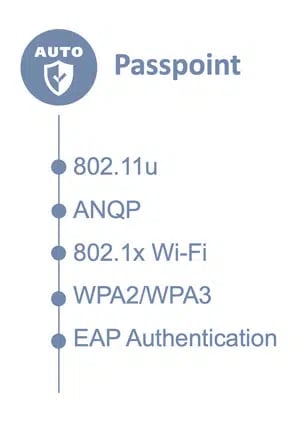
A Passpoint-capable network is defined by supporting the following functions:

  • The network (Wi-Fi access point) should broadcast its capabilities and available services using 802.11u and a protocol called ANQP.
  • The network must use 802.1x-based authentication and WPA2 or WPA3 for over-the-air encryption.
  • Support for EAP-SIM/AKA (SIM identity-based) or EAP-TLS/TTLS (certificate-based methods usually for non-SIM devices) authentication.
  • Optional Wi-Fi roaming with home operator billing.

A critical component is the capability of Passpoint services to deliver ‘Wi-Fi offload’-type services based on credentials stored in the subscriber’s SIM. This means mobile operators can integrate carrier Wi-Fi services into their total service offering. Read more about this in our Wi-Fi and Cellular Convergence – Opportunities Today post.

Passpoint is designed to create a carrier-grade Wi-Fi service with a familiar and seamless user experience like that of cellular networks. However, mobile operators can comfortably apply EAP-SIM/AKA authentication and mobile core integration outside the complete Hotspot 2.0/Passpoint specification. Aptilo Networks was already providing such solutions long before the release of the first Passpoint-capable devices. This also means that EAP-based authentication (SIM/AKA and TLS/TTLS) is not equivalent to Passpoint as such, which is a common misunderstanding.

In the USA, Passpoint-capable Wi-Fi services and roaming are fairly readily available, for example, on the Boingo Wi-Fi network deployed at many airport locations and on some public Wi-Fi networks provided by US cablecos, for instance, on the former Time Warner Cable public Wi-Fi network today owned and operated by Charter Communications. Today, both Android and iOS operating systems natively support Passpoint, and many phones provided by US carriers are pre-provisioned to support Passpoint services.

In Europe and elsewhere, Passpoint-capable Wi-Fi services are less common but available from some major carriers in the form of EAP-SIM/AKA enabled ‘Wi-Fi offload’ convergent mobile services. Most enterprise-grade Wi-Fi access points are certified according to the Passpoint specifications.
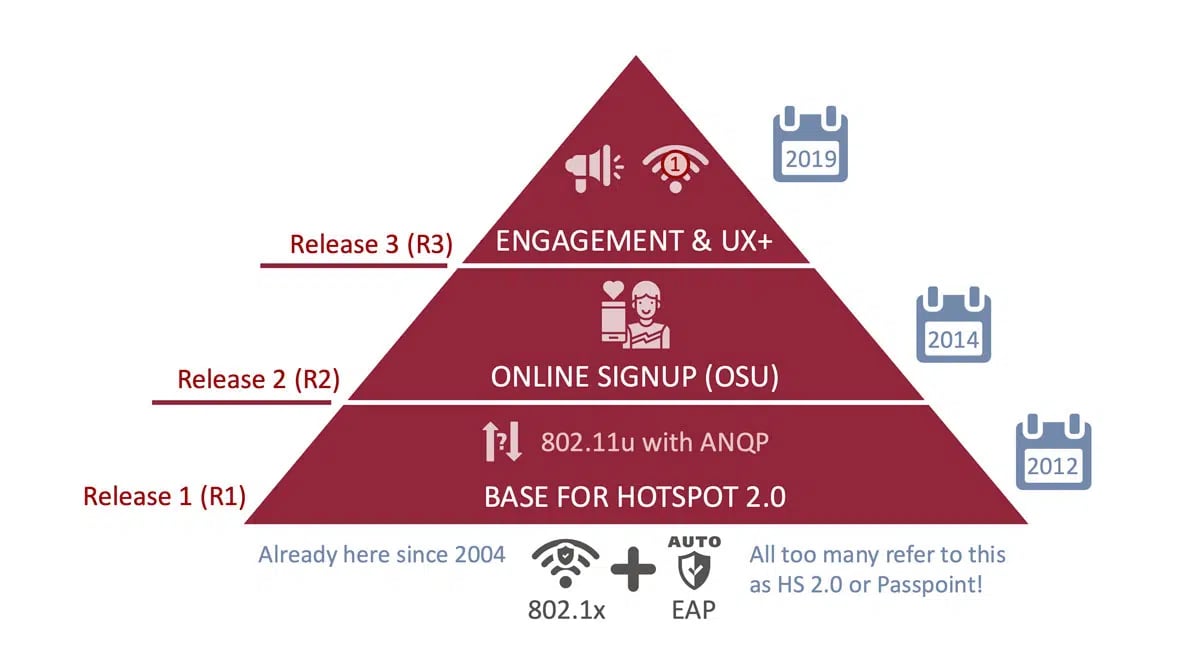
Release 1 (R1)
The first release was introduced in 2012, and all the protocols and standards mentioned above, including 802.11u and ANQP, were included with the ability for the device to discover Passpoint-enabled networks and automatically connect to the optimal one.

Challenges still remain in the onboarding of new devices. Users need to provision Pass-point R1 credentials manually by downloading a particular file that contains profile and credential information. Many service providers use an app to make this process seamless for the user. More or less, all mobile phones and laptops support Passpoint RI. This includes Apple iPhones, although Apple has never formally certified them.

Release 2 (R2)
This version, released in 2014, included the important Online Sign-Up (OSU) server allowing new users to create an account and, in a user-friendly way, provision Passpoint credentials at the point of access. This enables easy ad-hoc sign-up of new users, where they can select the service provider of choice if several options exist. The client validates the OSU server certificate to ensure that the server is trusted. SOAP-XML or OMA-DM messages over HTTPS are then used for secure communications between the client and the provisioning servers.

Passpoint R2 requires a separate SSID for Online Sign-Up, either an open SSID or a so-called OSEN (OSU Server-only Authenticated L2 Encryption Network). This version also includes enhanced policy control for service providers. Device support is still limited.

Release 3 (R3)
R3 was released in 2019, but has not yet been certified by any major handset manufacturers (as of September  2022). This version includes several new ANQP protocol elements and improvements in the interaction between operators and end-users. While previous versions have focused entirely on automatic connection and onboarding of the users, Passpoint R3 aims to enhance captive portal functions by leveraging ANQP messaging.

For the first time, Passpoint allows operators to offer B2B customers a tool to engage with visitors. They can do this through a Venue URL, which displays information about the Wi-Fi service and, at the same time, provides offers and local promotions. The R3 version also includes features for end-users to approve terms and conditions and charges for the Wi-Fi service.

We think Passpoint R3 may have attempted to push the user engagement features too far. Deploying these features through ANQP locally in the access points will make it harder to maintain central control, especially in a multi-vendor deployment scenario. Because of the challenges in management and lack of device support, there is a risk that R3 will never be implemented in carrier Wi-Fi networks.

Passpoint R3 also makes roaming much quicker and easier as the client can indicate its membership of a roaming consortium to a Wi-Fi access point.

Security is further improved in R3 with support up WPA3-Enterprise, whereas R2 and R1 only support up to WPA2-Enterprise. It is also possible to use the same SSID for both the actual Wi-Fi service (WPA2/WPA3) and the online sign-up (OSEN) functionality.

STRATEGIES FOR DEPLOYING PASSPOINT IN THE REAL WORLD
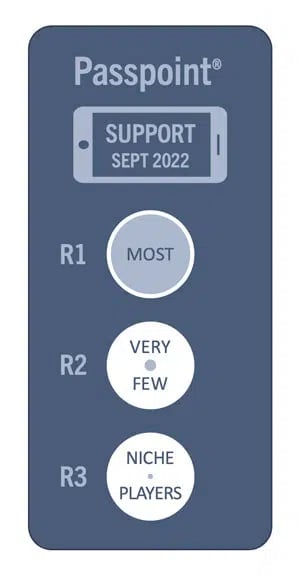
The Passpoint certification is a moving target, and things may have changed by the time you read this. But, as of September 2022, only niche handset brands has been certified for the latest Passpoint release (R3). Some Android-based phones are R2 certified, but many are old and not in the market anymore. In addition, smartphone vendors usually customize the Android platform to match their product requirements. So, just because it works with one vendor doesn’t mean it works with another.

The Passpoint certification from Wi-Fi Alliance only certifies the radio protocols. In practice, new releases from R2 and above, which include more complex service-related features, cannot be guaranteed to work end-to-end in a Wi-Fi service. We have experienced this through the testing conducted by the Wireless Broadband Alliance (WBA).

Conversely, it is probably true that devices with R2 support that has not been Passpoint certified also exist, just as R1 is supported in iPhones without official certification.

But as a service provider, you cannot rely on so many unknown parameters.

On a more positive note, it is generally true that most smartphones, tablets, and laptops now support at least Passpoint R1. Therefore, operators should create and deploy Wi-Fi services based on R1, possibly with an extension for selective use of R2.

One thing is certain: Operators who wait for new standards to be fully deployed and for mobile device manufacturers to adopt them risk waiting for a very long time. It is not only the complexity of the technology that decides whether a handset manufacturer develops support for standards like Passpoint R2/R3 or not. Thus, the wait could go on forever. Fortunately, there is no reason to delay the introduction of carrier-grade Wi-Fi services.

In our upcoming blog post, A Pragmatic Approach to Passpoint, we will discuss how Passpoint R1, together with the new Captive Portal API, may well be the interim solution that, in the end, becomes the permanent pragmatic solution for Passpoint-enabled networks.


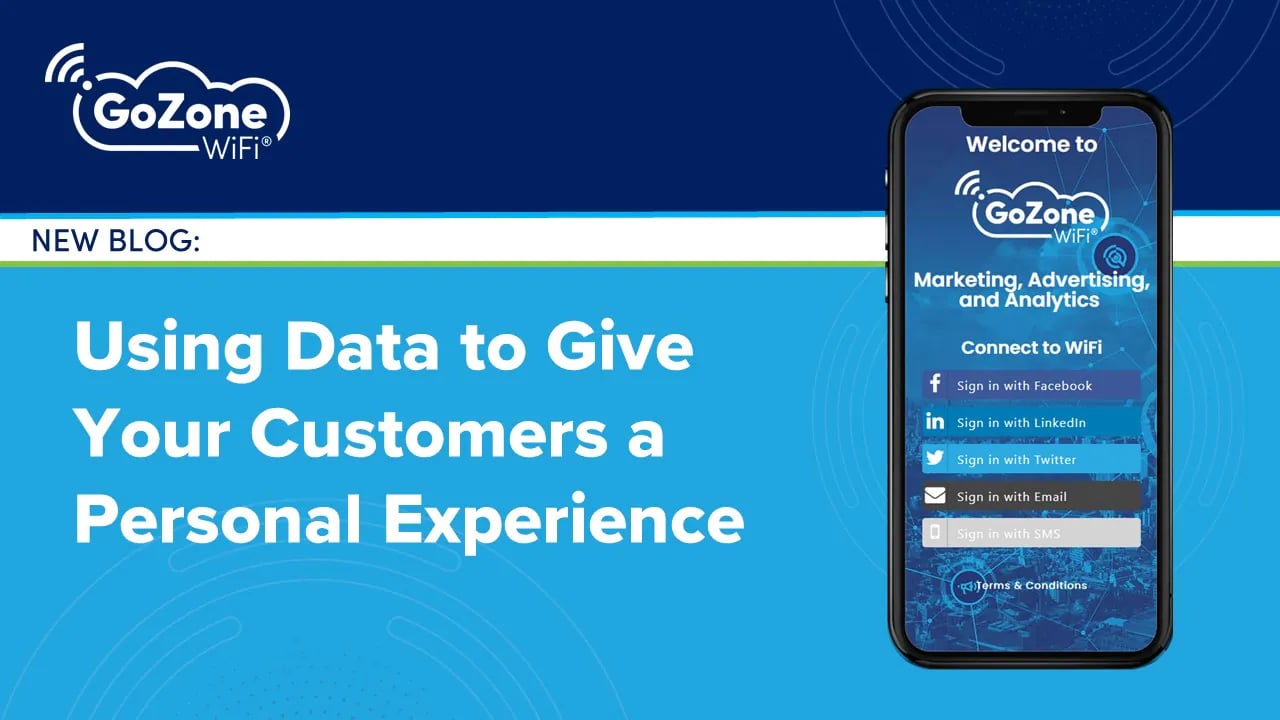
Using Data to Give Your Customers a Personal Experience

Collecting data is essential in any business’s marketing strategy, and for many companies, it can majorly impact their success.

New technologies make collecting data more accessible and in-depth than ever, providing insights businesses have never had. Collecting this personalized data in real-time allows you to use your customer’s data to give them a customized experience, improve their participation and increase your bottom line.

Collecting the correct data requires creative solutions if you run a business where your direct traffic is in-person visits. Places like event stadiums, shopping outlets, resorts, or gaming casinos use data collection to improve the customer experience. Utilizing tools such as Guest WiFi and Smart Marketing can allow you to collect data that can give insights into your customers and retarget them.

Use Data to Improve the Customer Experience

For many businesses, their product is the experience. Whether staying at a hotel or attending an event or concert, you want to ensure your customers have a great experience that will lead to repeat visits. The data you can collect can help provide insights through surveys, tracking behavior, and gathering feedback. Data allows you to better understand your customer’s demands by analyzing customer behaviors, reviews, and feedback that will enable you to modify and improve your services, processes, offerings, and more.

Use Data to Find your Marketing Blind Spots

Detailed and accurate data can provide you with an understanding of how your customers are engaged and responding to current marketing campaigns and allows you to make improvements. Using data that analyzes what actions or demands customers have taken previously can provide more personalized marketing analysis and predictions on future activities.

Our solutions are the Key to Collecting Data

You can leverage Go Zone WiFi to collect analytics and data on behaviors, locations, demographics, and marketing and social data. This data can help you drive business growth, increase revenue, and build brand loyalty.

Collecting quality data can allow businesses to streamline and improve the customer experience and increase revenue and growth.

Contact us to learn more about GoZone WiFi’s platform for gathering critical data and gaining key insights on your customers and audiences to help you learn, grow, and improve your business.

Austin, TX and Washington, D.C. – September 9, 2022 – Wi-Fi Alliance® welcomes today’s action by the United States Commerce Department’s Bureau of Industry and Security (BIS) to revise the Export Administration Regulations (EAR) that authorize the release of certain technology in the context of standards setting and development in standards organizations. The revised rule allows all Wi-Fi Alliance members to fully collaborate within our organization on the vital work of advancing Wi-Fi® globally. Industry-wide collaboration among nearly 900 Wi-Fi Alliance global member companies is essential to the success of Wi-Fi, which billions of users rely on each day.

Wi-Fi Alliance thanks the United States Department of Commerce Bureau of Industry and Security for providing important clarification and enabling Wi-Fi Alliance members to fully engage in our activities.


About Wi-Fi Alliance® |  www.wi-fi.org
Wi-Fi Alliance® is the worldwide network of companies that brings you Wi-Fi®. Members of our collaboration forum come together from across the Wi-Fi ecosystem with the shared vision to connect everyone and everything, everywhere, while providing the best possible user experience. Since 2000, Wi-Fi Alliance has completed more than 70,000 Wi-Fi certifications. The Wi-Fi CERTIFIED™ seal of approval designates products with proven interoperability, backward compatibility, and the highest industry-standard security protections in place. Today, Wi-Fi carries more than half of the internet’s traffic in an ever-expanding variety of applications. Wi-Fi Alliance continues to drive the adoption and evolution of Wi-Fi, which billions of people rely on every day.

Follow Wi-Fi Alliance:
wi-fi.org/beacon
wi-fi.org/signal
facebook.com/wificertified
twitter.com/wifialliance
linkedin.com/company/wi-fi-alliance
youtube.com/wifialliance

Media Contact:
Highwire PR for Wi-Fi Alliance
[email protected]

GREENSBORO, NC – September 13, 2022 – Qorvo® (Nasdaq: QRVO), a leading global provider of connectivity and power solutions, today unveiled a compact integrated front-end module (iFEM) that provides power-efficient and reliable whole-home coverage for Wi-Fi 6 (802.11ax) and eventually Wi-Fi 7 systems. The QPF7250 iFEM extends Wi-Fi range by 30% over competing devices while increasing capacity to support more access points for smart homes and the Internet of Things (IoT).

The Qorvo’s QPF7250 integrates a 2.4 GHz power amplifier (PA) with DC and RF power detectors, an FCC edgeBoost™ Bulk Acoustic Wave (BAW) filter, a transmit-receive switch (SP2T) and a bypassable low noise amplifier (LNA) into a single device. Qorvo edgeBoost filtering technology provides unique capability to maximize capacity and range by eliminating the need to reduce output power on any Wi-Fi channels to meet regulatory requirements. Its power amplifier has been optimized for efficiency resulting in 0.35 Watt lower power dissipation over previous generations.

Tony Testa, Qorvo director of Wireless Connectivity Product Marketing, said, “Qorvo’s newest iFEM provides superior power efficiency – up to 1.4 Watt savings in a 4-stream router – better than any other integrated FEM. The very compact QPF7250 makes possible smaller, less intrusive access points and wireless routers. This device is the latest in a growing Qorvo family of highly integrated products that will address operational and architectural flexibility for Wi-Fi 6 and 7 systems, and includes solutions for home gateways, routers and enterprise deployments.”

The QPF7250 iFEM uses 15% less power and generates less heat while increasing range by approximately 10% through higher regulatory-compliant power and leading throughput across Wi-Fi channels 1 through 11. It provides improved range, capacity and coexistence across all available channels, significantly increasing the quality of service. Qorvo iFEMs reduce time to market by resolving integration challenges within the module and delivering assured RF-tested performance. The reduced part count also lowers the bill of materials cost and overall cost of ownership.

QPF7250 samples and production devices are available from Qorvo and authorized distributors.

Qorvo’s Wireless Connectivity (WCON) business is a leading developer of wireless semiconductor system solutions for connected devices that support Wi-Fi, Zigbee, Thread and Bluetooth® Low Energy. WCON offers integrated Wi-Fi front ends and an extensive portfolio of advanced RF chips and software for the Internet of Things. More information about the company’s Wi-Fi innovation can be found at https://www.qorvo.com/innovation/wi-fi.

About Qorvo
Qorvo (Nasdaq: QRVO) supplies innovative semiconductor solutions that make a better world possible. We combine product and technology leadership, systems-level expertise and global manufacturing scale to quickly solve our customers’ most complex technical challenges. Qorvo serves diverse high-growth segments of large global markets, including consumer electronics, smart home/IoT, automotive, EVs, battery-powered appliances, network infrastructure, healthcare and aerospace/defense. Visit www.qorvo.com to learn how our diverse and innovative team is helping connect, protect and power our planet.

Qorvo is a registered trademark of Qorvo, Inc. in the U.S. and in other countries. All other trademarks are the property of their respective owners.

Media Contact:
Cindy Warschauer
Marketing Communications Manager
Qorvo Wireless Connectivity Products
W +1-972-994-8546

This press release includes “forward-looking statements” within the meaning of the safe harbor provisions of the Private Securities Litigation Reform Act of 1995. These forward-looking statements include, but are not limited to, statements about our plans, objectives, representations and contentions, and are not historical facts and typically are identified by use of terms such as “may,” “will,” “should,” “could,” “expect,” “plan,” “anticipate,” “believe,” “estimate,” “predict,” “potential,” “continue” and similar words, although some forward-looking statements are expressed differently. You should be aware that the forward-looking statements included herein represent management’s current judgment and expectations, but our actual results, events and performance could differ materially from those expressed or implied by forward-looking statements. We do not intend to update any of these forward-looking statements or publicly announce the results of any revisions to these forward-looking statements, other than as is required under U.S. federal securities laws. Our business is subject to numerous risks and uncertainties, including those relating to fluctuations in our operating results; our substantial dependence on developing new products and achieving design wins; our dependence on several large customers for a substantial portion of our revenue; the COVID-19 pandemic materially and adversely affecting our financial condition and results of operations; a loss of revenue if defense and aerospace contracts are canceled or delayed; our dependence on third parties; risks related to sales through distributors; risks associated with the operation of our manufacturing facilities; business disruptions; poor manufacturing yields; increased inventory risks and costs due to timing of customer forecasts; our inability to effectively manage or maintain evolving relationships with platform providers; our ability to continue to innovate in a very competitive industry; underutilization of manufacturing facilities as a result of industry overcapacity; unfavorable changes in interest rates, pricing of certain precious metals, utility rates and foreign currency exchange rates; our acquisitions and other strategic investments failing to achieve financial or strategic objectives; our ability to attract, retain and motivate key employees; warranty claims, product recalls and product liability; changes in our effective tax rate; changes in the favorable tax status of certain of our subsidiaries; enactment of international or domestic tax legislation, or changes in regulatory guidance; risks associated with environmental, health and safety regulations and climate change; risks from international sales and operations; economic regulation in China; changes in government trade policies, including imposition of tariffs and export restrictions; we may not be able to generate sufficient cash to service all of our debt; restrictions imposed by the agreements governing our debt; our reliance on our intellectual property portfolio; claims of infringement of third-party intellectual property rights; security breaches and other similar disruptions compromising our information; theft, loss or misuse of personal data by or about our employees, customers or third parties; provisions in our governing documents and Delaware law may discourage takeovers and business combinations that our stockholders might consider to be in their best interests; and volatility in the price of our common stock. These and other risks and uncertainties, which are described in more detail in Qorvo’s most recent Annual Report on Form 10-K and in other reports and statements filed with the Securities and Exchange Commission, could cause actual results and developments to be materially different from those expressed or implied by any of these forward-looking statements.