



Breaking News

GLOBAL Wi-Fi NEWS bulletin

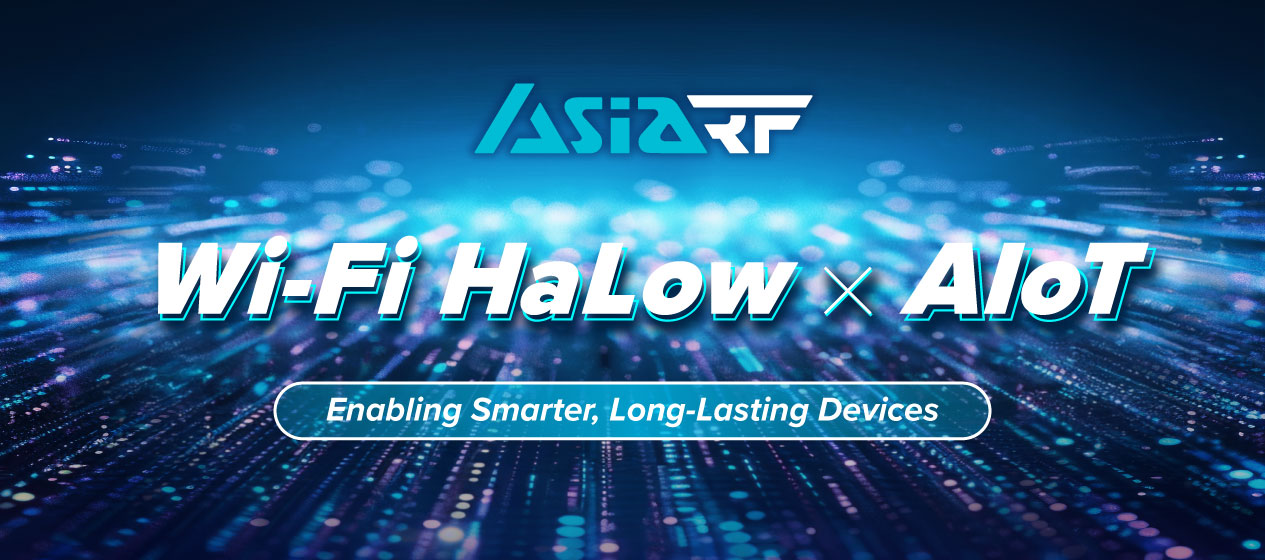
Wi Fi Halow And Aiot Enabling Smarter Blog

As the AIoT (Artificial Intelligence of Things) era advances, the ability to collect, connect, and compute data at scale defines true intelligence.
Yet, most IoT networks today still face the same barriers — limited range, unstable links, and short device lifespans.

That’s where Wi-Fi HaLow (IEEE 802.11ah) reshapes the game.

The Power of Wi-Fi HaLow for AIoT

Wi-Fi HaLow operates in the sub-1 GHz band, delivering :

  • 10 × longer range than traditional Wi-Fi
  • Better penetration through walls and obstacles, and
  • Ultra-low power consumption for multi-year battery operation.

These advantages make HaLow ideal for AIoT environments such as smart agriculture, logistics, factories, cities, and energy management, where thousands of devices need to stay connected over wide areas.

With more reliable coverage, AIoT systems can now gather richer, continuous data — powering smarter AI models, predictive analytics, and automated control.

 Introducing AsiaRF HaLowFly

At AsiaRF, we make Wi-Fi HaLow simple and universal.
HaLowFly is a Wi-Fi HaLow USB dongle that brings long-range, low-power connectivity to any device or operating system — including Windows, MAC, Linux, Android, iOS and more.

Just plug it in, and your device instantly gains access to a new world of connectivity :

  • Universal OS support — works seamlessly across multiple platforms
  • Energy-efficient operation — optimized for edge and sensor networks
  • Extended coverage — ideal for outdoor or industrial environments
  • Easy integration — no redesign, no complexity, just plug-and-connect

HaLowFly bridges the gap between existing IoT systems and the next generation of AIoT infrastructure, helping businesses deploy smarter and longer-lasting devices faster than ever.

 Building the Foundation of Smarter AIoT

AIoT’s foundation lies in the data layer — the “basement” where sensors collect information that drives intelligence.
Wi-Fi HaLow and HaLowFly make this foundation stronger :
more data, greater reach, and stable, energy-efficient connectivity that AI can rely on.


Qualcomm-image

What you should know:
  • With Wi-Fi 8, users benefit from consistently reliable connections, overcoming the limitations of previous Wi-Fi generations in demanding scenarios.
  • Breakthrough innovations at the PHY and MAC layers, enable robust connectivity, seamless roaming, higher throughput and extended coverage for devices across diverse environments.
  • Qualcomm Technologies is helping shape the future of Wi-Fi 8, bringing advanced wireless technologies and AI-driven connectivity to support next-generation intelligent systems and user experiences.

Wi-Fi 8

Wi-Fi 8 is beling developed to meet the demands of a new era shaped by AI-driven systems, personal device ecosystems and mission critical applications.

Learn more in Part 1 of this series

Previously, we explored how Wi-Fi 8 is being developed to meet the demands of a new era shaped by AI-driven systems, personal device ecosystems and mission-critical applications. Designed to deliver ultra-high reliability, Wi-Fi 8 aims to provide consistent, low-latency and near-lossless performance in real-life environments where congestion, interference, mobility and coverage boundaries challenge legacy Wi-Fi.

Here, we’ll take a closer look at the technologies making Wi-Fi 8 uniquely capable of solving these challenges. We’ll also explore how these innovations translate into tangible benefits across key environments: enterprise and industrial settings, connected homes and public venues — where seamless, intelligent connectivity is becoming more and more essential.

Qualcomm-image

1. The technology behind ultra-high reliability

Wi-Fi technology, like all wireless communication systems, is built on a layered architecture that organizes how data is transmitted and received. Two of the most critical layers in this architecture are the physical (PHY) layer and the medium access control (MAC) layer. The PHY layer is responsible for the actual transmission of data over the air. It defines how bits are converted into radio frequency signals and vice versa, including aspects like modulation, coding and signal strength. The MAC layer, on the other hand, governs how devices access the shared wireless medium, coordinating when and how data packets are sent to avoid collisions and ensure efficient use of the spectrum.

The IEEE 802.11bn standard, which serves as the base for Wi-Fi 8, introduces a suite of innovations at these foundational layers to improve reliability, throughput and responsiveness, especially in challenging conditions. Wi-Fi 8 tackles long-standing limitations in signal handling and spectrum coordination, setting the stage for a new generation of ultra-resilient and high-performance wireless connectivity.

Qualcomm-image
Enhancing the physical layer

Wi-Fi 8 brings a wave of targeted PHY layer enhancements to address connectivity challenges like weak uplink signals, inefficient MIMO modulation and signal degradation at the network edge. These enhancements are designed to deliver more robust performance and higher effective throughput in non-ideal signal conditions than any previous generation of Wi-Fi.

  • Improved Low Density Parity Check (LDPC) Coding: Packet loss and retransmissions can cripple performance in high-throughput or impaired signal conditions. Wi-Fi 8 offers longer block lengths for low-density parity check (LDPC) coding, significantly improving error correction and decoding. This results in fewer dropped packets and more reliable connections, even in noisy or congested environments.
  • Unequal Modulation Across Spatial Streams (UEQM): Legacy MIMO systems are only as strong as their weakest link, forcing all spatial streams to use the same modulation level. Wi-Fi 8 eliminates this constraint by allowing each stream to adapt its modulation based on individual signal quality. This unlocks higher throughput and greater resilience in environments with uneven signal propagation.
  • Additional Modulation and Coding Schemes (MCS): MCS defines the combination of modulation formats and coding rates that set how data is encoded for transmission over-the-air, thereby determining the achievable data rate. For legacy Wi-Fi, the coarse granularity of available MCS levels limited optimal rate adaptation in fluctuating signal environments, leading to suboptimal performance. Wi-Fi 8 introduces intermediate MCS levels, enabling finer-grained rate adaptation. This allows for smoother transitions and more stable performance in scenarios where signal quality varies rapidly, like in mobile or high-density public settings.
  • Enhanced Long Range (ELR): Devices at the edge of a network, such as outdoor cameras, garage sensors or mobile robots, can suffer from weak uplink signals due to power limitations. This can create an uplink-downlink power imbalance where APs transmit at higher power than clients. ELR addresses this imbalance by improving the link budget  effectively extending network reach and helping maintain reliable connectivity for low-power and distant clients.
  • Distributed Resource Units (DRU): In the 6 GHz band, regulatory limits on power spectral density (PSD), which cap the transmit power per MHz, restrict the total transmit power. For devices using small Resource Units in an OFDMA transmission, such as 26- or 52-tone RUs, this limitation translates into reduced range and reliability. Wi-Fi 8 addresses this challenge through DRU, which allows to spread tones across a wider frequency range, effectively increasing the total transmit power while staying within PSD limits. In regions with stricter PSD limits, this technique can yield power gains  significantly enhancing signal robustness. The result is extended coverage, improved link reliability, and better performance for clients.

Together, these PHY layer innovations form the foundation of Wi-Fi 8’s ultra-high reliability promise, ensuring performance remains consistent, robust and efficient, while also increasing range and boosting throughput in challenging wireless conditions.

Qualcomm-image
MAC layer innovations
  • SMD Roaming: The single mobility domain (SMD) is a key feature of Wi-Fi 8, designed to deliver seamless roaming across multiple access points without handoff interruptions which can cause packet loss, latency spikes or dropped connections. Legacy Wi-Fi roaming involves disconnecting from one AP and re-connecting (including reassociation and security setup) with another, which introduces delays and data discontinuity. This break-before-make roaming can cause latency spikes, packet loss resulting in audio/video glitches during movement and a poor user experience. In a single mobility domain, multiple APs are logically grouped into a unified domain. A client device maintains its association and security context across multiple APs and remains continuously connected as it moves between APs. SMD roaming is handled via a make-before-break mechanism, meaning the device establishes a new connection before releasing the old one. These innovations enable Wi-Fi 8 to deliver seamless connectivity and consistent performance as users and devices move through coverage zones.
Qualcomm-image
  • Spectrum Efficiency: Wi-Fi 8 introduces several mechanisms to improve how spectrum is utilized, especially in dense environments and where devices with varying capabilities must coexist efficiently.
  • Dynamic Sub-band Operation (DSO): Today, typically only premium clients support the full 320 MHz, or 160 MHz bandwidth offered by APs, leading to portions of the spectrum being unused and inefficiently allocated. DSO allows multiple narrowband devices to simultaneously operate within different portions of the wideband channel, maximizing spectrum utilization and increasing throughput in mixed-device environments.
  • Non-Primary Channel Access (NPCA): When the primary channel is busy due to overlapping BSS (OBSS) traffic or other conditions, NPCA allows Wi-Fi devices to opportunistically access a secondary channel. The key benefit is that it enables stations to continue transmitting data by switching to a designated NPCA channel, rather than waiting for the primary channel to become free, which improves overall network efficiency and reduces transmission delays in dense environments. Specifically, NPCA helps mitigate the impact of channel congestion caused by neighboring networks by allowing devices to dynamically switch and contend for access on a less congested channel frequencies. This leads to higher throughput, lower latency and better spectrum utilization, especially in scenarios where multiple networks overlap and compete for airtime on the same primary channel.
  • Dynamic Bandwidth Expansion (DBE): Enterprise deployments often avoid wide channels due to frequency reuse constraints. DBE allows APs experiencing high traffic to temporarily expand their operating channel bandwidth to serve high traffic loads, improving throughput without disrupting legacy clients when other channels are not highly utilized. This is especially useful in enterprise deployments where frequency reuse limits the use of wide channels like 160 or 320 MHz.
Qualcomm-image
  • Multi-AP Coordination: In dense environments with overlapping networks, unmanaged interference and contention can severely degrade performance. Wi-Fi 8 addresses this by introducing coordinated mechanisms that enable APs to operate as a unified system, reducing collisions and improving spectrum efficiency.
    • Coordinated TDMA (Co-TDMA): Enables APs to share transmission opportunities in a time-sliced manner, reducing contention and latency. By distributing airtime across coordinated APs, Co-TDMA enables more predictable access and improved performance for latency-sensitive applications.
    • Coordinated Restricted Target Wake Time (Co-rTWT): APs coordinate the times of access windows to facilitate priority access for latency-sensitive traffic, enabling more deterministic performance even in congested environments.
    • Coordinated Beamforming (Co-BF): APs use advanced antenna steering to focus signals on clients and null interference toward neighboring APs. This improves signal quality, reduces contention, and allows more efficient spectrum reuse in dense deployments.
    • Coordinated Spatial Reuse (Co-SR): allows access points to dynamically adjust transmit power based on the link conditions between the AP and a given client. This enables simultaneous transmissions on the same channel in dense multi-AP deployment scenarios The feature improves overall throughput and efficiency in dense environments.

These coordination mechanisms allow Wi-Fi 8 to deliver consistent, high-throughput, low-latency connectivity in environments with high device density and overlapping coverage.

Qualcomm-image

2. Mapping Wi-Fi 8 features to real-world environments

Wi-Fi 8 is designed not just for theoretical gains, but for impact; its innovations are tuned to the realities of modern connectivity, where reliability, responsiveness and efficiency are mission-critical. Let’s explore how the technical breakthroughs, many spearheaded by Qualcomm Technologies, connect to the environments where they’ll reshape expectations and redefine what wireless performance feels like.

Enterprise & Industrial IoT: Enabling intelligent and autonomous operations

Enterprise and industrial environments have long relied on wired Ethernet to meet the stringent demands for operations like robotic assembly, real-time monitoring, high-quality conferencing and increasingly AI-driven automation that require ultra-reliable, low-latency connectivity. Wi-Fi 8 introduces the opportunity to deliver that same level of reliability over wireless, unlocking new flexibility for intelligent operations.

  • For example, single mobility domains allow autonomous mobile robots to roam across large factory floors without experiencing reduced throughput or latency spikes. A technician using an XR headset can move between APs while maintaining a seamless video feed without buffering or interruptions.
  • In dense deployments, typical of enterprise campuses and factory settings, multi-AP coordination technologies, such as coordinated TDMA (Co-TDMA) and restricted target wake time (Co-rTWT) allow APs to collaboratively manage transmissions. In a factory setting, where autonomous robots depend on real-time control updates, these technologies can reduce contention and mitigate interference by sharing transmission opportunities and enforcing exclusive access windows for latency-sensitive traffic, thus enabling deterministic operation of these time-critical industrial systems.
  • At the network edge, enhanced long range (ELR) and improved LDPC coding extend coverage and improve reliability for devices like surveillance cameras and IoT sensors, which often operate in challenging RF conditions.
Residential: Consistent, high-throughput, low-latency coverage

While earlier Wi‑Fi generations delivered their strongest performance closest to the access point, Wi‑Fi 8 is designed to extend that experience, delivering consistently higher throughput and lower latency throughout the home.

  • To help maintain strong connections in areas farther from the router, enhanced long range (ELR) and distributed resource units (DRU) improve uplink reliability for distant devices and IoT endpoints such as cameras and sensors.
  • Additional modulation and coding schemes (MCS) provide finer-grained rate adaptation, smoothing out performance in dynamic conditions and supporting bandwidth-intensive applications like streaming and gaming.
  • For homes with multi-AP mesh networks, multi-AP coordination features enable nodes to manage fronthaul and backhaul traffic more efficiently. The Single Mobility Domain (SMD) featureset has the potential to significantly improve the overall user experience for users that are moving throughout their homes while being connected.
  • Finally, power efficiency features for both clients and APs help reduce energy consumption in always-on residential gateways, supporting sustainability goals without compromising responsiveness.
Public spaces: Seamless connectivity in high-density venues

In public venues like airports, stadiums and transit hubs, Wi-Fi 8 tackles the dual challenge of high user density and constant mobility.

  • Key features such as multi-AP coordination, dynamic sub-band operation (DSO) and non-primary channel access (NPCA) work in concert to dramatically boost capacity and manage interference in these crowded environments. By coordinating transmissions across multiple access points, they reduce collisions and maximize throughput with low latency, even when thousands of devices are competing for bandwidth.
  • Meanwhile dynamic bandwidth expansion (DBE) allows APs to temporarily widen their operating channels to handle traffic surges. For instance, during a halftime show or a busy airport rush, when large crowds simultaneously stream high-definition video or upload content, Wi-Fi 8 APs can momentarily open wider channels to accommodate the spike in demand. This ensures that no one experiences a slowdown, even during peak usage.
  • The single mobility domain feature further enhances user experience by enabling seamless roaming across APs. As people move through a venue, their devices hand off between APs without dropping connections, eliminating audio/video glitches during calls or streaming sessions.

In summary, Wi-Fi 8 introduces a suite of innovations designed to meet the demands of modern connectivity, where mobility, density and responsiveness are critical. Together, these innovations enable systems to operate with the precision, responsiveness and reliability traditionally reserved for wired infrastructure, while also delivering significantly faster wireless connectivity in scenarios where legacy Wi-Fi struggled.

As a leader in wireless innovation, Qualcomm Technologies is driving the development of Wi-Fi 8, delivering advanced connectivity solutions that empower enterprises, public spaces and homes worldwide. With our deep expertise in wireless technologies, we are uniquely positioned to unlock the full potential of Wi-Fi 8 for intelligent computing at the edge.

At the Institut Universitaire de Technologie (IUT) in Blagnac, France, a quiet revolution in ultra-wideband (UWB) education and research is underway. Thanks to a long-standing collaboration with Qorvo, faculty and students are developing real-world applications that bridge the gap between innovation, education and industry.

What began with a challenge in a PhD research project, accurately localizing nodes that kept getting nudged out of place, has grown into a robust, multi-facility UWB test bed. The project, spearheaded by IUT Blagnac’s educators and researchers Carine Livoti, Adrien Vonenbosch and Réjane Dalcet, is part high-tech experimentation, part professional training platform, and entirely driven by passion for accessible innovation.

“Our platform was built opportunistically,” said Adrien. “It wasn’t directly funded at the beginning, but every time we had a project, we looked for ways to expand and improve the platform.” With Qorvo’s early support and technology access, the team was able to get hands-on with UWB modules before the broader market recognized their potential. “This gave us a real head start,” he added.

The test bed spans two main locations: a research facility and a “smart home” environment in Blagnac. In the research building, UWB nodes are deployed in open spaces and even inside anechoic chambers to simulate radio-isolated conditions. Some nodes are installed on rails to allow for controlled movement, and recent additions include robotic mobility to add a higher degree of experimentation.

But it’s the smart home installation that reveals the human-centered possibilities of UWB. “It’s about more than experiments,” said Réjane. “It’s about providing a service to people, testing how UWB can function in real environments, with real users.” From locating lost keys to optimizing hospital asset management, their UWB applications focus on transforming technical localization data into intuitive, human-readable outputs. Instead of cryptic coordinates, systems can say, “Your keys are next to the coffee maker in the kitchen.”


The demo room at IUT Blagnac.

The team also places an emphasis on education and training. Their platform supports both undergraduate students and professionals from engineering schools and industry. As Carine noted, “At first, students may tune out when we explain that UWB occupies at least 500 megahertz of spectrum. But once they participate in hands-on activities, like a treasure hunt app built on UWB, the technology becomes real and exciting.”

That spirit of engagement drives the team’s larger mission: to popularize UWB and make cutting-edge research accessible to startups, educators and professionals. “A few years ago, I had never even heard of ultra-wideband,” said Carine. “Now, thanks to Qorvo, we are working with startups and developing training sessions that help people outside of academia understand and apply this technology.”


The test bed is deployed at a building scale, over the first floor of building C of IUT Blagnac, using Qorvo’s DWM1001C.

Qorvo’s contribution has gone far beyond supplying hardware. Their partnership has helped IUT Blagnac create an educational and experimental environment that merges technical rigor with public-facing impact. It’s a model for how industry and academia can collaborate to make complex technology both approachable and transformative.

Looking ahead, the Blagnac team sees even more opportunities to grow. They are working on turning UWB data into natural-language feedback for use in healthcare, smart homes and public services. Their goal is to continue opening research to the world and bringing innovation from the lab to everyday life. As Réjane put it: “We want to make ultra-wideband popular, understandable and useful. Not just for researchers, but for everyone.”

Find out more about Qorvo UWB solutions here.

The next frontier of connectivity

Across every industry, networks are under pressure. AI applications are consuming exponentially more bandwidth than traditional workloads. Device density is surging and experiences increasingly depend on reliable, real-time wireless performance.

As organizations embrace hybrid work, intelligent buildings, and connected operations, wireless networks must now handle unprecedented bandwidth, latency, and security demands.

But AI is more than a challenge—it’s an opportunity. From safer autonomous factories to smarter hospitals and immersive digital campuses, AI-driven innovation depends on fast, trustworthy data exchanges. To realize these opportunities, organizations need networks that are intelligent, secure, and scalable.

The latest Cisco wireless innovations deliver exactly that. IDC recently named Cisco a Leader in the IDC MarketScape: Worldwide Enterprise Wireless LAN 2025 Vendor Assessment—recognition that reflects our commitment to define what enterprise-grade connectivity looks like today. I’m excited to share how our newest advancements—built on three pillars: scalable devices ready for AI, AgenticOps for operational simplicity, and security fused into the network—extend that leadership even further.

Scalable devices ready for AI

The Cisco Wi-Fi 7 portfolio delivers comprehensive coverage for every operational need through a full range of advanced access points and infrastructure solutions. It provides scalable, reliable connectivity across hospitality, education, enterprise campuses, and high-density venues such as stadiums. Built on a foundation of continuous innovation, Cisco continues to raise the bar for wireless performance and scale with flexible management options spanning cloud, on-premises, and hybrid deployments.

We’re now extending this portfolio with new, versatile options engineered for low- to medium-density environments:

  • Cisco Wireless 9171 Series Access Points: Providing the flexibility, intelligence, security, and full performance of Wi-Fi 7 without the cost or complexity of high-density infrastructure; designed for low-density environments like classrooms, retail spaces, and small- to mid-sized businesses.
  • Cisco Wireless 9174 Series Access Points: Delivering high-speed, reliable connectivity for modern applications that can’t tolerate downtime; designed for demanding environments like healthcare facilities, hospitality, manufacturing floors, and large office campuses. This enterprise-grade access point offers tri-band support (2.4 GHz, 5 GHz, and 6 GHz) with both integrated omnidirectional and external antenna connector models, allowing the CW9174E to adapt to unique coverage scenarios and support mission-critical wireless needs.
  • Cisco CW9800-L Wireless Controller: Enabling enterprises in regulated industries like finance, healthcare, and government to modernize their wireless infrastructure while meeting stringent security certifications and compliance requirements. This robust and scalable controller platform delivers the secure, reliable wireless infrastructure that’s essential for critical business functions, seamlessly integrating with Cisco’s broader networking and security ecosystem without compromising performance.

Complementing these devices is the Cisco Campus Gateway, recently recognized with the Wireless Broadband Alliance Wi-Fi Network Technology Award 2025. This enterprise-class, cloud-native solution delivers real-time control and active-active stateful load balancing to ensure seamless roaming at scale—supporting up to 50,000 clients and 5000 access points with cloud management, without requiring network redesign.

This unified infrastructure empowers enterprises to meet evolving connectivity needs with seamless, high-performance, and secure wireless experiences built to handle AI’s unique demands.

AgenticOps for operational simplicity

Cisco is redefining wireless assurance—simplifying radio frequency (RF) and client management, accelerating troubleshooting, and delivering on the promise of AgenticOps. These innovations give IT teams greater visibility and control, allowing them to proactively detect issues, reduce mean time to resolution, (MTTR) and keep users connected with confidence.

Features like Cisco AI-Enhanced Radio Resource Management (AI-RRM), which automatically optimizes radio performance, and Cisco Intelligent Packet Capture, which provides real-time visibility and actionable insights down to the packet level—keep networks performing at their best.

Building on these foundations, we’re introducing new capabilities that further streamline operations and proactively maintain wireless health:

  • Roaming health insights: Identify and display roaming issues at the network and location level to accelerate troubleshooting. This feature simplifies visibility into client roaming behavior, providing actionable data that reduces MTTR.
  • Client analytics with Zebra integration: Gain native visibility into Zebra devices without requiring extra client software. Zebra joins Apple, Intel, and Samsung in partnering with Cisco to simplify client management by displaying trends and insights at the device and driver level. For instance, in a warehouse environment, network admins can leverage this to track Zebra handheld scanners—including driver and serial number information—to quickly troubleshoot connectivity issues.
  • Active testing (currently in beta): Enable on-demand and scheduled tests at the access point to proactively identify network issues. Powered by ThousandEyes, active testing enables network admins to easily pinpoint where issues occur—anywhere from the access point to the cloud. For example, a university campus can run active tests with the access point acting as a client device, helping to detect and resolve network bottlenecks before students experience connectivity problems during peak hours.

Together, these capabilities reduce manual effort, save time, and ensure consistent, reliable experiences across both cloud and on-premises deployments.

Security fused into the network

Security is foundational to everything we build. Cisco goes beyond traditional security measures by integrating it deeply into the network. This includes securing app access for users, things, and agents through solutions like Cisco Identity Services Engine (ISE), secure access service edge (SASE), and adaptive policy enforcement. Network access is protected with advanced wireless intrusion prevention systems (aWIPS) and Air Marshal, while network connectivity is safeguarded using WPA3, MACSec, and IPsec protocols.

Devices themselves are secured with features such as Cisco Secure Boot (PDF) and Cisco Live Protect. This holistic, multi-layered approach means security is intrinsic, not an add-on. Every component, from device to application, works together to protect data, prevent threats, and enable organizations to confidently scale wireless access in an increasingly complex, AI-driven environment.

Connectivity built for tomorrow

These innovations position Cisco at the forefront of wireless technology, delivering scalable, intelligent, and secure solutions that empower customers to thrive in an increasingly connected world.

Thank you for your continued trust in Cisco as we build the future of wireless together.

WASHINGTON, D.C. — Nov. 4, 2025  — DNSFilter, a global leader in protective DNS and content filtering, announced today a strategic partnership with Midis Group to provide enhanced cybersecurity solutions to customers across Eastern Europe, the Middle East and Africa. This partnership will empower organizations in these regions to safeguard their networks against evolving online threats through a cutting-edge, cloud-based platform known for its real-time threat detection and intuitive management.

DNSFilter’s unique approach leverages artificial intelligence to identify and block malicious domains, reducing cybersecurity risks. By integrating DNSFilter’s robust solution with Midis Groups’ expansive network of value-added distribution, service providers and in-territory experts, customers will now benefit from more reliable, proactive protection against threats such as phishing, malware and ransomware.

Midis Group is a trusted go-to-market partner for leading global technology vendors, including  Apple, Hewlett Packard Enterprise (HPE), IBM, Google, Cloud Software Group (Citrix), Broadcom and Dell Technologies. These partners leverage the company’s deep local expertise in technology and business to accelerate their regional growth.

The partnership aims to provide organizations of all sizes with advanced DNS-layer security, enhancing their ability to prevent and respond to potential attacks. Through DNSFilter’s innovative technology, customers in these regions can better integrate a seamless, protective experience that doesn’t compromise speed or performance. As cybersecurity becomes more complex, DNS-layer security is crucial for organizations aiming to prevent cyberattacks before they infiltrate the network.

Ernest Sales, President Local Office, Midis Group, said: “Partnering with DNSFilter enhances our security portfolio and enables us to better meet our customers’ needs for faster and more accurate threat protection. Together, Midis Group and DNSFilter are committed to ensuring a safer digital experience and helping organizations strengthen their defenses against cybercrime.”

Ken Carnesi, CEO and co-founder, DNSFilter, said: “Our partnership with Midis Group and the opening of our new Dubai office mark a significant milestone in DNSFilter’s commitment to the EMEA region. The Middle East and broader EMEA is a key market for secure DNS protection, and establishing a permanent presence here allows us to better serve our partners and customers. This partnership reflects our long-term investment in the region and our goal to build deep, lasting relationships with local enterprises and service providers.”

About Midis Group
With more than 6700 professionals, some 100 of the world’s leading technology vendors, and a solid 50-year track record of performance and reliability, the Midis Group is a multinational organization comprised of over 175 companies across Europe, Middle East and Africa. The group is known for its advanced offering of managed IT services and consultancy, system integration, cloud and data center capabilities and infrastructure, software, and hardware solutions, as well as technology distribution and retail. The Midis Group was named in 2006 as one of the World Economic Forum’s initial 100 Global Growth Companies. For more information, visit www.midisgroup.com.

About DNSFilter
DNSFilter is a cybersecurity company that protects every click, leveraging AI-driven content filtering and threat protection to block threats 10 days earlier than competitors. DNSFilter’s solution secures workers anywhere they are, helping to boost productivity, minimize compliance risk, and protect corporate brands on public Wi-Fi networks. Unlike traditional filtering solutions, DNSFilter deploys in minutes instead of days and is trusted by more than 43,000 organizations worldwide. Learn more about how DNSFilter is the first and last line of defense for corporate and hybrid networks at dnsfilter.com.

Picture a pallet of goods is loaded onto a truck, on a journey that will take it across a continent or maybe across oceans. It’s equipped with GPS and cellular tracking during transit, but the moment it enters a warehouse, that visibility vanishes. GPS can’t penetrate walls, and cellular triangulation loses accuracy indoors, especially in dense or signal-shielded environments like warehouses or hospitals. Our pallet is still there, but digitally, it’s gone dark.

This is where Wi-Fi steps in, but not in the way we’re used to. This isn’t about joining networks or streaming data. Instead, we’re talking about sensing presence, passively observing signals in the environment, and turning that information into location intelligence.

No handshakes. No connections. Just smart scanning. At Silicon Labs, we’ve built hardware that makes this model not only possible but also practical.

What is Wi-Fi Asset Tracking and How Does It Work?

Instead of depending on heavy infrastructure or GPS alone, positioning with Wi-Fi works by scanning for surrounding SSIDs and determining signal strength to estimate location. This means your devices don’t have to associate with a network, they just need to recognize that they’re near one.

Asset Tracking Device Diagram

Our SiWx917 Wi-Fi 6 ultra-low-power wireless MCU can cold boot and SSID scan all channels in about 5 seconds while consuming less than 50mA. The result is fast updates on location without draining the battery. Consider long-life sensors that only wake up when needed. But sensing alone isn’t enough.

The Cloud Knows the Way with our Wi-Fi Asset Tracking Solution

This is where the backend takes over. Once the SiWx917 identifies nearby SSIDs, that data gets pushed to the cloud via MQTT or another protocol. From there, cloud-based mapping, databases, etc. kick in. They match known SSIDs to real-world coordinates, giving you near real-time asset visibility, even indoors.

Wi-Fi Asset Tracking Without Connecting Diagram 2

This backend magic means facilities don’t need to install anything new. Your warehouse, hospital, or factory already has Wi-Fi. That existing infrastructure becomes your positioning system. No proprietary readers. Just the networks already deployed.

We handle the radio; you handle the maps.

That’s the beauty of this solution: it’s collaborative. We provide the silicon and the low-power intelligence. You bring your choice of the cloud, the dashboards, the data insights. Together, it becomes something greater, a full-coverage, multi-technology, fully visible platform that truly optimizes your return on investment of wireless tracker solutions.

You can track a container from factory to forklift. You can follow a medical cart from ICU to storage. You can monitor inventory on the move, through buildings, and blind spots. All using a chip that sips power and slips easily into your existing design.

And if you’re already using GPS and cellular? Great. Wi-Fi doesn’t replace them, it complements them. You can turn off the heavy radios when you don’t need them, hand off to Wi-Fi sniffing when you do. That flexibility is key to optimizing for both coverage and longevity.

Designing a Wi-Fi Asset Tracker: From Possibility to Deployment

We’ve taken this all the way to reference designs. The SiWx917 acts as a controller, working with GNSS, IMU sensors, and MQTT to push data to the cloud. In one of our hybrid builds, smart pallets were equipped with our Wi-Fi SoC to track transit through ships, trucks, and warehouses without ever joining a network. Just sensing. Just sending. Just working.

Wi-Fi Asset Tracking Without Connecting Diagram 3

The logistics company that implemented this deployment was able to add both Bluetooth LE and Wi-Fi with a single chip, extend battery life, and finally get eyes inside their own facilities.

Why Choose SiWx917 to Build a Wi-Fi Asset Tracker?

Easy. In addition to the features and benefits mentioned above, the SiWx917 Wi-Fi 6 ultra-low-power MCU is a fully integrated wireless solution giving you the functionalities and interfaces you need in Wi-Fi trackers. A few examples include:

  • Integrated networking stack with TCP/IP, TLS, MQTT, and more simplifies integration with the cloud and location database.
  • Includes a rich set of peripherals and GPIO to tie together all the required components such as the GNSS/GPS, LTE/GSM, gyroscope/accelerometer, and an ambient sensor.
  • Large SRAM, PSRAM, and flash memory capacity accommodate all necessary firmware, application software, and location data while also leaving room for OTA updates.
  • Dedicated application MCU with up to 180MHz and an AI/ML accelerator remove the need for an additional standalone MCU, reducing your BoM, power consumption, and board footprint.
  • Wireless and networking stacks are run on a separate processor, increasing MCU sleep time and reducing power consumption.
  • Finally, our SiWx917 modules come with an antenna and regulatory certifications, simplifying your RF design and certification work and reducing the development costs and time.

Let’s Build your Wi-Fi Asset Tracking Device Together

If you’re working on asset visibility, indoor positioning, or real-time logistics, this changes the game. You already have Wi-Fi. Let’s use it better. This is where smart hardware meets smarter networks. Let’s build it together.

To learn more, download our whitepaper, “Wi-Fi Power Optimization Examples for Six IoT Devices” where wireless experts from Silicon Labs and Sigma Connectivity share their best-practice Wi-Fi power optimization guidelines for six IoT devices, including a connectionless Wi-Fi tracker.


New global, tiered program designed to simplify how partners do business with NETGEAR delivers richer rewards, stronger enablement, and streamlined support for integrators, MSPs, and VARs serving small and medium enterprises.

November 4, 2025 – SAN JOSE, Calif. – NETGEAR® Inc. (NASDAQ: NTGR), a global leader in intelligent networking solutions designed to power extraordinary experiences, today introduced the NETGEAR Drive Partner Success Program, a reimagined global partner program built to strengthen collaboration, simplify engagement, and expand enablement for channel partners.

The new program aligns with NETGEAR’s increased enterprise focus, making it easier and more rewarding for integrators, managed service providers (MSPs) and value-added resellers (VARs) to grow with NETGEAR through streamlined tools, enhanced support and expanded go-to-market resources.

This launch marks the latest milestone in NETGEAR Enterprise’s evolution under the leadership of President and GM Pramod Badjate and advances the company’s mission to deliver simplicity, reliability and cost-effectiveness for small and medium enterprises.

“The goal of our Drive Partner Success Program is simple: make it easier for our partners to succeed and grow,” said Badjate. “Partners are the center of everything we do, and Drive will equip them with the tools, training, and support they need to accelerate business opportunities and revenue growth.”

The NETGEAR Drive Partner Success Program consists of three tiers — IGNITE, APEX, and APEX MSP — tailored to different partner service capabilities and business models. Each tier delivers benefits based on partner investment as demonstrated through customer impact and testimonials, as well as completion of training and certification milestones.

Program Benefits

NETGEAR Drive is built to accelerate profitability and sustainable growth, rewarding partners for service excellence and long-term co-investment.  Its tiered structure helps partners stand out in a competitive market and align more closely with customer needs, delivering exceptional value and expertise.

In addition to rewards, partners also gain access to co-investment opportunities, comprehensive training, marketing materials, collaborative campaigns, partner-focused technical support, and certifications that simplify selling NETGEAR’s business-class products. A new, dedicated partner portal further enhances self-service capabilities and streamlines program access.

Looking Ahead

To ensure a consistent global experience, NETGEAR Drive will roll out worldwide, giving all partners access to the new Partner Portal with the latest portfolio, technical information, and sales and marketing resources. Partners can continue transacting under existing program terms during the transition to ensure a smooth and seamless onboarding experience.

NETGEAR Drive Partner Success Program training materials and certification content will be available starting today, with new partner pricing and program benefits. Existing NETGEAR partners will transition to the new program by January 1, 2026.

To learn more about the NETGEAR Drive Partner Success Program, please visit https://www.netgear.com/business/solutions/partner-success-program/.

About NETGEAR, Inc.

Founded in 1996 and headquartered in the USA, NETGEAR® (NASDAQ: NTGR) is a global leader in innovative networking technologies for businesses, homes, and service providers. NETGEAR delivers a wide range of award-winning, intelligent solutions designed to unleash the full potential of connectivity and power extraordinary experiences. For businesses, NETGEAR offers reliable, easy-to-use, high-performance networking solutions, including switches, routers, access points, software, and AV over IP technologies, tailored to meet the diverse needs of small and medium enterprises. NETGEAR’s consumer products deliver advanced connectivity, powerful performance, and enhanced security features right out of the box, designed to help keep families safe online, whether at home or on the go. More information is available from the NETGEAR Press Room or by calling (408) 907-8000. Connect with NETGEAR: Facebook, Instagram and the NETGEAR blog at NETGEAR.com.

©2025 NETGEAR, Inc. NETGEAR and the NETGEAR logo are trademarks and/or registered trademarks of NETGEAR, Inc. and/or its affiliates in the United States and/or other countries. Other brand and product names are for identification purposes only and may be trademarks or registered trademarks of their respective holder(s). The information contained herein is subject to change without notice. NETGEAR shall not be liable for technical or editorial errors or omissions contained herein. All rights reserved.

remote-work-girl-freelancer-works-remotely-on-the-2022-11-11-07-49-26-utc

Enhancing Remote Work Security with Easy-to-Use Client VPN

Remote working, or telecommuting, allows employees to work outside a traditional office. This approach, often conducted from home, is gaining importance, particularly due to the digital revolution and the recent pandemic. Companies recognize its cost, productivity, and satisfaction benefits. Thus, remote working is becoming a standard in many industries.

However, maintaining online privacy and security is a complex task due to numerous challenges. Users often face risks such as using public Wi-Fi networks, which cybercriminals can exploit, and many are unaware of these risks. Data snooping is another issue, where third parties observe a user’s data without consent, posing a significant privacy threat.

Thus, providing a secure and easy-to-use VPN has become more critical than ever for a growing business and its workforce.

What is a VPN?

A VPN, or Virtual Private Network, is a service that creates a secure, encrypted online connection. This secure connection offers an additional layer of protection, mainly when using public Wi-Fi networks or accessing company files remotely.

What is Client VPN

Client VPN allows individual devices (clients) to connect to a secure private network from anywhere. It encrypts the user’s connection, making it difficult for third parties to detect the user’s activities or steal data.

What is a Site-to-Site VPN

Site-to-site VPN, on the other hand, allows multiple networks in different locations to connect to a central network through the Internet. This is particularly useful for businesses with several office locations or employees working remotely.

How VPN Benefits to Remote Workers

VPN technology provides a secure and encrypted connection, ensuring that all data transmitted between the remote worker and their company network remains confidential. It also offers remote workers the ability to safely access their company’s network and its resources, which is particularly crucial when handling sensitive data. Moreover, VPNs provide access control, allowing organizations to restrict and monitor access to sensitive information.

Protect Data and Enhance Cybersecurity in Public Wi-Fi

Under Cybersecurity, VPNs act as a first line of defense against cyber threats by masking the user’s IP address and obscuring their online activities. This makes it more difficult for cybercriminals to target specific users or launch phishing attacks. Additionally, VPNs can help protect against malware and other forms of cyber threats that may compromise the user’s system.

Secure Remote System Access

Under Secure Remote Access, VPNs provide remote workers with a secure pathway to access company resources, regardless of their location. This secure connection protects sensitive data from potential eavesdropping or interception. Additionally, it allows for smooth, uninterrupted remote work, fostering productivity and efficiency.

Manage and Control Access for Extra Protection

Access Control with VPNs allows companies to specify which users and devices can access specific resources. This minimizes the risk of unauthorized access to sensitive data. Furthermore, it enables organizations to manage and monitor their network’s usage easily, enhancing overall security.

The Risk of VPN

Despite its numerous benefits, using a VPN is not without potential risks. These include the possibility of VPN service providers logging user activity, potential vulnerabilities in VPN software that could be exploited, and slower internet speeds due to encryption processes. Understanding these risks is vital to ensuring the safe and efficient use of VPNs.

vpn-personal-online-security-virtual-private-net-2021-08-26-16-59-50-utc

How to Choose a Business VPN Solution

Choosing the correct Business VPN Solution can be complicated, but several factors can guide your decision. The security features are the first to consider, followed by these additional factors:

Interface and Ease of Use

The VPN solution should be user-friendly and intuitive, allowing your employees to integrate it into their workflow seamlessly. Given that employees use diverse devices dynamically in their day-to-day work, seamless VPN software that supports multiple platforms is also crucial for productivity.

Cost Effective

Cost is always a significant factor to consider. The VPN solution should provide excellent value for money and fit within your company’s budget. However, remember that the cheapest option may not always be the best, particularly with regard to security and reliability.

Flexibility and Scalability

As your business grows, your VPN needs may increase. Therefore, the chosen VPN solution should be flexible and scalable, capable of accommodating potential business growth and adapting to your changing requirements.

Privacy Policy

Moreover, the provider’s privacy policy should be transparent and robust, ensuring that sensitive data remains secure, confidential and comply with your company’s policy and standard.


EnGenius SecuPoint VPN – Seamlessly Connects Remote Workers

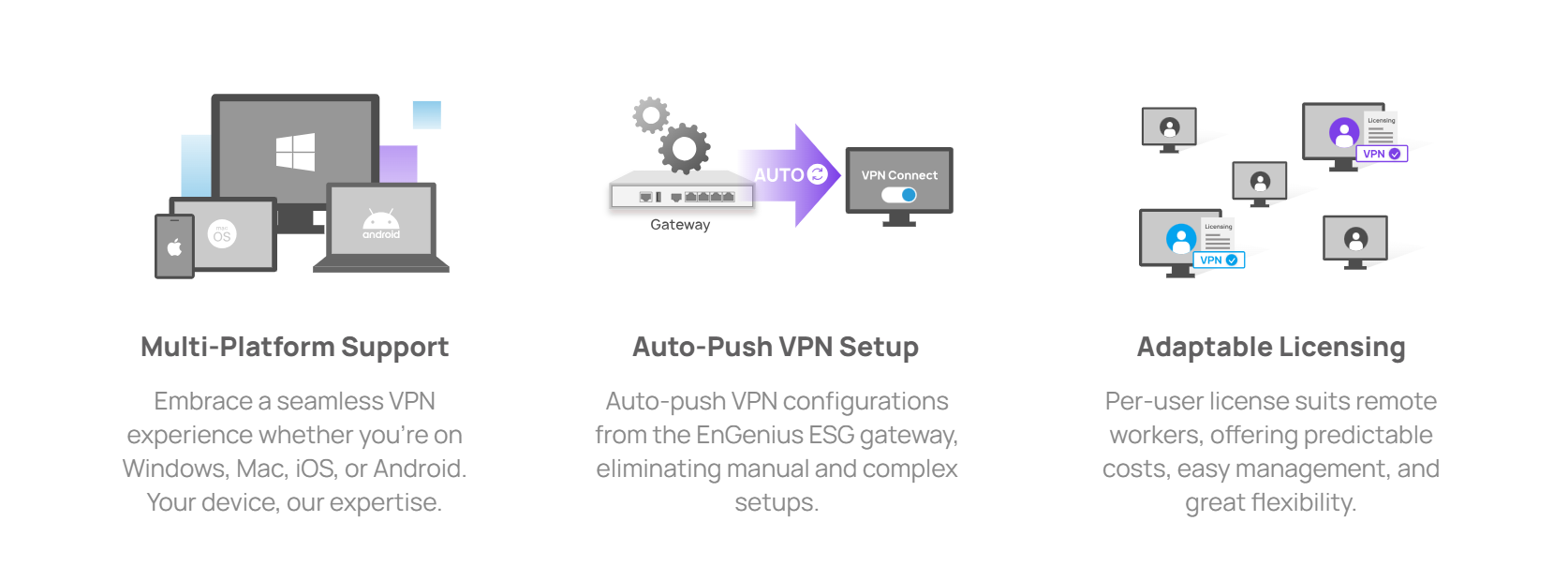
The EnGenius Cloud SecuePoint offers a seamless experience, and it stands apart with its tight integration with the EnGenius gateway, both the Cloud series and the Fit series. The unique per-user licensing model provides flexibility, sidestepping the limitations of per-device models, ofering a cost-effective VPN solution for enterprise and small business.

For IT Manager: Automatic Configuration

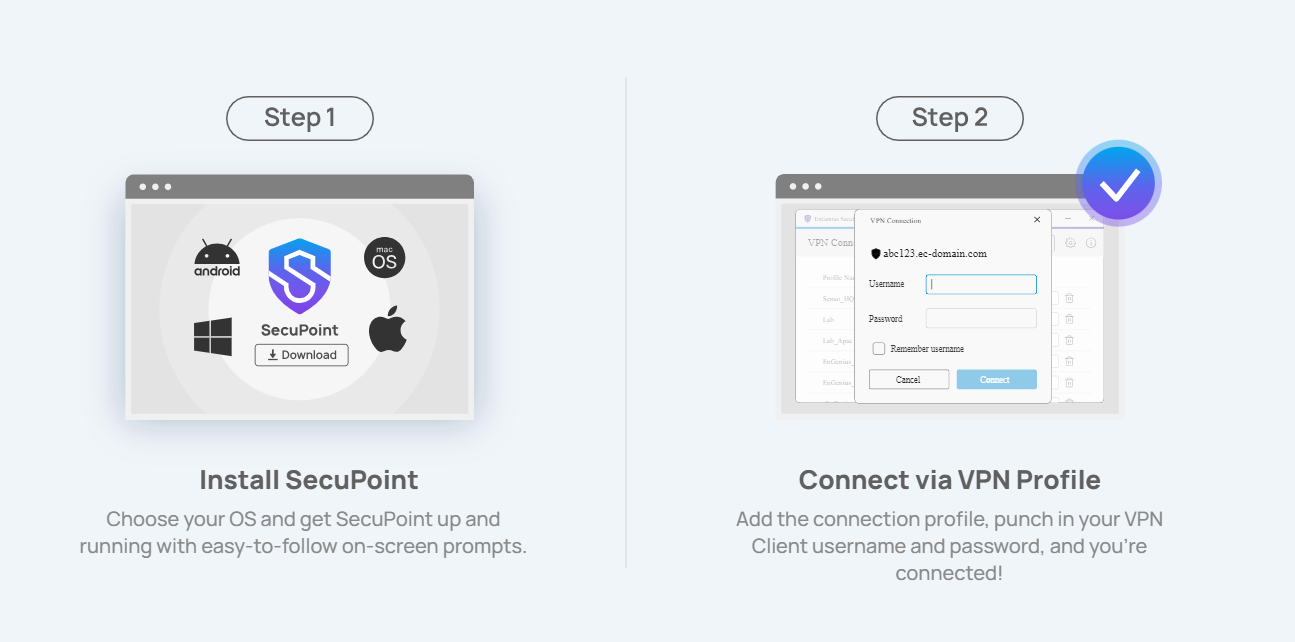
Once connected to the VPN server, the gateway immediately pushes the required configurations and certificates to SecuPoint. This ensures a seamless user experience and reduces the chance of errors that can arise from manual setups, which can cause connectivity issues or security vulnerabilities. secupoint setup

In addition, the automatic configuration allows for quick and easy scaling as businesses grow and onboard more employees, avoiding the need for manual VPN setups that can be overwhelming and strain IT resources. Furthermore, automatic configurations are self-reliant, reducing the need for specialized IT intervention and offering long-term cost savings.

For Remote Workers: Instant Cross-Platform Security

For remote workers, the log-in process was made easy by simply logging in to the SecuPoint app.  It automatically configures the best security settings to keep your connection safe.

SecuPoint VPN log in

As work becomes more dynamic, employees need to switch between devices without losing their connection. The multi-platform feature ensures that you can stay connected and secure while transitioning between devices, whether the device is provided by the company or of their own.


Conclusion

As we embrace this new era of telecommuting, it’s clear that the right VPN solution is not just a luxury, but a necessity for safeguarding our digital interactions and fostering a productive, secure remote work environment.

The use of VPNs represents a significant stride in addressing these needs. By providing a secure, encrypted connection, VPNs ensure the confidentiality and integrity of data transmitted between remote workers and their company networks. The ease of use, cost-effectiveness, and scalability of such solutions are paramount for businesses adapting to the evolving landscape of digital workspaces. Furthermore, the integration of automatic configurations and cross-platform compatibility highlights a commitment to seamless and efficient remote work experiences.

Hotel entertainment has entered a new era, and guests are leading the change. Today’s travelers expect in-room TVs to work like their devices at home, complete with streaming, casting, and interactive options. Legacy cable and satellite systems alone can’t always meet those expectations or the operational needs of modern hospitality.

IPTV for hotels solves that gap. By delivering live television and on-demand content through a property’s IP network, IPTV offers sharper picture quality, flexible channel control, and a more personalized experience for every guest. Viewers can stream, cast, and access hotel services directly from the screen. For operators, IPTV means lower long-term costs and simpler upgrades. It also enables full integration with property systems like PMS, housekeeping, and digital signage.

Industry data shows that hotels switching to IPTV can reduce five-year entertainment costs by as much as 65%. Choosing IPTV can also cut energy costs by nearly a third. As the global market for IPTV in hotels grows toward an estimated $10 billion within the next decade, forward-thinking properties are already making the shift.

The takeaway is clear: IPTV has matured from an emerging option into a hospitality standard. It enhances guest satisfaction, streamlines operations, and protects long-term investment.

Read our full white paper to explore how IPTV can modernize your property’s entertainment experience and why hotels that upgrade now will lead the connected guest era.

Download full white paper

STEM, Sensors, and Streaming: Why School Wi-Fi Needs to Be Ready for the Next Chapter

As the 2026 E-Rate cycle approaches, schools have an opportunity to modernize their infrastructure and prepare for the next generation of learning. The right network connects more than devices. It connects people, ideas, and opportunities that move education forward.

The modern classroom doesn’t run on chalk and projectors anymore. It runs on bandwidth.

From the moment teachers upload their lessons to the instant students power up their Chromebooks, the network quietly carries learning and collaboration forward. As schools prepare for their next E-Rate refresh cycle in summer 2026, dependable Wi-Fi and switching have become as critical as electricity.

The network is the classroom

New devices and applications are transforming learning, and K-12 IT leaders are managing much more than access points and switches. Each classroom is now a connected ecosystem of:

  • Smartboards, digital projectors, and AV systems
  • Laptops, tablets, and personal devices
  • Sensors, cameras, and building controls
  • Athletic and esports technology that demands real-time performance

For education environments, reliable coverage, high-density performance, and low-latency streaming are table stakes. But every new device impacts performance, increases management complexity, and introduces another potential point of failure to the network infrastructure. When the network slows, teaching and learning grind to a halt.

STEM in motion

Today’s K-12 classrooms have evolved into rich, personalized, interactive learning experiences. During a recent visit to a customer’s science lab, I watched students coding sensors on Raspberry Pis to track the temperature and humidity of their terrariums. Their data streamed wirelessly to dashboards they could check from home. Around them, 3D printers built objects, and tablets displayed visualizations.

It was STEM in action, a clear example of how far classrooms have come since the AV cart days of the 1990s. For IT teams, it was also proof of how much depends on the performance and reliability of the network.

The IT reality

Although reliable high-performance Wi-Fi is essential in every classroom, district IT teams are often stretched thin. They spend time on ghost issues, repeat tickets, and site visits just to locate the source of a slowdown. Without the right visibility and insight, troubleshooting becomes guesswork.

With RUCKUS AI™, IT teams can move from reactive to proactive network management. Predictive analytics, real-time diagnostics, and automated troubleshooting provide clear, relevant insight into performance. That means fewer classroom interruptions, faster fixes, and more time to focus on strategy.

Esports and the campus network

Esports programs are no longer a novelty. They have become a powerful tool for engaging students with active, collaborative experiences. They are also a critical proving ground for school networks. Competitive gaming requires low latency, consistent throughput, and reliable quality of service. The same standards apply to more traditional learning applications like digital testing, streaming assemblies, and remote learning. That means a network that performs under the pressure of esports can handle most anything the modern campus demands.

Building for results

Every IT director shares the same goal: delivering an engaging, uninterrupted learning experience.

For teachers, that means fewer Wi-Fi complaints.

For students, it means consistent access to digital tools that support creativity and collaboration.

For IT, it means networks that help them anticipate, identify, and resolve problems before they reach the classroom.

RUCKUS Networks builds for this reality. Our Wi-Fi 7 access points and network switches deliver the performance needed for future applications. Dynamic PSK™ (pre-shared keys) provides secure, simple access for students. RUCKUS AI gives IT teams the visibility and automation they need to manage growing demand efficiently. Together, these solutions create the foundation for a smarter, more reliable learning environment.

Looking ahead

The students writing code for sensors in classrooms today will become tomorrow’s engineers and scientists. Their learning experience should never be limited by weak signals or lag.

As the 2026 E-Rate cycle approaches, schools have an opportunity to modernize their infrastructure and prepare for the next generation of learning. The right network connects more t