
– First Wi-Fi 7 deployment by Deutsche Telekom to use Airties Home software to enhance connectivity of broadband customers
– Airties software continues to be deployed across Deutsche Telekom’s European footprint
PARIS – November 4, 2025 – Airties, a global leader of AI-driven software that improves the connectivity experience for ISPs’ subscribers, today announced that it has been deployed to support Deutsche Telecom’s first Wi-Fi 7 launch for consumers across Germany. Today’s announcement builds upon the longstanding relationship between the two companies in which Airties provides managed connectivity solutions to Deutsche Telekom.
Deutsche Telekom is one of the world’s leading integrated telecommunications companies. Airties empowers broadband service providers to deliver smooth, smart connectivity for all. Across the globe, ISPs rely upon Airties’ software for the ongoing optimization of their customers’ broadband experience to help reduce churn, attract new customers, lower operating and support costs, and innovate in new ways. Airties’ AI-driven insights, across devices and applications, helps ISPs improve performance quality, market effectively, and deliver a premium managed broadband experience to consumers.
“Launching Wi-Fi 7 in Germany, as part of a fully managed Wi-Fi experience, demonstrates our unwavering commitment to provide exceptional speed, connectivity, and reliability to our customers,” said Pedro Bandeira, Senior Vice President of Product and New Business at Deutsche Telekom. “We continue to rely upon Airties to help improve home connectivity, and we look forward to working with them, and all our partners, to launch Wi-Fi 7 to more of our customers.”
“We’re honored that Deutsche Telekom has deployed Airties to support their first Wi-Fi 7 launch across Germany,” said Metin Taskin, CEO and founder of Airties. “Our multi-year relationship is based on a mutual understanding that providing optimized and high-quality home connectivity is paramount to today’s consumers. Deutsche Telekom’s customers deserve the best possible performance across all of their devices and applications, which is what Airties Home was designed to help deliver.”
Airties Home directs consumers’ devices (laptops, tablets, phones, game consoles, IoT, smart home devices, etc.) to the best available Wi-Fi access point and frequency band based on real-time network conditions; manages Mesh networking; and optimizes QoS. It also helps ISPs observe, diagnose, and fix in-home connectivity issues automatically or through actionable recommendations; delivers insights and optimizations for connected devices and applications; and provides intuitive dashboards and APIs to support operators’ CRM systems and customer facing support apps to manage their home networks, set parent controls, prioritizations, guest access, and more.
Airties has received many prestigious industry awards for its innovations, including: “Best Home Wi-Fi Solution Award” from Broadband World Forum; “Best Wi-Fi Service Provider Solution” and “Best Home Wi-Fi Product” awards from Wi-Fi NOW; “Best Wi-Fi Innovation” and “Best-In Home Wi-Fi Network” awards from Wireless Broadband Alliance; “Best Broadband Customer Experience” from Cable & Satellite International; “Top Contributor Award” from the prpl Foundation, and numerous others.
Additional information about the Airties can be found at: www.Airties.com. Additional information about Deutsche Telekom can be found at https://www.telekom.com/en.

New IAP500BE combines Smart Mesh MLO and RF-first design to bring industrial sites up to speed for AI-driven automation.


Exec Talk article by Shahnawaz Siraj, Director of Technology | Intelligent Connectivity at MediaTek
AI is transforming industries, and without exception, it has become the buzzword of networking. While vendors and equipment manufacturers are pitching the same AI use cases for networking, such as configuration management, self-driving networks, anomaly detection, application visibility and QoS, and location services, the real differentiation in the execution – how reliably and at scale these solutions work.
On end-user devices, the role of AI is obvious: live translation, image editing, and voice assistants. In the cloud, it’s even clearer: the cloud is the “ocean” where all the data flows, it is where centralized AI workloads can see the big picture, correlating patterns across millions of devices and networks. That’s what enables use cases like anomaly detection and others.
The harder question has been how AI is reshaping the edge, and in particular, the Wi-Fi edge.
In the home, the gateway is the logical edge compute point before traffic heads to the cloud, especially now that integrated Wi-Fi has become the standard.
When it comes to the enterprise, the definition of “edge” can be less clear: is it the WAN edge (SD-WAN/secure gateway), or the Wi-Fi access points where client devices connect? If we extend the home analogy, the WAN edge remains the logical place for heavier AI workloads.
It best addresses the key concerns of data immediacy, real-time responsiveness, latency, privacy, and network bandwidth efficiency.
Which then raises the harder question: what’s the unique role of APs (Access Points) in AI at the edge?
The reality is that the industry hasn’t yet landed on a breakthrough “AI-on-AP” use case, and that’s fine. The role of the AP isn’t limited to running AI itself, but also to be ready for the traffic shifts AI will create, through programmability, better QoS, and more flexible platforms. That’s where APs can make a real impact and this is where the conversation turns 180 degrees. It’s not just AI for Wi-Fi, but also Wi-Fi for AI.
Are Wi-Fi networks ready for the new, unpredictable traffic patterns that AI applications will generate? End devices will keep getting smarter and running more inference locally, but that won’t reduce the demand on networks. Instead, it will create new and unpredictable patterns: burst of high-throughput or latency-sensitive traffic and dynamic flows across devices and the cloud. That means Wi-Fi’s role is not just more bandwidth, but resilience, adaptability, and future-proofing against traffic we can’t yet define today.
The industry is also moving to standardize this space. Within IEEE 802.11, the AI/ML group is set to explore how AI can be embedded into Wi-Fi. There are use cases being discussed to enhance WLAN performance, for example, the AP can leverage dynamic capabilities of AI/ML to assist STAs in proactively selecting optimal configuration parameters. In parallel, there are use cases focused on enabling AL/ML itself over WLAN, for example, supporting federated learning across Wi-Fi networks.
At MediaTek, as an innovation and technology leader, we see ourselves as enablers. We develop and provide the complete platform, hardware and software together, along with the SDKs, tools, and reference use cases that let our partners and customers innovate further. Whether it’s optimizing QoS using AI, enabling hooks for edge analytics and troubleshooting, or preparing APs for workloads that haven’t even been imagined yet, our goal is to make sure Wi-Fi isn’t just keeping up with AI, but empowering it.
The future of AI will depend on the networks that carry it. And Wi-Fi, more than ever, is at the front line.

Fixed Base Operators (FBOs) are the VIP terminals of the aviation world. Whether serving corporate executives, private charter passengers, or flight crews, FBOs are expected to deliver a premium experience—every time. And while amenities like leather lounges, valet services, and gourmet catering are front and center, there’s another element quietly shaping the customer experience and operational efficiency: Wi-Fi.
At 7SIGNAL, we’ve learned firsthand—through our work with some of the world’s busiest hubs like Atlanta’s Hartsfield-Jackson International Airport and Heathrow Airport in London that great Wi-Fi isn’t just a luxury in aviation. It’s an operational necessity.
The Digital Backbone of FBOs
FBOs may look like boutique lounges on the surface, but behind the scenes, they are complex operational environments. Pilots and crew rely on Wi-Fi for real-time weather updates, flight planning, and electronic manifests. Passengers expect fast, secure internet access for work or leisure, and increasingly, vendors—from catering to fuel services—depend on connected devices to stay in sync.
But FBOs face unique challenges:
The bottom line? When the Wi-Fi isn’t working, the entire operation feels it.
The Visibility Gap: Why Wi-Fi Problems Linger
Most FBOs—like many enterprises—rely on infrastructure tools that monitor the network from the inside-out. These solutions provide insight into hardware status or WAN availability, but they miss the most important perspective: the experience of the client device.
This is what we call the visibility gap and it’s where 7SIGNAL shines.
7SIGNAL: Built for the Edge of Aviation
7SIGNAL fills this critical gap with a unique outside-in approach to Wi-Fi and digital experience monitoring. Through a combination of software agents deployed on endpoint devices and cloud-managed sensors placed throughout facilities, 7SIGNAL gives IT teams complete visibility into how users and devices experience the wireless network—from the cockpit to the conference room.
For FBOs, this means:
Unlike other solutions, 7SIGNAL is vendor-agnostic, meaning it works across environments with Cisco Meraki, HPE Aruba, Extreme, or any other combination of networking gear. That’s crucial for FBOs, where network architecture can vary dramatically from one site to the next.
Real-World Proven, Globally Deployed
Our work with major global airports gives us the credibility and expertise to support FBOs of any size. At Atlanta Airport, one of the busiest in the world, 7SIGNAL helps ensure reliable Wi-Fi for millions of passengers and thousands of employees. At Heathrow, we support high-density environments where operational uptime is non-negotiable.
FBOs may not see the same foot traffic, but they serve customers who expect excellence—and who remember when technology fails them.
In an Always-On World, Wi-Fi Can’t Be an Afterthought
Whether it’s keeping a fueling operation online, ensuring a security camera is streaming, or helping a CEO download a presentation before takeoff, Wi-Fi is mission-critical for today’s FBOs. And with the rise of IoT devices, cellular failover, and cloud-based workflows, the complexity is only increasing.
7SIGNAL is purpose-built for these challenges. We empower IT teams with the visibility, control, and intelligence they need to deliver exceptional digital experiences—without needing to be on-site or in the dark.
If your FBO operations span dozens—or hundreds—of sites, and your team is still flying blind when it comes to Wi-Fi performance, it’s time to close the visibility gap with 7SIGNAL.
PARIS – November 4, 2025 – Airties, a global leader of AI-driven software that improves the connectivity experience for ISPs’ subscribers, today announced that it has been deployed to support Deutsche Telecom’s first Wi-Fi 7 launch for consumers across Germany. Today’s announcement builds upon the longstanding relationship between the two companies in which Airties provides managed connectivity solutions to Deutsche Telekom.
Deutsche Telekom is one of the world’s leading integrated telecommunications companies. Airties empowers broadband service providers to deliver smooth, smart connectivity for all. Across the globe, ISPs rely upon Airties’ software for the ongoing optimization of their customers’ broadband experience to help reduce churn, attract new customers, lower operating and support costs, and innovate in new ways. Airties’ AI-driven insights, across devices and applications, helps ISPs improve performance quality, market effectively, and deliver a premium managed broadband experience to consumers.
“Launching Wi-Fi 7 in Germany, as part of a fully managed Wi-Fi experience, demonstrates our unwavering commitment to provide exceptional speed, connectivity, and reliability to our customers,” said Pedro Bandeira, Senior Vice President of Product and New Business at Deutsche Telekom. “We continue to rely upon Airties to help improve home connectivity, and we look forward to working with them, and all our partners, to launch Wi-Fi 7 to more of our customers.”
“We’re honored that Deutsche Telekom has deployed Airties to support their first Wi-Fi 7 launch across Germany,” said Metin Taskin, CEO and founder of Airties. “Our multi-year relationship is based on a mutual understanding that providing optimized and high-quality home connectivity is paramount to today’s consumers. Deutsche Telekom’s customers deserve the best possible performance across all of their devices and applications, which is what Airties Home was designed to help deliver.”
Airties Home directs consumers’ devices (laptops, tablets, phones, game consoles, IoT, smart home devices, etc.) to the best available Wi-Fi access point and frequency band based on real-time network conditions; manages Mesh networking; and optimizes QoS. It also helps ISPs observe, diagnose, and fix in-home connectivity issues automatically or through actionable recommendations; delivers insights and optimizations for connected devices and applications; and provides intuitive dashboards and APIs to support operators’ CRM systems and customer facing support apps to manage their home networks, set parent controls, prioritizations, guest access, and more.
Airties has received many prestigious industry awards for its innovations, including: “Best Home Wi-Fi Solution Award” from Broadband World Forum; “Best Wi-Fi Service Provider Solution” and “Best Home Wi-Fi Product” awards from Wi-Fi NOW; “Best Wi-Fi Innovation” and “Best-In Home Wi-Fi Network” awards from Wireless Broadband Alliance; “Best Broadband Customer Experience” from Cable & Satellite International; “Top Contributor Award” from the prpl Foundation, and numerous others.
Additional information about the Airties can be found at: www.Airties.com. Additional information about Deutsche Telekom can be found at https://www.telekom.com/en.

The 3GPP specifications define two types of
non-3GPP access: trusted and untrusted. Non-3GPP access includes technologies such as Wi-Fi, WiMAX, fixed-line, and CDMA networks.
In the next three posts, we will explore the differences between trusted and untrusted 3GPP Wi-Fi Access and the various 3GPP standard methods for integrating these access types with cellular networks across different cellular generations (3G/4G/5G). We will only focus on 4G and 5G as the methods for 3G are essentially the same as for 4G, only with different names on the 3GPP nodes.
The numerous acronyms introduced with each new 3GPP release can be overwhelming and confusing. We’ve provided a ‘translation table’ to assist those of you already familiar with the terminology for 3G, 4G, or 5G.
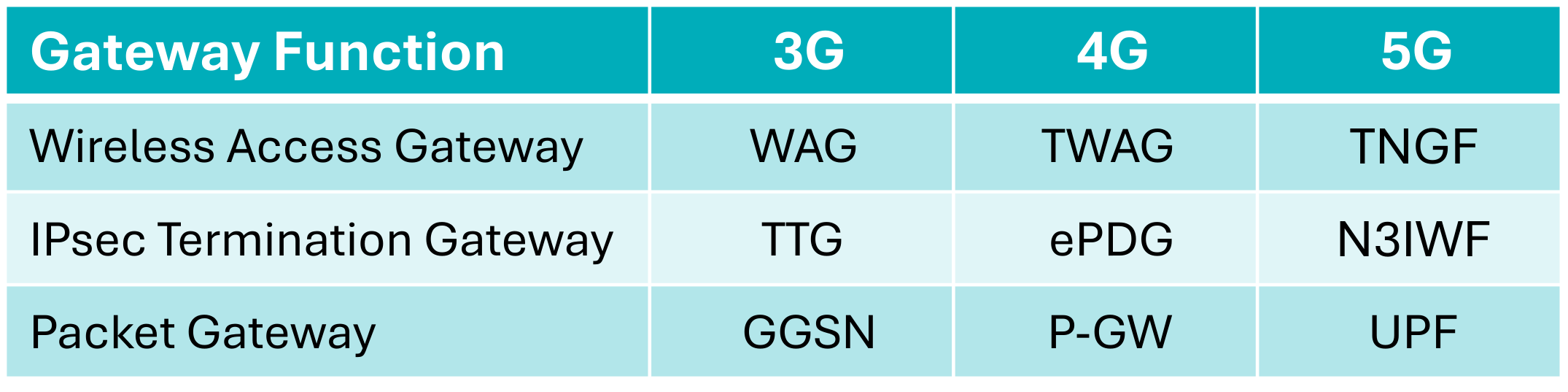
Please note that these are simply ‘functions’ that may be delivered as a combined solution with one or more nodes, deployed as containerized functions, or integrated into the same virtual or physical gateway node.
Trusted 3GPP Wi-Fi Access
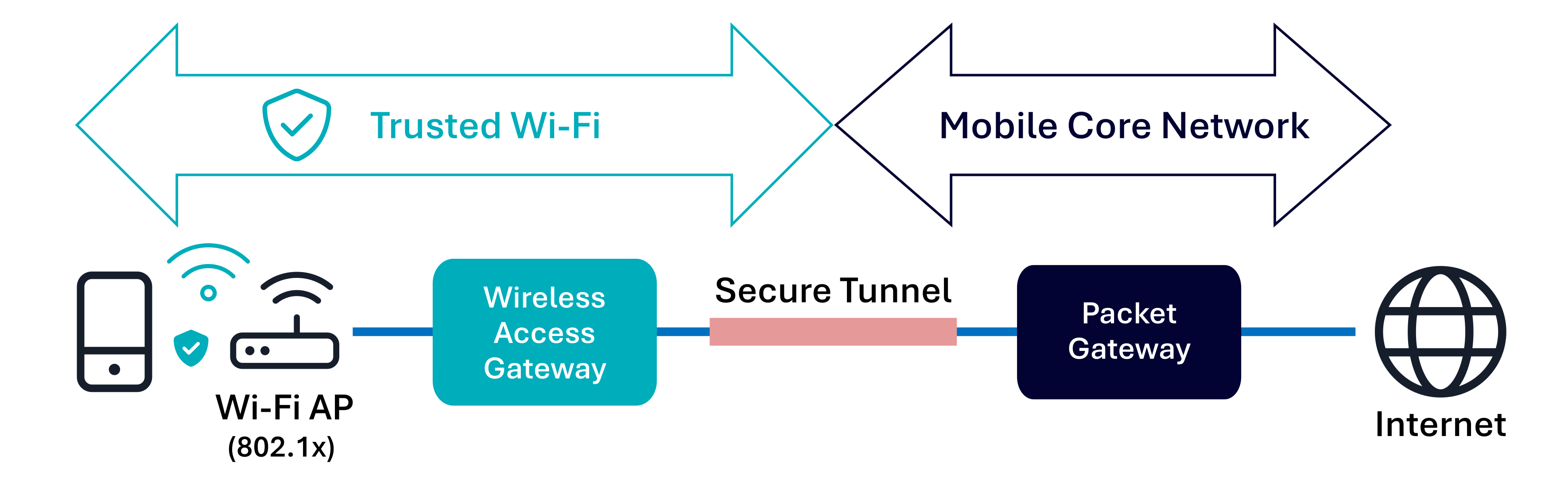
Trusted non-3GPP (Wi-Fi) access was first introduced with the LTE standard in 3GPP Release 8 (2008). Trusted access typically refers to operator-managed Wi-Fi networks that use encryption (enabled by 802.1x) within the Wi-Fi radio access network (RAN) and secure authentication methods like EAP.
In the case of trusted access, the user device (UE) connects through a Wireless Access Gateway (WAG/TWAG/TNGF/TWIF) in the Wi-Fi core. The gateway, in turn, establishes a secure tunnel directly with the Packet Gateway (GGSN/P-GW/UPF), which is also used for cellular traffic in the Mobile Core. For 5G standalone (5G SA) architectures, a null-encrypted tunnel is utilized between the device and the TNGF/TWIF—more details on this can be found in the Wi-Fi and 5G convergence section.
SIM authentication (EAP-SIM/AKA/AKA′ or 5G-AKA), performed by a 3GPP AAA server, is crucial for trusted non-3GPP access. Beyond authenticating, the device for access to the Wi-Fi network, it also generates cryptographic keys used for the Wi-Fi encryption (WPA2/WPA3).
Untrusted 3GPP Wi-Fi Access
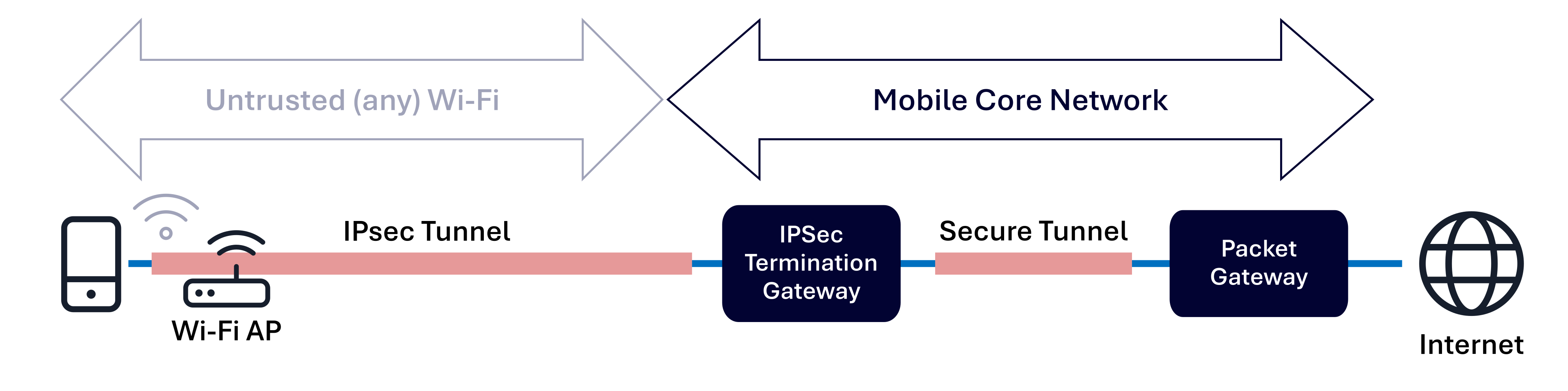
Untrusted non-3GPP (Wi-Fi) access was first introduced in the Wi-Fi specification of 3GPP Release 6 (2005). At that time, Wi-Fi access points with advanced security features were uncommon, so Wi-Fi was generally considered open and unsecured by default.
Untrusted access refers to any Wi-Fi network over which the operator has no control, including public hotspots, subscribers’ home Wi-Fi, and corporate Wi-Fi networks. This also encompasses Wi-Fi networks that lack adequate security mechanisms, such as EAP authentication and radio link encryption (802.1x enabling WPA2/WPA3-Enterprise encryption). Conversely, a Wi-Fi network using EAP and 802.1x outside the operator’s control, for instance, an Enterprise Wi-Fi network, is still considered untrusted.
The flexibility of untrusted non-3GPP access, which works over any Wi-Fi network, makes it the preferred method for services like Wi-Fi Calling (aka Voice over Wi-Fi).
The untrusted model requires no modifications to the Wi-Fi network itself but does impact the device side, as an IPsec client must be deployed natively on the device. The device connects through a secure IPsec tunnel directly to an IPsec Termination Gateway (TTG/ePDG/N3IWF) in the Mobile Core, which is then linked through an encrypted tunnel to the Packet Gateway (GGSN/P-GW/UPF), which handles both cellular and Wi-Fi traffic. This integration means that the device must interact with mobile core network components like the HLR/HSS/AUSF-UDM for SIM-based EAP authentication (EAP-SIM/AKA/AKA′ or 5G-AKA) to establish the IPsec tunnel, but not for granting Wi-Fi access. This ensures the same level of authentication security as in the cellular network.
Historically, not all standardized functions—like those defined in 3GPP—make it into real-world networks. Vendors and service providers only implement features when there are strong commercial incentives. The integration of Wi-Fi with 3G and 4G data planes is a prime example. Most mobile operators have implemented local break-out (LBO) for Wi-Fi traffic directly from their secure Wi-Fi networks (802.1x).
Without a compelling operational or commercial rationale for backhauling Wi-Fi traffic to the Mobile Core, operators have instead leveraged secure SIM-based authentication, often paired with policy control from the Mobile Core. This approach avoids adding unnecessary load to the Mobile Core, allowing operators to enforce policies locally through advanced service management systems like the Enea Aptilo SMP.
Mobile device vendors also play a critical role in determining what capabilities are implemented and what functionality that gets deployed into real-life services (Learn more about this in our recent post Wi-Fi Offloading and the Device). For instance, it took nearly a decade for device vendors to adopt the IPsec client required for untrusted Wi-Fi access. The motivation for this change materialized with the rise of Wi-Fi Calling, which served both the device manufacturers’ interests and the consumers. Backhauling Wi-Fi Traffic to the Mobile Core: Control vs. Efficiency In certain markets, some mobile operators choose to backhaul Wi-Fi traffic to the mobile core, mainly for perceived control and regulatory aspects. However, a vast majority (90%) prefer local traffic breakout due to cost and network optimization reasons.
The preference for local offloading is driven by the desire to minimize latency and reduce core network load. There are two primary reasons operators still consider backhauling traffic: Deep Packet Inspection (DPI): By routing traffic through the mobile core, operators can perform DPI to analyze and manage data flows. However, this can also be achieved outside the 3GPP standards using policy-based routing to a dedicated DPI function outside the mobile core. Policy Control, Quota Management, and Charging: Although these functions are managed in the mobile core, there is no strong justification for this approach. A well-integrated Wi-Fi service management system can handle policy enforcement, quota tracking, and charging locally within the Wi-Fi network while still maintaining alignment with the mobile core. Explore our solutions for local policy and charging integration. Learn More About Wi-Fi Offloading Architectures In the next upcoming white paper excerpts, we will cover the 3GPP specified architectures for Wi-Fi Offloading integrated with the Evolved Packet Core (EPC) and the 5G standalone mobile core (5G SA). If you don’t want to wait for these posts, go here for further insights on all the different Wi-Fi offloading architectures, and to learn why a standard 3GPP AAA function is not enough for effective Wi-Fi offloading.
Fixed Base Operators (FBOs) are the VIP terminals of the aviation world. Whether serving corporate executives, private charter passengers, or flight crews, FBOs are expected to deliver a premium experience—every time. And while amenities like leather lounges, valet services, and gourmet catering are front and center, there’s another element quietly shaping the customer experience and operational efficiency: Wi-Fi.
At 7SIGNAL, we’ve learned firsthand—through our work with some of the world’s busiest hubs like Atlanta’s Hartsfield-Jackson International Airport and Heathrow Airport in London that great Wi-Fi isn’t just a luxury in aviation. It’s an operational necessity.
The Digital Backbone of FBOs
FBOs may look like boutique lounges on the surface, but behind the scenes, they are complex operational environments. Pilots and crew rely on Wi-Fi for real-time weather updates, flight planning, and electronic manifests. Passengers expect fast, secure internet access for work or leisure, and increasingly, vendors—from catering to fuel services—depend on connected devices to stay in sync.
But FBOs face unique challenges:
The bottom line? When the Wi-Fi isn’t working, the entire operation feels it.
The Visibility Gap: Why Wi-Fi Problems Linger
Most FBOs—like many enterprises—rely on infrastructure tools that monitor the network from the inside-out. These solutions provide insight into hardware status or WAN availability, but they miss the most important perspective: the experience of the client device.
This is what we call the visibility gap and it’s where 7SIGNAL shines.
7SIGNAL: Built for the Edge of Aviation
7SIGNAL fills this critical gap with a unique outside-in approach to Wi-Fi and digital experience monitoring. Through a combination of software agents deployed on endpoint devices and cloud-managed sensors placed throughout facilities, 7SIGNAL gives IT teams complete visibility into how users and devices experience the wireless network—from the cockpit to the conference room.
For FBOs, this means:
Unlike other solutions, 7SIGNAL is vendor-agnostic, meaning it works across environments with Cisco Meraki, HPE Aruba, Extreme, or any other combination of networking gear. That’s crucial for FBOs, where network architecture can vary dramatically from one site to the next.
Real-World Proven, Globally Deployed
Our work with major global airports gives us the credibility and expertise to support FBOs of any size. At Atlanta Airport, one of the busiest in the world, 7SIGNAL helps ensure reliable Wi-Fi for millions of passengers and thousands of employees. At Heathrow, we support high-density environments where operational uptime is non-negotiable.
FBOs may not see the same foot traffic, but they serve customers who expect excellence—and who remember when technology fails them.
In an Always-On World, Wi-Fi Can’t Be an Afterthought
Whether it’s keeping a fueling operation online, ensuring a security camera is streaming, or helping a CEO download a presentation before takeoff, Wi-Fi is mission-critical for today’s FBOs. And with the rise of IoT devices, cellular failover, and cloud-based workflows, the complexity is only increasing.
7SIGNAL is purpose-built for these challenges. We empower IT teams with the visibility, control, and intelligence they need to deliver exceptional digital experiences—without needing to be on-site or in the dark.
If your FBO operations span dozens—or hundreds—of sites, and your team is still flying blind when it comes to Wi-Fi performance, it’s time to close the visibility gap with 7SIGNAL.

At Qorvo, we’re proud to lead the industry in high-performance RF filters—a title we work hard to earn every day. As spectrum becomes more crowded and devices grow smaller and more complex, filters must perform better than ever in less space.
We sat down with Gernot Fattinger, vice president of Global Operations Technology, to talk about how Qorvo is pushing the boundaries of filter innovation and why it matters to our customers across industries. His message was clear: filters are everywhere, and innovation is non-negotiable.
Q: Why are RF filters so important in today’s wireless world?
Gernot:Acoustic filters—specifically bulk acoustic wave (BAW) and surface acoustic wave (SAW)—are critical to virtually all wireless communication above 500 MHz, from smartphones and Wi-Fi networks to radar and Ultra-Wideband (UWB) applications.
Filters isolate and shape signals, allowing devices to connect faster, more reliably and more efficiently. Today’s premium smartphones contain nearly 100 filters, with Qorvo contributing across low-band, mid-band, high-band and ultra-high-band frequencies, and even Wi-Fi and UWB modules. However, filters aren’t just for mobile devices. They are essential for robust defense communications, aerospace, 5G base stations, the IoT and emerging wireless applications.
Q: What’s the latest innovation coming out of Qorvo’s filter technology?
Gernot: One of the biggest breakthroughs is our 7th generation BAW technology, also known as GEN7 BAW. GEN7 removes the cavity structure used in prior uBAW designs—a major step to shrinking size without compromising performance. GEN7 BAW is 30% smaller on average than its predecessor and offers better power handling, all while simplifying integration into compact modules. In short, we found a way to eliminate the cavity and can even place connections right on top of the resonator. This kind of innovation helps us deliver the performance our customers need.
Q: What about lower frequencies? Are you innovating there too?
Gernot: Absolutely. While BAW technology remains the predominant choice at higher frequencies, SAW filters play a vital role below 1.5 GHz, particularly in low-band applications, as well as for some specific mid-band frequencies. This is where our new low-loss resonator SAW (LRT-SAW) technology is leading the way. LRT-SAW delivers dramatically better performance than legacy SAW platforms, such as temperature-compensated SAW (TC-SAW). LRT-SAW enables sharper transitions and more efficient filtering—exactly what’s needed as more devices compete for low-band spectrum. I expect LRT-SAW to become the go-to solution for low-band frequencies and a critical component in future integrated modules. LRT-SAW will be Qorvo’s next crown jewel.
Q: What makes Qorvo’s approach to filter development different?
Gernot: Having our own BAW and SAW filter technologies isn’t just about performance — it’s a strategic advantage. We’re the only company manufacturing both SAW and BAW filters in the U.S., and our in-house technology gives us unmatched flexibility in how we build and integrate modules.
That matters more than ever, because the future is about integration. What used to be a few discrete parts has now evolved into highly integrated front-end modules. Soon, there will be one fully integrated RF front-end module per phone, containing every band and filter.
Final Thoughts
RF filters may be small, but their impact is massive. At Qorvo, our teams are already working on technologies that are five years ahead—and that will power products launching in 2030 and beyond. This is our commitment to helping our customers stay ahead with world-class technology, deep integration capabilities and relentless innovation across every band. Whether you’re building smartphones, defense systems, or the next-gen IoT device, Qorvo filters are built to power what’s next.
Explore surface acoustic wave (SAW) and bulk acoustic wave (BAW) technologies, how temperature affects filter performance, how multiplexers and antennaplexers help engineers create more complex wireless next-generation solutions and the secret of how RF filters help our many wireless devices coexist.

Unlike previous generations that focused on peak speeds, Wi-Fi 8 is all about reliability, intelligence, and context-aware networking. It’s designed to deliver ultra-high reliability, deterministic performance, and smarter traffic management—even in congested environments like busy homes, offices, and airports.
Here are some key takeaways from the white paper:
The white paper also outlines real-world use cases—from immersive XR collaboration and smart enterprise environments to AI-powered meeting rooms and connected homes. Whether you’re a gamer, a remote worker, or an enterprise IT manager, Wi-Fi 8 promises a more seamless and intelligent wireless experience.
Intel’s white paper doesn’t just scratch the surface—it provides a detailed technology overview, including multi-AP coordination, spectrum optimization, and power efficiency improvements. It’s a must-read for anyone looking to understand how Wi-Fi 8 will transform connectivity in the AI era.
The white paper is now available for download. Don’t miss your chance to explore the future of wireless networking with the industry’s most thorough guide to Wi-Fi 8.