







Breaking News

GLOBAL Wi-Fi NEWS bulletin

Houston-based company leverages the transformative, patented platform to deliver enhanced guest experience at Loews properties by 2027

HOUSTON (September 10, 2024) – WorldVue, a trusted provider of video, advanced connectivity and professional services to guest-centric properties worldwide, announced that they will be the designated in-room entertainment provider for Loews Hotels & Co properties by 2027. Four additional properties will be implemented this year, with the rest to follow throughout 2025 and beyond. Loews Hotels will eventually deploy the WorldVue HUB™ within its guest rooms, further enhancing the guest experience.

This new offering represents an significant advancement in in-room entertainment for New York based, Loews Hotels. WorldVue HUB™ will be integrated into 26 hotels, over the course of the next three years, including eight properties in Orlando, Florida. WorldVue first deployed the HUB™ platform at the Loews Arlington Hotel in early 2024 as a pilot property.

“We look forward to servicing every property within Loews Hotels & Co, a name that truly stands out for its exceptional service and dedication to customer satisfaction,” said David Goldstone, Executive Vice President and chief revenue officer at WorldVue. “At WorldVue, we are passionate about delivering top-notch service, providing Loews a dedicated contact in every department to ensure every installation and on-going support is treated with urgency and consistency.”

WorldVue HUB™ is a fully customizable in-room entertainment solution designed to enhance the brand and meet guests’ expectations, offering a comprehensive entertainment experience tailored to their preferences. From patented secured casting, streaming apps, events calendar, guest messaging, in-room checkout, live streaming of events, system integrations and more, WorldVue HUB™ helps hotel properties build brand loyalty, entertain guests and increase guest satisfaction.

Loews Hotels and WorldVue have been working together to integrate systems, Delphi and Cendyn, to implement automatic updates within the HUB digital compendium. These integrations will optimize processes and ensure data consistency by property such as providing groups with zoning and personalities, automatically update property amenity information, corporate event displays and more.

With WorldVue HUB™, guests will enjoy a seamless and personalized entertainment experience, enhancing their overall stay. This collaboration underscores WorldVue’s commitment to innovation in hospitality technology, setting a new standard for guest satisfaction and loyalty in the industry.

###

ABOUT WORLDVUE

WorldVue® is a trusted provider of video, advanced connectivity and professional services to properties and enterprises across the world. With a dedication to customer service, WorldVue is leading the way in delivering innovative technology solutions that enhance the resident, guest, and staff experience. From managed services to digital transformation, WorldVue is a single point of contact for all property technology needs.

Founded in 1975, WorldVue is a privately held company headquartered in the United States with offices in Canada, Mexico, United Kingdom, Netherlands, Dubai, Singapore and Australia. The company serves over 8,000 properties and over 980,000 rooms.


Media Contacts:

Sydney Holsclaw

[email protected]

Phase 3 Marketing & Communications

Ella Steele

[email protected]

WorldVue

New Nighthawk M7 Pro Mobile Hotspot Debuts at AT&T

San Jose, Calif. – Sept. 10, 2024 – NETGEAR®, Inc. (NASDAQ: NTGR), the leading provider of innovative and secure solutions for people to connect and manage their digital lives, today expanded its portfolio of high-performance WiFi 7 devices with the introduction of the Nighthawk M7 Pro Mobile Hotspot (MR7400). Based on NETGEAR’s nearly 30 years of pioneering network expertise, powered by the Qualcomm® Snapdragon™ SDX75 chipset and running on AT&T’s reliable 5G network, the M7 Pro provides flexible, high-speed connectivity for consumers and businesses anywhere, anytime.

Whether it’s working remotely, staying in touch with family and friends, or enjoying entertainment on the go, having a reliable, secure and fast internet connection anywhere can make a huge difference in productivity, convenience, and satisfaction. The Nighthawk M7 Pro Mobile Hotspot conveys the benefits of WiFi 7 and 5G technology, which offer faster speeds, lower latency, and better coverage than ever before. The M7 Pro provides a strong, reliable connection with 5G speeds of up to 6 Gbps[1]. With tri-band WiFi 7 and dual-band concurrent operation, it unleashes aggregated WiFi speeds of up to 5.8 Gbps[2].

“We’re raising the bar once again by packing secure, cutting-edge performance, based on our decades of experience, into an elegant pocket-sized package with the M7 Pro,” said David Henry, president & GM of Connected Home Products and Services at NETGEAR. “We’re proud to partner once again with AT&T 5G to unveil another world’s first and deliver an unparalleled solution for anyone who needs blazing fast, reliable WiFi anywhere they go.”

Powerful, secure connections on the go and at home

Consumers working from home or on the road, traveling for business or pleasure, can enjoy best-in-class technology that supports current and future 5G Sub-6 and effortless connections with any WiFi device whether it’s 5G compatible or not. On the road, traveling for business or pleasure, secure WiFi is imperative. Public WiFi, while convenient, is not secure and not worth risking confidential business information or a personal bank transfer. The M7 Pro provides a portable, private WiFi connection with a built-in firewall for up to 64 devices in any place that has cellular coverage. The hotspot makes 8K streaming, gaming and video conferencing virtually seamless and lag-free. In the home, it can be connected via the 2.5G internet port, act as a failover for a wired broadband connection, or integrate into an existing home router.

For businesses large and small

Perfect for small or remote offices, mobile businesses and pop-up locations, the new mobile hotspot is also ideal as a primary connection for businesses in the manufacturing, construction, health care and food and beverage industries, providing high-speed connectivity, scalability, flexibility and an enhanced customer experience. It can be an essential part of NETGEAR’s total network solution or integrated into existing business networking infrastructures using NETGEAR’s Insight Pro. Insight Pro facilitates simple device onboarding, configuration and management form a single pane of glass and comprehensive reporting, including devices usage, cellular signal strength, battery levels and more on all devices deployed.

Technical specifications

  • Powered by Qualcomm Snapdragon SDX75
  • Tri-Band WiFi 7 with dual-band dual concurrent operation
  • 5GHz + 6GHz concurrent support and bandwidth aggregation
  • Up to 2.5Gbps on-board ethernet
  • 5G Sub6(6CC)/300MHz, NR-CA
  • 4G LTE CAT20(5CC)
  • Battery – Removable 5040mAh Li-ion battery
  • External Ports (one USB Type-C, one 2.5GbE Port and two TS9 RF ports)

M7 Pro is enhanced by a vibrant 2.8-inch touch screen display and a removable 5040mAh Li-ion battery that provides up to 10 hours of usage. An omnidirectional MIMO antenna, sold separately, boosts performance indoors or in fringe network areas. Nighthawk M7 Pro Mobile Hotspot (MR7400) is available starting today for $449.99 on ATT.com. AT&T Enterprise Business customers can purchase the M7 Pro for $349.99 with a two-year agreement or $299.99 with a three-year agreement.

About NETGEAR, Inc.

NETGEAR® (NASDAQ: NTGR) has pioneered advanced networking technologies for homes, businesses, and service providers around the world since 1996 and leads the industry with a broad range of award-winning products designed to simplify and improve people’s lives. By enabling people to collaborate and connect to a world of information and entertainment, NETGEAR is dedicated to delivering innovative and advanced connected solutions ranging from mobile and cloud-based services for enhanced control and security, to smart networking products, video over Ethernet for Pro AV applications, easy-to-use WiFi solutions and performance gaming routers to enhance online game play. The company is headquartered out of San Jose, Calif. with offices located around the globe. More information is available from the NETGEAR Press Room or by calling (408) 907-8000. Connect with NETGEAR: Facebook, Instagram and the NETGEAR blog at NETGEAR.com.


©2024 NETGEAR, Inc. NETGEAR, NETGEAR Nighthawk, NETGEAR Insight and the NETGEAR logo are trademarks and/or registered trademarks of NETGEAR, Inc. and/or its affiliates in the United States and/or other countries. Other brand and product names are for identification purposes only and may be trademarks or registered trademarks of their respective holder(s). The information contained herein is subject to change without notice. NETGEAR shall not be liable for technical or editorial errors or omissions contained herein. All rights reserved.


Source: NETGEAR-G

U.S. Media Contact:

Valerie Motis

[email protected]

[email protected]

U.S. Sales Inquiries: (408) 907-8000, [email protected]


[1] This mobile hotspot has a maximum 5G speed of up to 7.5Gbps. Your actual speed will depend on multiple factors including (but not limited to) your ISP supporting at least 800MHz of 5G Sub-6, your ISP’s data plan restrictions, distance to your ISP’s 5G tower, network congestion, location of the mobile hotspot at your premise, and any obstructions between the mobile hotspot and your ISP’s 5G tower.


[2] Maximum wireless signal rate derived from IEEE 802.11 specifications. Actual data throughput and wireless coverage will vary and be lowered by network and environmental conditions, including network traffic volume, device limitations, and building construction. NETGEAR makes no representations or warranties about this product’s compatibility with future standards.

Manufacturing is an enormous, well-entrenched, mature market. Many of its business processes have been tried and true since time immemorial. However, a new wave of Edge Artificial Intelligence solutions has the potential to dramatically change how products are created.

With them, suppliers can streamline workflow, reduce delays, gain more insight into their operations, differentiate their services, and enhance customer satisfaction.

Manufacturing is a large global industry, generating trillions of dollars. Competition is intense, so suppliers are constantly searching for an advantage. IoT has already had a massive impact on efficiency, now Edge AI is on the brink of providing massive advantages in literally every part of their operation.

Edge AI’s Important Role in Industry 4.0

Edge AI is a key element in Industry 4.0, a movement that builds upon previous industrial revolutions by leveraging new technologies and creating smart factories and intelligent supply chains.

Industry 4.0 represents a big paradigm shift in manufacturing, enabling companies to achieve higher levels of efficiency, agility, and competitiveness, which are vital in today’s rapidly evolving global market.


Manufacturing is an Equipment Heavy Industry

Let’s take a closer look at this equipment. Manufacturers now have a wide and growing range of equipment that creates their products.

a) Industrial Robots: automated, programmable devices capable of movement on three or more axes. They are used in assembly, welding, painting, pick-and-place, packaging, labeling, inspecting, and testing.

b) Programmable Logic Controllers: specialized digital computers that control pieces of machinery.

c) Supervisory Control and Data Acquisition:  process, gather, and monitor real-time data, and interact directly with devices, like sensors, valves, pumps, and motors.

d) Centrifuge: uses centrifugal force to separate components of a mixture based on their density

e) Mixers: blend, mix, or homogenize various materials in the manufacturing process.

f) Drill Press: create holes in various materials, typically metal, wood, or plastic.

g) Conveyor Belts: mechanical material handling solutions that transport products and materials from one area to another. They are often used in factories, warehouses, and other industrial settings to move boxes, packages, and raw materials.

And many more. Traditionally, these devices had little to no intelligence. As microprocessor technology has shrunk in size and grown in capabilities, they have become smarter.

IoT was the first wave, enabling data to be collected from just about any device, process, motor or machine in the production line. This Big Data collection and analysis has allowed us to accurately predict equipment failures and take preventative measures to avoid them, and it has given factory managers countless other insights that help keep things running smoothly. However, storing big data in the Cloud and all the compute required to process it, isn’t cheap.

Edge computing is a game changer because it enables manufacturers to move data processing from large central servers to small intelligent devices. Edge AI takes this intelligence to another level by infusing IoT-enabled devices and equipment with on-board AI to filter, process, interpret and act up on the data they are collecting – without needing to pass so much, or any, data to the cloud, nor wait for insights or instructions from the Cloud. This is a significant evolution that will make factories even smarter, more efficient, and more flexible than ever before.


Benefits of IoT and Edge AI in Factories

IoT in manufacturing led to Big Data and analytics which enabled us to correlate information and gain insights into how their individual machines in a manufacturing plant are performing; and getting visibility on potential reliability issues or imminent failure.

With Edge AI on the horizon, new edge solutions are being designed to improve the efficiency and performance of manufacturing equipment further still.

Now Edge AI solutions can calculate machine vibrations, temperature, acceleration, displacement, and sound frequencies and more to determine the health of a motor or machine, and act upon that information autonomously – without needing to push large amounts of data to the cloud, or waiting for the cloud to interpret it, and suggest a course of action.


How IoT and Edge AI Edges Business Forward

1. Improved Operational Efficiency

Edge AI enables manufacturers to Increase efficiency. The solutions collect device data and leverage it immediately to gain unprecedented insights used to improve operations.

2. Predictive Maintenance

Equipment failures disrupt operations, sap productivity, and compromise safety. Real-time monitoring evaluates machinery performance around the clock. These systems use AI analytics to watch for potential problems. If anomalies arise, they alert personnel who can take swift action before failure occurs.

3. Enhanced Compliance

Manufacturers need to adhere to a wide range of industry and government regulations. Continuous monitoring of production processes provides them with the data needed to verify that their systems adhere to such standards.

4. Streamline Supply Chain

Analytics provide insights into demand, material availability, supplier performance, and logistic workflow. Management engages in proactive decision-making and is better able to balance resources to allocation, and adapt to market fluctuations. Manufacturers lower excess inventory, keep systems running longer and more efficiently, and streamline supply chain and manufacturing plant workflow.

5. Reduce Unplanned Downtime

When a system goes down, chaos ensues: interrupting manufacturing runs, disrupting supply chains, draining productivity, and creating safety hazards. With Edge AI solutions, manufacturers gain real-time data visibility into equipment performance and usage data so they address problems before they knock everything offline.

6. Asset Tracking

Materials constantly move through the supply chain, the manufacturing plant, and the distribution channel. Also, suppliers have on-site equipment that helps keep manufacturing processes moving forward. However, they don’t always know what is where. New edge AI solutions can provide them with the visibility to track these items in real time

7. Better Quality Control

Real time monitoring enables companies to detect defects throughout the production process. By overseeing production and detecting defects in real-time, manufacturers can adjust before faulty products come off the line. Suppliers lower the risk of making faulty products, saving money on costly recalls and repairs.


A New Manufacturing Era Emerges

In sum, Industry 4.0 represents a significant shift in how products are designed, manufactured, and delivered. It leverages advanced Edge AI to improve efficiency, productivity, and flexibility.

In fact, Edge AI will be everywhere and in just about everything going forward. Given the capabilities, the type of applications possible is virtually limitless. Manufacturing and industrial processes are being transformed through the integration of digital technologies. These new solutions enhance suppliers’ competitiveness, efficiency, and productivity. It changes how goods are produced, distributed, and serviced, improves quality, offers greater customization, and provides more responsiveness.

In essence, Industry 4.0 is ushering in an era of connectivity, advanced analytics, automation, and intelligent manufacturing that will transform the industry. Engineer and economist Klaus Schwab, founder and executive chairman of the World Economic Forum, said the scale, scope and complexity of Industry 4.0’s transformation will be unlike anything humankind has experienced. The speed and breadth of data becoming available forces suppliers to rethink and reimagine every part of their operation. Companies that embrace these technologies can gain a competitive edge and drive positive economic outcomes.


The Challenge of Creating Industry 4.0 Applications

While the benefits are game changing, manufacturers face challenges. Right now, these ideas are more theoretical than readily available. The infrastructure needed to support Edge AI applications is largely non-existent.

Creating such solutions is complex because they perform very sophisticated functions. To put it bluntly, most companies lack such expertise as well as the time, funding, and desire to develop Edge AI applications themselves.


Find the Right Partner

Manufacturers must build up the infrastructure before they can deploy applications that deliver Industry 4.0’s potential benefits. However, they cannot do it by themselves. The work requires an embedded systems firm with the know-how to develop software directly from the AI microprocessors the applications are intended to run on.

Such companies collaborate closely with silicon vendors, network equipment vendors, software suppliers, and AI experts, so they can deliver Edge AI solutions today. These embedded systems specialists pull functions together and adapt them for each customer, thus accelerating product development and reducing your time to market.

As an embedded systems company, embedUR has been at it for decades. We work closely with chip vendors and can help your organization realize Industry 4.0’s potential; edging ahead of your competition. Contact us to de-risk your Edge AI projects and accelerate time to market.

The WaveCore is a PTP (point-to-point) layer 2 Ethernet bridge that operates on PoE (power over Ethernet) or a 12V DC input. Testing with select customers earlier this year has shown results such as a 3Gbps connection through 8″ of concrete in the middle of a 54-foot link and a 4Gbps connection through a 12″ concrete wall in a garage that was in the middle of a 6-foot link.

Concrete walls average 20 cm / 8 in. or more in Commercial Real Estate (CRE) buildings around the world. These types of walls can form a building’s perimeter, serve as interior load bearing walls and as protection for spaces such as fire control or network server rooms. Connecting rooms or production areas separated by such walls can be even more problematic than connecting scores of Wi-Fi APs and other equipment in a wide open and spacious factory floor, as it often involves drilling a hole averaging 6″ in diameter through the wall, which is known as “core” drilling.

Furthermore, almost all floors in CRE structures are made up of concrete and rebar with a thickness of 4 to 5 inches minimum. To connect the floors, current practice consists of either routing cables to the nearest elevator riser shaft or existing riser or drilling through the floor.

In addition the WaveCore will prove useful in meeting connectivity requirements for fire control rooms. Such rooms are often located in the basement and surrounded by thick concrete walls. These rooms are mandated to have connectivity to the outside world (to the fire department and perhaps other first responder entities) and today typically use 3G connections. Unfortunately for building owners, 3G is now being phased out and 5G does not have the signal propagation to penetrate concrete walls and/or ceilings. Instead of core drilling to connect the outside world to the fire control system with a cable, a WaveCore link can deliver this connectivity cheaper and faster.

“We have proven with customers for more than a year now that the WaveTunnel provides cost-effective Gigabit-speed connectivity in MDUs, factories, warehouses, conference centers and other similarly large properties,” said Vivek Ragavan, CEO of Airvine. “However, we could not achieve the company’s founding vision of providing pervasive indoor wireless connectivity because we literally kept running into concrete barriers. The WaveCore system surmounts these obstacles and enables us to connect wirelessly any building with any floor plan anywhere.”

The combined WaveTunnel and WaveCore solution is managed by the VineSuite software platform, which facilitates network set-up and operation.

“We trialed the WaveCore bridge at one of our facilities and we were amazed by the ability of the WaveCore bridge to blow through several inches of concrete with a multi Gbps signal,” said JP Plouffe, Regional Vice President of CSI. “We can see where the WaveCore would save us considerable time and money when we need to connect adjacent rooms or areas separated by such a barrier.”

About Airvine
Airvine is a fast-growing Silicon Valley innovator of intelligent broadband wireless backhaul solutions for the enterprise. The company focuses on providing complete indoor wireless backbone systems in scenarios where cable or cable upgrades are too costly, too slow or may not be feasible at all. WaveTunnel is the industry’s first indoor 60 GHz wireless system that delivers multi-gigabit/sec data transfer rates without the complexity or cost of legacy solutions. Patented RF innovations extend the range and gain of wireless signals, penetrating walls and steering around obstacles that impede transmission—something never before possible within the 60 GHz band.

###

Media Contact
Dave Sumi
[email protected]

In my three-decade-long career, I have had the privilege of undergoing extensive training in various aspects of cybersecurity, network security, and computer forensics. With numerous certifications and over 900 hours of specialized training from the NSA and the National Cryptographic School (NCS), and more than 600 hours from the FBI and the FBI Academy in Computer Forensics, I have always been committed to staying at the forefront of this ever-evolving field. As a result, I’ve found that to be successful in cybersecurity, it is crucial to remain committed to continuous learning and stay aware of industry developments. That’s why I recently completed a course that stands out as one of the best I have ever taken: “Performing CyberOps Using Cisco Security Technologies” at Cisco University. I’d like to share my thoughts with you about the value it has added to skills set, and can add to yours as well.

The Cisco University experience

First off, Cisco University offers a plethora of courses designed to enhance your skills and knowledge in various networking, security domains, forensics, incident response and more. The great thing is you can join “Cisco U” for free, and they offer a massive amount of free courses offerings. So, you can dive right in without any expense. And although some courses do involve a fee, I have found they are well worth the expense.

Cisco University’s “Performing CyberOps Using Cisco Security Technologies” course was particularly exceptional. I learned so much. Despite the early mornings and late nights working around my day job, the experience was incredibly rewarding. The course was definitely challenging, but the knowledge and skills I gained were well worth the effort.

Why Cisco University training is Worth your time

Having accumulated a significant amount of training and certifications over the years, I can confidently say that Cisco University training programs are unparalleled. The “Performing CyberOps Using Cisco Security Technologies” course utilized Cisco’s security portfolio in a Security Operations Center (SOC) environment, making the learning experience both real and hands-on. This practical approach is what sets Cisco University training apart from others.

Cisco University provides engaging labs and learning through Cisco dCloud. The dCloud lab provided an unparalleled hands-on experience that helped bridge the gap between my theoretical knowledge and practical Security Operation Center (SOC) applications, playbook, and processes using the powerful Cisco Security Portfolio tools that Cisco uses in their SOC.

Cisco dCloud provided a dynamic, cloud-based platform where I was able to
access a wide array of preconfigured virtual environments tailored to both
the course content and the various Cisco security technologies and solutions.

This immersive learning environment allowed me to experiment with real-world
scenarios during the course, troubleshoot issues, and implement real security and
incident response solutions in a risk-free setting.

The virtual classroom instruction was fantastic, but by leveraging Cisco dCloud, I had the ability to gain invaluable experience that enhanced my understanding of complex concepts. The course prepared me for real-world challenges and will definitely help me in my everyday job.

My advice after taking this class is, whether you’re a seasoned security professional or new to the field, the interactive classes and labs on Cisco dCloud at Cisco University are an essential resource for deepening your expertise and staying ahead of adversaries with cybersecurity and incident response technologies.

Course highlights: Performing CyberOPS using Cisco security technologies

The course offered by Cisco University covered a wide range of topics essential for anyone involved in cybersecurity operations. The best part was that I got to use our great Cisco Security portfolio. Here are some of the key areas covered in the class that helped expand my skills set.

Threat hunting and incident response

What I learned at Cisco University: Threat hunting and incident response involve proactively searching for and identifying potential security threats within an organization’s network (threat hunting) and systematically addressing and mitigating security incidents when they occur (incident response). Threat hunting aims to uncover hidden threats that may have bypassed automated defenses, while incident response focuses on containing, eradicating, and recovering from detected security breaches. Together, these practices enhance an organization’s ability to detect, respond to, and prevent cyber threats effectively.

Performing CyberOPS using Cisco security technologies

What I learned at Cisco University: Performing CyberOPS using Cisco security technologies involved leveraging Cisco’s suite of security tools and solutions to conduct cybersecurity operations and incident response. This included monitoring, detecting, analyzing, and responding to security threats within an organization’s network. Utilizing Cisco’s advanced technologies, such as firewalls, intrusion detection systems, and security information and event management (SIEM) platforms and XDR, enhanced the effectiveness and efficiency of cybersecurity efforts, ensuring robust protection against cyber threats.

Performing incident investigations and response

What I learned at Cisco University: Performing incident investigations and response involved systematically examining security incidents to determine their cause, scope, and impact, followed by taking appropriate actions to mitigate and resolve the issue. This process included identifying the affected systems, collecting and analyzing evidence, containing the threat, eradicating the root cause, and recovering normal operations. I learned that effective incident investigations and response are crucial for minimizing damage, preventing recurrence, and improving an organization’s overall security posture.

Threat hunting basics

What I learned at Cisco University: Threat hunting basics involve the proactive search for cyber threats that may have evaded existing security defenses. This process includes using advanced techniques and tools to identify unusual patterns, behaviors, and indicators of compromise within an organization’s network. The goal is to detect and mitigate threats before they can cause significant harm. Mastery of these basics is essential for enhancing an organization’s security posture and staying ahead of potential attackers.

Threat investigations

What I learned at Cisco University: Threat investigations involve the systematic process of examining and analyzing potential security threats to determine their nature, origin, and impact. This includes gathering and analyzing data, identifying indicators of compromise, and understanding the tactics, techniques, and procedures (TTPs) used by threat actors. The goal is to uncover the full scope of the threat, mitigate its effects, and prevent future incidents. Effective threat investigations are crucial for maintaining an organization’s security and resilience against cyberattacks.

Malware forensics basics

What I learned at Cisco University: Malware forensics basics involve the fundamental techniques and methodologies used to analyze and investigate malicious software (malware). This includes identifying, isolating, and examining malware to understand its behavior, origin, and impact. The goal is to uncover how the malware operates, what it targets, and how it can be mitigated or removed. Mastery of these basics is essential for effectively responding to and recovering from malware incidents.

Performing security analytics and reports in a SOC

What I learned at Cisco University: Performing security analytics and reports in a SOC involves analyzing security data to identify trends, detect anomalies, and uncover potential threats. This process includes using advanced analytical tools and techniques to interpret data from various sources, such as network traffic, logs, and threat intelligence feeds. The findings are then compiled into comprehensive reports that provide insights into the organization’s security posture, helping to inform decision-making and improve overall security strategies.

Threat research and threat intelligence practices

What I learned at Cisco University: Threat research and threat intelligence practices involve the systematic study and analysis of cyber threats to gather actionable information about potential and existing security risks. This includes identifying threat actors, understanding their tactics, techniques, and procedures (TTPs), and monitoring emerging threats. The insights gained are used to inform and enhance an organization’s security posture, enabling proactive defense measures and more effective incident response.

Implementing threat tuning

What I learned at Cisco University: Implementing threat tuning involves adjusting and optimizing security tools and systems to improve their accuracy in detecting and responding to threats. This process includes fine-tuning detection rules, filters, and thresholds to reduce false positives and ensure that genuine threats are identified promptly. Effective threat tuning enhances the efficiency and effectiveness of a SOC by ensuring that security alerts are relevant and actionable.

Investigating endpoint appliance logs

What I learned at Cisco University: Investigating endpoint appliance logs involves analyzing the log data generated by endpoint devices, such as computers, mobile devices, and IoT devices, to identify and understand security events and incidents. This process helps in detecting anomalies, tracking malicious activities, and gathering evidence for incident response. Effective log investigation is crucial for maintaining endpoint security and ensuring the integrity and safety of an organization’s network.

SOC operations and processes

What I learned at Cisco University: SOC operations and processes encompass the day-to-day activities and workflows carried out within a SOC to monitor, detect, analyze, and respond to cybersecurity threats. These processes include threat detection, incident response, vulnerability management, and continuous monitoring of an organization’s IT environment. Effective SOC operations and processes are critical for maintaining robust security, minimizing the impact of security incidents, and ensuring the overall protection of an organization’s digital assets.

Understanding SOC development and deployment models

What I learned at Cisco University: SOC development and deployment models refer to the strategies and frameworks used to design, implement, and manage a SOC. This includes determining the SOC’s structure, operational processes, technology stack, and staffing requirements. Understanding these models is essential for creating an effective SOC that can efficiently monitor, detect, and respond to cybersecurity threats, tailored to the specific needs and resources of an organization.

Understanding APIs

What I learned at Cisco University: Application Programming Interfaces (APIs) are sets of rules and protocols that allow different software applications to communicate and interact with each other. APIs enable the integration of various systems and services, facilitating data exchange and functionality sharing. Understanding APIs is crucial for developing, managing, and securing applications, as they play a key role in enabling interoperability and enhancing the capabilities of software solutions.

Understanding cloud service model security

What I learned at Cisco University: Cloud service model security involves the strategies and practices used to protect data, applications, and infrastructure associated with different cloud service models—such as Infrastructure as a Service (IaaS), Platform as a Service (PaaS), and Software as a Service (SaaS). Each model has unique security requirements and responsibilities shared between the cloud service provider and the customer. Understanding these security measures is essential for ensuring data privacy, compliance, and protection against cyber threats in cloud environments.

Understanding analytical processes and Playbooks

What I learned at Cisco University: Analytical processes in cybersecurity involve systematically examining data to identify patterns, anomalies, and potential threats. These processes use various techniques, such as data mining, statistical analysis, and machine learning, to transform raw data into actionable insights. Understanding these processes is crucial for making informed decisions, improving threat detection, and enhancing overall security posture. Playbooks in cybersecurity are predefined, step-by-step guides that outline the procedures and best practices for responding to specific types of security incidents or threats. They provide a standardized approach to incident response, ensuring that actions are consistent, efficient, and effective. Playbooks help streamline operations, reduce response times, and improve coordination among security teams.

Understanding risk management and SOC operations

What I learned at Cisco University: Risk management in cybersecurity involves identifying, assessing, and prioritizing potential threats to an organization’s information assets. It includes implementing strategies to mitigate or manage these risks to ensure the confidentiality, integrity, and availability of data. Effective risk management helps organizations minimize the impact of security incidents and maintain business continuity. SOC operations refer to the processes and activities carried out within a SOC to monitor, detect, analyze, and respond to cybersecurity threats in real-time. SOC operations involve the use of advanced tools and technologies to ensure continuous surveillance of an organization’s IT infrastructure, enabling rapid incident response and threat mitigation to protect against cyberattacks.

Wrapping up: Final thoughts on Cisco University

If you are looking to elevate your cybersecurity, network security, forensics and/or incident response skills, Cisco University is the place to go. The “Performing CyberOps Using Cisco Security Technologies” course is a great example of the high-quality training that Cisco offers. It is challenging, rewarding, and incredibly informative. I highly recommend it to anyone serious about advancing their career in this very complex field.

Investing your time and effort in Cisco University training is undoubtedly worth it. The skills and knowledge you gain will not only enhance your professional capabilities but also prepare you to tackle all the hard challenges in the cybersecurity and computer forensics fields.

Well Connected

Everything from smartphones to blenders these days are WiFi-enabled and require internet connectivity. For smart WiFi to be effective, a network needs to determine how to identify and properly manage the device. Through years of experience, managing tens of millions of locations and billions of devices, Plume has built algorithms that can quickly and accurately determine device demands. This includes not just identification, but the technical assessment to inform how each device is handled, the necessary bandwidth and how to prioritize its position within the network traffic.

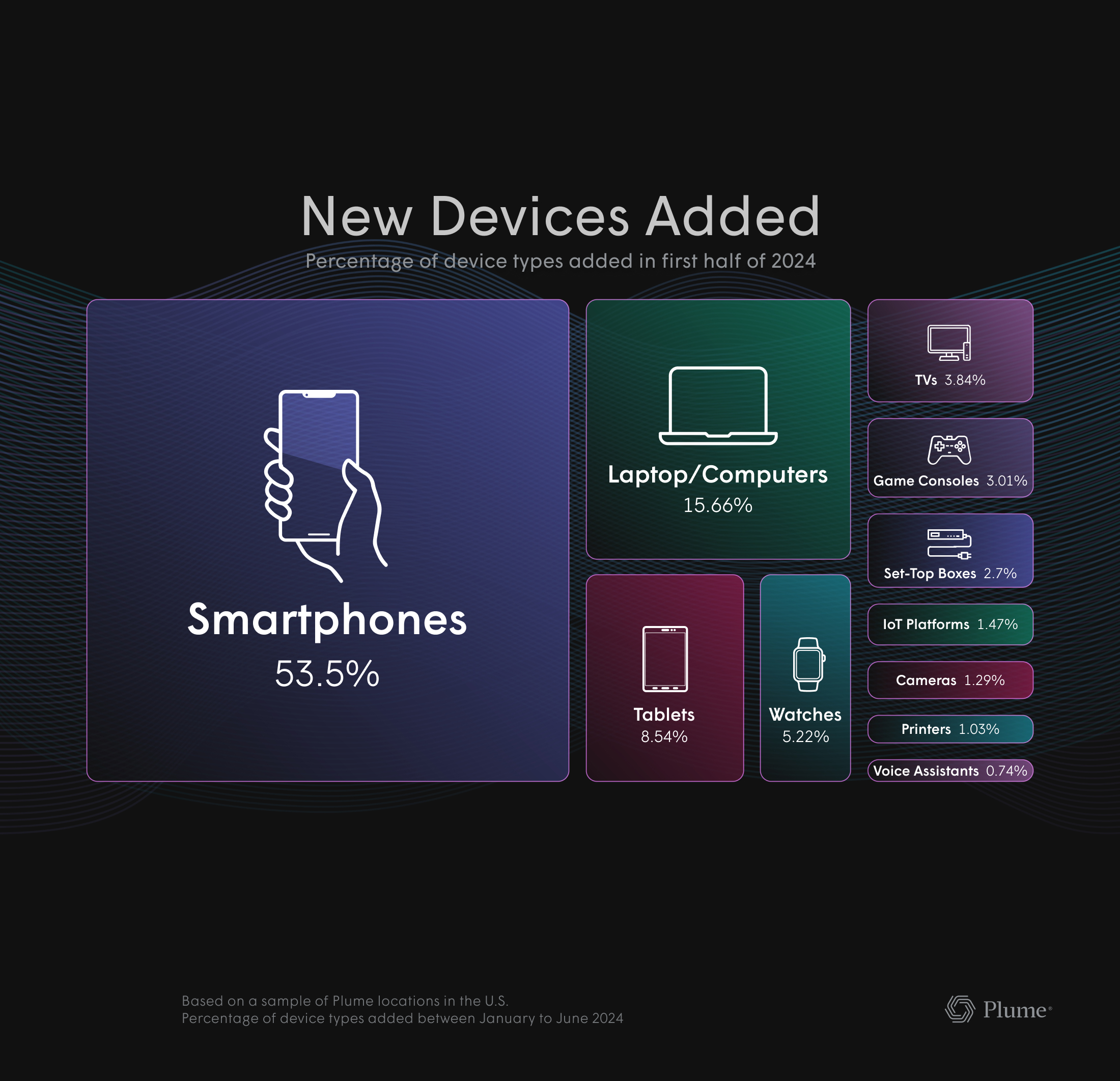
Every day, people add millions of new devices to Plume networks. In this Plume IQ, we are going to look at the devices added to Plume networks in the United States in the first half of this year.

The top device added? Smartphones, unsurprisingly. Over half (53.5%) of devices added in the first six months of the year were smartphones. Laptops and computers are in second place (15.7%) and then tablets (8.5%) are in the number three spot of added devices. After those three, comes a mix delineating how consumers interact with the internet. In descending order, the next devices are: watches (5.2%), televisions (3.8%), game consoles (3%), and set-top boxes (2.7%).

New devices added

Cameras, printers and voice assistants all show up on the list of new devices added – and at the bottom of the device list – blenders. But don’t let that deter any smoothie chefs out there – we see you.

Plume identifies dozens of different device types and the data evolves daily as it learns the demands of specific makes and models. All of this information allows for network management to become personalized in each location. Device detail all ladders up to a connected, smart and unparalleled experience.

Bell launches WorkPass

Bell announced the launch of its new Bell Business Wi-Fi App, designed to empower small businesses in Ontario and Québec with an enhanced Wi-Fi experience that combines improved security, customizable guest Wi-Fi, employee and customer data insights, and simplified network management.

The Bell Business Wi-Fi App with Bell pure fibre Internet provides tools and insights to help small businesses stay securely connected and manage their operations effectively, in addition to Wi-Fi access for employees and guests. A cloud-based platform designed in partnership with Plume, the app delivers an innovative, next-level experience.

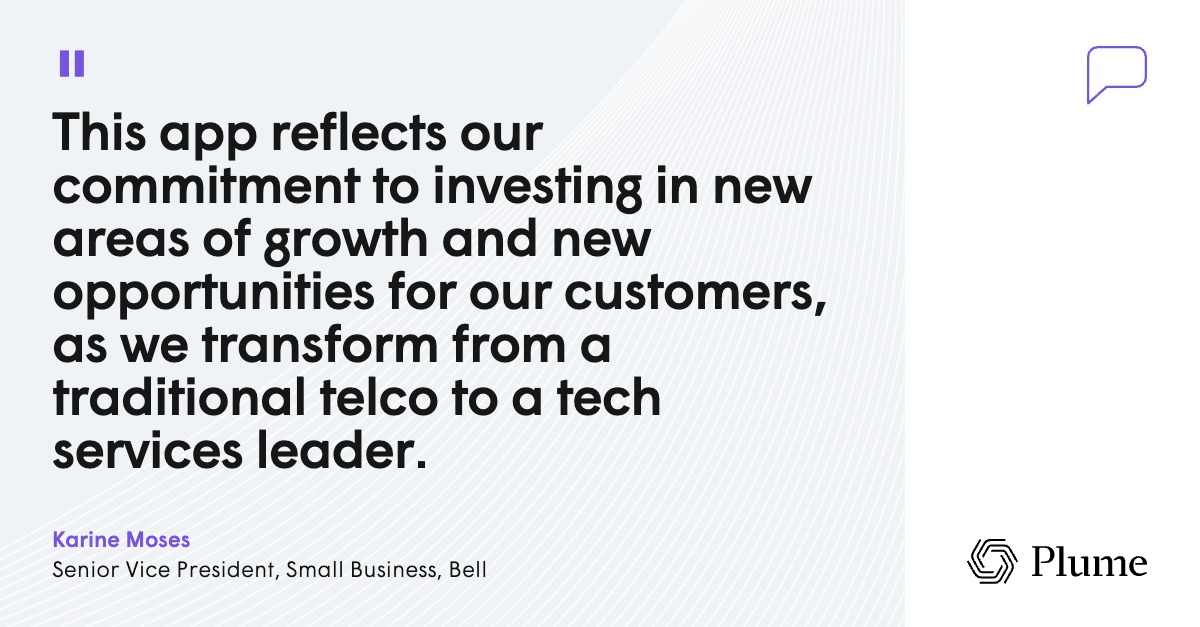
“We’re excited to launch the Bell Business Wi-Fi App, a powerful tool for small businesses. Powered by Canada’s fastest network, Bell pure fibre Internet, it offers innovative features to help small businesses thrive. This app reflects our commitment to investing in new areas of growth and new opportunities for our customers, as we transform from a traditional telco to a tech services leader.”

– Karine Moses, Senior Vice President, Small Business, Bell


Read more: Bell launches innovative Business Wi-Fi App, delivering a next-level experience for small businesses in Ontario and Québec on Canada’s fastest network

Award

WorkPass wins TMC 2024 Communications Solutions Products of the Year Award

Plume WorkPass was recently awarded with a Communications Solutions Product of the Year Award. The award honors exceptional products and services that enable, facilitate, and enhance voice, data, and video communications, and which were brought to market or greatly improved upon in the last twelve months.

See the list of TMC honorees here

News Roundup

“One of the things that we do to enhance corporate culture is to consistently engage and encourage our global remote teams. We connect outdoor activity throughout the year via Strava, and we frequently have employees engage in activities such as 29 minutes of outdoor activity a day for the 29 days of February. It’s a great way to do team building even though we are physically located all over the world.

For the upcoming #PlumeStrong Cycling Challenge in September we have several of our employees training to ride with us! You can check them out — and sponsor their fundraising efforts — here.”
– Jasna Mihelj Coustaury

More from Medium

If you’re installing products yourself, make sure they are both easy to install and simple to use. “The right smart home device should be simple to set up and fit into the existing ecosystem you may have,” says Matt Rosenberg of Plume Design, a company specializing in managed Wi-Fi services and network security.

More from Associated Press

Bell has launched its Bell Business Wi-Fi App for small businesses in Ontario and Quebec, which lets small businesses easily manage their network.

The Bell Business Wi-Fi App from California-based partner Plume, offers enhanced security with three separate Wi-Fi zones, providing increased protection for business, employee, and customer internet usage. It features an easy guest Wi-Fi experience with a customizable login portal.

More from iPhone in Canada

Bell Canada has launched a new app for business customers to help manage their Wi-Fi networks. Available in Ontario and Quebec, the Bell Business Wi-Fi App offers security controls to separate traffic from different users, customizable guest Wi-Fi access, employee and customer data insights, and network management tools such as pod installation and scheduled access. The app is aimed at business customers using Bell’s fibre broadband services. It was developed as a cloud-based platform with Plume.

More from Telecompaper

#PlumeStrong

The #PlumeStrong Cycling Challenge (#PSCC24) is on! Plume and its employees – with the help of generous corporate sponsors and individuals – are seeking to raise €1,000,000 to continue #PlumeStrong‘s mission to provide education and opportunity to communities in need.

#PSCC24 will be held from September 2-6, 2024. Our riders will begin in Zurich, Switzerland and finish in Venice, Italy. Returning #PlumeStrong Ambassador, three-time Tour de France champion, and recent winner of the Giro d’Italia, Tadej Pogačar, will join the ride for the first leg. Additional #PlumeStrong Ambassadors joining the ride include cyclists Urška Žigart, Scott Ogden and Marko Baloh.

Follow our #PSCC24 riders and all the updates from the ride on Instagram.
It’s not too late to sponsor our individual #PSCC24 riders here.
Bid on the new #PlumeStrong auction items here.
For more information and to donate directly to #PlumeStrong please visit our website.

In today’s connected world, reliable and secure Wi-Fi is a necessity, especially in Multi-Dwelling Units (MDUs) such as apartment complexes, condominiums, and student housing. Traditional Wi-Fi security methods often fall short in these environments, leading to potential security risks and management headaches. Enter Dynamic Pre-Shared Keys (dPSK aka iPSK aka xPSK aka mPSK etc), a game-changer for MDU Wi-Fi networks. Let’s explore the benefits of using DPSK in an MDU environment.

Enhanced Security

One of the primary benefits of DPSK is enhanced security. Unlike traditional Pre-Shared Keys (PSK), where a single key is shared among multiple users, DPSK assigns a unique key to each device. This means that even if one device’s key is compromised, the rest of the network remains secure. This individualized approach significantly reduces the risk of unauthorized access and potential data breaches.

Simplified Network Management

Managing a Wi-Fi network in an MDU can be challenging, especially when dealing with frequent tenant turnover. DPSK simplifies network management by allowing administrators to easily add or revoke access for individual devices without affecting the entire network. This flexibility is particularly useful in environments where residents frequently move in and out, such as student housing.

Improved User Experience

With DPSK, residents enjoy a seamless and secure Wi-Fi experience. Each device is assigned its own unique key, eliminating the need for residents to share a common password. This not only enhances security but also reduces the likelihood of connectivity issues caused by incorrect password entries. Additionally, residents can connect multiple devices without compromising network performance or security.

Scalability

As MDUs grow and the number of connected devices increases, scalability becomes a critical factor. DPSK offers a scalable solution that can accommodate a growing number of devices without compromising security or performance. This makes it an ideal choice for MDUs of all sizes, from small apartment buildings to large residential complexes.

Auto-Assigned VLANs

Another significant advantage of using DPSK in an MDU environment is the ability to auto-assign VLANs (Virtual Local Area Networks). With DPSK, each device can be automatically assigned to a specific VLAN based on its unique key. This allows for better network segmentation and management, ensuring that traffic from different devices or users is isolated and secure. Auto-assigned VLANs can help optimize network performance by reducing broadcast traffic and improving overall efficiency. Additionally, this feature enhances security by preventing unauthorized access between different VLANs, further protecting residents’ data and privacy.

Cost-Effective Solution

Implementing DPSK can also be a cost-effective solution for MDU operators. By reducing the need for complex network configurations and minimizing the risk of security breaches, DPSK can lower operational costs. Additionally, the simplified management process can free up IT resources, allowing them to focus on other critical tasks.

Conclusion

In conclusion, Wi-Fi Dynamic Pre-Shared Keys offer a robust and flexible solution for MDUs, addressing the unique challenges of these environments. By enhancing security, simplifying network management, improving user experience, and offering scalability, DPSK is a valuable tool for any MDU operator looking to provide reliable and secure Wi-Fi to their residents. GoZone’s SecurePass helps tenant self-signup and management of their own DPSK connections and also allows additional functionality such guest plans and payment for access. Talk to An Expert for more details.

Residential communities are undergoing a significant transformation driven by advancements in artificial intelligence (AI). From senior living to multifamily and mixed-use properties, AI is revolutionizing how we manage and interact with our living spaces. Staying abreast of these AI-driven trends is crucial for properties that want to remain competitive. Here, we explore ways AI can improve the resident experience while improving profitability and sustainability.

Enhancing the Resident Experience

As smart home devices become an integral part of modern living, AI offers opportunities to improve the daily living experience in MDUs. For example, AI-driven apps can help residents control lights, thermostats, and locks. They can even learn to adjust controls for individual spaces based on residents’ habits. This can help residents save money while improving convenience. It can also improve accessibility for seniors and people with disabilities by enabling them to adjust their environment without physically accessing on-wall devices.

AI-powered virtual assistants can help residents manage daily tasks, provide entertainment, and offer reminders. They can help coordinate the use of common spaces for resident events or act as a virtual concierge. In senior living communities, these assistants can remind residents to take medication or help them schedule appointments.

AI-driven chatbots can also help property managers with routine inquiries and maintenance requests. They can also keep residents informed on the status of repairs and other events. Chatbots ensure 24/7 availability for non-urgent requests, reducing the workload on staff and improving response times and resident satisfaction. This also enables staff to focus on personal interactions that need the “human touch.”

For enhanced security and safety, AI can improve features such as biometric access and smart surveillance. This can help ensure that only authorized individuals can access residences. With real-time monitoring and alerts, AI-based security solutions can alert staff quickly to unusual activity or potential emergencies, enabling faster responses.

For senior housing communities in particular, AI technology can help monitor residents’ health through wearable devices and smart home sensors. This can ease residents’ minds and lessen the burden on staff by providing ongoing information on residents’ health and safety without constant personal check-ins. It can also provide more detailed information to support personalized care plans.

Boosting Profitability

AI not only enhances the resident experience but can also boost the profitability of multifamily properties by optimizing operations. For example, AI solutions can use sensors and machine learning for predictive maintenance. By monitoring the performance and condition of appliances, plumbing, and utilities, these tools can schedule maintenance before a breakdown occurs, reducing downtime and repair costs. For example, an AI solution can alert maintenance staff if a toilet has begun leaking. A single leaky toilet can cost over $1000 per year, not including the cost of water damage – so this can save money as well as prevent headaches!

AI-driven optimization of energy use can also save money. For example, AI solutions can adjust thermostats and lighting systems in common areas. They can even take into account factors such as occupancy and weather conditions.

AI can also help improve profitability by analyzing market trends and demand to adjust rent prices dynamically. For example, factors such as local market conditions, historical pricing data, and current demand can help properties remain competitive while maximizing revenue. While managers can undoubtedly perform these types of calculations, AI-based solutions can potentially take into account more factors and update them more frequently to optimize pricing.

Similarly, AI-assisted analytics and machine learning can help spot opportunities in everything from marketing to operations. For example, by analyzing audience data, AI can suggest better ways to target and personalize messaging to prospects. Digital agents can jumpstart the leasing process by guiding prospects through their first inquiries. They can also screen prospective tenants and schedule property tours, ensuring leads aren’t missed. Some properties have also used AI to analyze operations and determine where hangups occur to streamline processes. There are even AI-based solutions for review management!

an apartment overlaid with icons suggesting AI-driven smart solutions for security, entertainment, energy, communications, and more

Driving Sustainability

Sustainability is becoming a selling point for modern residential communities. Many residents, especially in younger generations, say they prefer properties that support sustainable living. Green properties not only have lower operating costs but also command rent premiums. AI can help multifamily properties become more eco-friendly. For example, smart irrigation systems can adjust water usage based on weather forecasts and soil moisture levels. This enables properties to reduce water waste while maintaining beautiful landscapes.

As noted previously, AI solutions can also optimize heating, cooling, and lighting to minimize energy waste while decreasing operating costs. AI can even help with waste management by sorting out recycling. This assistance reduces the amount of waste sent to landfills while lessening the burden on residents.

Preparing Communities for AI

AI solutions are only part of what’s needed in modern housing communities. To support these solutions, it’s crucial to establish the right digital infrastructure.

Properties must invest in fast, reliable connectivity, including Wi-Fi and wired connections that can support the increasing number of connected devices. A property’s connectivity infrastructure needs to be able to accommodate not only devices pre-installed by the property, but also resident devices such as phones, TVs, gaming systems, and wearables. It also needs to perform well even when many residents are using it. Fiber provides a good foundation for AI-powered solutions and other connected devices. Properties will also need to ensure that their Wi-Fi architecture can handle the resulting traffic without degraded performance.

Because AI-enabled solutions can potentially collect personal and sensitive data, it’s essential that properties take action to preserve data security and privacy. Ideally, properties should implement cybersecurity at every stage, from designing and building products and systems to their implementation, use, and management, and even how staff respond when an attack is detected. It’s also important to ensure that managers make residents aware of what data these solutions collect and how systems will use that data.

It’s vital that everyone, from management and owners to staff, understand where AI excels and where it does not. AI will never be able to replace all facets of human interaction; there is a need to maintain a human connection with residents. To improve resident satisfaction, consider how best to achieve a balance between AI automation and human interaction. Also, be sure to review processes on an ongoing basis to ensure fairness and transparency, as AI can be as subject to biases as humans are.

AI is transforming multifamily and senior housing: Modern housing is smart housing. Residents are increasingly coming to expect the integration of smart solutions in their daily living environment. By investing in connectivity and security, you can set your property at the forefront of this digital revolution.

Property owners need to invest in a robust and secure connectivity infrastructure to support the continuing demand for connected technology in multifamily and senior housing. WorldVue is your trusted provider that can help you meet these growing needs. Give us a call to find out how our solutions can help you meet housing community technology trends for connectivity, infotainment, and more!

Today’s network infrastructures are undergoing a profound transformation, driven by the rapid proliferation of data and artificial intelligence (AI) at the edge. As agencies harness these technologies to their full potential, they face the critical challenge of modernizing their network infrastructures to be robust, scalable and agile.

Powering AI at the Edge with Modernized Network Infrastructure

This evolution is not merely about managing increased data volumes, but also about enabling smart, responsive and efficient operations across diverse environments. However, the journey toward network modernization requires careful navigation to avoid pitfalls that can lead to inefficiencies and increased costs. Misaligned investments and unvalidated network designs can derail modernization efforts. It’s crucial to select technologies tailored for the specific demands of AI at the edge and to validate network configuration designs to facilitate optimal network performance as data-driven devices increase.

This blog explores the insights and strategies outlined in Meritalk’s research study, “The Future of Connectivity,” which highlights the path to successful network transformation. By adopting a multivendor approach and prioritizing scalability, security, and innovation, federal networks can evolve into dynamic assets capable of meeting current challenges and adapting to future opportunities. As agencies navigate these complexities, solutions like those from RUCKUS are instrumental in building resilient, efficient network infrastructures designed to thrive in the era of AI at the edge.

Data Growth and AI at the Edge

According to the study, the explosion of data creation and consumption is driving network infrastructure modernization, necessitating a shift from centralized data center management to distributed edge computing. This approach places computing resources closer to where data is generated and utilized—facilitated by AI to enable real-time processing that minimizes latency and reduces bandwidth usage. This transformation mirrors the evolution seen in data centers moving to cloud computing. That is, in campus environments, there is a notable transition from traditional north-south traffic flows to east-west patterns. This shift reflects growing lateral data movement between devices and services within the network perimeter, fueled by collaborative AI-powered applications, internet of things (IoT) devices, and distributed computing. To keep pace with these changes, it’s critical for networks to efficiently manage complex, high-capacity traffic flows.

As the number of AI-powered applications and connected IoT devices soars, more advanced Wi-Fi technology will be essential to unlocking the full potential of these end devices. Federal agencies are also focusing on modernizing Wi-Fi networks to keep up with evolving technology and demands of AI at the edge. However, this process comes with inherent risks that, if not carefully managed, can lead to inefficiencies and increased costs. Understanding these risks is key to successfully navigating the complexities of network modernization.

Risk 1: Investing in the Right Technology

One of the top risks in modernizing a network is investing in technology that does not align with the agency’s long-term goals and security requirements. For example, choosing Wi-Fi 6 as a short-term solution may meet immediate bandwidth needs, but it could fall short in the long run due to limitations in spectrum efficiency and scalability. On the other hand, opting for Wi-Fi 6E, which utilizes the 6 GHz spectrum, could introduce complexities and require significant infrastructure upgrades like cabling and switching improvements. Despite offering increased bandwidth, Wi-Fi 6E is still considered a steppingstone technology and it does not provide the efficient use of the increased spectrum that Wi-Fi 7 provides. These limitations can lead to potential compatibility issues and shorter product life cycle.

Similarly, federal agencies considering the adoption of open-source operating systems should prioritize rigorous evaluation and robust security measures. While open-source systems offer customization, community support, and integration capabilities, concerns about security persist. Unlike closed-source systems with tightly controlled proprietary security measures, open-source operating systems may face challenges related to vulnerabilities and the ability to effectively respond to threats in a timely manner. Agencies seeking to enjoy the benefits of open-source openness and community collaboration should also confirm their solution’s ability to meet stringent security standards.

Finally, selecting a technology that cannot easily scale for future growth is an additional risk. As the number of computing devices at the edge multiplies, their network demands also increase—requiring technologies that can seamlessly accommodate additional users, devices, and data traffic. A Wi-Fi network that lacks scalability can become a bottleneck, leading to performance issues and necessitating costly overhauls. Agencies should choose a wireless technology that is inherently flexible (particularly with controller options) to adapt to a variety of deployments and administrative preferences. It is essential that the technology supports both centralized and distributed control models, allowing for tailored solutions that meet specific agency needs.

Risk 2: Design and Validation Challenges

Failing to adequately design and validate network configurations before implementation can also introduce risk. Poorly-positioned access points (APs) can result in coverage gaps or excessive interference, affecting network performance. For example, they could exacerbate co-channel interference issues due to the broader bandwidth, impacting overall reliability and user experience. Insufficient design validation may also overlook potential Wi-Fi issues such as signal attenuation in certain building materials, or unexpected environmental factors, necessitating costly adjustments post-deployment. Meticulous planning and testing can help agencies ensure optimal network performance and user satisfaction as data-driven devices populate the campus.

Importance of Planning

The risks associated with modernizing a Wi-Fi network underscore the importance of strategic planning and careful consideration of hardware and software technology choices. Investing in the wrong technology not only jeopardizes current operational efficiency but also sets the stage for future challenges, potentially requiring another round of costly refresh projects. Educating stakeholders is crucial to avoid short-sighted investments that do not align with a holistic view of the network and its future prospects—including advancements in AI, machine learning (ML), and edge computing enabled by advanced Wi-Fi solutions.

Furthermore, conducting an active site survey for Wi-Fi is essential to meet service-level agreements (SLAs) for high throughput and low latency. Surveys help determine the best locations and configurations for APs, minimizing coverage gaps and reducing co-channel interference. By thoroughly mapping the RF environment and analyzing potential obstructions, they can help anticipate and mitigate factors that could impair Wi-Fi performance and slow data flow at the edge.

AI and ML at the Core of RUCKUS

Despite the risks, agencies simply cannot plan for everything. Network environments are dynamic, and unanticipated challenges are inevitable. Poor planning or unforeseen circumstances can significantly impact network performance, but this is where AI and ML come into play. RUCKUS understands the unpredictability of network demands and has engineered its solutions to adapt and thrive in such conditions, maintaining peak performance in conditions where traditional networks might struggle.

  • BeamFlex+® patented adaptive antenna technology intelligently directs Wi-Fi signals toward client devices. Unlike static antenna systems, BeamFlex+ technology dynamically adjusts the signal path based on the client’s location and orientation. This capability is crucial in environments where devices are constantly moving—providing robust and reliable connectivity. Using AI and ML principles, BeamFlex+ technology continuously learns from the surrounding RF environment, optimizing signal direction and reducing packet loss. This results in enhanced network performance and a superior user experience, even in high-density and high-interference scenarios.
  • ChannelFly® software leverages AI and ML to optimize channel selection. Traditional networks often rely on static or manually-configured channels, which can lead to suboptimal performance as conditions change. ChannelFly software, however, dynamically analyzes the RF spectrum and predicts the best channels in real time. This proactive approach minimizes interference and maximizes throughput—providing a seamless, high-quality experience, particularly in congested environments where channel conditions can change rapidly.
  • For agencies that can utilize cloud-based solutions, RUCKUS extends its AI capabilities to the cloud. RUCKUS AI™ includes cloud-based radio resource management, which efficiently manages spectrum use by dynamically adjusting to environmental conditions. This cloud-based intelligence helps ensure optimal performance and efficient resource utilization across the network, making it ideal for complex deployments that require scalable, adaptable solutions.

RUCKUS is leading the charge in Wi-Fi innovation. RUCKUS® solutions are purpose-built to handle the heavy data flows and complex demands of modern applications. Our products are built to last and to be future-proof and ready to meet the needs of ongoing network modernization efforts. RUCKUS products with Wi-Fi 6 technology meet the rigorous demands of today’s high-data applications, providing reliable, high-speed connectivity. Likewise, RUCKUS is also at the forefront of Wi-Fi 7 advancements. Wi-Fi 7 introduces groundbreaking features like multi-link operation (MLO), which enables simultaneous transmission across multiple channels and bands—drastically improving throughput and reducing latency. Innovations like Punctured Transmission and the expanded 6 GHz band enhance spectral efficiency and data rates, making these technologies pivotal for AI at the edge applications that demand swift and reliable connectivity.

RUCKUS AI-driven solutions epitomize the concept of using AI to empower AI. By integrating sophisticated AI and ML technologies, RUCKUS not only meets today’s connectivity challenges but also anticipates and adapts to future demands.

The Future Is Edge-Centric

As AI continues to push data processing to the edge, Wi-Fi will become increasingly important. RUCKUS Wi-Fi stands at the forefront of this evolution with its advanced technologies and AI-driven features, uniquely positioned to meet the demands of this new era. Its purpose-built design for high capacity, low latency, and adaptive performance makes it the ideal choice for agencies looking to modernize their network infrastructure and harness the full potential of AI at the edge.

In “The Future of Connectivity,” Meritalk delves deeper into the strategies and insights essential for federal agencies embarking on the journey of network modernization. By adopting a multivendor approach and prioritizing scalability, security, and innovation, agencies can transform their networks into agile assets capable of supporting today’s challenges and anticipating tomorrow’s opportunities. This approach not only enhances operational efficiency but also prepares for the AI-driven future.

With RUCKUS, the future of wireless connectivity goes beyond technological progress; it represents leadership in creating a smarter, more connected world. Discover how RUCKUS solutions can assist your agency in modernizing its network and integrating AI at the edge. Contact our federal sales team to learn more.
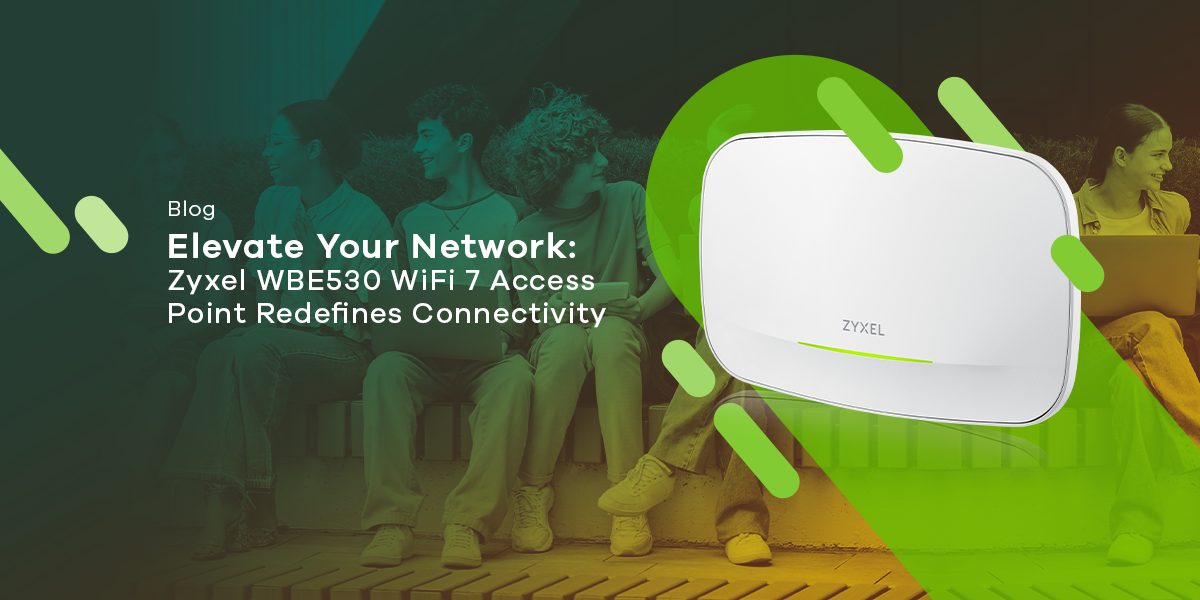
Imagine upgrading from a regular bicycle to a high-speed sports car—this is the leap you’ll experience with Zyxel’s WBE530 WiFi 7 Access Point. Just as a sports car delivers unmatched speed and performance on the road, the WBE530 transforms your network with incredible WiFi 7 speeds, expanded capacity, and cutting-edge security features.

Designed to meet the demands of modern educational environments and dynamic small businesses, the WBE530 ensures you’re equipped for the digital age. It’s like moving from a basic phone to the latest smartphone, where speed, reliability, and security are taken to new heights.

The WBE530 is powered by a Qualcomm quad-core CPU, delivering blazing-fast WiFi 7 data rates of up to 11Gbps and a substantial increase in capacity. This advanced technology is tailored to enhance online learning environments and support small business operations with unmatched efficiency and reliability.

Blog-2024-08-WBE530-1200x600

Enhanced by Zyxel’s Nebula platform, the WBE530 integrates a comprehensive suite of management and security features, providing robust connectivity and dependable performance. Nebula’s intelligent cloud management simplifies network installation and oversight, offering real-time notifications and a user-friendly interface, all without additional software or hardware costs.

With NebulaFlex Pro, the WBE530 offers unparalleled flexibility, allowing users to easily switch between cloud-managed, controller-managed, and standalone modes to fit their specific needs.

The Zyxel WBE530 WiFi 7 Access Point is more than just an upgrade—it’s a transformative leap in networking technology. Just as a sports car revolutionizes your driving experience, the WBE530 redefines your network’s speed, capacity, and security. Designed for modern educational settings and small businesses, this device offers the power and flexibility needed to excel in the digital age. With the advanced Qualcomm quad-core CPU and seamless integration with Zyxel’s Nebula platform, the WBE530 ensures that your network is prepared for today and ready for the future. Discover the difference and take your connectivity to the next level with the WBE530. For more info, click here.