
While public Wi-FI can be very convenient, both for users and providers, it also introduces a number of security challenges. Unsecured or under-secured public Wi-Fi networks can expose users to cyber threats like identity theft, financial fraud and data breaches. Once they are connected, attackers can monitor all traffic, extract sensitive data, and even inject and spread malware.
DNS queries are fundamental to the functionality of the internet; every time you access a website, you’re sending a DNS query. Some of these can be malicious. In fact, an average internet user might access as many as 5,000 DNS queries a day and up to five of those might be malicious. That’s equivalent to 1,825 incidents per year. A malicious query can be a wide range of activities, from phishing to ransomware to cryptojacking. Often, these queries take the form of redirecting traffic from a legitimate website to a similarly named malicious website.
This brings up a quandary: Today, offering public Wi-Fi is table stakes for places like hotels, airports and even restaurants. For these businesses, providing this service is part of the customer experience. Going to a hotel and discovering they don’t offer free public Wi-Fi is almost shocking. However, it comes with risks. Research from OnePoll found that public Wi-Fi at restaurants and cafes accounted for 25% of all personal data compromise, with airports at 23% and hotels at 20%.
The easy solution is to just not offer this service, but from a business standpoint, that’s not realistic. Ensuring you can provide safe, secure public Wi-Fi can protect your company and your customers. It can even become a competitive differentiator.
How do you do this? It starts with understanding the threats to these networks, with enough context that you can understand the most effective and affordable solution. It’s also key to understand some of the best practices to follow to keep public Wi-Fi use safe for your business and your end-users.
Public Wi-Fi networks have vulnerabilities that leave organizations open to many threats that can result in data breaches, theft of customer data and possible financial losses. To make these networks secure, organizations need to understand their many risks.
These are some of the biggest public Wi-Fi network threats:
There are proactive steps organizations can take to secure their public Wi-Fi. These steps create the foundation for a holistic security strategy to keep the network resistant to data breaches and an array of cyberattacks, and to keep customer data safe.
One step is to implement encryption standards.Use WPA3 for Wi-Fi networks or other robust encryption protocols to make sure that data sent via the network is encrypted. That makes data interception difficult for attackers.
Another step is web content filtering, which is crucial in blocking access to malicious content and sites that might jeopardize the Wi-Fi network’s security. Organizations can substantially lower their risk of breaches introduced via web browsing by filtering out phishing URLs and other known malicious sites and categories of sites that usually disseminate malware.
Installing firewalls is important, too, because they form a barricade between the internet and the public Wi-Fi network. They use predetermined security rules to observe traffic in both directions. If they are configured right, firewalls are good at preventing unauthorized access and some kinds of attacks.
Another step is to disable file sharing. This feature can be highly risky on public networks because it could let attackers directly access sensitive data or install malware. It involves turning off Bluetooth discovery and anything else that’s not essential. This helps make the attack surface as small as possible.
Finally, useVirtual Private Networks.They make encrypted tunnels that enable data to securely and privately pass between the network and the user. Mandating use of VPNs for those using public Wi-Fi will help safeguard data from hackers trying to grab sensitive data.
Public and guest Wi-Fi is a key service for today’s businesses (and other institutions) but these services represent massive risk as well. Public Wi-Fi must meet the same cybersecurity standards of any other business system. Many network threats lie in wait, and attacks continue to increase in sophistication and volume. Check the list of Wi-Fi security best practices noted above against your current practices, adjust and upgrade as needed. This will ensure a safe experience for your users and your network.

SAN JOSE, Calif.–(BUSINESS WIRE)–NETGEAR®, Inc. (NASDAQ: NTGR), the leader in advanced networking technologies for homes, businesses, and service providers around the world, today announced several new additions to its leadership bench. The new board member and executives follow the appointment of CJ Prober as NETGEAR’s CEO earlier this year, and join the robust group of accomplished leaders at NETGEAR.
“These talented executives bring incredible pedigrees, subject matter expertise and track records to our team. Collaborating with the rest of our talented team, they will contribute to delivering exceptional products and services to our customers across the globe,” said CJ Prober, Chief Executive Officer, NETGEAR. “As we look forward, these leaders will be instrumental in supporting the transformation of our businesses and driving long-term value creation for shareholders.”
Laura Orvidas joined the NETGEAR Board of Directors this month. She is the Chief Executive Officer of onXmaps, a leading consumer subscription company that helps inform, inspire, and empower outdoor enthusiasts. Prior to onX, Orvidas spent almost 18 years at Amazon in various positions before assuming the role of Vice President, Consumer Electronics, and Amazon Basics private label. Her consumer electronics and subscription experience will be instrumental to the future business transformation of NETGEAR.
Pramod Badjate brings his extensive experience in leading large networking businesses to his new role of President and GM of NETGEAR for Business. He invested his entire career in enterprise networking at Cisco, Ruckus Networks and, most recently, as the Group Vice President and General Manager for the Cognitive Campus business at Arista Networks. His invaluable experience as an engineering and product leader and proven track record as a general manager will help spur the continued growth of NETGEAR’s AV and IT businesses.
Kirsten Daru joins NETGEAR as the new General Counsel and Chief Privacy Officer with a strong background serving in similar roles with top technology companies. She spent over 11 years at Electronic Arts (EA) where she was appointed its first Chief Privacy Officer. After EA, she served as the General Counsel of Tile and when the company merged with Life360 she was appointed General Counsel of the combined company. She brings a reputation as a strategic leader to NETGEAR, focused on fostering a competitive marketplace where innovation can thrive.
Fiona Spratt steps into a new role at NETGEAR as the Senior Vice President of People, after being with the company for more than 10 years where she moved up the ranks of the HR department in Europe. She also successfully led the project to relocate NETGEAR’s international headquarters in Cork, Ireland, to accommodate a new software development center of excellence. In doing so, she played a critical role in helping the company to accelerate its transformation towards becoming more software-centric by leveraging the pipeline of diverse talent in Ireland. As a global leader, she will be responsible for helping to evolve NETGEAR’s culture for the benefit of current and future employees worldwide.
Antonio López Reus comes to NETGEAR as the new vice president of Strategy and Strategic Partnerships. He joins the company from Amazon, where he led revenue-generating partnerships for the Alexa Smart Home product line. Prior to Amazon, he managed Product Partnerships for Tile, bringing the technology to leading brands including Fitbit, Skullcandy, Google Home, and Alexa. Prior to his roles with Amazon and Tile, he led Asia-Pacific and Emerging Channels for Google Nest and was a Principal for the Boston Consulting Group. His wealth of experience and industry relationships will help NETGEAR discover and validate new opportunities for growth.
More information about the full NETGEAR executive team can be found here and the Board of Directors here.
About NETGEAR, Inc.
NETGEAR® (NASDAQ: NTGR) has pioneered advanced networking technologies for homes, businesses, and service providers around the world since 1996 and leads the industry with a broad range of award-winning products designed to simplify and improve people’s lives. By enabling people to collaborate and connect to a world of information and entertainment, NETGEAR is dedicated to delivering innovative and advanced connected solutions ranging from mobile and cloud-based services for enhanced control and security, to smart networking products, video over Ethernet for Pro AV applications, easy-to-use WiFi solutions and performance gaming routers to enhance online game play. The company is headquartered out of San Jose, Calif. with offices located around the globe. More information is available from the NETGEAR Press Room or by calling (408) 907-8000. Connect with NETGEAR: Facebook, Instagram and the NETGEAR blog at NETGEAR.com.
Delivering reliable Wi-Fi to remote locations like campgrounds, marinas, and farms has long been a challenge due to the limited availability and high cost of backhaul. However, WestEnd WiFi is now offering a groundbreaking solution by leveraging Starlink satellite broadband for backhaul and GoZone WiFi for comprehensive service management, including captive portals, analytics, and payment schemes.
WestEnd WiFi’s preconfigured package includes everything needed to set up a complete public or private Wi-Fi network. This package comprises a Starlink terminal, Ruckus (CommScope) access points, the GoZone WiFi platform, and peripheral equipment like a VPN for remote management. If necessary, additional equipment such as 60 GHz radios or Wi-Fi mesh can be included to further distribute the backhaul to more access points.
“This will make a huge difference for all places that are far from fixed network grids – and there are a large number of those right across the U.K. Starlink offers the ubiquitous backhaul that is otherwise difficult to procure, while GoZone WiFi delivers all the flexibility we need for creating Wi-Fi services, payment schemes, analytics, and more,” says Tim Belfall, Director at WestEnd WiFi.
In the UK, Starlink residential service provides up to 200 Mbps downlink and 20 Mbps uplink for £89 (about US$109) a month, with an initial hardware cost of £529 (about US$648). While these services are configured to work at a single location, they can be moved for an additional fee payable to Starlink. Full Wi-Fi services require suitable Wi-Fi APs and other equipment. For the complete equipment list, fill out the form below to download the case story document.
“The speeds may not sound like a lot, but they are very useful for many use cases. Add to this that it is possible to double or triple the data rates by aggregating several Starlink terminals using suitable channel bonding equipment,” Tim Belfall says. WestEnd WiFi has conducted extensive tests to verify performance and required equipment configurations. These test configurations and results are available in the case story paper.
GoZone WiFi CEO & founder Todd Myers emphasizes that the availability of backhaul, such as Starlink, opens up markets underserved with Wi-Fi. All public or private enterprise networks will benefit from GoZone WiFi’s service management, analytics, and marketing capabilities. “We’re excited to be part of the ecosystem delivering Wi-Fi to outlying areas together with WestEnd WiFi and offering the tools to make such networks profitable and sustainable. Wi-Fi should be for everyone, including tourists, businesses, and industry in remote locations,” says Todd Myers.
Implementing advanced captive portals in outdoor parks can significantly enhance the overall visitor experience and provide numerous benefits:
By incorporating advanced captive portals into their Wi-Fi service offerings, outdoor parks can create a more connected, engaging, and enjoyable environment for their visitors. GoZone WiFi’s platform, with its robust captive portal capabilities, provides the perfect solution for parks looking to enhance their Wi-Fi services and leverage the full potential of connectivity.

Bangkok, Thailand – July 25, 2024 – Wi-Fi Alliance® and Ramathibodi Hospital, Mahidol University successfully showcased next generation Wi-Fi® technologies that will transform the future of healthcare. This live demonstration presented sophisticated Wi-Fi virtual and augmented reality (AR/VR) use cases that require fast speeds, high throughput, and low latency, underscoring 6 GHz Wi-Fi’s ability to support high-quality digital infrastructure to enhance medical education and service delivery.
The demonstration – 6 GHz Wi-Fi in healthcare: the future of AR/VR use cases for medical applications – highlighted two use cases using only the three 160 MHz channels available in the lower 500 MHz (lower 6 GHz band) versus the seven channels available in the full 1200 MHz of the 6 GHz band (full 6 GHz band). The demo underscores the criticality of the full 6 GHz band for maintaining an optimal user experience under high network loads.
The demonstration highlighted the following key use cases:
Through mutual cooperation between Ramathibodi Hospital and Wi-Fi Alliance – along with Wi-Fi Alliance member partners Hewlett Packard Enterprise, Intel, and Meta – this initial demonstration phase of a multi-month long trial embraces 6 GHz Wi-Fi to enhance teaching and learning capabilities to doctors and medical students in the hospital.
Additional support is being provided by The National Broadcasting and Telecommunications Commission (NBTC) and United States Trade and Development Agency (USTDA), highlighting the socioeconomic impact of using full-spectrum 6 GHz Wi-Fi.
“Wi-Fi Alliance is proud to play a role in showcasing the tremendous opportunity of 6 GHz Wi-Fi to reshape healthcare,” said Kevin Robinson, President and CEO, Wi-Fi Alliance. “Today’s Wi-Fi offers a new level of performance and reliability, and these demonstrations are only a sampling of Wi-Fi’s potential impact on patient care and medical and operational efficiencies within healthcare environments.”
“By harnessing the power of 6 GHz Wi-Fi, we are making our facility more efficient and connected,” said Dr. Sithakom Phusanti, Assistant Dean for Policy and Planning Faculty of Medicine, Ramathibodi Hospital. “This demonstration is the next step toward enhancing our capabilities as a teaching hospital, and next generation Wi-Fi technologies will foster a new phase of learning and development.”
In addition to supporting critical use cases, 6 GHz Wi-Fi infrastructure provides a scalable, reliable network to ensure healthcare facilities are prepared for future advancements. The Ramathibodi Hospital deployment aims to serve as a model for nationwide adoption of next-generation Wi-Fi connectivity, highlighting the various ways that Wi-Fi will revolutionize and reshape the future healthcare. The project can be replicated around the world.
About Wi-Fi Alliance® | www.wi-fi.org
Wi-Fi Alliance® is the worldwide network of companies that brings you Wi-Fi®. Members of our collaboration forum come together from across the Wi-Fi ecosystem with the shared vision to connect everyone and everything, everywhere, while providing the best possible user experience. Since 2000, Wi-Fi Alliance has completed more than 80,000 Wi-Fi certifications. The Wi-Fi CERTIFIED™ seal of approval designates products with proven interoperability, backward compatibility, and the highest industry-standard security protections in place. Today, Wi-Fi carries more than half of the Internet’s traffic in an ever-expanding variety of applications. Wi-Fi Alliance continues to drive the adoption and evolution of Wi-Fi, which billions of people rely on every day.
Follow Wi-Fi Alliance:
wi-fi.org/beacon
wi-fi.org/signal
facebook.com/wificertified
twitter.com/wifialliance
linkedin.com/company/wi-fi-alliance
youtube.com/wifialliance
About Ramathibodi Hospital
The Faculty of Medicine Ramathibodi Hospital has a long-standing tradition of providing top-notch medical care. With a dedicated team of highly skilled healthcare professionals, the hospital offers a wide range of specialized services, from general practices to complex medical procedures. The institution’s unwavering commitment to patient-centered care ensures that each individual receives the highest standard of treatment in a compassionate and supportive environment. As a hub of medical research and innovation, the institute’s state-of-the-art research facilities and collaborative environment foster groundbreaking studies in various fields, including genomics, regenerative medicine, and public health.
In addition, the institution is also renowned for its comprehensive and forward-thinking educational programs by offering a wide array of undergraduate, graduate, and postgraduate courses designed to train the next generation of healthcare professionals. By integrating advanced technologies with AR/VR into the clinical anatomy curriculum, the hospital ensures that students receive hands-on, practical experience in a controlled and immersive setting.

MONTRÉAL, July 24, 2024 /CNW/ – Bell today announced the launch of its new Bell Business Wi-Fi App, designed to empower small businesses in Ontario and Québec with an enhanced Wi-Fi experience that combines improved security, customizable guest Wi-Fi, employee and customer data insights, and simplified network management.
Available now for small business owners in Ontario and Québec, the Bell Business Wi-Fi App is powered by Bell’s award-winning network. For the second year in a row, Bell’s pure fibre Internet has been named fastest in Canada in Ookla’s Q1-Q2 Speedtest Awards report2, the biannual analysis of wireline and wireless performance across the country. The report also ranks Bell pure fibre as fastest Wi-Fi in Canada3. With these new recognitions, Bell remains Canada’s most awarded Internet service provider.
The Bell Business Wi-Fi App with Bell pure fibre Internet provides tools and insights to help small businesses stay securely connected and manage their operations effectively, in addition to Wi-Fi access for employees and guests. A cloud-based platform designed in partnership with Plume, the app delivers an innovative next-level experience. Bell small business customers can expect:
For more details about the Bell Business Wi-Fi App, including pricing and eligibility, please visit Bell.ca/sbwifi.
As the demand for pervasive Wi-Fi on higher education campuses continues to grow, so does the pressure on IT teams. To reduce this burden, RUCKUS offers a suite of higher education tailored products and solutions. Read this blog to learn more about what RUCKUS has to offer your campus.

For colleges and universities, the need for reliable, high-speed connectivity across every corner of campus has never been more critical. From dormitories to auditoriums and everywhere in between, students, staff, and faculty expect seamless connectivity.
To alleviate the IT burden of meeting these demands, RUCKUS offers a suite of products specifically designed to address the unique needs of each campus area. In this blog, we will explore how RUCKUS empowers the digital experience across various campus environments.
Student Residences
Student residences are more than just a place for students to sleep—it is their home. Because of this, they expect seamless and safe connection for studying, streaming, and staying connected with peers and family. RUCKUS has products and solutions that can be tailored to each student’s unique needs.
Our access points (APs) deliver high-speed and high-density connectivity. Built with BeamFlex® and ChannelFly® technologies, these APs are designed to adjust Wi-Fi® signals to optimize performance, minimize interference, and assess network performance to choose the best available channel. This means students can seamlessly stream, study, and socialize uninterrupted, even in crowded residence halls. In addition to our APs, network administrators can utilize RUCKUS One™ and RUCKUS AI™ to manage student residence networks and proactively monitor potential issues to prevent network downtime.
Another game-changer for dormitories is the RUCKUS® Dynamic PSK™ (pre-shared keys) technology. Unlike traditional pre-shared keys that are shared among multiple users, ours give each user a unique encryption key, meaning each student gets their own secure connection and reduces the risk of unauthorized access. Our Dynamic PSK technology supports Wi-Fi on 6 GHz and WPA3™ and can be used on any device, such as speakers and gaming systems.
Lecture halls and classrooms
Lecture halls and classrooms are the heart of a college campus, so it is crucial that students have fast and uninterrupted connectivity for their learning. In addition to dorms, lecture halls are also the perfect environment for our APs, such as our Wi-Fi 7 indoor AP, the R770. Their BeamFlex technology adjusts Wi-Fi signals to focus directly on the users, while ChannelFly software optimizes channel selection to reduce congestion and enhance overall network performance. With RUCKUS APs, students’ learning is uninterrupted, and teachers can teach more effectively.
Even when the classroom isn’t being used, RUCKUS products can still improve campus efficiency. Our IoT Suite can create a responsive environment where heating and lighting are automatically adjusted based on real-time data. For example, when occupancy sensors detect that a lecture hall is empty, the systems will power down, which in turn reduces energy consumption and operational costs. Not only does this build a more sustainable campus, but it also saves money for your campus.
Safety across campus
Security technologies aren’t a new or groundbreaking concept when it comes to college technologies, but the RUCKUS difference is that these technologies can operate synergistically instead of in isolation. At the core of this are our APs, which provide connectivity for safety features, surveillance cameras, and user devices. The high bandwidth and low latency of a RUCKUS network helps these devices operate uninterrupted and makes security personnel able to respond quickly to any emergencies.
With the RUCKUS IoT Suite, devices such as smart locks, emergency call buttons, and environmental sensors can all be connected to the same network. Our IoT Suite enables these devices to communicate seamlessly and efficiently to enhance the safety of your campus.
An example of how this can all work interconnectedly is how our technologies react to someone trying to break into a residence hall at night. First, motion detectors identify movement at a time and place no one should be, and then our Wi-Fi-connected locks recognize that someone is trying to open doors without proper authorization. Because of this, the connected lights turn on, and smart surveillance can capture video of the person attempting to gain entry. If the person is a student or employee who has a device on them that is connected to Wi-Fi, the system will be able to detect who the owner of the device is. An alert will then be sent to campus security with real-time data and video so they can respond appropriately.
See it for yourself
We know that RUCKUS is the best choice for your campus, but don’t just take our word for it. With our higher education case studies, you can learn about how we have helped campuses across the world. Another great resource is our higher education brochure, which goes into more detail about our offerings for higher education.
When it comes to higher education, RUCKUS Networks is in a class of its own.
As companies strive to create greener and more ecologically conscious products and device ecosystems, the world of IoT is constantly adapting to embrace this shift. From smart home devices like locks and sensors, to industrial devices like factory monitoring equipment and machinery sensors, battery-less and low-power-consuming solutions are revolutionizing and reshaping the future of sustainable IoT.
The Problem with Batteries
The IoT is all about creating an inter-connected world; where innovative and intelligent devices interact seamlessly with each other to transform how we experience technology in our everyday lives.
However, every device needs to be powered to achieve this level of interconnectivity. While this power can have many sources, the most common and simplest source for IoT devices is a traditional battery.
So, what’s the problem? If traditional batteries are the simplest answer, why are consumers and device makers suddenly striving for a battery-less future?
Well, let’s get into it.
First, batteries are a menace to the environment. Not only is their disposal inconvenient, but improper disposal and recycling practices cause significant harm to ecosystems. Every year, more than 15 billion used batteries find their way to landfills. They contain acid and toxic metals like lead and mercury, which leads to the release of about 900,000 tons of hazardous, soil-and-groundwater-polluting waste into the environment.
Second, batteries have a limited lifespan. This requires constant replacing or recharging, which can be costly and time-consuming depending on the type of device, how much power it consumes, and how frequently the battery needs to be replaced or recharged. All of this adds up to the maintenance cost of the device.
Third, as the number of connected devices in a network is expected to grow rapidly, so will the number of batteries. The concept of IoT connectivity benefits relying on batteries threatens their adoption and scalability.
Ambient IoT – A New Class of Connected Devices
To address the challenges and drawbacks that batteries impose on smart connected devices, pioneers in IoT are now navigating their way into a new, energy-aware, battery-less future of connected devices. This realm of IoT, collectively referred to as Ambient IoT, aspires to achieve seamless connectivity without the environmental and functional implications that come with it.
What is Ambient IoT?
Ambient IoT refers to the class of connected IoT devices that harvest naturally available energy sources such as magnetic electric fields, light, thermal differential, kinetic energy, and vibration to power them. These sources, also referred to as Ambient sources of energy, can reduce the dependency on — and potentially even replace the need for — batteries, leading to products with flexible form-factors lower BOM costs and vastly longer product lifetimes.
An important term here is harvesting. Ambient IoT and Energy Harvesting are different yet related concepts. Energy Harvesting refers to the process of harnessing, transforming, and then storing energy from various ambient sources like solar power, RF waves, and physical vibration.
Ambient IoT leverages Energy Harvesting technologies to power a new era of devices targeting applications that rely on short-range, wireless connectivity. These applications include smart home devices like switches and locks, smart buildings, asset tracking, smart metering, and factory automation.
However, before we jump to these applications of Ambient IoT, let’s dig deeper into why energy-efficient solutions are not only essential to IoT but can also potential game-changers.
Why Should Designers Embrace Ambient IoT Designs?
With Ambient IoT, our beloved smart devices can now rely on natural sources of energy to draw power and maintain connectivity instead of relying on conventional batteries. These sources (like light, heat, motion, etc.) extend the device’s lifetime and notably reduce the detrimental impact that batteries have on the environment. But how is relying on these sources for power any better than relying on traditional batteries? Why is there a sudden shift to powering devices through renewable sources of energy? Well, there are quite a few reasons:
Enables a Greener Future for Customers
Not relying on batteries- or reducing the amount consumed by smart devices- contributes to a healthier ecosystem. As previously mentioned, improper battery recycling or disposal practices contaminate the environment by releasing toxic metals like lead, cadmium, mercury, and lithium.
Improves Scalability
An IoT solution is only as strong as its network size and scale of adoption. Having a denser and more reliable network can potentially increase the range and frequency of communication between devices. For example, communicating with nearby gateways is important in asset tracking to ensure better traceability and reduce the risk of losing valuables. Another example is a smart building and how its energy rating can be improved if more sensors are deployed. If each of these sensors requires a battery cost and replacement, the benefits at scale are diminished. Integrating battery-less nodes into the network can help mitigate this problem. Additionally, the constant need for battery replacements increases demand, and when the supply cannot keep up with this rising demand, it causes scalability issues.
Helps with Long-Term Cost Savings
Not relying on traditional batteries to power your device can impact the BoM) cost in quite a few ways. On one hand, it may decrease this cost by eliminating the need to constantly replace batteries. On the other hand, it could also increase the BoM cost as energy harvesting components like Integrated power management systems may be more expensive to install than traditional batteries. However, the long-term cost savings from reduced maintenance and extended lifespan of battery-less devices often outweigh the initial increase in the cost of developing these devices.
Additionally, traditional batteries must regularly be replaced or recharged. This maintenance is not only time-consuming but also adds to the overall cost associated with owning and maintaining a smart device. In the US alone, an average household buys over 90 batteries annually, and most of them do not even have a 10-year lifetime.
Fosters Innovation
Battery-less architecture allows for a more compact device by eliminating the need for the previously reserved socket for traditional batteries. This is particularly beneficial for devices like wearables and implanted medical devices where size and weight are essential considerations. This battery-less design also helps create more durable devices, eliminating the risks associated with battery degradation and failure. Additionally, the saved hardware space can also be used to add more peripherals, driving innovations in the boards’ physical design and technical features. This push towards battery-less devices also serves as a catalyst for the development of eco-friendly and sustainable innovations in IoT.
Unlocks New Use Cases
By fostering innovation, Ambient IoT can also unlock new use cases that would not have been convenient to implement with a battery-reliant architecture. For example, in smart agriculture, applications for crop management that are installed in greenhouses are very difficult to replace after installation. They require sensors to be installed all over the field, and having to replace the batteries in these sensors is time-consuming, labor-intensive, and costly. The notion of running wires to power these systems is even more impractical because they are prone to breaking due to the harsh conditions of the application. The abundance of solar power in a greenhouse or the vast amount of vibration created on machinery can easily be harvested to power these sensors.
While all these advantages make a great case for Ambient IoT, relying on natural sources to power smart devices also poses some challenges. An ambient IoT source can only produce limited amounts of power compared to traditional batteries. This makes them more suitable for smart devices that consume low to moderate amounts of power. Furthermore, Ambient IoT is best suited for devices that are designed for a specific function like beaconing, brief periodic advertisement, or intermittent connections to a gateway for data logging status and have low reconfigurability. This is also because of the limited power supply from energy efficient methods. However, these types of devices have the ability to be energy conscious and therefore make energy-awareness based decisions dynamically. For instance, based on available energy, an IoT radio may choose to shorten its payload and interval and instead opt to remain in a deeper sleep mode for longer while it regenerates more energy.
Ambient IoT Applications
With Ambient IoT, developers can now build devices using an energy-friendly platform that minimizes power consumption, improves device longevity, and decreases the device’s reliance on traditional batteries. Many current IoT applications can potentially switch to ambient and power-optimized solutions.
Some other key applications include tire pressure monitor sensors (TPMS), ESLs, factory automation, and predictive maintenance machine monitoring using vibration and thermal energy harvesting.
Silicon Labs and Ambient IoT
As we venture into a more connected and intelligent future of smart devices, it is important that leaders in IoT do not fall behind in this shift. It is imperative for experts and companies to invest time and resources into Ambient IoT and other energy-efficient solutions and stay ahead of the curve to meet their ESG goals. This will help us navigate a more sustainable future of IoT and help us strike a balance between technological advancements and environmental sustainability.
At Silicon Labs, it is our mission to enable wirelessly connected devices that transform industries all over the world. Achieving seamless inter-connectivity in an increasingly digital world is our utmost priority. To help ensure the future of IoT is ecologically responsible, we have now optimized our xG22 line of SoCs (BG22E SoC, MG22E SoC, and FG22E SoC) to include features that will support energy harvesting.
With a dual Cortex-M33 and Cortex M0+ radio core, the xG22E is our most energy-friendly SoC to date. It is the ideal choice for developers who are looking to build low-power consuming, high performing smart devices, that function on a battery-optimized, energy-efficient platform. It is the ideal choice for device-makers looking to implement a solution that offers an ultra-fast, low-energy cold start, low-energy deep-sleep wake up, and efficient energy mode transitions that mitigate harmful current spikes and prevent damage to the storage cells.
In addition to our radio board and xG22E Explorer Kit, we are e-peas , an industry leading provider of PMIC, to develop an Explorer Kit Shield. This kit consists of the Explorer Kit and 3 shields that fit onto the Explorer Kit board. The first shield allows for experimentation with alternative battery chemistries and supercapacitors, the second shield is dedicated for kinetic/pulse harvest applications, and the third shield allows developers to experiment with dual harvest sources simultaneously.
ANAHEIM, California (July 15, 2024) Zyxel Networks, a leader in delivering secure, AI- and cloud-powered business and home networking solutions, announced today that CRN®, a brand of The Channel Company, has recognized the company as a finalist in two categories in the 2024 CRN Tech Innovator Awards. Zyxel’s WBE660S BE22000 WiFi 7 Triple-Radio NebulaFlex Pro Access Point has been named as a finalist in the Wireless Networking category and the USG FLEX 700H Security Firewall Appliance is a finalist in the Security category.
This annual award showcases innovative vendors in the IT channel across 37 distinct technology categories ranging from cloud to storage to networking to security. The 2024 winners were selected by a panel of CRN editors who reviewed hundreds of vendor entries and solution provider testimonials. Standout innovations were determined using multiple criteria, including key capabilities, uniqueness, technological ingenuity, and ability to address customer and partner needs.
The first shipping WiFi 7 access point designed for the SMB market, WBE660S BE22000 WiFi 7 Triple-Radio NebulaFlex Pro Access Point incorporates Smart Antenna technology. Equipped with a 10G Ethernet uplink to translate the BE22000-class wireless speeds into wired speeds on the network, WBE660S can be managed as a standalone device or as a component of a complete network of Nebula-compatible access points, firewalls, and switches using the intuitive Nebula Control Center.
USG FLEX 700H Security Firewall Appliance is a multi-gigabit 2.5G and 10G port advanced security firewall with built-in 30W PoE+ for high-speed UTM threat protection that supports increased WAN speeds without compromising network security. Easily managed via the Nebula Cloud Management System, USG FLEX 700H incorporates a complete suite of security services including anti-malware, intrusion prevention system (IPS), application patrol, web filtering, reputation filter, SecuReporter, sandboxing, device insight, and Secure WiFi.
“It is an honor to be recognized as a finalist in two categories this year as this validates our ongoing efforts to bring to market solutions that enhance the capabilities and productivity for SMBs, and expand growth opportunities for our partners,” explained David Soares, Executive Vice President Channel Sales and Marketing North America for Zyxel Networks. “WBE660S and USG FLEX 700H are designed to bring enterprise-class speed, performance, and security down to an SMB price point, and enable our partners to meet the evolving networking requirements of their customers.”
The CRN Tech Innovator Awards finalists are featured online at crn.com/techinnovators.
For more information about Zyxel, its connectivity solutions, and the Zyxel Authorized Partner Program, visit www.zyxel.com/us and follow us on Facebook, X(formerly Twitter) and LinkedIn.
About Zyxel:
Zyxel Networks is a technology provider with over 30 years of experience, specializing in delivering solutions for small to medium-sized businesses and the enterprise-edge in partnership with VARs, MSPs and System Integrators. We enable network professionals to connect and protect organizations with greater ease by bringing together intuitive, scalable and secure cloud management with a complete portfolio of network devices.
We are thrilled to introduce the newest member of the Orbi family – the Orbi 770 Series Mesh WiFi 7 System. Shop Orbi 770 Series Now
The latest in the Orbi WiFi 7 line-up offers unreal WiFi performance at an unprecedented value. Never has whole-home WiFi been as important as it is in today’s connected world, where home networks, guest networks, and smart home IoT devices all must work in sync together. So if you’re ready to leave slow, unreliable internet and WiFi dead zones behind, the Orbi 770 Series WiFi 7 Mesh System is the perfect solution for you.
IN THIS ARTICLE
Orbi 770: WiFi Reimagined
The whole-home coverage and performance from the Orbi 770 Series Mesh WiFi System redefines NETGEAR’s home WiFi offerings with its game-changing value. The average US household today has more than 20 connected devices, all vying for faster speeds and a seamless networking experience for streaming, gaming, and video conferencing, along with running a range of WiFi-enabled smart home applications. NETGEAR’s latest offering, the budget-friendly Orbi 770 Series Whole-Home Mesh WiFi 7 system, is the future-proofed way for your family to experience the best WiFi on the planet.

Flawless Whole-Home WiFi 7
WiFi 7 (IEEE 802.11be), also called EHT for Extremely High Throughput, is the latest WiFi standard that offers significant improvements compared to WiFi 6E, WiFi 6, and WiFi 5. WiFi 7 delivers faster speeds, lower latency, more capacity, and improved network and device reliability. The Orbi 770 Series delivers tri-band whole-home WiFi 7 and provides next-level connectivity, blanketing your home with blazing-fast internet – upstairs, downstairs, in the backyard, or by the pool.
This Orbi Whole-home WiFi 7 system includes the main mesh router and multiple satellites with optimized antennas. The router and satellites communicate wirelessly to deliver seamless WiFi to every nook and corner of your home, especially in WiFi dead zones. With an Orbi 770 Series WiFi mesh network, everyone can enjoy their personal internet connection for work or play, without buffering or lag. Orbi 770 Series Mesh System makes whole-home WiFi coverage a reality.
Transformative NETGEAR WiFi 7 Router Technologies
Each WiFi band (2.4GHz, 5GHz, 6GHz) is broken into channels. WiFi 6E, for example, supports 60 channels that can be as wide as 160 MHz WiFi 7 doubles the capacity by supporting wireless channels up to 320 MHz wide. A simple analogy: Orbi 770 WiFi 7 is like a 6-lane superhighway, while earlier WiFi standards are limited with only a few slower WiFi lanes can easily become congested WiFi traffic jams with slower WiFi speeds and buffering stop-start progress. Wider WiFi 7 channels allow more data to be transmitted unimpeded at multi-gig speeds. Orbi 770 series is a tri-band WiFi mesh system with that offers strong connectivity for all your network devices in all 3 frequency bands.
Another exciting WiFi 7 technology is Multi-Link Operation (MLO). While previous WiFi standards establish connections between devices on a single band (2.4GHz, 5GHz, or 6GHz), Orbi 770 WiFi 7 MLO can combine several bands into a single connection. MLO enables wider channels capable of transmitting more data and mitigates the limited WiFi range associated with higher frequency bands, allowing WiFi 7 mesh to seamlessly connect to your devices as you move around the home.

Higher QAM
Quadrature Amplitude Modulation (QAM) transmits and receives data in radio-frequency waves. With higher performance amplitude modulation support of WiFi 7 – more data is packed in to each transmission. Orbi 770 WiFi 7 supports 4K QAM, WiFi 6 supports 1,024 QAM, and WiFi 5 is limited to 256 QAM. WiFi 7 delivers a 20 percent increase in peak performance compared to WiFi 6.
Expansive Coverage and Connectivity
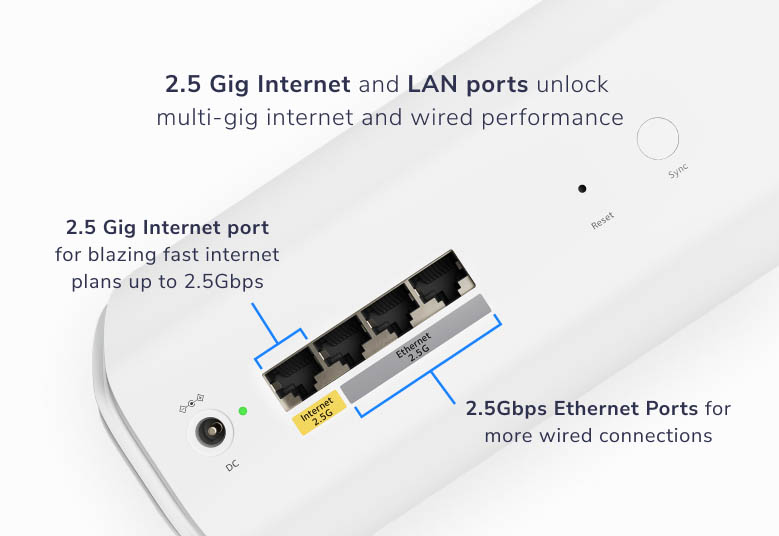
Orbi 770 Series whole-home mesh kits are perfect for large homes with expansive WiFi requirements. Orbi 770 includes wireless backhaul and optional wired 2.5Gb backhaul via the built-in Ethernet ports for super fast speeds of up to 11 Gbps. This powerful WiFi system offers whole-home WiFi coverage up to 8,000 sq. Ft. (For a 3-pack) The NETGEAR Orbi 770 router includes 3x 2.5Gb Ethernet ports and a 2.5Gb WAN port. Each 770 series satellite has 2x 2.5Gb ports to guarantee seamless internet connectivity options.
The addition of NETGEAR Armor and Smart Parental Controls ensures that your WiFi network devices and device users are all protected from spam, malware, and other malicious intrusions for total peace of mind.
Enhanced Security with Advanced Router Protection
The Orbi 770 series is set to be the first product to feature NETGEAR’s innovative Advanced Router Protection. This new security layer not only shields the router from known threats but also utilizes advanced exploit prevention and heuristic techniques to detect and block unknown threats.
Furthermore, it enables the rapid deployment of live patches for emerging threats, eliminating the wait for new firmware releases. This approach dramatically reduces response times and enhances our dedication to delivering industry-leading cybersecurity for our router and mesh products. The Advanced Router Protection feature will be extended to the rest of our WiFi 7 lineup later this year.

Game-Changing Value: Orbi 770 vs. Orbi 970
At NETGEAR, we offer a wider range of premium routers and mesh systems at different price points. The NETGEAR Orbi 770 Series is an unprecedented value alternative to the top-of-the-line Orbi 970 whole-home mesh WiFi System. Both systems use blazing-fast WiFi 7 and many other similar features so everyone under your roof can experience the best of the best. Compare some major Orbi 770 Series and Orbi 970 Series specs in the table below.
 Orbi 770 Series Flawless connectivity to power work, streaming, gaming & More. |
 Orbi 970 Series The Most Powerful & Advanced Orbi for the Ultimate WiFi experience. |
||
| MSRP: | $999 | $2,299 | |
| Coverage: | 8,000 sq. ft. | 10,000 sq. ft. | |
| Performance: | Up To 11Gbps | Up to 27Gbps | |
| ISP Speed: | Up to 500Mbps | 1Gbps+ | |
| Technology: | WiFi 7 Tri-band | WiFi 7 Quad-band | |
| Backhaul: | Enhanced Backhaul | Enhanced Dedicated Backhaul | |
| Ports Router | 4x 2.5Gb | 2x 10Gb, 4x 2.5Gb | |
| Ports Satellite | 2x 2.5Gb | 1x 10Gb, 2x 2.5Gb | |
| Armor Security: | 30 Days | 1 Year | |
Not sure which Orbi is best for you? Answer a few questions about your requirements with our “Find my Orbi” quiz.
Orbi 770 Series Model Numbers: 3-Pack, 2-Pack, Satellite
Below is further details on Orbi 770 Series availability. For in-depth product information – visit product page for each pack.
Orbi 770 Series: Ideal for Whom?
The Orbi 770 Series Mesh WiFi System is ideal for medium to large households with multiple WiFi-enabled devices including laptops, consoles, Apple iPads, Android smartphones, and smart home applications such as smart TVs, home security systems, Amazon Alexa, and many more. WiFi 7 is backwards compatible with devices using older WiFi standards, but is also future proofed for upcoming WiFi 7 enabled technologies such as the recently announce native AI powered CoPilot+ Microsoft Surface Pro and Surface Pro Laptop, improving response times and performance.

Additionally the Orbi 770 Series with WiFi 7 easily handles high-definition gaming, streaming, and conferencing, and can handle large file downloads in a fraction of the time taken by earlier WiFi standards.
This system is the solution if you require multi-gigabit speeds, greater bandwidth, and the ability to move about your home without losing connectivity. The Orbi 770 Series offers speeds up to 11Gbps and is the cost-effective solution for savvy networkers who don’t require the astounding 27Gbps speeds that Orbi 970 Series systems are capable of.
Unleash Endless Possibilities with Orbi 770
The Orbi 770 Series Mesh WiFi System represents advanced wireless networking technology. Home internet users are also benefiting from WiFi 7 technology. Here are some real-world applications of the powerful NETGEAR Orbi 770 Series Mesh WiFi System.
The Orbi 770 Series offers excellent whole-home coverage and endless possibilities. The main router and satellites all contain 2.5Gb Ethernet cable ports for your choice of wireless connectivity or priority wired device connections. It’s worth noting that the WiFi speeds your system can achieve will be impacted by the speeds offered by your internet service provider (ISP) and the performance of your Modem.
Welcome to the Orbi Family: How to Set Up Orbi 770

The Orbi 770 Series WiFi System consists of the Orbi router and one or more Orbi satellites depending on if you want the 2-pack or 3-pack. The system is easy to configure and can be set up quickly and conveniently using the handy Orbi App. Once set up, you can use the app to monitor system and device performance. Simply download the Orbi App and follow the easy setup instructions.
Experiment with router and satellite positioning. Placement options are almost unlimited, but you may still want to experiment with router device placement and the app speed test ensuring the WiFi signal overlaps with peak performance as you move further away from the main router and modem.
There is no special technical knowledge required to know how to set up Orbi 770. The entire system is self-contained without needing additional WiFi extenders or adapters. Solving Orbi 770 problems and troubleshooting is straightforward using the Orbi App.

Orbi by NETGEAR – Innovative WiFi 7 Solutions
If you are looking for your first Tri-Band WiFi 7 mesh system at a game-changing value, or upgrading from a WiFi 5 or WiFi 6 system – you won’t find a better choice than the NETGEAR Orbi 770 Series Mesh WiFi 7 System. The Orbi 770 Series delivers an amazing WiFi experience. NETGEAR has been leading the world in WiFi systems for homes and businesses for decades, and the tradition continues with the flawless Orbi 770 Series Whole-Home WiFi 7 Tri-Band Mesh System.
As esports surges in popularity, the need for high-performance, reliable, and secure network infrastructure grows. Wi-Fi 7 revolutionizes esports with unparalleled speeds, lower latency, and superior reliability. RUCKUS Networks leads with AI-driven Wi-Fi 7 solutions, ensuring seamless gameplay, quicker reaction times, stable connections, and robust security. With RUCKUS One™, our AI-driven platform, esports venues can deliver a fully immersive, state-of-the-art experience.

s esports continues to surge in popularity, the demand for high-performance, reliable, and secure network infrastructure has never been greater. Enter Wi-Fi 7, the latest iteration of wireless technology, poised to revolutionize the esports landscape with its unparalleled speeds, lower latency, and superior reliability.
Wi-Fi 7 changes the esports game
Wi-Fi 7 is a game-changer for esports, offering a level of performance, reliability, and quality of service that eclipses what previous iterations of the wireless technology could offer its users. Here’s how Wi-Fi 7 is set to enhance the esports experience:
RUCKUS leads the way in purpose-driven networking for esports and beyond
RUCKUS Networks, a leading provider of purpose-driven networking, is at the forefront of delivering enterprise-class Wi-Fi 7 solutions. RUCKUS® AI-driven Wi-Fi 7 solutions leverage artificial intelligence to further enhance network assurance and deliver amazing user experiences.
RUCKUS One™, our AI-driven converged network assurance and business intelligence platform, simplifies network management—providing fine-grained metrics about network and Wi-Fi performance and network and application utilization. This allows esports venues to stay ahead of the game as esports continues to grow.
Wi-Fi 7 is set to transform the esports landscape, offering unparalleled speeds, lower latency, and superior reliability. With RUCKUS’s advanced technologies and AI-driven solutions, esports venues can deliver a fully immersive, state-of-the-art esports experience.