



Breaking News

GLOBAL Wi-Fi NEWS bulletin

We recently had a Matter roundtable at Silicon Labs Works With 2024. It was a fantastic chance for ecosystems, device makers, development partners, and others to learn more about the current state of Matter, its challenges and limitations, what is being done to address its shortcomings, new device types coming in the future, and new markets or use cases that are being worked on.

The goal of the roundtable was to allow people to have a more open and honest conversation, so we did not stream or record the event as has been done in previous Works With events. This allowed for attendees to share their own experiences for bad or good, confusion with the goals of the standard, or just general concerns. It is never easy to hear this but is important to get the open feedback.

One of the pieces of confusion that we heard had to do with the need for multiple apps on your mobile device. Shouldn’t Matter mean I can get rid of all my other smart home apps? I never need to even download another smart home app again right? Well, almost.

Matter as a standard has done great things for providing a baseline of interoperability to greatly simplify the commissioning and standardize IP based IoT communications. This helps so many new and existing device makers avoid inventing ways of doing the same basic commissioning that Matter already provides. It doesn’t mean there isn’t room for improvement in the Matter device setup, but the goal is to ensure that proprietary improvements will be really innovative and not just mildly improved.

When it comes to smart home apps, I see them falling into three categories:

  • Generalist smart home apps
  • Device feature apps
  • Services apps

Generalist Smart Home Apps

There is a lot of simple functionality that can be accessed via Matter, and that means users can do most all of it with just a single app. Matter already has support for most of the popular device types. Put more succinctly, I don’t need multiple lighting apps on my phone just because the smart bulbs happen to be from different manufacturers.

Apps that will handle most of the basic home automation, I call generalist smart home apps. These will handle associating devices with different rooms, scenes, routines, and labelling them to make logical sense with the way we naturally live in our smart homes. Users only need one of these generalist apps on their phone. However, it’s important that we allow users the option to switch between generalist smart home apps if they want. One of the goals of Matter is to avoid manufacturer lock-in by ensuring devices can be paired to multiple smart home apps simultaneously, even if the user will only use one.

From a developer perspective, creating your own mobile app is a high barrier to entry and could mean a sub-par experience for something basic. I recently bought a temperature sensor system that had a hub and a number of remote sensors so that I could monitor the temperature in remote locations in my house (the garage, the attic, and a couple of rooms where the thermostat wasn’t located). My goal was to get a better sense of the temperature swings during the cold winters and the warm summers here in the Boston area. These temperature sensors required me to download the mobile app, create an account on the manufacturer’s website, commission the hub, commission each sensor individually, label the sensors, and only then could I finally achieve what I wanted. Monitoring the system required me to re-launch the app regularly, which on occasion made me log back in just to see the temperature. The worst part is that this particular system had extremely poor range and I couldn’t find the right place to install the hub to make all the sensors happy. I eventually gave up and returned the system.

This entire experience has a lot of overhead just to get a temperature sensor up and running. This really shouldn’t be the case, for either a user or developer. It is easy to say that a temperature sensor doesn’t need its own Mobile App. This is an obvious case where a generalist smart home app could easily provide support for temperature sensors along with its other features and functionality. Apple, Google, Samsung, and Amazon all provide this kind of experience through their current hardware and software offering.

Smart Home Device Feature Apps

But now let’s take something more sophisticated like a robot vacuum. This is a more complex device type that can be setup with a schedule, maps of rooms, excluded vacuum areas, control for mopping vs vacuuming, sensors for indicating battery charge, the level of the vacuum bag, and more. Although Matter does have support for robot vacuums, you can easily see why you may want to have a device feature app on your phone for your a robot vacuum and its more complex management. Now certain simpler functionality could be handled, and I would argue should be handled, via a generalist smart home app means. Start, stop, or notifications could easily be handled by a generalist app. If your robot vacuum starts running while you are in the middle of having a kids party, you may want to very quickly use a voice assistant to tell the device to stop or delay its routine. Perhaps the device gets stuck, and you would like to see a notification pop up on a more convenient screen such as a Matter-enabled TV.

From a user perspective, it should be intuitive when you need a dedicated app.

From a developer perspective, Matter enables simpler device integrations but also provides flexibility for a more complex interface experience via a dedicated device feature app. Building a smart home mobile app is now a choice based on the user experience and the device capabilities, rather than just a necessity in all cases.

For some device classes, Matter will grow in its feature set and the major ecosystem will evolve to provide a “good enough” experience for your device that you can phase out your own specialized app. For smaller companies, this means they can focus on adding new hardware features rather than being required to hire mobile developers to re-create yet another a smart home mobile app.

Smart Home Device Services Apps

Now, for a users there will be situations where a generalist smart home app will be too simple in what it can do but where a device feature app will be too limiting. A device feature app is focused in its usage to interact with a single device or single device type. What a user may want is to integrate with a feature across multiple devices. This is where a services app comes in.

Take for example the case of energy management. Matter has enabled devices to report their energy usage and provide the means to aggregate that data in a single unified place. A services app can interact with multiple devices in the home all in support of tracking energy usage. An energy management app needs to understand big energy consumers, like thermostats connected to HVAC, laundry dryers, laundry washers, and a few other related devices like ceiling fans. It doesn’t need to know about lights or sensors or many other Matter enabled nodes that are just not relevant to that goal. It doesn’t need to provide home automation routines or integrate with a voice assistant. This app may have knowledge of your local utility’s cost for electricity or that you have solar panels on your roof, or a generator hooked up to the house. An energy management app may have dedicated screens showing your energy usage over time, correlating this to the past weather conditions. It could have various modes focused on how you can fine tune energy in your home or business to achieve lower costs or just going more green and comparing to your neighbor’s usage. This kind of app will need access to your Matter network but is not meant to be a substitute for the other kinds of apps, and in particular will not be a generalist app.

This kind of specialized service offering is common on the internet. Take for example Slack. Slack is still hugely important for business messaging. It integrates with a number of other tools to provide a means of getting updates and even interacting all within Slack as a means to provide a better user experience. However, it is not a substitute for those other tools. You can integrate Slack with Jira to get updates and perform some simple operations, but it doesn’t replace Jira. I foresee the same kind of thing will occur with user’s Smart Homes.

Smart Home App Conclusion

Ultimately it’s up to the user to decide how they want to manage their network. If they want only a single generalist smart home apps because their usage is simple enough that’s their choice. But if they need a bit more functionality there is option for a blend of smart home apps based on what they do or which one the user likes best.

Having the option for multiple apps is a good thing because it will allow companies to specialize and innovate, and of course compete. Device makers can focus on building the best-in-class device and how to highlight those unique elements that users desire. Services apps can build a service offering based around a theme or specialized use case without having to support all the Matter enabled device types. For all the typical automation use cases, you have the generalist apps.

To put it more succinctly, Chris La Pre Head of Technology at CSA had this great way to summarize it: “You’ll intuitively know when you need a separate app for your smart home device”.

There are a lot of amazing WiFi 7 technologies and features worth knowing about, and Preamble Puncturing is one of them. You may know of quad-band WiFi 7 with faster speeds, 320 MHz channels, multi-link operation (MLO), and 4096 Quadrature Amplitude Modulation (4K QAM), but did you know preamble puncturing can split the bandwidth even more to cut through the chatter?https://www.netgear.com/hub/wp-content/uploads/2025/01/preamble-punturing-graphic-featured.jpg

What Is Preamble Puncturing?

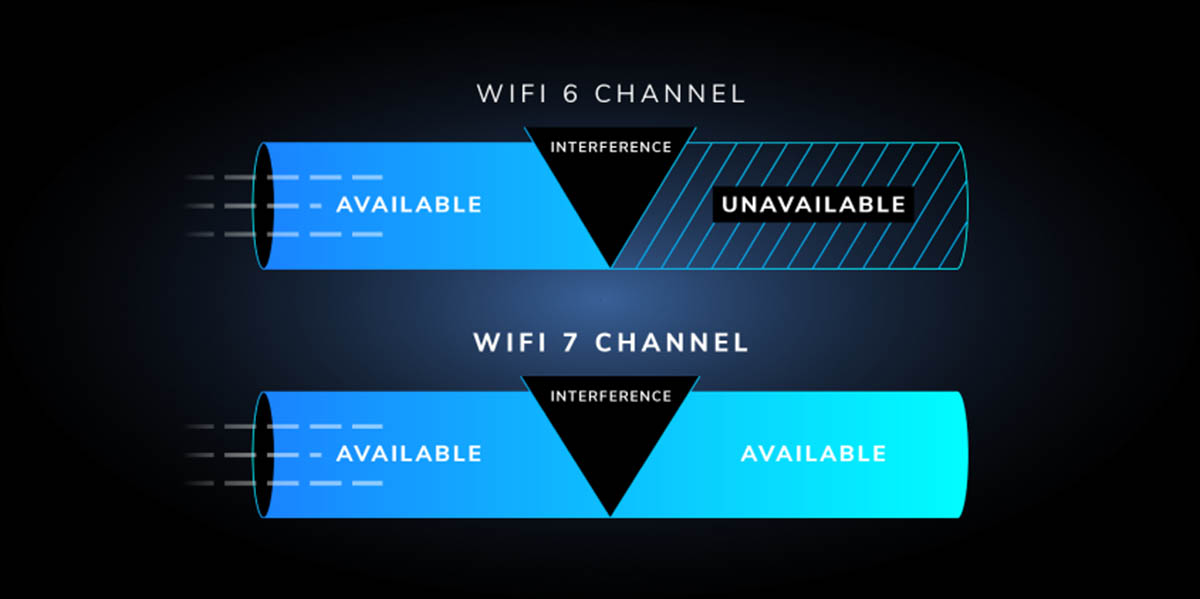
Multi-RU Preamble Puncturing is a new feature in WiFi 7 routers. It lets you bypass interference from neighboring networks or radio sources by “puncturing” or “splitting” part of a WiFi channel. The rest of the channel remains usable with better internet speed, particularly in busy and built-up environments.

Imagine a highway, but only the left lane is open, and the other lanes are closed. That was the scenario before the introduction of WiFi 7 routers. Preamble Puncturing allows your router to split the bandwidth into additional usable channels.

Preamble puncturing gives you an extra lane of superfast and reliable WiFi 7, comparable to an extra lane opening on a highway to relieve congestion.

How Preamble Puncturing Benefits Users

WiFi 7, also called Extremely High Throughput, builds upon the best WiFi 6 and WiFi 6E features such as MU-MIMO and OFDMA to deliver multi-Gbps speeds, more usable channel bandwidth, and ultra-low latency. Preamble Puncturing can:

Reduce Network Congestion

Preamble Puncturing makes your WiFi more efficient by letting your devices use any part of the channel that’s not already in use. You can connect WiFi devices seamlessly to the internet with a WiFi 7 router, unlike older routers that only connect when the entire channel is clear.

Improved Performance for High-Bandwidth Applications

By keeping more bandwidth available, Preamble Puncturing is perfect for large WiFi networks and consistently high speeds for gamers, streamers, and podcasters. WiFi 7 is the secret behind the best enhanced AI, virtual reality, and augmented reality technology for the internet.

How Preamble Puncturing Works

Preamble puncturing gives you wider channels for wireless networking. The new ‘punctured’ channel portion doesn’t suffer from narrowband interference from nearby networks or devices. This allows for more WiFi 7 access points and next-generation devices in your network. The average home in the US includes 24 WiFi-connected devices all vying for speed and bandwidth, and WiFi 7 routers and mesh systems are the best way to stay connected.

Leading NETGEAR Nighthawk Routers and NETGEAR Orbi Whole-Home Mesh Systems include WiFi 7 for faster data rates, more channel width, and connection for up to 200 concurrent devices. You can create a home network, a guest network, and a smart home IoT network, so everyone under your roof has their own space for online work or play. NETGEAR WiFi 7 with Preamble Puncturing makes life easier.

NOTE: Preamble Puncturing is a new WiFi 7 technology. You will experience the full benefit of preamble puncturing as you progressively upgrade to WiFi 7 devices.

How WiFi 7 Benefits Users

There are lots of use cases that showcase the benefits of WiFi 7. The new WiFi generation is a quantum leap forward in a world where wireless connectivity is important. The addition of the 6 GHz band, 4096 QAM, and 320MHz channels (up from 160MHz), preamble puncturing, and other benefits give WiFi 7 2.4x faster speeds than WiFi 6, with lower latency for multiple devices. WiFi 7 is perfect for homes and apartments of all sizes.

Industry-leading networking test and analysis company appoints proven channel and sales leader to support revenue growth, market development and partner expansion.

29th January 2025 – Colorado Springs, CO USA – NetAlly, a global leader in handheld network test and cybersecurity solutions, is doubling down on its commitment to EMEA market growth with the appointment of Nathan Collins as Regional Vice President. Collins brings decades of expertise to lead the company’s ambitious expansion strategy, focusing on empowering partners and enhancing network resilience.

NetAlly provides network test, management and security products for companies to better understand and secure their networks. Their solutions cover a range of network management requirements, from testing tools that technicians can use to troubleshoot network issues in seconds to robust cybersecurity solutions that provide fast insights into potential vulnerabilities in edge network environments.

With over 300 active partners across the EMEA region, NetAlly is transitioning to a fully two-tier distribution model to ensure its cutting-edge solutions are readily available in all major markets. By partnering with local distributors, NetAlly enables faster product availability, better service quality, and streamlined operations for both customers and partners. Collins brings his more than 25 years of expertise in the data storage, networking, and business continuity markets to NetAlly, including senior leadership positions at the likes of AvePoint, CommVault, Druva, and PAVilion.

“Companies rely on their networks to connect their operations and support their goals, so networks must evolve faster and be dynamic and responsive to those business goals. At the same time, increasing regulation and security challenges make building, deploying, and managing networks more challenging than ever. Helping our customers and partners navigate these evolving trends is crucial to our success. Nathan brings us a wealth of experience to help us deliver these goals,” said Mike Parrottino, CEO at NetAlly.

“The European Union has introduced numerous new regulations focused on security and resilience, while similar critical infrastructure regulations are being enforced in the UK for companies and service providers. These regulations aim to make digital services more reliable and resilient, but they need to be supported over time, all the time. Without strong networks, you can’t deliver those great digital services to your customers. Compliance with these security regulations is a critical requirement for both partners and customers. NetAlly’s network test and security vulnerability solutions will be essential to stay compliant,” explained Collins. “I look forward to working with our partners on developing their networking infrastructure businesses, delivering more opportunities for them, and ensuring more reliable and secure networks for their customers.”

Intec Microsystems is a NetAlly distributor based in the UK. Of their partnership with NetAlly, Tom Newall, direct vendor manager, said, “The market certainly has a strong, positive sentiment about NetAlly. As a trusted advisor to our customers, we saw partnering with NetAlly as a way to build out our solutions portfolio and capture a larger share of wallet in our market space.” Newall continued, “The launch of our partnership was our most successful vendor kick-off in 2024. Our team is very enthusiastic about this addition to our portfolio, as NetAlly’s product line provides an attractive margin and good value attach to our network infrastructure sales. On top of that, their team is easy to work with and super responsive.”

Lennart Heijnen, CEO at Heynen BV, a Dutch supplier of solutions in the field of professional electronics in the Benelux countries, said of their partnership with NetAlly, “We’ve experienced many years of year-over-year growth with the NetAlly portfolio, including significant large deals with several service providers. We’ve had particular success with a key customer in the electronic payments processing industry. NetAlly’s close collaboration, teamwork, and responsiveness to their unique needs resulted in multiple large orders over the years.”

Under Collins’ leadership, NetAlly is poised to transform how partners and customers experience network management and cybersecurity in the EMEA region. By focusing on accessibility, innovation, and collaboration, NetAlly will ensure that every business, from local enterprises to global corporations, can have secure, high-performance networks they can rely on.

About NetAlly
For decades, the NetAlly® family of network test and analysis solutions has been helping network and cybersecurity professionals better deploy, manage, maintain, and secure today’s complex wired and wireless networks. Since creating the industry’s first handheld network analyzer in 1993, NetAlly continues to set the standard for portable network analysis and cybersecurity assessment with tools that include EtherScope®nXG, CyberScope®, AirMagnet®, LinkRunner®, LinkSprinter®, AirCheck™, and more.

NetAlly simplifies the complexities of network testing and cybersecurity assessments, provides instant visibility for efficient problem resolution, and enables seamless collaboration between site personnel and remote experts. To learn more, visit https://netally.com, follow us on Facebook, X, LinkedIn, Instagram or YouTube.


PARIS, France – AMMAN, Jordan – January 23rd, 2025 – SoftAtHome and Orange Jordan announced the imminent deployment of the world’s first fully prpl-based broadband solution with a home gateway and Wi-Fi repeater powered by prplWare and complementary SoftAtHome products.

The new home gateway and Wi-Fi repeater are powered by prplWare, which includes the prplOS and prplMesh.

prpl extends the Orange device’s shelf life and brings operators greater independence from hardware constraints to deliver new and innovative services. Through this project, SoftAtHome enabled five critical advantages promoted by the prpl Foundation, including higher velocity by de-complexifying Gateway stack integration onto multiple platforms, a focus on service-driven innovation, enabling proprietary differentiation from a 3rd-party services ecosystem, API harmonization through collaboration and convergence to help scale up businesses, open source to improve testing and avoid duplication and wasted efforts, and cultivating a community.

Orange Jordan’s new gateway offers fiber connectivity and delivers the advantages of Wi-Fi6E. For this project, prplWare was extended with several critical operator features such as VoIP, Wi-Fi repeater, API migration, all the while keeping compatibility with the existing infrastructure, etc.

prplMesh already brings Wi-Fi management capabilities and hardware abstraction. SoftAtHome added smart Wi-Fi algorithms, such as Wi-Fi repeater management, packet prioritization, intelligent channel selection, remote device management, and enhanced security features with the Wifi’ON Product running on top of prplWare.  


Orange Jordan commented on this agreement saying: “At the outset of this project, we were looking for a software solution that leveraged our installed base of devices while simultaneously preparing an exciting future of services for our broadband subscribers. SoftAtHome exceeded our expectations with this prpl-based advanced solution and their extensive expertise.” 

Orange Group said, “Orange Jordan is the first within the Orange Group to deploy a prpl-based home gateway solution, which is the result of Orange Group’s investment in prpl open-source solutions. The whole operator community will benefit from access to new home gateway-based services.”

Arnaud Bellivier de Prin, CEO at SoftAtHome, said, “I am proud that our teams have delivered the world’s first prpl-based solution deployed simultaneously on the home gateway and Wi-Fi repeaters and grateful to Orange Jordan for their continued trust in SoftAtHome and for paving the prpl way for our club of operators.”


About SoftAtHome

SoftAtHome is an independent software provider with seven critical solutions: broadband (Connect’ON), Wi-Fi (Wifi’ON), security (Secure’ON), smart home (Things’ON), video (Watch’ON), analytics and QoE monitoring (Eyes’ON), and a gateway Appstore environment (Orchestr’ON). SoftAtHome’s solutions power over 30 million connected homes globally, delivering unmatched broadband, Wi-Fi, and smart home experiences. With its focus on energy efficiency and open-source communities like prpl, SoftAtHome continues to innovate for the future of the connected home.

For more information: www.softathome.com or [email protected]

Press Contact:
Marta Twardowska-Rienks for SoftAtHome

E: [email protected] – M: +31 621-184-585 – LI: SoftAtHome

About Orange Jordan

Orange Jordan is one of the subsidiaries of Orange Global Group, which is present in 26 countries around the world. Orange Jordan operates in line with the Group’s strategy “Lead the Future”, and through its positioning as a Responsible Digital Leader, it supports the national digital transformation vision. Orange Jordan prioritizes community service, and in this context, it implements a comprehensive CSR strategy that revolves around 4 pillars including digital education, digital inclusion, entrepreneurship, climate, and environment.

Orange Jordan, with more than 1600 employees in 301 shops and locations across Jordan, strives to provide the best customer experience through an integrated set of digital solutions including fixed, mobile, internet, data, and Smart Life Solutions to around 4.1 million customers in Jordan.

Orange Jordan’s solutions are comprehensive as they serve businesses in addition to individuals under its sub-brand Orange Business.

Orange Jordan inspires by its values namely transparency, agility, results-oriented, customer centricity, collaboration, caring, and excellence.

To learn more about us, please visit our website: www.orange.jo.

Imagine coming home to one that knows you as well as you know it. It’s a future where your living space doesn’t just respond to commands but anticipates your needs and subtly adapts to your routine. That’s where we’re headed—a future where the smart home feels less like a collection of devices and more like an extension of you, and your family.

Generative AI is one of the major innovations helping us reach this future. MediaTek’s Genio IoT platform is already leading the way by making AI-driven interactions more natural and responsive. Picture a personal assistant who’s helpful and empathetic, even providing companionship for elderly family members. And now, with natural language interaction, you won’t need to memorize specific commands or tap through multiple screens; you can simply speak naturally, and your devices will accurately interpret, understand and respond. This isn’t just tech—it’s a new level of human connection and comfort right in your living room.

This transformation intends to elevate connected homes into truly autonomous living spaces. And it’s happening faster than many realize; soon, your home recognizes when you decide to go to bed, for example, and will automatically adjust the lighting, secure doors, and even optimize the temperature throughout each room without needing a second thought from you. Think of it as a silent virtual assistant, always there but never in the way, adapting quietly to your needs.

And as homes become more connected, they need to be harmoniously integrated. We know how frustrating it can be when gadgets don’t play well together. MediaTek is committed to ensuring that whether it’s the security cameras, sensors, thermal control systems, a smart hub, plus all your smartphones, tablets, laptops, PCs, smart TVs, and everything else – all your devices must always connect reliably, and communicate seamlessly across platforms. It’s smart living made simple.

Finally, personalization will be at the heart of tomorrow’s smart homes. Imagine that your home learns from you—adjusting the lighting and music as you wind down for the evening, or planning your workouts based on what you did, or didn’t do last week! It’s a world where every piece of tech aligns with your unique lifestyle, making each day a little more tailored to you.

At MediaTek, we believe that the future of smart homes is one where technology moves quietly to the background, working smoothly and intuitively to elevate your daily life. We’re building the foundations today so that, tomorrow, you won’t just have a smart home—you’ll have an intelligent, personalized space that truly feels like yours.

Learn more about our featured products:

Dulles and Reagan airports join Ads4WiFi to boost revenue from their free Wi-Fi networks, enhancing passenger experience and supporting operations.

WASHINGTON D.C., DC, UNITED STATES, January 14, 2025 /EINPresswire.com/ — Dulles International Airport (IAD) and Reagan National Airport (DCA) are excited to announce their participation in Ads4WiFi, a digital out of home (DooH) Wi-Fi advertising marketplace. This collaboration aims to drive advertising revenue into the airports, helping to offset the costs associated with operating their free passenger Wi-Fi networks.

By joining the Ads4WiFi marketplace, these airports can now display targeted advertisements to passengers as they log in to the free Wi-Fi networks. This innovative approach allows the airports to stay in control of their concessions without needing the expertise to broker advertising contracts or deliver campaigns.

Ads4WiFi provides a robust platform that manages the entire process, ensuring a smooth and efficient experience for both the airports and their passengers.

“GoZone’s business model provides a great service to meet the needs of this time-constrained industry. We’re excited and hopeful for the future with this new partnership!” said Anthony Balestrino, Business Development Lead of MWAA Labs. “This collaboration allows us to maintain control over our concessions and focus on delivering a high-quality experience for our travelers.”

One of the key benefits of this partnership is that Ads4WiFi offers the airports the option to use their platform to manage advertising campaigns at no additional charge if they do not have an existing solution. This flexibility ensures that the airports can maximize their advertising potential without incurring extra costs.

“We are proud to support Dulles and Reagan National in their efforts to generate additional revenue through our platform,” said Todd Myers, CEO of GoZone WiFi that powers the Ads4WiFi marketplace. “Our goal is to provide a user-friendly solution that enables airports to earn added revenues without any additional hardware or software fees.”

Passengers at these airports can expect to see a variety of engaging advertisements as they connect to the free Wi-Fi networks, enhancing their overall travel experience while supporting the airports’ operational costs. The Ads4WiFi marketplace enables brands and DooH-focused ad agencies a single source to help broker and facilitate campaign delivery no matter who owns or operates the property.

Airports that are interested can visit https://www.ads4wifi.com/venues/airports. Brands and ad agencies can visit https://www.ads4wifi.com/advertisers for additional information.

About Ads4WiFi
Ads4WiFi, powered by GoZone WiFi, is an advertising marketplace that connects advertisers with aggregated Wi-Fi networks in high-traffic locations such as airports, shopping malls, and public transportation hubs. The platform provides a seamless solution for managing and delivering targeted advertising campaigns, helping their partners generate additional revenue while enhancing the user experience.

About MWAA Labs
MWAA Labs, the technology innovations team of the Metropolitan Washington Airports Authority, has been addressing airport challenges since 2013. Using their two airports as testing grounds, they develop and refine solutions with input from customers and partners. Their notable success includes veriScan, a biometric traveler verification system acquired by Pangiam in 2021. MWAA Labs values community collaboration and specializes in cloud services, AI, IoT, and more to enhance the travel experience. Learn more at mwaalabs.com.


Austin, TX and Washington, D.C. – January 20, 2025– Wi-Fi Alliance® congratulates Olivia Trusty on her nomination to serve as a Commissioner at the Federal Communications Commission (FCC). Her extensive experience in telecommunications policy and public service will be instrumental in shaping the future of connectivity in the United States.

As the FCC continues to play a pivotal role in advancing connectivity benefits, Wi-Fi Alliance looks forward to working with Ms. Trusty and her colleagues to ensure that Wi-Fi® remains an essential enabler of the U.S. digital ecosystem — powering industries, public services, and next-generation applications such as healthcare, education, smart infrastructure and beyond.

Wi-Fi Alliance stands ready to collaborate with Commissioner-designate Trusty and the FCC to promote policies that foster investment, innovation, and connectivity for all Americans.

About Wi-Fi Alliance®  |  www.wi-fi.org
Wi-Fi Alliance® is the worldwide network of companies that brings you Wi-Fi®. Members of our collaboration forum come together from across the Wi-Fi ecosystem with the shared vision to connect everyone and everything, everywhere, while providing the best possible user experience. Since 2000, Wi-Fi Alliance has completed more than 80,000 Wi-Fi certifications. The Wi-Fi CERTIFIED™ seal of approval designates products with proven interoperability, backward compatibility, and the highest industry-standard security protections in place. Today, Wi-Fi carries more than half of the Internet’s traffic in an ever-expanding variety of applications. Wi-Fi Alliance continues to drive the adoption and evolution of Wi-Fi, which billions of people rely on every day.

Follow Wi-Fi Alliance:
wi-fi.org/beacon
wi-fi.org/signal
facebook.com/wificertified
twitter.com/wifialliance
linkedin.com/company/wi-fi-alliance
youtube.com/wifialliance

The European Union’s introduction of NIS2 marks a significant evolution in cybersecurity regulation, building upon and expanding the original Network and Information Security Directive.

NIS2 Directive Explained: Strengthening Network Security

As a comprehensive framework for securing Europe’s digital infrastructure, the directive establishes stringent requirements for essential and important services, fundamentally transforming how organizations must approach their security responsibilities. (European Union) EU member states must implement through legislation the enforcement of the NIS2 directive. But what does NIS2 mean for your network, and how can you ensure compliance with its requirements?

The EU NIS2 Directive is a comprehensive update to the original NIS Directive to improve critical infrastructure security. NIS2 addresses the limitations of its predecessor (NIS) by expanding scope, harmonizing incident reporting, and enforcing stricter penalties for non-compliance up to 2% of a company’s global annual revenue or €10 million.

What is NIS2 and what are its key features?

Targeting a wider range of organizations, NIS2 now applies to essential entities that support sectors like energy, healthcare, financial services, and important entities addressing sectors such as postal and courier services, manufacturing, and data center operations.

The objective is to mandate that public and private entities across these sectors adhere to a uniform standard of cybersecurity capabilities to mitigate potential threats that could disrupt key societal services, basic necessities, and functions or compromise sensitive data. Companies that supply or support these essential and important entities may also need to comply with NIS2 directives.

Overview of NIS2 Cybersecurity Requirements

NIS2 establishes a comprehensive framework for an overall level of cybersecurity, built around four core pillars: risk management, incident handling, business continuity, and information sharing. These pillars are supported by ten detailed categories, which can be distilled into the following key requirements:

  • Risk Management and Cybersecurity Policies: Organizations must develop and maintain comprehensive cybersecurity risk management measures and frameworks incorporating regular risk assessments, threat modeling, and clearly documented security policies. These frameworks should adapt to emerging threats and evolving business needs.
  • Incident Reporting and Response: Any cyber incident that could have a significant impact on services or compromise data must be reported within 24 hours as an “early warning,” emphasizing the urgency of a swift, well-coordinated response; this is just an example of required NIS2 incident response capacities in the evolving cybersecurity threat landscape.
  • Business Continuity and Crisis Management: Entities plan for how they intend to ensure business continuity in case there is a major cyber incident and how they will recover quickly in the aftermath.
  • Supply Chain Security: Acknowledging that suppliers are often a weak link, NIS2 mandates enhanced scrutiny of third-party security standards.
  • Data Integrity and Confidentiality: Measures to protect data integrity and confidentiality are essential, aligning with data protection laws like GDPR to avoid unauthorized access or breaches.

NIS2 Directive and a Company’s Network Security

NIS2 mandates must be reflected in a company’s approach to network security. With expanded legal measures, the mandate that NIS2 be incorporated into EU member state national law, and the inclusion of more sectors, organizations who support essential or important business, or are themselves essential or important businesses, are now accountable for meeting a high common level of cybersecurity standards. This accountability should be reflected in cyber resilience throughout the network architecture and infrastructure.

Does the NIS2 Directive apply just to Information Systems and Cloud?

While network security measures are crucial to NIS2 compliance, the directive’s scope extends far beyond information systems or cloud computing. It requires active engagement from C-level executives and board members who must oversee security governance, build organizational awareness, and ensure accountability. This includes strategic cooperation on incident response, security awareness and training, and facilitating cross-border information sharing across all organizational levels.

What are the Essential Controls for NIS2 Compliant Network Security?

With the broad focus of NIS2, the network is still a central focus and implementation area for cybersecurity controls, access control and management, incident identification and response, and many other security requirements that can help with a company’s NIS2 compliance. Specifically, NIS2 requires network security controls that focus on prevention, detection, cyber crisis management, and recovery. Here are some key controls that must be implemented across multiple network layers:

  • Network Segmentation: Separating networks into distinct zones prevents attackers from moving laterally across systems, limiting the potential damage of a breach.
  • Access Controls: Enforcing strong identity verification and role-based access to enforce that only authorized personnel can access sensitive areas of the network.
  • Intrusion Detection and Prevention Systems (IDPS): These tools help monitor network traffic for unusual activity, intended to stop potential threats before they escalate.
  • Security Audits and Vulnerability Assessments: Continuous security checks enable organizations to identify and address weak spots before they’re exploited.
  • Endpoint Detection and Response: EDR solutions allow for real-time monitoring and faster detection of compromised devices within the network.
  • Incident Response Planning and Training: A well-documented incident response plan, coupled with regular training, ensures that employees understand how to respond to an incident swiftly and effectively.

The Importance of Network Security

As organizations increasingly rely on complex digital infrastructures to manage sensitive data and essential operations, network security has become one of the cornerstones of effective information system security. Effective network security protects the confidentiality, integrity, and availability of data—a triad critical for maintaining trust with customers, partners, and regulatory bodies. Implementing the right controls and best practices, from granting and authenticating access and threat detection to documented and practiced incident response management, companies can use strong network security to reduce the threat landscape and the need to utilize incident response plans.

Network security breaches have real-world consequences, so a properly implemented and secure network architecture is fundamental. Network compromises can cause cascading effects, impacting not just the organization itself but also its customers, partners, and the broader industry. A secure network minimizes disruptions, shields critical data from unauthorized access, and provides a foundation for achieving compliance with NIS2 and other international standards.

data-breach-NIS2-blog

Conclusion

NIS2 marks a significant transformation in European cybersecurity, introducing rigorous standards and embedding accountability throughout every level of organizational security infrastructure. For organizations, this means not just fulfilling compliance requirements but building a security-first culture that values and prioritizes robust network architecture and defenses. By implementing essential controls, companies can establish resilience and responsiveness, meeting NIS2’s requirements while protecting their networks from increasingly sophisticated cyber threats. Network security is not just a technical necessity but a business imperative, required for both operational continuity and sustained trust in doing business.

Increasing use of artificial intelligence and machine learning to enhance performance, security and manage networks will be a key trend over the next 12 months.
Zyxel Networks is predicting that AI and machine learning will play a much more significant role in managing the efficiency, performance and protection of networks in 2025. Other key trends will see the accelerated adoption of WiFi 7, further uptake of multi-gig switching, and the continued integration of security into the network.


The forecasts are made in a blog post by Kevin Drinkall, Director – Marketing and GTM Strategy, EMEA at Zyxel Networks, and a podcast featuring Kevin and other Zyxel Networks experts.


In the blog post, Kevin emphasises the influence that AI will have in driving advances and improving user experiences, stating: “AI is what everyone will be talking about (again) in 2025. But the underlying trends will be all about meeting higher bandwidth demand, future-proofing and protecting investment, and finding ways to manage networks more efficiently and effectively.”
Zyxel Networks has been using AI for some time to improve the self-diagnosis and healing capabilities of its products. It also gathers information from installed devices and analyses the data using AI tools, feeding this information directly into R&D and helping focus efforts on areas that will have the most positive impact. AI will also help improved network security and make it easier and faster to diagnose and troubleshoot issues.


Kevin sets out his expectations for strong growth in WiFi 7 uptake, predicting that it will become the dominant standard, leaving WiFi 6 as the budget-friendly option. “Customers will choose WiFi 7 for its superior bandwidth, low latency and the additional future-proofing and investment protection it provides.”
An acceleration in multi-gig switches is also on the cards, he says, largely driven by WiFi 7 adoption. Zyxel Networks is planning to launch its first switch that provides 25G on network ports and up to 100G on the uplink in 2025.


All of these developments will also fuel further growth of managed services and activation of Zyxel Networks’ Nebula cloud management platform. This allows administrators and managed services providers to remotely configure, monitor and manage Zyxel Networks devices. Nebula was the fastest-growing area of the company’s business last year and is expected to grow further in 2025.
The move to managed services – for both the network and security – makes sense both for the end user organisations using networks and for MSP partners, says Kevin. “It means that there is no need to have someone in-house who is responsible for network management and cybersecurity – it can be left to a dedicated expert to keep watch over the network from a distance.”


In the podcast, Kevin discusses all these trends with Michel Nicolai, EMEA Senior Regional Sales Engineer; Hugh Simpson, EMEA Marketing Development Manager – Wireless; and Luke Harley, EMEA Market Development Manager – Switch.
To read the full version of the blog visit https://www.zyxel.com/global/en/blogs/ai-and-wifi-7-become-the-agents-for-change-the-key-trends-in-networking-for-2025.
The podcast can be found at https://www.buzzsprout.com/2152480/episodes/16412621-looking-ahead-at-the-trends-in-2025.

The European Union’s introduction of NIS2 marks a significant evolution in cybersecurity regulation, building upon and expanding the original Network and Information Security Directive.

NIS2 Explained: A Framework Strengthening Network Security

As a comprehensive framework for securing Europe’s digital infrastructure, the directive establishes stringent requirements for essential and important services, fundamentally transforming how organizations must approach their security responsibilities. (European Union) EU member states must implement through legislation the enforcement of the NIS2 directive. But what does NIS2 mean for your network, and how can you ensure compliance with its requirements?

The EU NIS2 Directive is a comprehensive update to the original NIS Directive to improve critical infrastructure security. NIS2 addresses the limitations of its predecessor (NIS) by expanding scope, harmonizing incident reporting, and enforcing stricter penalties for non-compliance up to 2% of a company’s global annual revenue or €10 million.

What is NIS2 and what are its key features?

Targeting a wider range of organizations, NIS2 now applies to essential entities that support sectors like energy, healthcare, financial services, and important entities addressing sectors such as postal and courier services, manufacturing, and data center operations.

The objective is to mandate that public and private entities across these sectors adhere to a uniform standard of cybersecurity capabilities to mitigate potential threats that could disrupt key societal services, basic necessities, and functions or compromise sensitive data. Companies that supply or support these essential and important entities may also need to comply with NIS2 directives.

Overview of NIS2 Cybersecurity Requirements

NIS2 establishes a comprehensive framework for an overall level of cybersecurity, built around four core pillars: risk management, incident handling, business continuity, and information sharing. These pillars are supported by ten detailed categories, which can be distilled into the following key requirements:

  • Risk Management and Cybersecurity Policies: Organizations must develop and maintain comprehensive cybersecurity risk management measures and frameworks incorporating regular risk assessments, threat modeling, and clearly documented security policies. These frameworks should adapt to emerging threats and evolving business needs.
  • Incident Reporting and Response: Any cyber incident that could have a significant impact on services or compromise data must be reported within 24 hours as an “early warning,” emphasizing the urgency of a swift, well-coordinated response; this is just an example of required NIS2 incident response capacities in the evolving cybersecurity threat landscape.
  • Business Continuity and Crisis Management: Entities plan for how they intend to ensure business continuity in case there is a major cyber incident and how they will recover quickly in the aftermath.
  • Supply Chain Security: Acknowledging that suppliers are often a weak link, NIS2 mandates enhanced scrutiny of third-party security standards.
  • Data Integrity and Confidentiality: Measures to protect data integrity and confidentiality are essential, aligning with data protection laws like GDPR to avoid unauthorized access or breaches.

NIS2 Directive and a Company’s Network Security

NIS2 mandates must be reflected in a company’s approach to network security. With expanded legal measures, the mandate that NIS2 be incorporated into EU member state national law, and the inclusion of more sectors, organizations who support essential or important business, or are themselves essential or important businesses, are now accountable for meeting a high common level of cybersecurity standards. This accountability should be reflected in cyber resilience throughout the network architecture and infrastructure.

Does the NIS2 Directive apply just to Information Systems and Cloud?

While network security measures are crucial to NIS2 compliance, the directive’s scope extends far beyond information systems or cloud computing. It requires active engagement from C-level executives and board members who must oversee security governance, build organizational awareness, and ensure accountability. This includes strategic cooperation on incident response, security awareness and training, and facilitating cross-border information sharing across all organizational levels.

What are the Essential Controls for NIS2 Compliant Network Security?

With the broad focus of NIS2, the network is still a central focus and implementation area for cybersecurity controls, access control and management, incident identification and response, and many other security requirements that can help with a company’s NIS2 compliance. Specifically, NIS2 requires network security controls that focus on prevention, detection, cyber crisis management, and recovery. Here are some key controls that must be implemented across multiple network layers:

  • Network Segmentation: Separating networks into distinct zones prevents attackers from moving laterally across systems, limiting the potential damage of a breach.
  • Access Controls: Enforcing strong identity verification and role-based access to enforce that only authorized personnel can access sensitive areas of the network.
  • Intrusion Detection and Prevention Systems (IDPS): These tools help monitor network traffic for unusual activity, intended to stop potential threats before they escalate.
  • Security Audits and Vulnerability Assessments: Continuous security checks enable organizations to identify and address weak spots before they’re exploited.
  • Endpoint Detection and Response: EDR solutions allow for real-time monitoring and faster detection of compromised devices within the network.
  • Incident Response Planning and Training: A well-documented incident response plan, coupled with regular training, ensures that employees understand how to respond to an incident swiftly and effectively.

The Importance of Network Security

As organizations increasingly rely on complex digital infrastructures to manage sensitive data and essential operations, network security has become one of the cornerstones of effective information system security. Effective network security protects the confidentiality, integrity, and availability of data—a triad critical for maintaining trust with customers, partners, and regulatory bodies. Implementing the right controls and best practices, from granting and authenticating access and threat detection to documented and practiced incident response management, companies can use strong network security to reduce the threat landscape and the need to utilize incident response plans.

Network security breaches have real-world consequences, so a properly implemented and secure network architecture is fundamental. Network compromises can cause cascading effects, impacting not just the organization itself but also its customers, partners, and the broader industry. A secure network minimizes disruptions, shields critical data from unauthorized access, and provides a foundation for achieving compliance with NIS2 and other international standards.

data-breach-NIS2-blog

Conclusion

NIS2 marks a significant transformation in European cybersecurity, introducing rigorous standards and embedding accountability throughout every level of organizational security infrastructure. For organizations, this means not just fulfilling compliance requirements but building a security-first culture that values and prioritizes robust network architecture and defenses. By implementing essential controls, companies can establish resilience and responsiveness, meeting NIS2’s requirements while protecting their networks from increasingly sophisticated cyber threats. Network security is not just a technical necessity but a business imperative, required for both operational continuity and sustained trust in doing business.