Breaking News

GLOBAL Wi-Fi NEWS bulletin

Broadband service provider delivers high speed tiered services to residential subscribers with a combination of fiber core and 60 GHz millimeter wave fixed wireless broadband.

ROLLING MEADOWS, Ill., Mar 22, 2022 – Cambium Networks’ (NASDAQ: CMBM) 60 GHz millimeter wave fixed wireless broadband enables broadband service providers to deliver multi-gigabit access with faster time to service than trenching fiber. With hybrid fiber and 60 GHz cnWave™ fixed wireless technologies Desert iNET, a leading broadband service provider in Scottsdale, Arizona is rapidly expanding by delighting customers with “the most reliable and customer friendly high speed service.”

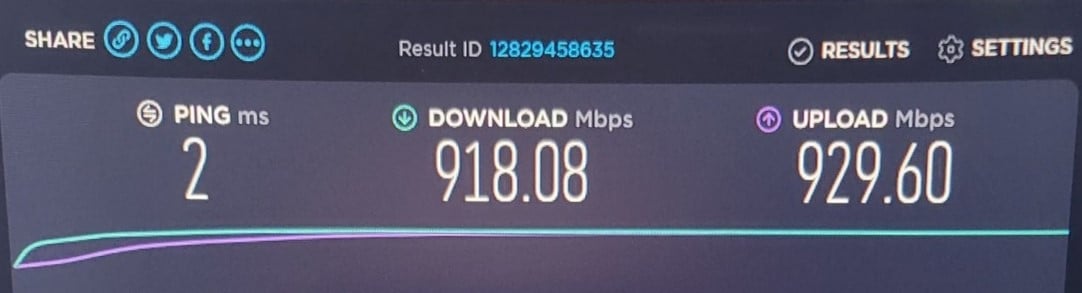
Subscriber Stephen L. described his experience: “Desert iNET recently upgraded us to a Gigabit by Gigabit service on their new technology, and my boys are over the moon!  I had the house wired for ethernet and now their ping to the Fortnite servers is 2 ms, and speeds are 918 Mbps by 930 Mbps symmetrical!”

Desert iNET 60 GHz cnWave Fixed Wireless Speed Test

Cambium Networks cnWave platform exploits the 60 GHz spectrum and 802.11ay standard to eliminate the wait for last mile fiber, at a fraction of the cost. The system uses Terragraph meshing technology, beam steering, software defined radios, and centralized cloud management. Conventional wisdom says that FTTH is the only way to achieve gigabit broadband to the home.  Desert iNet is proving that’s not the case. The wireless fabric from Cambium Networks makes it easy to plan, deploy, and manage affordable Gigabit speeds to the home.

“It’s every bit as fast as fiber,” said Jeff Hardesty, Vice President and co-founder, Desert iNET. “With 60 GHz cnWave, we can now offer Gigabit download and 100 Mbps uplink, or greater, speeds for streaming video conferencing, and business applications in addition to gaming, Netflix and other entertainment services.”

Desert iNET is onboarding more than 15 customers per week to the 60 GHz cnWave enabled network. Using meshing technology, they are able to leverage selected residences as host sites for the V5000 cnWave Distribution Nodes (DN) and then connect V3000 or V1000 cnWave Client Nodes (CN) at other locations. The relay points are hardened and the efficient mesh provides redundancy so that the subscribers have continuity of service should a relay point fail.

“Broadband service providers are deploying Gigabit speed connectivity quickly,” said Atul Bhatnagar, president and CEO of Cambium Networks. “Millimeter wave is the exciting tip of the iceberg. Service providers also depend on the essential infrastructure underneath – Cambium Networks’ wireless fabric which includes includes planning tools, management, switching, Wi-Fi 6 access points, and support options.”

Jeff Hardesty will share his experiences at the 60 GHz cnWave Roadshow in Scottsdale, Arizona April 12-13. Register Here.

For more information,

About Cambium Networks
Cambium Networks delivers wireless communications that work for businesses, communities, and cities worldwide. Millions of our radios are deployed to connect people, places, and things with a unified wireless fabric that spans multiple standards and frequencies of fixed wireless and Wi-Fi, all managed centrally via the cloud. Our multi-gigabit wireless fabric offers a compelling value proposition over traditional fiber and alternative wireless solutions. We work with our Cambium certified ConnectedPartners to deliver purpose-built networks for service provider, enterprise, industrial, and government connectivity solutions in urban, suburban, and rural environments, with wireless that just works.

Media Contact (Cambium)
Dave Reddy – Big Valley Marketing for Cambium
+1 (650) 868-4659
[email protected]

Stockholm, Sweden, March 21, 2022:  Enea today announced that its Wi-Fi Service Management Platform (SMP) was deployed by Batelco to seamlessly connect visitors at the Bahrain International Circuit (BIC). The BIC has a capacity of over 70,000, and the Enea Aptilo Wi-Fi SMP authenticated and connected Batelco’s customers automatically, and subscribers from other networks via a dedicated portal, during the Grand Prix event.

The BIC is part of Batelco’s ‘Bahrain Wi-Fi’ service, the Kingdom’s WiFi digital network. For over ten years the operator has used Enea’s solution to connect subscribers in hotspots nationwide.

“Enea is a valuable partner, and we share a common ethos,” said Batelco General Manager Enterprise Abdulla Danesh. “When we launched our service for people in the Kingdom to benefit from a uniform, island wide network – we relied on Enea’s technology.  They have helped us deliver secure and reliable connectivity not only for our subscribers but for all people in Bahrain and visitors to the country.”

Enea’s Wi-Fi SMP not only provides secure connectivity, but also enables communication service providers (CSPs) to secure revenue streams with their Wi-Fi service. The technology has been deployed by over 100 CSPs in 75 countries and has a subscriber footprint of over 250 million.

“Our expertise supported Batelco’s delivery of Wi-Fi on one of the most important days in the sporting calendar,” said Jonas Jacobsson, Senior Vice President of Service Provider Sales at Enea. “Wi-Fi is a critical component of any sporting event adding the extra dimension on connecting fans to the action.”

References

Contact
Chevaan Seresinhe, Sonus PR for Enea
Email: [email protected]
Telephone: +44 797 1967 644 Stephanie Huf, Enea Chief Marketing Officer

E-mail: [email protected]

About Enea
Enea is one of the world’s leading specialists in software for telecommunications and cybersecurity. The company’s cloud-native products are used to enable and protect services for mobile subscribers, enterprise customers, and connected devices. More than 4.5 billion people rely on Enea technologies in their daily lives.

Enea is headquartered in Stockholm, Sweden, and is listed on Nasdaq Stockholm.

For more information: www.enea.com

Connectivity solution delivered by Future Technologies improves elder care and enables digital transformation while keeping costs under control

ROLLING MEADOWS, Ill., March 16, 2022 – Cambium Networks (NASDAQ: CMBM) enterprise networking solutions enable elder care facilities to provide excellent care in the nursing shortage and enable further efficiencies from digital transformation initiatives. The Villas of Holmdel provides human-centered, accessible and affordable care for assisted living residents. With Wi-Fi 6 access points (AP), cnMatrix™ switches and centralized cloud management from Cambium Networks, designed and deployed by Future Technologies, Inc., the 130,000-square-foot assisted living facility achieves excellence in care and is paving the way for future digital transformation initiatives while minimizing total cost of ownership.

Villas of Holmdel improves elder care with Wi-Fi 6 connectivity

Residents want the ability to connect with friends and family, and elder care operations managers need reliable Wi-Fi at reasonable costs. At the same time, challenges such as the ongoing shortage of nurses and caregivers, inflation driving costs higher, and lingering COVID issues are putting a strain on facilities to provide security and comfort with fewer staff.

The Villas of Holmdel, one of Hackensack Meridian Health’s newest assisted living facilities in New Jersey, is comprised of 110 rooms, 15 office rooms, a dining area, an indoor pool and other amenities. Campus-wide Wi-Fi coverage and high performance were essential for the Villas since residents and staff required higher density and capacity, especially at high-traffic, high-density nursing stations.

“Wi-Fi 6 connectivity enables our residents and nurses to do more than they could before,” said Walt Gant, Director, Hackensack Meridian Health. “They can now stay connected throughout the facility, and we’re able to focus on our core business. It will pave the way for us to do more for our residents in the future.”

Future Technologies Venture, LLC., which planned the network design and served as lead system integrator, deployed Cambium Networks’ XV2-2 and XV3-8 Wi-Fi 6 APs and EX2052-P switches to handle an uptick in simultaneous video streams, as well as an increasing number of concurrent network users. The Cambium Networks solution will also enable future IoT initiatives, such as sensors, controls and potentially robotics. These future initiatives include robots for cleaning floors, delivering items to residents and remote patient monitoring – a critical need at elder care/memory care facilities.

“With the Cambium Networks solution, we were able to offer complete coverage and capacity with 64 access points – immediately reducing the hardware and associated installation costs by one third. Being able to reduce the total access point count by 35% and having a single pane of glass to manage the system really made a big difference in meeting these needs,” said Peter Cappiello, CEO, Future Technologies. “We considered other options, but they couldn’t provide the end-to-end solution portfolio capabilities we required to meet the technical and commercial requirements of The Villas.”

The deployment of Cambium Networks’ Wi-Fi 6 APs and switches are managed under the cnMaestro™ wireless network management system. The entire network is monitored and managed from one screen and the service comes at zero operating expense. Future Tech designed the solution so the facility can self-maintain.

“Care facilities need a communications network that must be seamless, reliable and easy to manage so that the primary focus is on patient care,” said Atul Bhatnagar, president and CEO of Cambium Networks. “Working with our partner Future Technologies, we were able to equip The Villas with great connectivity at an attractive total cost, enabling them to focus on providing excellent care at a time of significant nursing shortage and skyrocketing inflation.”

In a recent ranking of Wi-Fi 6 access points, the Tolly Group, an independent testing analysis organization, concluded that Cambium Networks’ products outperformed competitors Aruba, Meraki (Cisco) and Ruckus in terms of performance and total cost of ownership. What’s more, Cambium Networks’ Wi-Fi solutions are certified and proven for healthcare applications.  

Download the case study on the Villas at Holmdel installation to learn about the details.

Future Technologies is hosting an Innovation Center Open House on March 22, 2022, in Atlanta, where attendees can tour the facilities and experience solutions from the company’s ecosystem partners, including Cambium Networks. Register here.

About Future Technologies Venture, LLC
Future Technologies Venture, LLC. is Lead System Integrator (LSI) specializing in the assessment, planning, design, implementation, and support of innovative communication solutions. Future Technologies maintains a strong concentration on emerging standards such as 5G, 4G Private LTE, Wi-Fi, SCADA, Automation, and Autonomous technologies. Through this practice and our knowledge of legacy solutions (2G, 3G, 2-Way, TDM) and Broadband Wireless solutions, Future Technologies consistently distinguishes itself as an industry expert in all aspects of customer network evaluation for private and public network infrastructure projects throughout the US and International markets. Future Technologies is headquartered in Atlanta, GA. Please visit www.futuretechllc.com for more information.

About Cambium Networks
Cambium Networks delivers wireless communications that work for businesses, communities, and cities worldwide. Millions of our radios are deployed to connect people, places and things with a unified wireless fabric that spans multiple standards and frequencies of fixed wireless and Wi-Fi, all managed centrally via the cloud. Our multi-gigabit wireless fabric offers a compelling value proposition over traditional fiber and alternative wireless solutions. We work with our Cambium certified ConnectedPartners to deliver purpose-built networks for service provider, enterprise, industrial, and government connectivity solutions in urban, suburban, and rural environments, with wireless that just works.

Media Contact:
Dave Reddy
Big Valley Marketing for Cambium
+1 (650) 868-4659
[email protected]

Recognition honors companies demonstrating exceptional leadership and a commitment to
business integrity through best-in-class ethics, compliance, and governance practices

PHOENIX – March 15, 2022 – onsemi (Nasdaq: ON), a leader in intelligent power and sensing technologies, has been recognized by Ethisphere, a global leader in defining and advancing the standards of ethical business practices, as one of the World’s Most Ethical Companies in 2022. This marks the company’s seventh consecutive year on this list. In 2022, 136 honorees were recognized spanning 22 countries and 45 industries. Only four honorees were in the semiconductor industry.

“At onsemi, we have a mission to propel the world forward with intelligent technology and a goal to achieve net-zero emissions by 2040,” said Hassane El-Khoury, president and chief executive officer of onsemi. “We understand how we work, impact the environment and give back makes a difference to the customers we serve and the communities we live in. By continuing to focus on governance and ethics and committing to be a responsible business, we are doing our part to build the future today.”

onsemi is dedicated to maintaining high ethical business standards with employees, customers, shareholders, and other stakeholders. In living up to the company’s core values, the actions of every employee reflect an individual and collective effort to create an ethical work environment for their colleagues and business partners, driving further shareholder value.

“Today, business leaders face their greatest mandate yet to be ethical, accountable, and trusted to drive positive change,” said Ethisphere CEO, Timothy Erblich. “We continue to be inspired by the World’s Most Ethical Companies honorees and their dedication to integrity, sustainability, governance, and community. Congratulations to onsemi for earning the World’s Most Ethical Companies designation.”

Ethisphere and others have recognized onsemi over the years for its environmental, social and governance (ESG) efforts and this year is no different. The company was included on Barron’s 100 Most Sustainable Companies list for the fifth consecutive year and Corporate Knights’ Clean200 global list for the second time. onsemi also received Platinum Level Recognition from EcoVadis and was named to Bloomberg’s Gender Equity Index for the third consecutive year. Newsweek included onsemi on its America’s Most Responsible Companies list for the third consecutive year. These awards are contributed to the tremendous work that has been done and continues to be done by all employees of onsemi.

Methodology & Scoring
Grounded in Ethisphere’s proprietary Ethics Quotient®, the World’s Most Ethical Companies assessment includes more than 200 questions on culture, environmental and social practices, ethics and compliance activities, governance, diversity, and initiatives to support a strong value chain. This process serves as an operating framework to capture and codify the leading practices of organizations across industries and around the globe.

###

About onsemi
onsemi (Nasdaq: ON) is driving disruptive innovations to help build a better future. With a focus on automotive and industrial end-markets, the company is accelerating change in megatrends such as vehicle electrification and safety, sustainable energy grids, industrial automation, and 5G and cloud infrastructure. With a highly differentiated and innovative product portfolio, onsemi creates intelligent power and sensing technologies that solve the world’s most complex challenges and leads the way in creating a safer, cleaner and smarter world.

About Ethisphere
Ethisphere® is the global leader in defining and advancing the standards of ethical business practices that fuel corporate character, marketplace trust and business success. Ethisphere has deep expertise in measuring and defining core ethics standards using data-driven insights that help companies enhance corporate character and measure and improve culture. Ethisphere honors superior achievement through its World’s Most Ethical Companies recognition program and provides a community of industry experts with the Business Ethics Leadership Alliance (BELA). More information about Ethisphere can be found at: https://ethisphere.com.

onsemi and the onsemi logo are trademarks of Semiconductor Components Industries, LLC. All other brand and product names appearing in this document are registered trademarks or trademarks of their respective holders.

Contacts

Stefanie Cuene
Head of Public Relations
onsemi
(602) 244-3402
[email protected]

Parag Agarwal
Vice President – Investor Relations & Corporate Development
onsemi
(602) 244-3437
[email protected]

Iris Global Services has signed a Distribution Agreement with HFCL – Himachal Futuristic Communications Ltd, one of the largest private sector Indian telecom companies. It manufactures state-of-the-art telecom equipment besides delivering innovative and customized end to end turnkey telecom solutions.

Speaking to newsman, Ms Neena Vats, Vice President – Iris Global said, “HFCL products are highly user-friendly and have immediate use in SMB & Enterprise connectivity. Their performance in today’s pandemic time makes it a necessity.”

HFCL is a global leader in telecommunication products, optical fiber cables and intelligent power systems & implements telecommunication networks, Iris Global has recently been brought in for distribution of HFCL’s Telecom products such as Access Points, Switches, Antennas for SMB & Enterprise users. Iris Global shall be distributing these products thru its Channel Partners and Distribution Network. Iris spans across India with its 22 cities presence.

While speaking on this alliance, Mr. Jitendra Chaudhary, Executive President HFCL Ltd said, said M “We are pleased to expand our distribution network with Iris Global as it will augment our efforts in amplifying the availability of our Access Solutions. Their strong supply chain network, backed by a state of art IT backbone will definitely help us in gaining a stronger foothold in this domain and further accelerate our mission of connecting the unconnected.

HFCL Access Points are widely implemented as user friendly last mile connectivity for end customers’ devices allowing other Wi-Fi devices to connect to a wired network. Their Switches allow enterprises users for parallel connectivity for their computing devices while the HFCL Antennas facilitate receiving and streaming Data traffic while the UBR – Unlicensed Band Radio or Free Radio frequency is largely used for particularly smaller area or cluster to control or maintain the heavy network usage like Highways, Corporate Business parks, Markets etc

The HFCL products carry a certification and come with a replacement warranty. They are largely used by SMBs & Enterprise customers for their perfect connectivity

“We are delighted to have HFCL onboard. Their high technology telecom products with rich features bring a good point of advantage in business connectivity for small, medium and large consumer sectors. They will help India connect better.” Said Mr Sanjiv Krishen Founder Chairman, Iris Global Services.

Iris Global has recently diversified into the distribution of Medical & Healthcare Products seeing the aggravating Corona Virus Pandemic situation in the country. It is adding into its portfolio products of immediate use and high demands

Post-COVID life—the way consumers live, learn, work, and play—is unlikely to ever return to the old “normal.” For example, international consulting firm Telecom Advisory Services estimates that 54% of the workforce will be hybrid, working from home at least part of the time. The pandemic also accelerated digital transformation for many businesses, and consumers will not be giving up on the newfound digital experiences that resulted from that transformation.

These tech trends are taking hold just as WiFi 6 builds momentum in the market. Capable of supporting more advanced, bandwidth-intensive use cases such as virtual reality (VR) and augmented reality (AR), WiFi 6 is expected to bring drastic changes, both for consumers and enterprises. While this is exciting, it also presents a challenge for CSPs because they need to ensure their service delivery can support these use cases without adversely affecting the quality of experience for subscribers.

The pandemic already began altering the WiFi connectivity landscape. But the combination of three factors—the changing consumer behaviors, WiFi 6 adoption, and the expectation that regulators will allocate more WiFi spectrum—has the potential to elevate the role of WiFi to levels never seen before. And CSPs need to be ready.

Capable of supporting more advanced, bandwidth-intensive use cases such as virtual reality (VR) and augmented reality (AR), WiFi 6 is expected to bring drastic changes, both for consumers and enterprises.

The combination of these three factors has the potential to elevate the role of WiFi to levels never seen before

WiFi-powered innovation and future tech trends

Some of the potential of the new WiFi technology hinges on access to the 1200 MHz and 6 GHz band (WiFi 6E). Many countries have already made great strides in that direction. The US, for example, approved the 6 GHz spectrum to unlicensed WiFi in April 2020 (in what some have called a historic and monumental decision)—and by December 2020, FCC had already authorized the first WiFi 6E device.

April 2020
The US approved the 6 GHz spectrum to unlicensed WiFi

December 2020
FCC authorized the first WiFi 6E device

While these developments are still in the early stages, the 6 GHz spectrum and future WiFi generations will deliver another wave of AR/VR innovation, IoT expansion, increase in video streaming, and more.

One trend that CSPs should be preparing for right now is the self-optimizing, adaptive home of the future. Simply having smart home conveniences is no longer satisfying for consumers. In the near future, consumers of all ages will be expecting a truly smart home—one that learns from their living patterns and behaviors and adapts to their lifestyles.

As another example, consider the metaverse, one of the hottest ideas that’s making its way from enthusiastic consumer discussions into the business space. A virtual world that mixes digital technologies like VR, videoconferencing, gaming, live-streaming, cryptocurrency, and others, the metaverse is only a fantasy at the moment. What stops it from moving forward is, in large part, the lack of superfast, low-latency connectivity.

If the metaverse does take a leap forward as WiFi speeds and reliability improve, it has the potential to bring millions of people together into a digital world that they can access from anywhere, and not just to play. Shopping, team meetings, concerts—the potential for experiences is unlimited, which explains why technology giants like Facebook and Microsoft want to move the concept of the metaverse forward. The commercial potential is huge.

While this idea is years—and leaps and bounds—away, it’s an illustration of what’s to come. Our future will become more and more connected, and WiFi’s social and economic benefits will grow exponentially.

Benefiting from the digital economy boom

CSPs can take advantage of all these exciting developments by delivering new services to subscribers, such as smart home and IoT services. As all the new WiFi-powered innovation makes it into customers’ homes, managed WiFi will also see high demand. Already, people want to take better control of their home WiFi experience—and this will increasingly become an expectation as their connectivity needs evolve.

But the old business models weren’t designed for these kinds of opportunities. With competition in the space fiercer than ever, only CSPs that are agile and innovative will succeed. Traditional solutions that are based on hardware simply can’t keep up with the fast-paced changes in the digital economy. And they don’t scale to the level that these changes require.

For an industry that’s so critical to digital resilience and to the economy, CSPs have been surprisingly slow to transform. For example, the cloud, among other technologies, has long been driving transformation across numerous sectors, yet CSPs are only just now realizing its transformative potential.

Unlike service delivery that’s based on hardware and software, the cloud enables fast time to market and the ability to roll out services quickly to millions of customers. And that’s just for starters.

With cloud-based service delivery platforms, CSPs can continuously add new services with simple software coding, drastically cutting costs.

What’s next?

Whether the connected future brings us exciting new adventures like the metaverse or simply better digital experiences with the technologies we already have, CSPs can’t afford to sit on the sidelines.

Other WiFi industry players are moving fast to benefit from the digital boom—it’s time for CSPs to do the same. They need to implement forward-thinking ideas and lead some of the innovation instead of trying to catch up with it.

Plume’s cloud-based service-delivery platform can help CSPs to benefit from the changing connectivity landscape and next-generation WiFi trends.

Learn how to take advantage of the agility and scalability of the cloud, combined with Plume’s interoperable, hardware- and vendor-agnostic platform.

Wi-Fi 7: Wi-Fi’s Plaid Mode

With the 802.11be standard (a.k.aWi-Fi 7), Wi-Fi has gone to plaid!As hinted at by its name, the IEEE 802.11be EHT “Extremely High Throughput” standard is primarily aiming to provide super-fast data rates for the next generation Wi-Fi 7 devices. The IEEE’s Project Authorization Request(1) (PAR) document sets the impressive goal of supporting a maximum throughput of at least 30 Gbps while improving worst case latency and jitter. These performance objectives are driven by the demands of next generation applications such as high-definition video, industrial automation, immersive experiences, and gaming. To power this WLAN (r)evolution and address future innovative use cases, the 802.11be standard relies on the physical layer (PHY) with key enhancements and new features such as doubling the channel size and increasing the modulation order.

In this blog, we will examine the applications driving the next generation Wi-Fi and their performance requirements as well as the key PHY changes necessary to meet the target performance objectives set by the 802.11be standard.

What drives the need for speed? 

With Wi-Fi 6 and 6E high-performance access points and client devices just rolling out, one can wonder why even higher performance is needed. But it is anticipated that by the time Wi-Fi 7 reaches maturity, emerging applications in the Extended Reality (XR) sphere will drive the need for even higher throughput. Uses cases in Augmented Reality, Mixed Reality and Virtual Reality fall under the XR umbrella and encompass fields as diverse as gaming, industrial, health care and enterprise settings. High throughput content delivery is required to ensure excellent user experience and drive adoption of these new applications, but more importantly key performance indicators like latency, jitter and reliability play a critical role to guarantee the sense of reality, and interactivity necessary for the highest user experience.

  • High-resolution video is necessary for immersive user experience. Today’s 4K video (4096 x 2160 pixels) requires 20 to 40 Mbps throughput and 8K (7680 x 4320 pixels) content (four times the resolution of 4K) will require 80 to over 100 Mbps.
  • Video resolution is not the only driver for higher throughput, other parameters like higher frame rate (> 90 FPS), High Dynamic Range (HDR), stereoscopic video (separate video stream for left and right eye) and 6 Degrees of Freedom (DoF) motion drive these requirements even further. It is expected that 200 Mbps to 5 Gbps (2) are necessary for a rich immersive video experience.
  • The data rates requirements are even higher for uncompressed/raw video or lightly compressed video (> 30 Gbps). Uncompressed or lightly compressed content provides reduced processing latency at the end points but at the cost of higher data rates needed for transport.

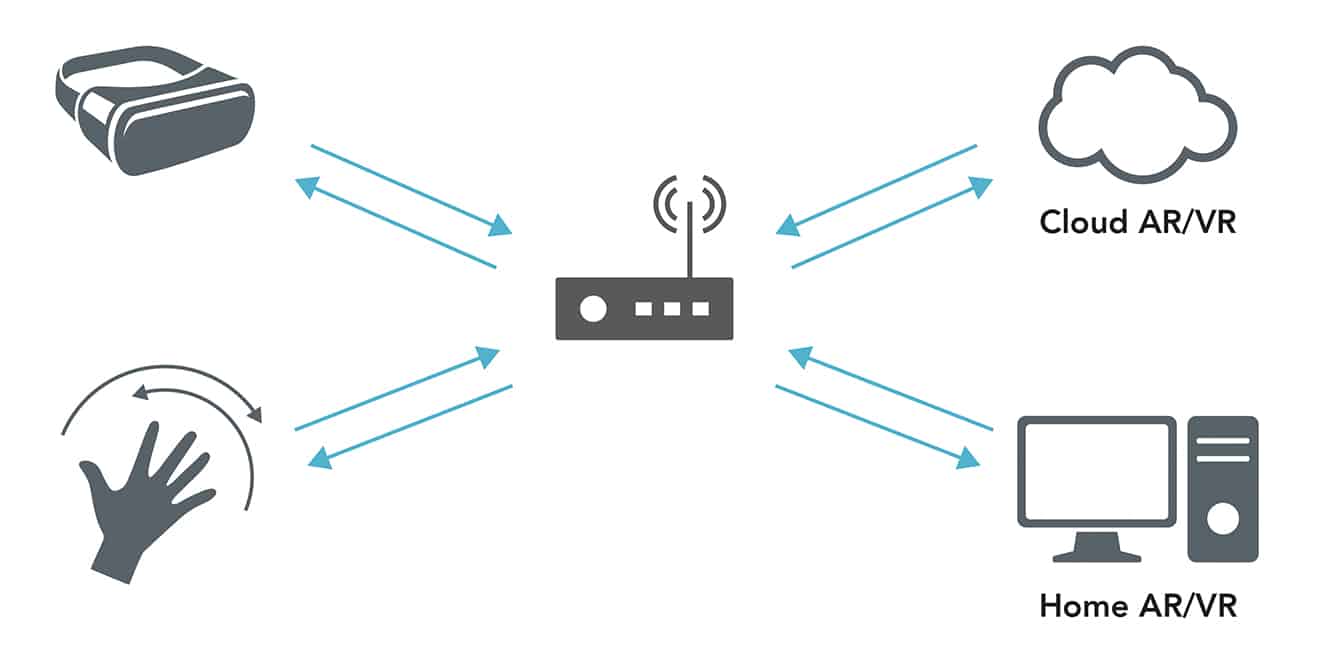
Figure 1: End to end latency

  • Low latency is critical for interactions during game play, or for mission critical applications like industrial robotics operations or medical procedures. This type of application requires real-time exchanges where the data provided in response to the user’s action must be delivered immediately.  The system’s feedback needs to be optimized for human reaction time depending on the senses that are used. For example, the Motion to Photon (MTP) latency between head motion and display should remain < 20 ms (2) for user comfort. The delay on the air interface is only a part of the end-to-end latency and the requirements will be driven by the type of application.

A look at Wi-Fi’s speed evolution

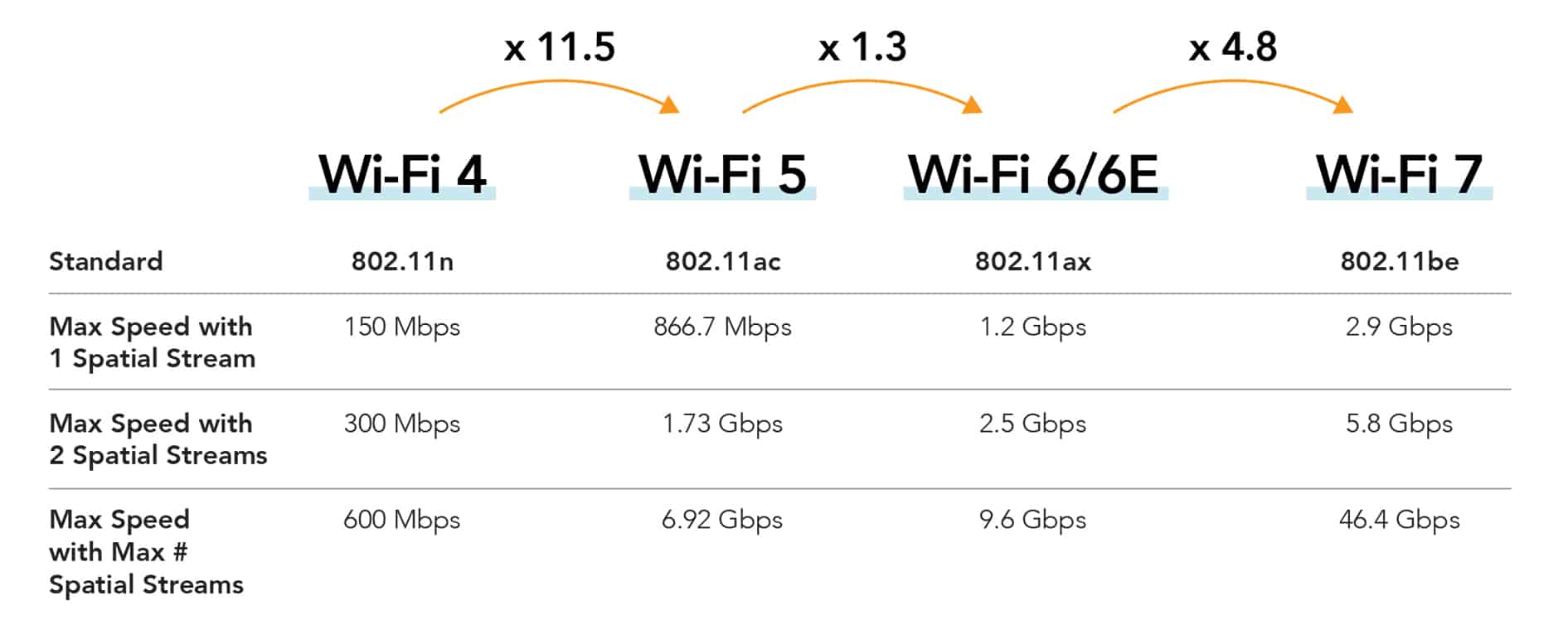
The IEEE’s 802.11be target performance of reaching a throughput of at least 30 Gbps may seem ambitious but looking back at Wi-Fi’s generational evolution of the past 20 years, the most striking progress is the pace at which the top data rates have increased. Thanks to a mix of technological advances and breakthrough new features, each generation has delivered higher performance than its predecessor.

Figure 2: Wi-Fi generational speed evolution

The current generation of Wi-Fi 6 devices is based on the 802.11ax standard. At its inception, in 2014, the High Efficiency WLAN (HEW) 802.11ax standard was directed at improving spectrum efficiency and performance in dense networks.  This goal was a departure from previous Wi-Fi generations that had mostly focused on throughput enhancements. Via innovative features most notably Uplink and Downlink OFDMA and MU-MIMO, in dense environments Wi-Fi 6 devices can achieve an average per-user throughput improvement of 4 times over Wi-Fi 5.

Furthermore, with the expansion of Wi-Fi in the 6 GHz band, Wi-Fi 6E devices can now benefit of up to 1200 MHz of uncongested spectrum. This additional spectrum opens the door to numerous new channels and enough contiguous spectrum to support the creation of extra wide 320 MHz channels. This is why, with the 802.11be standard, the focus is once again on delivering even higher throughput for Wi-Fi users with top speed up to 4.8 times faster than Wi-Fi 6/6E.

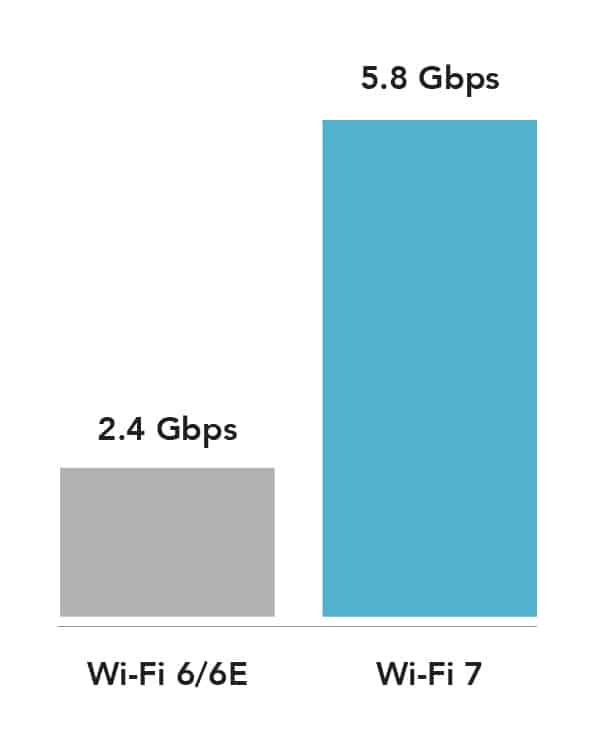
Figure 3: WiFi 6/6E and Wi-Fi 7 Speed Comparison for 2 Spatial Stream devices.

Wi-Fi 7 can reach a top link speed of 46 Gbps with 16 spatial streams and maximum 320 MHz channel bandwidth. For typical clients with 2 spatial streams, the highest data rate is around 5.8 Gbps on a single link, 2.5 times higher than similar 802.11ax clients.

What powers the Wi-Fi speed evolution?

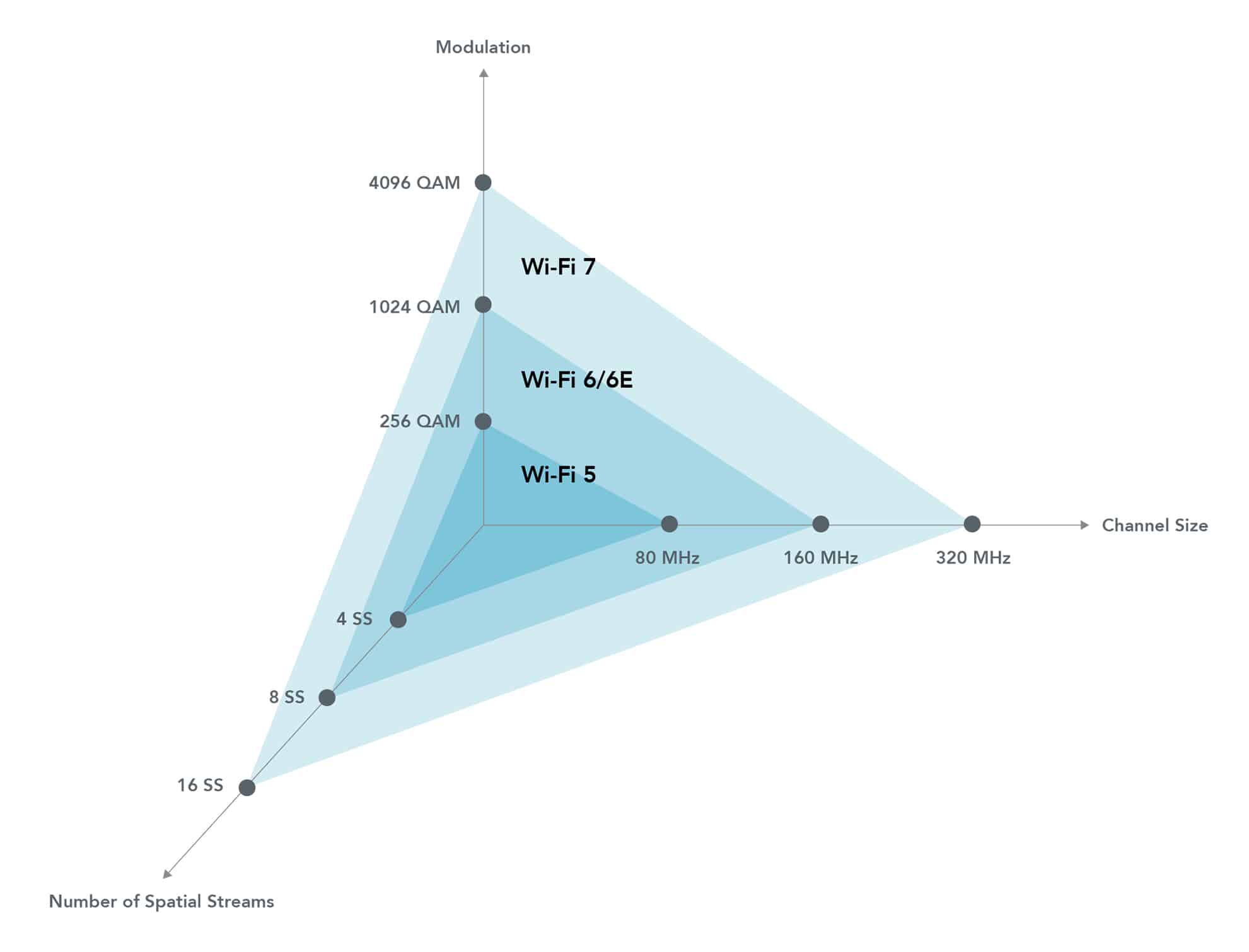
Wi-Fi’s link speed evolution is powered by PHY technological enhancements along 3 dimensions:

  • Modulation Order (QAM)
  • Channel Size
  • Number of Spatial Streams

Figure 4: Wi-Fi PHY generational evolution

Modulation Order

Wi-Fi uses Quadrature Amplitude Modulation (QAM) for efficient data encoding. With each new Wi-Fi generation, higher data rates are achieved by encoding more data bits per symbol. Higher-order QAM enables to transmit more data bits while maintaining the same spectrum footprint and therefore achieve better efficiency.

  • 802.11ac (Wi-Fi 5) supports up to 256-QAM where 8 bits of data are encoded per symbol
  • 802.11ax (Wi-Fi 6/6E) supports up to 1024-QAM, where 10 bits of data are encoded per symbol
  • 802.11be introduces 4096-QAM modulation with 12 bits of data per symbol

4096-QAM leads to an increased data rate of 20% over 1024-QAM.

Channel Size

By doubling Wi-Fi’s channel bandwidth, nearly twice the amount of data can be carried in a single transmission. The 802.11be standard defines operation in the 6 GHz band, with a channel plan currently defined for up to 6 overlapping 320 MHz channels.  The availability of 1200 MHz contiguous spectrum in the 6 GHz band has opened the door to doubling the channel bandwidth from 160 MHz (maximum bandwidth in 802.11ax) to 320 MHz channels, hence doubling the maximum throughput. Availability of the 6 GHz band is however subject to regulatory approval and not all worldwide regions can enjoy the same amount of spectrum. The 5 GHz and 2.4 GHz bands cannot support 320 MHz channels, therefore this Wi-Fi 7 feature will be accessible to only a subset of users.

Spatial Streams

Spatial streams increase the system’s throughput by transmitting independent data streams on multiple antennas simultaneously. Therefore, the maximum throughput of a system with 8 spatial streams is 8 times that of a system with a single antenna. The 802.11ax standard defined MIMO support up to 8 spatial streams and this capability is already supported by some AP chipsets. The 802.11be generation could support up to 16×16 in the future, and thus doubling the maximum throughput compared to 802.11ax. While the theoretical maximum throughput can only be achieved between devices with the same antenna count, the number of MIMO streams for Client Stations is typically limited to 2 or 3.  The high number of spatial streams is an important factor for increased spectral efficiency with the implementation of Multi-User-MIMO (MU-MIMO), another feature supported in the 802.11be standard.

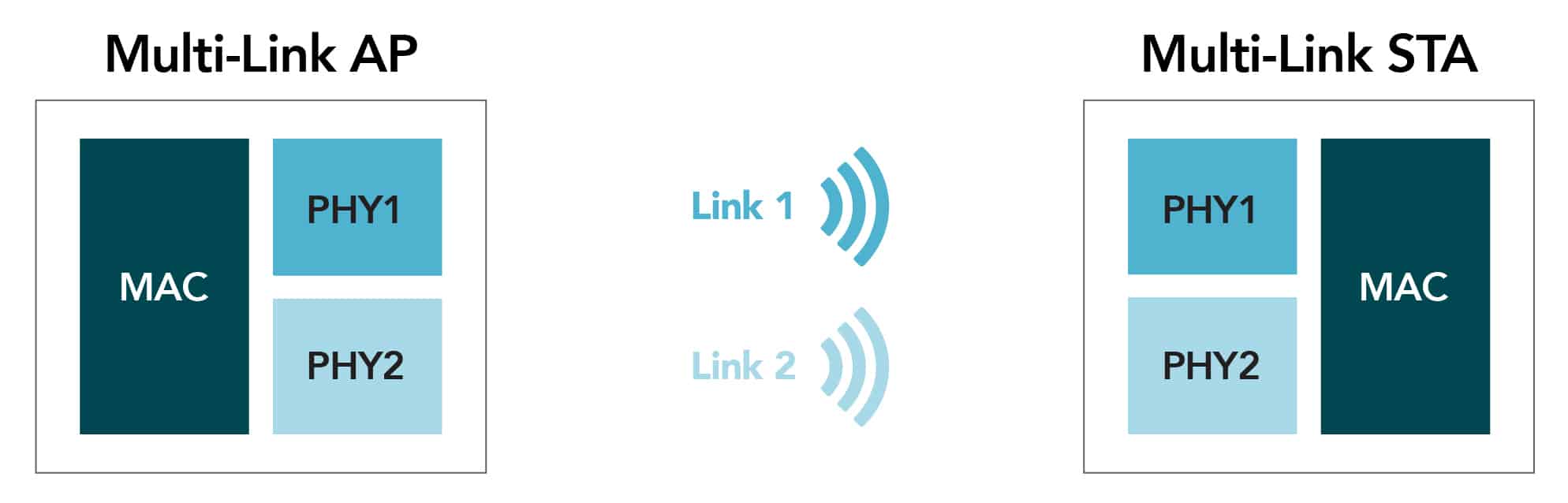
Multi-Link Operation (MLO), a breakthrough feature defined in the 802.11be standard adds a new dimension to Wi-Fi’s link speed evolution diagram. 

Figure 5: 802.11be Multi-Link Operation

With a common MAC layer and separate PHY layers, Wi-Fi 7 Access Points and Client Stations are capable of transmitting and receiving simultaneously on multiple links. In the hypothetical case of an AP Multi-Link Device (MLD) operating at 320 MHz channel in the 6 GHz band and 160 MHz channel in the 5 GHz band connected to a dual-radio MLD Client (2×2 + 2×2), the throughput could reach up to 8.6 Gbps by having data transmitted simultaneously on both links and thereby reducing latency. By taking advantage of intelligent traffic scheduling and prioritization, MLO enables reduced latency(3) and jitter by prioritizing data transmission on links with the best RF conditions or improve reliability by duplicating data on multiple links. 

Conclusion

While Wi-Fi 6 and Wi-Fi 6E high devices are well positioned for the needs of today’s applications, by the time Wi-Fi 7 reaches maturity it is anticipated that the consumer, enterprise, and industrial spaces will be upended with new applications requiring content delivery with extremely high throughput, low latency, low jitter and high reliability. The 802.11be standard is being defined to serve these applications so that Wi-Fi 7 can become the main connectivity technology capable of delivering the highest user experience. Wi-Fi device’s RF PHY performance is the critical foundation that will unlock this potential.

For more information visit the IQxel-MX page to learn about LitePoint’s test solutions for 802.11be or watch a replay of our webinar on Wi-Fi 7.

References:

1: https://standards.ieee.org/ieee/802.11be/7516/

2: https://www.qualcomm.com/media/documents/files/vr-and-ar-pushing-connectivity-limits.pdf

3: https://www.qualcomm.com/news/onq/2022/02/14/pushing-limits-wi-fi-performance-wi-fi-7

Wi-Fi 6/6E is a significant evolution of the Wi-Fi standard that boosts throughput and reduces latency to make it better for high-capacity applications as well as for emerging applications such as AR/VR, ultra-high definition video streaming, 5G offload and others.

These changes and the new opportunities they open up were the focus of a recent webinar hosted by RCR Wireless’ Catherine Sbeglia featuring LitePoint’s Adam Smith and Kevin Robinson from the Wi-Fi Alliance.

Wi-Fi 6 shipments have taken off surpassing 50% market share in terms of shipments in three years – a feat that took Wi-Fi 5 four years to achieve.

Wi-Fi 6 has a fundamentally different way of operating, using new technologies including orthogonal frequency division, multiple access (OFDMA) channel access method and 1024 QAM modulation to get this performance. With Wi-Fi 6E, the technology pushes into the 6GHz frequency band for the first time.

All of this sets the stage for understanding the new technologies that will impact the test strategies used to ensure the quality of Wi-Fi 6/6E products. Here are a few key points brought up by Adam during the webinar about the technologies and capabilities involved with Wi-Fi 6 and beyond:

With Wi-Fi 6E, systems need to support very wide spectrum – the 6 GHz band adds a total of 1.2GHz of additional spectrum over the 2.4 and 5 GHz bands. The RF front end will not be able to do this with a single filter bank or amplifier. This results in more complex RF front ends.

The other big factor with the RF front end will be band separation as the possibility exists that in a tri-band router that is transmitting in the 5GHz band could desensitize the receiver in the 6 GHz band.

The switch to OFDMA allows multi-user operation, enabling multiple users to transmit/receive simultaneously, making more efficient use of the channel. In Wi-Fi 6/6E, OFDMA allows the router to divide a channel into subchannels that can each support a user. This will require devices to have low frequency errors so as to not override a neighboring subchannel. Tight timing is also important to enable simultaneous transmissions so that all the client station devices respond to the access point within their allotted times.

And if that isn’t enough, Wi-Fi 7 is in the standards process and is offering all the efficiency of Wi-Fi 6/6E with extremely high throughput including 4096 QAM, 16 user streams and 320 MHz channels.

The full webinar discussion of the changes in Wi-Fi – including questions and answers – is available for replay and can be found here: State of Wi-Fi 6/6E

WiFi has become inextricable from daily life. But it hasn’t always been like that. Standards and adoption in the WiFi space today took years of research, iteration, and certification. While some key work has already been accomplished, there is still more that must be done for WiFi Sensing to continue along the road to standardization. But what exactly is it going to take for WiFi Sensing to become fully standardized and adopted in the mass-market? As ubiquitous as WiFi is for communications, so too will WiFi Sensing be for the modern home and beyond. But to pave the road for such a future, core standards must be developed to innovate and unify.

Standardized WiFi Sensing by 2024
The story of WiFi Sensing began about a decade ago with the publication of key academic research. Back then, utilizing WiFi signals for more than device communications was just a concept. This work was largely enabled by specialized research systems. With hardware too expensive to sell as a consumer WiFi product, WiFi Sensing remained largely in the academic space. Some work also began to utilize either unofficial third-party firmware patches or vendor-released research tools, which were specific to a small subset of consumer WiFi chipsets. During this time, it was difficult to get access to all the information necessary to develop a successful WiFi Sensing product.

To Each Vendor Their Own
To facilitate mass adoption of WiFi Sensing, there needs to be an effective transition from academic research to industry integration and application. Not only did it require proven commercial potential, key industry growth and scalability, it also needed to be a part of mainstream WiFi chipsets. But this big step from conceptualization to execution requires proven commercial potential and key industry partnerships for growth and scalability.

Cognitive was founded out of the desire to build a powerful but low-cost and easily scalable device that could leverage insights about changes in radiofrequency signals. That, however, would require us to design our own chip: the R10. The core advantage of the R10 was that it was mostly software-based in its interface with RF signals and so could be used for many different applications, simply by writing new software. By accessing channel state information not typically exposed in commercial chipsets, we were able to develop and refine our motion detection algorithms and build our consumer proof-of-concept product, Aura Home, the first solution of its kind in market which launched December 2017 and sold through Amazon. However, for the technology to be successful alongside pre-existing WiFi chips, we knew we would have to partner with key chipset companies like Qualcomm, Broadcom, Onsemi, and MaxLinear. But through this experience, it became apparent that without a standard, each vendor would implement things in a slightly different way, presenting a core challenge and requiring significant time and resources to design a technology capable of operating with all the different possible implementations. Standardization is important to enable vendor compliance and ensure compatibility among different vendors. Service and technology providers rely on utilizing a fixed set of features to efficiently and reliably provide their solutions. This is where WiFi Sensing standardization comes in, bringing all industry experts together to discuss and establish a baseline of key processes.

These efforts towards standardization will also have a noticeable positive impact on customers. With the development of new features and capabilities for WiFi Sensing, ISPs can deliver innovative consumer products to increase customer satisfaction through motion insights and analytics. Standardization is also extremely important to consumers because they want confidence that all the different products they purchase will simply work together and behave as expected. The 802.11bf standard is especially important for consumers as it opens up the possibility of endless potential applications in the home by using common devices instead of expensive, dedicated motion sensing hardware. WiFi is what it is today because there has been a standard or blueprint that describes exactly how anybody can build the components necessary to interact and function with the rest of the network. For WiFi Sensing to achieve its true market penetration potential, this blueprint needs to first be developed. Additionally, each product that receives the Wi-Fi logo and stamp must go through the certification program run by the Wi-Fi Alliance. Consumers look for that logo and stamp as a sign that the product not only has been designed with the IEEE 802.11 standard in mind, but has also gone through compliance testing.

How WiFi Motion is Leading the Journey
Innovation requires continuous, dedicated effort with the investment of key industry partners to see mass adoption and scalability — Cognitive’s WiFi Motion entered the market February 2020 as a camera-free home monitoring solution and is now available from 79 ISPs in over 65 countries. As WiFi Sensing continues along its journey, standardization will be the catalyst for endless new advanced features and services that redefine how the world uses WiFi. But the road doesn’t end there. WiFi Sensing needs companies like Cognitive with the technological, artificial intelligence, and algorithms expertise to create a robust network to provide faster adoption and greater accessibility. ISPs around the globe are already leveraging WiFi Motion to introduce their customers to the unlimited possibilities of WiFi Sensing. By joining WiFi Motion’s journey early, these companies are uniquely positioned to take advantage of new features as standards are developed. Only through collaboration will WiFi Sensing become a robust option for every wireless network and allow WiFi Motion to grow into a foundational ecosystem for WiFi Sensing.

The Road Ahead Is Clear: A Bright Future for WiFi Sensing
While the road to standardization can often seem nebulous, there are some key steps that aid the process in setting up a timeframe. The first step is to get interested people together to develop a standard. This was officially achieved when IEEE 802.11’s TGbf formed in October 2020. The next step is to develop the standard, which TGbf is currently working on, where the first draft is targeted to be released in March 2022. As per the IEEE process, the entire standard work being performed by TGbf is expected to be fully completed by September 2024. Once there is a written standard, a certification program is required to ensure all different vendor implementations are compliant with the standard. This will be completed by the Wi-Fi Alliance (WFA) as a parallel branch. Finally, it will take time for certified products to make their way into the hands of consumers, – but once they do, Cognitive’s technology will be ready to leverage the latest capabilities.

Through our involvement with these associations, we have gained a vast amount of knowledge as to what is necessary to build a successful sensing system. We also have a deeper understanding of some of the technological limitations that the current state of sensing presents. We want to continue to contribute to this field, encourage collaboration, and ultimately ensure there are tools available to help push the limits of WiFi even further in the future. Standardization is a naturally slow process but crucial for building a strong foundation for WiFi Sensing and future WiFi-based services. Cognitive wants to make sure that the standards being created not only have a complete feature set for modern challenges but are also positioned to gain widespread adoption in the future.

The Major Players in WiFi Sensing Standardization
The work towards standardization is ultimately a collaborative process only possible through the combined expertise of various organizations, companies, and individuals invested in the future of WiFi. There are three key players in this space: IEEE 802.11 Task Group bf (TGbf), the Wireless Broadband Alliance (WBA), and the Wi-Fi Alliance (WFA).

At the IEEE level, 802.11 is a group that owns, maintains, and develops the medium access control (MAC) and physical layer (PHY) specifications for WiFi. The MAC and PHY layer specs describe features, capabilities, and mechanisms that govern the operation of the lowest layers. Further, TGbf will produce an amendment to existing 802.11 standards that will ultimately build upon what already exists to enhance WiFi Sensing. It is important to understand that TGbF is an amendment, not a complete redesign of what already exists. In fact, within the scope of the TGbf project, there will not be any PHY layer changes or modifications for sub-7 GHz operation or descriptions. By utilizing IoT devices already connected to a home’s native network, a larger motion sensing coverage area can be created without requiring additional traditional security devices that might be more intrusive.

The WFA, on the other hand, works with specifications developed by the IEEE to create and test a certification program to ensure each implementation conforms to the standard. Components that pass all the defined tests and conform to the required standards receive the trademark WiFi logo and can be marketed and sold as such. The process of certification is extremely important as it quickly establishes trust with vendors, providing confidence that all due diligence has been performed. Specifically, for consumers, that means that they can feel confident in taking home a certain product that has passed specific levels of testing.

Finally, the WBA consists of a group of network operators and technology innovators who want to offer their customers seamless connectivity (i.e., allowing roaming between partner networks, billing exchanges, etc.). Utilizing their collective industry and research expertise, this group is focused on enhancing services, applications, connectivity, and customer experiences. Cognitive first got involved with the WBA when we were looking for the right platform to develop our technology that would benefit its members through various working groups. At the time, the WBA was the perfect fit, as they had a large network operator base and a number of technology providers. Together, we established the Wi-Fi Sensing Group, where we have been working to help not only introduce the technology, but also raise awareness of its current and future capabilities, and ultimately help with getting people ready for adoption. Part of the group’s work has also been helping publish Wi-Fi Sensing focused whitepapers, which highlights technological gaps that with standard support could further improve the technology. To date, the WBA has published three whitepapers in order to advance the field and stimulate critical thought around the technology. Topics include recommendations for early adoption of WiFi Sensing, how to evaluate a WiFi Sensing system, and factors that can impact the performance of a WiFi Sensing system (will be publicly available in spring 2020).


STOCKHOLM, Sweden, January 20, 2022 – Bumbee Labs, the Scandinavian-based global leader in providing footfall data and analytics via anonymized Wi-Fi signals, has partnered with DOTS Tech Systems, a globally renowned Internet of Things solutions provider from UAE.


This collaboration enhances DOTS ability to deliver Wi-Fi based and privacy secure footfall data to their smart buildings, smart retail, airport and other transport hub verticals. In particular, the retail industry will benefit greatly from their new offerings with added data features such as the ability for shopping center management to understand and respond to peaks and flows in customer footfall more effectively and understanding important consumer behaviour. Features such as consumer dwell time, movement patterns and conversion rates in stores will help businesses to more accurately tailor their offering to encourage more visits, longer visits and ultimately more sales.

The partnership will bring Bumbee Labs into Middle Eastern territory for the first time, expanding their leadership from the European markets into further areas of the world. Already providing footfall data to some of the largest names in their home base of Sweden, such as Telia, Bluecom, IMAS, Springboard and CK Delta has inspired Bumbee Labs to explore and offer services to more diverse markets.

The physical retail industry is in dire need of additional data in order to be able to compete with online shopping. Bumbee Labs’ GDPR secure method can provide a number of important KPI’s using existing Wi-Fi installations, which reduces the need for additional hardware investments. 

“We are excited to work with DOTS as our partnership in the UAE. Their innovation in delivering working solutions within smart city services (and the Internet of Things domain) will be merged with our expertise in providing anonymized data from smart phones to create an enhanced service that will accelerate the growth of the retail industry sector,” says Karl Samuelsson, the CEO of Bumbee Labs.

The CEO of DOTS Dheeraj Singh adds, “We are continually committed to delivering innovative and cutting-edge solutions for Smart Cities. As a pioneer in the space of Internet of Things (IoT) enabled Smart City applications, DOTS have a proven track record of delivering solutions that meet and exceed client’s expectations of digitization on the ground. We are very excited by this collaboration with Bumbee Labs as their data expertise will complement our IoT know-how providing an unparalleled service to our clients across several verticals, industries and markets in the Middle East.”

The partnership between Bumbee Labs and DOTS will enhance the retail industry of the Middle East by improving the accuracy of data collected from physical spaces. With this innovative collaboration, both companies expect to see a rise in ownership of sales from retailers again following a pause in growth during the last two years of the pandemic. The idea of monetizing Wi-Fi is now expanding to all markets around the world that want to stimulate the retail industry.

About Bumbee Labs 


Bumbee Labs measures visitor flows by capturing anonymized Wi-Fi signals in smart phones and can do measurements in both outdoor and indoor environments. Visitor flows are measured anonymously, and the method is unique in being approved by a European Court of Law. Today, Bumbee Labs’ solutions also work outdoors in, for example, town centers. This is only the beginning of the digital alteration that we are working on to make towns and physical shopping even more effective and profitable. Discover more at www.bumbeelabs.com. Follow us on LinkedIn.


About DOTS

DOTS Tech Systems is a prestigious, Dubai-based smart solutions company whose mission is to develop cutting edge smart city technologies that deliver unbeatable, tailored IoT offerings for their customers. DOTS have solutions across numerous industries and verticals and within the context of the retail sector they are currently serving some of the best retail brands of the Middle East. Learn more at www.dotstechsystems.com. Follow us on LinkedIn. 


Contact persons for further questions relating to the partnership: 

DOTS:
Mohammad Foudeh, Sales Director, +97 155 2940707, [email protected]

Bumbee Labs:
Karl Samuelsson, CEO, +46 707 588971, [email protected]


For PR enquiries please contact: 

DOTS:
Rebecca Lightbody, B2B Engagement & Digital Marketing, DOTS, [email protected]

Bumbee Labs:
Amanda Herzog, Marketing Coordinator, Bumbee Labs, [email protected]