Breaking News

GLOBAL Wi-Fi NEWS bulletin

High Speed Meets Intelligence

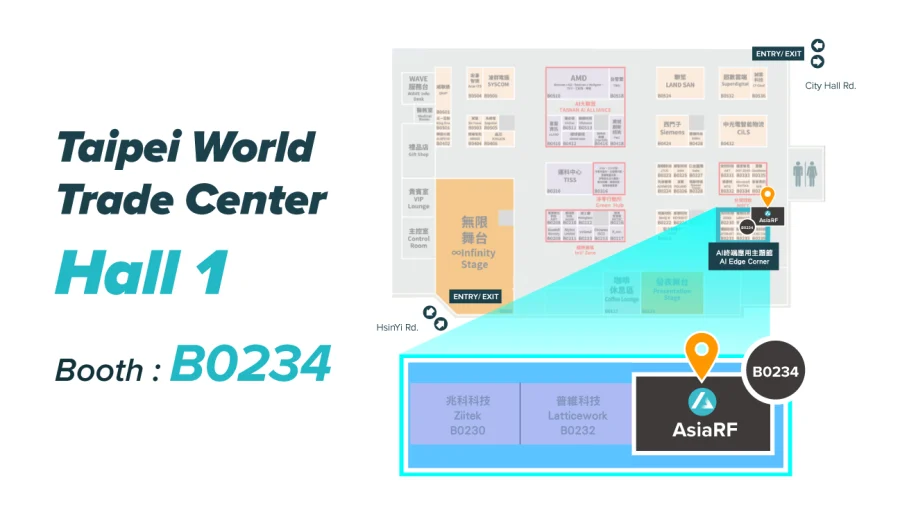
We are proud to announce that AsiaRF will be exhibiting at AI Wave.

As businesses demand faster, more secure visual analytics, moving AI from the cloud to the edge has become critical. At this yearโ€™s show, AsiaRF is presenting our integration of Edge AI and Next-Gen Wireless Connectivity.

The 4-Layer Architecture on a Single Table

At our booth, we are moving away from traditional complex infrastructure. Instead, we are demonstrating a seamless, full-stack Edge AI Camera Solution directly on our showcase table, built on a powerful 4-layer architecture:

  • Application Layer : Enterprise-grade control and monitoring.

  • AI Layer (Jetson) : Localized, high-performance computing for instant object, facial, and safety recognition.

  • Wi-Fi 7 Layer (AsiaRF Module) : Utilizing our latest Wi-Fi 7 modules to provide the massive bandwidth and ultra-low latency required for uncompressed data streams.

  • Devices Layer : Industrial-grade smart cameras and sensors optimized for edge ecosystems.

Join Us in Taipei

Come and see how AsiaRF modules unlock the true potential of NVIDIA Jetson platforms and smart AI cameras. Our technical team will be on-site to walk you through live demos.


Wave Ai 2026 Map

Fortinetโ€™s purpose-built ASIC expertise and Intelโ€™s semiconductor design, packaging, and manufacturing capabilities will drive greater security, scale, performance, and resiliency for organizations

Fortinet and Intel logos on a blue background

SANTA CLARA AND SUNNYVALE, Calif. โ€“ July 21, 2026 โ€“ Intel Corporation (NASDAQ: INTC) and Fortinet (NASDAQ: FTNT), today announced a strategic collaboration to develop Fortinet Security Processor 6 (SP6). Expanding a long-standing relationship between the two companies, this collaboration combines Fortinetโ€™s proprietary, purpose-built security processor expertise with Intelโ€™s advanced design, packaging, and manufacturing capabilities to accelerate and strengthen SP6 development. This work will also help to improve the resilience and diversity of Fortinetโ€™s global supply chain.

โ€œAs organizations face a rapidly evolving threat landscape, security infrastructure must deliver both performance and innovation at scale,โ€ said Lip-Bu Tan, CEO of Intel. โ€œThis collaboration demonstrates how Intelโ€™s semiconductor leadership and advanced design, packaging, and manufacturing capabilities can help cybersecurity leaders like Fortinet accelerate the development of critical security technologies while building a more resilient and diversified global supply chain.โ€

โ€œFortinetโ€™s purpose-built ASICs have been a key differentiator for more than two decades, enabling us to deliver the security effectiveness, performance, and efficiency our customers demand,โ€ said Ken Xie, Founder, Chairman, and CEO of Fortinet. โ€œThis expanded relationship with Intel will leverage its unique combination of advanced semiconductor technology, manufacturing expertise, and global supply chain capabilities, helping Fortinet accelerate and strengthen our ASIC strategy, while also better supporting organizations all over the world.โ€

In addition to bringing together Fortinetโ€™s leadership in purpose-built security processors with Intelโ€™s broad portfolio of ecosystem IP, proven expertise in disaggregated semiconductor design, and advanced packaging solutions tailored for both AI-enabled and cost-sensitive applications, this collaboration aims to deliver a highly integrated security processor capable of supporting increasingly sophisticated security services and the demanding performance requirements of todayโ€™s organizations.

The companies will explore additional opportunities to further deepen collaboration across semiconductor technology, manufacturing, and the infrastructure underpinning future cybersecurity innovation. This work is expected to advance Fortinetโ€™s long-term ASIC roadmap, support greater performance and service richness, and strengthen supply chain assurance for customers worldwide.

7SIGNAL is pleased to announce an upcoming strategic meeting with valued client Top Dog LLC. The two organizations will come together to review progress, align on goals, and chart the next phase of their partnership around enterprise Wi-Fi optimization.

Cleveland, OH โ€“ 7SIGNALยฎ, the leader in enterprise Wi-Fi optimization, today announced that it will meet with Top Dog LLC to discuss how 7SIGNALโ€™s platform can continue to deliver a seamless and reliable wireless experience across Top Dog LLCโ€™s environments.

The meeting will focus on Top Dog LLCโ€™s connectivity priorities, review recent performance insights, and outline a roadmap for expanding the use of 7SIGNALโ€™s monitoring and analytics capabilities. Both teams look forward to a productive session that strengthens an already collaborative relationship.

โ€œWe are excited to sit down with the team at Top Dog LLC,โ€ said a 7SIGNAL spokesperson. โ€œMeetings like this are where we listen closely to our customers, understand their evolving needs, and make sure our platform is delivering measurable value for their business.โ€

For more information about the 7SIGNAL platform, click here.

Reliable wireless connectivity is a critical part of modern system design. Engineers need solutions that reach beyond the limitations of traditional Wi-Fi while maintaining the flexibility of IP networking. Whether monitoring remote equipment, connecting sensors across large industrial sites or extending wireless coverage into difficult environments, long-range communication can simplify deployment and reduce infrastructure costs.

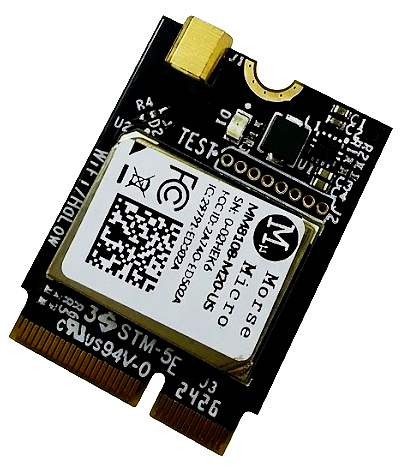
The new Gateworks GW16170 High-Power Wi-Fi HaLow M.2 Card was designed to meet these challenges for applications in North America. Powered by the Morse Micro MM8108-M20 chipset, the GW16170 combines the long-range advantages of IEEE 802.11ah Wi-Fi HaLow with the rugged reliability expected from Gateworks embedded solutions. The result is a compact wireless module that helps developers build scalable Industrial IoT networks with greater range, improved penetration, and seamless IP connectivity.

Why Wi-Fi HaLow?

Traditional Wi-Fi performs well in many applications, but coverage can become a challenge as devices spread across warehouses, manufacturing facilities, agricultural operations, transportation infrastructure and utility installations. Higher-frequency wireless signals naturally lose strength over longer distances and struggle to penetrate walls, machinery and other physical obstacles.

Wi-Fi HaLow addresses these limitations by operating in the license-exempt 902โ€“928 MHz frequency band. Lower-frequency signals travel farther and penetrate common obstacles more effectively than conventional Wi-Fi frequencies. This enables broader wireless coverage while preserving the familiar benefits of standards-based Wi-Fi networking.

Unlike many proprietary long-range wireless technologies, Wi-Fi HaLow supports native IP networking. Developers can leverage existing networking tools, simplify system integration, and build secure wireless architectures using familiar software environments.

Meet the GW16170

The GW16170 is a high-power M.2 2230 E-Key Wi-Fi HaLow radio built around the Morse Micro MM8108-M20 chipset. The module delivers up to 28.5 dBm transmit power and supports theoretical data rates up to 43.3 Mbps, making it an excellent choice for industrial applications that require both long-range communication and meaningful data throughput.

Key features include:

  • IEEE 802.11ah (Wi-Fi HaLow) support
  • Morse Micro MM8108-M20 chipset
  • 902โ€“928 MHz operation
  • Up to 28.5 dBm transmit power
  • Data rates up to 43.3 Mbps
  • M.2 2230 E-Key form factor
  • USB 2.0 host interface
  • Industrial operating temperature from -40ยฐC to +85ยฐC
  • North America only

These capabilities allow developers to extend wireless coverage while maintaining a compact hardware footprint suitable for embedded systems.

Built for Industrial Applications

Industrial environments demand wireless technologies that remain reliable over long distances and in challenging conditions. The GW16170 helps engineers connect equipment where traditional Wi-Fi infrastructure may be difficult or expensive to deploy.

Typical applications include:

  • Industrial automation
  • Smart agriculture
  • Environmental monitoring
  • Utility infrastructure
  • Smart cities
  • Transportation systems
  • Remote monitoring
  • Industrial gateways
  • Edge computing

Many of these applications require communication with devices located hundreds of meters or even kilometers apart. Wi-Fi HaLow helps bridge these distances while supporting reliable wireless communication using familiar IP protocols.

Powered by Morse Micro Innovation

At the heart of the GW16170 is the Morse Micro MM8108-M20, a second-generation Wi-Fi HaLow solution engineered specifically for next-generation IoT connectivity.

The MM8108 supports channel bandwidths from 1 MHz to 8 MHz and delivers improved performance while maintaining the power efficiency that makes Wi-Fi HaLow attractive for Industrial IoT deployments. It also supports dense device deployments, allowing more connected endpoints to operate across a single wireless infrastructure.

This combination of long range, low power operation, and scalable connectivity makes Wi-Fi HaLow well suited for applications where reliability and network coverage are equally important.

Designed for Gateworks Platforms

The GW16170 integrates directly with Gateworks Single Board Computers through its USB 2.0 M.2 interface. For Venice platforms without an onboard M.2 E-Key connector, developers can utilize the GW16151 adapter to add compatibility.

Gateworks also provides software support for the MM8108 within its Ubuntu Linux and OpenWrt Board Support Packages. Developers can begin evaluating Wi-Fi HaLow quickly while leveraging the same software ecosystem used across Gateworks embedded computing platforms.

This tight hardware and software integration helps reduce development time and allows engineering teams to focus on application development rather than wireless integration.

Engineered for Real-World Deployments

Industrial wireless hardware must perform consistently under demanding operating conditions. The GW16170 is designed with the same industrial focus found throughout the Gateworks product portfolio.

Its industrial temperature rating of -40ยฐC to +85ยฐC allows deployment in outdoor enclosures, transportation systems, industrial equipment, energy infrastructure, and other environments where commercial wireless hardware may not be suitable.

Combined with its compact M.2 2230 form factor, the GW16170 provides a flexible solution for space-constrained embedded designs without compromising wireless performance.

Bringing Long-Range Wi-Fi to the Industrial Edge

As Industrial IoT applications continue to expand, engineers need wireless technologies that deliver greater range, simpler integration and reliable performance in demanding environments. The GW16170 brings these capabilities together in a compact, industrial-grade module designed specifically for embedded systems.

By combining Gateworksโ€™ rugged embedded computing expertise with Morse Microโ€™s advanced Wi-Fi HaLow technology, the GW16170 enables developers to extend network coverage, simplify wireless deployments, and build scalable Industrial IoT solutions with confidence.

Whether connecting remote sensors across a manufacturing campus, monitoring utility infrastructure, enabling smart agriculture, or deploying next-generation edge computing systems, the GW16170 provides the long-range wireless foundation needed to support tomorrowโ€™s connected industrial applications.

Learn More

Ready to add long-range Wi-Fi HaLow connectivity to your next embedded design?

Visit the GW16170 Gateworks product page to explore specifications, software support, and compatibility with Gateworks Single Board Computers. Learn more about Wi-Fi HaLow technology by visiting Morse Micro.

Buy evaluation units through DigiKey HERE. Also available through Braemac Americas, Avnet and directly through Gateworks.

Leadership appointments to take effect upon completion of previously announced transaction

IRVINE, Calif. and GREENSBORO, N.C., JULY 28, 2026 โ€” Skyworks Solutions, Inc. (Nasdaq: SWKS) and Qorvo, Inc. (Nasdaq: QRVO) today announced the expected executive leadership team for the combined company, effective upon the successful completion of the pending transaction.

“Our expected leadership team unites deep industry expertise, proven operating experience and a shared commitment to helping customers solve their most complex challenges,โ€ said Phil Brace, president and chief executive officer of Skyworks, who will serve as chief executive officer of the combined company. โ€œIdentifying this team is an important step in preparing us to move with clarity and conviction after close. This group will play a critical role in bringing together the strengths of both organizations, supporting a smooth transition and positioning our combined company to realize the tremendous opportunities ahead.”

The following executives are expected to report to Mr. Brace as of the closing:

  • Philip Carter – Chief Financial Officer and Senior Vice President
  • Philip Chesley – Senior Vice President and President of High Performance Analog
  • Kari Durham – Senior Vice President, Human Resources
  • J.K. Givens – Senior Vice President and General Counsel, Secretary
  • Yusuf Jamal – Senior Vice President and General Manager of RF and Mixed-Signal Intelligence Solutions
  • Reza Kasnavi – Executive Vice President, Chief Operations and Technology Officer
  • Joel King – Senior Vice President and General Manager of Mobile Solutions Business
  • Todd Lepinski – Senior Vice President, Sales and Marketing
  • Frank Stewart – Senior Vice President and President of Advanced Cellular

Bob Bruggeworth, president and chief executive officer of Qorvo, who is expected to join the board of directors of the combined company post-close, added, โ€œTodayโ€™s announcement reflects the strong partnership that has shaped our integration planning efforts from the very beginning. I am confident these leaders will help foster collaboration across our teams as we build on the engineering excellence, innovation, and customer focus that have long distinguished both organizations.โ€

About Skyworks
Skyworks Solutions, Inc.ย is empowering the wireless networking revolution. We are a leading developer, manufacturer and provider of analog and mixed-signal semiconductors and solutions for numerous applications, including aerospace, automotive, broadband, cellular infrastructure, connected home, defense, entertainment and gaming, industrial, medical, smartphone, tablet and wearables.
Skyworksย is a global company with engineering, marketing, operations, sales and support facilities located throughoutย Asia,ย Europeย andย North Americaย and is a member of the S&P 500ยฎ market index (Nasdaq: SWKS). For more information, please visit Skyworksโ€™ website at:ย www.skyworksinc.com.

Aboutย Qorvo
Qorvoย (Nasdaq: QRVO) supplies innovative semiconductor solutions that make a better world possible. We combine product and technology leadership, systems-level expertise and global manufacturing scale to quickly solve our customers’ most complex technical challenges.ย Qorvoย serves diverse high-growth segments of large global markets, including automotive, consumer, defense & aerospace, industrial & enterprise, infrastructure and mobile. Visitย www.qorvo.comย to learn how our diverse and innovative team is helping connect, protect and power our planet.

Qorvoย is a registered trademark ofย Qorvo, Inc.ย in theย U.S.ย and in other countries. All other trademarks are the property of their respective owners.

Important Information About the Proposed Transaction and Where to Find It

In connection with the mergers, Skyworks has filed with the SEC a registration statement on Form S-4 (File No. 333-291947) (the โ€œRegistration Statementโ€), which includes a prospectus with respect to the shares of Skyworksโ€™ common stock to be issued in the mergers and a joint proxy statement for Skyworksโ€™ and Qorvoโ€™s respective stockholders (the โ€œJoint Proxy Statement/Prospectusโ€). The Registration Statement was declared effective on December 23, 2025, and Skyworks filed a final prospectus on December 23, 2025, and Qorvo filed a definitive proxy statement on December 23, 2025. The Joint Proxy Statement/Prospectus was mailed to stockholders of Skyworks and Qorvo on or about December 23, 2025. Each of Skyworks and Qorvo may also file with or furnish to the SEC other relevant documents regarding the mergers. This communication is not a substitute for the Registration Statement, the Joint Proxy Statement/Prospectus or any other document that Skyworks or Qorvo may mail to their respective stockholders in connection with the mergers.

INVESTORS AND SECURITY HOLDERS OF SKYWORKS AND QORVO ARE URGED TO READ THE REGISTRATION STATEMENT AND THE JOINT PROXY STATEMENT/PROSPECTUS INCLUDED WITHIN THE REGISTRATION STATEMENT, AS WELL AS ANY OTHER RELEVANT DOCUMENTS FILED WITH THE SEC IN CONNECTION WITH THE MERGERS OR INCORPORATED BY REFERENCE INTO THE REGISTRATION STATEMENT AND THE JOINT PROXY STATEMENT/PROSPECTUS (INCLUDING ANY AMENDMENTS OR SUPPLEMENTS THERETO), BECAUSE THEY WILL CONTAIN IMPORTANT INFORMATION REGARDING SKYWORKS, QORVO, THE MERGERS AND RELATED MATTERS.

The documents filed by Skyworks with the SEC also may be obtained free of charge at Skyworksโ€™ website at https://www.skyworksinc.com/investors or upon written request to Skyworks at [email protected]. The documents filed by Qorvo with the SEC also may be obtained free of charge at Qorvoโ€™s website at https://ir.qorvo.com/ or upon written request to Qorvo at [email protected]. These documents filed with the SEC are also available for free to the public at the website maintained by the SEC at www.sec.gov.

No Offer or Solicitation

This communication is for informational purposes only and does not constitute, or form a part of, an offer to sell or the solicitation of an offer to buy any securities or a solicitation of any vote or approval, nor shall there be any sale of securities in any jurisdiction in which such offer, solicitation or sale would be unlawful prior to registration or qualification under the securities laws of any such jurisdiction. No offer of securities shall be made except by means of a prospectus meeting the requirements of Section 10 of the Securities Act of 1933, as amended, and otherwise in accordance with applicable law.

Executive Summary

Fully certified Wi-Fi 8 (802.11bn) routers and consumer devices are expected to be officially finalized and certified by the Wi-Fi Alliance in 2028. However, early pre-standard hardware (draft-compliant with basic capabilities) is already hitting the market. For instance, manufacturers like TP-Link have announced plans to launch the TP-Link Archer 8 router as soon as October 2026.

Wi-Fi 8 (IEEE 802.11bn) marks a turning point. For the first time, a Wi-Fi generation optimizes for reliability rather than peak speed, targeting a 25% improvement in throughput under interference, a 25% reduction in 95th percentile latency, and a 25% reduction in packet loss as users move through the home. These are the right goals, and Plume welcomes them. Plume has been delivering these outcomes for over a decade across every device already in the home. When Wi-Fi 8 arrives, Plume will orchestrate its already outstanding capabilities on top of it. This is Plume and Wi-Fi 8 together, not one or the other.

Plume delivers the outcomes Wi-Fi 8 targets across the Wi-Fi generations people own today.
Wi-Fi 8โ€™s alleged reliability gains come largely from coordination and intelligence: choosing the best channel, steering clients to the right band and access point (AP), prioritizing the right application, and avoiding interference. Since these decisions sit above the radio, Plume already makes them in the cloud for Wi-Fi 5, 6, 6E, and 7 devices now, and will continue to adhere to this strategy for Wi-Fi 8 silicon when it comes to market. Plume does not raise a deviceโ€™s physical ceiling. A Wi-Fi 5 client maintains its peak rate. What Plume does is work every device as close to that ceiling as conditions allow, and keeps the whole-home experience consistent across a mixed fleet. This matters because the installed base lags the standard by years: as of November 2025 only 2% of connected devices are Wi-Fi 7 capable (WBA), the Wi-Fi Alliance expects just 15% of the 3.9 billion devices shipping in 2025 to support Wi-Fi 7, only 1.29% of devices in Plume trials support MLO, and the majority of devices Plume manages today still run Wi-Fi 5, a 2013 standard. Some Wi-Fi 8 mechanisms remain device-resident, such as HARQ and MLO, and Plume orchestrates those as the hardware lands.

On identical silicon, Plume delivers a measurably better experience.
In recent internal Wi-Fi 7 competitive testing against two leading mesh systems built on the same Qualcomm chipset, with six clients running at once, Plume scored 93.3% across the test suite versus 46.2% and 51.8%, roughly twice the nearest competitor. Plume kept roaming handoffs under the 300ms threshold that ensures they are invisible to users, whereas the two competing systems took around 8 and over 90 seconds, respectively. Plume moved a sticky client to a better access point in about 70 seconds, while one competitor never moved it and the other took 17 minutes to do so. Plume detected and avoided interference in roughly 10 minutes, whereas both competitors showed no response after 30 minutes. Finally, Plume delivered 194% more throughput to the worst-served client in the home. Same hardware, very different experience. The difference is orchestration, not the radio.


Side-by-side CPE testing results available upon request.

Rolling out Wi-Fi 7 and Wi-Fi 8 still requires Plume on top.

Wi-Fi 8 ships mechanisms, not the decisions that all but ensure a good experience. Choosing the channel, steering the client, prioritizing the application, and coordinating across access points all require an intelligence layer above the radio. That layer will be required even inside a fully Wi-Fi 8-installed home, and it has to work across the different vendors, chipsets, and platforms that a real home accumulates over time, which the new standardโ€™s coordination features do not. Plume is, and has long been, that layer. Driven by cloud-scale telemetry rather than per-AP heuristics, and unified across hardware through OpenSync, RDK-B, and OpenWRT, the mixed installed base makes this urgent rather than eventual: homes will run Wi-Fi 5, 6, 6E, 7, and 8 side by side for years, with meaningful Wi-Fi 8 adoption not expected before 2028.

Newer standards raise the hardware burden. Plume softens it.
Each Wi-Fi generation requires more access points to cover the same home area because higher modulation schemes, such as 4096-QAM, and higher frequencies, such as 6 GHz, penetrate walls less effectively. More APs also mean more capital expenditure and more coordination complexity. Plume offsets this inevitability by shifting core capabilities to the cloud, improving performance through adaptive intelligence rather than another hardware refresh, and automating the onboarding, configuration, and troubleshooting that managing a denser mesh would otherwise require.

Augment your Wi-Fiโ€“and your subscriber experienceโ€“with Plume.
Beyond the Wi-Fi standard, Plumeโ€™s deeper differentiator is data. It runs optimizations using telemetry from over 500 million devices across more than 50 million homes, 70,000 device types, and the top 3,000 applications, with 90% of devices identified within 1-2 minutes at the model level, all on a single data fabric and a single source of truth rather than a stack of siloed tools. That data feeds three platform pillars: Intelligence, Orchestration, and Engagement. It is why Plume is the trusted platform for over 450 ISPs worldwide. With security, parental controls, operational tooling, and monetization all on the same platform, it is the perfect enhancer to standard Wi-Fi optimization. Underpinning it all is Quality of Outcome (QoO), which estimates the likelihood that the application a subscriber is using will deliver the outcome they expect and drives real-time adaptations toward it, across every Wi-Fi generation in the home.

It shows up on the operatorโ€™s P&L.
Subscribers will not read a Wi-Fi spec, but they will notice when the video call drops, and call support when it does. Every support call carries a cost, every truck roll a larger one, and every churn event carries the highest cost of all. By getting ahead of the small failures that erode confidence over months, Plume turns fewer interference events into fewer dropped calls, fewer dropped calls into fewer tickets, and better in-home visibility into faster, cheaper resolution when a ticket does arrive.

In short: Wi-Fi 8 strengthens the foundation. Plume turns that foundation into a consistent, reliable, and intelligent whole-home experience; directly affecting ISPsโ€™ P&L.


Overview

Wi-Fi 7 (IEEE 802.11be) introduced Extremely High Throughput (EHT) mode, which focuses on maximizing raw data rates through wider channels, higher modulation, and multi-link operation. Wi-Fi 8 (IEEE 802.11bn), by contrast, introduces Ultra-High Reliability (UHR) mode. That shift captures the core difference between the two standards: while Wi-Fi 7 pushes theoretical throughput to its limits, Wi-Fi 8 is designed to ensure consistent, predictable performance in everyday environments where interference or congestion affects wireless quality. It is probably the first Wi-Fi generation whose main objective is not higher peak speed but reliability, targeting a 25% improvement in throughput under interference, a 25% reduction in 95-percentile latency, and a 25% reduction in packet loss when users move throughout the home and in areas where the signal is weak compared to Wi-Fi 7.

Plume embraces this shift because the challenge with Wi-Fi has never been maximum data rate (peak throughput); itโ€™s what happens when conditions are imperfect, which is the reality in most homes. This is the problem Plume has been addressing since its inception. Long gone are the times when a single gateway is enough for every home. Wi-Fi 7 already requires a denser mesh system to cover the home due to extremely high modulation (up to 4096-QAM) and weaker penetration at higher frequencies like 6 GHz, which calls for more advanced coordination to manage effectively. That advanced coordination, together with multi-vendor hardware abstraction, AI-powered device and application intelligence, cloud-based optimization across every Wi-Fi generation, and the back-office tools that enable Care, NOC, onboarding, security, and day-to-day operational excellence, is what Plume delivers to service providers.

Wi-Fi 8 strengthens the foundation, but Plume uses it to deliver a consistently reliable end-user experience.

Wi-Fi 8 also brings a set of physical layer (PHY) and media access control (MAC) evolutions to bear:

  • Dynamic Sub-channel Operation (DSO) and Non-Primary Channel Access (NPCA) to use spectrum more flexibly and work around parts of the channel affected by interference.
  • Coordinated Multi-AP operation (Co-SR, Co-BF, coordinated scheduling) to make multiple APs behave as a coordinated group rather than isolated devices.
  • Deterministic Multi-Link Operation (dMLO) and MLO-aware QoS, treating each link (2.4/5/6 GHz) as independently scheduled but jointly optimized.
  • Hybrid ARQ (HARQ) to improve robustness under low Signal-to-Interference-plus-Noise Ratio (SINR) by reusing partial information from failed frames.

In contrast, Plume has built a cloud-based, adaptive Wi-Fi platform that seeks to achieve many of the same end goals as Wi-Fi 8, regardless of the Wi-Fi version running on the device. Even when Wi-Fi 8 launches, it will take years for the device ecosystem to catch up, and real homes will continue to contain a mix of Wi-Fi 5/6/7/8 clients for the foreseeable future. At Plume, we push the intelligence to the cloud so even older devices can benefit from many incremental Wi-Fi improvements. In fact, the majority of devices managed by Plume today are still Wi-Fi 5, a 2013 standard, and, thanks to Plume, they can perform at levels well above industry expectations.

Plume also ensures the same user experience across heterogeneous CPE of all types, multi-vendor, multi-platform, and multi-SOC, each with different radio and chipset capabilities. Thanks to OpenSync, RDK-B and OpenWRT integrations, and with global, cross-AP optimization driven by large-scale telemetry rather than per-AP heuristics. This ability to unify and optimize networks across different hardware vendors, chipsets, and platforms is something Wi-Fi 8 does not provide.

One of the main sources of dissatisfaction with Wi-Fi user experience is interference. Wi-Fi 7 introduced puncturing as a mechanism to reduce interference by shrinking channels, though this reduction came at the expense of a sharp drop in throughput. Wi-Fi 8 enhances that with Dynamic Subchannel Operation (DSO) and Non-Primary Channel Access (NPCA). Plume, in contrast, already performs fine-grained off-channel measurements and advanced channel planning for all devices and all Wi-Fi standards, ensuring that the wireless network is always on the best possible channel. It doesnโ€™t require Wi-Fi 8โ€™s Coordinated Spatial Reuse (Co-SR) to achieve multi-AP coordination; instead, it uses cloud visibility. As part of the recent internal Wi-Fi 7 competitive testing, we have confirmed that we remain the only tested company to respond to interference within minutes. Also, in another recent internal managed access points connectivity study conducted in the US and Europe, we have numbers showing 1 out of 5 homes in the US suffer from medium-to-high interference in 5GHz and 2 out of 3 suffer that same level of interference in the 2.4GHz band

When congestion hits the network, prioritizing between different applications is essential to ensure a good user experience. While Wi-Fi 8 defines deterministic QoS classes and deterministic access periods, Plumeโ€™s Full Stack Optimization and Application Prioritization provide application-aware scheduling and QoS enforcement across the entire home or property, using traffic classification and KPIs such as latency, jitter, and bitrate stability for each app. Sure, in a full Wi-Fi 8 network, with all devices Wi-Fi 8-capable, Plume will also leverage this capability, but Plumeโ€™s application intelligence, powered by AI models trained on massive telemetry datasets, delivers benefits across all devices, not just the new ones compliant with the latest standards. This was also tested in the Wi-Fi 7 competitive testing, showing that Plume was the only company in the test pool to be able to prioritize traffic when in bridge mode, the most common deployment scenario.

The thesis is simple: Plume delivers the reliability that Wi-Fi 8 is designed to achieve, plus the cloud intelligence to manage devices, applications, and multi-vendor hardware throughout the home. Unlike Wi-Fi 8, Plume works across a variety of Wi-Fi generations and devices, delivering these benefits years before the standard becomes widely adopted.


Wi-Fi 8 Overview

As mentioned earlier, Wi-Fi 8 certainly brings many improvements over Wi-Fi 7, with a focus on improved reliability, higher coding efficiency, and stronger performance in real-world conditions found in everyday homes.

Wi-Fi 8 is not just chasing higher โ€œpeak data ratesโ€; it aims for ultra-high reliability (UHR), greater consistency, and lower latency, especially in dense, interference-heavy, or mission-critical environments. Additional techniques, such as Dynamic Sub-Channel Operation (DSO), Non-Primary Channel Access (NPCA), Coordinated Spatial Reuse (Co-SR), and Coordinated Beamforming (Co-BF), help Wi-Fi 8 use the spectrum more efficiently, reduce interference, and improve performance under less-than-ideal conditions. Multi-AP coordination becomes more important: several APs coordinate in time, frequency, and space so the network behaves as a cooperating system, rather than each access point working independently.

Letโ€™s discuss some of these changes in more detail.

PHY layer evolution
Wi-Fi 8 maintains the up to 320 MHz channelization and 4K-QAM introduced by Wi-Fi 7, but refines how that bandwidth is used.

Dynamic Sub-channel Operation (DSO)
Wi-Fi 7โ€™s preamble puncturing allows an AP to mark certain sub-channels as unusable using predefined puncturing masks. This mechanism allows the AP to exclude only the sub-channels affected by interference while continuing to use the remaining clean portions of the wide channel. This is effective but coarse-grained.

Wi-Fi 8 extends this idea with Dynamic Sub-channel Operation (DSO), in which the wide channel (e.g., 320 MHz) is subdivided into finer sub-bands, and for each transmission opportunity, the transmitter may select any combination of clean sub-bands, not limited to a static, standardized puncturing pattern. Multiple stations can simultaneously occupy disjointed sub-bands within the same wide channel, improving spectral efficiency in mixed-capability device populations. This per-packet dynamic โ€œpuncturingโ€ is more efficient than the Wi-Fi 7 approach.

DSO directly targets situations where existing narrowband systems (such as radars, analog video, or legacy equipment) occupy portions of the spectrum, or where neighboring BSSs partially overlap within a wide channel.

Coordinated Spatial Reuse (Co-SR) and Coordinated Beamforming (Co-BF)
Multi-AP coordination is pulled deeper into the PHY, with the following features:

  • Coordinated Beamforming (Co-BF): APs exchange CSI and jointly tune their beam directions to reduce inter-BSS interference while maintaining per-link SINR.
  • Coordinated Spatial Reuse (Co-SR): APs share local interference measurements and dynamically adapt their transmit power and CCA thresholds, enabling more aggressive spatial reuse without breaking UHR guarantees.

The PHY is no longer optimized per AP, but is co-designed with multi-AP scheduling at the MAC layer.

MAC Enhancements
Wi-Fi 8 uses Deterministic Multi-Link Operation (dMLO) and Non-Primary Channel Access (NPCA) to achieve lower jitter, more predictable latency, and more robust multi-stream performance in congested bands.

It also uses Hybrid ARQ (HARQ), which is one of the largest technical leaps in 802.11bn.

With HARQ, the receiver retains partial information from failed frames, and upon retransmission it sends only parity additions rather than full frames, resulting in much better performance at low SINR. This feature brings substantial reliability gains, especially near the edges of coverage areas or in noisy environments, and is expected to significantly reduce worst-case latency.

Mobility and Roaming
Wi-Fi 8 introduces Fast Multi-AP Handoff (F-MAH), allowing clients to pre-associate with multiple APs in a coordinated group. This enables seamless handover at the MLD level without losing connectivity during sessions. It also adds proactive key caching, reducing handover times to below one millisecond, and coordinated beam steering based on predictions of the clientโ€™s movement direction and speed, allowing mobile devices to roam with no perceptible dropouts.

Deterministic Quality of Service
Wi-Fi 8 introduces several components to ensure predictable latency for real-time traffic classes.

These include:

Deterministic Access Periods (DAPs)
These are time slices assigned by AP(s) in which only specific traffic classes or STAs may transmit. Inside these windows, there is no random CSMA contention. It works similarly to TSN Time-Aware Shapers (IEEE 802.1Qbv) and represents a major shift, as the AP acts as a time-domain scheduler rather than just a contention arbiter.

QoS traffic classes
Wi-Fi 8 extends beyond Wi-Fi Multimedia (WMM) and maps traffic into 4 different classes:

  • Deterministic latency
  • Low-latency but non-deterministic
  • High-throughput
  • Background/best-effort

Traffic shaping and admission control
Wi-Fi 8 introduces a far more sophisticated approach to traffic shaping and admission control. Instead of relying solely on the traditional EDCA model, it adopts mechanisms that resemble the QoS bearer architecture found in LTE and 5G. Using the Enhanced Traffic Specification (eTSPEC), devices can describe their flow requirements in detail, allowing the network to make flow-based resource allocation decisions. APs admit deterministic flows only when performance guarantees can be met, and assign reserved scheduling slots to ensure predictability.

Time-Sensitive Networking (TSN) integration
Wi-Fi 8 (802.11bn) includes native integration with Time-Sensitive Networking (TSN), aligning wireless behavior with wired TSN networks. To achieve this, the standard maps TSN time slots directly onto Wi-Fi 8โ€™s Deterministic Access Periods (DAPs), ensuring that time-critical traffic retains its guarantees even when transitioning to the wireless medium. These mechanisms preserve essential TSN characteristicsโ€”bounded latency, limited jitter, and controlled frame delay variation- so that end-to-end performance remains predictable. Wi-Fi 8 further aligns wireless flows with wired TSN priorities through mapping to 802.1Qbv and 802.1Qci filters, enabling consistent traffic treatment regardless of whether the packet is moving across Ethernet or the radio interface.

Coordinated Multi-AP QoS Enforcement
Wi-Fi 8 extends QoS beyond a single access point by enabling Coordinated Scheduling (CS) across entire AP clusters. Through this mechanism, a group of access points share scheduling information and synchronize their medium access behavior. Instead of each AP independently attempting CSMA/CA access, CS allows APs to coordinate their transmissions, reduce interference between neighboring networks, and reserve airtime for specific traffic classes.

CS essentially turns multiple APs into a single coordinated scheduler, improving SINR, reducing collisions, ensuring QoS guarantees are met, and enabling more predictable roaming performance across multiple APs.

MLO-Aware QoS (QoS per Link)
Wi-Fi 7 introduced multi-link operation (MLO), but Wi-Fi 8 adds QoS awareness for each individual link, meaning the 2.4, 5, and 6 GHz links can each have their own traffic class and latency target.

With this MLO-aware QoS, a single flow can be deterministic on one link, best-effort on another, or split across links using priority-aware scheduling. This enables much more robust performance for XR, industrial, or other latency-sensitive applications.

HARQ + QoS
Previously, we discussed Hybrid ARQ (error recovery) and how significant this change is. This can be used with its QoS model so retransmissions no longer cause long delays. With this, latency-sensitive flows get HARQ โ€œfast repairโ€ priority, significantly lowering worst-case latency compared to Wi-Fi 7.


Plume Capabilities Delivered Today

Wi-Fi 7 offers lower latency and improved performance over Wi-Fi 6, but it still mainly works under ideal conditions and in close proximity to the AP. At Plume, we know that ideal conditions rarely exist, and we work hard every day to improve worst-case scenarios, so every customer can have a good wireless experience at home. As tested in the Wi-Fi 7 competitive study, Plume gets the highest comparative throughput for the worst-positioned client. Wi-Fi 8 aims for much more deterministic latency (not just on average, but in the worst moments), seamless mobility (devices roaming between APs without losing connectivity), and stronger reliability at the edges of coverage.

Plumeโ€™s cloud-based control, AI-driven optimization, and open CPE integration were designed around many of the same UHR principles that now formalize Wi-Fi 8:

  • Focus on worst-case experience, not peak benchmarks.
  • Treat the network as a coordinated system of APs, not isolated boxes.
  • Optimize end-to-end application performance and QoE, not just PHY metrics.

And we can do all of the above by applying advanced machine learning algorithms that consider past and present conditions, user behavior, device intelligence, and application information to maximize user experience.

The following chapters highlight concrete parallels.

Reliability
Earlier, we noted the PHY and MAC changes in Wi-Fi 8 to manage narrowband interference more effectively than with โ€œjustโ€ preamble puncturing. At Plume, a cloud-based optimizer continuously analyzes on-channel metrics such as RSSI, SNR, retransmission rates, airtime usage, per-client MCS, and off-channel scans (overlapping BSSs, DFS radar events, and narrowband interferers). It considers both short- and long-term interference to choose the best channel for each AP.

This long-term interference and visibility give Plume the ability to proactively avoid interference when it is cyclical. When interference appears suddenly (โ€œfast interferenceโ€), we react within seconds, seamlessly moving to the best available channel.

For Wi-Fi 7 networks, we also use preamble puncturing to avoid narrowband interference, and we proactively puncture channels when neighboring APs detect DFS-related interference.

Using a cloud optimizer (a powerful mathematical optimization solver) allows for more advanced use cases, such as interference reduction in Multi-Dwelling Units (MDUs). In this scenario, the optimizer coordinates channel distribution across the MDUs to improve the performance of clients utilizing the network at any given time, similar to Coordinated Spatial Reuse in Wi-Fi 8.

Device Intelligence
No Wi-Fi standard can compensate for the wide variety of devices connected today. The Wi-Fi Alliance expects 3.9B Wi-Fi devices to ship in 2025 across all generations, of which only 15% will be Wi-Fi 7-capable, representing less than 2% of the total installed base. In our trials, only 1.29% of devices support MLO.

More importantly, many devices still do not support specific channels due to regulations, outdated drivers, or country-code issues. For example, even if Channel 100 in 5 GHz is completely clean, a Wi-Fi 6 Amazon Firestick may not connect to it.

Unlike approaches that rely on theoretical performance models, Plume combines intelligence from billions of daily network observations with device-aware AI to understand what each connected client is truly capable ofโ€”then optimizes channels and topology accordingly.

Beyond channel selection, Plumeโ€™s Adapt system improves steering with device-specific profiles, such as Windows-optimized steering. Compared to generic steering, the Windows profile improved upsteer success rates by ~25% and reduced troubled events and disconnects by ~50%.

Deterministic Wi-Fi
As discussed, Wi-Fi 8 introduces new QoS classes that map traffic into deterministic latency, low-latency, high-throughput, and background categories. Plume already operates a QoS and scheduling stack that is application-aware and centrally controlled. With Plumeโ€™s Application Prioritization, we automatically detect real-time traffic classes (a concept that Wi-Fi 8 incorporates) versus non-real-time classes, and, within the real-time class, Plume is aware of the impact of different KPIs for each. Gaming is highly sensitive to latency, video streaming depends on a consistent bitrate, and videoconferencing is sensitive to sudden bitrate drops.

We apply different profiles for each application and device type, with auto-optimization and the option for the user to choose what is most important. One family may prioritize video calls; another may prioritize low-latency gaming. This works for all device types, not just the newest models, and provides a deterministic experience at the application layer, even when the underlying MAC is Wi-Fi 5, 6, or 7.

We also mentioned that Wi-Fi 8 supports Coordinated Scheduling (CS) across APs, a mechanism that allows AP clusters to share their QoS schedules. As a result, high-priority flows receive protected spectrum across the entire AP cluster. In Plume-managed homes, this coordination already happens today, with QoS policies enforced across the full network regardless of how many APs are present.


Conclusion

Wi-Fi 8 (802.11bn) represents a meaningful evolution from Wi-Fi 7. Its shift from peak throughput to Ultra-High Reliability brings improvements such as coordinated multi-AP behavior, deterministic scheduling, reduced worst-case latency, and greater predictability for real-time applications. These enhancements address the same challenges highlighted in this paperโ€™s introduction: real-world interference, device diversity, and the need for consistency rather than theoretical peak rates.

However, achieving the benefits of Wi-Fi 8 in the real world will take time. Its capabilities depend on new silicon, new access points, and new client hardware. The ecosystem refresh required to support these benefits is long, costly, and slow. Industry outlooks suggest that meaningful Wi-Fi 8 adoption will not begin until 2028, and even then, homes will still contain a mix of Wi-Fi 5, 6, 6E, 7, and 8 devices for many years. As with every past standard transition, the installed base will lag far behind the specification.

Plume removes this dependency on hardware refresh cycles.
The same principles that Wi-Fi 8 formalizes โ€“ worst-case optimization, coordinated AP behavior, deterministic QoE, device-aware intelligence โ€“ are already built into Plumeโ€™s cloud-based architecture and operating at scale across millions of homes today. Plume delivers many of the reliability, coordination, and QoS outcomes of Wi-Fi 8 targets, but does so across existing Wi-Fi generations, not just new devices.

In addition, Plume extends far beyond what any Wi-Fi standard can provide:

  • Performance for every device generation: Plume improves Wi-Fi 5, 6, 6E, and 7 clients alongside emerging Wi-Fi 8 devices, something the standard itself cannot achieve.
  • Reduced capital expenditures: Instead of requiring new hardware, Plume improves performance through adaptive cloud intelligence by shifting certain core capabilities to the cloud.
  • Simplified onboarding and daily operation: Each standard requires more access points to achieve the desired level of quality. Managing these APs in a home is complex. Plume automates onboarding, configuration, optimization, and troubleshooting, reducing subscriber friction and support burden.
  • Consistency across vendors and chipsets: Plume delivers a unified experience through OpenSync, RDK-B, and OpenWRT, capabilities the Wi-Fi standard does not address.
  • Continuous learning through cloud-scale telemetry: Plume adapts in real time to interference, device mix, home layout, and usage behavior, exceeding the limits of on-device logic.
  • Rapid enablement of new Wi-Fi features: As Wi-Fi 8 capabilities reach commercial silicon, Plume can enable them immediately, without waiting for a full ecosystem turnover.
  • Value beyond Wi-Fi: Cybersecurity, parental controls, content filtering, motion sensing, and digital-life services all sit outside the scope of Wi-Fi 8 but are part of Plumeโ€™s platform.
  • Deep operational and monetization tools for ISPs: Plume provides diagnostics, insights, service differentiation, and revenue expansion opportunities, none of which are defined in the standard.

For service providers, Plume is the practical and immediate path to what Wi-Fi 8 promises. Plume delivers Wi-Fi 8-level reliability today, improves the performance of every device already in the home, and layers cloud intelligence, security, operational visibility, and new services on top of the evolving radio standard.

Wi-Fi 8 strengthens the foundation. Plume turns that foundation into a consistent, reliable, and intelligent whole-home experience, now, not years from now.


Picture a hospital during a busy shift. A physician opens a patientโ€™s X-ray to plan what is next, but the image is slow to load and then stalls. The IT team wants to fix it right away, but they cannot easily tell whether the issue is the local Wi-Fi or the internet connection. When several providers each manage a different piece of the network, simply finding the source can take time. In medicine, that kind of lag is more than an inconvenience. It can delay a diagnosis and the care that follows.

That scenario plays out because most distributed networks are not one network at all. They are built from separate systems and tools spread across every site. When something goes wrong, there is no single place to see the whole picture.

That is why Lumen chose Cisco. Our experience as the leading provider of cloud-managed networking solutions, including Cisco routers with built-in firewall, is the foundation for a fully managed network experience. Cisco provides the secure, scalable platform that brings WAN, LAN and security together. Lumen runs it day to day with 24/7 operational expertise. Organizations get fast, secure and reliable connectivity from a single partner accountable for all of it.

The real problem is fragmentation

When the WAN and the LAN are managed separately, small IT teams juggle different tools and vendors, which makes problems harder to see and slower to solve.

That changes when you manage the WAN and LAN as one network. The WAN links your sites together. The LAN runs inside each site. Manage both from one place, and the network is much easier to run. New sites provision themselves, so they come online fast. The same security policies protect every location. And because the design is modular, you can scale quickly to handle heavy AI and cloud workloads without building the network by hand.

The answer is not another tool. It is a Cisco-powered platform for the branch, delivered through Lumenโ€™s managed service experience, built on three principles: simple, secure and responsive.

Simple, secure and responsive

Simple: run the business, not the network. Cisco gives you one place to see and control everything. Lumen runs it day to day.

  • Always-on, highly available dashboard
  • Centrally management user interface, no command line
  • Single-touch provisioning and updates

Secure: Ciscoโ€™s protection covers every site, with Lumen watching around the clock.

  • 24/7 monitoring and alerting
  • Built-in firewall, content filtering and IDS/IPS
  • SD-WAN and Site-to-Site Auto VPN

Responsive: a Cisco-powered network that adapts to demand.

  • Flexible WAN designs, with multiple ports
  • Automated updates and real-time visibility
  • Smart routing that picks the best path

One platform, one partner, from the wire to the workspace

Underneath the three principles is a single, integrated stack. Cisco 8000 Series Secure Routers deliver secure, reliable connectivity with SD-WAN and firewall built in and expand the network with zero-touch provisioning. With everything managed through the Cisco dashboard, organizations get a unified operating model that Lumen can manage consistently across locations.

It is a standardized, full-stack solution built on Cisco hardware and managed from the cloud. WAN, LAN and security are all covered under a single Cisco platform, while Lumen designs, deploys and manages the devices and licenses. That makes the offer far more scalable, because Lumen certifies standardized devices to match each locationโ€™s use case and requirements.

From overhead to advantage

With Ciscoโ€™s Secure Networking solutions delivered as a managed service by Lumen, organizations can simplify the full network lifecycle and free IT teams to focus on strategic goals instead of firefighting. Managed centrally through Cisco, the network stops being overhead and becomes a foundation for faster execution. Together, Cisco and Lumen help organizations gain a more secure, scalable and responsive foundation for an evolving digital landscape.

The next time an X-ray is slow to load during a busy shift, you should not have to wonder which vendor to call. A Cisco-powered platform shows what is happening, and Lumenโ€™s managed service team can resolve issues quickly.

This partnership helps organizations scale secure connectivity and applications across locations. Explore how Cisco and Lumen can simplify your network operations.

Put BLE and Wi-Fi on the same board, run them both under load, and something often happens that no bench test predicted. BLE connections start dropping. Not randomly, and not because either radio has a defect. They drop specifically during Wi-Fi bulk transfers, OTA updates, large telemetry syncs, and video uploads, and they recover once the Wi-Fi traffic quiets down.

This is RF coexistence, and it is one of the most consistently under-planned aspects of multi-radio embedded design. Not because engineers donโ€™t know about it, but because it almost never surfaces in a lab environment. Weโ€™ve covered more on this in a previous post โ€“ UWB vs BLE vs Wi-Fi.ย 

Basically, labs donโ€™t generate the kind of sustained, simultaneous radio demand that a product sees in actual use. So the problem ships, and it gets diagnosed from field reports rather than from a test pass.

Why This Matters More Now

For most of embedded hardwareโ€™s history, putting multiple radios on one board was a specialized design decision, something that gateway and hub teams dealt with. Ordinary products carried one radio, and there was nothing to arbitrate.

That has changed. BLE combined with Wi-Fi is now close to a default configuration across consumer electronics, industrial IoT, and commercial connected hardware. In most of these designs, both radios live on a single combo chip with one shared RF front-end.ย 

The shared front-end is what creates the coexistence problem, and it exists regardless of which vendorโ€™s silicon is on the board and regardless of how capable that silicon is.

How the Shared Radio Front-End Actually Works

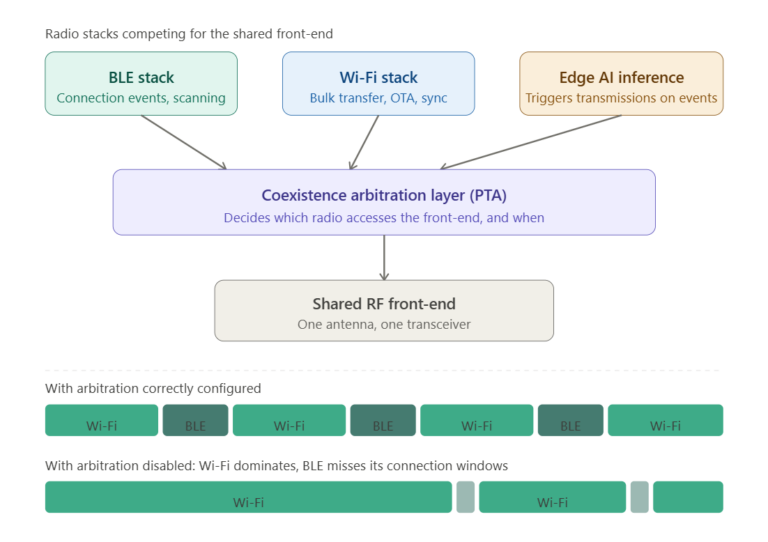
A combo chip with BLE and Wi-Fi does not let both radios transmit at the same time. An arbitration layer sits between the two radio stacks and the shared hardware, deciding on a millisecond timescale which radio gets access to the front-end at any given moment.

The diagram below shows the full structure:

As Espressifโ€™s ESP-IDF coexistence documentation describes, the allocation shifts across four defined states: idle, connected, scanning, and connecting, with each state carrying a different time-slice proportion between Wi-Fi and BLE.ย 

When Wi-Fi is idle, BLE gets a generous slice. When Wi-Fi is actively transferring data, its slice expands and BLEโ€™s contracts. The arbitration layer adjusts this continuously based on real-time conditions.

But the problem is that BLE has firm timing requirements at the protocol level. A BLE peripheral that misses its scheduled connection interval can be treated as disconnected by the central device, because the central has no way to distinguish between a missed packet and a dropped link.

Wi-Fi during a bulk transfer holds the front-end for longer continuous windows than BLEโ€™s connection intervals can accommodate. When arbitration is not tuned to protect BLEโ€™s timing, Wi-Fi takes precedence by default, and BLE pays for it, in dropped connections.

The symptom shows up in three recognizable ways in production. BLE connections drop during Wi-Fi OTA updates or large data syncs. Wi-Fi throughput falls noticeably when BLE begins scanning. And in some designs, the failures are intermittent enough that they only emerge under real sustained load, making them hard to reproduce in normal testing.

Where the Industry Is Heading on This Problem

Solving coexistence has historically meant firmware work. Engineers enable Packet Traffic Arbitration between the BLE and Wi-Fi cores, adjust BLE scan windows and connection intervals to create gaps that Wi-Fi can use without disrupting BLEโ€™s timing, and validate the results under a realistic combined load.

That approach still applies, but silicon vendors are increasingly building coexistence arbitration into hardware. NXPโ€™s IW612 and IW623 parts both implement a central hardware Packet Traffic Arbiter that provides real-time arbitration between Wi-Fi and Bluetooth on a per-packet basis, with software algorithms available to tune its behavior. This is a meaningful shift in who carries the base responsibility for solving the problem.

The important practical detail is that enabling this hardware capability is not automatic. NXPโ€™s own application note states that the hardware PTA arbitration can be statically enabled or disabled. Espressifโ€™s documentation for the ESP32-C3 explicitly states that coexistence must be enabled through menuconfig, otherwise the coexistence function cannot be used.ย 

A team that integrates one of these chips, validates it in a quiet RF environment, and ships without configuring the coexistence hardware is shipping a product that has the capability to manage the problem correctly, but is not using it.

This is the most common source of coexistence failures on modern silicon. It is not a hardware limitation. It is a configuration step that did not happen.

What Edge AI Adds to This Picture

On-device inference does not directly compete for radio time. Modern edge AI hardware is increasingly built around dedicated inference cores or micro-NPUs that run alongside the main MCU specifically to avoid that kind of contention. The inference workload itself does not draw on the radio front-end.

What draws on the radio is what the inference result decides to do. When a model detects an anomaly, recognizes a keyword, or crosses a threshold, it typically triggers a transmission: an alert over BLE, a compressed event clip over Wi-Fi, a status update over LTE. That transmission enters the same arbitration queue as every other radio event on the board.

Research on edge AI scheduling increasingly treats inference timing and radio access as a joint coordination problem, because separating them creates edge cases where an inference-triggered event competes poorly for radio time at exactly the moment when timely delivery matters most.

For teams designing a coexistence policy, this is worth planning for. A policy tuned around predictable periodic telemetry and scheduled OTA windows will behave differently once an inference layer adds an event-driven, unpredictable source of radio demand. The arbitration parameters that work well in one traffic model may not hold in the other.

The Cost of Finding This After the Board Is Locked

Coexistence problems found early are configuration problems. Coexistence problems found after a board is finalized are much harder to resolve cleanly. Firmware workarounds can reduce the severity, usually by sacrificing some performance on one radio to protect the other.ย 

If the antenna layout does not provide adequate physical isolation between the two radio paths, firmware tuning alone may not be sufficient, and the fix requires a board revision with the associated schedule and recertification cost.

What Smart Teams Do

The teams that ship clean multi-radio products tend to follow a few practices that are not complicated but are easy to skip under schedule pressure.

1. They read the coexistence section of the vendor SDK documentation before bring-up, not during debugging. Every major combo silicon vendor, including Espressif, Silicon Labs, Nordic, and NXP, publishes application notes and SDK configuration guides specifically for coexistence.

These documents describe which registers to enable, which parameters to tune, and which traffic scenarios to validate against. Most of the configuration that teams discover they needed during field escalations was already documented before the product shipped.

2. They configure the coexistence hardware explicitly, rather than leaving it at SDK defaults. As discussed earlier, most vendor SDKs do not enable coexistence arbitration by default. Treating a default configuration as a validated configuration is where most avoidable coexistence problems begin.

3. They test under simultaneous, sustained load before the board is locked. This means running a BLE connection and a Wi-Fi bulk transfer at the same time, at the data rates and packet sizes the product will actually see in the field, not in isolation on a quiet bench. A spectrum analyzer during this test is not optional. It is what makes the arbitration behavior visible rather than inferred from symptoms.

4. They account for event-driven radio demand if the product includes any form of on-device inference. A model that triggers transmissions changes the traffic profile the arbitration system has to manage. Teams that model only their periodic telemetry and OTA traffic when tuning coexistence parameters, and then add inference later, often find that the parameters need revisiting.

5. They treat coexistence validation as a gate in the design process, not a checkbox after the fact. The engineers who avoid field escalations are not necessarily more skilled than the ones who donโ€™t. They are more deliberate about when in the schedule this validation happens.

Conclusion

RF coexistence is not an exotic problem, but itโ€™s one thatโ€™s hard to avoid these days with multi-radio chips increasingly becoming the norm. It is a predictable consequence of putting multiple radios on shared silicon without a deliberate coordination strategy.ย 

The tools to manage it are well documented, the silicon to handle it is widely available, and the validation process is straightforward. What it requires is that the work gets done at the right point in the design cycle, before the board is locked rather than after the product is in the field.

The products that handle this well are not the ones built by teams with access to better components. They are the ones built by teams who treated radio coordination as a critical design requirement from the beginning.

If your team is working through a coexistence problem on a current design, or planning a product that will combine radios on shared silicon for the first time, embedURโ€™s engineering team is happy to take a look.ย 

We have worked through this class of problem dozens of times across BLE and Wi-Fi combo designs from several silicon vendors, and we can help identify where the gap is and what it takes to close it. Get in touch with us here.

The IoT has evolved, and so have consumers. End users have come to expect more from their connected devices, including being able to communicate with the entire home ecosystem. Driven by standards like Matter, the market is demanding devices that speak multiple wireless languages. It’s not enough for a smart hub, digital assistant, smart speaker, or set-top box to have only Wi-Fi. Now, these products are increasingly expected to act as full-fledged Thread Border Routers or Zigbee hubs. This requires integrating 802.15.4 radios alongside Wi-Fi and Bluetooth into a single, compact design.

Silicon Labs addresses this complex challenge head-on with its wireless SoCs and modules, which are purpose-built for robust, multi-protocol environments.

The Growing Pressure on 2.4 GHz Networks and What Interference Means for 802.15.4

The pressure on the 2.4 GHz band is relentless. Every new Wi-Fi router adds to the noise. For a low-power, low-data-rate protocol like 802.15.4, Wi-Fi interference is an existential threat to its reliability, which is its core value proposition

When an 802.15.4 radio encounters interference from a strong or nearby Wi-Fi transmission on an overlapping channel, it experiences several detrimental effects, including:

  • Reduced range: The interference raises the effective noise floor through in-band interference. For a receiver to successfully decode a packet, the signal must be significantly stronger than the interference. As this interference increases, the effective range of the device shrinks dramatically.
  • Increased latency: When a packet is corrupted by interference, it has to be retransmitted by the protocol. Additionally, CSMA/CA backoff delays increase. Each retry adds delay, leading to a sluggish and unresponsive user experience.
  • Reduced battery life: Radio transmissions are the most power-hungry operations for a battery-powered IoT device. A high number of retries keeps the radio active longer, significantly reducing battery life potentially from years to months depending on conditions.
  • Network Instability: In severe cases, a device may be unable to successfully transmit after multiple attempts, causing it to lose its connection to the network and require a rejoining process.

Understanding these impacts is key to appreciating why a robust coexistence strategy is a fundamental requirement for any successful IoT product.

The Limitations of Unmanaged Wireless Coexistence

The first line of defense against interference is unmanaged wireless coexistence, where systems operate independently but are designed to minimize conflict. This approach relies on a combination of physical design, protocol behavior, and radio performance.

One of the most effective techniques is frequency separation. By selecting channels that are distant from active Wi-Fi channels, 802.15.4 networks can reduce the likelihood of overlap. However, this strategy has limitations. Wi-Fi signals are wideband and often strong enough to interfere even with channels that are nominally non-overlapping. This is particularly true in environments where access points are located within a meter to IoT devices.

Spatial separation is another important consideration. Increasing the physical distance between devices or improving antenna isolation can significantly reduce interference. This is relatively straightforward for distributed end devices but becomes more challenging in compact, multi-radio products.

For devices interacting with a noisy external environment, “unmanaged” coexistence using a robust radio to passively resist interference – is beneficial. However, when multiple radios are operating tens of millimeters apart on the same circuit board, this strategy is insufficient. The raw power of a nearby Wi-Fi radio can completely overwhelm a low-power 802.15.4 radio.

For the complex multi-radio devices that are now becoming standard, a proactive, managed wireless coexistence strategy is needed.

Managed Wireless Coexistence: Packet Traffic Arbitration (PTA) is the Foundation of Cooperation

Managed coexistence moves from passive resilience to active, hardware-level coordination. The industry-standard mechanism for this is Packet Traffic Arbitration (PTA). Silicon Labs’ EFR32MG24 SoCs provide flexible hardware support for all standard PTA configurations, allowing seamless integration with a wide variety of Wi-Fi chipsets.

As shown in the diagram below, Packet Traffic Arbitration operates on a simple but highly effective principle of request and grant signals exchanged between the MG24 (handling 802.15.4) and the Wi-Fi radio.

Wireless coexistence engineering for multi radio devices image1

How Packet Traffic Arbitration Works

  1. 802.15.4 Needs Access
    The 802.15.4 radio has data to send or receive.
  2. Request Sent
    The 802.15.4 radio asserts a REQUEST to the Wi-Fi radio.
  3. Wi-Fi Evaluates
    The Wi-Fi radio evaluates the request based on its internal policy (e.g., priority, fairness, current activity).
  4. Grant Sent
    The Wi-Fi radio asserts a GRANT back to the 802.15.4 radio.
  5. Access Granted
    The 802.15.4 radio uses the channel; the Wi-Fi radio pauses or defers its transmissions.

The level of coordination can be scaled depending on the system’s needs:

  • 2-Wire PTA: A COEX_REQ signal from the MG24 and a COEX_GRANT signal from the Wi-Fi radio.
Wireless coexistence engineering for multi radio devices image2
  1. Normal Operation: Wi-Fi is using the airwaves (No request โ€” 802.15.4 is idle.)
  2. 802.15.4 Requests Access: MG24 asserts COEX_REQ to request the airwaves.
  3. Wi-Fi Grants Access: Wi-Fi acknowledges by asserting COEX_GRANT.
  4. 802.15.4 Transmits: MG24 now has the airwaves and can transmit/receive.
  • 3-Wire PTA: Adds a COEX_PRIORITY signal, allowing the MG24 to flag the urgency of its request (e.g., a high-priority ACK vs. a low-priority sensor reading).
Wireless coexistence engineering for multi radio devices image3
  1. 802.15.4 Needs Access: The MG24 has data to send or receive. (Wi-Fi may already be using the airwaves.)
  2. Request + Priority Sent: MG24 asserts COEX_REQ and sets COEX_PRIORITY to indicate urgency (High or Low).
  3. Wi-Fi Evaluates Priority: Wi-Fi evaluates the priority level and decides whether to grant access (immediate grant or delay/defer).
  4. Grant Returned: If access is granted, Wi-Fi asserts COEX_GRANT.
  5. 802.15.4 Uses the Airwaves: MG24 transmits or receives without Wi-Fi interference.
  • 4-Wire PTA: Provides the richest context by adding signals that can specify the exact packet type (TX or RX), giving the Wi-Fi arbiter maximum information to manage traffic most efficiently.
Wireless coexistence engineering for multi radio devices image4
  1. 802.15.4 Needs Access: The MG24 has data to send or receive.
  2. COEX_REQ + COEX_PRIORITY + COEX_FREQ Sent: The MG24 asserts COEX_REQ and provides context using: COEX_PRIORITY for urgency and COEX_FREQ for frequency/channel information.
  3. Wi-Fi Evaluates Request + Frequency Context: The Wi-Fi radio evaluates the request using current activity, priority level, and COEX_FREQ frequency/channel information.
  4. COEX_GRANT Returned: If access is allowed, the Wi-Fi radio asserts COEX_GRANT.
  5. 802.15.4 Uses the Airwaves: The MG24 transmits or receives in a protected window while Wi-Fi defers its activity.

The timing diagram below illustrates how MG24 uses PTA to create clear, protected windows of operation. The MG24 asserts its REQ signal before its transmission begins. It keeps the REQ asserted not only for its own transmission (TX) but also for the critical window when it is waiting to receive an acknowledgment (RX ACK). Only after the entire transaction is complete does it de-assert the REQ. This process guarantees that the full 802.15.4 transaction is protected from self-interference.

Wireless coexistence engineering for multi radio devices image5

Duty-Cycled Packet Traffic Arbitration for Advanced Management

For battery-powered devices where power conservation is important, the MG24 platform also supports duty-cycled PTA. Instead of a continuous request, the MG24 can be programmed to request access only during very specific, scheduled windows. The Wi-Fi radio, aware of this schedule, can proactively quiet itself just for those brief, critical moments. This minimizes the time the Wi-Fi radio is paused, increasing throughput while still helping to manage essential 802.15.4 traffic and saving power.

The Signal Identifier: A Patented Leap in MG24 Intelligence

Normal PTA allows the 802.15.4 radio to request access to the shared medium and can defer Wi-Fi activity to avoid collisions. However, this approach has inherent limitations. Without awareness of ongoing Bluetooth Low Energy (LE) or Zigbee activity during Wi-Fi idle periods, the system has to rely on conservative or aggressive scheduling strategies such as increased priority or duty cycling. These approaches can either degrade Wi-Fi performance or fail to guarantee reliable low-power wireless communication.

The Signal Identifier (SI), a unique and patented hardware feature integrated into the Silicon Labs MG24 SoC, adds a higher level of coexistence intelligence. Rather than detecting Wi-Fi packets, SI continuously monitors the airwaves for valid Bluetooth LE and Zigbee signals with protocol awareness.

During natural gaps between Wi-Fi transmissions, the SI listens for active Bluetooth LE or Zigbee packet activity. If a valid signal is detected, SI immediately asserts a high-priority PTA request to delay the next Wi-Fi transmission. This creates a protected receive window, allowing the Bluetooth LE or Zigbee packet to be successfully received without interference.

This intelligent coexistence mechanism enables the MG24 to dynamically protect critical low-power wireless traffic while minimizing unnecessary impact on Wi-Fi performance, delivering a major improvement in robustness and coexistence efficiency.

Wireless coexistence engineering for multi radio devices image6

The following sequence highlights how the MG24โ€™s Signal Identifier intelligently protects BLE and Zigbee traffic during Wi-Fi coexistence, enabling far more efficient and reliable operation than conventional PTA-only approaches:

  1. Wi-Fi transmission starts: The Wi-Fi radio is actively transmitting and occupying the channel.
  2. A Wi-Fi gap occurs: A natural gap appears between Wi-Fi packets, creating a short opportunity for other radios to communicate.
  3. SI detects a valid Bluetooth LE/Zigbee Signal: During the Wi-Fi gap, the Si detects a valid Bluetooth LE or Zigbee packet on the airwaves.
  4. SI requests Wi-Fi delay: The SI immediately asserts a high-priority PTA request to delay the next Wi-Fi transmission.
  5. Wi-Fi defers transmission: The Wi-Fi radio honors the PTA request and temporarily pauses its next transmission.
  6. Bluetooth (LE)/Zigbee communication proceeds: The MG24 safely receives or transmits the Bluetooth LE/Zigbee packet during the protected window.
  7. Transaction completes: The Bluetooth LE/Zigbee communication finishes successfully without Wi-Fi interference.
  8. Wi-Fi resumes transmission: The PTA request is released, allowing Wi-Fi to resume normal transmissions.

This patented, intelligent coexistence mechanism transforms coexistence from a static scheduling problem into a dynamic, protocol-aware protection system. By selectively delaying Wi-Fi transmissions only when valid Bluetooth LE or Zigbee activity is detected, the MG24 delivers significantly improved wireless robustness and coexistence efficiency, serving as a key differentiator for the platform.

Managed Wireless Coexistence is a Requirement for the Modern Smart Home

As the smart home accelerates and standards like Matter push for more integrated functionality, managed coexistence is no longer a niche feature. The proliferation of OpenThread Border Router (OTBR) and hub functionality into a wider range of consumer devices makes it an essential requirement. By leveraging the comprehensive coexistence toolkit built into the Silicon Labs MG24 family, from flexible multi-wire PTA to the patented, intelligent Signal Identifier, developers can build the reliable, high-performance, multi-protocol devices that will power the next generation of the IoT.

Now included with AllyCare Pro, Ally Intelligence guides any network engineer with step-by-step guidance for resolving network issues, reducing time to fix from hours to minutes for many common issues.

  • Available as a free update for customers with an active AllyCare Pro support subscription.
  • Transforms diagnostic test results into step-by-step guidance to help even junior IT professionals quickly resolve network issues in the field.
  • Expert advice built on three decades of NetAlly troubleshooting expertise and millions of network tests โ€” directly on the handheld tester.
  • Rogue device and open port detection now available across the NetAlly portfolio at no additional cost.

COLORADO SPRINGS, Colo., July 28, 2026 โ€“ NetAlly, a leader in handheld network testing solutions, today announced Ally Intelligence, a new service that embeds expert troubleshooting guidance directly into its handheld network testers, enabling frontline engineers of any experience level to diagnose and resolve network problems faster without escalation.

โ€œUptime just got a whole lot easier,โ€ said Jeff Oโ€™Mara, CEO of NetAlly. โ€œAlly Intelligence helps organizations scale network engineering expertise to every field tech with expert step-by-step instructions to fix complex issues right at the port without escalation.โ€

An Expert in Every Hand

Ally Intelligence empowers field engineers to resolve complex network issues on the spot, eliminating costly escalations to senior engineers or centralized operations teams that slow time for resolution. Built on 30 years of real-world networking expertise, it transforms NetAllyโ€™s diagnostic results into guided troubleshooting workflows, with contextual guidance and recommended next steps, to help even junior IT professionals move from problem identification to verified results, all from the handheld tester.

With a single EZ Test, a technician reaches one of two fast outcomes. If the network is proven healthy, NetAlly documents the result so the team can rule it out and move on. If there is an issue, Ally Intelligence delivers step-by-step instructions to fix it in the field, without an escalation or a return trip to the site.

Ally Intelligence is an expert system built on the millions of network tests NetAlly devices have done over three decades. Itโ€™s the fastest way to fix a network problem, and there are no tokens to track or AI slop to contend with.

Scaling Expertise Across the Team

One of the biggest challenges facing network operations teams is extending the knowledge of experienced engineers across a distributed workforce. Ally Intelligence helps make proven troubleshooting guidance available directly on NetAlly testers, giving technicians access to contextual recommendations that improve consistency and confidence in the field.

For managed service providers, systems integrators, and distributed enterprise teams, Ally Intelligence helps reduce unnecessary escalations while streamlining troubleshooting, enabling senior engineers to focus on the most complex network issues.

Enhanced Security Capabilities Across the Portfolio

In addition to including Ally Intelligence free with the AllyCare Pro subscription, the company is also expanding advanced network discovery capabilities across its product portfolio. Nmap and Discovery Monitoring, previously available only on CyberScopeยฎ, are now supported on EtherScopeยฎ nXG, AirCheckยฎ G3, and the LinkRunnerยฎ AT 4000 for customers with active AllyCare subscriptions.

โ€œOur goal is to help technicians solve problems faster with the tools they already carry every day,โ€ said Oโ€™Mara. โ€œBy bringing Nmap and Discovery Monitoring to more of our testers, weโ€™re giving network teams greater visibility into connected devices and network changes without requiring additional tools or workflows.

Available Now with AllyCare Pro

Organizations with an active AllyCare Pro subscription can begin using Ally Intelligence today on AirCheck G3, CyberScope, EtherScope nXG, and most LinkRunner products. Customers renewing AllyCare also gain access to Ally Intelligence, Link-Live collaboration, ongoing software updates, and the latest platform enhancements.

About NetAlly

For decades, the NetAllyยฎ family of network test and analysis solutions has helped network and cybersecurity professionals deploy, manage, maintain and secure complex wired and wireless networks. Since introducing the industryโ€™s first handheld network analyzer in 1993, NetAlly has continued to advance portable network testing and cybersecurity assessment through solutions including EtherScope nXG, AirMagnet, LinkRunner, LinkSprinter, and AirCheck.

NetAlly solutions simplify network testing, accelerate problem resolution and improve collaboration between field personnel and remote experts.