With the Q2 release of Simplicity SDK for Zephyr, support for the SiWx917 is expanding. This is a meaningful step forward and provides developers a more mature Zephyr path for building with the SiWG917, supported by continued validation with a focus on product development.
This release offers an opportunity to take a fresh look at the SiW917 and what it represents for manufactures of energy-sensitive IoT devices. A key feature is that the SiWx917 brings together ultra-low-power Wi-Fi, Bluetooth Low Energy (LE), and application processing integrated on one device. In this blog, we’re going to take a closer look at what the SiWx917 + Zephyr means for developers.
The quality levels associated with Simplicity SDK for Zephyr map to concrete commitments and provides insight into a fully tested development tool. These levels include:
If you’re unfamiliar with the SiWx917, or haven’t looked closely at it lately, here’s why this is interesting. The SiWx917 is an ultra-low-power Wi-Fi 6 + Bluetooth LE 5.4 wireless SoC with an integrated Arm Cortex-M4F application processor (up to 180 MHz), radio, and security — all in a single 7×7 mm package. It’s available with as much as 8 MB of in-package Flash and includes a full complement of digital and analog peripherals.
It’s built for the kind of devices where battery life and board space are at a premium, including smart home sensors, wearables, connected health, asset tracking, and industrial IoT devices. On Zephyr, the SiWx917 is supported as a wireless SoC, giving developers a flexible path for building connected applications on a single device. Now all of that is available with the flexibility of Simplicity SDK for Zephyr.
Bringing the SiWx917 to GA brings much of its Wi-Fi capability into production-ready Zephyr environments. On Zephyr, the SiWx917’s Wi-Fi feature set covers the core requirements real products depend on, including reliable connectivity, security, power-aware operation, and the flexibility needed to support connected devices across a range of IoT use cases.
These features have been through additional levels of testing and a few capabilities continue to mature at earlier quality levels, so the Quality Levels page remains the authoritative, feature-by-feature reference — always worth checking against your specific design.
The SiWx917 isn’t just a Wi-Fi part, and its Bluetooth LE support moves to GA in this release as well. The Bluetooth LE feature set on Zephyr is genuinely broad and includes:
That’s enough to build modern, secure Bluetooth LE applications, from simple peripherals to more sophisticated multi-role designs, on the same chip handling your Wi-Fi.
The appeal of the SiWx917 has always been the combination of capabilities: Wi-Fi 6, Bluetooth LE, and an application MCU. What the Q2 release changes is the foundation you build that combination on. A GA-quality Zephyr target means a complete feature set, full verification against the test plan, and a real support path — the things you need to take a design from prototype to production with confidence.
The full, feature-by-feature breakdown of quality levels for Wi-Fi, Bluetooth, drivers, security, and bootloaders lives here: Quality Levels — Simplicity SDK for Zephyr.

WiFi 8 isn’t about more speed — it’s about disappearing entirely, creating a network so steady you’ll stop thinking about it even as more devices join in. The technology to power today’s connected home already exists, and it’ll only keep improving — but if you need performance now, waiting isn’t the answer.
Today, the average home supports about 17 connected devices. These devices aren’t bandwidth-heavy laptops or TVs – they’re AI voice assistants, always-on smart locks, light bulbs, thermostats, sensors, and appliances that depend on reliable, uninterrupted connectivity rather than raw speed. As more connected devices enter the home, networks must deliver a seamless connectivity experience now more than ever.
For years, each new WiFi generation arrived with a familiar promise: more speed, more bandwidth, more capability. Wi-Fi 7 brought multi-gigabit performance, and the level of responsiveness modern homes need. But the next chapter of WiFi is not just about going faster.
That is where WiFi 8 comes in. Rather than focusing primarily on speed, it represents a shift toward greater stability, consistency, and intelligent connectivity, building on what WiFi 7 already made possible. The next generation of wireless technology goes beyond faster data speeds by improving how networks handle more connected devices.
NETGEAR has navigated every major WiFi transition — WiFi 5, 6, 6E, and 7 — and that experience shapes how we think about what comes next. And while we work toward bringing WiFi 8 to our products, the standard isn’t ready yet. Let’s look at what’s in front of us right now with WiFi 7.
WiFi 7 is the most capable wireless technology widely available today, and for most homes, it already delivers more than enough performance. It is built on the progress made by WiFi 6 and WiFi 6E, which introduced faster speeds, lower latency, and better support for crowded environments. WiFi 7 takes that foundation further, giving households the performance needed for 4K and 8K streaming, cloud gaming, video calls, smart home devices, and connected work and entertainment.
WiFi 7 isn’t the end of its story. It’s the foundation for the next wave of connected experiences, providing the performance today’s households need while paving the way for the innovations WiFi 8 will help unlock.

Each WiFi generation has solved a different challenge. WiFi 6E expanded capacity by opening a new spectrum, much like adding an express lane to a busy highway. WiFi 7 raised the speed limit, allowing more devices to move data faster than ever before. WiFi 8 will take a different approach. Rather than simply increasing speed, it will focus on managing traffic more intelligently, so everything flows more smoothly, even when the network is busy.
In other words, WiFi 7 made WiFi faster, while WiFi 8 will make WiFi feel smarter. With WiFi 8, connectivity will feel so natural that you will rarely think about your WiFi at all. The next generation of homes will include more devices competing for reliable, always-on connectivity. Although many of those devices transmit very little data, they can’t afford interruptions. By improving how networks handle congestion, interference, and simultaneous connections, WiFi 8 is being designed to deliver greater consistency as connected homes continue to evolve.
The WiFi standard matters, but the experience built on top of it matters just as much. That’s where NETGEAR stands out – and it’s the lens through which we’re approaching WiFi 8. A new WiFi generation isn’t defined by when a router first reaches the market. It depends on the entire ecosystem evolving together. When those pieces mature cohesively, consumers experience the full benefits of a new wireless standard. That’s the approach NETGEAR has taken across every WiFi generation, and it continues to guide how we’re preparing for WiFi 8.

AI is reshaping real-world Wi-Fi usage as devices increasingly send data for image, text, and video processing.
James Chen, VP of Technical Product Marketing at MediaTek, highlights how Wi-Fi 7 improves uplink efficiency to support this shift, while Wi-Fi 8 further enhances connectivity through lower latency and seamless roaming for a more stable and consistent experience across devices and environments.

The 2026 World Cup isn’t just a global event, it’s a full-scale stress test for networks under real-world pressure. Hotels across North America are seeing surges in occupancy, with many properties operating at or near capacity. Every room is occupied. Every screen is on. Guests are streaming matches, posting highlights, and connecting multiple devices at once.
What used to be predictable peaks in network usage has shifted into something far more demanding, constant, high-density connectivity throughout the day. And in this moment, one thing becomes clear: when connectivity struggles, the entire guest experience feels it.
During moments like this, demand doesn’t just grow, it concentrates, spikes, and never slows down. A single room can now generate more data traffic than entire floors did just a few years ago, and it’s happening everywhere, all at once. Lobbies are packed, viewing areas are full, and operational systems are running nonstop in the background.
Many networks don’t fail because they lack bandwidth, they fail because they can’t adapt. They react too slowly, rely on manual intervention, and struggle to balance guest traffic with critical hotel operations. That reactive model simply doesn’t hold up when thousands of devices are online simultaneously.
Guests don’t think about connectivity – until it breaks at exactly the wrong moment. Buffering in the middle of a decisive goal. Dropped connections in a crowded lobby. Digital services like kiosks, hotel apps and mobile check-in slow exactly when guests need them the most. Inconsistent performance from one area of the hotel to another.
During a high-profile event like the World Cup, these experiences don’t stay private. They surface immediately in reviews, social posts, and real-time feedback. The impact to hotel owners is direct and measurable: lower guest satisfaction, operational strain, and missed revenue opportunities. When the network fails, the guest experience fails with it.
The challenge doesn’t stop with guest Wi‑Fi. Behind the scenes, hotel operations rely on the same infrastructure, supporting smart locks, IPTV, security systems, property management platforms, and staff communications. During peak demand, these systems must perform flawlessly, even as guest traffic surges. That creates a balancing act. Connectivity is no longer just a guest amenity; it’s the foundation for both the guest experience and the hotel’s ability to operate efficiently.
Handling this level of demand isn’t about adding more capacity, it’s about adapting in real time. Modern hospitality environments require infrastructure that can continuously optimize performance, intelligently distribute connections, and maintain consistency across every space on the property. In high-density areas, adaptability becomes the difference between stability and disruption.
This is where purpose-built solutions like RUCKUS access points and AI‑driven network management platform such as RUCKUS One® make a difference, helping manage interference, balance client loads, and delivering reliable performance even at peak occupancy. The goal isn’t just to keep up. It’s to stay ahead of demand as it grows.
World Cup is not a one-time anomaly. It’s a preview of where hospitality is heading. Device density will continue to rise. Guest expectations will continue to grow. Digital services will continue to expand across the hotel experience. Networks must evolve alongside these shifts, delivering consistent performance, faster responsiveness, and greater operational simplicity through automation. Adaptive, resilient networks are no longer optional. They’re becoming the standard for how connectivity supports modern environments.
At moments of peak demand, the difference between properties becomes obvious. Where networks perform, everything else follows. Guests stay connected without frustration. Services remain responsive, staff operate efficiently and operations continue without disruption. It’s not just better performance – it’s a better experience. And it’s one guests remember.
The World Cup will come to an end – but the elevated demand it exposes will continue long after the final match. Hotels that use this moment to evaluate and improve their network infrastructure will be better prepared for what’s ahead. Those that don’t will continue to feel the strain as expectations rise with every major event. The question isn’t whether demand will increase -it already has. The question is whether your network is ready to keep up. Your guest experience deserves a winning game plan. Talk to a RUCKUS specialist about your property’s network readiness.
*FIFA World Cup 2026™ is a trademark of FIFA. RUCKUS Networks is not affiliated with, endorsed by, or sponsored by FIFA.

Paris, France – July 9, 2026 – Airties, a global leader of AI-driven software that improves the connectivity experience for ISPs’ subscribers, today announced that it has entered into a definitive agreement to acquire Aprecomm, a leading provider of intuitive, self-healing network and customer experience solutions. The acquisition accelerates Airties’ geographic expansion serving broadband operators in high-growth regions and benefits from synergies across product portfolios, R&D, and added AI expertise from Aprecomm to further serve ISPs around the world. Financial details were not disclosed.
Aprecomm, founded in 2016 and headquartered in Bengaluru, India, has built a reputation for its intuitive, self-healing Wi-Fi and broadband network solutions for ISPs. Aprecomm allows ISPs to improve connectivity through AI-driven software services that deliver real-time insights and optimizations to reduce operational costs and increase customer satisfaction. Today, Aprecomm manages more than seven million homes and business locations, serving more than 50 ISPs worldwide.
Under the terms of the agreement, Aprecomm will operate as a subsidiary of Airties following the close of the deal. Aprecomm will continue to provide tailored solutions to serve its customers and the markets in which it operates.
“Aprecomm is very well positioned in growth markets like India and Southeast Asia, so we now have an unmatched foundation to accelerate our expansion further across Asia-Pacific and into South America, two markets where demand for intelligent connectivity is growing at extraordinary speed,” said Metin Taskin, CEO and Co-Founder of Airties. “In addition, the acquisition is aligned with our vision of helping ISPs move to agentic AI platforms for the connected home, where the network autonomously anticipates, adapts and acts to provide the best broadband connectivity experience, lower churn and unlock new revenue for ISPs.”
“Joining Airties, the industry’s pioneer and leader in advancing connectivity experience, is a strong validation of the vision that has shaped Aprecomm from the start,” said Pramod Gummaraj, CEO and Co-Founder of Aprecomm. “Aprecomm was built with the belief that every service provider should be able to deliver a far more intelligent and reliable broadband experience. This combination gives us a broader platform to take that vision further and extend our impact across more markets globally.”
“This combination brings together Airties’ global reach and Aprecomm’s AI-native platform. With our edge AI, cloud-native architecture, and vendor-agnostic design, we have a strong foundation to deliver smarter, more scalable connectivity experiences to service providers worldwide,” said Guharajan Sivakumar, CTO and Co-Founder of Aprecomm.
The acquisition brings complementary go-to-market capabilities for ISPs across the globe. Aprecomm’s software suite enables service providers to deliver intuitive, self-healing networks and improved in-home broadband experiences. Distinctively, Aprecomm’s product portfolio was purpose-built to address the economics and ARPU profiles of ISPs in developing markets, while delivering core improvements to home connectivity for consumers. Conversely, many of the world’s leading Tier-1 operators rely upon Airties’ proven AI-powered Connectivity Experience Management Platform to optimize performance, lower churn, reduce expenses, boost satisfaction, unlock new revenue, and build stronger customer relationships. Airties complete product suite, including Airties Home, Airties Pro, and Airties Multi is designed to provide the performance, features, scale, and flexibility required to serve Tier-1 operators across their fibre, cable/DSL, and fixed wireless access (FWA) footprints. Having different offers available underneath the Airties or Aprecomm banners will enable Airties to customize solutions and address a wide range of customer requirements and market dynamics.
The acquisition is subject to customary closing conditions and is expected to close later in 2026. Additional details about Airties is at www.airties.com, and more about Aprecomm is at https://aprecomm.ai/.
About Airties
Airties empowers operators to provide smooth, smart, secure connectivity. Airties turns smart connectivity into a competitive advantage for operators and enhances how subscribers experience connectivity in the real world: making every connection smarter and more reliable. Airties’ AI-driven insights enable operators to lower churn, reduce expenses, boost satisfaction, and attract new customers. Across departments, from engineering to marketing, Airties helps increase efficiency, accelerate innovation, and design smarter campaigns. Airties’ holistic suite of hardware-agnostic software enables ISPs to manage connectivity, based on leading industry standards and open-source software, across their fibre, cable/DSL, and fixed wireless access (FWA) deployments. Airties’ customers include leading service providers such as AT&T, Cox, Deutsche Telekom, Telia, Telstra, T-Mobile US, Vodafone, and many others across the world. More information is available at www.airties.com.
About Aprecomm
Aprecomm harnesses AI to deliver a unique application suite that enables service providers to build self-optimizing, self-healing broadband networks. Our quality-of-experience engine monitors and optimizes WiFi performance to ensure consumers enjoy the best possible internet experience. At the same time, our cloud-based support applications leverage real-time data to predict and resolve customer service issues before they happen, saving providers time and money. Aprecomm manages over 7 million home and business locations, partnering with more than 50 service providers worldwide.

SCOTTSDALE, Ariz. & SAN JOSE, Calif. – June 25, 2026 – onsemi (Nasdaq: ON) and Synaptics Incorporated (Nasdaq: SYNA) today announced they have entered into a definitive agreement under which onsemi has agreed to acquire Synaptics in an all-stock transaction, representing a total enterprise value of approximately $7 billion. The transaction value reflects a fixed exchange ratio of 1.350 shares of onsemi common stock for each Synaptics share and represents an approximately 19% premium to the volume weighted average closing prices of onsemi and Synaptics over the last 10 trading days.
The combination would accelerate onsemi’s evolution toward global leadership in intelligent systems. By adding Synaptics’ differentiated Edge AI compute franchise and strong portfolio of human-machine interface and wireless connectivity solutions, onsemi is expected to extend its capabilities beyond power and sensing to intelligent systems, delivering greater value to a broad range of end markets. Building on onsemi’s expertise in automotive, industrial and AI data center, the combined platform is intended to position onsemi at the center of Physical AI, with the potential to expand onsemi’s TAM by $30 billion to $243 billion by 2030.
“As artificial intelligence moves beyond the cloud and into the physical world, including automotive and industrial, the next phase of innovation will depend on systems that can sense, decide, act and adapt in real time,” said Hassane El-Khoury, President and CEO of onsemi. “This shift towards Physical AI will require Power, Sense, Connected Compute and Control to work together seamlessly. The addition of Synaptics helps position onsemi at the intersection of these four pillars, enabling us to capture a significantly larger AI opportunity that extends beyond AI data center and into edge applications. This transaction would add immediate connected compute capabilities, expand our software and ecosystem reach and position onsemi to deliver greater value as customers increasingly seek intelligent systems.”
“Today’s announcement marks an important step in accelerating Synaptics’ growth and leadership in Edge AI and Physical AI,” said Rahul Patel, Synaptics President and CEO. “Together with onsemi, we will combine Synaptics’ strengths in AI-native compute, connectivity, and human-machine interface with onsemi’s leadership in intelligent power and sensing to offer customers integrated solutions and development platforms across every layer of the Edge AI stack, deepening customer engagement and expanding across a greater total addressable market. The all-stock structure allows our shareholders to participate in the compelling growth and value creation opportunities ahead, and I look forward to working with the onsemi leadership team to help realize the full value of this combination.”
Compelling Strategic and Financial Rationale
The combination is expected to deliver substantial value:
Transaction Details
Under the terms of the agreement, which has been unanimously approved by the Boards of Directors of both companies, Synaptics stockholders will receive 1.350 shares of onsemi common stock for each share of Synaptics common stock held at the time of closing, implying pro forma ownership of approximately 12% for Synaptics stockholders on a fully diluted basis.
As part of the transaction, one member of the Synaptics Board of Directors is expected to join onsemi’s Board of Directors.
The transaction is expected to close in mid-2027, subject to approval by Synaptics stockholders, the receipt of required regulatory approvals and other customary conditions.
onsemi and Synaptics Reiterate Previously Provided Financial Outlooks
As part of today’s announcement, onsemi is reiterating its financial outlook for the second fiscal quarter of 2026 provided on May 4, 2026. Synaptics is reiterating its financial outlook for the fiscal fourth quarter of 2026 provided on May 7, 2026.
Conference Call and Webcast Information
onsemi will host a conference call for the financial community at 5:00 p.m. Eastern Daylight Time (EDT) on June 25, 2026, to discuss the transaction announcement. A live webcast and related presentation materials will be available on onsemi’s IR site at http://www.onsemi.com. The webcast replay and presentation will be available following the call. Investors and interested parties can also access the conference call by pre-registering here.
Advisors
Morgan Stanley served as lead financial advisor to onsemi. J.P. Morgan Securities LLC also served as a financial advisor and Skadden, Arps, Slate, Meagher & Flom LLP served as legal counsel to onsemi. Qatalyst Partners acted as exclusive financial advisor and Baker McKenzie served as legal counsel to Synaptics.

Intelligently connecting virtually everything around us is the vision that drives our work at Qualcomm Technologies, and it’s why we deliver a broad portfolio of purpose-built processing and connectivity solutions to meet the needs of diverse industries.
A key focus area is low-power, wide-area (LPWA) connectivity designed for massive IoT deployments, where deep coverage and multi-year battery life are must-haves. This is where 3GPP-standardized LPWA technologies, narrowband IoT (NB-IoT) and enhanced machine-type communication (eMTC) aim to provide secure, globally interoperable connectivity for sensors, meters, trackers and other low-complexity IoT devices designed to operate for years on a single battery charge.

For most LPWA IoT applications, power consumption is often the primary design constraint: devices must deliver reliable coverage while having multi-year battery life, so every microamp counts in both low-power and active modes. Lower power extends operating life and reduces maintenance visits—cutting total cost of ownership (TCO)—and it can also enable smaller device form factors by requiring a smaller battery, improving overall aesthetics and sustainability.
That’s why the Qualcomm E51 4G Modem-RF leads in LPWA IoT, purpose-built to support both LTE Cat-M1 and Cat-NB2 with advanced power efficiency. It is developed to pair optimized power consumption with a compact, cost-effective design and rich peripheral support—helping customers build smaller, longer-lasting devices without compromising features.

To quantify the advantage of Qualcomm E51 4G Modem-RF, we measured its power consumption in our lab across different power modes and representative use cases — then benchmarked those results against one of the most deployed eMTC and NB-IoT dual-mode chipsets, the Altair ALT1250.
Figure 3 below shows a comparison of the measured results of E51 versus ALT1250’s published specifications. The takeaway is clear: E51 delivers >20% power savings across all power modes, from ultra-low-power modes such as power save mode (PSM) to active transmit/receive states.

In extended discontinuous reception (eDRx) mode, the power profile is defined by both the baseline sleep current and the periodic paging wakeups. A closer look at the curves shows E51 implements power optimizations to reduce total energy in these low-power states — delivering 33% lower deep-sleep current and a more efficient wakeup mechanism with 67% shorter paging wakeup time. The result is smaller current spikes, which reduces overall battery draw while maintaining network reachability.

To go beyond lab measurements, we also ran system-level simulations based on our lab-measured power data to model end-to-end modem behavior in real-life operating profiles. These simulations translate sleep, wake, attach and transmit events into expected battery draw over time — showing how E51 can support battery life required by targeted use cases. In this study, we looked at the power profiles for three different low-power, wide-area use cases and their battery life requirements, including smart meters, remote sensors and asset trackers.
Smart meters: Water and gas meters typically have no main power, so they run on batteries and require ultra-long life — often 15+ years — with infrequent data transmission. For gas meters, paging monitoring is the primary battery drain, so the device commonly operates in eDRX; our simulation shows E51 reaching 15-year battery life with 7.5–11 Ah batteries, depending on the number of uplink transmissions per day. Similarly for water meters, the same 15-year target can be achieved with 0.3–4.5 Ah batteries, primarily by relying on PSM.

Remote sensors: In applications ranging from weather stations and agricultural sensors to grid-monitoring devices, the typical battery life target is up to five years of operation on a compact battery. With PSM and sending infrequent, one-way data uploads, the E51 can achieve this target with as little as 0.2–2.6 Ah of battery capacity, depending on payload size and reporting frequency. This is designed to support smaller device formfactors and can help reduce maintenance needs and total cost of ownership for large-scale remote deployments.

Asset trackers: These devices operate in challenging conditions, continuously uploading location data via GNSS, monitoring temperature, humidity, ambient light and motion through multiple onboard sensors, all while running in power-efficient eDRX mode. Despite this workload, the E51 can achieve up to three months of battery life on just 0.2–0.7 Ah of battery capacity, depending on upload frequency.

At Qualcomm, high-performance wide-area connectivity and ultra-low-power design are part of our DNA. This is the foundation needed for delivering cutting-edge products like the Qualcomm E51 4G Modem-RF. Engineered for LPWA use cases, it helps devices run longer on a single battery charge, connect more reliably, and scale deployments more cost-effectively. We’re excited to help power what’s next in IoT, and we’ll continue to share updates as the ecosystem advances toward the vision of connecting virtually everything.
Network demands are surging as businesses adopt AI across more applications, branches, and cloud environments. At the same time, networking and security teams are under growing pressure to protect distributed users, devices, applications, and data—without adding more operational complexity.
In today’s distributed, cloud-first environments, legacy overlay security can’t protect high-bandwidth AI workloads, remote users, hybrid branches, and dynamic data flows.
To safely scale AI initiatives while protecting corporate data and preventing data leakage—and without overwhelming already-stretched IT teams—growing businesses need embedded network security, infusing protection into the network itself.
AI and agentic workloads demand massive bandwidth and create complex, unpredictable traffic patterns. Data now flows dynamically across hybrid environments, remote branches, cloud applications, and multicloud infrastructures. In fact, a single agentic task generates 450% more traffic than a human doing equivalent work. Securing that movement requires a more agile, intelligent network.
At the same time, attackers are using AI to increase the volume, speed, and sophistication of cyberattacks. Phishing campaigns are now hyper-personalized, malware is adapting to evade detection, and automated bots are probing networks for weaknesses at an unprecedented scale.
AI-era threats require AI-assisted network and security operations. By integrating AI directly into network devices and leveraging AI-enabled SecOps tools, networking and security teams can move from reactive firefighting to faster detection, prioritization, troubleshooting, and response. This can help growing businesses adopt AI with more operational confidence, while helping lean teams reduce manual investigation and contain risk faster.
Traditional overlay security adds appliances and software to existing infrastructure. This often creates more operational complexity: fragmented visibility, disjointed consoles, inconsistent policy enforcement, and bottlenecks that can slow performance.
Some businesses may look into upgrading a firewall appliance or investing in new routers, but with this add-on approach, traffic may need to be routed out of its way to a security checkpoint and back again. That added latency and complexity can be especially challenging for AI workloads, distributed users, and cloud-first environments.
Embedded network security changes the model. Instead of treating security as a separate layer, protection is integrated across the network fabric itself, including routing, switching, wireless access, cloud access, and identity-aware controls. The network becomes a point of visibility, intelligence, and enforcement.
In this model, every node becomes both a sensor and an enforcer, and every connection becomes a point of visibility and control.
Moving away from fragmented point solutions and adopting a secure networking model can help reduce operational complexity, improve resilience, and give lean IT teams more consistent control across distributed environments.
The Cisco approach to secure networking is a model that can support business continuity, modernization, and scale without a linear increase in tools or manual work.
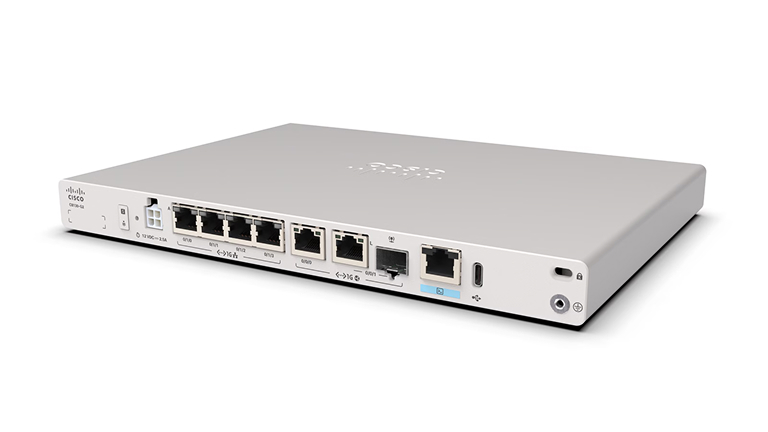
Secure networking starts by embedding protection into the infrastructure, not bolting it on piecemeal. Cisco 8000 Series Routers with built-in Cisco firewall provide protection at the WAN edge, helping organizations secure distributed environments and support cloud-managed security. Cisco Wi-Fi 7 and Cisco Smart Switches extend embedded security directly into campus and branch infrastructure, where users, devices, and applications connect.
Cisco Multicloud Fabric (announced at Cisco Live 2026) helps IT connect sites directly to clouds and cloud-to-cloud with built-in security, end-to-end visibility, and a fabric that scales with AI workloads.
These solutions help IT teams gain visibility and enforce policy closer to where activity begins, whether supporting remote employees, securing branch connectivity, or protecting regulated environments where consistent access control and uptime are critical.
The agentic AI era requires a network that can support true innovation while defending against rapidly evolving threats. At Cisco Live 2026, the secure harness for agentic AI was announced: Cisco Cloud Control.
Cisco Cloud Control is an AI-native management solution for orchestrating and securing enterprise IT infrastructure. Cisco Cloud Control gives humans and agents a unified operations platform that brings every Cisco domain and third-party tool into one environment—one login, one view, one operating model.
Cisco also delivers AI tools to enhance security operations. Cisco AI Assistant and AI Canvas make ops more actionable by helping teams detect threats faster, simplify management, and respond more effectively. These capabilities can reduce the burden on lean IT teams by making complex network and security tasks easier to understand and act on.
With intelligence built into the operating model, teams can move from manual investigation and reactive troubleshooting to more proactive, AI-assisted operations.
Firewalls remain essential, but modern security can no longer rely on firewall-centric thinking alone. Users, devices, applications, and data now operate across branch locations, cloud services, software-as-a-service (SaaS) platforms, remote environments, and hybrid infrastructures.
Cisco’s approach to secure networking goes beyond the firewall by integrating protection across routing, access, and cloud environments. Secure routers and firewalls help protect traffic moving between sites, clouds, and users while SASE extends identity-aware protection to cloud applications and remote users.
This equips IT teams with consistent control across WAN edge, campus, branch, cloud, and remote access environments.
In distributed environments, trust cannot be assumed based on location. A user in the office, a remote employee, a branch device, and a cloud application all need consistent, identity-aware access control.
Cisco Access Manager enables unified access control across users, devices, and applications. It helps organizations verify who and what is connecting, apply appropriate policy, and reduce the risk of unauthorized access.
Together with Cisco SASE for Meraki, organizations can extend secure, identity-aware access to remote users and cloud applications without multiplying management tools.
For many growing businesses, the biggest security challenge isn’t just the number of threats. It’s the number of tools required to manage them.
Cisco helps simplify operations through a unified platform that brings networking and security together across routers, firewalls, wireless, switches, access control, SASE, and AI-powered operations. This integrated approach helps lean IT teams maintain high performance and strong security while reducing complexity.
Policies can be applied more consistently. Visibility improves across users, devices, branches, and clouds. AI-assisted capabilities help teams investigate, troubleshoot, and respond faster. The result? Integrated security and network performance that lean teams can manage more consistently across distributed environments.
For teams building a business case, the Cisco secure networking model can also support tool consolidation and operational efficiency discussions.
As a maritime technology company helping the shipping industry improve vessel efficiency and reduce emissions, Silverstream Technologies depends on digital collaboration and dependable access across a growing global business.
For a company focused on serving customers across a complex maritime ecosystem, the network is more than infrastructure. With the Cisco Meraki dashboard and Cisco Secure Client, Silverstream strengthened the technology foundation needed to support its operations, connect teams, and scale securely.
The company now enforces consistent policies, encryption, and monitoring across all facilities and remote connections—including a London HQ with more than 1600 detectable wireless networks.
Silverstream’s secure, cloud-managed Cisco network also helps it achieve ISO 27001 certification by adhering to the rigorous data protection standards demanded by the world’s leading shipbuilders.
YMCA of Niagara is a mission-driven organization with a goal to deliver better digital experiences across distributed locations. Supporting multiple facilities, programs, staff, members, and guests requires reliable connectivity and simplified IT operations.
With Cisco Meraki switches and SD-WAN appliances, YMCA of Niagara transformed their network foundation to better support secure access and consistent connectivity across community environments. Thanks to the Cisco Premier Breach Protection Suite, YMCA of Niagara deploys threat detection and response across network, cloud, endpoint, and email, with integrated tools like XDR Premier and Cisco Secure Email Threat Defense combined with 24/7 managed services.
By moving to the centralized Cisco Meraki dashboard, their IT team is now spending less time managing complexity and more time supporting the services and experiences people rely on. They have achieved an 80%+ decrease in mean time to resolution (MTTR) and 70% reduction in support incidents with Cisco.
The AI era has rewritten the rules of enterprise technology. To keep pace with business demands while defending against automated, intelligent threats, organizations can no longer rely on fragmented, bolt-on security tools.
The future belongs to those who build security from the ground up. By unifying networking and security into a single embedded architecture, IT teams can simplify daily operations, reduce complexity, and build more consistent availability, policy control, and operational resilience.
It’s time for your network to do more than connect your business. With Cisco, your network actively defends itself—everywhere—so you can scale assuredly as you grow.
New tiered program delivers deeper GTM support, named account management, and co-marketing investment for MSPs growing their security practice on DNSFilter
WASHINGTON, D.C., June 30, 2026 — DNSFilter, a global leader in AI-powered protective DNS and content filtering, today announced a significant expansion of its MSP Partner Program. The enhanced program introduces a structured three-tier model designed to meet MSPs where they are and invest more deeply in those growing their security services practice.
New research from DNSFilter reveals the scale of the commercial pressure MSPs are navigating with 85% of MSP leaders surveyed admitting there is a security capability they cannot effectively deliver today as they spend more time stitching tools together than stopping threats. The financial impact is direct: 49% cite security tool licensing costs as their single biggest obstacle to growing security revenue, 26% point to an unmanageable tech stack, and 23% to training overheads.
AI-Phishing top concern among MSPs surveyed
The top threats MSPs are most worried about over the next 12–18 months are operating at a layer that most current tools do not cover:
The common thread: these attacks operate at the DNS and web layer, before the endpoint agent can intervene. By the time an endpoint agent sees a threat, the user has already clicked, the page has loaded, and the resolution has happened. 38% of MSPs say they cannot effectively deliver protection against AI-generated threats today with 30% saying they cannot deliver network-level visibility beyond the endpoint.
The Security Opportunity MSPs Are Sitting On
DNSFilter’s 2026 MSP Research* found that 47% of MSP leaders cannot effectively deliver security posture reporting for compliance or cyber insurance purposes, the second-largest capability gap in the market, behind only advanced threat detection. For MSPs serving finance, healthcare, manufacturing, and legal clients, that gap is both a risk and a missed revenue opportunity.
“Our research makes the commercial reality facing MSPs impossible to ignore, but the flip side of that is a real opportunity we want to help our partners capture. When our partners succeed, more businesses get protected. That’s the outcome we’re building for,” said Ken Carnesi, CEO and Co-Founder of DNSFilter.
Built for MSPs from Day One: Introducing the Three-Tier MSP Partner Program
Today, more than 6000 MSPs use DNSFilter, and last year the company made its largest MSP investment to date, acquiring Zorus and launching CyberSight to identify phishing infrastructure and lookalike domains before they reach client networks.
The new enhanced MSP Partner Program builds on this foundation with a three-tier structure designed to match the level of investment DNSFilter makes to the level of commitment an MSP brings:
DNSFilter Select Partner: Partners get immediate access to our multi-tenant platform and the DNSFilter Partner Edge Portal, white-label campaign assets, self-paced training, and volume-based pricing with no application form, no approval queue, and no long-term contract standing between them and a security layer their clients will feel.
DNSFilter Accelerator Partner: By invitation or application, for MSPs committed to growing their security services practice. Accelerator Partners receive a named account manager, sales engineer support for demos and POCs, co-marketing resources backed by MDF investment, and a dedicated annual business review so growth conversations are grounded in actual numbers, not guesswork.
DNSFilter Strategic Partner: DNSFilter’s deepest commitment, reserved for partners going all-in on security services growth. Includes custom enablement, joint selling motions, co-branded/white-label marketing, ongoing MDF, and a dedicated DNSFilter team aligned to the partner’s revenue goals. When a Strategic Partner wins, DNSFilter wins with them.
“The MSP community is where cybersecurity protection actually gets delivered to the businesses that need it most. With this next chapter in our program, we’re putting more resources, more people, and more structure behind the partners who are growing with us. If you’re an MSP who’s been thinking about making DNSFilter a bigger part of your stack, this is the right time” said Dan Cucchi, VP of MSP and Channel Sales, DNSFilter.
“DNSFilter has been a core part of our security stack for years, and this new MSP program reflects exactly what we’ve always valued about this partnership, a team that understands how MSPs operate and builds programs to match,” said Rick Dupuis, Sr. Manager, Technical Solutions, Mainstay Technologies. “For Mainstay, DNS protection isn’t optional; it’s a non-negotiable first layer of defense for every client we onboard. Having a partner program that reinforces that model with the right pricing, support, and tooling makes it easier for us to deliver consistent security outcomes at scale.”
“Being part of DNSFilter’s MSP program isn’t just about adding another tool to our stack, it’s about aligning with a team that genuinely understands how we operate and what our clients need. DNSFilter has earned that trust. The platform delivers where it matters: reliable protection, a management experience built for multi-tenant environments, and a support team that treats us like partners. That’s what makes the relationship sticky and what makes it easy for us to put DNSFilter in front of our clients with confidence,” commented Charles Love, COO, ShowTech Solutions.
For more information please read our blog or visit the Partner Page for further details.
*About the Research Methodology
Survey of 100 senior-level cybersecurity and IT professionals at US-based Managed Service Providers. Fieldwork conducted in spring 2026. Respondents hold titles of Director level and above. Full report can be found here
About DNSFilter
DNSFilter is a cybersecurity company that protects every click, leveraging AI-driven content filtering and threat protection to block threats up to 10 days earlier than competitors. DNSFilter’s solution secures workers wherever they are, helping organizations boost productivity, minimize compliance risk, and protect corporate brands on public Wi-Fi networks. Trusted by more than 45,000 organizations worldwide, DNSFilter enables organizations to deploy powerful protection in minutes while gaining deep visibility into their security posture. Learn more at dnsfilter.com
Media Contacts:
Rebecca Cradick
Vice President, Global Communications and Investor Relations
[email protected]