







This month, I had the opportunity to attend Unify 2026, hosted by the Connectivity Standards Alliance (CSA). As a senior campaign manager on the Global Marketing team, I work closely with Product Marketing to translate product strategy into integrated campaigns that educate and engage audiences around emerging technologies, thought leadership, and Silicon Labs solutions. Unify gave me a valuable opportunity to hear directly from the people shaping these technologies and to better understand where the industry is headed.
The goal of Unify was to bring together leaders and product makers across the IoT ecosystem to explore the future of connected technology. Through technical sessions, product demonstrations, and networking, the event highlighted the industry’s shared goal of accelerating adoption of open, interoperable IoT standards.
After experiencing a range of panels and networking events, I left with one overarching takeaway: the future of IoT isn’t just about connecting devices, it’s about building smarter, more secure, and more interoperable experiences through collaboration.

Photo courtesy of the CSA
The event opened with IoT pioneer Kevin Ashton, best known for coining the term “Internet of Things”. His message challenged us to think beyond today’s smart home devices and imagine technologies that solve meaningful, everyday problems.
Rather than creating connected products simply because we can, Ashton encouraged us to focus on innovations that genuinely improve people’s lives, including ways to detect if someone is sick or making everyday chores easier with a self-folding dryer. Think bigger!

Photo courtesy of the CSA
Although there was a dedicated security panel, security quickly emerged as a theme throughout the entire conference.
The key message we heard consistently was that security is now a baseline expectation. Consumers, enterprises, and regulators expect connected devices to be secure from day one, and that responsibility extends across every layer of the ecosystem from silicon and devices to networks, applications, and cloud services.
This reinforced Silicon Labs’ approach to security. Security isn’t treated as just a feature, it’s a foundational design principle. Through features like Secure Boot, Secure Over-The-Air updates, and through third-party security evaluations and testings, we help customers build products that are protected throughout their lifecycle. As an active contributor to Matter, Thread, Zigbee, Bluetooth, Wi-SUN, and Z-Wave, we’re also helping strengthen the security of the broader IoT ecosystem.

Photo courtesy of the CSA
One of my favorite parts of the week was watching fellow Silabers take the stage to share their expertise.
Colin Cureton, Product Line Vice President of Home, explored one of today’s hottest topics: Edge AI.
As AI continues to transform the industry, IoT devices are becoming more intelligent and capable of making decisions locally rather than relying entirely on the cloud. Running AI at the edge reduces latency, improves privacy, and enables faster, more reliable decision-making for applications ranging from manufacturing and smart buildings to predictive maintenance and energy management.
For me, the main takeaway was that the future of IoT is about more than just connecting devices. It’s about enabling devices to think and respond in real time.
Rob Alexander, Principal Product Manager and Vice Chair of the CSA Board of Directors, spoke about how companies can actively shape the future of Matter by participating in alliances.
The key message here was that Matter evolves through collaboration. The standard can’t be built in a silo. It needs to be shaped through contributions from Alliance members, technical working groups, implementation feedback, and real-world experience. Rather than waiting for new capabilities to arrive, companies have an opportunity to help define what’s next.
Our very own Campaigns Team Manager and Vice President of Marketing for Thread, Ann Olivo, joined two sessions focused on Thread and Matter. She helped attendees better understand how the technologies work together and where they fit into a product roadmap.
One of the biggest misconceptions addressed throughout the week was the idea that it’s “Thread or Matter.” In reality, it’s both.
Thread provides the reliable, low-power mesh networking foundation for many connected devices, while Matter builds on that foundation to deliver interoperability across ecosystems. Together, they allow manufacturers to focus less on ecosystem-specific development and more on building innovative, high-quality products.
The conversations also reinforced that these technologies extend far beyond the smart home. From commercial buildings and energy management to industrial and enterprise deployments, Thread and Matter are enabling connected solutions at much larger scales.
In fact, Silicon Labs is already demonstrating this through our Large-Scale Matter over Thread Deployment in our Boston office, proving that Matter-over-Thread networks can deliver reliable, enterprise-scale performance. Check out our white paper on Matter over Thread to learn more.

Photo courtesy of the CSA
Beyond the sessions, the demo showcase offered a chance to see the latest innovations up close. At the Silicon Labs booth, attendees experienced demos featuring technologies like Aliro, while our booth neighbor, Thread Group, demonstrated how Thread connects devices across a growing ecosystem.
Some of my most engaging conversations actually happened between sessions. Whether attendees were just beginning to explore Thread or were already building Matter products, it was clear that people were excited to learn more and contribute to open standards.
I left Unify energized, both by the expert-led panels and the collaboration I saw firsthand between the companies driving the industry forward.
I gained a much deeper appreciation for the work happening across the CSA community. From security and AI to interoperability and open standards, every company has a role to play in shaping the future of IoT.
Seeing Silicon Labs contribute not only through our technology, but also through leadership, technical expertise, and active participation in standards development made me especially proud to be part of the team helping build what’s next!

There’s a conversation happening in boardrooms and IT departments around the world, and it sounds something like this: “We need a reliable network, but everything we’re being shown is either way too much or not enough.”
It’s a real dilemma. On one side, there are solutions engineered for massive corporations: powerful, feature-rich, and built to handle complexity at a scale most organizations will never reach. On the other hand, there are low-cost alternatives that look attractive on paper until outages start, hidden maintenance costs pile up, and the network becomes a liability rather than an asset.
Neither path was designed for the reality of most mid-sized businesses. And the outcomes prove it.
Enterprise solutions from global vendors come with a long list of capabilities, most of which will never be used. What follows is predictable: budgets that don’t add up, deployment timelines that stretch for months, and integrators stuck in endless negotiation cycles with margins that barely justify the effort. The technology works, but the fit is wrong.
Cheap now almost always means costly later. Unreliable performance, frequent downtime, and the slow accumulation of replacement and maintenance expenses quietly erase any upfront savings. Worse, an unstable network doesn’t just cost money; it costs trust, productivity, and opportunity.
NETGEAR Enterprise’s proposition is straightforward: enterprise-grade quality and reliability, with pricing built for the real scale of your business.
Solutions designed for the largest corporations aren’t always the right fit for growing organizations —even ambitious, multi-site ones. What most businesses actually need is robust, scalable, and battle-tested technology that matches their operational reality, whether that’s a regional retail chain, a multi-campus education group, a logistics network, or a fast-growing mid-sized company.
The equation changes completely. You eliminate overpaying for features you’ll never touch. You keep the robustness and reliability that modern operations demand. Deployment becomes simpler, channel profitability improves, and growth is supported without compromising the underlying network.
The conversation shifts from “which solution is cheaper?” to “which solution is better designed for our reality?”
The NETGEAR Enterprise portfolio gives you networks built to grow, scalable infrastructure that delivers the performance larger or multi-site operations need, without the complexity and overhead of solutions never designed for businesses like yours. Whether you need centralized visibility, simplified management, or robust infrastructure that can scale with your ambitions, there’s a solution built for where you actually are and where you’re going.
You don’t need to overspend to operate like a modern, competitive business. The right network isn’t the most expensive one; it’s the one built for where you actually are and where you’re going.
If you’re evaluating how to modernize your network without exceeding your budget, or you’re a partner looking for solutions that deliver real value and better margins, let’s talk.


By Sajid Khan, Director, New Business Growth – IoT BU
While much of the hype around AI centers on consumer applications, the Industrial Internet of Things (IIoT) is undergoing a major transformation driven by real-time insights, autonomy, and predictive analytics. These capabilities are helping the industrial sector boost productivity, streamline operations, and reduce costs. It’s no wonder that IIoT applications are growing rapidly, with a projected CAGR of 24.7% over the next eight years.
To unlock the latest IIoT capabilities, OEMs and developers need reliable, high-performance, and energy-efficient silicon designed for intelligent edge applications.
A silicon portfolio built for IIoT
MediaTek Genio empowers IIoT developers and designers looking to create intelligent, differentiated products. Our portfolio is designed to meet a broad range of performance and power requirements, from low-power edge devices to premium AI-enabled systems.
On the value-tier side, our solutions support low-power IIoT devices with a balance of multimedia support, efficiency, and versatility. Our mainstream platforms take performance to the next level with advanced generative AI, neural processing, and high-performance compute. For more demanding industrial AI workloads, our new MediaTek Genio Pro series has rewritten what’s possible for intelligent industrial systems.
Industrial systems, upgraded
Let’s explore three key IIoT segments that MediaTek Genio powers:
A new generation of AI-ready IIoT applications
With customer appetite for real-time connectivity, intelligence, and automation continuing to rise, demand for advanced IIoT capabilities will only accelerate. MediaTek is helping OEMs, developers, and manufacturers build the next generation of intelligent industrial systems with high-performance, energy-efficient platforms designed for AI-driven edge applications.
Learn more about MediaTek’s portfolio for IIoT applications >


Stadium Wi-Fi has become mission-critical. Fans expect instant sharing, mobile ticketing, in-seat ordering, and real-time highlights. Staff need reliable connectivity for operations, security, POS, and venue apps. And venue operators are under pressure to turn connectivity into measurable business outcomes.
That is why we are excited to announce that GoZone WiFi will be participating in the upcoming Wi-Fi NOW webinar:
Connected stadiums Webinar: Networks driving experience, engagement, & revenue
Wednesday, July 8
7:00 pm CEST / 10:00 am PDT
Register here: Reserve your spot
Our speaker will be Wayne Newton, VP Sales & Business Development at GoZone WiFi, joining a panel of stadium connectivity leaders to discuss what is changing, what is working, and what is next.
Stadiums represent one of the ultimate challenges in Wi-Fi networking. You are serving tens of thousands of users in a high-density environment where demand spikes instantly, usage patterns change by the minute, and the physical environment is complex.
At the same time, expectations have never been higher:
The result is a simple truth: stadium Wi-Fi is no longer just an IT project. It is a business platform.
The webinar session will explore the latest advances in stadium connectivity, including:
As Wi-Fi standards evolve, the conversation is also shifting toward what next-generation capabilities enable, including:
This webinar brings together a strong lineup of industry leaders:
At GoZone WiFi, we work with venues and large public spaces to help them get more from their guest Wi-Fi.
Reliable stadium Wi-Fi is the foundation, but the opportunity is bigger than access. With the right approach, venues can turn guest connectivity into:
In other words, the network becomes a tool for both fan experience and business performance.
If you are involved in stadium connectivity, fan experience, or venue operations, this session is built for you, including:
The event is live and free to attend. Register here to watch:
We hope you can join us on July 8 and be part of the discussion on what is next for stadium Wi-Fi, Wi-Fi 7, and the future of connected venues.
Brussels, Belgium – June 24, 2026 – The undersigned organisations representing the European connectivity ecosystem – including fibre operators, ISPs, semiconductors, hardware and software manufacturers, online pharmacies, tourism, and consumer electronics retail – and fully committed to strengthening Europe’s digital infrastructure, welcome the European Commission’s proposal for a Digital Networks Act (DNA).1 However, we note that, in its current form, the proposal does not sufficiently recognise the critical role of Wi-Fi® as a key enabler of European connectivity.
Without adequately prioritising Wi-Fi as a key enabler of the 2030 Digital Decade targets – including gigabit-capable connectivity for all European households, full 5G coverage of populated areas, and ensuring that 90% of SMEs reach at least a basic level of digital intensity2 – achieving these objectives will become significantly more difficult, ultimately undermining Europe’s broader digital ambitions.
Fibre (FTTH), mobile, satellite, and Wi-Fi must be recognised as complementary and interdependent layers of Europe’s connectivity ecosystem. While each technology plays a distinct role in enabling high-performance networks, Wi-Fi serves as the critical final link that ensures gigabit connectivity effectively reaches end users across homes, businesses, public services and industrial environments. Therefore, as full-fibre transition is completed, Wi-Fi performance will become a critical factor in delivering the end-user experience and the full benefits of next-generation broadband connectivity. Indeed, for most Europeans, Wi-Fi is the primary gateway to the internet, delivering Gigabit connectivity from the network termination point to end-user devices where connectivity is consumed. Today, Wi-Fi carries over 90% of indoor internet traffic across homes, hospitals, businesses, public services and industrial environments. It is also a foundational technology that SMEs and industries rely on for edge computing, automation, robotics and AI-driven applications.3 Beyond industry, advanced Wi-Fi connectivity is increasingly essential to Europe’s travel and visitor economy, underpinning digital and AI-driven services across smart destinations, cultural heritage sites and tourism SMEs — making it a key enabler of innovation and competitiveness across the full breadth of the European economy.
Current spectrum policy highlights the need for the DNA framework to effectively recognise the critical role of Wi-Fi connectivity. Insufficient access to spectrum is increasingly constraining Wi-Fi performance and thereby impedes implementation of advanced use cases. Recent studies indicate that growing Wi-Fi traffic congestion is limiting the ability of gigabit connectivity to effectively reach more than 50-60% of indoor environments.4 Europe is falling behind. Leading economies such as the United States, Canada and South Korea have already opened the entire 6 GHz band for Wi-Fi use, accelerating innovation in immersive education, healthcare services, smart manufacturing, and sustainable technology. 5This is not merely a spectrum policy debate, but a strategic policy choice with significant implications for Europe’s technological sovereignty, industrial competitiveness, technological leadership, and long-term innovation capacity.6
In this context, to ensure that the DNA fully reflects the role of Wi-Fi as a strategic component of Europe’s connectivity infrastructure, we urge the co-legislators to address the following elements in the proposal:
Article 17 – Union Radio Spectrum Strategy
|
Article 27 – “Use it or share it” principle
|
Article 28 – Radio Spectrum Database
|
The DNA represents a unique opportunity to establish a forward-looking and technologically balanced policy framework that will effectively guide Europe towards the Digital Decade objectives. Such a framework should accurately reflect the evolving connectivity landscape and ensure that integral components of the connectivity ecosystem, including Wi-Fi, are recognised and prioritised as strategic elements of Europe’s digital infrastructure.
The signatories to this statement represent a broad cross-section of hundreds of European and global connectivity players, including internet service providers, fibre network providers and operators, hardware and software manufacturers, semiconductor manufacturers, consumer electronics retail, online pharmacies, tourism innovation, and global industry associations focused on spectrum-sharing, advancing Wi-Fi and wireless broadband connectivity.

How the convergence of AI maturity, rising network complexity, and a widening talent gap is reshaping enterprise IT and what RUCKUS’s Agentic Operations means for the teams managing it.

For decades, network operations have followed a familiar pattern: engineers monitor dashboards, triage alerts, diagnose root causes, and apply fixes, often under pressure, and often at 2 a.m. Each generation of tooling automated part of that loop, but the operating model itself remained largely human-driven.
That model is straining under the weight of three converging pressures:
Network complexity is outpacing human capacity. Modern enterprise environments span wireless, wired, and multiple services simultaneously. The number of variables a human can effectively process during a live incident is finite; the networks generating those variables are not.
The talent gap is widening. Experienced engineers are retiring faster than new experts can be developed. Hard-won operational knowledge, the kind that lets a senior engineer diagnose a client issue in minutes, walks out the door with them and doesn’t come back easily.
AI models are finally capable enough to help. For years, “AI in networking” mostly meant dashboards with smarter labels. That has changed. With stronger language reasoning and domain-specific tuning, AI systems can now interpret network conditions, identify failure patterns, and support, or in some cases execute, operational decisions in ways that weren’t practical before.
These three forces aren’t arriving independently. They’re arriving together, and they’re arriving now.
The journey toward autonomous networking hasn’t been a single leap, it’s been a deliberate progression through four distinct operational stages:
Stage 1: Observability: The foundation. Network-wide telemetry, performance metrics, health dashboards, and historical trend analysis across deployment types. Without this raw signal, nothing above it works. Teams went from flying blind to having visibility.
Stage 2: AIOps Insights: Machine learning models identify user experience degradation, correlate events across the network, and surface actionable incidents before they escalate. This is where the industry moved from reactive operations, fixing what broke, to proactive operations: catching what’s about to break.
Stage 3: Automated Remediation: Intent-based AI translates high-level operational goals into specific network actions. Automated remediation workflows close the loop from detection to resolution without requiring manual intervention for every event.
Stage 4: Agentic Operations: The frontier. AI agents with natural-language understanding, expert-level reasoning, and autonomous decision-making, operating within a governed framework, explaining their actions, and increasingly handling what used to require a skilled engineer on-call.
Each stage amplifies the one beneath it. Agentic AI without a foundation of observability, insight, and remediation is just a chatbot. The full stack is what makes agents operationally meaningful.

The term “agentic AI” is becoming overused. It’s worth being precise about what it means for network operations, and what it doesn’t.
An agentic system doesn’t just surface information or suggest actions. It can reason about a problem, take corrective action, and explain its decisions in plain language. The distinction matters: moving from “here’s an alert” to “here’s what I diagnosed, here’s what I did about it, and here’s why” is a fundamentally different operational experience.
There are two meaningful forms this takes in a network context:
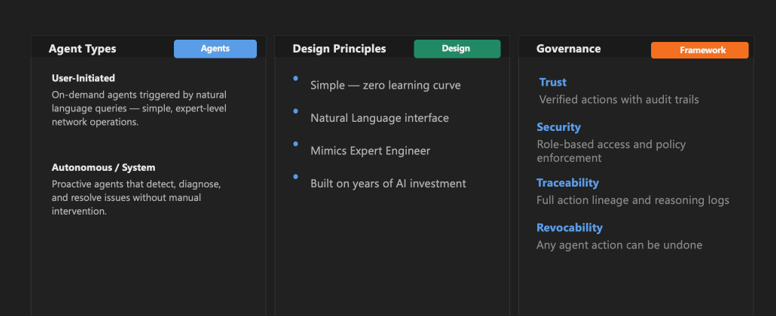
Interactive agents respond to natural-language questions from operators. Instead of navigating multiple screens or running command-line workflows, an engineer asks, “Why is client ABC experiencing slow connections?” The agent investigates across the stack and returns an explanation with recommended next steps. The interface is conversational; the reasoning is expert-level.
Autonomous agents are system-initiated, they monitor continuously, predict conditions, and respond to network events within policy guardrails without waiting for a human to intervene. They handle auto-remediation, security response, and compliance workflows, then log what they did and why.
The common thread is that both types operate in natural language, both are designed to reflect the reasoning patterns of experienced network engineers, and both aim to make advanced operations accessible, even to teams without deep networking expertise.
RUCKUS’s answer to this shift is Agentic Operations, a new class of AI-powered agents now rolling out as part of the RUCKUS One platform. What makes the approach credible is that it isn’t built on a single product launch. It sits at the top of a carefully constructed AI stack, with each layer already deployed in production across thousands of customer environments.
The first three layers, observability, AIOps incident detection, and intent-based automated remediation, are live. They have already reduced mean time to resolution for incidents and eliminated hundreds of manual hours typically required for network fine-tuning. Agentic Operations builds on that proven foundation, introducing advanced autonomous reasoning as the next layer rather than a replacement for what’s already working.
The platform spans both wireless access points and wired ICX switching infrastructure through a unified management experience. That matters because real-world network issues rarely respect domain boundaries, a wireless client problem often traces back to a wired switch misconfiguration, and an agent that can only see one side of that equation will miss the root cause.
For interactive agents, the operational engine is DSE, the Digital Systems Engineer, an AI-powered assistant embedded in RUCKUS One. RUCKUS positions DSE not as a single generalist model, but as an orchestrator coordinating specialized agents with clearly defined scopes and domain-specific competence.
When an operator asks, “Why is the guest Wi-Fi slow in the lobby?”, the orchestrator decomposes the request, routes subtasks to the right specialist sub-agents, and synthesizes the results into a coherent answer. This architecture reflects a practical lesson from enterprise AI deployment: focused sub-agents with specific skillsets and bounded authority are easier to validate, govern, and improve over time than a single agent trying to do everything at once.
Governance: Autonomy Without Chaos
Giving AI agents the ability to change network configuration is powerful. Without guardrails, it’s also risky. RUCKUS’s governance model rests on four pillars:
The operating model is explicit: autonomous networking with human oversight. AI handles speed and complexity; humans retain responsibility for judgment, policy, and strategy.
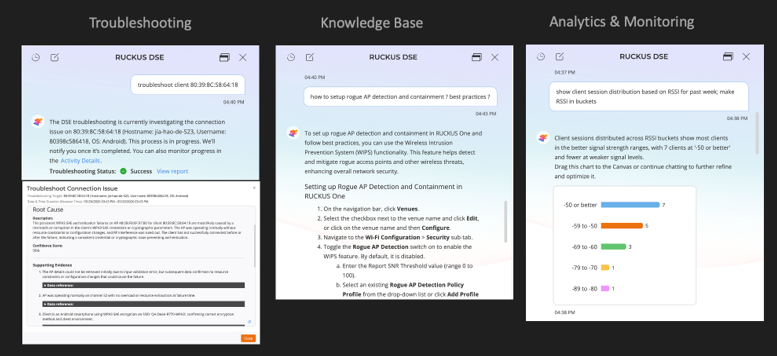
RUCKUS Networks is rolling out Agentic Operations as part of the RUCKUS One platform. DSE and related agent capabilities are in active development, with customer-facing availability expanding over time.
Agentic Operations is rolling out in stages, but the directional arc is clear:
Near-term: Interactive agents improve troubleshooting, analytics, and guided remediation, giving IT teams an expert co-pilot for everyday operations.
Mid-term: Autonomous agents take on common remediation workflows, security response patterns, and performance optimization tasks within explicit policy boundaries.
Long-term: Self-optimizing networks increasingly tune themselves around business intent, user behavior, and predictive models, while people stay focused on governance and outcomes.
The destination, networks that increasingly help solve their own problems with humans focused on what requires human judgment, is being built layer by layer. For teams managing growing infrastructure with flat or shrinking headcount, that shift isn’t just a capability upgrade. It’s a different way of working.


120 times in a 100-minute presentation. Yes, that’s the count for the number of times speakers mentioned Artificial Intelligence (AI) at a recent tech conference! [1] It’s a reflection on how AI is on everyone’s mind, with enterprises large and small, eager to understand and explore how to use it in their operations.
Concepts such as agentic AI, autonomous systems, predictive intelligence, and frictionless customer experiences are dominating conversations in boardrooms and leadership agendas across industries.
AI is now a business priority, and the hunger to adopt it, is peaking with the eagerness to adopt AI stemming from the conviction of its potential to dramatically boost enterprise growth, performance, and revenue.
Yet, in practice, how many of these businesses have applied AI? Do real-life cases exist? How easy or difficult is it to put these into action?
At Aprecomm, we have asked ourselves the same question. Over the last few years we’ve been actively exploring AI, embedding it into our processes, and into our algorithms to meet real world needs and deliver tangible results.
This persistence has paid off. In February this year, at The Fast Mode Awards 2026, one of the telecom industry’s latest and most competitive recognition programs, Aprecomm and broadband service provider, Fibernet, were recognized with the AI & GenAI Pioneer | Telco – Impact award – an award that validated our efforts in delivering measurable impact through the application of AI technologies.
ACT Fibernet (ACT) is a valued and key Aprecomm customer, and one of India’s largest fixed-line broadband providers. ACT faced a deceptively simple challenge on the surface: customer churn was holding back potential growth and undermining planning certainty. The reason was customer impatience with the WiFi quality at home.
It wasn’t just a speed problem. It was the channel interference from neighboring networks, lag from device congestion, and bandwidth hogging by background applications that was quietly degrading the experience of the subscriber. And that gap between “the internet is working” and “the internet feels broken” is where trust was eroding and leading to churn.
The traditional “reactive” response of waiting for a complaint, dispatching a technician, and resolving the issue was no longer satisfying the customer. Moreover, it was also expensive, slow, and by the time it was resolved, the customer had already decided that they were unhappy.
ACT Fibernet needed something fundamentally different. They needed an AI that could see the problem before the customer did.
Aprecomm’s platform is built around a core insight: Quality of Experience (QoE) is not the same as Quality of Service. A network can be technically healthy while still delivering a poor experience. What matters is what the subscriber actually experiences. Like the video call that stutters, the game that lags, and the stream that buffers.
To close this gap, Aprecomm put into action, an AI-powered solution across ACT Fibernet’s home subscriber base.
The solution was Aprecomm-developed agentic AI solution, ACT SmartWi-Fi®. This platform works to optimize every device and application to enable a superior WiFi experience delivering among several other benefits, improved speed, reduced latency, and enhanced reliability.
Here is how the Aprecomm’s AI works in actual practice:
Continuous, real-time monitoring. The AI platform monitors WiFi performance at the application level. It monitors not just whether the connection is alive, but how each application is performing across every connected device. This generates a continuous stream of data that forms the basis for all downstream decisions.
Intelligent channel optimization. WiFi channels are a shared, contested resource. The AI continuously analyses channel utilization across the environment and automatically shifts devices and access points to less congested channels. This happens invisibly without subscriber involvement or a wait for a problem to be reported.
Traffic management by application priority. Not all traffic is equal. A video call has different latency requirements than a file download. Aprecomm’s QoE engine classifies traffic by application type and manages bandwidth allocation, accordingly, ensuring that high-priority, real-time applications get what they need, even when the network is under load.
Predictive issue resolution. Rather than waiting for a threshold breach or a support call, the platform identifies patterns that precede degradation and acts proactively. A device that is consistently underperforming, a channel that is trending toward saturation, a router exhibiting early signs of stress — the AI flags and responds to these signals before they become visible to the subscriber.
Unified visibility for support teams. ACT Fibernet’s support teams gained access to a real-time dashboard showing network health across the entire subscriber base. When a call comes in, agents have full context: device history, recent channel changes, application performance data. First-call resolution improves because the agent is no longer diagnosing blind.
Results started showing at the six-month mark post the deployment across ACT Fibernet’s home subscriber base.
Quality of Experience (QoE) scores rose significantly. As the AI optimized channels, managed traffic, and resolved issues proactively, subscribers began experiencing the kind of consistent, reliable connectivity that broadband providers promise but rarely deliver at scale. A 3X times improvement in speed was recorded. Latency dropped by 15%. Device QoE scores improved by an average of 20% over the 1.35m homes where deployment was complete.
Support call volumes fell. With the AI catching and resolving issues before subscribers noticed them, the volume of inbound support calls dropped by 25%.
As the experience improved and complaints decreased, subscriber retention improved. The customers who had been leaving because of unpredictable WiFi quality had fewer reasons to leave.
The ACT Fibernet deployment illustrates something that is easy to miss in the broader AI conversation: genuine AI maturity lies in its appropriate and specific use in the application.
Aprecomm deployed a system with a precise understanding of how WiFi degrades, how application performance maps to subscriber experience, and how proactive intervention translates into business outcomes. The AI use is interesting because the outcome is measurable and commercially useful.
For ISPs evaluating AI investments, this distinction matters enormously. Instead of focusing on whether a platform uses AI, it is more important to ask how AI is used and if it is successfully closing the gap between what the network provides and the experience subscribers expect.
For ACT Fibernet, over six months of deployment, the answer was yes. Ravi Karthik, Chief Marketing and Customer Experience Officer of ACT Fibernet, stated “We are thrilled to see the transformative impact of ACT SmartWi-Fi® on our customers’ digital lives. Our initial launch data validates our commitment to delivering our promise—ensuring a significantly superior online experience for our customers. Whether streaming on a Smart TV, working on a laptop, or browsing on a mobile device, ACT is redefining what high-performing internet looks like in Indian homes.”
Aprecomm manages over 7 million home and business locations and partners with more than 50 service providers worldwide. The company won both the Analytics & Intelligence Champion and the AI & GenAI Pioneer awards at The Fast Mode Awards 2026.
[1] https://timesofindia.indiatimes.com/technology/tech-news/sundar-pichai-responds-to-viral-ai-ai-ai-meme-elon-musk-tempted-to-join-in-the-fun/articleshow/110244042.cms

Adds Ruggedized SBC Engineering for Defense, Aerospace and Industrial customers to Ezurio’s growing portfolio
Ezurio, a leader in wireless connectivity and embedded compute solutions, today announced the acquisition of Gateworks Corporation, a California-based designer and manufacturer of industrial single board computers (SBCs) engineered for rugged, remote, and regulated environments.
Headquartered in San Luis Obispo, California, Gateworks holds AS9100D and ISO 9001 certifications, operates a U.S.-based SMT manufacturing facility, and brings an established customer base across defense, aerospace, railway, smart energy, and industrial automation. Gateworks’ SBCs are powered by NXP processors, including the latest i.MX 95-based Catalina family, with options for AI acceleration, Wi-Fi HaLow, precision GPS, and satellite connectivity.
“We have long served high-criticality markets such as healthcare infrastructure, with defense platforms and avionics systems representing new areas for growth”, said Mark Pugerude, CEO of Ezurio. “These are markets where reputation matters as much as performance, and where customers need a partner who can commit to the full lifecycle of a program. Gateworks gives us additional engineering depth and credentials to compete in those environments. For customers in defense, aerospace, and healthcare who require a long lifecycle, ‘Made in America’ solution, that partner is Ezurio.”
The Gateworks acquisition reflects Ezurio’s ongoing strategy to grow through targeted acquisitions that expand its embedded compute portfolio and open new high-value markets. Ezurio has built a strong foundation as a U.S.-based designer and manufacturer of standard SMARC and OSM system-on-modules and custom SBC solutions on NXP, TI, and MediaTek platforms. Gateworks extends upon this foundation with a distinct, complementary capability: AS9100D-certified SBC engineering for the most demanding environments on earth, built in partnership with customers to meet their unique specifications.
“We built Gateworks on a simple belief that American engineering, held to the highest standards of quality and long-term commitment produces better outcomes for customers in the markets that matter most,” said Gordon Edmonds, President, Gateworks Corporation. “That philosophy is exactly what drew us to Ezurio. Together, we can offer customers a depth and breadth of domestic embedded compute capabilities that neither of us could deliver alone.”
Ezurio’s certified RF module portfolio, spanning Wi-Fi, Bluetooth LE and multi-protocol connectivity, is now directly available to Gateworks’ customers as a fully supported connectivity solution. As “Madein-America” requirements and supply chain resilience become decisive factors in program awards, Ezurio stands uniquely positioned as a domestic partner where origin, regulatory compliance, and long-term support matter as much as technical performanc

Whether you’re hailing a ride on a busy city street, navigating a drone over a field or relying on your car to get you safely home, one thing underpins it all: knowing exactly where you are. Location technology has quietly become one of the most essential capabilities in modern connected devices — and it’s evolving faster than most people realize.
Qualcomm Technologies has long been a leading provider of Global Navigation Satellite System (GNSS) solutions, and today we’re pushing the boundaries further than ever before. To us, GNSS is more than a standalone feature. It’s a system-level capability that’s designed alongside connectivity, compute and power management to enable precise, reliable location across billions of devices. From meter-level accuracy on your smartphone to centimeter-level precision for drones and autonomous vehicles — all with significantly reduced power consumption — the latest innovations from Qualcomm Technologies are setting a new standard for what location technology can do.
You’ve almost certainly heard of GPS, or Global Positioning System. It’s the satellite navigation system launched commercially by the United States in the early 1990s and for many years it was synonymous with the idea of positioning. But the satellite navigation landscape has grown considerably since then.
Today, other countries and regions have launched their own global or regional satellite constellations. Europe operates Galileo, Russia operates GLONASS, and China operates BeiDou. India has its NavIC system, and Japan operates QZSS. Taken together, all these systems fall under a common umbrella term: GNSS, which stands for Global Navigation Satellite System.
Why does having multiple satellite systems matter? Because when a device can receive signals from more than one constellation simultaneously, positioning becomes faster, more accurate and more reliable. Think of it like triangulating your location with more reference points — the more signals your device can hear, the more confident it can be about exactly where you are. This multi-constellation approach is especially critical in dense cities, remote regions or other real-world environments where reliability matters as much as raw accuracy.
GNSS didn’t start out as a consumer technology. In its early days, it was the domain of researchers, surveyors and engineers — people who needed to monitor shifts in the earth’s crust, plan the construction of roads and bridges, or manage large-scale precision agriculture. That changed in the early 2000s, when GNSS technology began making its way into mobile phones. Emergency services mandates in multiple countries required phones to be able to report their location, and that opened the floodgates. Suddenly, location awareness wasn’t just for experts — it was for everyone. App developers quickly embraced it, and today there are thousands of location-capable apps available across every major platform.
GNSS is now woven into the fabric of daily life, powering experiences across a remarkable range of devices.
On your smartphone, GNSS helps you discover what’s nearby, navigate from one place to another, order a ride through your favorite app or make sure your food delivery lands at your door rather than your neighbor’s.
In your car, GNSS has become a cornerstone of telematics and infotainment systems — and increasingly, it plays a critical role in the push toward autonomous driving.
For professional and industrial users, GNSS powers everything from precision agriculture — where knowing the exact position of a tractor or planter can dramatically improve efficiency — to infrastructure monitoring and logistics.
The common thread across all of these applications is a growing demand for location data that is not just present, but precise.
Modern connected devices are marvels of engineering. At any given moment, your smartphone might be running 4G or 5G connectivity, Wi-Fi, Bluetooth and GNSS — all while simultaneously executing demanding computing tasks. Every one of these technologies draws on your battery, and managing power consumption is a constant engineering challenge.
GNSS is no exception. Location services that run continuously — tracking your route on a long drive, for example — can meaningfully drain a battery over time. That’s why Qualcomm Technologies has made power efficiency a key pillar of its location technology innovation. Our technologies incorporate GNSS as part of a broader power-optimized system that is designed to enable continuous, high-accuracy positioning without compromising battery life.
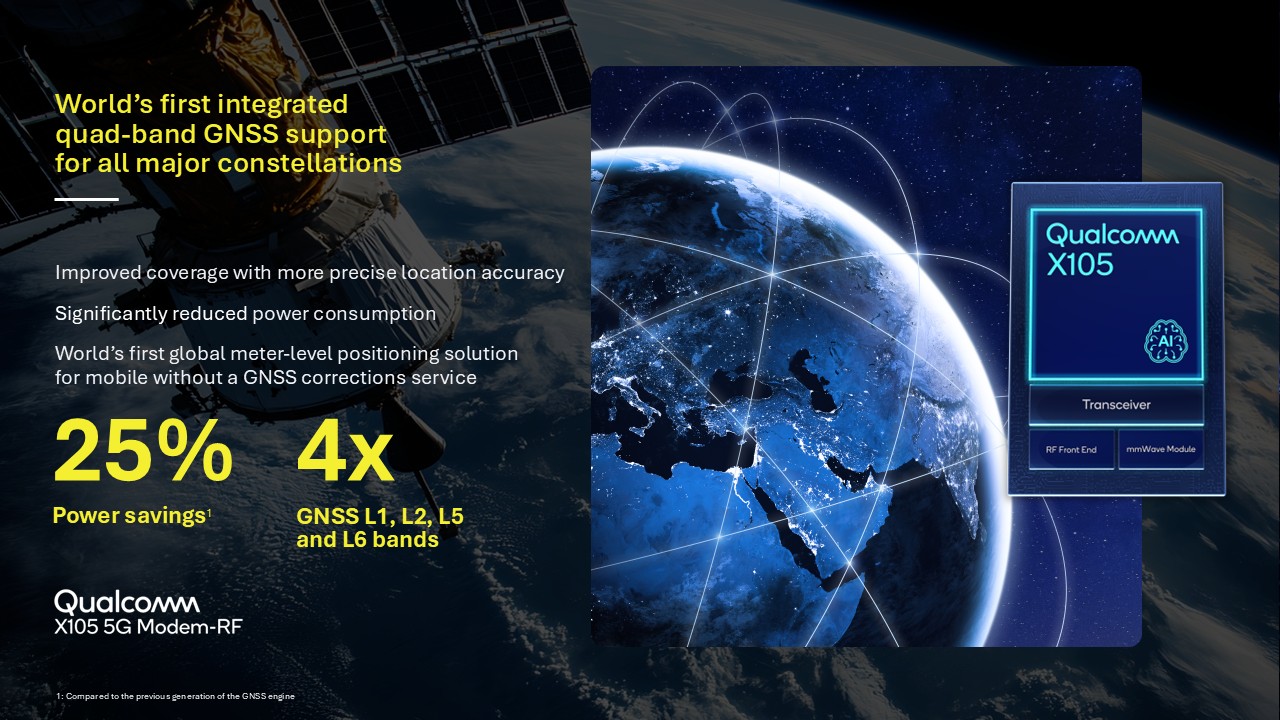
To put the impact in concrete terms: a 25% reduction in GNSS power consumption can translate to an additional 100 hours of GNSS tracking on a device with a 5,000 mAh battery. That’s not a marginal improvement — it’s the difference between a device that works for you throughout a long day (or a multi-day adventure) and one that leaves you scrambling for a charger.
One of the most exciting recent advances from Qualcomm Technologies is what we call Qualcomm Meter-Level Positioning.
Qualcomm Technologies first introduced Meter-Level Positioning in 2020. The original implementation used a combination of enhanced signal processing on Qualcomm Technologies’ chipsets and a paid external correction service to achieve significantly better accuracy under real-world conditions.
But here’s the key development: Qualcomm Technologies has now made it possible to achieve a similar level of accuracy without relying on a paid correction service. This is a significant shift. It removes a cost burden that previously fell on device manufacturers, network operators or end users, and it makes superior positioning accuracy accessible to a much broader audience.
What does this mean in the real world? Imagine you’re waiting for a ride-share pickup on a busy city street. With conventional GPS, your driver might not know which side of the street you’re on — and you might have to dodge traffic to reach them. With Qualcomm Meter-Level Positioning, the app can pinpoint your location with enough precision to eliminate that ambiguity. For the ride-share company, the same technology can track their entire fleet with greater accuracy, identifying which lane each vehicle is in and dispatching cars more efficiently — reducing both wait times and operational costs.
To understand what Qualcomm Technologies is introducing with its latest Qualcomm X105 modem-RF chipset, it helps to know a little about how GNSS signals work.
Satellites broadcast their signals across different frequency bands. Most modern GNSS devices have long supported two of these: the L1 band (around 1,575 MHz) and the L5 band (around 1,176 MHz). Using both — what the industry calls Dual-Frequency GNSS, which Qualcomm Technologies introduced in 2018 — gives devices a meaningful accuracy advantage, especially in challenging environments like dense urban areas where signals can bounce off tall buildings.
In 2022, Qualcomm Technologies introduced Triple-Frequency (L1/L2/L5) support, adding the L2 band (around 1,227–1,246 MHz). Triple-frequency devices, when paired with sophisticated external correction services, can achieve positioning accuracy at the decimeter level — that’s roughly four inches — or even centimeter-level accuracy with a high-quality antenna. Remarkable, but it required subscribing to a paid correction service to unlock the full benefit.
Now, with the Qualcomm X105 modem-RF chipset, Qualcomm Technologies is introducing quadruple-frequency GNSS, adding support for the L6 band (around 1,278 MHz). L6 signals are already being broadcast by two constellations: Galileo (known as Galileo E6) and QZSS. What makes L6 remarkable is that it carries the same kind of high-accuracy correction data that previously required a paid service — but it is available free of charge to any device that can receive it.
In practical terms, this means that the decimeter-level and even centimeter-level accuracy that was once reserved for professional surveying equipment or premium subscription services is now accessible to a much wider range of devices — at no additional cost to the user.
The implications of quad-frequency GNSS reach across industries and device categories.
And at Qualcomm Technologies, we know that delivering this at scale requires tight integration across silicon, software and connectivity.
Qualcomm Technologies has spent decades pioneering in GNSS technology, and the innovations described here represent the next chapter in that story. By delivering breakthrough accuracy improvements without added cost or complexity, these advances reflect a deep commitment to making location technology work better for everyone.
To summarize what’s new:
Looking ahead, there is no doubt that these enhancements in GNSS accuracy and power efficiency open the door to entirely new use cases across devices and device categories. As the world becomes more connected — and as devices become smarter, more autonomous, and more deeply integrated into the fabric of daily life — knowing precisely where you are will only matter more. Location technology will shift from a background utility to a core input. Qualcomm Technologies is committed to making sure the technology is ready when the world needs it by enabling devices to understand not just where they are, but how to act on that information efficiently, securely and at global scale.