
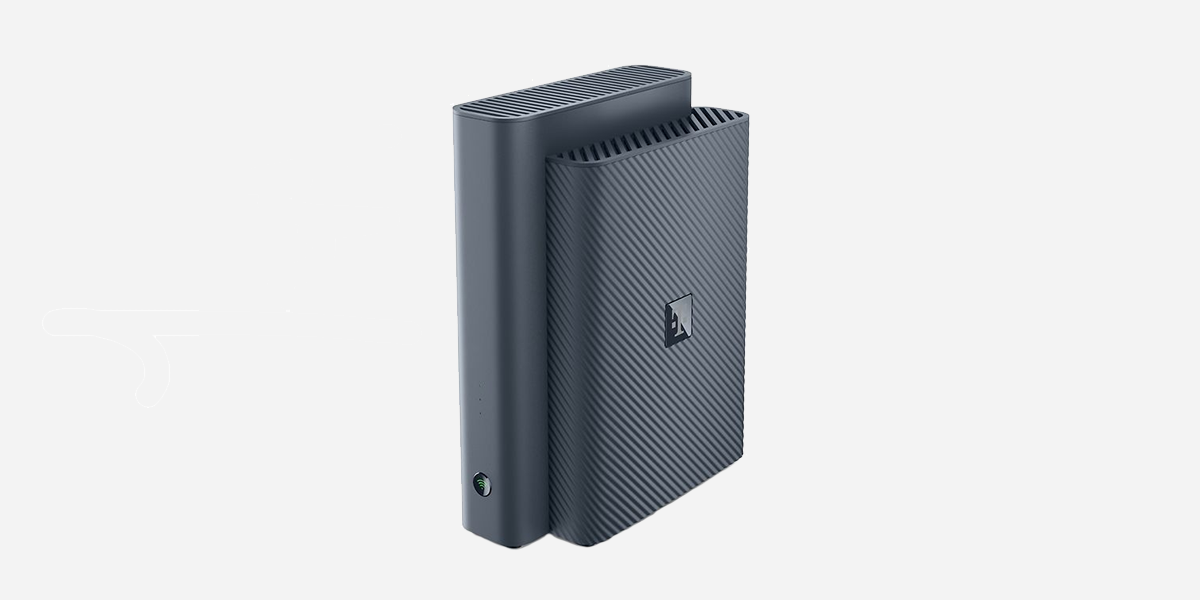
To meet growing demand for faster, more reliable home connectivity, Deutsche Telekom partnered with MediaTek to develop the Speedport 7, a class-leading broadband gateway designed for nationwide deployment. The device marked Deutsche Telekom’s first Wi-Fi 7 program and required support for fiber, DSL, Ethernet, and cellular backup, along with seamless connectivity across an increasingly complex home network environment. It also represented the company’s most advanced in-house software integration to date.
MediaTek worked closely with Deutsche Telekom throughout the project, providing end-to-end support from design to deployment. This collaboration enabled key technologies such as Wi-Fi 7 Multi-Link Operation and EasyMesh, while ensuring compatibility with third-party applications and meeting strict requirements for quality, reliability, and security.
The result was the successful launch of Speedport 7 in October 2025. The device delivers Wi-Fi 7 BE7200 performance, dual-band operation, and broadband speeds of up to 2 Gbps, along with intuitive app-based management and robust security features.
Now widely deployed across Germany, Speedport 7 has received strong customer approval and industry recognition for its performance and reliability, demonstrating how close collaboration and advanced platform design can enable next-generation broadband experiences.

PARIS, Feb. 2, 2026 /PRNewswire/ — Airties, a global leader of AI-driven software that improves the connectivity experience for ISPs’ subscribers, today announced the appointment of Deepak Harie, former Senior Vice President of Technical Support and Deploy Services at Nokia, to lead Airties’ sales and business development efforts globally.
“In recent years, Airties has significantly expanded our customer deployments, product portfolio, and software integrations with leading hardware suppliers, and Deepak Harie is the right leader to help us capitalize on today’s market opportunities and best serve our customers,” said Metin Taskin, CEO and founder of Airties. “Deepak is highly regarded across our industry for his proven record of accomplishments, technical knowledge, adept leadership skills, and customer-centric ethos. Our mission is to enable broadband service providers to deliver smooth, smart, secure connectivity, and I am confident that Deepak will help us deliver on that commitment.”
“Airties is widely recognized as both a category-defining pioneer and market-leading innovator, and I could not be prouder to help build upon that remarkable legacy,” said Deepak Harie, Chief Revenue Officer of Airties. “ISPs rely on Airties’ AI-driven software for the ongoing optimization of their customers’ broadband experience, to improve performance, reduce churn, lower costs, and market effectively, and I am thrilled to be part of the Airties journey. Above all, I’ll be committed to championing our customers’ needs and helping them, as their trusted partner, to achieve their strategic objectives.”
Prior to joining Airties, Deepak spent almost 25 years at Nokia in wide-ranging senior leadership roles. Most recently, he served as Senior Vice President of Technical Support and Deploy Services. He also served as Vice President of Cloud and SI Services, Vice President of Systems Integration, and Account Director of UK and Ireland earlier in his career. In his new role at Airties, Deepak will report to Airties’ CEO and founder, Metin Taskin.
Airties suite of software solutions, including Airties Home, Airties Pro, and Airties Multi, direct consumers’ devices (laptops, tablets, phones, game consoles, IoT, smart home devices, etc.) to the best available Wi-Fi access point and frequency band based on real-time network conditions; manages Mesh networking; and optimizes QoS. The software helps ISPs observe, diagnose, and fix connectivity issues automatically or through actionable recommendations; delivers insights and optimizations for connected devices and applications; and provides intuitive dashboards and APIs to support operators’ CRM systems and customer facing support apps to manage their networks, set access controls, prioritizations, and more.
Airties has received many prestigious industry awards for its innovations, including: “Best Home Wi-Fi Solution Award” from Broadband World Forum; “Best Wi-Fi Service Provider Solution” and “Best Home Wi-Fi Product” awards from Wi-Fi NOW; “Best Wi-Fi Innovation” and “Best-In Home Wi-Fi Network” awards from Wireless Broadband Alliance; “Best Broadband Customer Experience” from Cable & Satellite International; and numerous others.
About Airties
Airties empowers operators to provide smooth, smart, secure connectivity. Airties turns smart connectivity into a competitive advantage for operators and enhances how subscribers experience connectivity in the real world: making every connection smarter and more reliable. Airties’ AI-driven insights enable operators to lower churn, reduce expenses, boost satisfaction, and attract new customers. Across departments, from engineering to marketing, Airties helps increase efficiency, accelerate innovation, and design smarter campaigns. Airties’ holistic suite of hardware-agnostic software enables ISPs to manage connectivity, based on leading industry standards and open-source software, across their fibre, cable/DSL, and fixed wireless access (FWA) deployments. Airties’ customers include leading service providers such as AT&T, Cox, Deutsche Telekom, Telia, Telstra, T-Mobile US, Vodafone, and many others across the world. More information is available at www.airties.com.
SOURCE Airties

Former Cisco and Meraki executive to oversee Plume’s go-to-market strategy with a focus on deepening engagement with ISP customers and building subscriber confidence by turning intelligence into action
PALO ALTO, Calif., Jan. 21, 2026 /PRNewswire/ — Plume, a leader in cloud-managed Wi-Fi, security, and smart home services for Internet Service Providers (ISPs), today announced the appointment of Rebecca Stone as the company’s new Chief Marketing Officer.
Stone brings more than 20 years of experience leading global enterprise and service provider marketing organizations across brand, product marketing, growth, and revenue strategy, as well as a deep understanding of service provider needs across multiple industry tiers. Most recently, she served as Senior Vice President of Revenue Marketing and Customer Solutions Marketing at Cisco, where she oversaw media, integrated marketing, campaign planning, content marketing and operations, and demand marketing for Cisco’s $50B networking portfolio.
At Plume, Stone will help Plume deepen engagement with ISP customers while clearly articulating the value of the company’s expanding capabilities around intelligent Wi-Fi management, telemetry and analytics, cybersecurity, and customer care, powered by an unprecedented dataset and artificial intelligence. Plume aims to work with ISPs to strengthen subscriber confidence by turning data and insights into action, including a more robust offering that incorporates powerful AI orchestration technology from recently acquired Sweepr.
“The industry is shifting quickly, and Plume is entering a new chapter: one platform, a stronger customer experience, and more value from data and AI for ISPs,” said Dan Herscovici, CEO of Plume. “In a market this crowded, clarity wins and we’re going to make Plume the obvious choice. Rebecca has built and scaled world-class marketing teams across cloud, networking, and service providers. Her customer empathy and ability to translate complex technology into differentiated value will be critical as we help partners stand out, grow, and compete.”
Plume’s cloud platform connects nearly half a billion devices, creating an unmatched foundation of real-world network and device telemetry across diverse home environments. In this rapidly evolving broadband landscape—with rising subscriber expectations, intensifying competition, and AI shaping service delivery—Stone will oversee marketing strategy, brand positioning, and go-to-market execution as the company enters its next phase of growth. She will play an integral role in how Plume communicates this refreshed approach and suite of new capabilities to ISPs and the broadband industry, bringing them to life with clarity and inspiration across channels.
“I’m delighted to join Plume at this transformative moment in the company’s growth,” says Rebecca Stone, Chief Marketing Officer at Plume. “I’ve spent my career focused on building innovative marketing teams that accelerate growth and drive customer success, especially in an increasingly AI-powered landscape. There’s nothing more valuable than hearing from your customers, learning from them, and turning those insights into action that propels their success. I look forward to curating experiences where Plume can engage in a deeper and more meaningful way with them in the year ahead.”
Prior to Cisco, Stone was Chief Marketing Officer at Meraki, where she doubled the global marketing team to 150 employees, led a major rebrand and messaging transformation, and grew marketing-sourced pipeline contribution to 35%. At LiveRamp, she served as VP of Marketing, leading a team of 70 marketers and sales staff and helping the company expand from $20M to $300M+ in four years. She previously held marketing leadership roles at DataSift and Calix, and holds a Bachelor of Arts in Communications from UC Santa Barbara.
About Plume
Plume created the first managed Wi-Fi platform for Internet Service Providers (ISPs) in 2016 and continues to lead today with a best-in-class solution for cloud-managed Wi-Fi, security, and workflow orchestration – all powered by an unmatched dataset and AI. With almost half a billion devices connected to its platform, Plume is a trusted technology partner for more than 400 ISPs around the world, helping them deliver subscriber confidence through better Wi-Fi experiences, new services, and proactive customer care. Plume leverages OpenSync®, an open-source framework that comes pre-integrated and supported on the leading silicon, CPE, and platform SDKs, and supports leading industry standards like RDK-B and prplWave. Combined with powerful AI orchestration tools with its acquisition of Sweepr, Plume now offers ISPs a true end-to-end solution to power their most important workflows and customer experiences, while making deployment simpler and faster. Plume is leading the way in providing ISPs an intelligence and innovation edge to stay competitive, build subscriber confidence, and adapt to the changing needs of the market. Discover more about how Plume is empowering ISPs by visiting https://www.plume.com.
SOURCE Plume Design, Inc.
24% of Japanese consumers said they are considering changing their home Internet service provider (ISP), in the near future, citing quality issues as the leading factor; Compared to 28% of consumers in the US and 37% in the UK who are considering changing ISPs in the near future
Findings show that up to 60% of potential churn in Japan could be avoided by investing in better quality, features and customer support, independent of pricing. Of those considering changing home their home ISP, the main reasons include unhappiness with the quality of home Wi-Fi or Internet (38%); missing advanced features (13%), poor customer support (9%), compared to 34% who cited pricing considerations
44% of Japanese consumers would be interested in a “Guaranteed or Smart Wi-Fi” service that guarantees coverage and automatically fixes issues and would be willing to pay more for it
Silent suffering is pervasive: 51% experience noticeable problems or interruptions, but only 18% contacted their ISP over the past year
Very dissatisfied consumers are 5 times more likely to churn than very satisfied consumers: 61% of respondents who are currently very dissatisfied with their ISPs are considering switching ISPs in the near future compared to 12% of very satisfied customers.
Paris, France and Tokyo, Japan – January 27, 2026 – At today’s Wireless Global Congress (WGC) APAC 2026, Airties, a global leader of AI-driven software that improves the connectivity experience for ISPs’ subscribers, today announced findings from a newly commissioned consumer survey, independently conducted by Qualtrics, of more than 1,000 Japanese households*. The survey revealed a potential churn crisis for home ISPs in Japan: approximately one-quarter of households are considering switching providers in the near future, with quality of service being a decisive factor. Similar research, disclosed last month**, found that roughly one-third of consumers across the US and UK are considering switching ISPs in the near future. Even though the likelihood of churn is lower in Japan, it demonstrates the scale of churn risk within the country. Notably, the survey also found that up to 60% of potential churn in Japan could be avoided by investing in better quality, features, and customer support, independent of pricing.
“Many Japanese households are silently suffering with real connectivity frustrations, and a stunning quarter of them are considering leaving their current Internet service provider in the near future,” said John Lancaster-Lennox, Executive Vice President and General Manager Asia Pacific at Airties. “Our research shows that Japanese consumers want ISPs to take more responsibility for the quality of their home Wi-Fi experience, and to provide a smarter managed service with advanced features that guarantee performance across apps and devices. Airties’ AI-driven connectivity software was designed to meet these expectations, provide better customer support, proactively mitigate churn risks, and improve customer satisfaction.”
Looming Risk for Japanese ISPs:
Quality vs Price:
Consumers Want ISPs to Manage the Home Wi-Fi and are Willing to Pay
Exceptional Connectivity and Prioritization is Essential
Airties empowers broadband service providers to deliver smooth, smart, secure connectivity. Across the globe, ISPs rely upon Airties’ software for the ongoing optimization of their customers’ broadband experience to help reduce churn, attract new customers, lower operating and support costs, and innovate in new ways. Airties’ AI-driven insights, across devices and applications, helps ISPs improve performance quality, market effectively, and deliver a premium managed broadband experience to consumers.
Airties Home directs consumers’ devices (laptops, tablets, phones, game consoles, IoT, smart home devices, etc.) to the best available Wi-Fi access point and frequency band based on real-time network conditions; manages Mesh networking; and optimizes QoS. It also helps ISPs observe, diagnose, and fix in-home connectivity issues automatically or through actionable recommendations; delivers insights and optimizations for connected devices and applications; and provides intuitive dashboards and APIs to support operators’ CRM systems and customer facing support apps to manage their home networks, set parent controls, prioritizations, guest access, and more.
Airties has received many prestigious industry awards for its innovations, including: “Best Home Wi-Fi Solution Award” from Broadband World Forum; “Best Wi-Fi Service Provider Solution” and “Best Home Wi-Fi Product” awards from Wi-Fi NOW; “Best Wi-Fi Innovation” and “Best-In Home Wi-Fi Network” awards from Wireless Broadband Alliance; “Best Broadband Customer Experience” from Cable & Satellite International; and numerous others.
Airties representatives will be at the Wireless Global Congress (WGC) APAC Event in Shinagawa, Tokyo, Japan. On January 27 at 11:00 a.m., John Lancaster-Lennox will present these survey findings at the Tokyo Innovation Base (TIB) during the session: “Inside the Japanese Home: Consumer Survey Perspectives and Implications for Broadband Providers”, and join a panel session at 6:40 p.m. on “Wi-Fi Opportunities for Carriers and Service Providers”.
* Survey of 1,055 respondents who are connected to Wi-Fi across Japan, commissioned by Airties in Q4 2025, and conducted by Qualtrics.
** Survey of 2,130 respondents who are connected to Wi-Fi across the UK (1,038) and US (1,092), commissioned by Airties in Q3 2025, and conducted by Qualtrics;
About Airties
Airties empowers operators to provide smooth, smart, secure connectivity. Airties turns smart connectivity into a competitive advantage for operators and enhances how subscribers experience connectivity in the real world: making every connection smarter and more reliable. Airties’ AI-driven insights enable operators to lower churn, reduce expenses, boost satisfaction, and attract new customers. Across departments, from engineering to marketing, Airties helps increase efficiency, accelerate innovation, and design smarter campaigns. Airties’ holistic suite of hardware-agnostic software enables ISPs to manage connectivity, based on leading industry standards and open-source software, across their fibre, cable/DSL, and fixed wireless access (FWA) deployments. Airties’ customers include leading service providers such as AT&T, Cox, Deutsche Telekom, Telia, Telstra, T-Mobile US, Vodafone, and many others across the world. More information is available at www.airties.com.

We will only give a technical overview of OpenRoaming here and what it could mean in the Wi-Fi offloading context. For deeper insights about OpenRoaming and exactly how the Roaming Consortium Organization Identifiers (RCOIs) are encoded, please read our White Paper, All You Need to Know About OpenRoaming.
OpenRoaming is a groundbreaking initiative by the Wireless Broadband Alliance (WBA) that aims to revolutionize how we connect to Wi-Fi networks worldwide. Enea is a member of the WBA.
OpenRoaming is growing fast. In May 2022, the OpenRoaming federation had around 1 million hotspots globally. In February 2023, the count was over 3 million. It may become the silver bullet for neutral host Wi-Fi offloading.
An ANP provides the Wi-Fi network, and they can be anything from major Wi-Fi service providers to hotel chains, malls, airports, or congress centers. Any organization with a Wi-Fi network can apply to be part of the OpenRoaming federation.
An IdP authenticates and authorizes users for the OpenRoaming service offered by ANPs. Anyone providing a user account can apply to join the OpenRoaming federation. An excellent example is device manufacturers. Both Samsung and Google are identity providers. But in the Wi-Fi offloading context, the IdP will, of course, be the mobile operator.
The beauty of the OpenRoaming federation is that any IdP and ANP can roam with each other without even being aware that the other party exists. Roaming is enabled by well-established technology standards, including Passpoint, Dynamic Peer Discovery (DPD), Public Key Infrastructure (PKI), and RADIUS over TLS (RadSec).
Both an IdP and an ANP can control the characteristics of a roaming partner by implementing so-called Closed Access Group policies (CAG). An IdP can, for example, choose to only roam with ANPs that provide a specific Quality of Service (QoS). The CAG is an optional part of the Passpoint Roaming Consortium Organization Identifier (RCOI) for OpenRoaming. However, Wi-Fi offloading is a use case that may drive adoption as MNOs acting as IdPs may only want to cooperate with Wi-Fi networks of a certain quality.
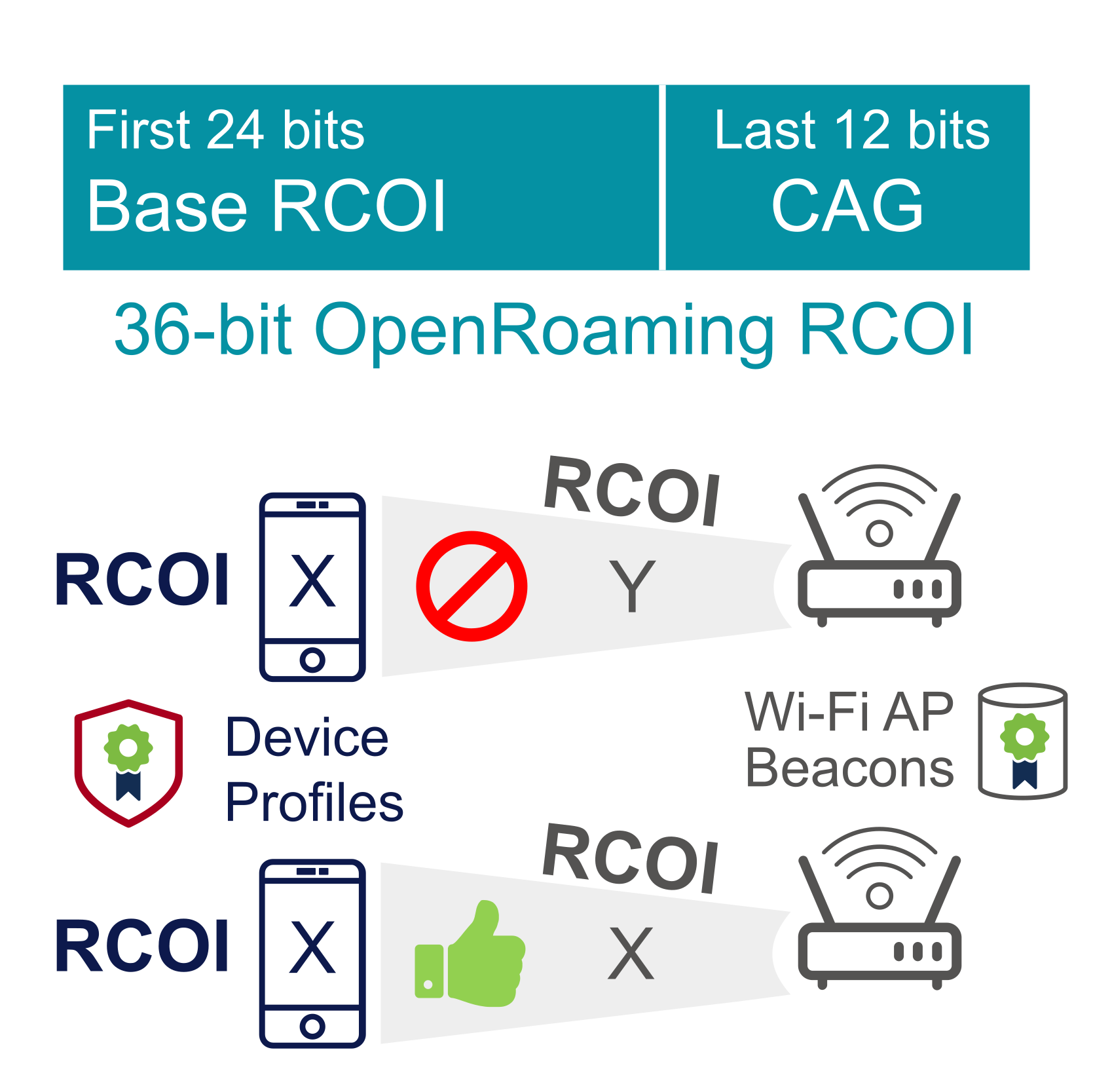 There are two base Passpoint Roaming Consortium Organization Identifiers (RCOIs) for OpenRoaming:
OpenRoaming-Settled: BA-A2-D0-xx-xx
OpenRoaming-Settlement-Free: 5A-03-BA -xx-xx
The last 12-bit extension (xx-xx) of the base RCOI is used to implement Closed Access Group Policies (CAG). The RCOIs are provisioned in the device’s OpenRoaming Passpoint profile(s) and advertised in the Wi-Fi Access Point beacon. If there are more RCOIs to be advertised than what fits in the beacon, a list of available RCOIs can be sent through the Passpoint Access Network Query Protocol (ANQP) messages.
Only IdPs and ANPs with fully matching RCOIs, including the CAG, will roam.
Let’s now move into the more advanced use cases of OpenRoaming using the last 12-bit extension in the OpenRoaming RCOIs to encode the Closed Access Group (CAG) policies. The aim is to deliver an equivalent functionality to the CAG policies encoded in 3GPP using one or more CAG-IDs.
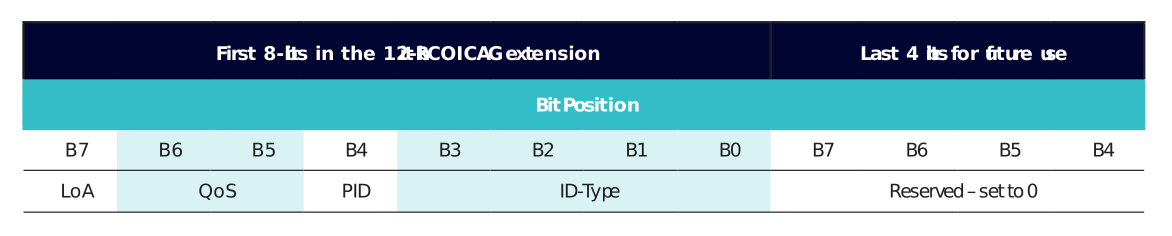
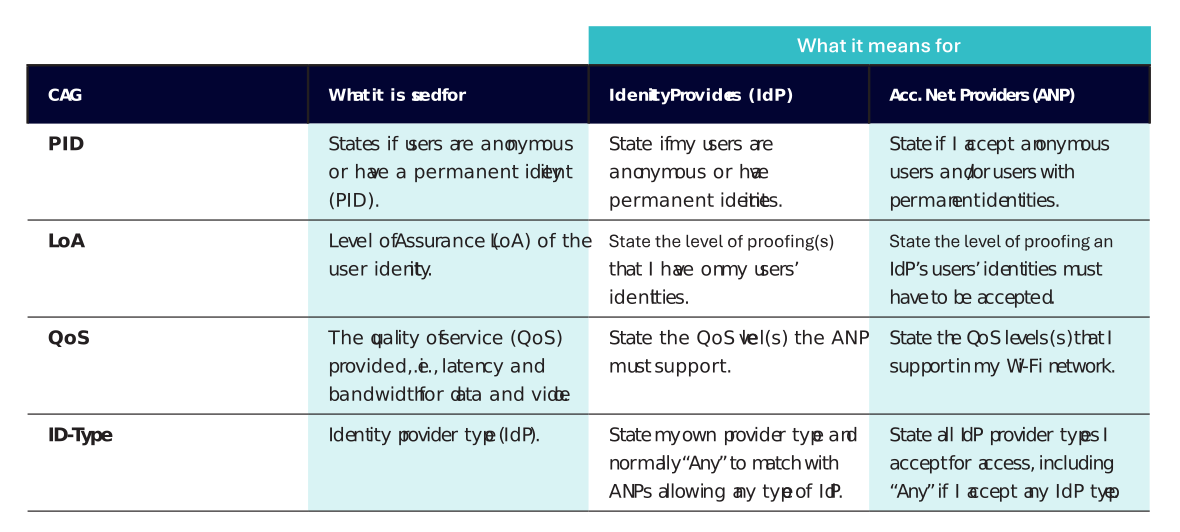
Note that there is no implicit logic behind the RCOI extensions. It is just a matter of matching the exact RCOIs between the IdP and the ANP. As a result, IdPs and ANPs must advertise multiple RCOIs to cover all cases. This, even if it might feel superfluous to, e.g., explicitly say that you accept users with Permanent IDs if you want to allow anyone, including anonymous users, onto your network.
It is vital for ANPs and IdPs to also include the tiered CAG policies that go above their minimum requirement and below what they provide:

There are many high-quality Wi-Fi networks in the OpenRoaming federation that mobile operators could utilize to achieve indoor coverage for their subscribers.
A mobile operator IdP can, for example, decide to roam only with ANPs fulfilling at least the Silver QoS level by using the corresponding Closed Access Group (CAG) policies.
By doing so, the mobile operator will ensure the quality of service for the offloaded user is good enough for, e.g., Wi-Fi Calling and video. This is crucial for settlement-free use cases where they may roam with ANPs with which they have no relationship.
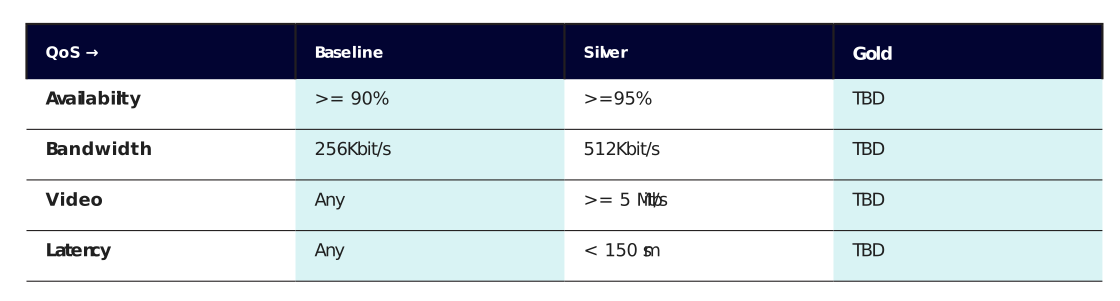
A venue such as a shopping mall could advertise the settled RCOI and make bilateral commercial agreements with multiple mobile operators acting as IDPs.
The shopping mall can even prioritize the mobile operators’ subscribers over other users if they comply with the advertised QoS level for all. This will allow the shopping mall to charge more for the offloaded users.
It is not a problem that the user may have multiple installed OpenRoaming profiles on the device, such as one from the mobile operator and one from the device manufacturer. The shopping mall can utilize the Home Service Provider preference functionality defined in Passpoint to prioritize the mobile operators over other IdPs.
It should be noted that the CAG policies are based on trust between the different actors in the OpenRoaming federation, so the QoS level is not verified independently. Some ANPs may also only advertise the base RCOI without any CAG policies. However, if OpenRoaming advances to become the go-to solution for neutral host Wi-Fi offloading, this could lead to significant changes. For instance, OpenRoaming might evolve to deliver consistent, verified QoS levels across all ANPs.
The Dynamic Peer Discovery (DPD) mechanism is used in OpenRoaming to find the IdP authentication server by looking up the IdP’s realm in DNS. This is a problem when the mobile operator acts as an IdP as the 3gppnetwork. org realm, which all mobile operators use, is not publicly resolvable by DNS because of security concerns.
The remedy is to use the subdomain pub.3gppnetwork.org for DPD, which 3GPP specifies for public use and is thus resolvable by DNS.
Mobile Operators in the OpenRoaming federation must provision their public subdomain in DNS. In the example of Swisscom, that would be:
wlan.mnc001.mcc228.pub.3gppnetwork.org
The public subdomain enables DPD-based discovery of their SIM-Authentication server (3GPP AAA) used to authenticate subscribers in the OpenRoaming federation.
However, the authentication request from a user with a mobile operator Passpoint profile will likely come in the form used by mobile operators, i.e., without the pub subdomain, e.g., <user>@wlan.mnc<MNC>.mcc<MCC>.3gppnetwork.org.
The <user> is the subscriber’s international mobile subscriber identity (IMSI).
As discussed, the DNS-based DPD cannot resolve this realm, so the ANP must dynamically add “pub” in the DNS lookup.
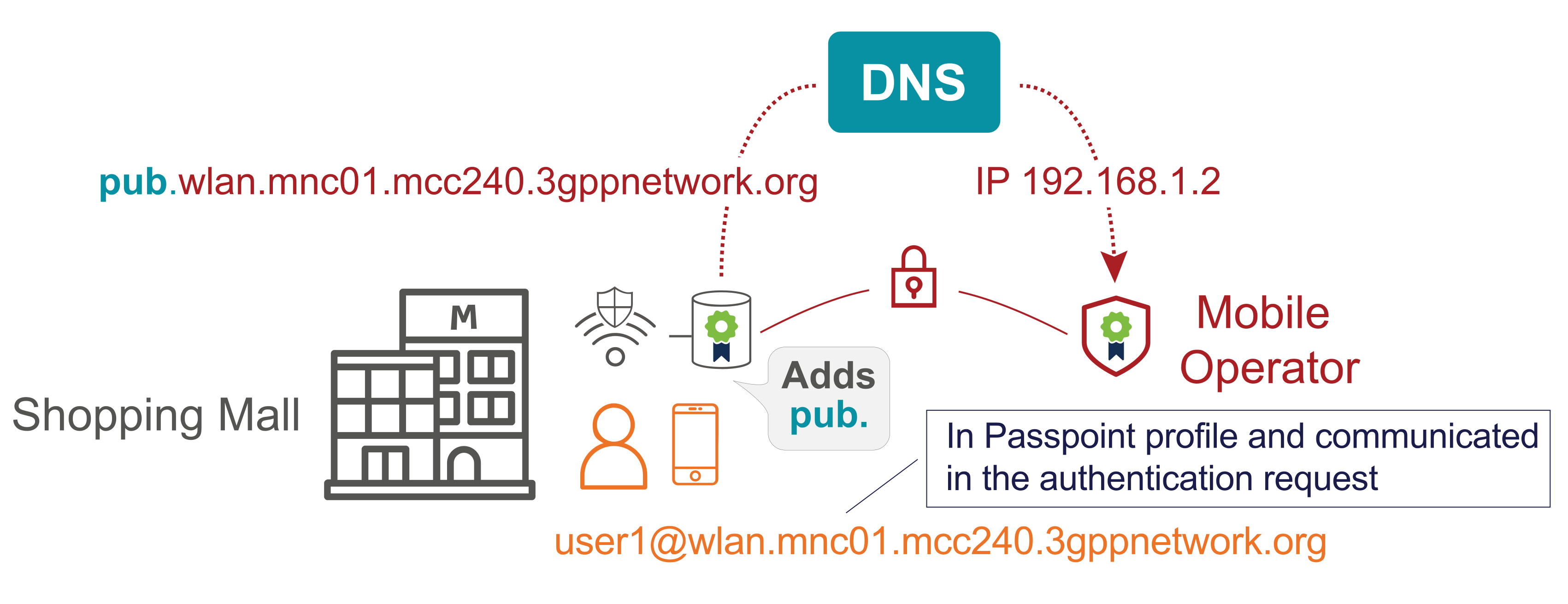
Once the ANP’s and the IdP’s AAA servers have established communication through RADIUS over TLS (RadSec), it is business as usual, and the user can be authenticated using the user credentials from the OpenRoaming Passpoint profile.

[NEW TAIPEI CITY, TAIWAN – January 8, 2026] – AsiaRF, a global leader in wireless innovation, proudly announces the official launch of its high-end strategic brand, WiBRAVO. Built upon a 20-year legacy of wireless mastery and 15 years of strategic refinement, WiBRAVO enters the market as a specialized ecosystem dedicated to high-end Vision Visible-talking Body Worn Cameras (BWC) and Intelligent Emergency Operations Center (EOC) platforms. This launch marks a pivotal shift from traditional hardware manufacturing to providing holistic, mission-critical intelligence for the modern world.
WiBRAVO was born from a singular, critical observation: the dangerous isolation of field officers and the “chaotic fog” that commanders face during high-stakes operations. In an era where communication is more than just data—it is a lifeline—WiBRAVO bridges the gap with its “Total-Connectivity Mesh.” By integrating breakthrough Wi-Fi 7 for crystal-clear 4K near-field streaming and Wi-Fi HaLow for penetrative, long-range reliability over 1km, WiBRAVO ensures that no officer is ever truly alone.
The Depth of Connection While many chase the next wave of speed, WiBRAVO defines the depth of reliability. We don’t just build hardware; we carry forward AsiaRF’s 20-year legacy of wireless mastery and 15 years of strategic refinement. WiBRAVO was born from a singular observation: the critical isolation of field officers and the chaotic fog of information facing commanders. To solve this, we created a specialized ecosystem for high-end Visible-talking Body Worn Cameras (BWC) and Intelligent Emergency Operations Center (EOC) platforms.
A Lifeline in Every Minute Communication is more than data—it is a lifeline. By harnessing AsiaRF’s breakthrough long-range technologies, WiBRAVO constructs an unbreakable Total-Connectivity Mesh. We utilize Wi-Fi 7 for near-field 4K crystal-clear streaming, Wi-Fi HaLow to penetrate dense obstacles over a kilometer away, and 4G LTE & 5G for seamless wide-area roaming. From remote wilderness to the concrete jungle, WiBRAVO ensures the flow of information remains uninterrupted.
Intelligence Without Borders At the heart of the field is the WiBRAVO EOC Intelligence Platform. By merging 3D Digital Twin technology with AI Vision, we transform 2D monitoring into a live, spatial experience. Commanders gain a synchronized view of every BWC wearer’s precise location and real-time environment situation. With AI-driven detection of facial data, license plates, and anomalies, the system shifts from passive observation to proactive, split-second response.
Pure Lineage, Absolute Trust In a world of compromise, WiBRAVO stands firm on its “Pure Lineage” philosophy. Every device is 100% powered by tier one U.S. and Taiwan-grade ICs and is 100% Made in Taiwan (MIT). This isn’t just about technical specifications; it’s a commitment to a secure, vulnerability-free digital foundation for a complex global landscape.
About AsiaRF
AsiaRF established in 1997 and headquartered in Taipei, Taiwan, we are a global leader in wireless connectivity for internet, enterprise, and IoT applications. Our company is dedicated to meeting the diverse needs of our customers worldwide. With a strong presence on six continents and a particular focus on North America, our innovative products have earned the trust of hundreds of customers. Learn more about AsiaRF at www.asiarf.com.


Engineering teams are feeling the pressure of rapid industrial automation. Devices need to support more data, more sensing and more real-time control. The wireless foundation underneath everything still struggles with latency spikes, radio frequency (RF) noise and unpredictable behavior in harsh environments. This is a critical challenge.
Production lines depend on precise timing. Robotics systems require coordination that can’t afford jitter, and every year, device density continues to increase while your operational expectations rise with it.
Previous Wi-Fi generations made progress, but they were not built around the determinism that modern industrial systems require. They fall short of meeting current demands. Below, we’ll explore how Wi-Fi 7 is powering the next wave of industrial Internet of Things (IIoT) innovation, and how its capabilities translate into practical advantages for automation, robotics and real-time control.
To truly understand the impact of Wi-Fi 7, it’s essential to look beyond just faster speeds. This new standard introduces several features. For industrial teams, three stand out as especially transformative.
MLO enables devices to communicate simultaneously over multiple bands, including 2.4 gigahertz (GHz), 5 GHz and 6 GHz. This directly improves reliability in challenging industrial environments.
The following are a few key ways in which MLO supports industrial wireless performance:
Wi-Fi 7 expands channel widths up to 320 megahertz (MHz), which is double the width offered by Wi-Fi 6. This wider channel creates more room for industrial devices that need to push large amounts of data quickly.
The following examples illustrate how 320 MHz channels support heavy workloads:
Wi-Fi 7 introduces 4K Quadrature Amplitude Modulation (QAM), which increases the amount of data encoded in each transmission. This improves throughput and spectral efficiency, especially when the network is busy.
The following are some practical benefits of 4K QAM for industrial IoT systems:
The true potential of Wi-Fi 7 becomes clear when its advanced features are applied to real-world industrial problems.

In many industrial environments, low latency only matters if it is consistent. A slight delay at the wrong moment can cause a robot arm to misalign or prompt an automated system to pause.
Wi-Fi 7 supports more-predictable performance, since MLO allows time-sensitive traffic to align with the most stable and low-latency path in real time, instead of being locked to a single band that might become busy. In addition, more-efficient handling of simultaneous access demands reduces jitter caused by variable backoff and retries, resulting in a more stable and predictable network.
Industrial spaces are filled with metal beams, shelving, enclosures and machinery. Slow-moving equipment, such as forklifts and overhead cranes, often blocks paths. Motors and heavy equipment produce electromagnetic noise that disrupts signals. Wi-Fi 7 is better equipped to manage this type of environment.
In these harsh environments, MLO provides multiple bands to work with, so devices are not locked into a band that suffers from recurring interference. Additionally, with improved scheduling and resource allocation, Wi-Fi 7 manages heavy traffic more effectively, even when some sections of the spectrum experience intermittent noise.
The expansion of industrial IoT is creating unprecedented device density. For example, a single facility may host thousands of sensors, dozens of mobile robots, operator tablets, machine controllers and safety systems, all sharing the same wireless infrastructure.
Wi-Fi 7 addresses this density through its higher overall capacity since wider channels and 4K quadrature amplitude modulation increase the amount of data that can be moved in a given period. The expanded multi-user, multiple-input, multiple-output (MU-MIMO) capabilities also enable more devices to transmit and receive data simultaneously, thereby minimizing delays.
The new capabilities of Wi-Fi 7 support a more ambitious approach to automation. Engineering teams can design systems that rely on wireless connectivity without worrying that mobility or precision will be compromised.
Automation is shifting toward more-mobile, flexible and collaborative systems. Collaborative robots (Cobots) work alongside people, automated guided vehicles (AGVs) navigate dynamic routes and production lines change configurations based on real-time demand.
The following are examples of how Wi-Fi 7 supports advanced automation and robotics:
Asset tracking and real-time location services (RTLS) have become essential tools for managing inventory, tools and mobile equipment. Wi-Fi 7 improves these systems by increasing refresh rates and reliability while scaling to more tracked items.
Wi-Fi 7 unlocks significant improvements in asset tracking and management. With higher throughput and better scheduling capabilities, tags and tracked devices now report their positions without overloading the network. Additionally, in locations where numerous assets and personnel are concentrated, Wi-Fi 7’s density handling helps maintain smooth RTLS performance.
Machine vision and imaging are central to modern industrial quality control, inspection and predictive maintenance. Historically, many systems relied on Ethernet because previous Wi-Fi generations were unable to reliably handle high-resolution video streams.
Wi-Fi 7 empowers industrial machine vision through several key advancements. The availability of 320 MHz channels supports high data rates for 4K and even higher-resolution camera streams. Additionally, 4K QAM allows cameras to transmit detailed imagery without excessive compression.
Selecting the right wireless foundation is essential for any next-generation industrial device. Wi-Fi 7 introduces powerful capabilities, but those benefits can only be realized through solutions that implement the standard with industrial-grade reliability.
Synaptics’ Veros™ Wi-Fi 7 solutions are designed to address these demands and provide the industrial IoT connectivity foundation needed for the next generation of automation, robotics, sensing and real-time control devices.
If you’re planning your next IIoT platform or evaluating how to upgrade an existing product line, this is an ideal moment to align your wireless strategy with Wi-Fi 7. Contact us today to explore how purpose-built Wi-Fi 7 silicon can support your applications.
Ever found yourself circling a packed parking lot, heart sinking as you realize the only spot left is impossibly tight? Or perhaps you’ve experienced the dreaded “door ding” aftermath, wishing your car could just… park itself? And what about the sheer frustration of trying to squeeze yourself into your vehicle when it’s boxed in by other cars? What if we told you that future is already here, and it’s smoother, smarter, and more seamless than you can imagine? Prepare to say goodbye to parking woes and hello to a whole new era of convenience, thanks to innovative robotics and the ultra-reliable power of Cisco technology!
Watch the incredible video below showcasing HL Robotics’ “Parkie, – a revolutionary automated parking solution that’s changing the game in Korea. This isn’t just about parking; it’s about transforming the entire experience. You’ll see firsthand how Cisco’s Ultra-Reliable Wireless Backhaul (URWB) ensures the seamless, continuous connectivity these intelligent robots need to operate flawlessly. Get ready to witness parking perfection!
You’ve seen the magic, but how does it work? For a fleet of parking robots like Parkie to operate flawlessly, the underlying network isn’t just important – it’s absolutely critical. Imagine robots zipping around, precisely maneuvering vehicles, coordinating with each other, and responding to commands in real-time. Any hiccup, any delay, any dropped signal, and the whole system grinds to a halt.
These mechanical marvels demand uninterrupted, strong wireless communication. They need stable connectivity even in complex, dynamic environments like multi-story parking garages. High-speed roaming, seamless handoffs between access points, and zero packet loss are non-negotiable. It’s like a finely choreographed dance, and the network is the music that keeps everyone in perfect sync.
Enter HL Robotics, a visionary company dedicated to making our lives easier and more efficient. Their flagship product, Parkie, is a testament to their innovative spirit. Parkie isn’t just a robot; it’s your personal parking valet! These intelligent robots take the stress out of parking by autonomously moving your vehicle into tight spots, eliminating door dings, and even handling your luggage with ease.
HL Robotics understands that parking lots come in all shapes and sizes, requiring flexible solutions. Whether it’s a single pair of robots or a fleet of ten or more working simultaneously, Parkie ensures seamless service, optimizing space and delivering unparalleled convenience.
So, what’s the secret sauce enabling Parkie’s smooth moves? It’s Cisco’s powerful wireless technology, specifically our Ultra-Reliable Wireless Backhaul (URWB). Cisco URWB technology is engineered for environments where even a millisecond of disruption can be costly.
Here’s how Cisco URWB ensures Parkie’s flawless performance:
This robust, industrial-grade wireless infrastructure is what allows Parkie robots to constantly communicate with the server, send appropriate commands, and coordinate their intricate dance with absolute precision.
The challenging environment of a parking lot – with its concrete structures, moving vehicles, and harsh environmental conditions like humidity, rain, or extreme temperatures – perfectly illustrates the need for truly resilient networking. This is precisely where Cisco’s Rugged Enterprise Networking solution truly shines.
Just as URWB ensures Parkie’s reliability in a demanding parking garage, Cisco’s broader Rugged Enterprise Networking solutions are designed to extend your secure campus network beyond traditional office walls, across rugged environments. This enables innovation, reduces complexity, and enhances security in even the toughest conditions. These solutions, which include our Industrial Wireless Access Points with URWB technology, are purpose-built to withstand extreme conditions, delivering secure, reliable, and high-performance connectivity where standard networks simply can’t. Ultimately, it’s about empowering businesses to connect everything, everywhere, no matter how tough the terrain.
Don’t just read about it – experience it! Watch the video above to see HL Robotics’ Parkie, powered by Cisco URWB, in action. Prepare to be amazed by the convenience, efficiency, and sheer brilliance of automated parking. The future of parking is here, and it’s connected by Cisco!

LAS VEGAS, Jan. 5, 2026 /PRNewswire/ — Silicon Labs (NASDAQ: SLAB), the leading innovator in low-power wireless, is showcasing a comprehensive portfolio of IoT advancements at CES 2026. Through live technical demonstrations, engineering-led presentations and key product introductions, the company is underscoring why developers worldwide rely on Silicon Labs to build secure, scalable, and energy-efficient connected devices.
At CES 2026, Silicon Labs is:
CES has always been a place for companies to demonstrate how their products are pushing the cutting-edge of innovation. As these devices have become more complex, they require new software that can operate and meet the demands of their advanced applications. To meet that need, Silicon Labs is bringing one of the most popular open-source real-time operating systems to enterprise users.
Silicon Labs Open Source Expertise Extends to Zephyr
On the first day of CES, Silicon Labs announced the release and general availability of the Simplicity SDK for Zephyr. Zephyr has quickly become the go-to open RTOS for connected embedded systems, offering a portable, production-grade alternative to proprietary kernels. As a Platinum member of the Zephyr project, Silicon Labs brings deep open source expertise along with a broad portfolio of wireless protocol technologies, particularly in Bluetooth® LE and Wi‑Fi.
At large-scale IoT deployments — where devices may remain in the field for decades –manufacturers and users need long-term confidence in security, performance, and regulatory compliance. Open-source RTOS options do not always meet these requirements, which is why Silicon Labs is creating an enterprise-grade commercial package for Zephyr.
The new Simplicity SDK for Zephyr delivers:
For more details on the Simplicity SDK for Zephyr visit “Introducing Simplicity SDK for Zephyr” on the Silicon Labs blog. Developers can begin with the Zephyr Getting Started guide and explore Silicon Labs’ extensive Zephyr resources on GitHub.
Read more about Silicon Labs’ presence at CES, including details on demos and speaking engagements, and see the Top Three Silicon Labs Things to Do at CES on the Silicon Labs blog.
About Silicon Labs
Silicon Labs (NASDAQ: SLAB) is the leading innovator in low-power connectivity, building embedded technology that connects devices and improves lives. The company provides highly integrated SoCs, software, and tools for smart home, industrial IoT, and smart city applications, helping device makers create advanced edge connectivity products. Headquartered in Austin, Texas, Silicon Labs operates in more than 16 countries. Learn more at silabs.com.
SOURCE Silicon Labs

January 6, 2026, San Jose, Calif. – NETGEAR® Inc. (NASDAQ: NTGR), a global leader in intelligent networking solutions designed to power extraordinary experiences, today announced that the new Nighthawk 5G M7 Portable WiFi 7 Hotspot (MH7150) with eSIM marketplace is now available for pre-order at www.netgear.com. Worldwide shipping and retail rollout are set to kick off on January 27, 2026. The innovative device combines reliable, portable connectivity with groundbreaking flexibility, allowing users to choose coverage that fits their needs and connect instantly to high-speed internet in up to 140 countries.
Designed for dynamic lifestyles, the M7 delivers fast, reliable WiFi 7 speeds up to 3.6 Gbps, supporting up to 32 devices. Its compact build, robust battery, and simple setup make it the ideal companion for travel, remote work, and secure connectivity on the go.
With the new NETGEAR eSIM Marketplace, users can buy and activate affordable, high-quality data plans in over 140 countries directly through the NETGEAR app, no roaming fees required. The M7 is unlocked, supporting both physical SIMs and third-party eSIMs for true flexibility worldwide.
Advanced security features, including WPA3 encryption, firewall protection, and automatic updates, safeguard your connection. For wired needs, connect via USB-C or add an Ethernet adapter (sold separately) for even faster speeds.
The M7 Portable WiFi Hotspot, featuring an integrated eSIM marketplace, is now available for pre-order on www.netgear.com at $499.99 MSRP. Worldwide shipping and rollout to retailers begins on January 27, 2026. For additional details and purchasing options, please visit https://www.netgear.com/on-the-go/hotspots/mh7150/.
Founded in 1996 and headquartered in the USA, NETGEAR® (NASDAQ: NTGR) is a global leader in innovative networking technologies for businesses, homes, and service providers. NETGEAR delivers a wide range of award-winning, intelligent solutions designed to unleash the full potential of connectivity and power extraordinary experiences. For businesses, NETGEAR offers reliable, easy-to-use, high-performance networking solutions, including switches, routers, access points, software, and AV over IP technologies, tailored to meet the diverse needs of small and medium enterprises. NETGEAR’s consumer products deliver advanced connectivity, powerful performance, and enhanced security features right out of the box, designed to help keep families safe online, whether at home or on the go. More information is available from the NETGEAR Press Room or by calling +1 (408) 907-8000. Connect with NETGEAR on LinkedIn, Facebook, Instagram and the NETGEAR blog at NETGEAR.com.
©2026 NETGEAR, Inc. NETGEAR, NETGEAR Insight and the NETGEAR logo are trademarks and/or registered trademarks of NETGEAR, Inc. and/or its affiliates in the United States and/or other countries. Other brand and product names are for identification purposes only and may be trademarks or registered trademarks of their respective holder(s). The information contained herein is subject to change without notice. NETGEAR shall not be liable for technical or editorial errors or omissions contained herein. All rights reserved.
Source: NETGEAR-G