


Breaking News

GLOBAL Wi-Fi NEWS bulletin

In the embedded systems world, embedUR has spent the last twenty years in the trenches. Weโ€™ve built the wireless infrastructure that runs enterprise access points and the residential gateways sitting in millions of homes. In that time, weโ€™ve learned one thing: regulatory shifts arenโ€™t just legal problems. They are engineering problems.

The EU Cyber Resilience Act (CRA) is one of the biggest shifts weโ€™ve seen in a decade. It isnโ€™t just a footnote in a policy briefing; itโ€™s a fundamental change in how we need to or should design, build, and most importantly, sustain products. At embedUR, weโ€™ve guided teams through every Wi-Fi evolution from the early days of 802.11n to the complexities of Wi-Fi 6E and the new world of tinyML at the edge.

From where we stand, the CRA shouldnโ€™t be a headache. It should be the catalyst that finally forces the industry to build smarter, more resilient systems.

But letโ€™s be honest: for an engineering lead trying to hit a product launch date while staring down resource gaps, the CRA looks like a mountain of paperwork. To climb it, you have to bridge the gap between using an open-source RTOS like Zephyr and meeting the rigorous demands of European law.

The Clock is Ticking: Understanding the CRA Milestones

We are currently in early 2026. The grace period is evaporating. The CRA was formally adopted back in late 2024, and the first major hammer will drop on September 11, 2026. That is the date when mandatory vulnerability reporting goes live.

If your device has a digital element and you sell it in the EU, you have 24 hours to report an exploited vulnerability. Not 24 hours after you fix itโ€”24 hours after you find it.

By December 2027, the remaining requirements kick in: security-by-design as a legal mandate, machine-readable Software Bills of Materials (SBOMs), and a 5-year support window. If you miss these marks, the fines are eye-watering: up to โ‚ฌ15 million or 2.5% of your global turnover. For any U.S. company exporting to Europe, which is a massive chunk of the global market, this is now the cost of doing business.

Why Zephyr is our Go-To (And Why Itโ€™s Not a Silver Bullet)

Weโ€™ve been working with Zephyr RTOS since its early releases in 2016. Itโ€™s under the Linux Foundation, itโ€™s transparent, and itโ€™s modular. On paper, itโ€™s the perfect answer to the CRA.

Zephyrโ€™s PSIRT (Product Security Incident Response Team) is excellent. They handle CVEs (Common Vulnerabilities and Exposures) with a level of transparency that mirrors the Linux kernel. When a bug is found in the networking stack, the fix is public and documented.

Furthermore, the Long-Term Support (LTS) releases, like the 3.7 LTS, offer five years of security maintenance. That perfectly maps to the CRAโ€™s support requirements.

Zephyr also gives us the โ€œWestโ€ tool. Using west spdx, we can generate an SBOM automatically during the build process. If youโ€™ve ever tried to manually track every library and sub-component in a proprietary RTOS, you know that automated SBOM generation is a godsend. It takes the drudgery out of compliance.

However, this is the local engineerโ€™s truth: upstream Zephyr is not the same thing as a shipping product.

The Reality of โ€œThe Forkโ€ and Maintenance Debt

Here is where the theory hits the floor. In our work sustaining Wi-Fi products for major global brands, where we manage fleets of over 10 million units, weโ€™ve seen divergence as a major problem.

An engineer starts with a clean Zephyr LTS branch. Then, the silicon vendor provides a HAL (Hardware Abstraction Layer) that isnโ€™t quite right for the specific power constraints of a Cortex-M4 gateway. So, the engineer tweaks the kernel. Then the marketing team requests a specific feature that requires a custom driver. Before you know it, youโ€™ve forked the repo.

When a security patch comes down from the Zephyr upstream six months later, it doesnโ€™t fit. It breaks your custom power management. It conflicts with your Wi-Fi driver. Now, compliance means a three-week rebase and a full regression test.

If you have a multi-SKU product line, maybe some devices use ARM and others use RISC-V, your vulnerability tracking turns into a nightmare. There are cases where a field-reported bug traced back to an unpatched erratum in a silicon vendorโ€™s HAL. Because the team had drifted too far from the clean upstream code, they couldnโ€™t pull the fix.ย 

This kind of delay is exactly what the CRA will penalize.

The tinyML Constraint

The complexity doubles when you add tinyML. Weโ€™re seeing more industrial gear using TensorFlow Lite Micro on Zephyr to do predictive maintenance at the edge. These models are ultra-constrained. Every byte of RAM matters.

When youโ€™re fighting for every kilobyte to make an AI model work on an IoT sensor, security overhead feels like an enemy. But under the CRA, that edge intelligence is part of the productโ€™s digital footprint.

If your ML inference engine has a buffer overflow vulnerability, you are liable. Shoehorning these models into Zephyr while maintaining a secure, updatable bootloader (like MCUboot) requires a level of memory management that most teams arenโ€™t prepared for.

Making Compliance a Competitive Edge

So, how do we stop compliance from being a burden and turn it into a reason why customers choose you over a competitor? You have to treat security as a feature, not a chore.

1. Stop Wild Forking

The biggest mistake we see is that engineers treat Zephyr like a one-off download. You have to stay aligned with the LTS branches. We recommend a โ€œcherry-pickโ€ strategy. You pin your project to a stable LTS version and build a rigorous process for pulling in only the security patches you need. This keeps your custom โ€œsecret sauceโ€ separate from the core RTOS plumbing.

2. Automate the Paperwork

If an auditor asks for your SBOM, you shouldnโ€™t have to spend a week in Excel. We help our clients integrate SBOM tools directly into their CI/CD pipelines (like GitLab or GitHub Actions).ย 

Every time a developer pushes code, the system should automatically run a vulnerability scan (using tools like grype or trivy) and generate a new SPDX file. If a vulnerability is found, the build should fail before the code ever reaches a device.

3. Standardize via Device Tree Overlays

To handle the multi-SKU headache, we use Zephyr Device Tree overlays. Instead of having different codebases for different hardware, you keep one core application and use overlays to describe the hardware differences. This minimizes code drift and ensures that a security patch for your BLE stack works across every device in your catalog.

4. Hardware-in-the-Loop (HiL) Testing

You canโ€™t trust a simulation for CRA compliance. You need automated test rigs where real hardware is subjected to simulated exploits. At embedUR, weโ€™ve built environments where we test everything from LTE stack vulnerabilities to timing glitches in crypto libraries.ย 

This is how you catch a DoS (Denial of Service) bug before it gets found in the field andย  becomes a mandatory 24-hour report to the EU.

The embedUR Difference: Real Engineers, Real Solutions

This is what we do. We arenโ€™t a compliance consultancy that just hands you a PowerPoint. We are an engineering firm with over 400 expert embedded systems engineers who live in the kernel. Our architects have upstreamed code to Zephyrโ€™s networking modules. We also know the silicon vendorsโ€”NXP, Infineon, Nordic, and Silicon Labsโ€”and where their HALs usually break.

We have the sustainment framework ready to go. We handle the kernel upgrades, the CVE monitoring, and the SBOM maintenance so that your senior engineers can focus on the stuff that actually makes you money, like your next-gen predictive maintenance algorithms or your cloud-to-edge analytics.

The Bottom Line

The September 2026 deadline is closer than it looks on the calendar. In the world of embedded systems, eighteen months is one design cycle. If you start thinking about the CRA during the testing phase, youโ€™ve already lost.

Is your Zephyr setup a solid foundation, or is it a house of cards? If youโ€™re building for the EU market and worried about staying compliant without killing your product roadmap, letโ€™s talk.

We can do a technical review of your current stack and show you exactly where the gaps are. Weโ€™ve been through the Wi-Fi wars and the IoT explosion; we can get you through this, too.

Letโ€™s get your engineering team back to innovating. Schedule a Technical Review: Talk directly with our lead architects about your current Zephyr stack and CRA gaps.

For more than a decade, wireless microcontrollers (MCUs) have been evaluated primarily on radio performance. Range, sensitivity, protocol support, and transmit power defined leadership. These metrics still matter, but in modern IoT systems, connectivity is no longer the primary constraint. System complexity is.

Rethinking the Role of the IoT MCU

Todayโ€™s IoT products are expected to deliver more intelligence, tighter power efficiency, and faster time to market, all while reducing cost. Yet many designs still rely on multiple MCUs operating on the same board. A single device might have one MCU for connectivity, another for application control, and a third for real-time processing. And sometimes a fourth is required for sensing or device management.

This architecture persists because itโ€™s familiar. But itโ€™s far from optimal.

As IoT systems evolve, RF performance alone is no longer the defining metric. What matters today is how efficiently the entire system is architected.

Silicon Labs Series 2 was designed around the premise that wireless MCUs should not just connect devices, but consolidate them.

The Hidden Inefficiency in Todayโ€™s IoT Designs

A typical connected device often includes:

  • A wireless SoC for Bluetooth Low Energy (LE), Zigbee, Thread, or proprietary connectivity
  • An application MCU for control logic
  • A motor-control MCU for deterministic actuation
  • A low-power controller for sensing or housekeeping

Each additional device increases:

  • Bill-of-material cost (BOM)
  • PCB area
  • Firmware complexity
  • Validation effort
  • Inter-processor latency
  • Idle and leakage power

Ironically, much of this duplication is unnecessary. Wireless workloads are event-driven and burst-based. In many systems, the connectivity stack consumes a fraction of available CPU cycles. The processor becomes active during packet handling, then remains idle for extended intervals.

This creates a structural inefficiency. Significant compute headroom remains unused while additional MCUs are added elsewhere on the board. This presents an opportunity to reclaim that headroom and consolidate system functionality without compromising wireless performance.

Consolidation Only Works if Isolation is Guaranteed

The primary reason many systems remain partitioned is concern. Engineers hesitate to combine workloads for fear of degrading wireless determinism or introducing timing jitter into real-time tasks.

Silicon Labs Series 2 addresses this directly. It employs a multicore, event-driven architecture with functional separation:

  • Dedicated cores manage radio and security operations
  • Latency-critical wireless tasks execute independently
  • The application core remains available for control, sensing, and AI workloads

This separation ensures that adding application functionality does not degrade wireless performance or real-time behavior. Instead of protecting RF integrity through partitioning, designers can now protect it through architecture.

Event-Driven Compute: Doing More with Less Power

Reducing component count is only part of the system equation. Power efficiency is equally critical. Traditional MCU-based systems rely heavily on CPU intervention. Interrupt-driven designs wake the processor frequently, increasing dynamic power consumption and adding software overhead.

Series 2 takes a fundamentally different approach.

Its Peripheral Reflex System enables peripherals to communicate directly with one another. Hardware events trigger hardware responses. Data can move through DMA pathways without waking the CPU.

For example:

  • An ADC conversion can automatically initiate a memory transfer
  • A comparator event can directly adjust a PWM output
  • Timers can coordinate control loops autonomously

The processor wakes only when meaningful computation is required. This architecture delivers:

  • Lower dynamic power consumption
  • Deterministic real-time behavior
  • Higher effective compute utilization

More work is done in hardware, so less energy is spent orchestrating it in software. In battery-powered and energy-sensitive systems, this is a structural advantage.

Real-Time Control and Connectivity on One Chip

Motor control illustrates the consolidation challenge clearly.

Closed-loop Field-Oriented Control (FoC) demands precise timing, high-speed ADC sampling, and coordinated PWM updates. Historically, this required a dedicated MCU to guarantee deterministic performance.

Series 2 challenges that assumption.

By combining advanced PWM peripherals, high-performance ADCs, hardware-based event routing, and efficient Arm Cortex-M33 processing, Series 2 can execute closed-loop FoC while simultaneously maintaining a Bluetooth LE stack on the same device.

This enables:

  • Single-chip motor and wireless designs
  • Reduced system latency
  • Simplified firmware architecture
  • Lower PCB complexity

For customers, the impact is direct:

  • BOM reduction
  • Lower power consumption
  • Shorter validation cycles
  • Faster time to market

The economics of intelligent devices shift when real-time control and connectivity coexist on one platform.

Embedded AI Without Additional Silicon

The next generation of IoT systems requires local intelligence. Sensor fusion, anomaly detection, predictive maintenance, and signal classification are increasingly moving from cloud to edge.

Traditional approaches add hardware. External NPUs or larger application processors increase cost, board space, and power complexity.

Series 2 integrates a Matrix Vector Processor (MVP) optimized for linear algebra, DSP workloads, and neural network inference.

By offloading math-intensive operations:

  • CPU cycles remain available for control and connectivity
  • Inference latency becomes predictable
  • Energy per inference is significantly reduced

AI becomes a native system capability rather than an architectural add-on. Intelligence is integrated, not appended.

Platform Consistency That Scales

Architectural consistency is as important as performance.

Series 2 capabilities extend across Bluetooth, multiprotocol, sub-GHz, and proprietary families. Motor-control peripherals, AI acceleration, event routing, and security architecture are shared across the portfolio.

This enables:

  • Software reuse across product variants
  • Reduced SKU proliferation
  • Simplified qualification processes
  • Faster feature scaling

As organizations expand product lines or enter adjacent markets, a consistent platform reduces both technical and operational friction. Platform continuity becomes a multiplier for engineering productivity.

Connectivity is No Longer the Edge of the System, Itโ€™s at The Center

Many vendors approach connectivity by adding radios to traditional MCU architectures.

Series 2 takes the opposite path by absorbing application compute, control logic, and AI into the wireless platform itself. Instead of adding features through more silicon, the objective becomes removing silicon entirely.

In modern IoT systems, leadership will be measured by:

  • How many components can be eliminated
  • How efficiently compute headroom is utilized
  • How intelligently power is managed
  • How seamlessly functionality scales

A New Definition of the Wireless MCU

Series 2 redefines what a wireless MCU can be. A connectivity platform, an application processor, a real-time control engine, and an embedded AI accelerator. All within a single, power-efficient architecture optimized for real-world IoT systems.

As IoT architectures continue to consolidate, the question is no longer whether wireless MCUs should do more.

The real question becomes, how efficiently can they replace the rest of the system?

Series 2 was designed for this future from day one.

In modern IoT design, the most valuable innovation may not be what is added to the board, but what can finally be removed.

Change is coming to NETGEARยฎ Insightโ„ข, and itโ€™s designed entirely around you.

In the coming weeks, all Insight customers will automatically receive a significant platform update. This evolution enhances the user experience, simplifies workflows, and provides a strong foundation for long-term scalabilityโ€”while preserving the secure, cloud-based management you rely on every day.

More than a visual refresh, this thoughtful redesign is the direct result of your feedback and is built to support the way SMEs and MSPs manage networks today.

A Modern Interface Built for Clarity

The first thing youโ€™ll notice is a refreshed, contemporary interface. Built on a Material UI (MUI) foundationโ€”an industry-standard design systemโ€” the new experience is cleaner, more consistent, and easier to navigate.

From typography to layout structure, every element has been refined to reduce friction and improve usability. Whether youโ€™re managing a single site or a multi-organization deployment, the interface is designed to help you move faster and work smarter.

Simplified Navigation and Hierarchy

Managing multiple locations and customers requires speed and precision. The updated Insight experience introduces a more intuitive menu system and an improved hierarchy tree that makes navigating organizations, locations, and devices significantly more efficient.

Instead of clicking through layered menus, you can now access what you need with fewer steps. The result is less time spent searching and more time spent managing.

For MSPs and IT administrators managing complex environments, this means faster navigation, fewer clicks, and more time focused on delivering results for customers.

Faster Onboarding, Faster Deployment

Time matters โ€“ especially during deployment.

The updated Insight platform introduces a simplified two-step customer sign-up process and an accelerated device onboarding workflow. These enhancements remove unnecessary steps and reduce setup friction, allowing teams to bring networks online more quickly.

Whether youโ€™re deploying a new location or expanding an existing network, the improved onboarding flow helps ensure faster time to value.

A Streamlined Subscription Model

Weโ€™ve also simplified the commercial side of Insight.

The new single-tier subscription model replaces multiple tiers with one streamlined option. This change reduces confusion, simplifies purchasing decisions, and makes subscription management easier for both partners and end customers.

For MSPs, this means more straightforward conversations and fewer administrative complexities. For IT managers, it means clarity and predictability.

Built for Scale

Insight continues to deliver secure, cloud-based control of routers, switches, access points, and mobile hotspotsโ€”all through a single pane of glass.

The updated architecture and navigation improvements make the platform even more scalable. Whether you manage one business with several locations or a portfolio of clients across industries, Insight is engineered to grow with you.

The improved structure supports expanding device counts, additional sites, and evolving organizational needs without increasing management complexity.

Reliable, Secure Cloud Foundation

While the interface evolves, the foundation remains the same: secure, resilient cloud infrastructure designed to protect your data and ensure continuity.

Insight continues to operate on NETGEARโ€™s trusted cloud-native platform, allowing devices to function even if cloud connectivity is temporarily interrupted. Security remains a priority, with enterprise-grade protections and robust access controls built into the system.

This update enhances the experienceโ€”but it does not compromise the reliability you depend on.

What You Need to Do

Nothing.

The update will automatically apply to your existing Insight environment. Your configurations, data, organizations, and devices will remain intact.

We will share updated documentation and resources to help you quickly familiarize yourself with the new interface, but no reinstallation or migration steps are required.

Designed for the Way You Work

This next evolution of Insight reflects a simple principle: powerful technology should feel effortless.

By modernizing the interface, streamlining navigation, accelerating onboarding, and simplifying subscriptions, weโ€™re making it easier for IT teams and MSPs to manage networks with confidence and clarity.

Weโ€™re excited for you to experience whatโ€™s next.

Stay tuned for additional updates as we approach launch.

Genio Pro 5100: Extreme Compute & Multimedia Platform Unleashes the Full Potential of IoT AI

IoT is now powering intelligent, autonomous systems, so developers need platforms that can handle real-time AI at the edge without sacrificing efficiency or scalability. That is exactly where the MediaTek Genio Pro comes in.

The MediaTek Genio Pro is a flagship platform designed for extremely high-performance, AI-driven embedded systems. Built on a cutting-edge 3nm process and equipped with an advanced AI processing unit capable of delivering over 50 TOPS of compute, it enables everything from real-time vision systems to on-device generative AI. With support for large language models, multi-camera inputs of up to 16, and rich multimedia capabilities such as 8K video, it is ready to support even the most demanding and varied applications.

MediaTek Genio Pro_Bento Infographic 032611 conv 1

Different industries will find unique value propositions in the MediaTek Genio Pro:

Robotics and Autonomous Systems Developers
Autonomous mobile robots or drones will benefit from Genio Proโ€™s sensor fusion, ROS2 support, and real-time AI inference, which allow them to sense, see, and make decisions instantly. It can process data from multiple cameras while running AI models locally, which is critical for navigation and decision making without cloud latency.

Industrial IoT Engineers
For factory automation, predictive maintenance, or machine vision, the platformโ€™s certification for industrial temperatures ensures it fits demanding environments. High compute density combined with exceptional power efficiency lowers total cost of ownership by reducing lifetime power consumption, minimizing reliance on communication infrastructure, and lowering cloud server costs. Combined with Linux support including Yocto, Ubuntu, and Debian, it integrates smoothly into existing industrial stacks.

Smart Retail and Commercial IoT Builders
Developers working on smart kiosks, digital signage, or customer analytics systems can leverage multi-display support and edge AI to deliver personalized, real-time experiences throughout the store, all from a single device.

Edge AI and Generative AI Innovators
With on-device LLM capabilities that handle models up to 7B parameters, Genio Pro opens the door to private, low-latency generative AI applications, from intelligent or agentic assistants to advanced analytics at the edge.

Make sponsorships more valuable. Understand fan movement. Drive on-property revenue.

Why Stadiums Use Smart Wiโ€‘Fi

Stadiums have a rare advantage: a concentrated audience on property for a fixed window of time. GoZone Smart Wiโ€‘Fi helps you turn that window into measurable revenueโ€”by creating sponsor activation inventory, improving fan journey insights, and triggering automated campaigns that increase concession and merchandise sales.

The 3 Outcomes That Matter Most

  1. Sponsor activation revenue
    • Create new digital inventory partners can sponsor
    • Tie activation value to measurable engagement
    • Deliver reporting that supports renewals and upsells
  2. Traffic flow + fan journey insights
    • Understand movement across gates, concourses, concessions, and retail
    • Identify high-value zones for activations
    • Support ops decisions with real venue behavior data
  3. On-property campaign lift (concessions + merchandise)
    • Run automated, event-window campaigns
    • Promote limited-time offers and featured stands
    • Drive team store visits while fans are still present

What Makes GoZone Different

  • Hardware-neutral: works with many major enterprise Wiโ€‘Fi networks
  • Built for revenue: sponsor activations + campaigns are core, not an add-on
  • Flexible branding: team-first experiences with partner co-branding

Quick Examples

  • Wiโ€‘Fi presented by a headline sponsor on game day
  • Halftime concession offer to boost mid-event sales
  • Team store promo in the final quarter or post-event
  • Zone-based sponsor activations tied to high-traffic areas

Next Step

Talk to an Expertย to map sponsor inventory and campaign opportunities for your venue. Request a quote for your stadium and event schedule.

How Room Layout, Materials, and AP Placement Impact Guest Connectivity

This article builds on our recent two-part series on hospitality technology infrastructure. In those articles, we covered how to plan network infrastructure and how WorldVue designs, deploys, and supports guest-facing technology.

In this article, we take a closer look at real-world hotel Wi-Fi design scenarios. Using heatmap examples, we show how room layout, construction materials, and access point (AP) placement affect signal strength in guest rooms.

These examples help explain why careful planning is critical to meet guest expectations. Small design decisions can have a major impact on the guest experience.

Why Heatmaps Matter in Hotel Wi-Fi Coverage and Design

Wi-Fi heatmaps show how wireless signals travel through a space. They highlight areas with strong coverage and areas where signal strength drops.

Design teams use heatmaps to validate AP placement and coverage before installation. This helps ensure guests receive reliable connectivity throughout the room.

โ€œWi-Fi design is not just about adding more access points,โ€ says Hitesh Patel, VP of Solution Architecture at WorldVue. โ€œPlacement needs to reflect how signals actually move through a space.โ€

Standard Guest Room Scenarios (Mid-Market Hotel)

The following examples reflect a typical mid-market hotel with standard-sized guest rooms. These properties often use consistent layouts and may include concrete or drywall construction.

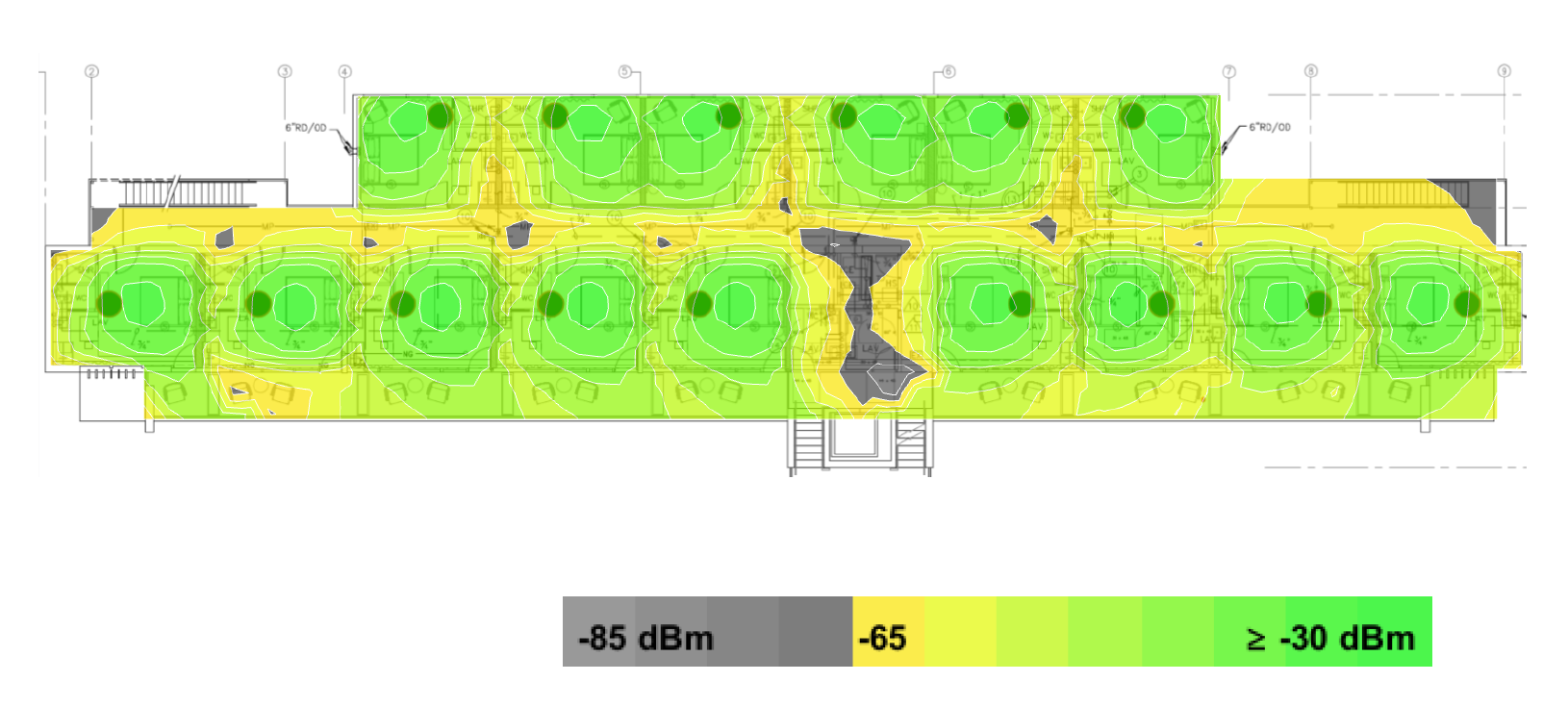
Example 1: In-Room AP in Each Room (Concrete Walls)

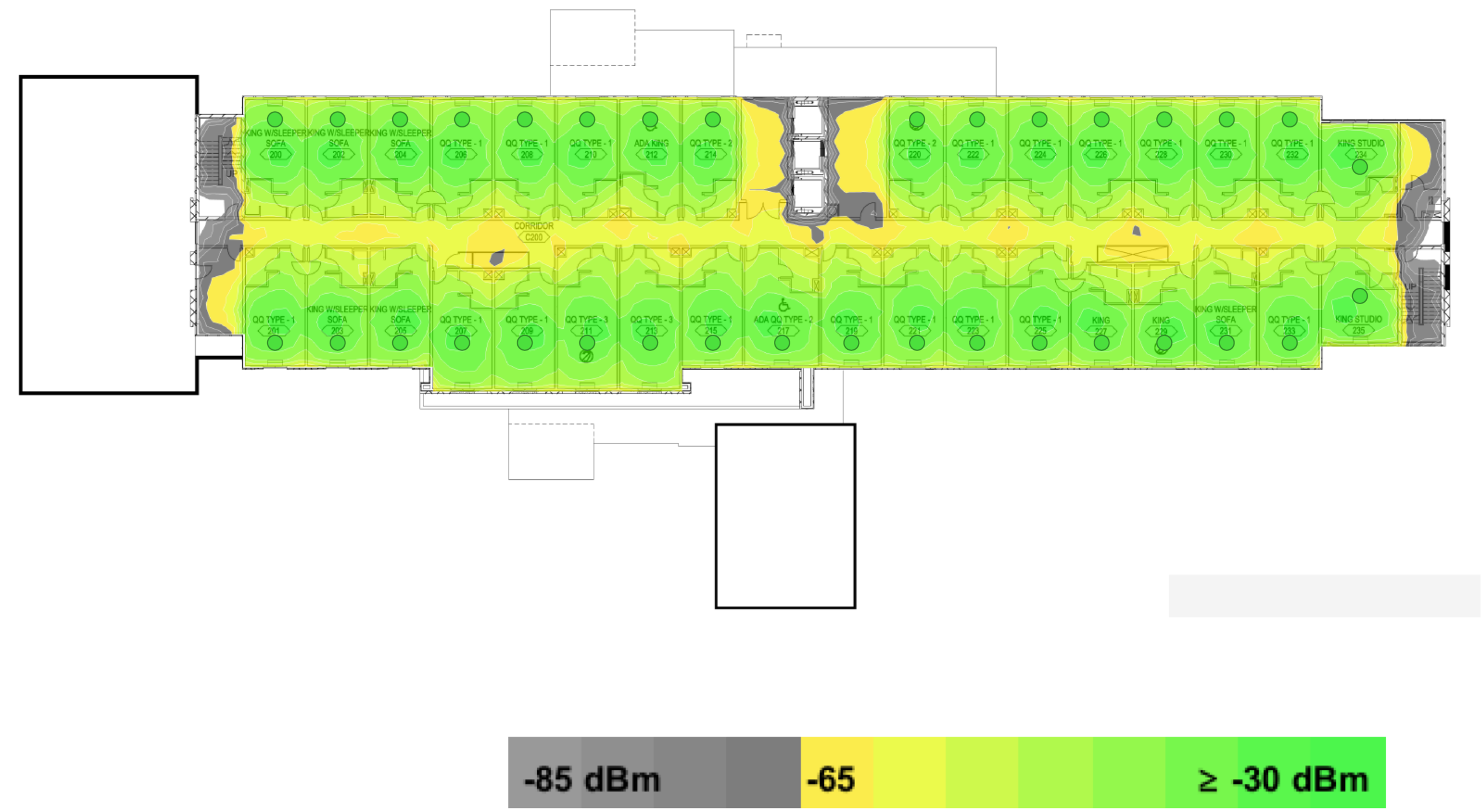
heatmap example 1- concrete walls with AP in each room

This scenario shows an access point placed inside every guest room with concrete walls.

Concrete limits how Wi-Fi signals travel between rooms. With an AP in each room, coverage remains strong and consistent within each space.

This setup delivers reliable performance and avoids coverage gaps.

Takeaway: Concrete construction often requires an AP in each room to maintain consistent coverage.

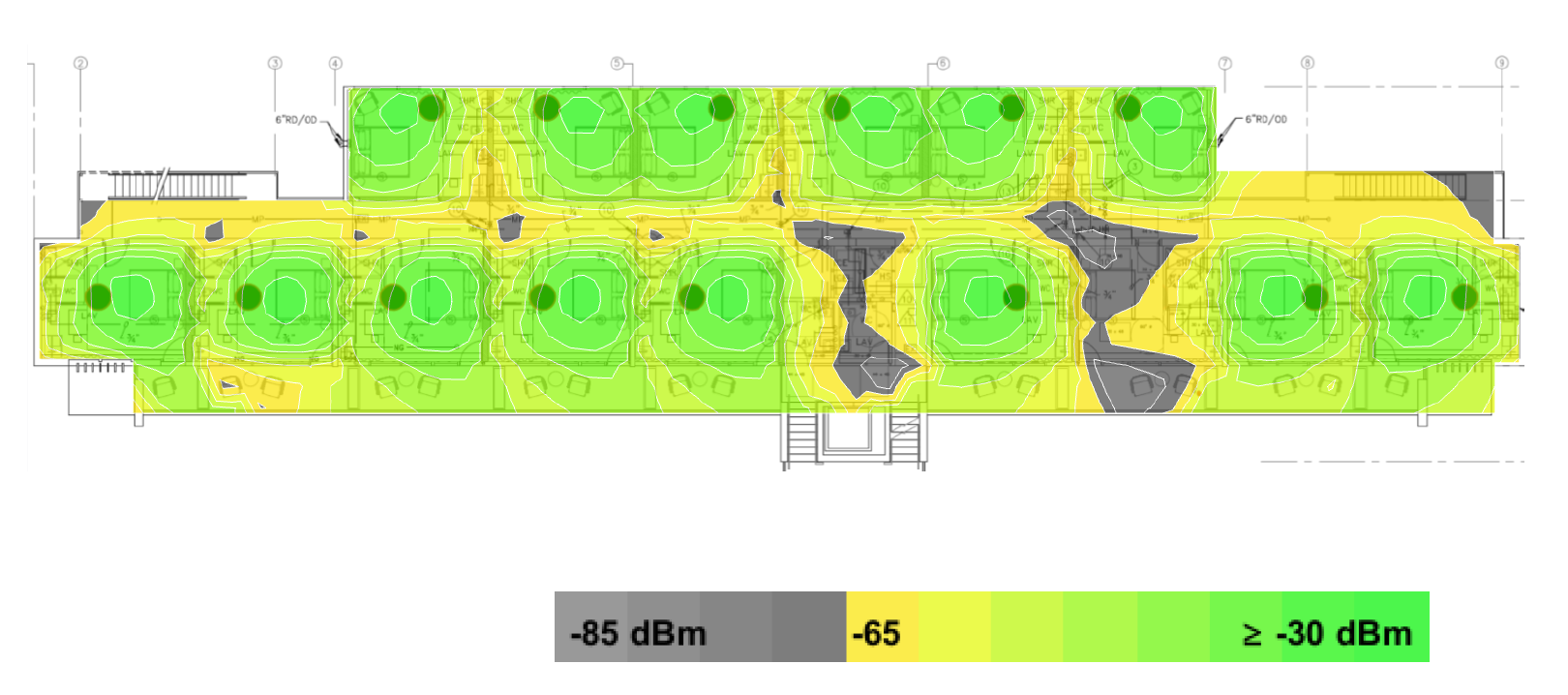
Example 2: One Room Without an AP (Concrete Walls)

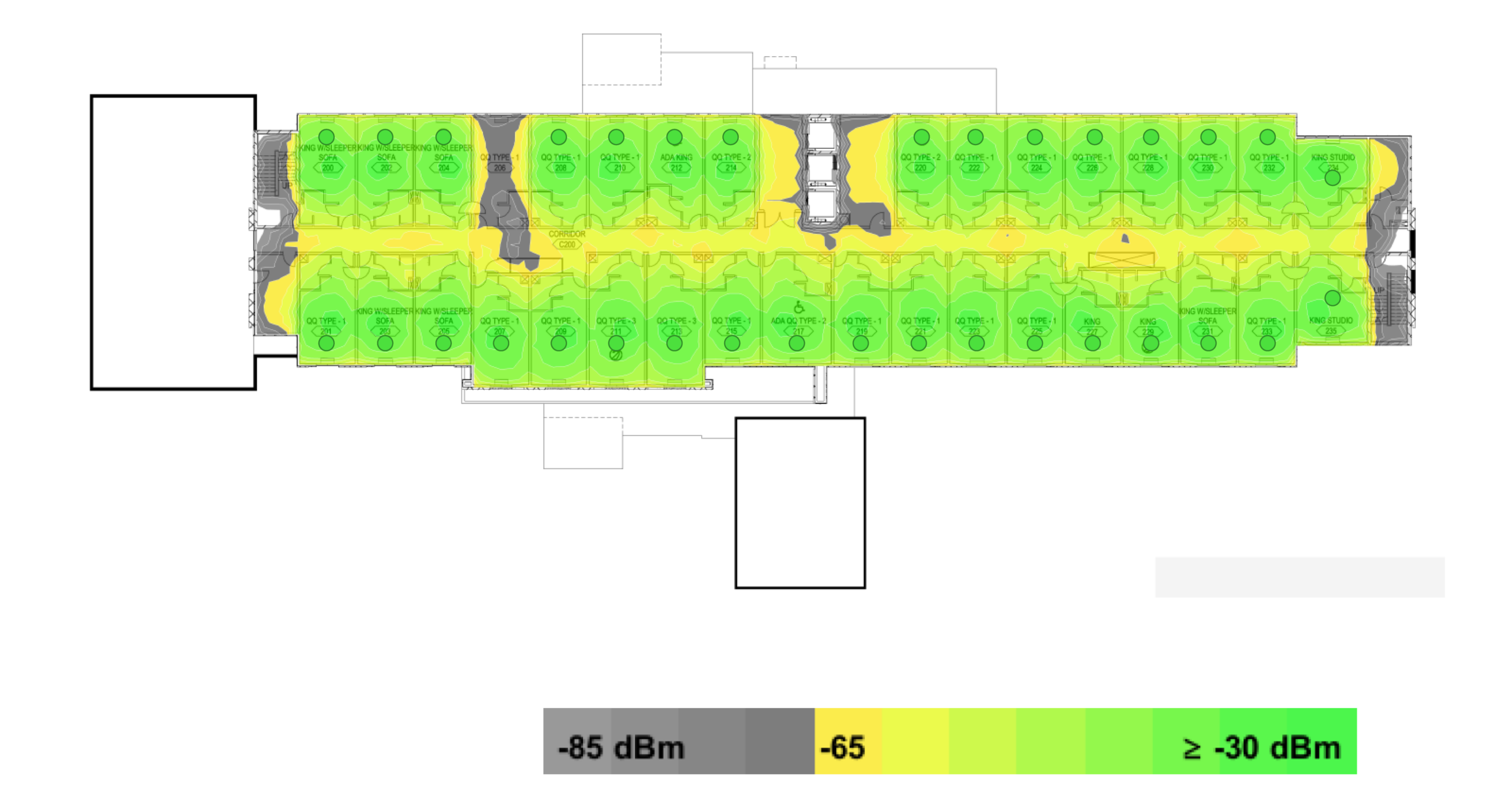
heatmap example 2- concrete walls with AP in each room but one removed

This heatmap shows the same concrete-wall layout, but with one room missing an access point.

The room without an AP becomes a clear dead spot. Concrete walls block the signal from adjacent rooms.

Takeaway: Removing even one AP in concrete environments can create immediate coverage gaps.

โ€œConcrete limits how far the signal can travel,โ€ Patel explains. โ€œIf you remove an AP, coverage drops off quickly in that space.โ€

Example 3: AP in Every Other Room (Drywall Construction)

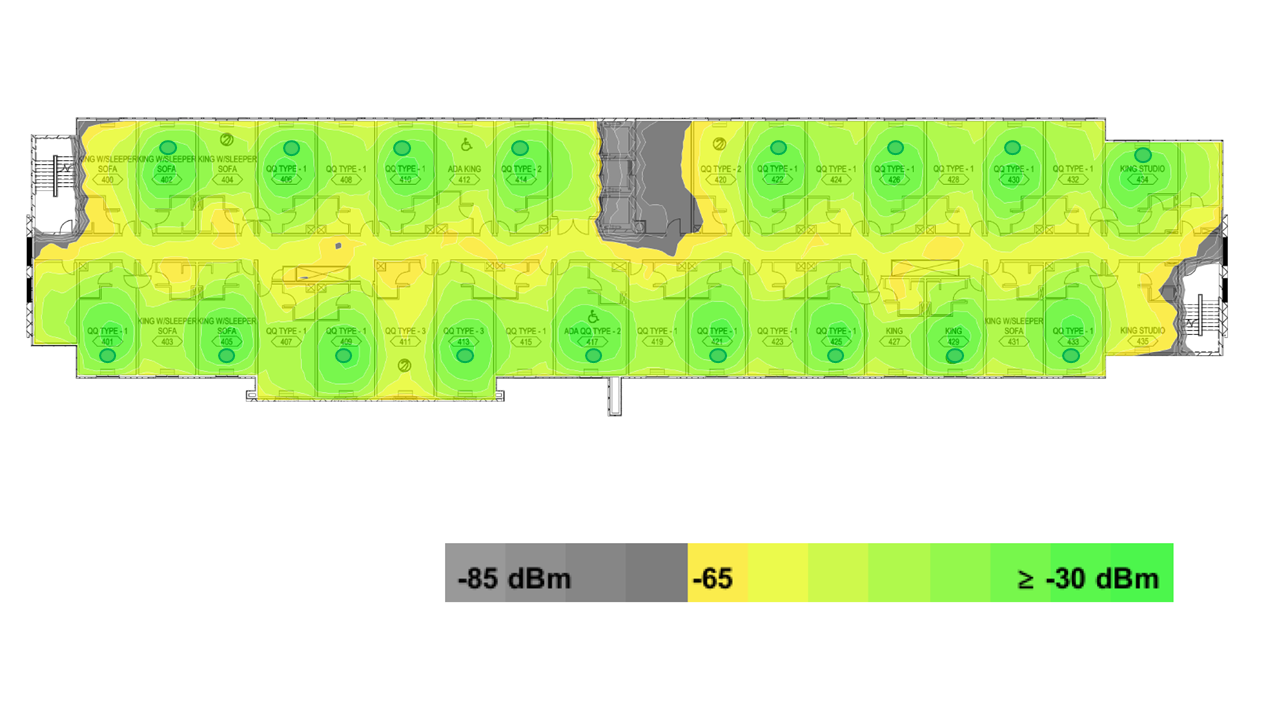
heatmap example 3- drywall with AP in every other room

In this example, access points are installed in every other room with drywall construction.

Signals travel more easily through drywall. Coverage extends into adjacent rooms, though strength varies.

This setup can work in some layouts, but it may still create weaker areas.

Takeaway: Drywall allows the signal to travel, but shared APs can still lead to inconsistent performance.

Example 4: One Room Without an AP (Drywall Construction)

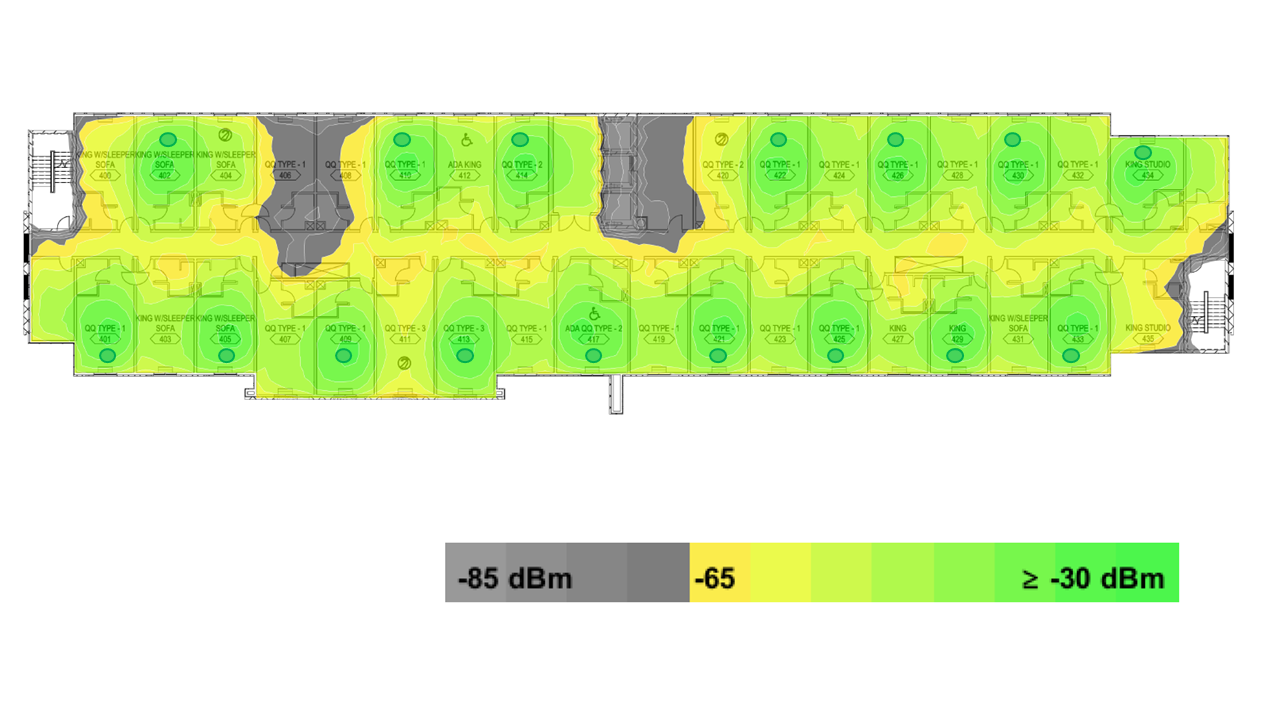
heatmap example 4- drywall with AP in every other room but one removed

This scenario removes one AP from the drywall configuration.

Even with better signal travel, the room without an AP shows a noticeable drop in coverage. The signal also drops in part of an adjacent room.

Takeaway: Even in drywall construction, removing APs reduces reliability in affected rooms.

โ€œConstruction materials play a major role in Wi-Fi performance,โ€ Patel says. โ€œDrywall allows more signal movement, but placement still matters.โ€

Larger Room Scenarios (Upscale / Full-Service Property)

The following examples reflect a larger, upscale or full-service hospitality property with more spacious guest rooms and concrete construction. These properties often include suites or expanded layouts that require more careful Wi-Fi planning.

Example 5: AP in Each Room (Large Rooms, Concrete Walls)

heatmap example 5- larger rooms with concrete walls and AP in every room

In this example, larger rooms use concrete construction with an AP in each room.

Coverage remains strong within each room, but the signal does not travel far beyond the walls.

This setup supports consistent performance despite larger spaces.

Takeaway: Larger rooms still benefit from dedicated APs, especially with dense construction.

Example 6: One Room Without an AP (Large Rooms, Concrete Walls)

heatmap example 6- larger rooms with concrete walls and AP in every room but one removed

This heatmap removes one AP from the larger room configuration.

The affected room shows a clear dead spot. Concrete walls prevent nearby APs from filling the gap.

Removing even one AP can significantly reduce coverage in larger spaces.

Takeaway: Coverage gaps increase quickly in larger rooms when AP density drops.

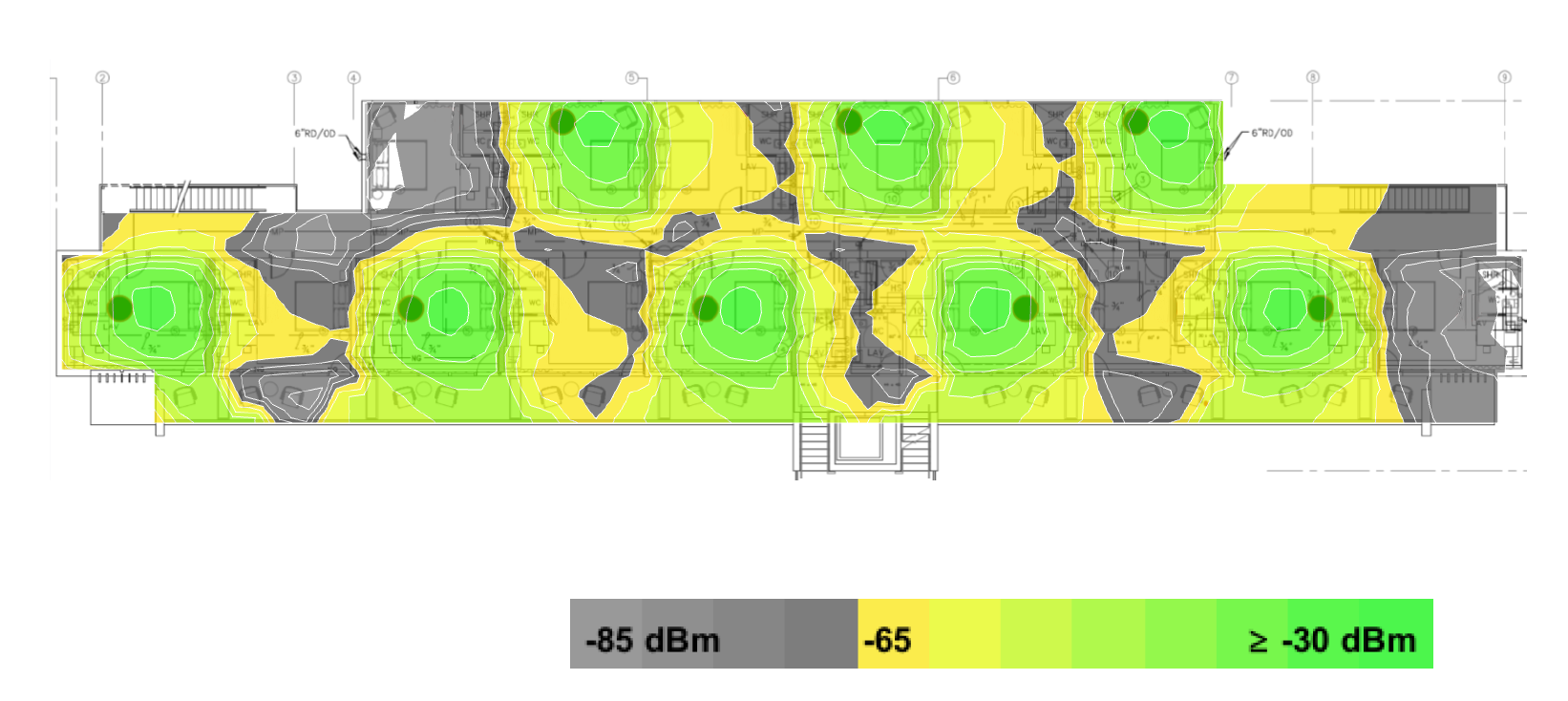
Example 7: AP in Every Other Room (Large Rooms, Concrete Walls)

heatmap example 7- larger rooms with concrete walls and AP in every other room

This scenario places APs in every other room in a large room, concrete-wall layout.

Coverage extends unevenly into adjacent rooms. Some areas show weak signals or inconsistent performance.

This approach may reduce hardware costs, but it can affect the guest experience.

Takeaway: Lower AP density can introduce inconsistent coverage, even if some signal reaches adjacent rooms.

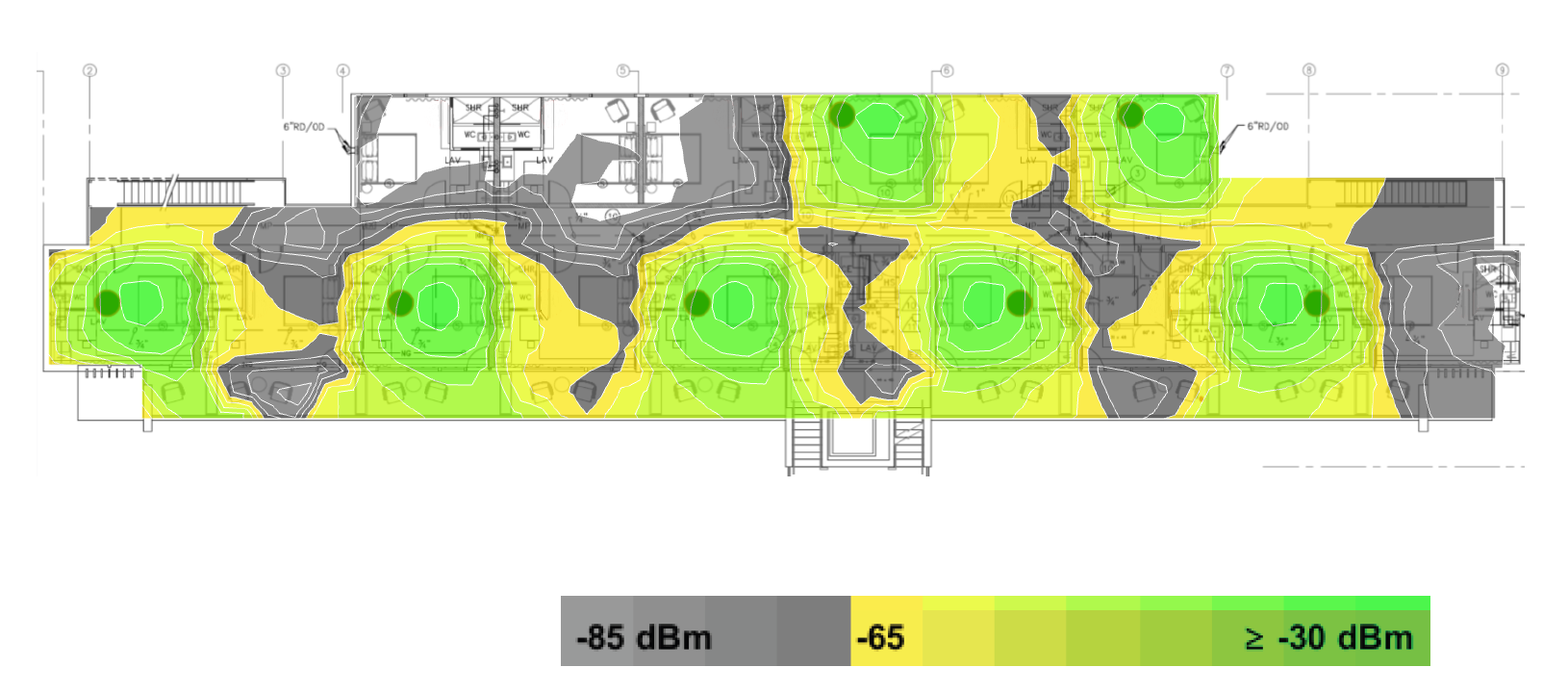
Example 8: Reduced AP Coverage (Large Rooms, Concrete Walls)

heatmap example 8- larger rooms with concrete walls and AP in every other room but one removed

This final example removes an AP from the every-other-room configuration.

Coverage gaps become more pronounced. Several areas show weak or inconsistent signals. One whole section of this floor shows no signal at all.

These results highlight the risk of reducing AP density in larger rooms with concrete construction.

Takeaway: Cost-saving decisions on AP count can lead to widespread performance issues in larger properties.

What These Examples Mean for Hospitality Properties

These heatmaps highlight a key point: Wi-Fi performance depends on design decisions made early in the process.

Room layout, construction materials, and cabling availability all influence the outcome. There is no one-size-fits-all solution.

Working with an experienced technology partner like WorldVue helps ensure these factors are evaluated before installation begins. With five decades of experience, we can help you avoid stumbling blocks that waste time and money.

For additional guidance, properties can reference industry resources such as our AAHOA technology toolkit. You can also explore our guide to technology planning for new construction hotels.

Key Lessons from These Heatmaps

These examples highlight several important principles for hospitality Wi-Fi design:

  • Concrete walls limit signal travel and often require an access point in each room.
  • Removing access points creates immediate dead spots, even in smaller rooms.
  • Drywall allows better signal movement, but shared APs still reduce consistency.
  • Larger rooms increase the risk of weak coverage when AP density drops.

These factors directly impact guest satisfaction, especially as streaming and connected devices continue to increase.

โ€œGuests are connecting more mobile devices than ever,โ€ Patel says. โ€œItโ€™s not uncommon for a family to bring 10 devices into their guest room. That puts more demand on the Wi-Fi network and makes consistent coverage more important.โ€

Bringing It Back to Infrastructure Planning

These real-world examples reinforce the recommendations outlined in our earlier articles. They also demonstrate why access point placement, cabling design, and early planning matter.

Strong infrastructure planning supports better Wi-Fi performance and a more consistent and enjoyable guest experience.

Explore Hospitality Wi-Fi Solutions from WorldVue

Wi-Fi performance starts with the right design decisions. Learn how WorldVue helps hospitality properties plan and deploy wireless networks that support guest-facing technology.

As broadband networks become complex, delivering a seamless home connection is critical. At MWC 2026, industry leaders met to explore the future of home connectivity. The panel featured experts from top tech companies. Speakers included Ayman Saidi from AWS, Jos Delbar from Airties, and Alex Gledhill from Intel. Importantly, they discussed the profound impact of AI-powered personalized Wi-Fi on both the subscriber experience and operators.

Boosting Revenue and Reducing Churn

A major challenge for ISPs is driving business growth while keeping subscribers happy. Therefore, they need innovative solutions. During the discussion, the panel highlighted a compelling statistic. Specifically, operators adopting an AI-powered personalized Wi-Fi approach generate 40% more revenue. Furthermore, these operators actively reduce customer churn. Consequently, this shift toward tailored user experiences is completely transforming customer retention strategies.

Navigating Home Network Complexity

Jos Delbar of Airties pointed out a crucial reality. Despite massive infrastructure investments, subscribers judge services based on their immediate home experience. In fact, the rising number of smart devices makes the home network highly complex. To solve this, Airties empowers operators to navigate this complexity smoothly. As a result, they deliver a highly individualized connection for every single user. You can explore our Airties Connectivity Experience Management solutions to see exactly how this works.

The Power of Intel and AWS

Delivering this intelligence requires robust processing power from the edge to the cloud. Next, Alex Gledhill detailed Intelโ€™s long history in connectivity. This ranges from early standards up to the latest Wi-Fi 7. To enable these advanced services, Intel provides a powerful combination of hardware and software. Consequently, this supports the vast data required for AI-powered personalized Wi-Fi.

This spans from deploying new AI PCs at the edge to open-source collaboration. Ultimately, this culminates in scalable cloud services built within AWS. Specifically, backend operations run on Intel Xeon 6 processors using 8th generation AWS instances. Thus, operators gain the computational strength needed for real-time network optimization.

In conclusion, transitioning to an intelligent home network is now a business imperative. Operators must leverage the combined expertise of Airties software, Intel processing, and AWS cloud infrastructure. By doing so, they can successfully implement AI-powered personalized Wi-Fi. Ultimately, this delights customers, reduces support costs, and drives substantial long-term growth.

Watch Video

There was a time when power engineers and RF engineers occupied different ends of the hallway.

The RF team debated noise figure and linearity as if civilization depended on it. The power team worried about volts, amps and whether something might overheat. They shared a PCB but not always a worldview. If a spur appeared in the spectrum, it was clearly an RF problem. If something got hot, that was clearly a power problem.

Life was simpler then.

Today, those hallway boundaries are dissolving. Modern converters switch fast enough that layout parasitics resemble transmission lines. Gate loops behave like resonant structures. Package inductance stops being an afterthought and starts showing up in the lab as an unexpected oscillation.

And when power management is treated casually, the PCB occasionally rewards you with a full laser-light-and-pyrotechnics show.

The oscilloscope glows with overshoot. The spectrum analyzer fills with harmonics you never budgeted for. That tidy switching node becomes a broadband radiator with impressive range and zero respect for your carefully tuned RF front end. A near-field probe appears, wielded like a fire extinguisher.

The board may not literally ignite, but it can behave as if it is auditioning for a stadium tour.

Fast edges create ringing. Poor loop control creates EMI. A little optimism in the layout can turn a clean design review into spectral damage control. Once the show begins, it is very difficult to argue that power management belongs to someone elseโ€™s discipline.

Eventually the smoke clears โ€” metaphorically, one hopes โ€” and the lesson becomes obvious: high frequency is no longer exclusive to the RF team.

At the same time, RF systems have grown far less tolerant of sloppy electrons. AI accelerators, phased array radars, 5G radios and satellite payloads all share a dependency on tightly controlled, dynamically managed power. We celebrate the antenna aperture, beamforming algorithms and heroic PA linearity. But none of those subsystems behave well if the supply rail resembles a suggestion rather than a specification.

Ripple becomes phase noise.
Transients become spectral regrowth.
Impedance becomes destiny.

Consider a modern phased array. Hundreds or thousands of elements must maintain phase coherence while digital control, converters and RF front ends draw from shared power domains. A transient event in one corner of the board can surface elsewhere as jitter, drift or degraded dynamic range. In high order modulation schemes, that becomes degraded EVM. In radar systems, it can mean reduced detection sensitivity.

Efficiency, in this environment, is not merely a thermal metric. It becomes an RF specification.

As systems scale, so does power density. Data centers supporting AI workloads offer a convenient illustration. We speak of โ€œthe cloudโ€ as if it floats. In reality, it is racks of silicon pulling tightly regulated current at astonishing speed. Switching frequencies rise to shrink passives and sharpen transient response. Those faster edges introduce coupling paths and parasitics that refuse to be ignored.

The physics is indifferent. Inductance does not care whether it resides in a matching network or a buck converter. A poorly controlled current loop will radiate whether it carries a carrier wave or a switching waveform. Maxwellโ€™s equations remain gloriously impartial.

This is where the quiet revolution in power management becomes compelling. The focus is shifting from delivering power to managing it intelligently. Adaptive control loops respond in real time. Power domains are segmented to isolate sensitive circuits. Integration reduces loop area and parasitic uncertainty. Packaging and layout are treated as electromagnetic structures, not mechanical necessities.

In other words, power design increasingly looks like RF design โ€” just with larger currents and fewer Smith charts.

For microwave engineers, this convergence is both challenge and opportunity. The electromagnetic environment inside modern systems is crowded. High di/dt edges, dense routing and compact integration leave little margin for wishful thinking. Power integrity analysis belongs in the same conversation as S-parameters and stability circles.

The opportunity is equally clear. RF engineers already think in terms of impedance, resonance and coupling. Applying that intuition to power distribution networks and switching loops can elevate overall system performance. When the supply rail is treated as part of the signal chain rather than background infrastructure, the architecture becomes more predictable and more robust.

Power management is no longer the quiet corner of the board that โ€œjust has to work.โ€ In high performance infrastructure, aerospace and defense systems, it is a lever for differentiation. A well-managed power architecture enables higher linearity, lower noise floors and tighter timing margins. It allows RF subsystems to operate closer to their limits without being sabotaged by their own energy source.

We often talk about pushing the boundaries of frequency. Just as important is pushing the boundaries of how precisely we manage the energy that makes those frequencies possible.

The best light show, after all, is the one that never makes it past the layout review.

This article first appeared inโ€ฏBrent’s Musingsโ€ฏin Microwave Journal.

Time pressure is real. And increasing. Competing demands from work, family, and social commitments place enormous strain on individuals already stretched thin. The average person juggles multiple tasks and responsibilities every day, trying to make the most of limited time by prioritizing certain tasks, delaying a few, and dropping some entirely.

The digitized world has further influenced habits. Bombarded by instant everything from one-click shopping to instantaneous payments and same-day deliveries, patience has diminished, rewiring expectations. The blurring of work-life boundaries by remote work, constant digital distractions, and the desire to be constantly available has exacerbated the perception of reduced time availability. Research on โ€œtime povertyโ€ conducted by Ashley Whillans, a Harvard Business School professor, reinforces this, finding that a staggering 80% of Americans feel rushed or do not have enough time.[1]

Time is money. Digital friction steals customer time.

Picture an employee working from home on a critical deadline. Suddenly, the internet connection drops. Every second of buffering, every audio drop-out, and every frozen screen adds to the stress. Every delay chips away at the customerโ€™s trust and confidence in the internet services they pay for.

For online businesses, the real loss occurs when repeated disruptions frustrate customers enough to abandon tasks, question the businessโ€™s reliability, or even switch to a competitor. The high value placed on seamless, instant experiences makes even the slightest disruption unacceptable.

The high cost of digital friction highlights the need for businesses to reduce it and protect the customer experience. A frictionless digital experience is a cornerstone of positive customer perception and a meaningful contributor to their quality of life.

The cost of lag for businesses

The impact of lag is both immediate and cumulative. When a digital experience falls short of customer expectations, revenue leakage follows. A Google study found that 53% of mobile users abandon any site that takes longer than 3 seconds to load.[2]ย 

In e-commerce, the impact can be brutal. Slow load times, buffering, or delayed transaction processing impact conversion rates, increase bounce rates, and contribute to significant losses from abandoned carts. Poor digital experiences directly drain bottom lines. Beyond direct sales loss, poor performance weakens brand perception and lifetime value. Reliable performance thus becomes a driver of revenue protection and growth and not just a technical metric.

Impact of smallest inconveniences

Even the smallest digital inconveniences have an exaggerated impact on customer experience perception. Any delay translates into frustration and disappointment. For customers, technical causes mean nothing. The experience defines the brand.

These micro-frictions add up over time, eroding confidence, reducing engagement, and making customers less tolerant of future issues. When expectations are unmet, perceptions shift to distrust, leading customers to disengage or seek alternatives. Ultimately, lost time equates to lost satisfaction.

Network performance as a competitive advantage

For internet service providers (ISPs) in particular, consistent network performance offers a powerful competitive edge. While speed and continuity are considered baseline requirements, there are now strategic differentiators that directly influence customer choice, loyalty, and quality of life. For example, customers expect uninterrupted streaming services, regardless of the many other apps running on the same network. Financial transactions must go through securely on the first try, without a hitch. Network coverage must be strong and available wherever the user is located.

A superior network experience reduces frustration, saves time, and enhances daily convenience, which defines the brand reputation, customer retention, and visible market differentiation.

Network optimization solution as a competitive moat

For ISPs, a network optimization solution that delivers reliable, consistent digital experiences by intelligently managing traffic, reducing latency, and minimizing disruptions is a powerful strategic tool. The value extends beyond technical efficiency. It has a clear and direct positive impact on customer satisfaction and time savings for customers.

Where the industry historically measured network performance using the quality of service (QoS) metric that looked at the delivery of internet to the home, the benchmark has now shifted to the quality of experience (QoE) which is a measure of the customerโ€™s actual experience and level of satisfaction all the way down to the application level.

When users experience superior QoE through smooth streaming, quick transactions, and responsive applications, brand confidence grows. This in turn drives higher engagement, stronger loyalty, and better commercial outcomes. Proactively optimizing performance allows organizations to give customers back valuable time, prevent revenue loss, and create a sustainable competitive moat.

Customer satisfaction and network performance are tightly interconnected drivers of business success. At its core, network optimization exists to give people their time back. For ISPs, this means going beyond QoS compliance to delivering real QoE. When network connections are seamless, human connections grow stronger. Families enjoy uninterrupted movie nights, students learn without disruptions, remote work happens reliably, and calls with loved ones never drop at the wrong moment. A quality network experience is proof of how technology can keep its promise to make life better and enhance the quality of experience.

By leveraging AI to build self-healing networks that improve online experiences, Aprecommโ€™s product suite helps save precious time for both customers and the service providers they depend on. As Theophrastus wisely wrote, โ€œTime is the most valuable thing a man can spendโ€, so itโ€™s certainly the most valuable thing we can help people save.

For patients who depend on insulin pumps, remote continuous glucose monitors, wearable heart-rate patches, pacemakers and other wireless medical technologies, the battery is a precious energy resource. When it comes to healthcare outcomes, how long โ€“ and how well โ€“ a battery does its job before it must be charged or changed isnโ€™t a matter of convenience, it can define clinical safety and quality of life.


Unlike consumer electronics, these devices operate in tightly constrained biological environments where every milliwatt counts. Batteries power sensors, compute, storage and radio communications while also pushing RF signals through dense human tissue โ€“ one of the more challenging mediums for wireless signal propagation.

As medical devices become more connected, manufacturers increasingly face a complex question: How to guarantee robust wireless performance without accelerating battery drain? LitePointโ€™s testing expertise helps medical device designers solve that problem to efficiently validate RF performance, extend device uptime and improve product reliability all while ensuring patients receive timely, accurate, actionable data.

Why Wireless Testing Is Critical for Battery-Powered Medical Devices

Whether a device uses a replaceable cell or a sealed rechargeable battery, wireless testing plays an essential role in ensuring the radio transmitter and receiver behave reliably. For battery-powered medical devices, inefficient testing can shorten device life.

For example, a continuous glucose monitor patch rated for 14 days of use might lose an entire day of uptime simply because its RF tests consumed too much battery during production. Faced with this trade-off, some manufacturers may opt to reduce their RF test coverage. While this may seem like a fair exchange, shipping devices with unverified connectivity performance can cause problems down the line.

The primary battery-saving contribution that test delivers is optimizing energy during the test process itself, ensuring devices leave the factory at maximum capacity and with verified performance. Rigorous testing also reduces:

  • Device recalls by catching RF failures before shipment
  • Warranty and service costs by limiting early-life field failures
  • Healthcare risk by improving the reliability of continuous monitoring
  • Yield fallout by accurately identifying borderline units

Without sufficient test data, companies may think they are saving battery capacity during manufacturing, when in fact they are compromising long-term device reliability and the patient experience.

What Makes Wireless Operation Uniquely Challenging in Biological Environments

Human tissue is a notoriously lossy environment for RF signals. The body absorbs and attenuates energy, increasing the amount of transmit power required to deliver data to an external receiver. This drives up energy consumption, especially for implantable devices like pacemakers or emerging ingestible sensors, where signals must travel through multiple tissue layers and fluid types.


Even for devices worn on the skin, performance varies based on placement, body orientation or whether the device is covered by clothing. These factors create propagation conditions far more complex than a smartphone or wearable used in open air.

Medical manufacturers often rely on specialized labs equipped with CTIA-style phantoms โ€“ human-body simulators filled with tissue-mimicking material โ€“ to quantify how much signal is lost through the body. While LitePoint does not conduct biological absorption testing directly, RF data gathered from LitePoint equipment complements phantom-based testing to give engineers a full picture of how signal strength, receiver sensitivity and antenna orientation perform in real-world conditions.

Test Solutions Help Optimize Connectivity and Energy Efficiency

Optimizing wireless efficiency in medical applications means tuning the radio for both performance and power. Device accuracy and battery life are tightly linked as missed data packets mean retransmissions, and retransmissions cost energy. But the longer a device stays in test mode, the more battery life it burns before ever reaching a patient.

LitePointโ€™s specializes in test time optimization using advanced techniques like proprietary Bluetooth over-the-air (OTA) test. This method measures radio transceiver performance using beacons without establishing a full Bluetooth connection, which allows manufacturers to capture critical RF data in far less time than a manual test using a standard Bluetooth adapter and software.


This preserves battery capacity and allows designers to test multiple devices in parallel, reducing manufacturing bottlenecks without compromising quality.

How Coexistence Testing Contributes to Better Battery Management

Many medical devices now incorporate multiple radios, for instance, Bluetooth LE for data transfers, Wi-Fi to sync data with the cloud and near-field communication (NFC) for device pairing and user authentication. While each radio may be optimized individually, coexistence issues can cause interference that forces retransmissions, increases latency and drains battery life.


The key is to determine where and when to run these tests as full coexistence testing is too power-intensive for many high-volume production lines. LitePoint helps manufacturers by moving testing earlier in the product development cycle or design verification environment, where engineers can identify interference patterns and tune channel plans or antenna layouts without draining battery life during manufacturing.

The Risks of Insufficient Wireless Testing in Medical Devices

The consequences of inadequate testing are more serious than a dropped Netflix video frame. At minimum, poor RF performance leads to inconsistent data transmission or premature battery drain. In the worst cases, devices risk missing early warning signs of a serious condition, such as a glucose spike or a heart arrhythmia.

There is also a significant brand-trust implication. Medical device companies spend years building credibility, and a single high-profile failure tied to missed wireless data can easily erode customer confidence.

Still, some manufacturers rely on shortcuts like โ€œgolden devices.โ€ These prototype units are presumed to represent ideal RF performance, but unless they are repeatably calibrated, theyโ€™re subject to signal drift over time which can degrade accuracy. A dedicated tester eliminates that variability and ensures consistent measurement across every unit.

Likewise, radio duty-cycling, which determines how often the radio wakes to transmit or receive data, is primarily a design consideration. Test data can help refine these decisions by revealing signal margins, sensitivity thresholds or susceptibility to interference, while RF test helps designers understand how aggressively they can duty-cycle without data loss.

Connected Healthcare Is Reshaping Wireless Test

Medical device volumes can reach hundreds of thousands or even millions of units. Repeatability and speed are essential. LitePointโ€™s automation tools, such as theย IQfact+โ„ขย platform andย IQfactATMโ„ขย software for module-based designs, allow manufacturers to validate critical RF parameters quickly and consistently, even when they lack direct access to the underlying chipset. These tools help ensure every device shipped meets its RF performance targets, enabling reliable operation for months or years in the field.

Healthcare is becoming a high-connectivity device environment. Everything from blood pressure cuffs to ultrasound imaging have wireless โ€“ and cloud-connected โ€“ options. As adoption scales, the need for efficient, precise, low-impact RF testing becomes even more critical. LitePoint is continuing to innovate in areas such as OTA efficiency, beacon-based RF measurement and automation, all aimed at helping med-tech engineers extend battery life while ensuring the data their devices generate is trustworthy.